

Decussate Dorm: Rethinking Taipei's Aging Houses as Multi-generational Co-living
A compact four-story home in Da'an District transforms into shared housing for a grandmother and four exchange students, responding to Taiwan's super-aged


What happens when a 40-year-old house, built for one family, needs to shelter five strangers and a grandmother? In Taipei's Da'an District, where nearly 30% of the local population are foreigners and the over-65 demographic is accelerating toward 20% by 2026, the answer is not demolition. It is reconfiguration. Decussate Dorm takes a narrow, utilitarian residential building along Civic Boulevard and reimagines it as a co-living prototype that pairs a widowed grandmother with four international students, turning underutilized domestic space into a functioning micro-community.
Designed by Jesden Tang and honored with an Honorable Mention in the Nano Nest 2020 competition, the project tackles two converging crises: elderly isolation and student housing scarcity. Rather than treating these as separate policy problems, Tang proposes architecture as the mediator, compressing private quarters to essential sleeping and storage functions while expanding shared zones for dining, study, and socializing. The building's name references the botanical term for leaves arranged in alternating perpendicular pairs, a structural principle that informs both the building's section and its approach to light and air.
A Dense Urban Fabric Demanding Spatial Intelligence
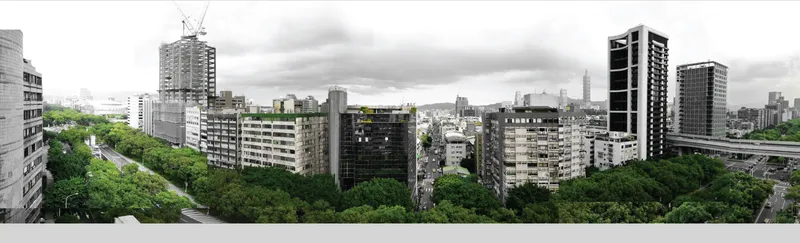
The panoramic street view reveals the project's context: tree-lined avenues cutting through a dense grid of aging mid-rise buildings under overcast Taipei skies. Da'an District carries a layered history. The site once hosted railroad-side shops before infrastructure modernization relocated the rail line and replaced it with a flyover, reshaping the neighborhood's spatial dynamics. What remains are compact plots, narrow façades, and utilitarian iron railings that define Taipei's typical residential stock. Tang's intervention works within these constraints rather than against them, retaining the existing footprint while introducing layered concrete and reinforced glass volumes that optimize daylight penetration and passive ventilation.
Interlocking Volumes That Choreograph Daily Life
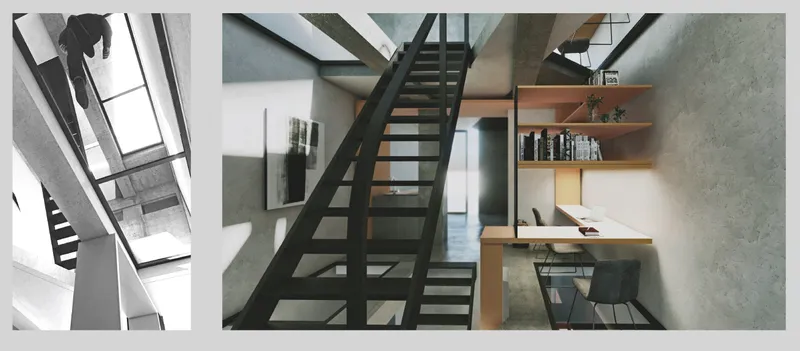
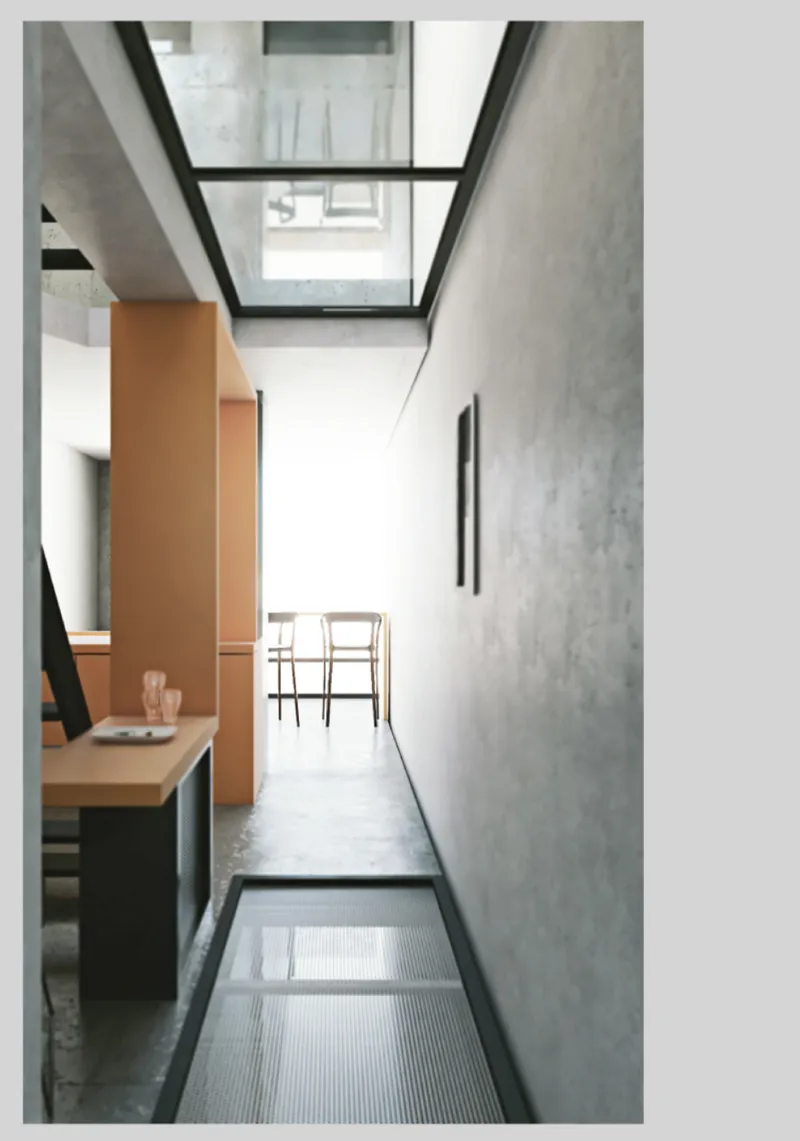
The interior photographs show how Tang handles the tension between compactness and livability. A black steel staircase ascends through a double-height space flooded by skylights above, with a built-in desk tucked beneath, turning vertical circulation into a study nook. Nearby, a glass floor panel set into concrete beneath an angular skylight pulls light deep into the section, making every surface work for illumination as well as structure. These are not decorative gestures. In a building this narrow, every decision about where light enters and how floors connect determines whether the space feels habitable or claustrophobic.
The split-floor zoning strategy assigns the ground and second floors to the grandmother, with slope access enabling ease of movement. Upper floors host student residents in compact rooms organized around multifunctional shared areas. Bedrooms are deliberately minimized, pushing residents toward communal life. The staggered form creates light-filled corridors and passive thermal comfort throughout the building, with staircases framing greenery and light wells rather than simply connecting floors.
Bioclimatic Logic in Concrete and Glass
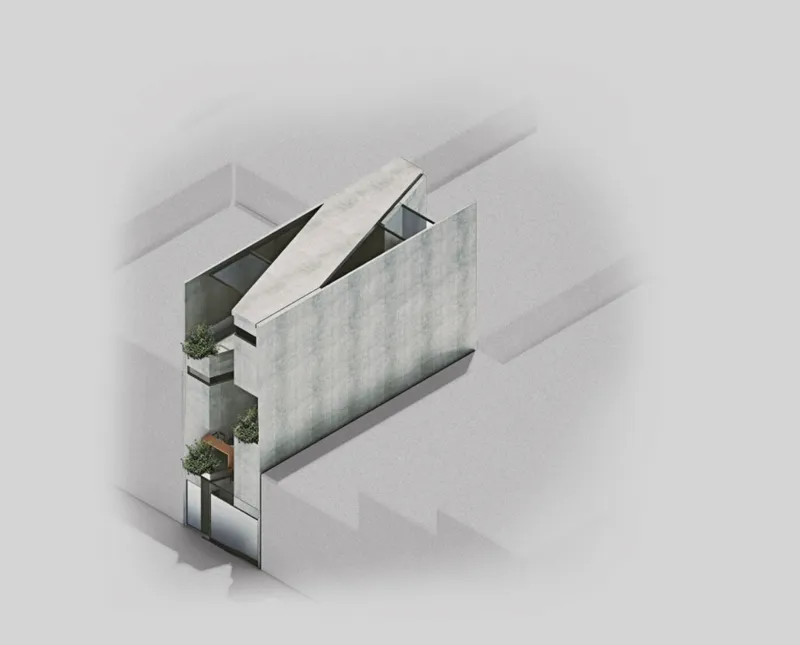
The axonometric drawing makes the decussate principle legible. Cantilevered concrete volumes overlap and rotate like perpendicular leaf pairs, creating planted terraces at their intersections and allowing sunlight and airflow to reach spaces that would otherwise be sealed off by the dense urban fabric. The old iron mesh elements characteristic of Taipei façades give way to an open visual language of reinforced glass and concrete that still echoes the neighborhood's texture. Materials including steel, wood planks, and reinforced concrete are locally sourced and prefabricated off-site using CNC techniques, reducing on-site pollution and construction costs while keeping the project economically viable as a replicable housing model.
Four Floors, Two Generations, One Section
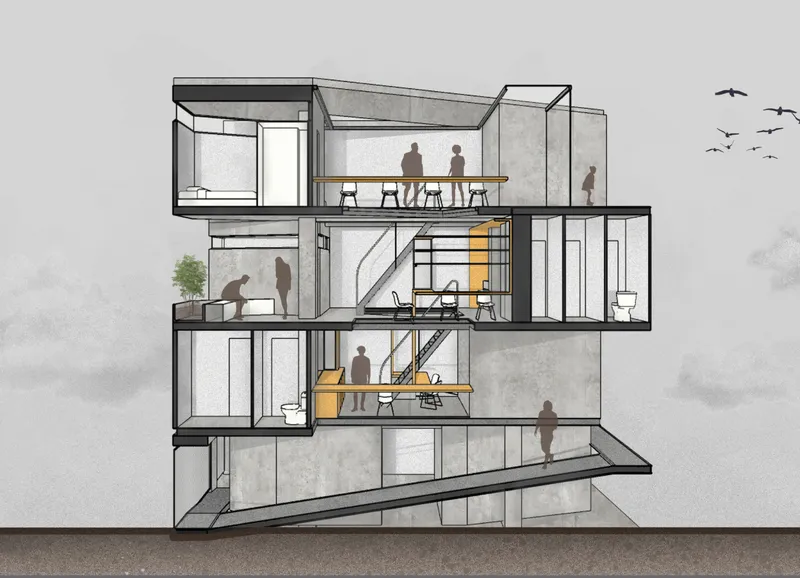
The sectional drawing lays bare the project's social architecture. Silhouetted figures occupy four split-level floors connected by staircases that shift position at each landing, preventing the long, dark corridor typical of Taipei's narrow houses. Public and private spaces stack vertically to promote interaction while maintaining individual retreat zones. Dining areas blend into reading alcoves; corridors double as gallery space. The section reads less like a traditional house and more like a vertical village, each half-level creating visual and acoustic distance without the isolation of closed doors.
Why This Project Matters
Taiwan's demographic trajectory is not unique. Countries across East Asia and Europe face the same collision of aging populations, shrinking households, and housing stock designed for nuclear families that no longer exist. Decussate Dorm proposes that the solution is already built: millions of underutilized homes in dense urban neighborhoods waiting for programmatic reinvention rather than replacement. Tang's design demonstrates that co-living need not mean luxury dormitories for young professionals. It can mean pairing a grandmother who needs company with students who need affordable rent, and designing the architecture to make that arrangement work.
What elevates the project beyond a housing diagram is the precision of its spatial tactics. The bioclimatic form, the split-level accessibility, the CNC-prefabricated construction: each decision serves both the immediate residents and a broader replicability argument. If one 40-year-old Taipei townhouse can become a functioning multi-generational co-living unit, so can thousands of others. That is the kind of scalable thinking compact housing competitions should be rewarding, and Nano Nest 2020 was right to recognize it.
View the Full Project
About the Designers
Designer: Jesden Tang
Enter a Design Competition on uni.xyz
uni.xyz runs architecture and design competitions year-round that reward proposals with spatial conviction and real site intelligence.
Project credits: Decussate Dorm by Jesden Tang Nano Nest 2020 (uni.xyz).


Popular Articles
Popular articles from the community

Tsunami Convergenics: Turning Catastrophic Ocean Forces into Underwater Housing Infrastructure
A speculative underwater settlement off the coast of Onagawa, Japan, treats tsunamis and typhoons as energy sources rather than threats.

Singing Woman: Contemporary Architecture Inspired by Estonia’s Voice and the Sea
Singing Woman turns Estonia’s song culture into flowing opera house architecture, blending public life, landscape, sea, and national memory.
Cloaked Colonization: A Mobile Underwater Habitat That Moves Like a Fish
Micah Abaya's shortlisted EHC Pacific entry reimagines ocean settlement as a dispersed network of self-sustaining architectural organisms.

The Amber Palace Opera: A Geological Fiction Surfaces on Tallinn's Baltic Waterfront
Pierre Brillard reimagines a Baltic legend as a public landscape, opera house, and waterfront promenade rooted in Tallinn's coastal identity.

Similar Reads
You might also enjoy these articles

Day and Night Park: A Time-Based Urban Newsstand in Beijing
A temporary urban newsstand in Beijing blending travel, light, and reading through poetic colors, compact form, and community-focused design.

Modernist Patio Renovation in El Masnou, Barcelona by Oliver Segura Arquitectura + Cebrià Arquitectura
Modernist patio renovation blending tradition and innovation with a movable pool, leveled floors, and Catalan materials in El Masnou.

Alto Residencial Coop: Cooperative Housing Development in Santiago de Compostela by Carbajo Barrios Arquitectos
A linear cooperative housing complex blending white volumes and perforated metal façades, enhancing community living, natural light, privacy, and urban integration.

Vil Genis School by BPA ARCHITECTURE – Massy, France
Vil Genis School in Massy, France, features sustainable design, south-facing classrooms, community integration, accessible spaces, and modern educational architecture.

Comments (0)
Please login or sign up to add comments
No comments yet. Be the first to comment!