
83 Designs a Busan Café That Glows Like Sunlight Beneath the Sea
DEMER Busan Station Store uses diffused light, terrazzo, and iridescent surfaces to hold warmth in a quiet office district.


A 96 m² café has no business being this conceptually loaded, but 83 makes a convincing case with the third outpost of DEMER Coffee Roasters, tucked into the office-heavy streets near Busan Station. The name DEMER derives from French, meaning "of the sea," and the architects took that etymology seriously: rather than decorating with nautical kitsch, they built an entire spatial strategy around the way light behaves beneath water. The result is a room that seems to hold its own luminosity, a quality that proves especially pointed in a neighborhood that empties out after the evening commute.
The guiding question behind the project is unexpectedly poetic for a coffee shop: could a space retain warmth even after everyone has gone? That inquiry pushed the design beyond conventional hospitality fit-out into something more atmospheric. Every material decision, from fluorescent chips embedded in the terrazzo floor to the Barrisol light fixture suspended above the bar, serves the ambition of making the café function as a kind of lantern for the street. It is a small interior with an outsized commitment to emotional resonance.
A White Facade That Shimmers
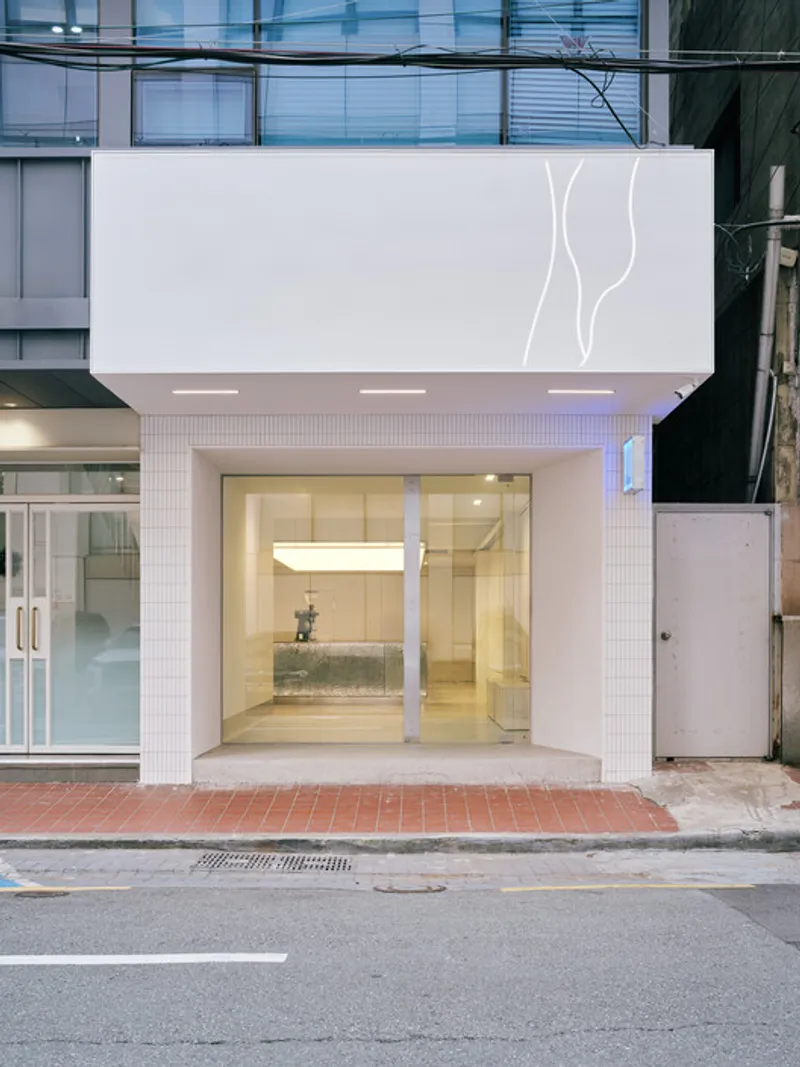
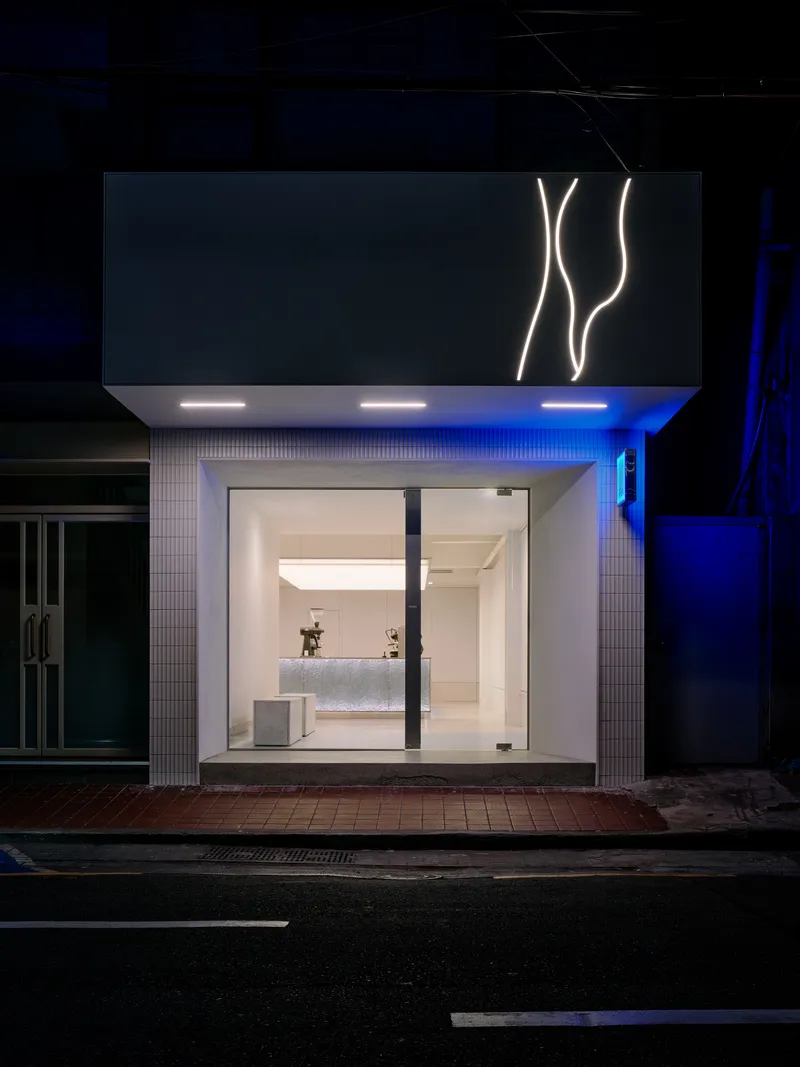
The storefront reads as crisp and minimal from a distance, but up close it reveals a subtle material ambition. Elongated rectangular mosaic tiles wrap the exterior in white, their concave surfaces catching and scattering light in a way that suggests water rather than stone. The effect is quiet during the day and more pronounced at night, when the illuminated interior turns the recessed glass entrance into a glowing threshold. A wave-inspired DEMER logo sits softly lit against the facade, legible without being loud.
Linear massing dominates: no curves, no flourishes, just clean planes that let the tile texture and the light do the talking. Even the flat metal door handle has been designed to eliminate the push-pull confusion common in retail entries, encouraging an intuitive opening gesture. It is a small touch, but it signals the level of deliberation running through the entire project.
Entering Through Terrazzo
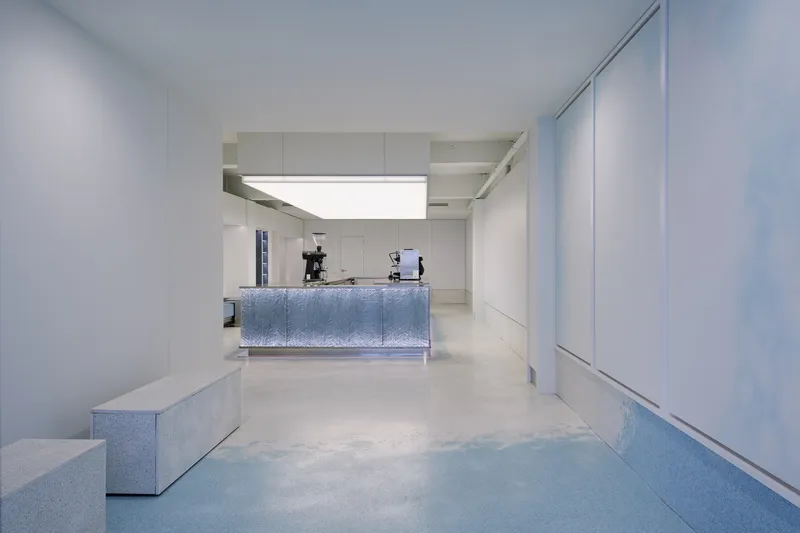
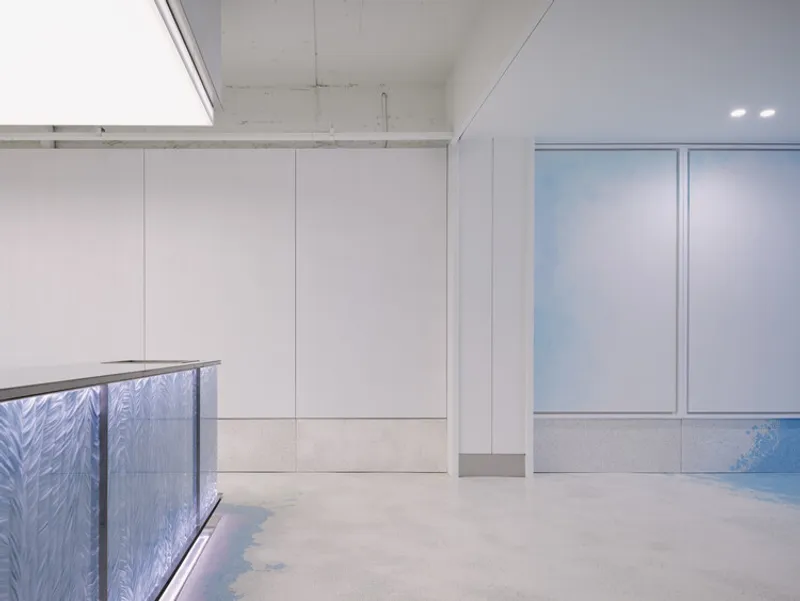
The transition from street to interior is handled through material rather than geometry. Epoxy terrazzo, custom-mixed to a specific color, runs across the entrance flooring and wraps portions of the walls, deliberately blurring where outside ends and inside begins. The intent is to carry the "flow of the sea" inward, a metaphor that works because the terrazzo's speckled surface genuinely reads as granular and fluid rather than static. Fluorescent chips embedded in the floor add a secondary glow: the material literally stores light, releasing it faintly when the room dims.
White portal frames reinforce the linear language established on the exterior, framing views toward the illuminated bar at the back of the narrow plan. The sequence is direct and legible. You know where you are going the moment you step inside.
The Bar as Luminous Core
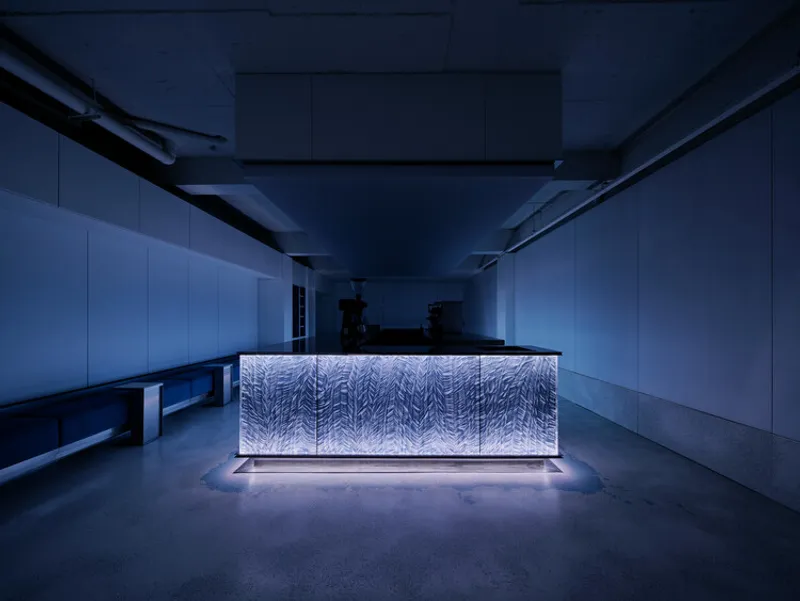
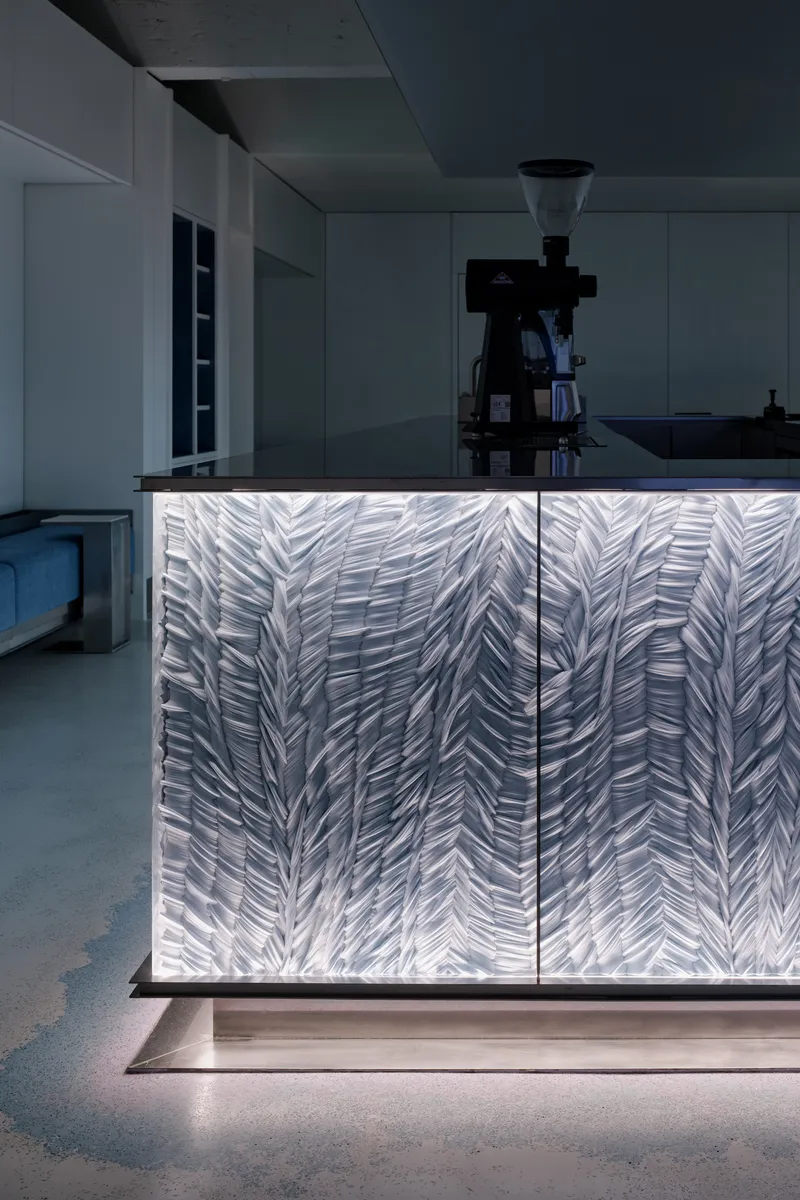
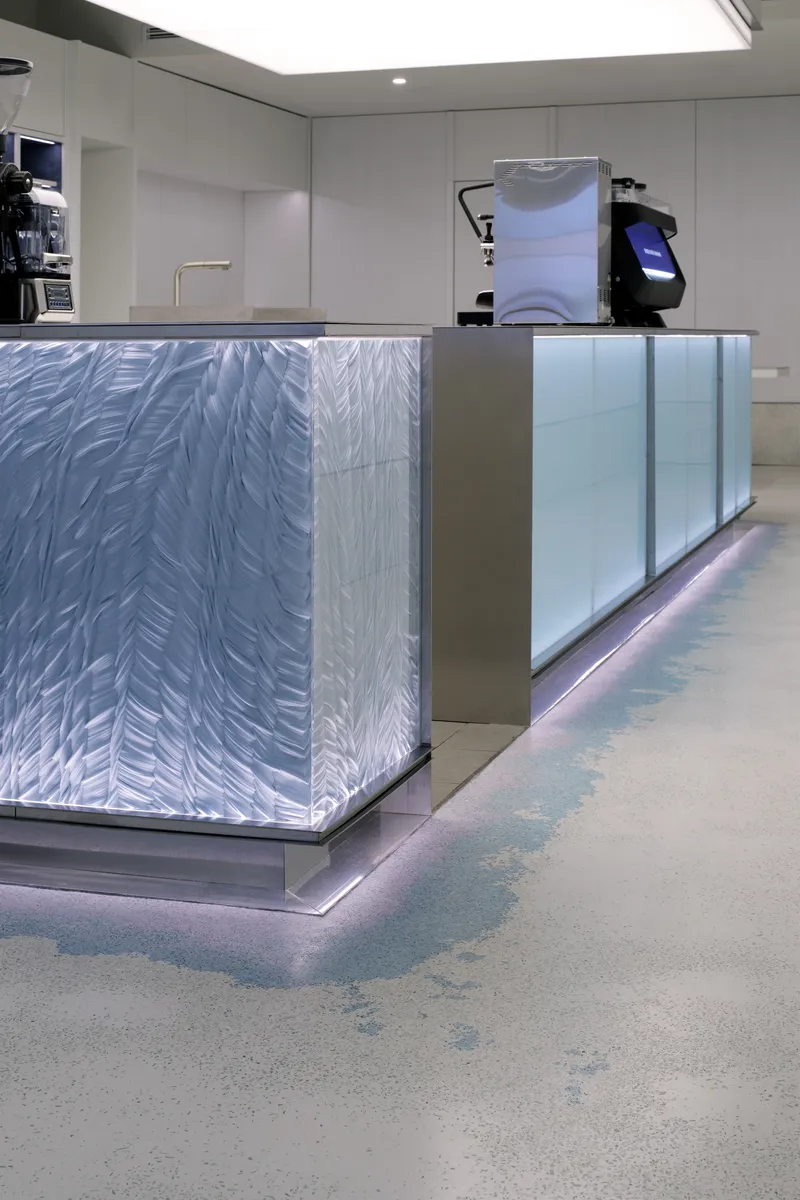
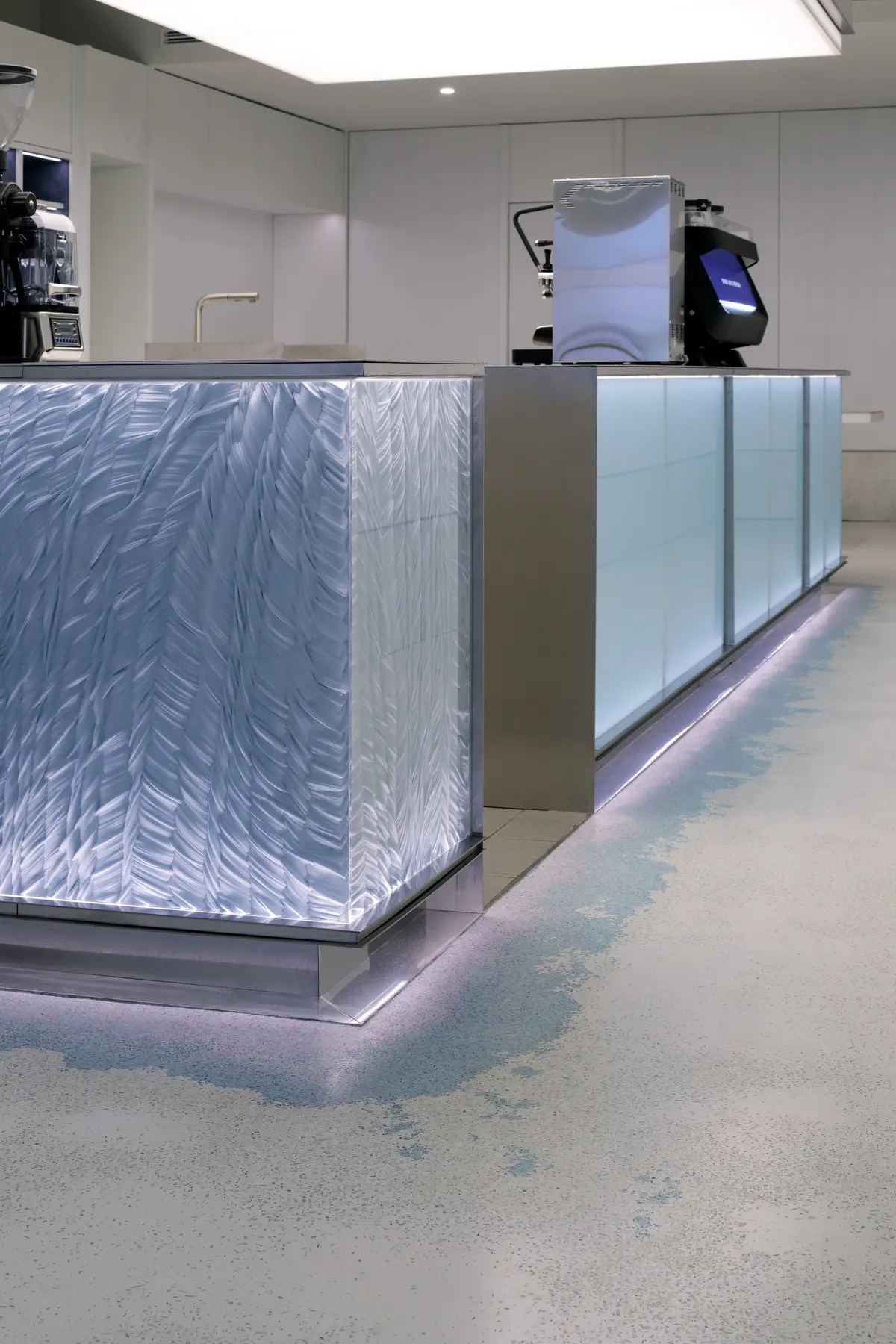
The main bar is the conceptual and spatial heart of the café, and 83 treated it accordingly. A suspended Barrisol fixture hangs above the counter, conceived to resemble light filtering beneath the surface of the sea. Light diffuses from both its underside and its edges, wrapping the barista station in a soft, even glow that avoids the harsh directionality of typical task lighting. The fixture draws you in from the entrance like a visual magnet, which is exactly the point.
The counter itself layers acrylic with Jesmonite to create a front surface that reads as iridescent and faintly organic. Satin acrylic panels add depth and vibrancy, while metal finishes on adjacent surfaces keep the palette restrained. The combination produces a bar that shifts in appearance depending on the angle and the ambient light, reinforcing the oceanic metaphor without ever becoming illustrative. A coffee grinder sits above the translucent panel, grounding the whole composition in function.
Seating and Texture
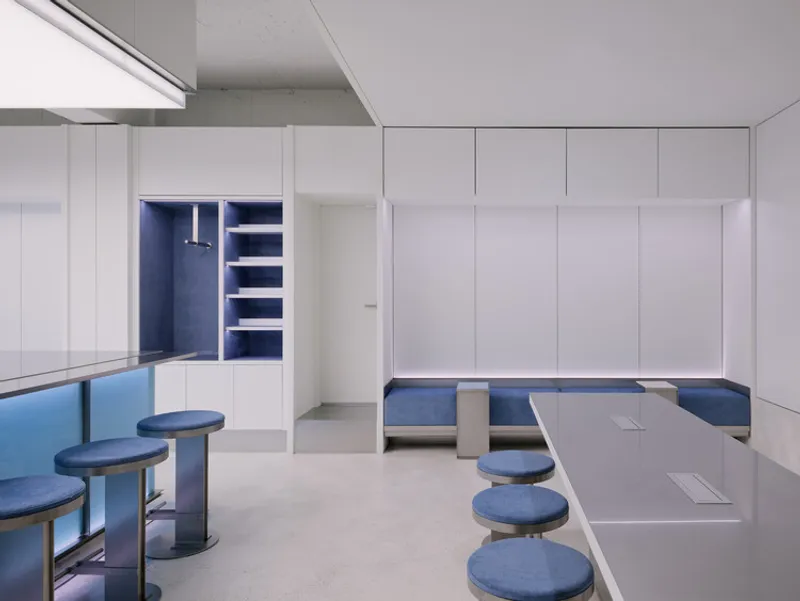
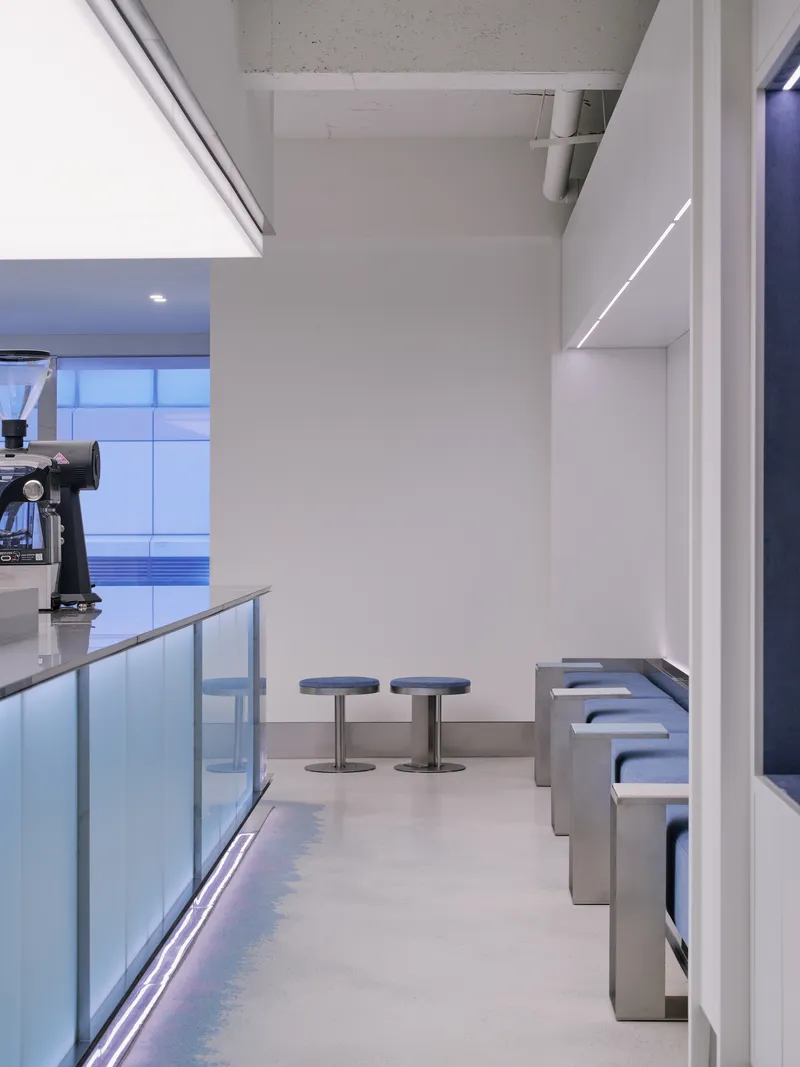
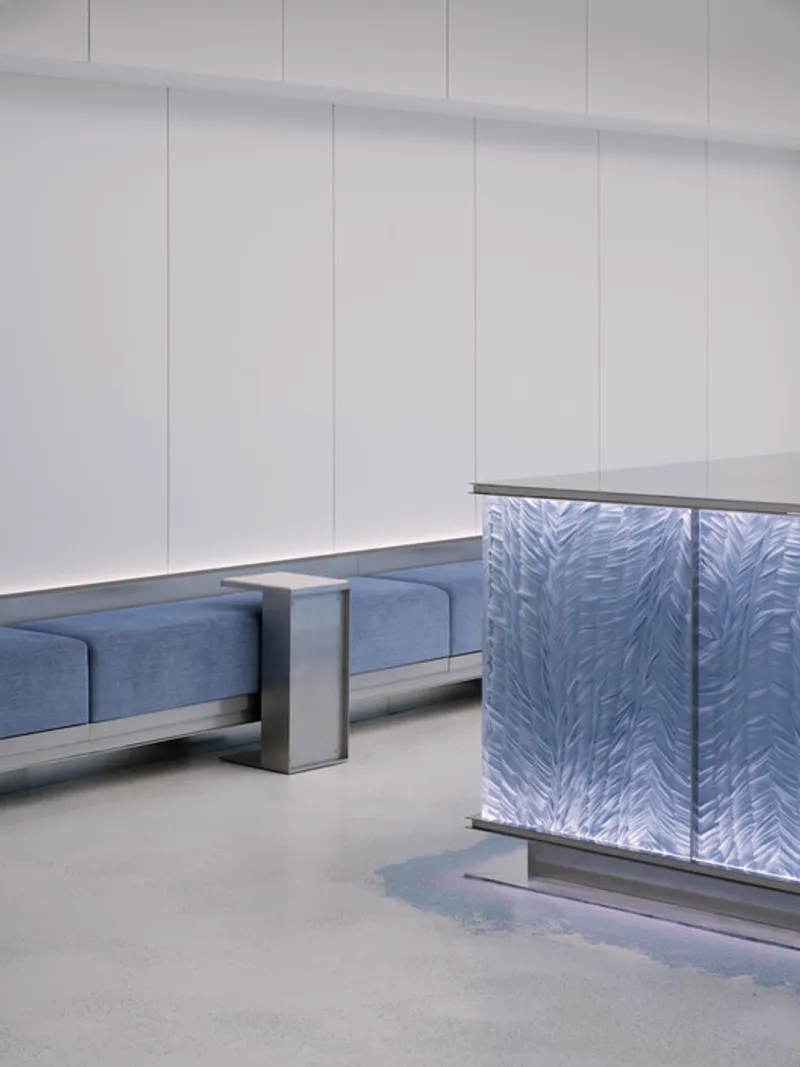
The seating zones run along one side of the narrow plan, organized as banquettes and stools beneath white storage cabinetry. Blue upholstered benches introduce the only real color in the room, and they do it with restraint: the blue is cool, slightly muted, evoking water without insisting on it. Metal stools and dividers between seating positions add a utilitarian counterpoint to the softer surfaces, preventing the interior from tipping into preciousness.
Exposed concrete ceilings overhead provide a raw textural contrast to the polished whites and iridescent panels below. The decision to leave the ceiling untreated is smart: it anchors the space in its actual construction while allowing the designed surfaces at eye level to feel more considered by comparison. The juxtaposition gives the room a layered quality that a fully finished ceiling would flatten.
Light as Lingering Presence
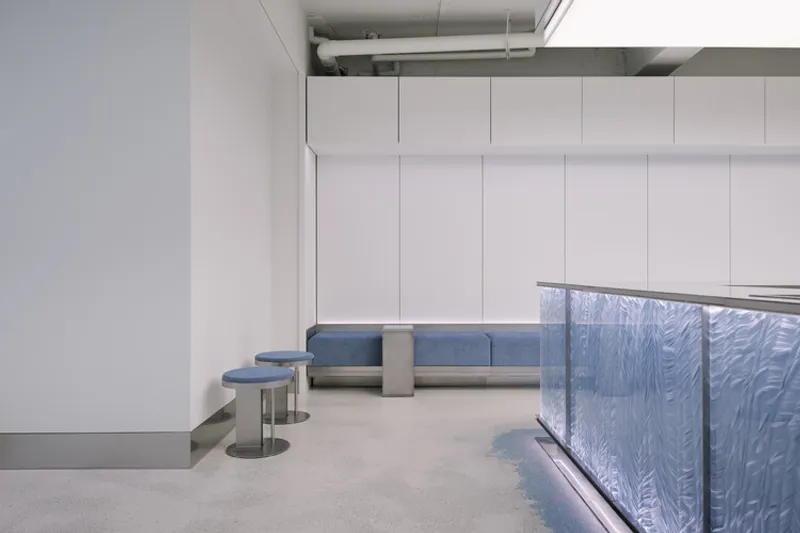
The most interesting aspect of the lighting strategy is its temporal dimension. During the day, with commuters streaming past and the café busy, the Barrisol fixture and the iridescent bar panels operate at moderate intensity, complemented by natural light through the glass storefront. As the district empties in the evening, the café's luminosity becomes more conspicuous. The fluorescent chips in the terrazzo floor metaphorically "store" the day's warmth, and the softly glowing facade maintains a presence on the street even when the room is empty.
This is where the founding question, whether a space can hold warmth after everyone has gone, finds its most tangible answer. The materials themselves become the carriers of atmosphere, independent of occupancy. It is a thoughtful resolution for a neighborhood that cycles between density and stillness every 24 hours.
Plans and Drawings
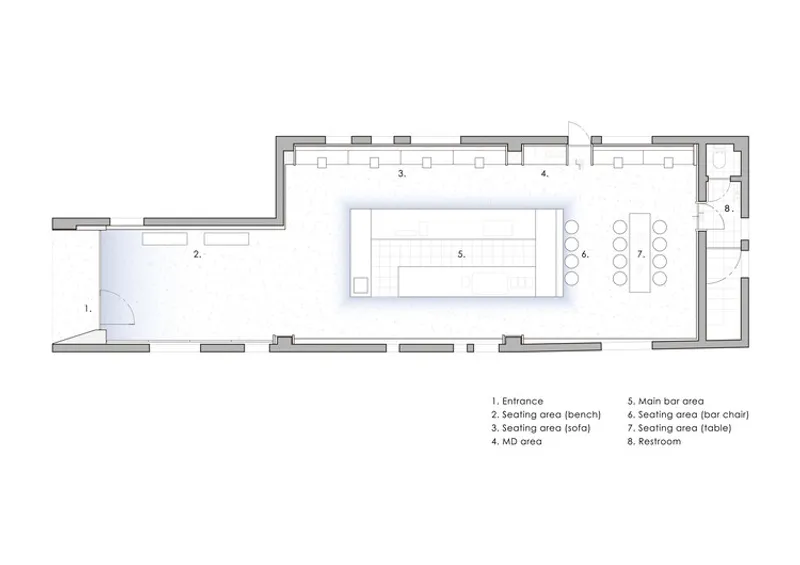
The floor plan reveals the project's narrow, deep proportions, a typical constraint in dense Korean commercial districts. The entrance leads directly into the seating zones along one wall, with the bar positioned at the rear as the spatial terminus. A restroom is tucked at the back of the plan. The linear organization is efficient and clear, but the material transitions along that axis, from terrazzo to epoxy to acrylic, give the procession a layered richness that the plan alone cannot convey.
Why This Project Matters
Small commercial interiors rarely attempt this level of conceptual coherence. Most café designs pick a mood board and stop there. 83 started with a genuine spatial question about warmth and persistence, then engineered every surface to answer it. The fluorescent terrazzo, the Barrisol fixture, the iridescent acrylic panels: each choice reinforces the central idea without redundancy. The project demonstrates that 96 square meters is more than enough room for architectural thinking, provided the thinking is disciplined.
DEMER Busan Station Store also offers a compelling model for hospitality design in transitional urban zones. Rather than simply catering to the daytime crowd and going dark at night, it maintains a luminous street presence that contributes to the district's atmosphere around the clock. The café becomes an urban lantern, a modest but genuine act of placemaking that extends its value well beyond the hours when anyone is ordering coffee.
DEMER Busan Station Store by 83, located near Busan Station, Busan, South Korea. 96 m², completed in 2025. Photography by Donggyu Kim.
About the Studio
Share Your Own Work on uni.xyz
If projects like this are the kind of work you want to make, uni.xyz is a place to publish your own, find collaborators, and enter design competitions.


Popular Articles
Popular articles from the community


longwave studio Reorganizes a 112 m² Tainan Apartment Around the Daily Routines of a Family and Two Cats
In Tainan, Taiwan, birch plywood, rust-red furniture and a freestanding plaster wall link arrival, storage, work and family life in one apartment.

LT2A and OPEN Architectes Thread a Brick and Glass High School Through a Wooded Belgian Campus
In Braine-l'Alleud, a 3,000 m² wing for Collège Cardinal Mercier pairs pale brick with a glazed colonnade, deferring to a small chapel and a dense wood.

David Macias Steps a Doorless Stone and Plaster House Down a Tropical Colombian Hillside
In the humid hills of Colombia, Threshold House replaces the front door with an open void and terraces its 850 m² down the slope instead of fighting it.

Architekt Andreas Gruber Scatters 23 Dark Timber Chalets Across a South Tyrolean Forest Edge
In Molini di Tures, Amonti Chalets breaks a resort into a hamlet of gabled timber houses, with parking, storage and services pushed into the slope.

Similar Reads
You might also enjoy these articles

Gil Mello Arquitetura Tilts a Single Roof Toward the Waterfalls on a Plateau Above Aiuruoca, Brazil
In Aiuruoca, Minas Gerais, a 200 m² house of local labor and reclaimed poles pairs a low valley veranda with a tall mountain one.

U.GA Architects Wraps an Oval Rooftop Pool in Curved Board-Formed Concrete on Busan's Jeollidan-gil
In Busan's Jeonpo-dong, a 454 m² mixed-use block stacks a neighborhood facility, guest rooms and an oval rooftop pool inside spiraling concrete walls.

Felipe Hess Arquitetos Turns a Blind Stone Wall to the Street and Opens a Brazilian House onto a Courtyard and Canal
A canal-front house in Brazil hides behind painted stone and planting, then opens to an olive-tree courtyard, a reed-ceilinged porch and a curving pool.
David Macias Steps a Doorless Stone and Plaster House Down a Tropical Colombian Hillside
In the humid hills of Colombia, Threshold House replaces the front door with an open void and terraces its 850 m² down the slope instead of fighting it.

Explore Architecture Competitions
Discover active competitions in this discipline

Challenge to reimagine the Iron Throne

Photograph architecture without architects

Illustrate the lost glory of Angkor Wat - Render Challenge

Design challenge to reuse E-waste
Comments (0)
Please login or sign up to add comments
No comments yet. Be the first to comment!