

Deployable Inflatable Mars Habitat: A Vision for Space Architecture and Future Living
A deployable inflatable Mars habitat enabling rapid space colonization through adaptive architecture, compact transport, and expandable living systems


As humanity moves closer to interplanetary exploration, the role of space architecture becomes increasingly critical. The Deployable Inflatable Mars Habitat redefines how we approach extraterrestrial living by combining compact transport efficiency with expansive spatial experience. Designed as a flexible, adaptive system, this project introduces a scalable model for future habitation beyond Earth.
Developed by Stellar Amenities and Anastasia Prosina, this concept was recognized as a Shortlisted entry of Habitats '20, positioning it among forward-thinking proposals addressing the future of human settlement in extreme environments.
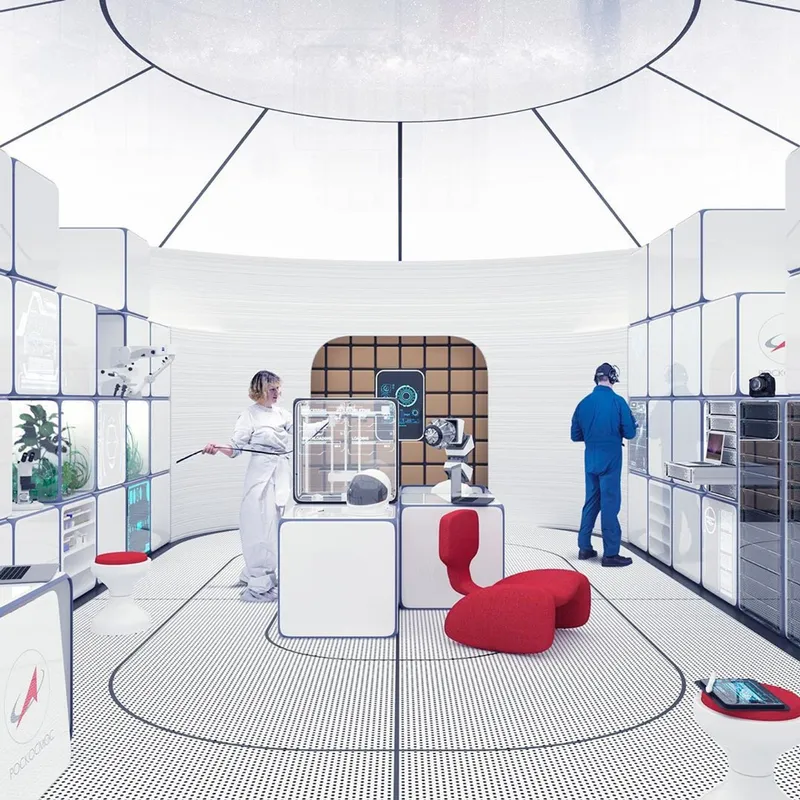
Rethinking Space Architecture for Mars
Traditional architectural systems rely on rigid construction, heavy materials, and permanent foundations. However, Mars demands an entirely different paradigm. The constraints of launch capacity, harsh environmental conditions, and limited on-site resources require architecture to be lightweight, compact, and transformable.
This project responds with an innovative inflatable architecture system that transitions from a compact cylindrical unit into a fully functional habitat. The strategy prioritizes efficiency during transport while maximizing usability once deployed.
Compact to Expandable: The Core Design Logic
At the heart of the design lies a deployable cylindrical module. During transport, the habitat remains tightly packed within a protective outer shell. Upon arrival, the structure undergoes a transformation process:
- The outer panels are removed, exposing the internal mechanism
- An inflatable membrane expands outward, forming the primary living volume
- A concealed transforming floor unfolds, increasing the diameter up to 10 meters
This transformation creates a significant increase in usable space without increasing launch mass, a crucial advantage in space missions.
The result is a spatial system that shifts from minimal volume to a generous, open environment capable of supporting daily life, work, and rest.
Interior Flexibility and Human-Centric Design
Inside the habitat, flexibility becomes the defining principle. The expanded floor system creates a free-plan interior, allowing astronauts to configure spaces based on operational needs. Workstations, rest zones, and collaborative areas can be dynamically arranged, reflecting a human-centered approach to space architecture.
The clean, modular interior language seen in the visualizations emphasizes clarity, efficiency, and psychological comfort. In isolated environments like Mars, spatial quality directly impacts mental well-being. This design acknowledges that architecture is not only functional but also experiential.
Inflatable Architecture as a Future Standard
Inflatable systems have emerged as a promising direction in aerospace engineering. Their ability to compress into small volumes and expand into large enclosures makes them ideal for space missions. This project leverages that principle while integrating architectural intelligence into the system.
Key advantages include:
- Reduced payload weight during launch
- Rapid deployment on site
- Increased spatial efficiency after expansion
- Adaptability for different mission scales
By combining engineering precision with architectural thinking, the project pushes the boundaries of what space habitats can achieve.
Contextual Adaptation: Surface and Subsurface Scenarios
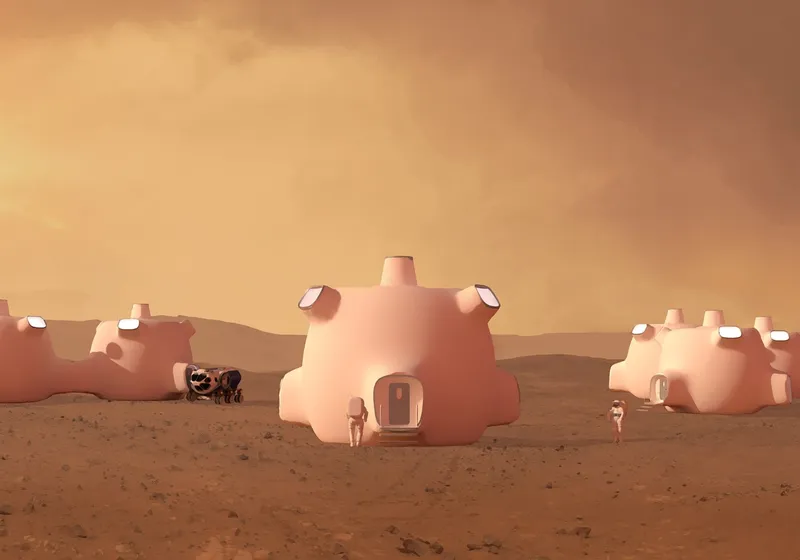
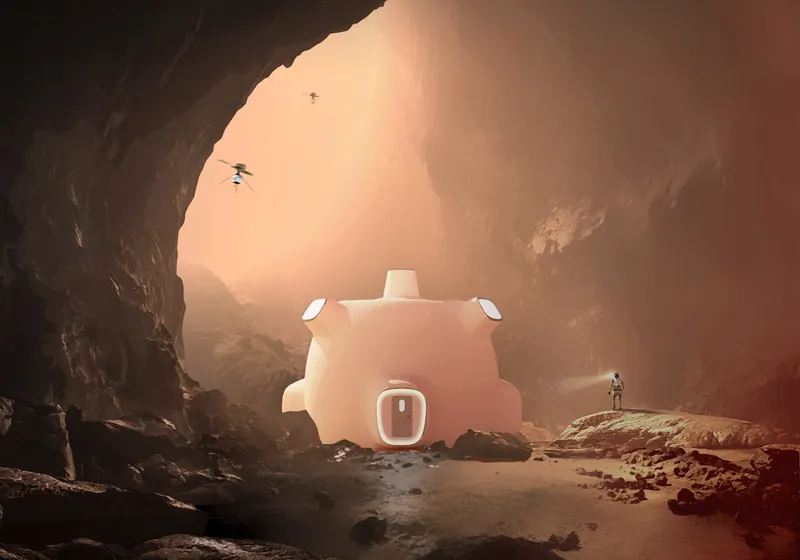
The visual narrative of the project explores multiple Martian contexts, including open terrain and cave environments. This highlights the adaptability of the habitat across different site conditions.
On the surface, the habitat stands as a soft, organic volume contrasting with the harsh Martian landscape. In subsurface scenarios, such as caves, it benefits from natural protection against radiation and extreme temperatures.
This dual adaptability reinforces the concept of a resilient architectural system capable of responding to diverse environmental challenges.
Toward Scalable Mars Colonization
Beyond a single unit, the project hints at a broader vision for modular space settlements. Multiple habitats can be deployed and connected to form larger colonies, enabling scalable growth over time.
Such systems could support:
- Scientific research bases
- Long-duration habitation
- Collaborative living environments
This scalability transforms the project from an isolated prototype into a foundational model for future Martian cities.
A New Language of Architecture Beyond Earth
The Deployable Inflatable Mars Habitat represents a shift in architectural thinking. It moves away from permanence and rigidity toward adaptability, transformation, and efficiency. It challenges architects to design not just for Earth, but for entirely new worlds.
As space exploration accelerates, projects like this will define how humanity inhabits the cosmos. They demonstrate that architecture is not limited by gravity, geography, or tradition, but is instead an evolving discipline capable of shaping life anywhere.
Project Credits
Project: Deployable Inflatable Mars Habitat
Designers: Stellar Amenities, Anastasia Prosina
Recognition: Shortlisted entry, Habitats '20


Popular Articles
Popular articles from the community


Manzana Morphosis: Stretching Barcelona's Grid into a Living Landscape for 2050
A radical reworking of the Eixample manzana turns density into a tool for generous public space, vertical ecology, and environmental performance.
Temporary Home for Dogs: A Reversed Zoo Rethinks Animal Shelter Architecture
In Bucharest, a sinuous corridor and freed landscape flip the logic of containment, designing a shelter that works to make itself unnecessary.

Extended Shell: Retrofitting Kolkata's Balconies as Living Urban Thresholds
A modular retrofit system recovers the social and environmental intelligence of Kolkata's historic verandas for contemporary Park Street residents.

Singing Woman: Contemporary Architecture Inspired by Estonia’s Voice and the Sea
Singing Woman turns Estonia’s song culture into flowing opera house architecture, blending public life, landscape, sea, and national memory.

Similar Reads
You might also enjoy these articles

Eco Chapel: A Green Architecture Pavilion Designed in Symbiosis with the Forest
Eco Chapel uses green architecture to weave prayer, learning and reuse into a forest pavilion shaped by modular hexagonal canopies for life.
Kaffeebühnen: Coffee Shop Architecture Designed as a Civic Stage Between Vienna’s City and Park
Kaffeebühnen turns coffee shop architecture into a civic stage, linking Vienna’s park edge, urban life, warm timber yards, and coffee craft.
Healing Façade: Sustainable Architecture for Reforestation, Community, and Sacred Ecology in Ethiopia
Healing Façade reimagines sustainable architecture as a living wall that restores soil, catches water and renews Ethiopia's forest churches.


Urban Forest: A Vertical Ecosystem for 5,000 Workers in Singapore's Changi Business Park
Radially stacked pods and layered green decks turn a 7-acre plot into 47 acres of ecological workspace projected for 2040.

Explore Space Habitat Competitions
Discover active competitions in this discipline

Challenge to design luxury tourism on rails

Challenge to reimagine the Iron Throne

Photograph architecture without architects

VR headsets Storefront design competition
Comments (0)
Please login or sign up to add comments
No comments yet. Be the first to comment!