
DESIGN2TONE Folds Industrial Grit and Fine Dining into a 109 m² Seoul Restaurant
SSOC Dining channels Seongsu's warehouse aesthetic into a warm, timber-lined interior where every seat faces the kitchen.


Seongsu has earned its reputation as Seoul's most self-aware neighborhood. Former shoe factories and printing workshops now house specialty coffee bars and concept stores, and the district's identity hinges on a tension between roughness and polish. DESIGN2TONE understood this duality when they were tasked with fitting a proper dining room into a 109 m² ground-floor unit on one of the area's mixed-use streets. SSOC Dining, completed in 2025, is their answer: a restaurant that reads as industrial from the sidewalk and intimate once you step inside.
What makes the project worth studying is how much coherence the studio extracted from so few square meters. The plan is essentially one room with a galley kitchen pressed against a wall, yet DESIGN2TONE layered materials, lighting registers, and furniture geometry so deliberately that the space feels neither cramped nor underdesigned. Every seat faces the open kitchen, turning meal preparation into the restaurant's primary ornament. The concept, which the studio frames as "new harmony within diversity," sounds like boilerplate until you look at the joinery details and realize they meant it literally: oak, terrazzo, brushed brass, brick, wire mesh, and plaster all share the same room without competing.
A Facade That Shifts with the Clock
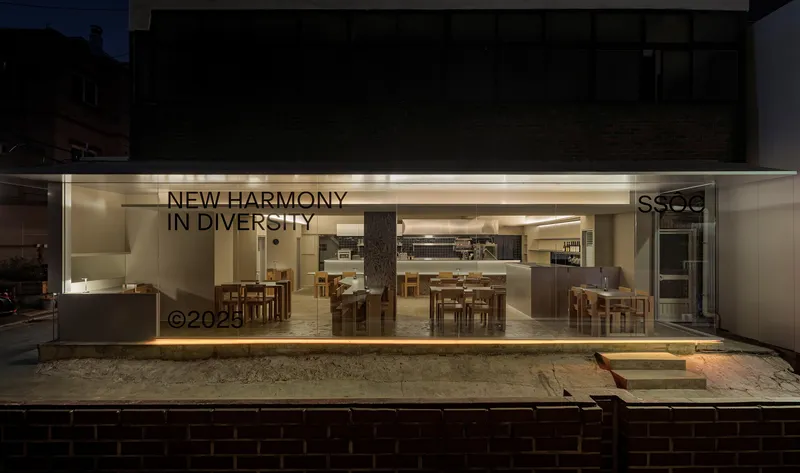
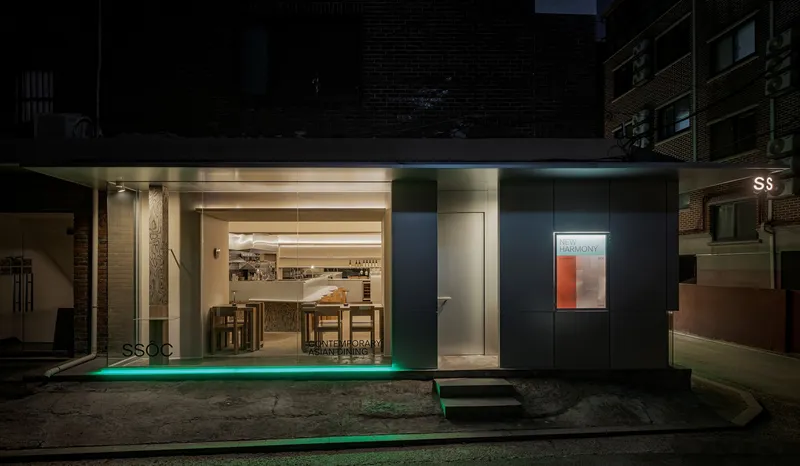
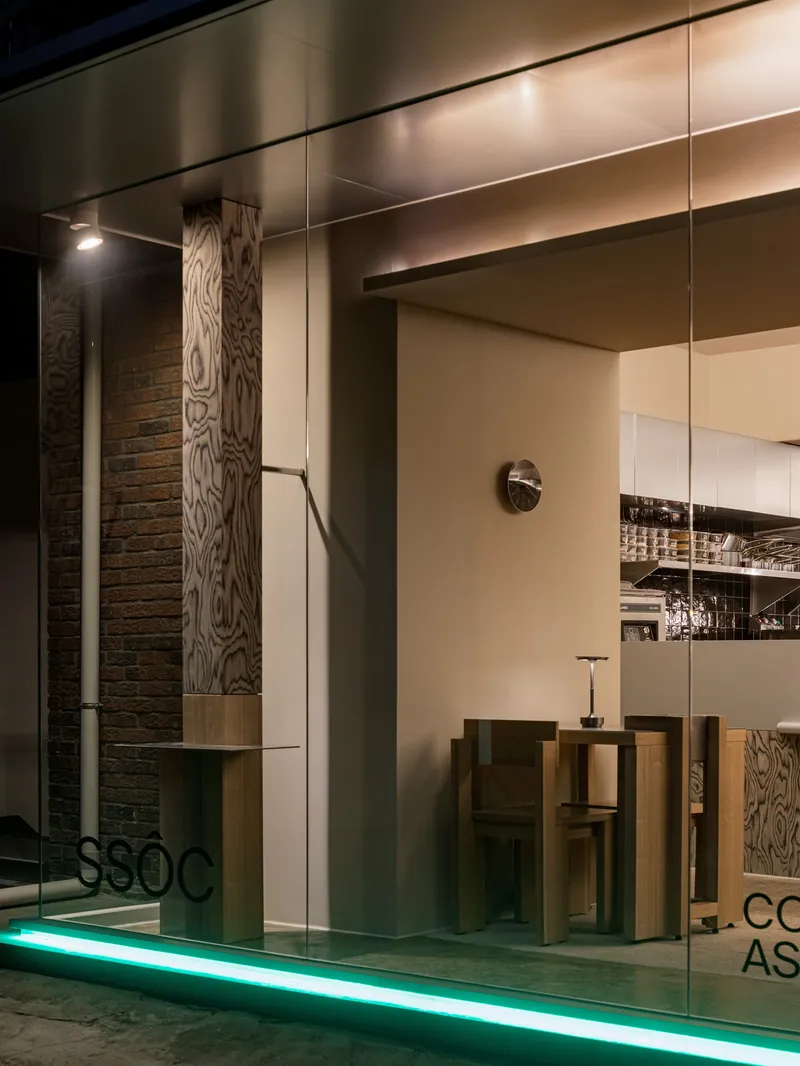
The full-height glazed storefront is the restaurant's calling card. During the day, it dissolves the boundary between sidewalk and dining room, letting natural light run across the terrazzo floor and pick up the grain of the timber column. At night the equation inverts. Black metal cladding frames the glass, and a strip of green ground lighting at the base gives the entrance a theatrical underline without resorting to neon or signage excess. A lighting installation embedded in the facade responds to changing outdoor conditions, making the storefront feel alive rather than simply transparent.
The move is smart for Seongsu, where foot traffic is dense and storefronts compete for attention. DESIGN2TONE chose restraint over spectacle, letting the warm interior glow do the marketing.
Timber as Structure, Surface, and Character
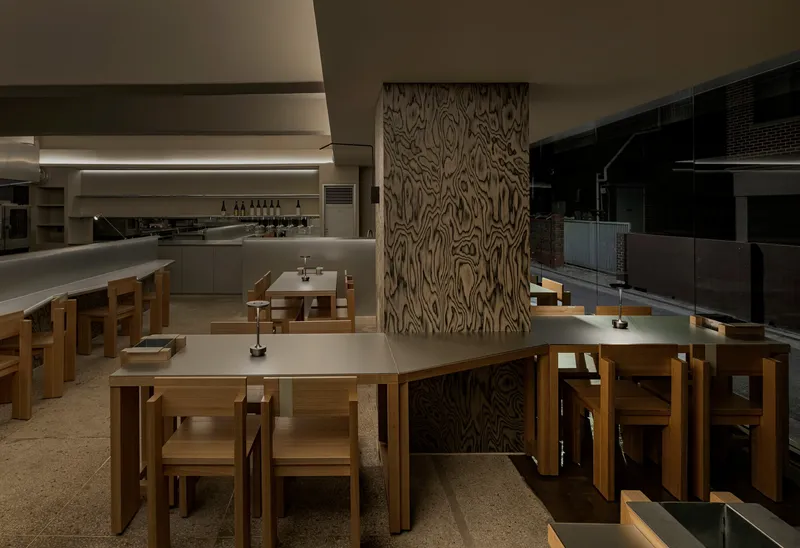
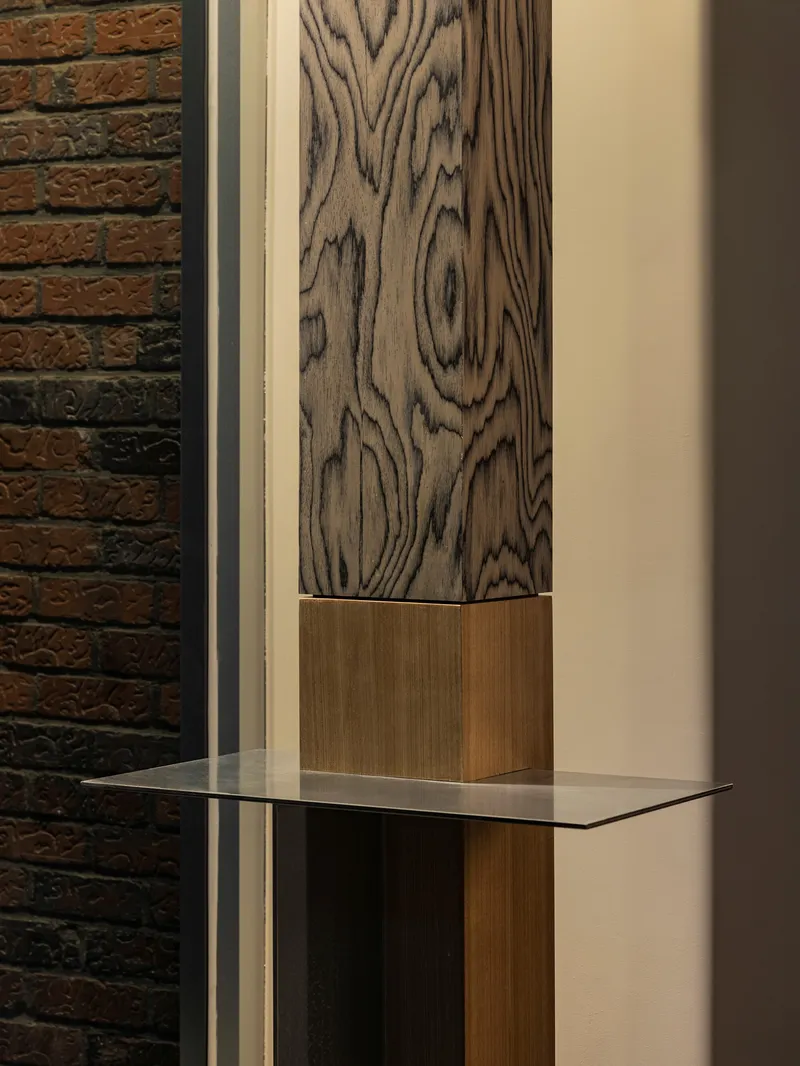
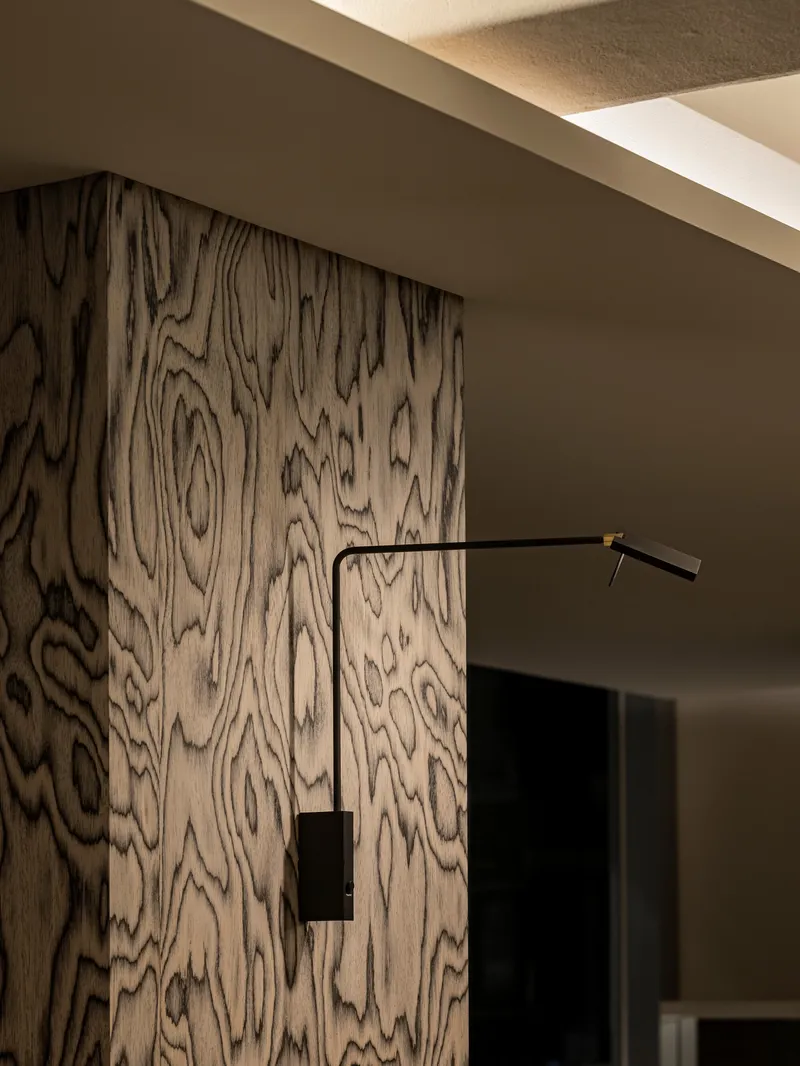
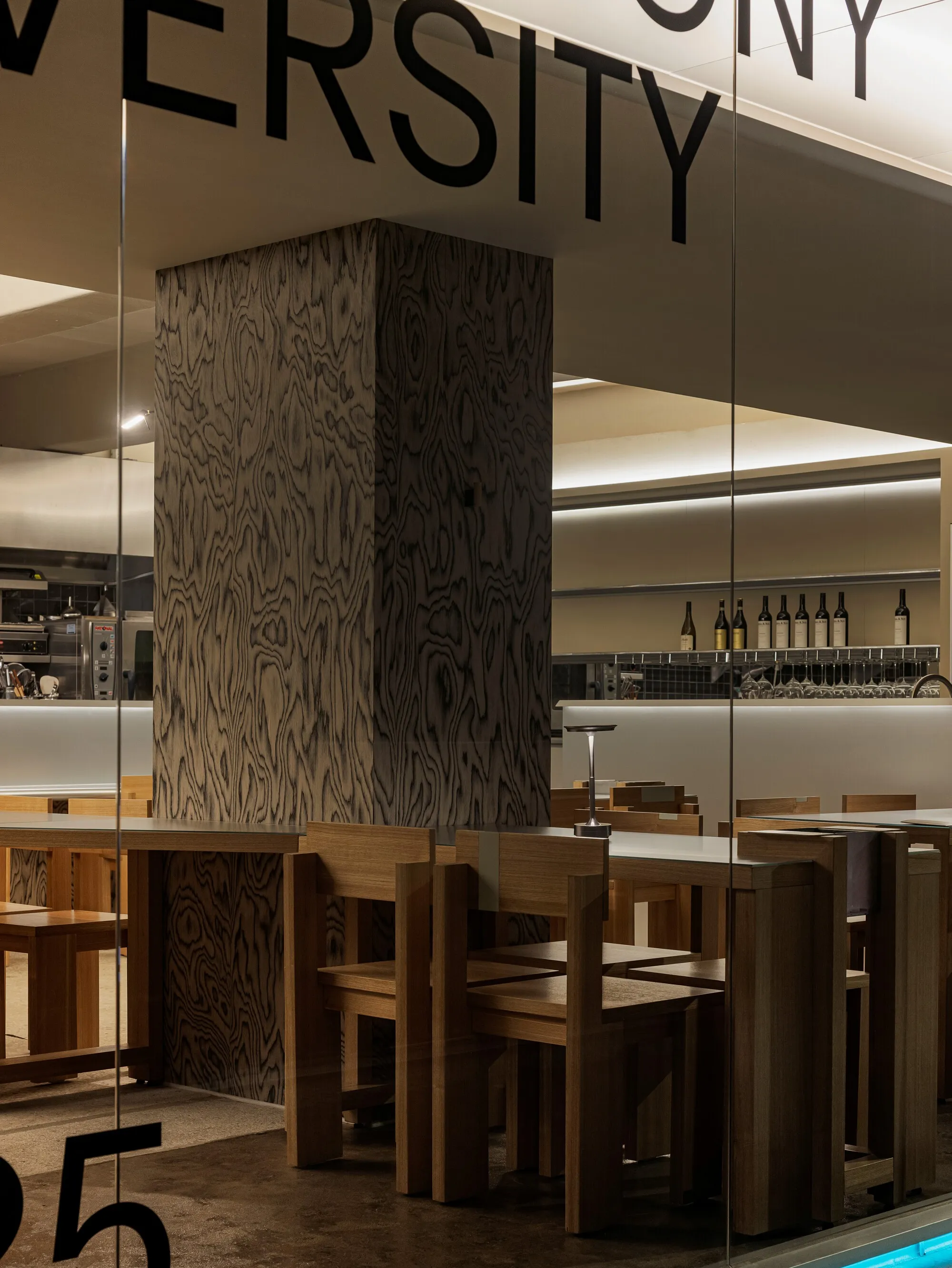
A wood-grained column anchors the dining area visually. It is not structural in the engineering sense, but it acts as a spatial pivot: seating clusters orbit around it, and its figured grain pattern is echoed in wall panels elsewhere in the room. DESIGN2TONE paired this central element with a glass shelf set against exposed brick, a juxtaposition that summarizes their whole material strategy. Nothing matches by color, but everything matches by temperature.
The figured wood grain panel with a black swing-arm sconce recessed into the ceiling is a quiet highlight. It suggests a private dining nook without any partition, using material intensity to carve out intimacy within the open plan.
Furniture as Architecture
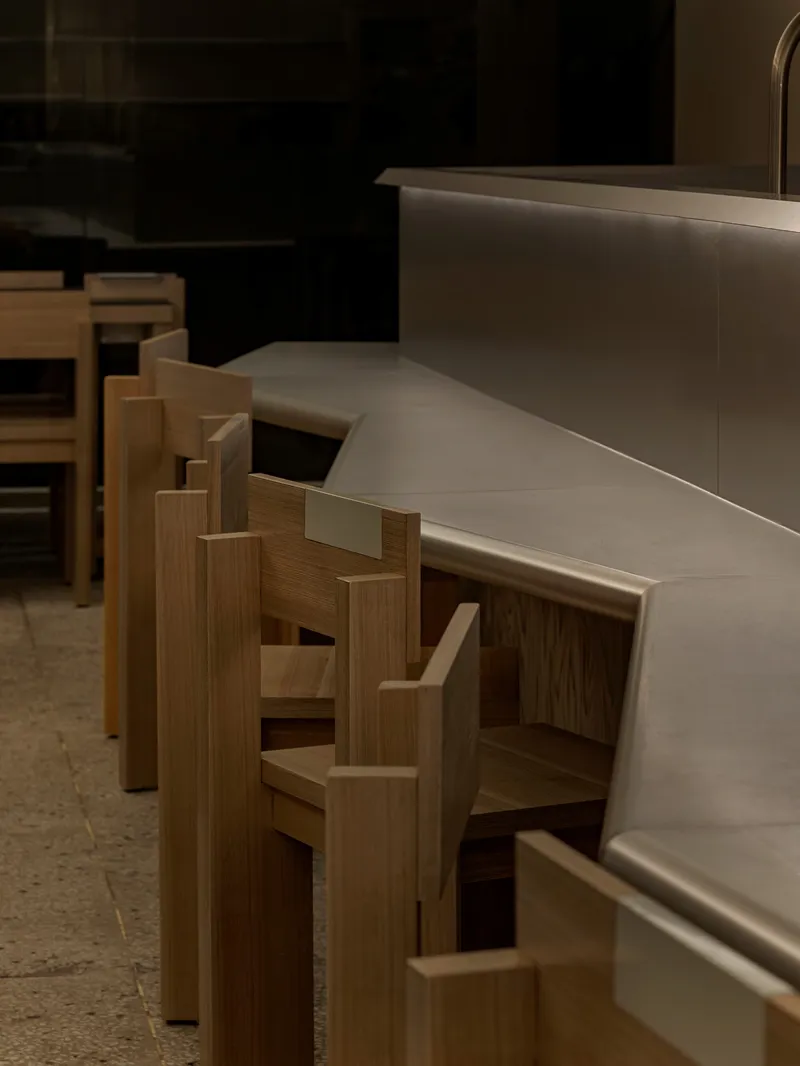
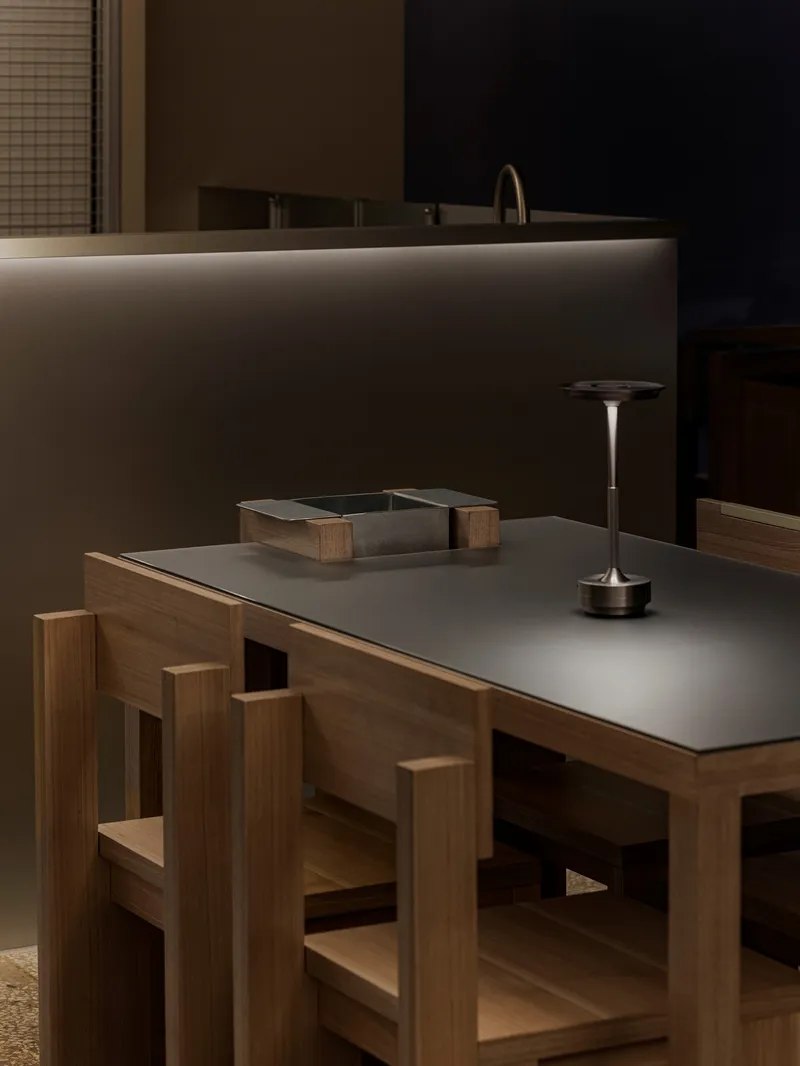
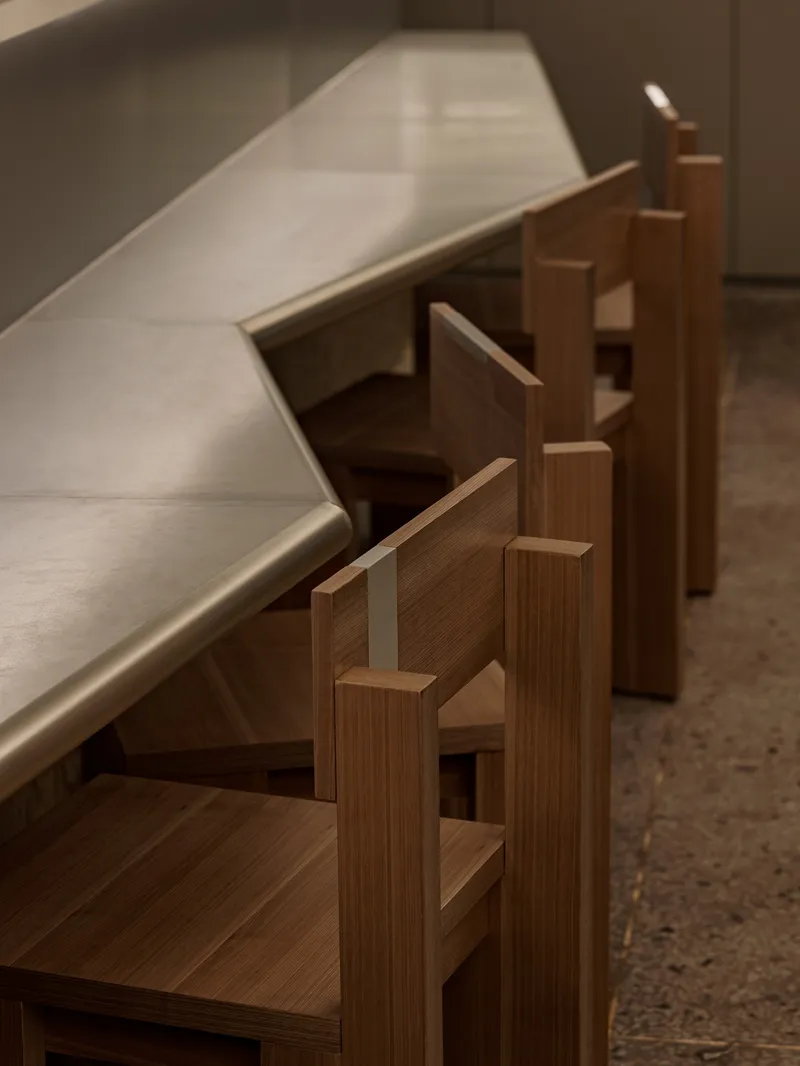
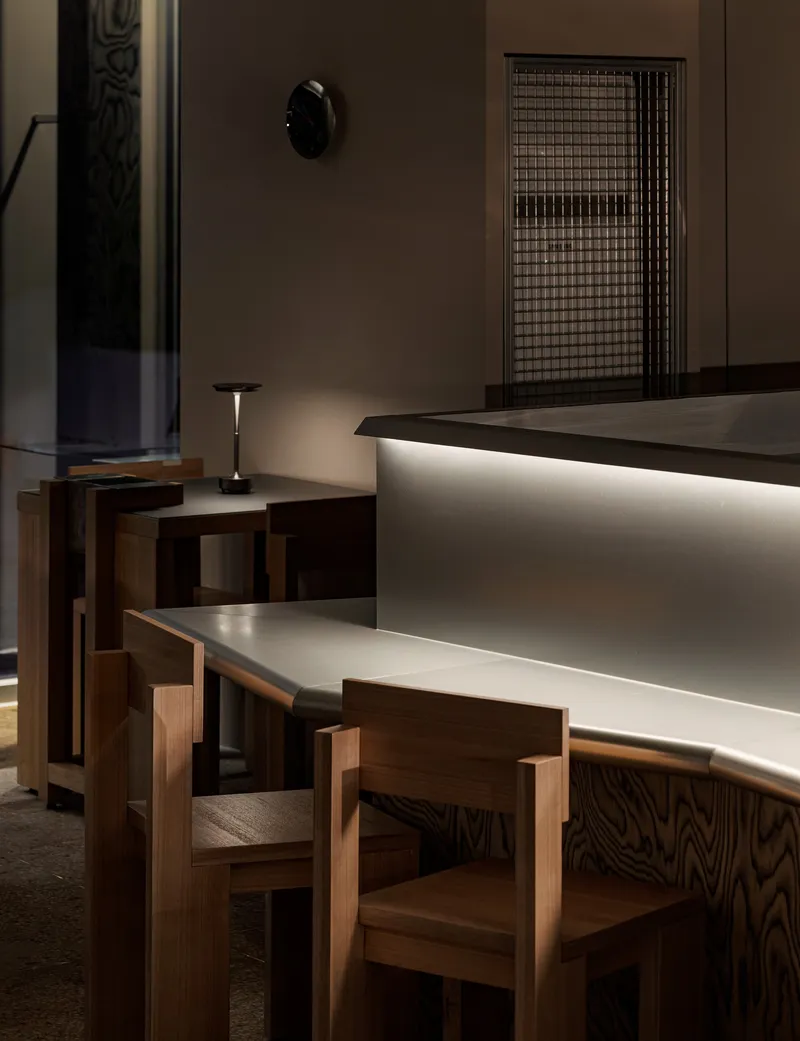
In a space this small, furniture does more than furnish. The timber bar stools with their stepped backrests are practically a section drawing come to life: each step catches light differently, creating a rhythm along the curved counter edge. The oak dining tables use a geometric timber base with a matte grey surface, a combination that reads as both warm and contemporary. DESIGN2TONE designed these pieces to hold their own against the harder surfaces of brass and metal, and they succeed.
The stepped timber seating elements along the brushed metal counter repeat the stool logic at a different scale. Repetition without monotony is one of the hardest things to pull off in compact hospitality design, and it works here because the proportions vary just enough to keep your eye moving.
The Open Kitchen as Social Engine
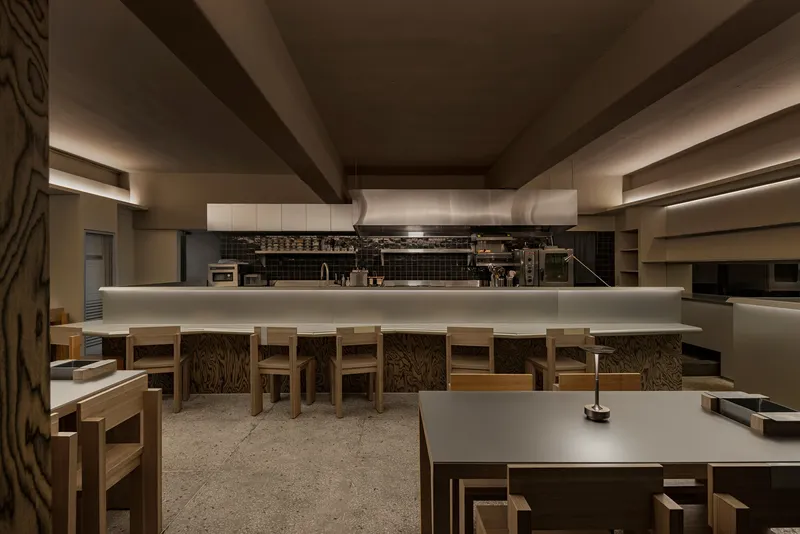
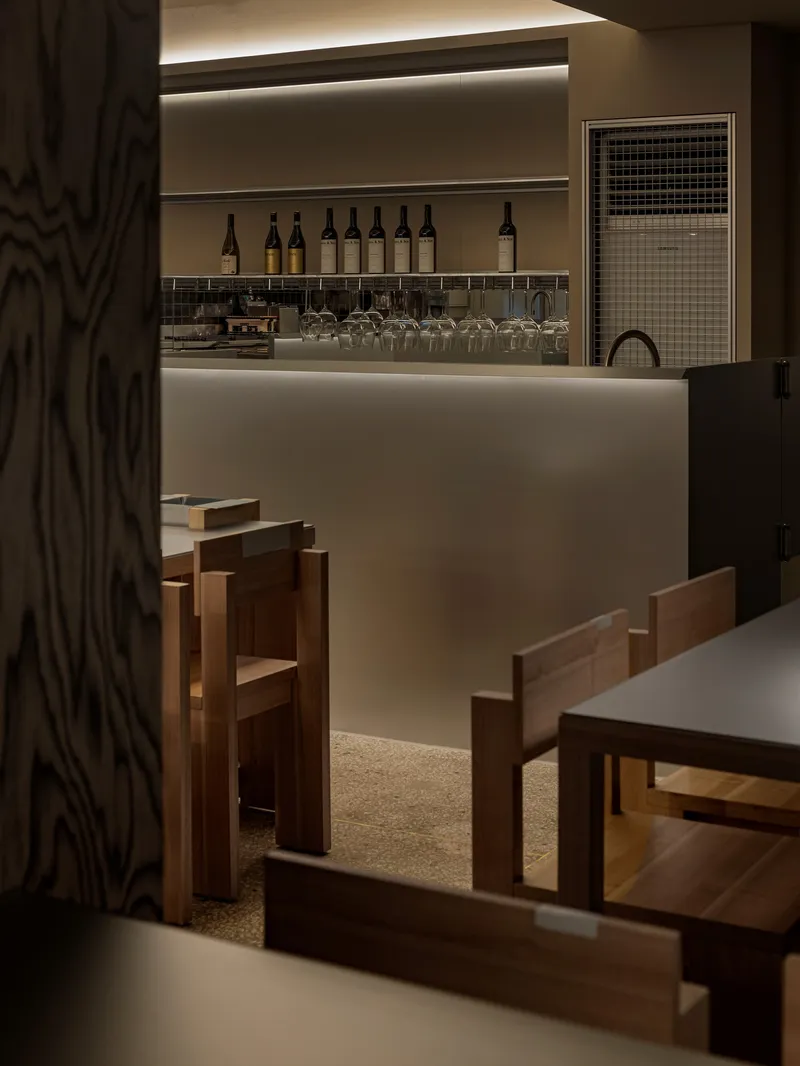
The galley kitchen runs along one wall behind a backlit counter, its wine bottles doubling as decoration. Exposed ceiling beams above frame the scene, and the backsplash in dark ebony grounds the composition against the lighter tones of the dining room. Every chair and banquette is oriented so that guests have at least a peripheral view of the cooking, a choice rooted in Asian dining culture where the act of preparation is part of the meal's narrative.
A wire mesh screen provides partial separation without blocking sightlines, and the brushed brass counter edge meeting timber millwork beneath white plaster walls creates a material transition that signals the shift from guest zone to service zone without a hard boundary.
Light as a Calibrated Ingredient
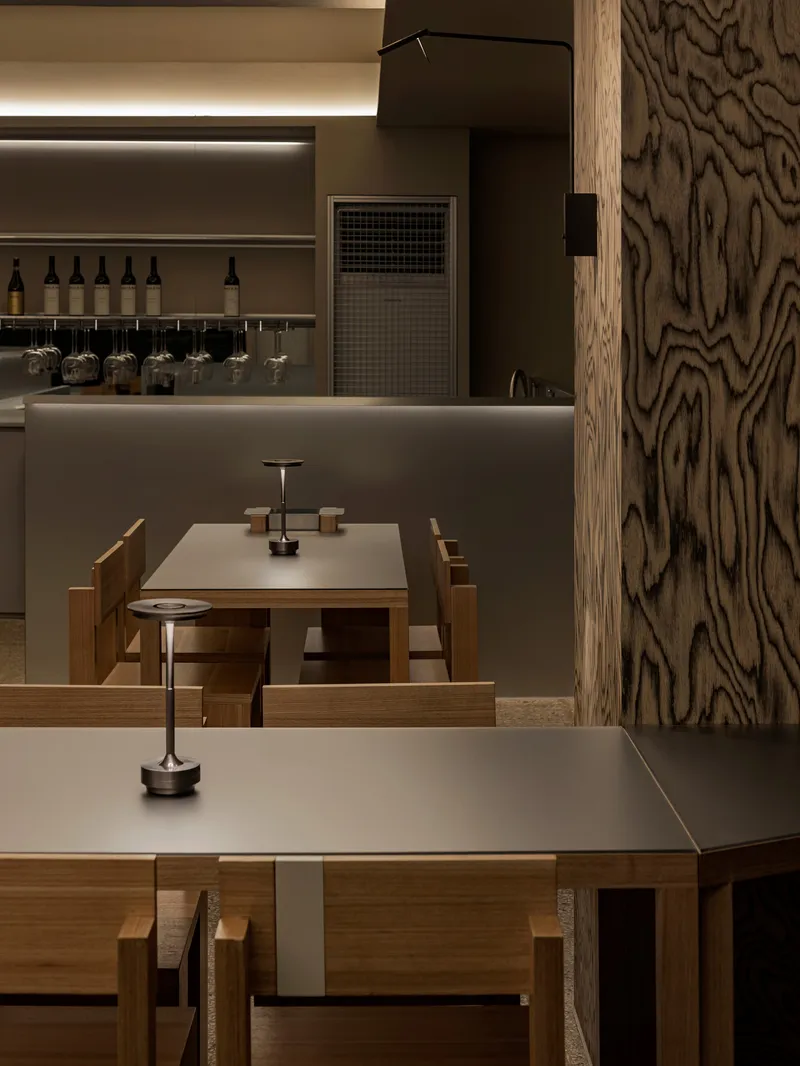
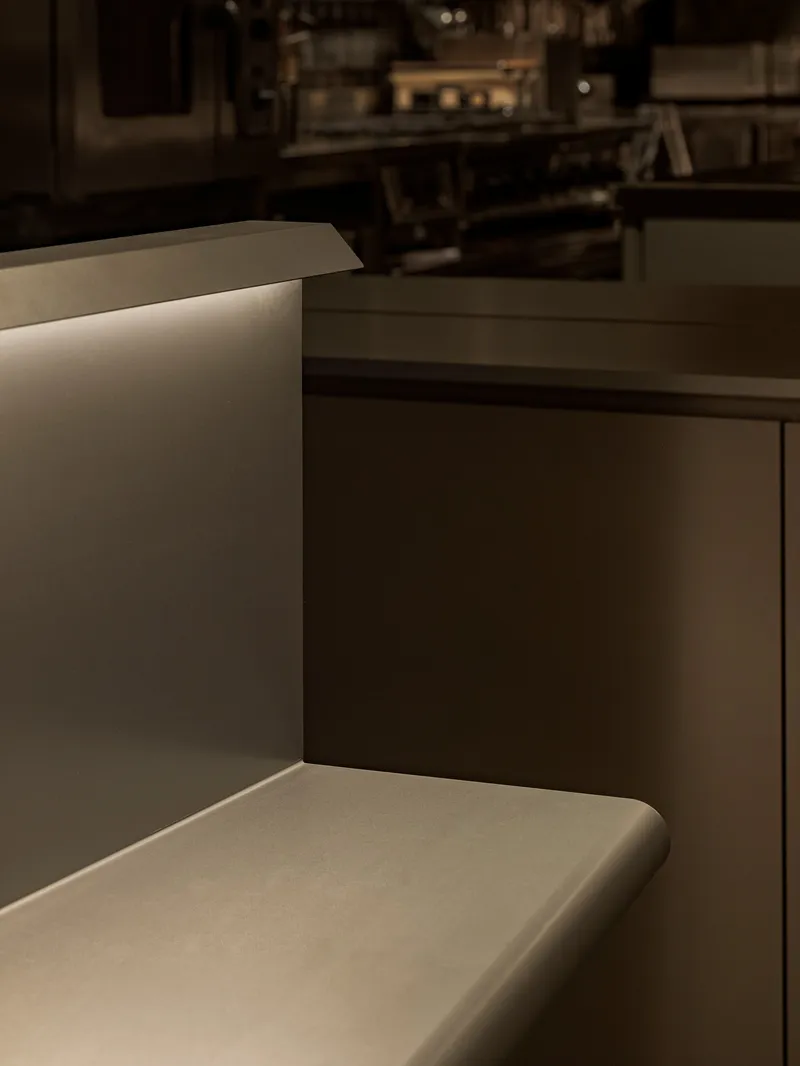
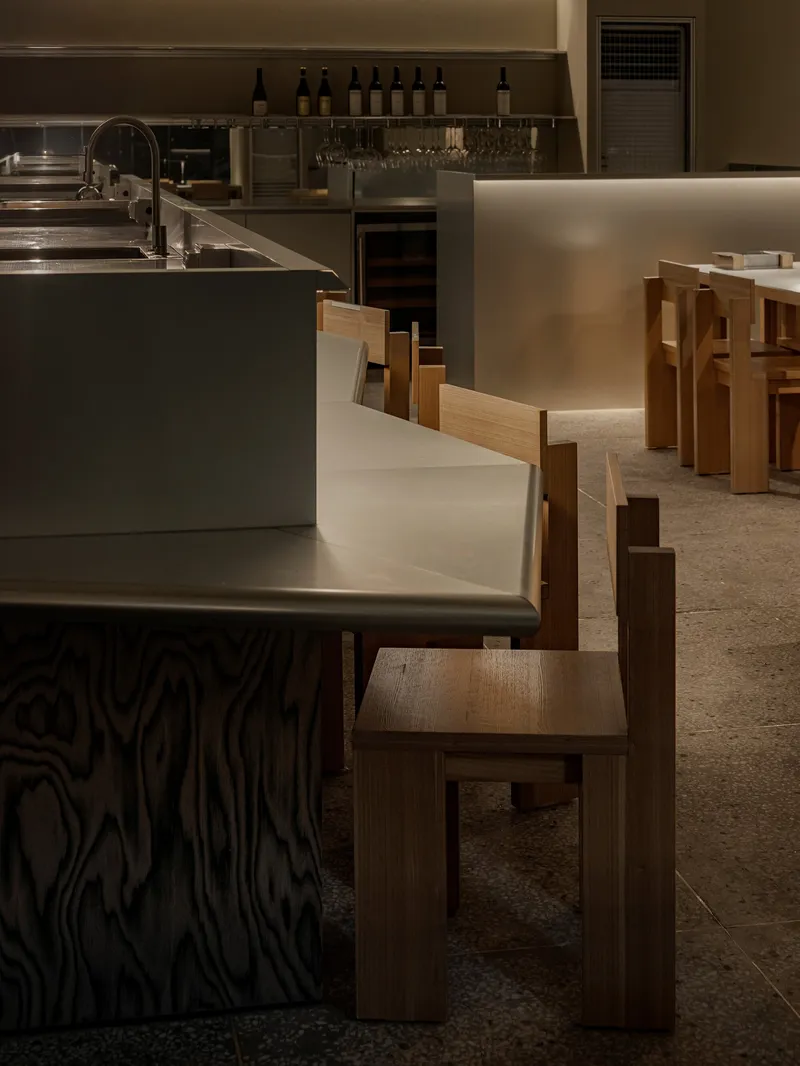
DESIGN2TONE used at least three distinct lighting registers. Backlit ceiling coves provide ambient wash. Recessed LED strips at the banquette edges add a thin line of warmth at seating level. And concentrated overhead beams focus attention on the table surfaces, making plates and glassware the most brightly lit objects in the room. The effect after dark is cinematic: the terrazzo floor fades into a soft grey ground, timber absorbs the warm tones, and the food itself becomes the focal point.
It is a lighting strategy borrowed from gallery design, where illumination hierarchy tells visitors what to look at first. In a restaurant, that hierarchy directs your eyes to the dish.
Material Intersections
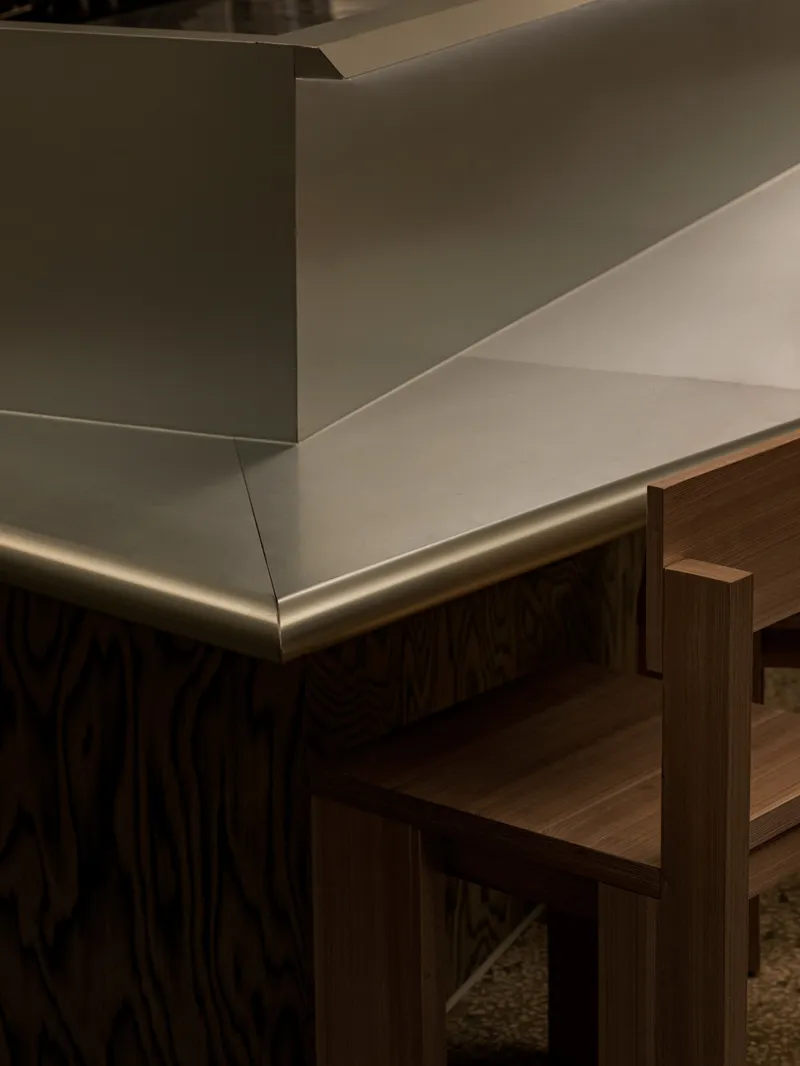
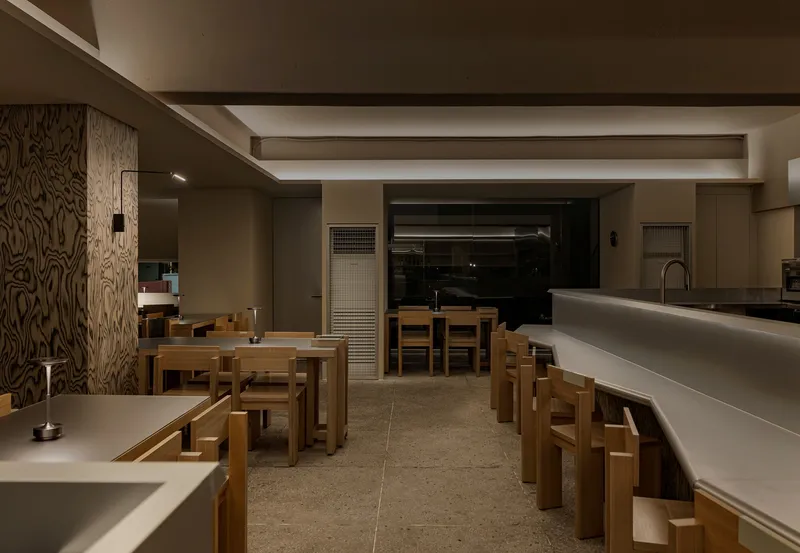
The most instructive detail shots show where materials meet. Brushed brass butts up against timber millwork beneath white plaster with no cover trim, a decision that requires precision fabrication and rewards close inspection. Terrazzo flooring meets the timber seating zone without a transition strip, letting the floor read as a continuous surface that simply changes texture underfoot. These are small moves, but they accumulate into a sense of craft that separates SSOC Dining from the wave of Instagram-ready Seoul interiors that rely on a single photogenic gesture.
Plans and Drawings
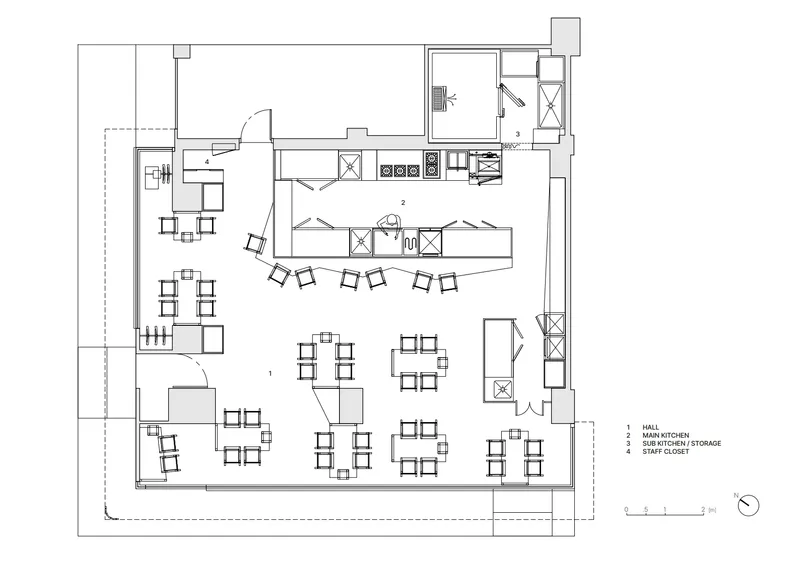
The floor plan confirms how straightforward the arrangement actually is. Tables scatter across the open dining area with no fixed partition, and the galley kitchen occupies a single wall. What the plan cannot show, but the photographs do, is how material and lighting modulation create the illusion of distinct zones within what is essentially a rectangle. The scattered table groupings allow flexible configurations for different party sizes, a practical benefit that also prevents the space from reading as a canteen.
Why This Project Matters
SSOC Dining is a useful case study in how constraint breeds clarity. At 109 m², the room offers no room for filler, and DESIGN2TONE responded by making every surface, every joint, and every light source count. The result is a restaurant that feels considered rather than decorated, a place where the architecture participates in the dining experience instead of merely housing it.
For a district that thrives on the friction between old industry and new culture, SSOC Dining manages to honor both sides of the equation. Its raw materials nod to Seongsu's warehouse past, while its precision detailing and lighting choreography belong firmly to the present. It is not a loud project, but it is a disciplined one, and discipline, in a neighborhood saturated with design, turns out to be its own form of distinction.
SSOC Dining, designed by DESIGN2TONE, Seoul, South Korea. 109 m². Completed 2025. Photography by Yongjoon Choi.
About the Studio
Share Your Own Work on uni.xyz
If projects like this are the kind of work you want to make, uni.xyz is a place to publish your own, find collaborators, and enter design competitions.




Popular Articles
Popular articles from the community


The Earth Pod: 3D Printed Homes for Resilient Refugee Communities
The Earth Pod reimagines refugee housing through 3D printed homes made from clay, combining resilience, self-sufficiency, and rapid shelter.

Co-life: Sustainable Architecture for Age-Friendly Community Living
Co-life reimagines sustainable architecture for seniors through courtyards, rammed earth, shared gardens, and spaces designed for belonging.

Hill & Cross Opera: Sculptural Opera House Architecture Shaped by Tallinn’s Landscape and Identity
Hill & Cross Opera reimagines opera house architecture in Tallinn through its sculptural hill, civic plaza, glass wave and a luminous cross.

Lunar Spiral: Space Architecture Shaped by the Mathematics of the Universe
Lunar Spiral reimagines space architecture through Fibonacci geometry, lunar regolith, levitating habitats, and self-sustaining Moon living.

Similar Reads
You might also enjoy these articles

Bao Huynh Watercolor Atelier: A Serene Art Retreat in Hội An
Bao Huynh Watercolor Atelier in Hội An blends multifunctional art spaces, sustainable design, local materials, and family-friendly living in a serene environment.

Atelier Macri Concept Store Interior Design by CASE-REAL
Atelier Macri store features a "ko" counter, walnut wood details, cork displays, blending retail, gallery, and seamless customer experiences.

Manuel Vargas Izquierdo Stadium and High-Performance Sports Center: Architectural Excellence in Jalpa de Méndez
The Manuel Vargas Izquierdo Stadium blends sustainable design, inclusive sports facilities, and cultural-inspired architecture, revitalizing Jalpa de Méndez’s public spaces.

KAKR Buluh Awar Hall: Revitalizing Community and Ecology Through Bamboo Architecture
Community built bamboo hall revitalizes Buluh Awar village, empowering youth, restoring ecology, celebrating vernacular craftsmanship through sustainable architecture and culture.


Explore Space Design Competitions
Discover active competitions in this discipline



Challenge to design a portable theatre


Challenge to design a portable music platform


Challenge to design an open learning module for the elderly
Comments (0)
Please login or sign up to add comments
No comments yet. Be the first to comment!