
Designing an Architectural & Construction Studies Science & Innovation Center
Studying the impact of the surrounding environment and seeing others' actions on human's behavior)
Regarding the design of a place with an educational function aimed at bringing the educated and the common people together, there were some critical issues.
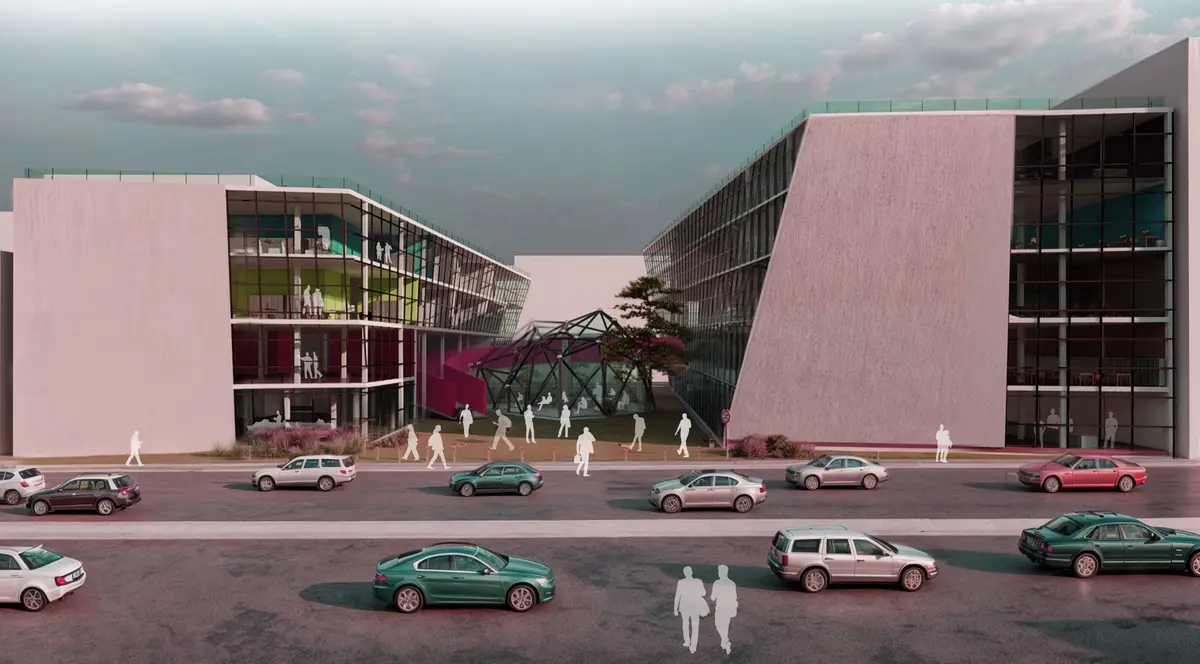
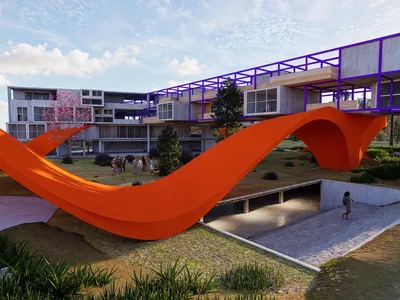
Nowadays, people are less attracted to education and the academic atmosphere, and the main spaces belonging to ordinary people and elite individuals have become divided over time. However, by placing educated people next to ordinary individuals, we aim to unconsciously attract them to science and knowledge, reshaping this disunited bond and creating a social environment that fosters more interaction between people. Additionally, the urban space created on the ground floor allows passersby to gather and have conversations, which may lead to innovation and consensus.
The concept behind this Center is rooted in the idea of breaking down the barriers that have historically separated different social strata. The design philosophy emphasizes inclusivity and the democratization of knowledge. By facilitating a seamless interaction between the educated and the common people, the Center seeks to create an environment where learning and innovation become accessible to all. This approach addresses the growing disinterest in traditional educational settings and aims to rejuvenate the public's enthusiasm for learning.
This Center stands as a beacon of collaboration, weaving together the expertise of engineers, designers, and researchers to shape the smart cities of tomorrow. The innovation center includes three main parts: laboratories and research areas where people develop their ideas, public spaces for ordinary people to interact with educators and support the spirit of research, and an exhibition area. In the exhibition area, breakthroughs are showcased to the architecture industry and market, igniting conversation and driving change. With every exhibit, the center reaffirms its mission to shape a more sustainable, interconnected world where collaboration reigns supreme and the cities of tomorrow thrive in harmony with the environment.
At its core are the Laboratories and Research Areas, dynamic spaces where innovation takes flight. These include various laboratories such as Public Research Areas, Environmental Studies, Wood, Facade, Smart Buildings, Biology, Neuroscience, 3D Printing, Material Science, IT, and Structure Laboratories. Here, individuals delve into their research interests, pushing the boundaries of sustainability and paving the way for a greener future. Complementing these hubs of innovation are the inviting Public Spaces, where the exchange of ideas extends beyond academia. Finally, the Exhibition Area stands as a testament to the collective ingenuity of the center's inhabitants.
The Laboratories and Research Areas are designed to be the heart of the Center. These spaces are equipped with state-of-the-art facilities and tools that enable researchers and innovators to explore new frontiers in their respective fields. The Public Research Area, for instance, is an open-access space where anyone with a keen interest in science and technology can come and work on their projects. This inclusivity ensures that ideas are not confined to the academic elite but are open to anyone with the passion and drive to innovate.
The Environmental Studies Laboratory is another key component of the Center. In this lab, researchers focus on developing sustainable solutions to pressing environmental issues. From renewable energy technologies to waste management systems, the work done here aims to create a healthier planet for future generations. The Wood and Facade Laboratories are dedicated to exploring new materials and construction techniques that enhance the sustainability and resilience of buildings.
Smart Buildings Laboratory focuses on integrating advanced technologies into building design and construction. This includes the development of intelligent systems that improve energy efficiency, enhance occupant comfort, and reduce the environmental impact of buildings. The Biology and Neuroscience Laboratories offer a different but equally important perspective on sustainability. Here, researchers study the biological processes and neural mechanisms that can inform the design of more sustainable and human-centric environments.
The 3D Printing and Material Science Laboratories are at the forefront of technological innovation. These labs enable the creation of new materials and structures that are both sustainable and efficient. The IT and Structure Laboratories complement these efforts by focusing on the digital and structural aspects of building design. Together, these laboratories form a comprehensive ecosystem that supports interdisciplinary research and innovation.
The Public Spaces in the Center are designed to facilitate the exchange of ideas and knowledge. These spaces include lounges, cafes, and open work areas where people from different backgrounds can come together and collaborate. By creating a welcoming and inclusive environment, the Center encourages spontaneous interactions and collaborations that can lead to new insights and innovations.
The Exhibition Area is a critical part of the Center's mission to disseminate knowledge and inspire change. This space is designed to showcase the latest breakthroughs in architecture, engineering, and design. The exhibits are not just static displays but interactive experiences that engage the audience and encourage them to think critically about the challenges and opportunities facing our cities. By making these innovations accessible to a broader audience, the Center hopes to inspire the next generation of thinkers and doers.
In the design of this project, the height of the neighboring buildings and the lack of sufficient light have been considered. Additionally, due to the lack of a collective space in the project, an attempt has been made to create such a space for socializing and interacting by incorporating an open area. The use of a curtain wall has also been employed to allow the audience to see and be seen. This approach creates a living museum and, according to neuroscience studies, forms a familiar path for the audience, encouraging them to walk this path and thereby shaping a more educated society.
The design considerations for the Center also extend to its urban context. The height of neighboring buildings and the availability of natural light were key factors in the design process. By carefully analyzing these elements, the architects were able to create a building that harmonizes with its surroundings while maximizing natural light and creating inviting public spaces.
The decision to use a curtain wall system was driven by the desire to create transparency and openness. This architectural feature allows for a visual connection between the interior and exterior spaces, fostering a sense of community and engagement. The curtain wall also serves as a metaphor for the Center's mission: to break down barriers and create an environment where knowledge and innovation are accessible to all.
According to neuroscience studies, familiar and well-designed pathways can significantly enhance the user experience. By creating a clear and intuitive circulation path, the Center encourages visitors to explore and engage with the space. This design approach not only enhances the functionality of the building but also promotes a sense of belonging and community among its users.
The Center's commitment to creating a more educated society is reflected in every aspect of its design. From the layout of the laboratories to the configuration of the public spaces, every element is designed to foster interaction, collaboration, and learning. By creating an environment that encourages these activities, the Center aims to inspire a new generation of thinkers and innovators who are committed to building a better future.

Popular Articles
Popular articles from the community


ALGAL REALM: A Bio-Integrated Lunar Habitat Design for Life Beyond Earth
ALGAL REALM reimagines lunar habitat design with algae-powered life support, 3D-printed regolith, and vertical living for a lunar future.

Little Red Riding Hood: Architectural Design as a Journey Through Fear, Light, and Storytelling
Little Red Riding Hood reimagines the fairy tale through architectural design shaped by fear, light, scale, memory, uncertainty, and choice.

The Musturak Paradise: Senior Living Architecture for a Connected Future in Temara, Morocco
The Musturak Paradise reimagines senior living architecture in Temara via private homes, social spaces, culture, community, and shared care.

Co-Life: Senior Housing Design That Reconnects Older Adults With the City
Co-Life reimagines senior housing design through healing gardens, shared streets, workshops, and a sustainable community across generations.

Similar Reads
You might also enjoy these articles
Sustainable Architecture Design: Embracing Nature and Modernity at Villa Solsidan
The article explores Villa Solsidan by AndrénFogelström, showcasing its sustainable architecture design and integration with the natural surroundings in Saltsjöbaden, Sweden.

Maya Harvest: A Cacao Resort Village Rooted in Mayan Tradition and Local Craft
Situated within a Tabasco cacao plantation, this shortlisted resort proposal merges vernacular materials with hands-on cultural immersion.
Harmonia: A River-Shaped Community That Grows Over Decades in Boa Vista
Curved pathways and modular grid structures along the Branco River create a phased settlement designed to evolve from 2030 to 2050.

The Architecture of Bathing: A Mughal Hammam Reimagined Across the Yamuna
Charlotte May's honorable mention entry for The Black Taj reinterprets Agra's bathing rituals through red sandstone, water, and framed views of the Taj Mah

Explore Science In Architecture Study Competitions
Discover active competitions in this discipline


Challenge to reimagine the Iron Throne

Photograph architecture without architects

Illustrate the lost glory of Angkor Wat - Render Challenge

Design challenge to reuse E-waste
Comments (0)
Please login or sign up to add comments
No comments yet. Be the first to comment!