

Dolce Gusto Neo Flagship Store by Estudio Guto Requena: A Sustainable and Algorithmic Design Innovation in São Paulo
A biodegradable, 3D-printed flagship in São Paulo, inspired by coffee flowers, merges sustainability, parametric design, and circular architecture.


Architects: Estudio Guto Requena

A New Era of Retail Architecture: 3D-Printed and Biodegradable
The Dolce Gusto Neo Flagship Store, designed by renowned Brazilian architecture studio Estudio Guto Requena, stands as a pioneering example of sustainable architecture, cutting-edge parametric design, and biodegradable construction. Set in a public park in São Paulo, this temporary structure breaks new ground as Latin America's first 3D-printed architectural work made with biodegradable materials.
Conceived to launch the Dolce Gusto Neo coffee machines—crafted using recycled ocean plastics and paired with compostable capsules—the store exemplifies the future of circular design thinking in retail spaces.
Nature-Inspired Form: The Coffee Flower as Architectural Muse
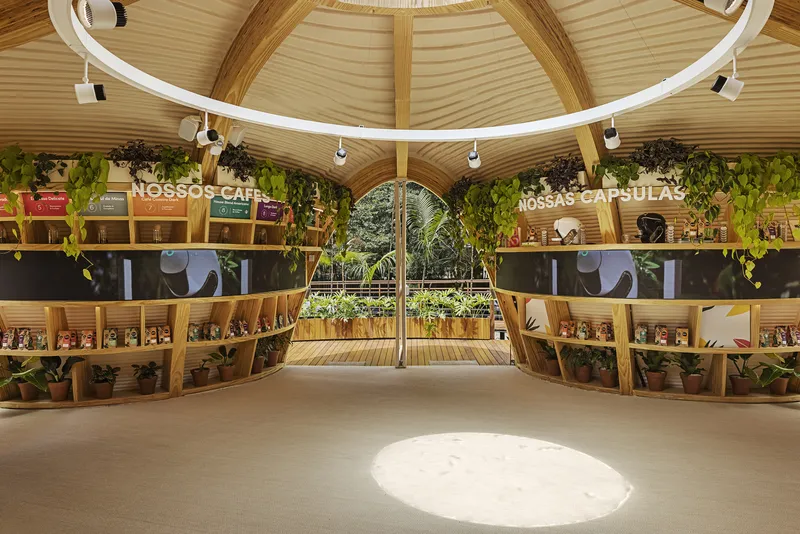
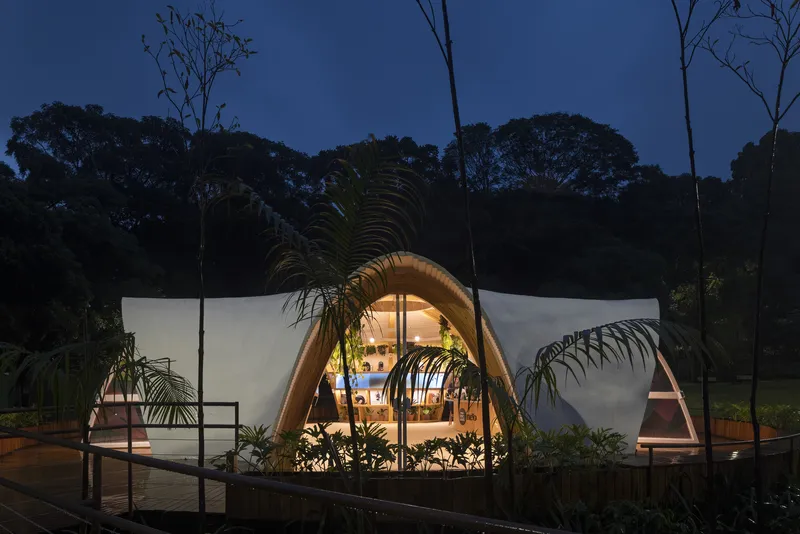
The store’s design draws direct inspiration from the five-petal geometry of a coffee flower, forming a dome-like structure defined along five radial axes. Each axis features a glass portico, resulting in 360-degree visual permeability and equalized entry points, eliminating any traditional “front” or “back.”
Inside, the organic form creates a serene, temple-like ambiance, enhanced by a central glass skylight that fills the space with natural light. A circular installation of curved LED panels anchors the store's center, presenting immersive digital content while visually unifying the layout.


Sustainability at Every Layer: Materials and Lifecycle
Sustainability was not an afterthought—it was the store’s central premise. The structure features a prefabricated glued laminated timber (GLT) frame, sourced from reforested pine, covered by a biodegradable outer shell crafted using CNC-milled molds derived from algorithmic modeling. This waffle-structured shell uses minimal material while maintaining stability and fluidity.
Upon dismantling after its estimated two-year lifespan, the wood components will be fully recycled, and the plaster elements crushed and reused as agricultural fertilizer, feeding the soil with nutrients like calcium and sulfur—completing a virtuous material cycle.
Scalable and Accessible: The Dolce Gusto Neo Kiosks
Building on the flagship’s architectural language, Dolce Gusto Neo’s kiosks, intended for deployment across shopping malls, follow the same flower-inspired five-axis layout and sustainable ethos. Constructed entirely from recycled pine wood, these smaller-scale retail units are digitally fabricated, minimizing waste through precision CNC milling and algorithmic optimization.
The circular LED displays and minimal-waste design strategy carry through into the kiosks, ensuring continuity across the brand’s physical presence while maintaining a low environmental footprint.

Parametric Design and Circular Economy in Architecture
At the heart of the project is the integration of parametric tools, allowing designers to digitally simulate and optimize every aspect of the form—from material thickness to structural performance and fabrication workflow. This approach reduces waste, enhances efficiency, and reimagines construction as a regenerative process, not a destructive one.


A Landmark for Climate-Responsive Retail Design
More than just a product launch, the Dolce Gusto Neo Flagship is an experiential space that embodies the urgency of climate-conscious design. In rejecting polluting materials like concrete and steel in favor of recyclable wood, 3D-printed bioplastics, and algorithm-driven efficiency, Estudio Guto Requena challenges the industry to rethink how we build in the age of environmental crisis.


All photographs are works of Leonardo Finotti


Popular Articles
Popular articles from the community


Cube Design Draws an Ecological Corridor Between Two Shenzhen Hills with the Nankai Building
Beside Shenzhen's container docks, the Nankai Building pairs stacked balconies with a climbing green screen to connect two hillsides across its height.

David Ortega Stacks a Two-Story Mexico City Penthouse Around a Steel Stair and a Pergola-Shaded Roof Terrace
In Colonia Roma, a 300 m² penthouse uses oak joinery, a planted steel stair and a slatted roof pergola to make a new-build apartment feel like a house.

LT2A and OPEN Architectes Thread a Brick and Glass High School Through a Wooded Belgian Campus
In Braine-l'Alleud, a 3,000 m² wing for Collège Cardinal Mercier pairs pale brick with a glazed colonnade, deferring to a small chapel and a dense wood.

Juan García Correa, John González and Claudia Rueda Sink a Circular Amphitheater into a Manizales Engineering Building
On the La Nubia campus in Manizales, Colombia, the S1 Building folds labs and offices into a hillside of ramped lawns that double as a campus route.

Similar Reads
You might also enjoy these articles


Hodi-Mandai Geram
Project Function: Preservation and revitalization of the Intangible heritage and socio-spatial identity of the Hodi by Housing, Cultural Memory Center, Sacred Grove, landscape, local tourism economy


Olio Towers: A Mid-Rise for Performers That Fuses Housing, Rehearsal, and Stage
Located blocks from Houston's Theater District, this modular tower stacks living units around a central performance atrium.

Oasis: Modular Green Housing Carved into Dhaka's Urban Fabric
A shortlisted Plugin Housing entry reclaims unauthorized settlements in Dhaka with stepped concrete volumes, green roofs, and ventilation-driven design.

Black Hole: A Floating Megastructure for the Post-Physical Era
Emiliano Mazzarotto envisions a spherical, self-scaling arena where e-sports, digital hotels, and holographic stadiums replace traditional public space.

Explore Brazilian Architecture Competitions
Discover active competitions in this discipline

Challenge to reimagine the Iron Throne

Photograph architecture without architects

VR headsets Storefront design competition

Illustrate the lost glory of Angkor Wat - Render Challenge
Comments (0)
Please login or sign up to add comments
No comments yet. Be the first to comment!