
Alberto Pizzoli Architetto Disguises a Verona Home as an Agricultural Outbuilding
Dolor y Gloria House uses OSB-imprinted concrete and patio typology to embed domestic life within the farmland south of Verona.


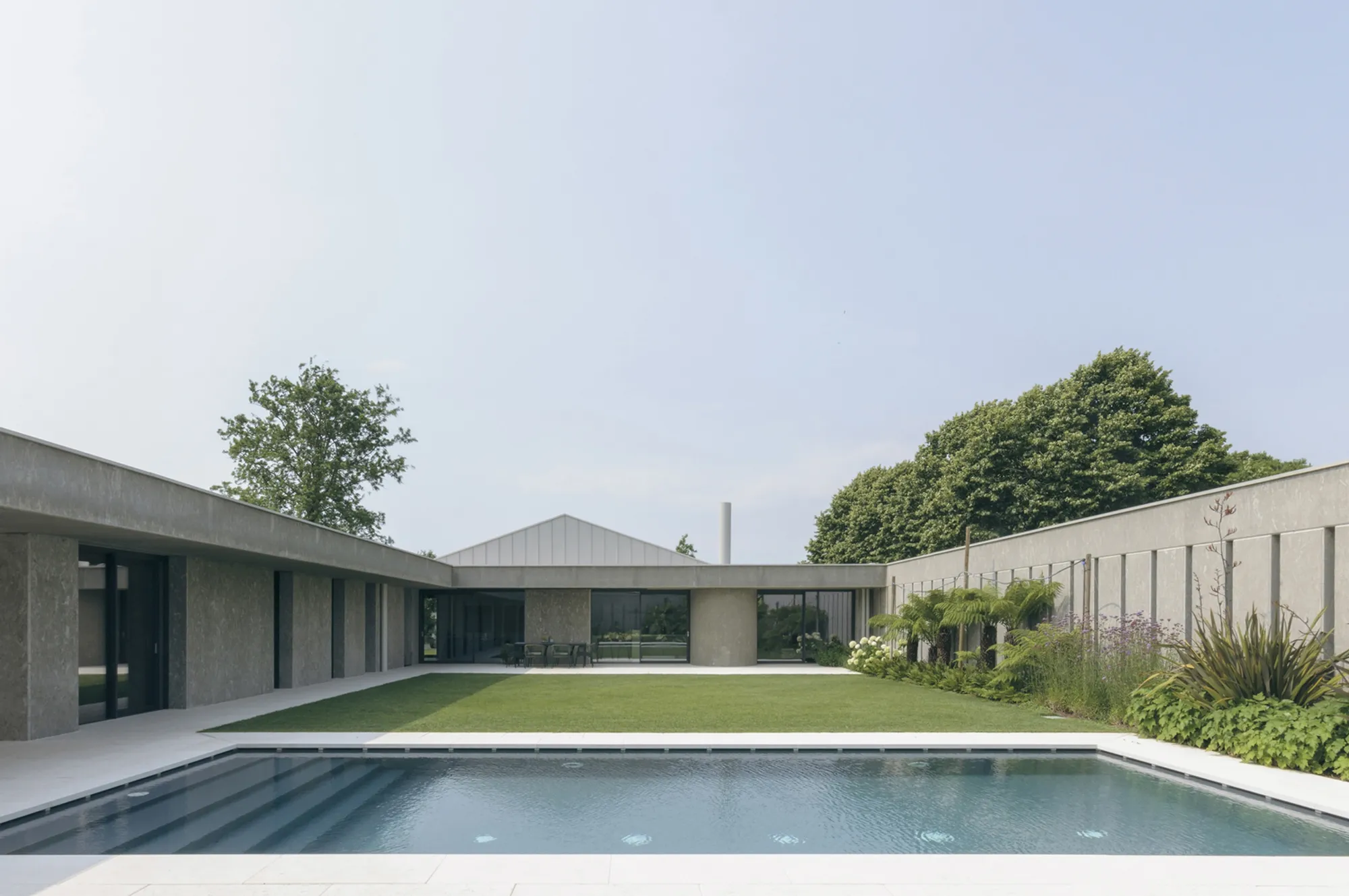
From the road, Dolor y Gloria House looks like another productive building on the agricultural fringe of Villafranca di Verona. A concrete perimeter wall, aluminum-clad roof, and garage doors face outward, offering almost nothing to suggest that behind that barrier sits a 400-square-meter single-level home organized around a private courtyard with a swimming pool and subtropical garden. That is exactly the point. Alberto Pizzoli Architetto treats the residential program like a secret held inside an industrial shell, one calibrated to disappear into an Italian landscape of orchards, warehouses, and cultivated fields.
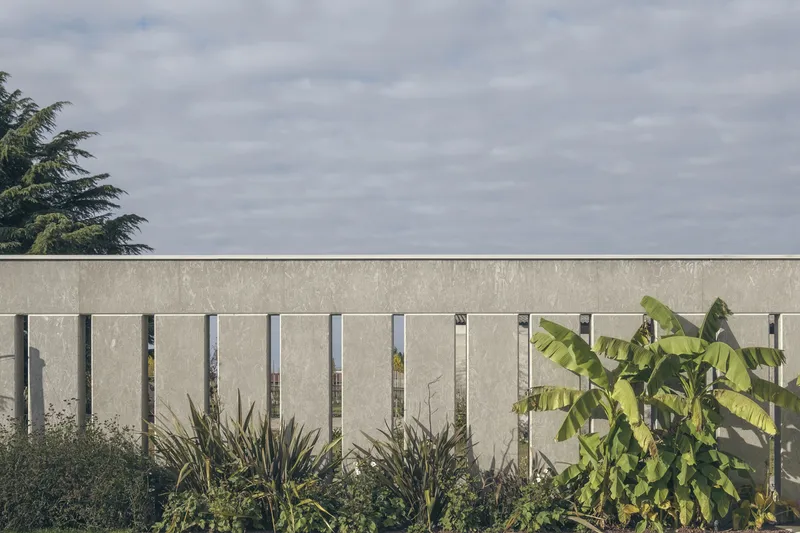
What makes the project genuinely interesting is the method by which that camouflage is achieved. The reinforced concrete walls carry imprints of the OSB boards used as formwork liners. When the concrete set, it absorbed the warm tones and irregular chip texture of the oriented strand board, producing a surface that oscillates between raw industrial material and something almost organic. Against the surrounding greenery, the walls read as a mottled, neutral screen rather than the hard grey slab you might expect. The structural envelope doubles as the finish: there is no cladding, no render, no pretense. Structure is surface, and surface is strategy.
A Shell Facing the Street

The street-facing elevation gives almost nothing away. Vertical metal cladding, white garage doors, and gravel make it read as a farm shed or storage building. The only concessions to domesticity are a covered entrance porch and a large triangular glazed gable, a faint echo of the pitched-roof archetype. Pizzoli understands that in small rural communities, the boundary between public road and private life needs to be legible and firm. The exterior wall is that boundary, and it is deliberately mute.
Along the perimeter, concrete fins and planted beds introduce a secondary rhythm. Banana palms and spiky foliage press against textured concrete panels, softening the industrial character without undermining it. The building does not try to look friendly from the outside. It earns your trust only after you cross the threshold.
The Patio as Organizing Principle

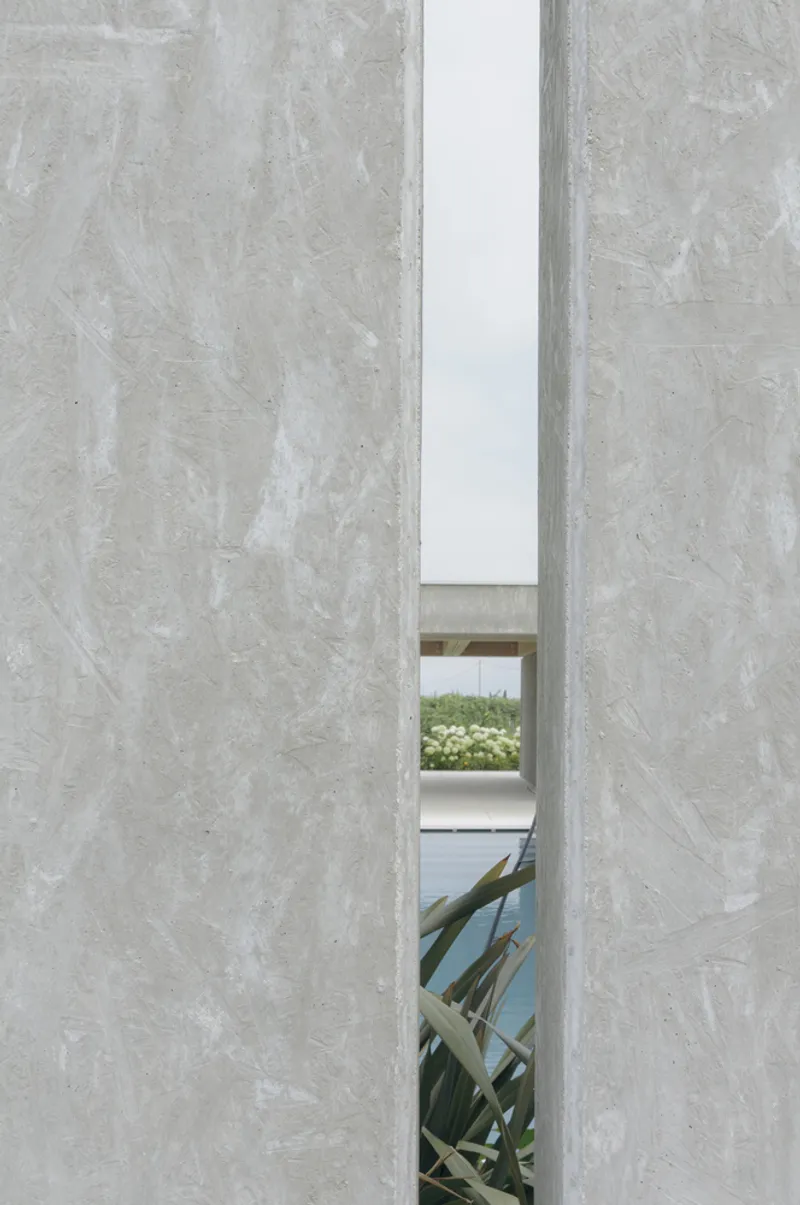
Pizzoli's plan follows a clear logic. The buildable perimeter of the agricultural lot is traced according to minimum boundary setbacks, and the domestic program is distributed along that edge, leaving a large central void. The result is a patio house in the most literal sense: every room faces inward toward a garden, pool, and sky. The slot between two concrete panels in image four is a precise illustration of how the architect controls visual and physical porosity, offering a narrow vertical aperture through which the pool and tropical planting are framed like a painting.
The courtyard itself is generous. A rectangular pool sits within a lawn flanked by concrete pavilion walls and mature trees. Because the building wraps around three sides, the garden is insulated from the surrounding fields and road. Privacy is total, which is the operative word in a settlement where neighbors are close and domestic life easily becomes public.
Timber Interior, Concrete Exterior
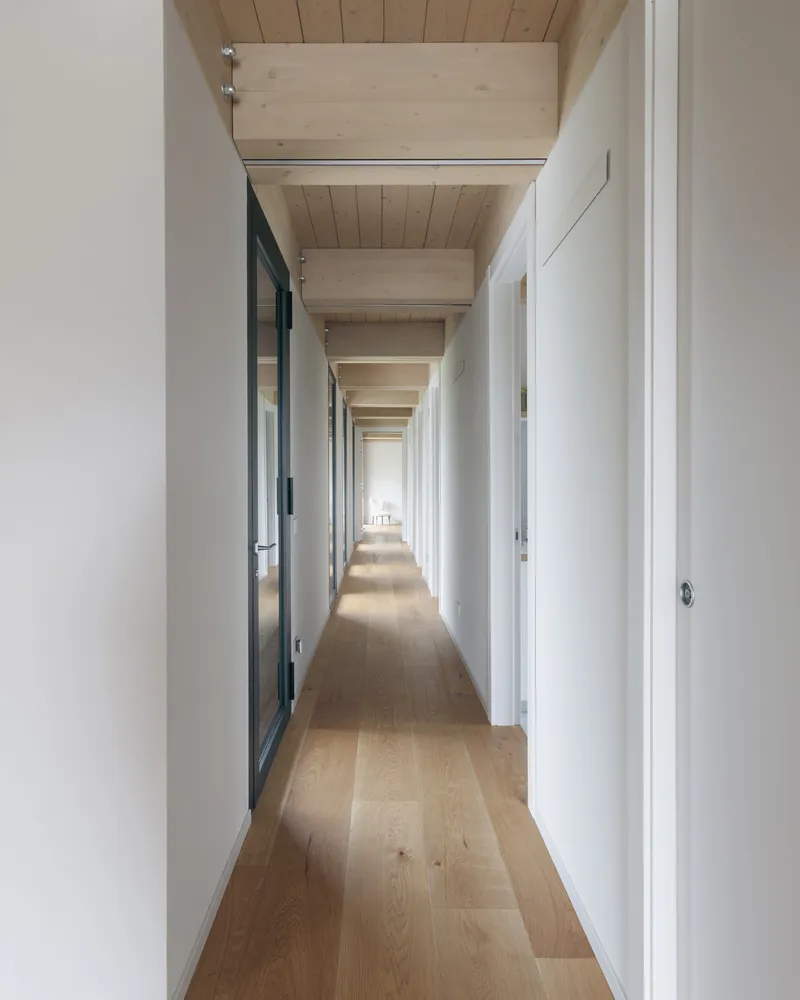

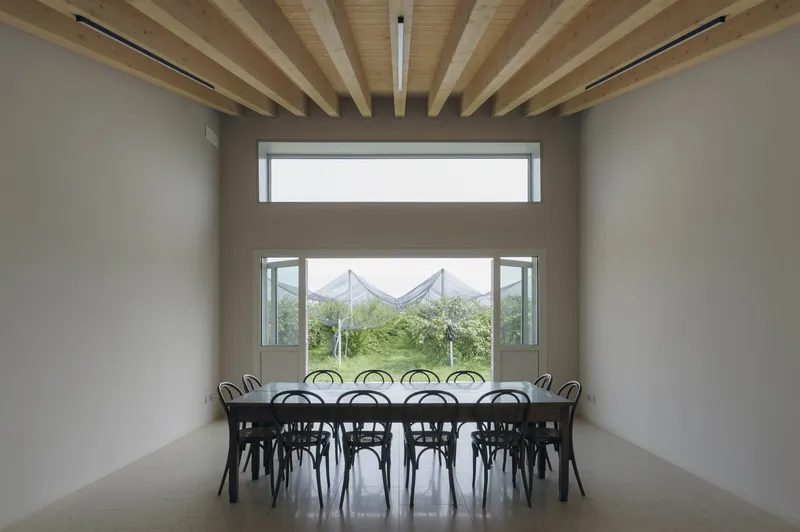
Step inside and the material register shifts entirely. The ceiling is a warm timber structure of double-coupled beams spaced 180 centimeters apart, with hidden lighting fixtures concealed between each pair. Wood flooring reinforces the domestic warmth. White walls amplify daylight. The contrast with the exterior concrete is stark and deliberate: outside is territory; inside is home.
The long corridor in image one reveals the house's spatial discipline. Exposed beams march along the ceiling in tight cadence, creating a deep perspective line that connects rooms along the building's length. In the living room, full-height sliding glass doors dissolve the boundary between interior and courtyard. Built-in shelving and a fireplace anchor the room without competing with the structural rhythm overhead. The dining room, meanwhile, looks out through windows onto rows of orchard trees, binding the domestic interior back to the agricultural landscape that generated the design in the first place.
Details That Hold the Concept Together
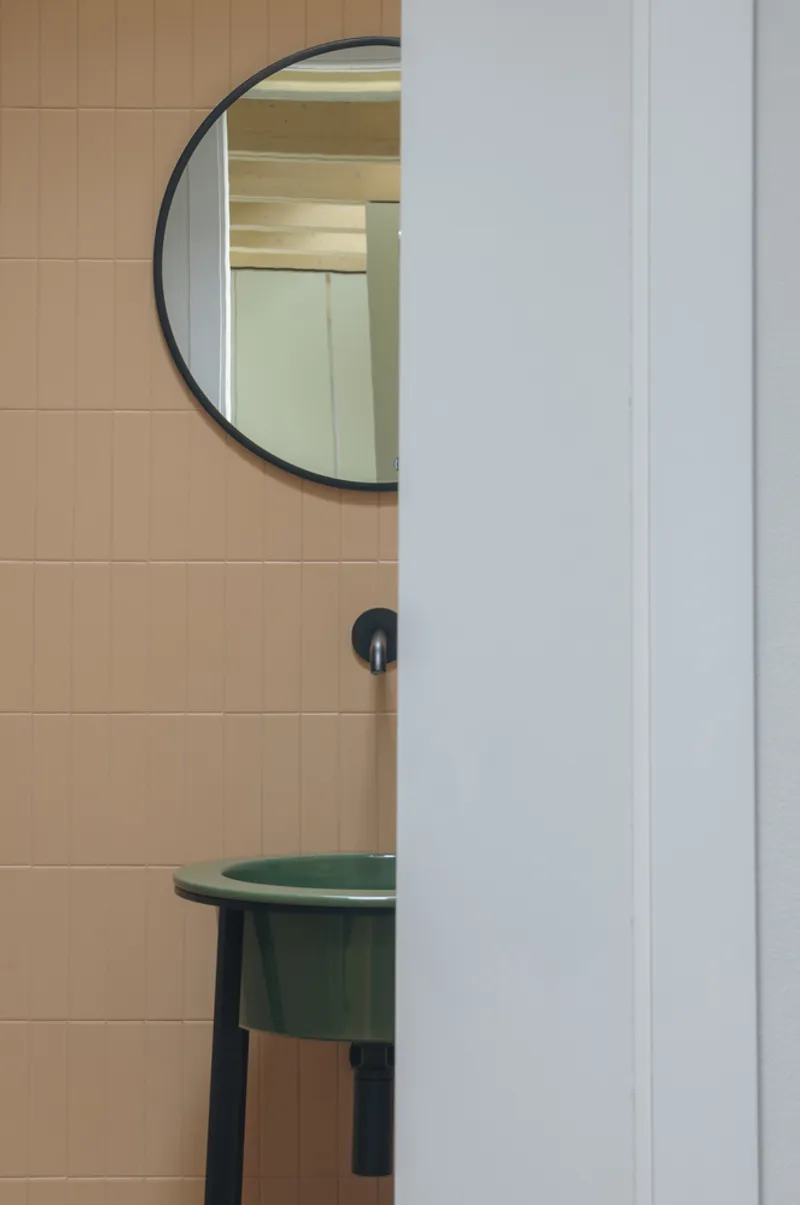
A half-round mirror above a green basin set against beige tiles signals the care Pizzoli brings to secondary spaces. Bathroom finishes echo the earthy, warm palette of the main rooms without resorting to the same materials. The green of the basin picks up on the tropical planting visible throughout the courtyard, a small gesture that ties interior details to the landscape strategy.
Custom-designed kitchen furniture serves as the primary spatial organizer in the open-plan living zone. Rather than relying on partition walls, Pizzoli uses cabinetry volume to define cooking, dining, and sitting areas within a single flowing space. It is a pragmatic move that keeps the plan flexible while giving each zone its own identity.
Why This Project Matters
Dolor y Gloria House succeeds because it takes its context seriously without romanticizing it. Pizzoli does not dress a countryside home in stone and shutters to perform rurality. Instead, he looks at the actual buildings that populate the Veronese flatlands, the sheds, warehouses, and barns, and borrows their language to make a house that belongs. The OSB-imprinted concrete is the linchpin: a technique that gives industrial material a tactile, almost accidental warmth, collapsing the distance between structure and ornament.
The patio typology, often discussed in Mediterranean housing, is applied here with restraint and intelligence. It solves the privacy problem inherent in low-density edge settlements, where plots are large but neighbors are visible. It also converts the house from a solid object into a frame for landscape. From the street, you see a shed. From the courtyard, you see sky, water, and banana palms. That inversion, the decision to save all the generosity for the interior, is what makes the project worth paying attention to.
Dolor y Gloria House by Alberto Pizzoli Architetto. Located in Villafranca di Verona, Italy. 400 m². Completed 2022. Photography by Lorenzo Linthout.
About the Studio
Share Your Own Work on uni.xyz
If projects like this are the kind of work you want to make, uni.xyz is a place to publish your own, find collaborators, and enter design competitions.




Popular Articles
Popular articles from the community


AL-JANNAH: Sustainable Architecture and Permaculture for Afghan Widows
AL-JANNAH uses sustainable architecture and permaculture to create resilient oasis of housing, learning, work and renewal for Afghan widows.

Co-life: Sustainable Architecture for Age-Friendly Community Living
Co-life reimagines sustainable architecture for seniors through courtyards, rammed earth, shared gardens, and spaces designed for belonging.

The Earth Pod: 3D Printed Homes for Resilient Refugee Communities
The Earth Pod reimagines refugee housing through 3D printed homes made from clay, combining resilience, self-sufficiency, and rapid shelter.

Co-Life: Senior Housing Design That Reconnects Older Adults With the City
Co-Life reimagines senior housing design through healing gardens, shared streets, workshops, and a sustainable community across generations.


Similar Reads
You might also enjoy these articles


Hodi-Mandai Geram
Project Function: Preservation and revitalization of the Intangible heritage and socio-spatial identity of the Hodi by Housing, Cultural Memory Center, Sacred Grove, landscape, local tourism economy


Olio Towers: A Mid-Rise for Performers That Fuses Housing, Rehearsal, and Stage
Located blocks from Houston's Theater District, this modular tower stacks living units around a central performance atrium.

Oasis: Modular Green Housing Carved into Dhaka's Urban Fabric
A shortlisted Plugin Housing entry reclaims unauthorized settlements in Dhaka with stepped concrete volumes, green roofs, and ventilation-driven design.

Black Hole: A Floating Megastructure for the Post-Physical Era
Emiliano Mazzarotto envisions a spherical, self-scaling arena where e-sports, digital hotels, and holographic stadiums replace traditional public space.


Explore Architecture Competitions
Discover active competitions in this discipline



Challenge to reimagine the Iron Throne


Photograph architecture without architects


Illustrate the lost glory of Angkor Wat - Render Challenge


Design challenge to reuse E-waste
Comments (0)
Please login or sign up to add comments
No comments yet. Be the first to comment!