
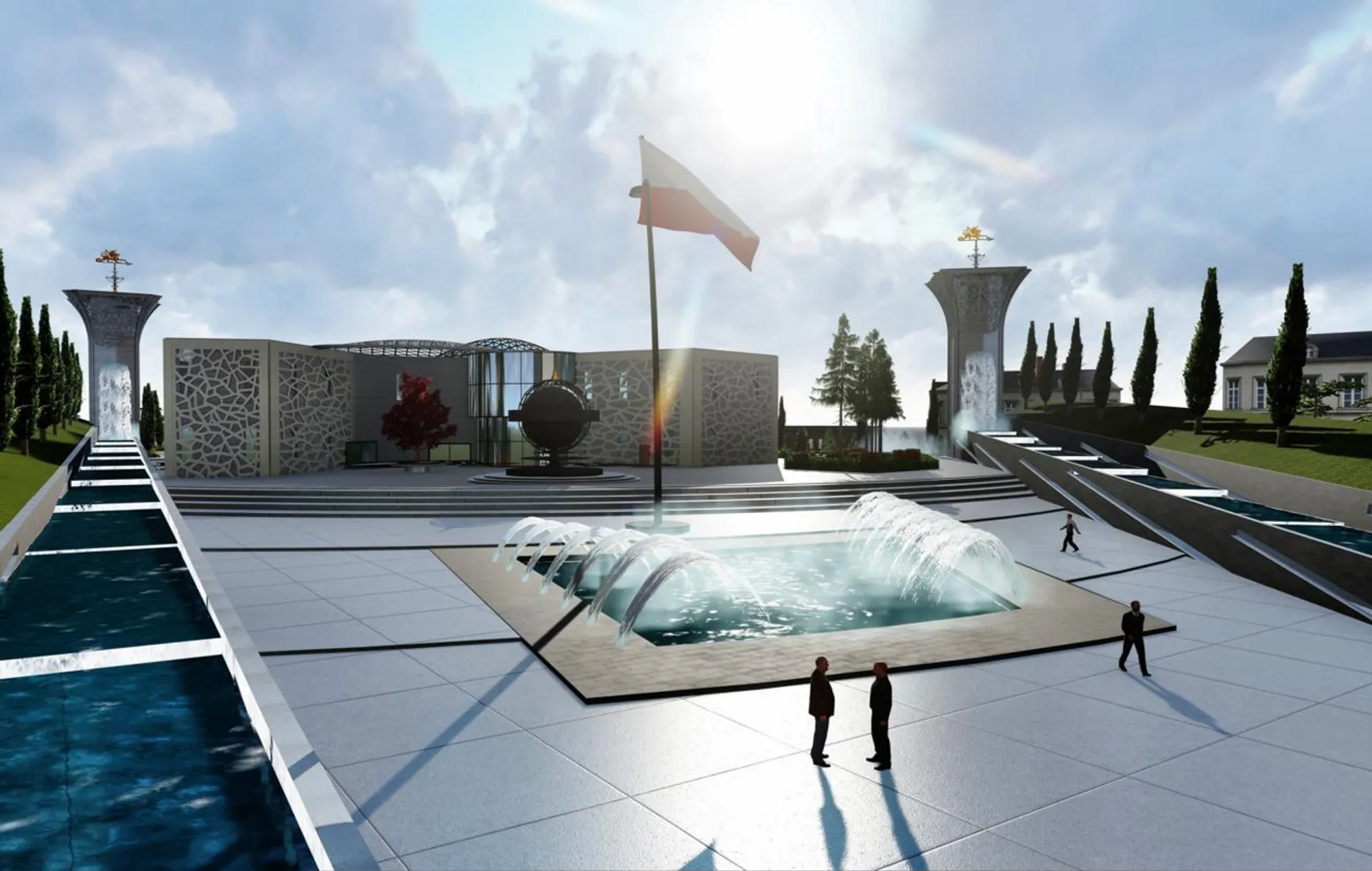
Dom Życia: Where Curvilinear Form Becomes a Manifesto for Intellectual Freedom
An educational architecture project that sculpts movement, light, and open space into a spatial argument for lifelong learning and liberation.


What if a building could physically embody the act of thinking freely? Dom Życia, which translates to "House of Life," takes this question seriously. Its curvilinear volumes, wavelike facades, and open courtyards are not decorative gestures but deliberate spatial strategies: each curve is meant to mirror the fluidity of a body in motion, and each open threshold is calibrated to dissolve the rigid hierarchies that conventional educational buildings tend to reinforce. The result is an architecture that treats learning not as a stationary task performed in rows of desks, but as a continuous, self-directed journey through space.
The project is the work of designers Nada Shahin, At Safwat, Sayf Ashraf, and Rodaina M. Fawzy. Drawing on the educational philosophy of Gabrea Narly, who described education as an "intentional influence" that should never strip away individuality, the team designed a multi-level cultural and learning center where program, symbolism, and landscape converge around a single thesis: education is the foundation of true freedom.
White Volumes and Cypress Courtyards: A Campus Read from Above
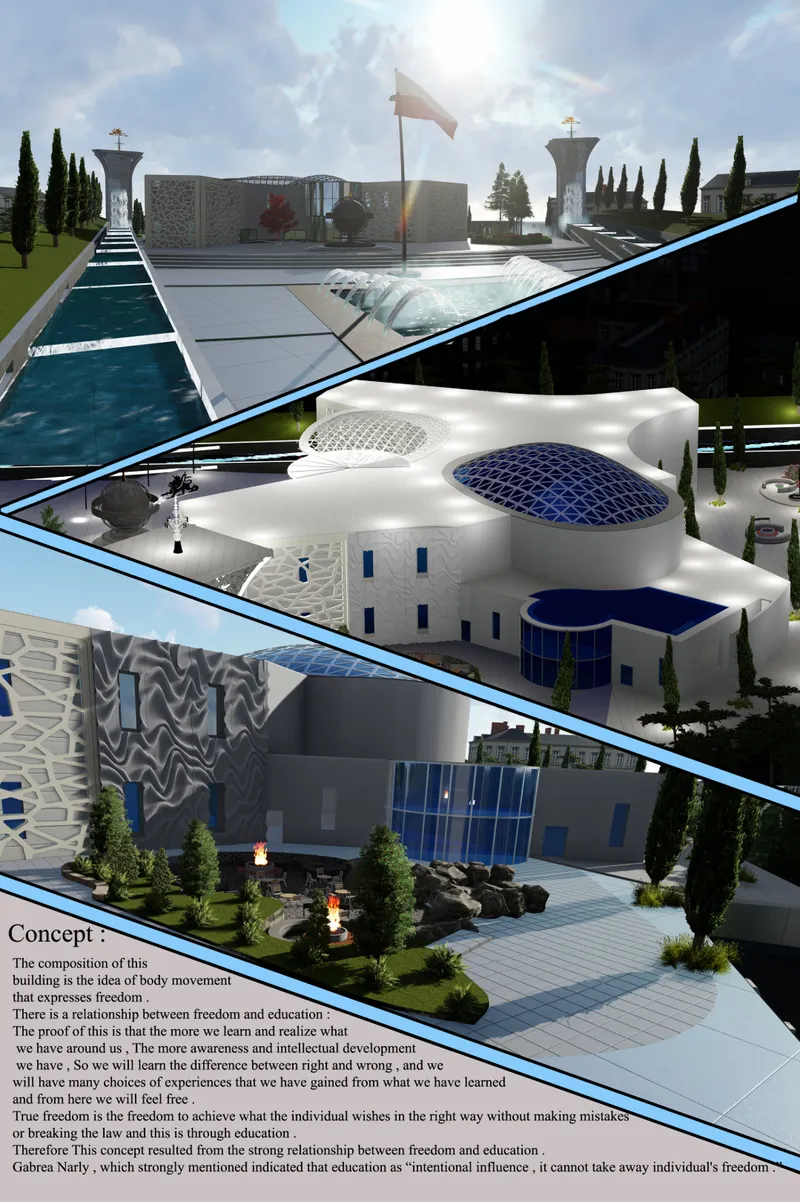

From the air, Dom Życia reads as a composition of white, organically sculpted roof forms punctuated by tall cypress trees and carefully patterned courtyards. The massing avoids orthogonal discipline entirely; instead, volumes swell and taper like breath, creating pockets of outdoor space that feel discovered rather than prescribed. Cypress trees cast long afternoon shadows across geometric paving, turning the ground plane into a secondary layer of visual rhythm. These courtyards are not leftover space between buildings. They are programmed thresholds: informal gathering zones, outdoor cafes, and reflective gardens that encourage dialogue and pause as integral parts of the learning experience.
A prominent water feature runs along the main axis of the site, functioning both as a reflective surface and as a metaphor for the flow of knowledge. The interplay of water, stone paving, and vegetation gives the exterior a calm gravity that counterbalances the building's formal exuberance. It is an approach that treats landscape as pedagogy: nature is not decoration here, but a co-teacher.
Domed Roofscapes and Lattice Screens at Dusk
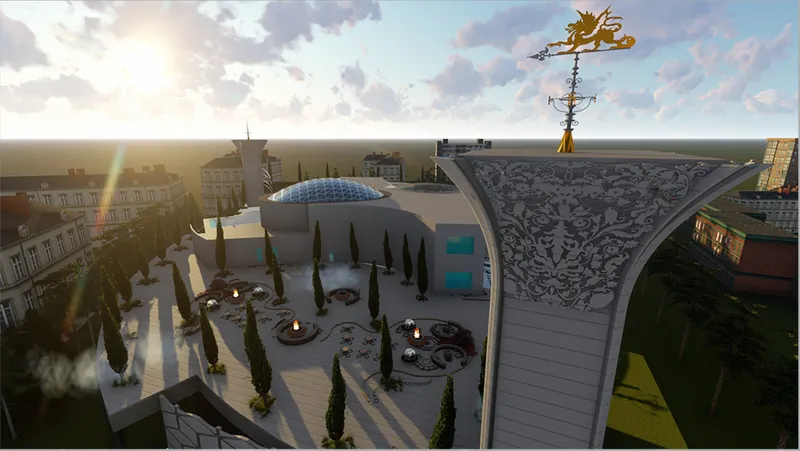
The building's dome-like roofs and patterned facade panels gain a second life at dusk, when night lighting accentuates the dynamic geometry. An ornamental weathervane crowns the tallest dome, adding a vertical accent that anchors the skyline composition. The facade panels are not flat; they carry texture and depth, referencing heritage craft motifs while filtering light into the interiors below. The team's decision to use cultural ornamentation is deliberate: it subtly reinforces identity and shared knowledge, grounding the project's progressive educational philosophy in a sense of place and continuity.
A Curved Glass Tower Behind Geometric Screen Walls
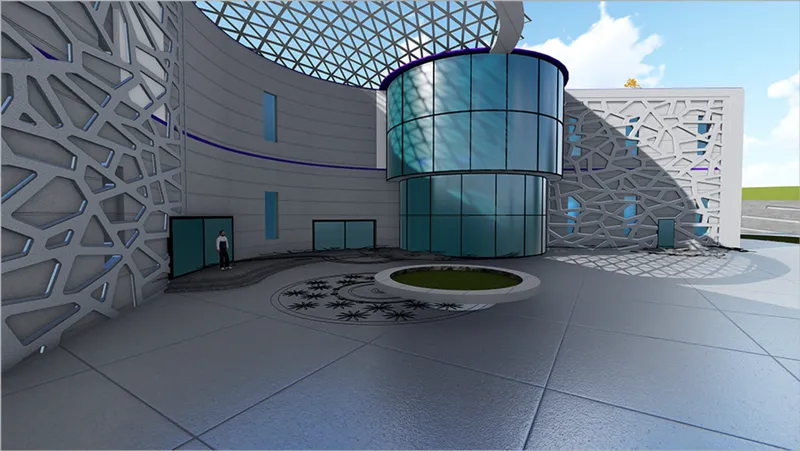
At ground level, the architecture shifts register. A curved glass tower rises behind white geometric screen walls, and a lattice canopy stretches overhead to mediate between direct sunlight and the courtyard below. The screens do double duty: they provide shading and privacy for interior zones while creating a layered visual depth that draws visitors inward. The ground floor houses kids' areas, learning spaces, event zones, a multipurpose hall, and outdoor cafe and restaurant spaces designed as informal hubs for dialogue. Movement through the plan is non-linear, encouraging exploration rather than compliance.
The first floor places a library at its heart, surrounded by learning classrooms, open court areas, administrative zones, and technical support rooms. Upper levels hold specialized IT and library areas, storage, and additional open courts. Each level is organized to promote cognitive flexibility and self-direction, with sightlines between floors that maintain a sense of connectivity across the entire educational program.
Beneath the Geodesic Dome: A Library as Spatial Centerpiece

The sectional cutaway reveals the project's most compelling interior moment: a library nestled beneath a geodesic dome, its bookshelves arranged in concentric rings that draw the eye upward through the lattice screen facade to the sky beyond. Light filters through the structure's geometric openings, creating a shifting pattern on the floor that changes with the sun's arc. It is a space designed to feel both intimate and expansive, where the act of reading is elevated by the architecture surrounding it. The lattice screens reappear here as interior elements, maintaining visual continuity between inside and outside while controlling glare and thermal gain.
The section also clarifies how the building's sweeping curves translate into inhabitable volume. Ceiling heights vary dramatically, from compressed entry sequences to soaring double-height reading halls, producing a spatial choreography that keeps occupants oriented through bodily sensation rather than signage. The dome, the curves, and the open courts are not formalism for its own sake; they are instruments of an architectural argument that equates spatial generosity with intellectual generosity.
Why This Project Matters
Dom Życia takes a position that too few educational buildings dare to take: that the form of a learning environment is inseparable from the quality of thought it produces. Where most schools and libraries default to orthogonal efficiency, this project insists on curvature, porosity, and symbolic richness as functional necessities. The programmatic layout, spanning kids' zones through specialized IT libraries, is deliberately non-hierarchical, treating a child exploring a courtyard with the same spatial respect as a researcher in the upper-level reading rooms.
For Nada Shahin, At Safwat, Sayf Ashraf, and Rodaina M. Fawzy, architecture is not neutral infrastructure but an active agent in human development. Dom Życia makes a compelling case that when buildings move as freely as the bodies inside them, education stops being something that happens in a room and becomes something that happens in a world. In a discipline increasingly drawn to quantifiable performance metrics, that is a reminder worth holding onto.
View the Full Project
About the Designers
Designers: Nada Shahin, At Safwat, Sayf Ashraf, Rodaina M. Fawzy
Enter a Design Competition on uni.xyz
uni.xyz runs architecture and design competitions year-round that reward proposals with spatial conviction and real site intelligence.
Project credits: Dom Życia by Nada Shahin, At Safwat, Sayf Ashraf, Rodaina M. Fawzy.




Popular Articles
Popular articles from the community


The Ocean Hive: Sustainable Architecture for a Self-Sufficient Civilization at Sea
The Ocean Hive imagines sustainable architecture at sea, where modular habitats, algae, wave power and ocean waste sustain a growing colony.

Riyadh For All: Intergenerational Urban Design for Active Aging in Rabat
Riyadh For All reimagines urban design in Rabat with intergenerational co-living, adaptive courtyards, and Moroccan cultural exchange today.
AL-JANNAH: Sustainable Architecture and Permaculture for Afghan Widows
AL-JANNAH uses sustainable architecture and permaculture to create resilient oasis of housing, learning, work and renewal for Afghan widows.

Hill & Cross Opera: Sculptural Opera House Architecture Shaped by Tallinn’s Landscape and Identity
Hill & Cross Opera reimagines opera house architecture in Tallinn through its sculptural hill, civic plaza, glass wave and a luminous cross.


Similar Reads
You might also enjoy these articles

Day and Night Park: A Time-Based Urban Newsstand in Beijing
A temporary urban newsstand in Beijing blending travel, light, and reading through poetic colors, compact form, and community-focused design.

Modernist Patio Renovation in El Masnou, Barcelona by Oliver Segura Arquitectura + Cebrià Arquitectura
Modernist patio renovation blending tradition and innovation with a movable pool, leveled floors, and Catalan materials in El Masnou.

Alto Residencial Coop: Cooperative Housing Development in Santiago de Compostela by Carbajo Barrios Arquitectos
A linear cooperative housing complex blending white volumes and perforated metal façades, enhancing community living, natural light, privacy, and urban integration.
Vil Genis School by BPA ARCHITECTURE – Massy, France
Vil Genis School in Massy, France, features sustainable design, south-facing classrooms, community integration, accessible spaces, and modern educational architecture.

Explore Architecture Competitions
Discover active competitions in this discipline



Challenge to reimagine the Iron Throne


Photograph architecture without architects


Illustrate the lost glory of Angkor Wat - Render Challenge


Design challenge to reuse E-waste
Comments (0)
Please login or sign up to add comments
No comments yet. Be the first to comment!