

BETA Stacks 95 Apartments and Three Communal Lounges into a Concrete Tower on Amsterdam's Last Shipyard
Draaier op Oostenburg rises from the former Dutch East India Company grounds with a light blue facade and a vertical chain of shared spaces.


Amsterdam's Oostenburg district carries centuries of weight. The Dutch East India Company built ships here in the seventeenth century, and the Werkspoor factory left behind a monumental industrial hall that now anchors the neighborhood's redevelopment. Into this charged ground, BETA Office for Architecture has planted Draaier op Oostenburg: 95 apartments organized around a provocation. What if a residential tower could be designed not just for efficiency, but to make people actually run into each other?
The answer is a concrete building that treats circulation as social infrastructure. Three communal rooms, a library lounge, a kitchen with winter garden, and a sky lounge, are stacked at different levels and connected by staircases that residents are nudged to use. The strategy emerges directly from BETA's research into Active Design, a framework that treats movement through a building as something to be choreographed rather than minimized. The result is a tower that functions less like a stack of isolated units and more like a vertical neighborhood.
A Monolith in Light Blue
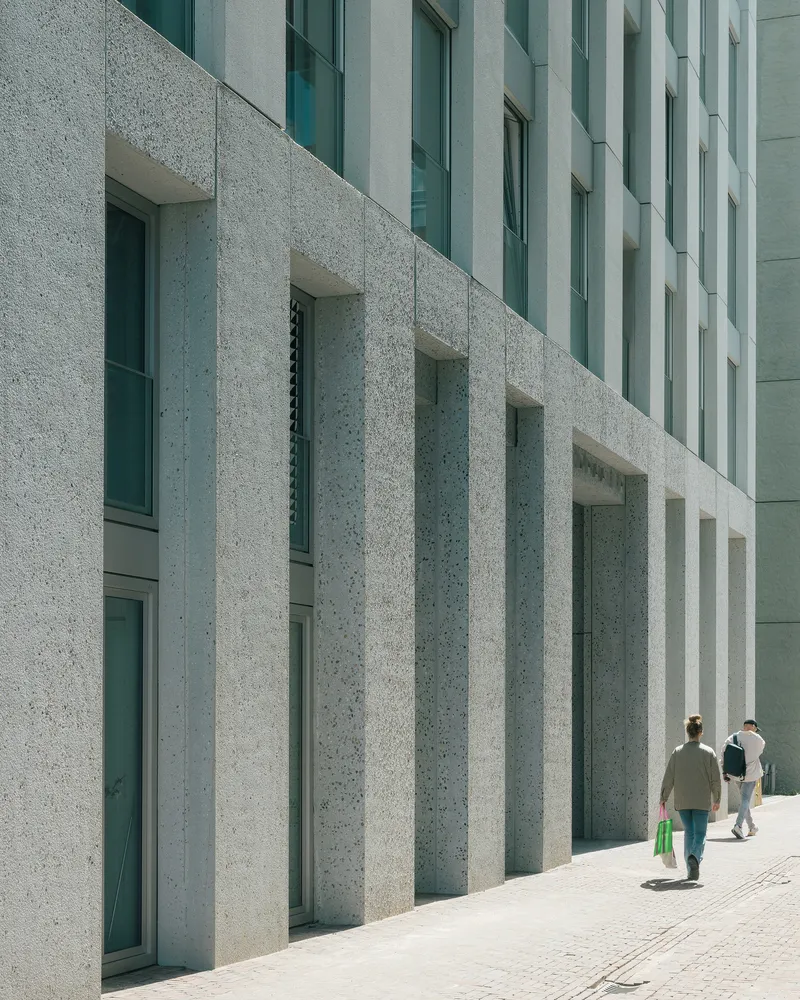
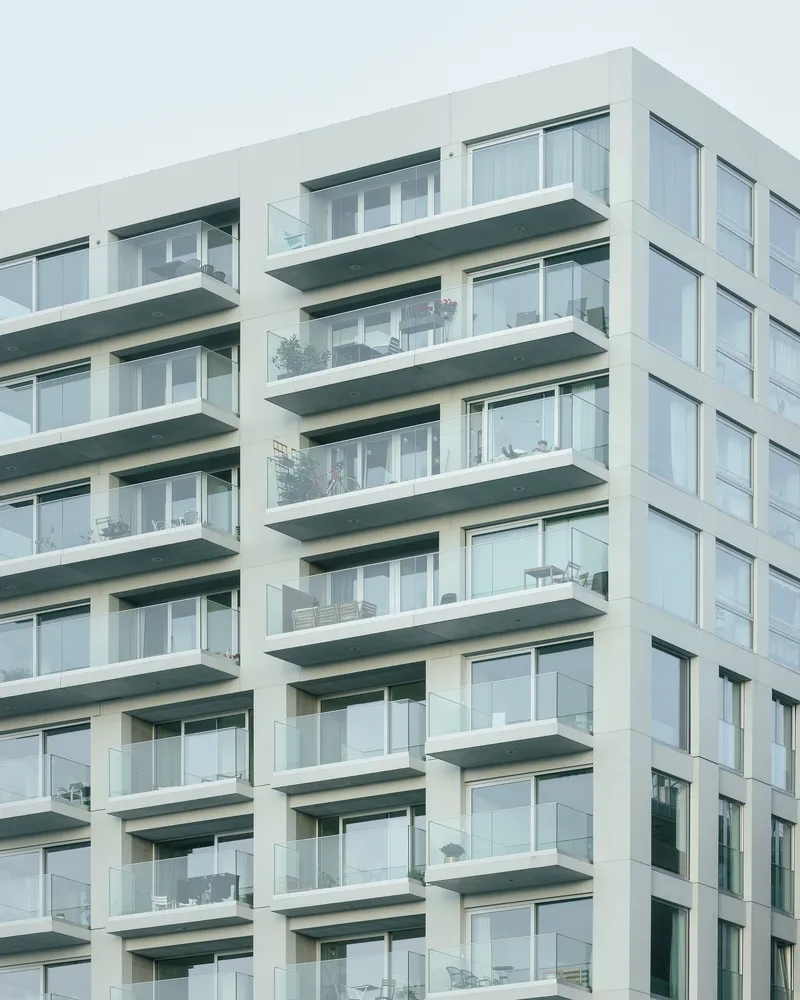
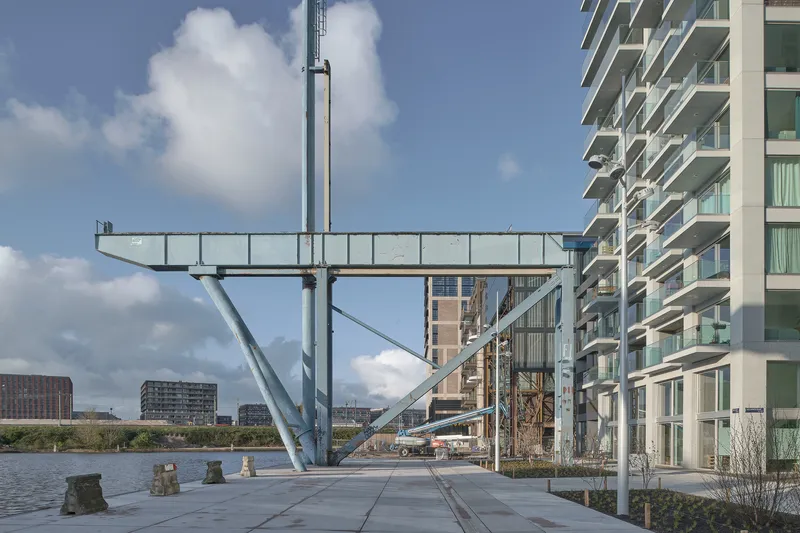
The facade reads as a single slab of concrete rising from the ground, its light blue hue borrowed from a large blue crane that once marked the shipyard skyline. It is a color reference specific enough to feel earned rather than decorative. Deep vertical fins and recessed windows give the exterior a pronounced sculptural depth, casting sharp shadows that shift throughout the day and grounding the building in a language of weight and permanence that echoes the industrial structures nearby.
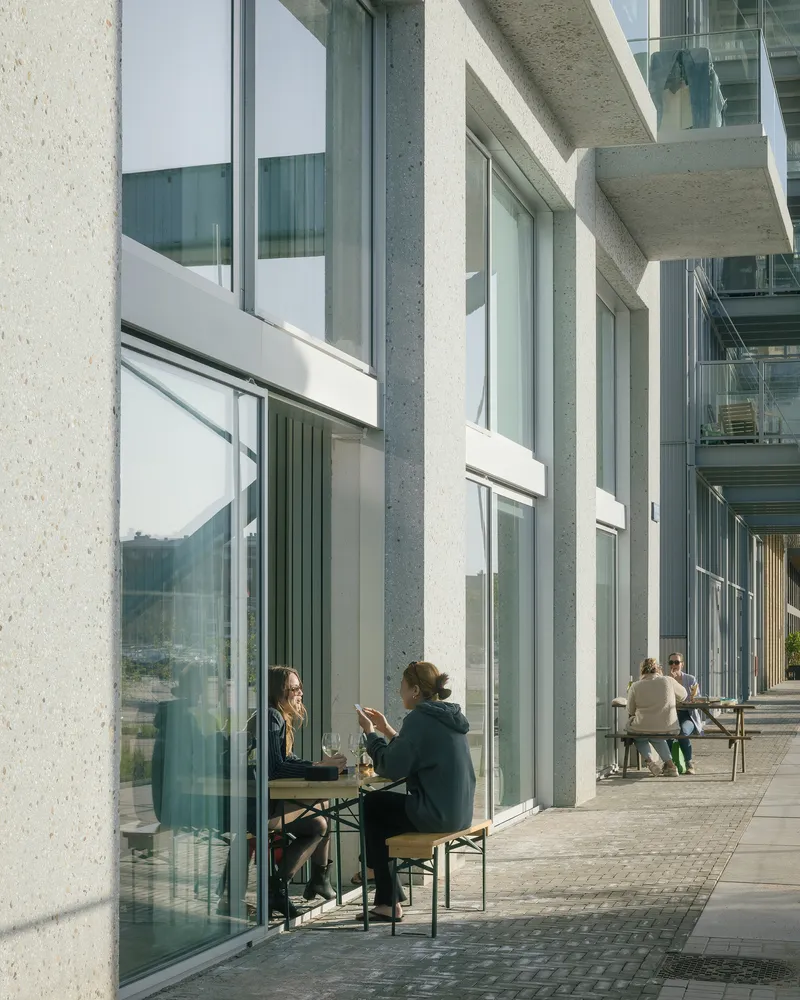
At the plinth, the concrete takes on a coarser character, mixed with oversized pebbles that give the base a rugged, almost geological quality. The texture softens at the entrance, where the concrete is polished to a smooth finish, a material transition that signals the shift from public streetscape to domestic threshold. Stacked balconies with glass balustrades punctuate the upper levels, while the building's massing serves as an intermediary between taller towers and the lower blocks aligned with the Werkspoorhal. It is the smallest of four height accents on the site, a deliberate piece of urban calibration.
Staircases as Social Connectors
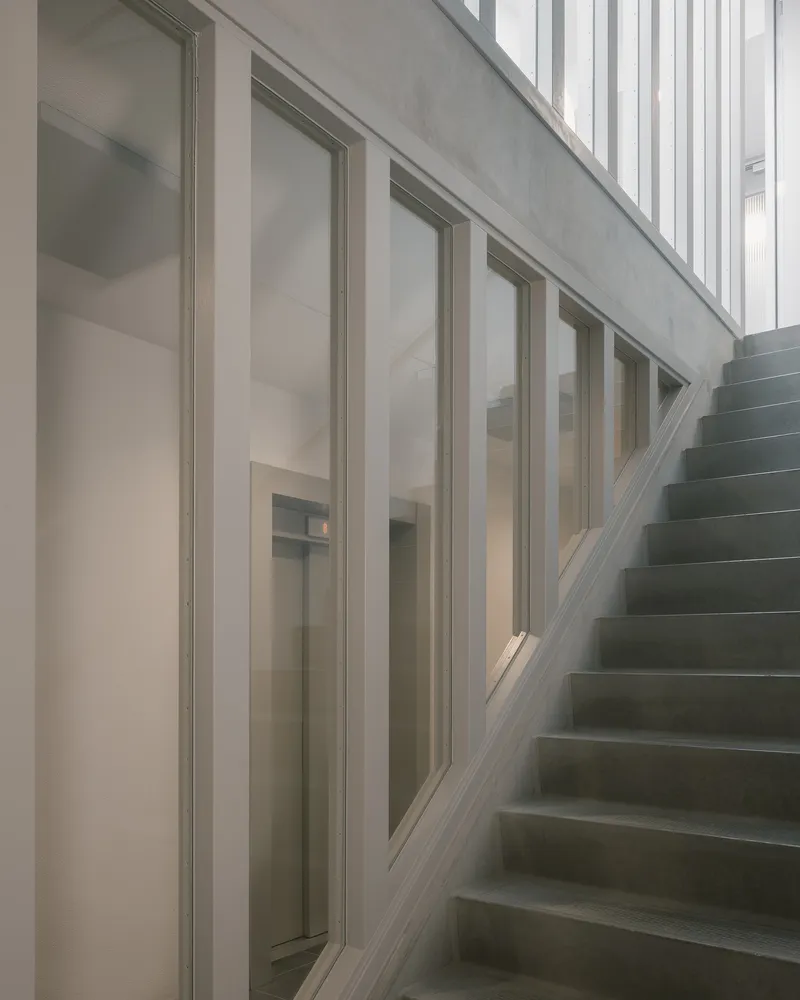
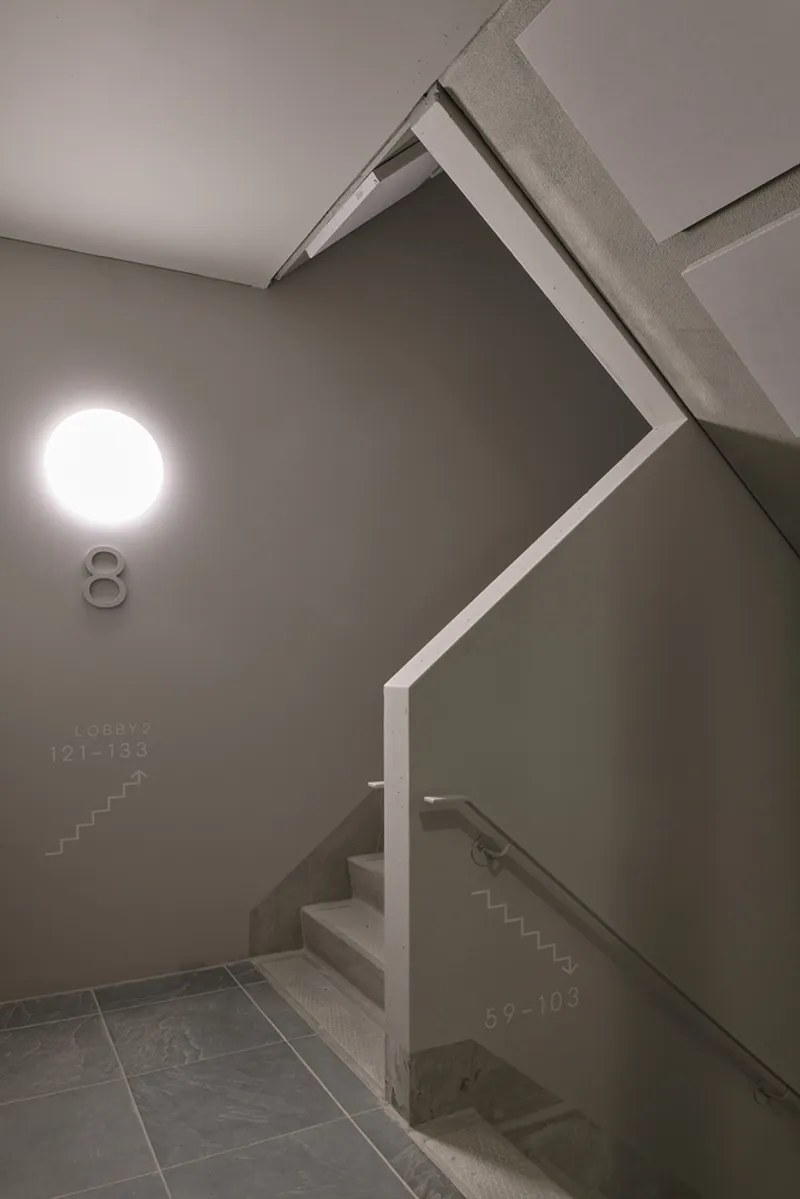
In most residential towers, the stairwell is a fire escape you never visit. BETA treats it as the building's circulatory system. The main staircase is lined with continuous glazing along the exterior wall, flooding it with natural light and framing views of the surrounding cityscape. This is not a grudging code requirement hidden behind a fire door; it is an invitation. The design bets that if you make stairs pleasant, people will choose them, and if people choose them, they will encounter their neighbors.
Interior landings are treated with care rather than afterthought. Circular wall sconces provide warm illumination, and the angular geometry of the staircase creates small moments of pause, places where a brief exchange can happen without blocking traffic. The vertical sequence of communal rooms gives residents a reason to move between floors, turning the staircase from a utility into a genuine piece of social architecture.
Three Rooms for Collective Life
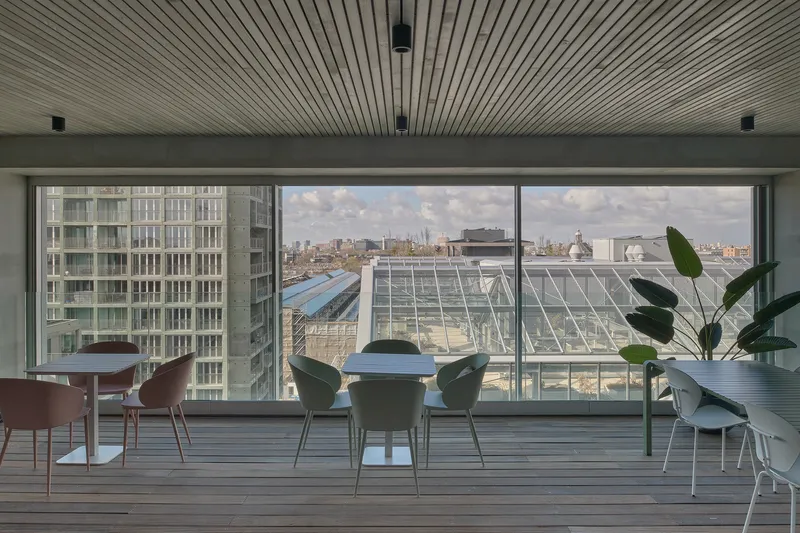
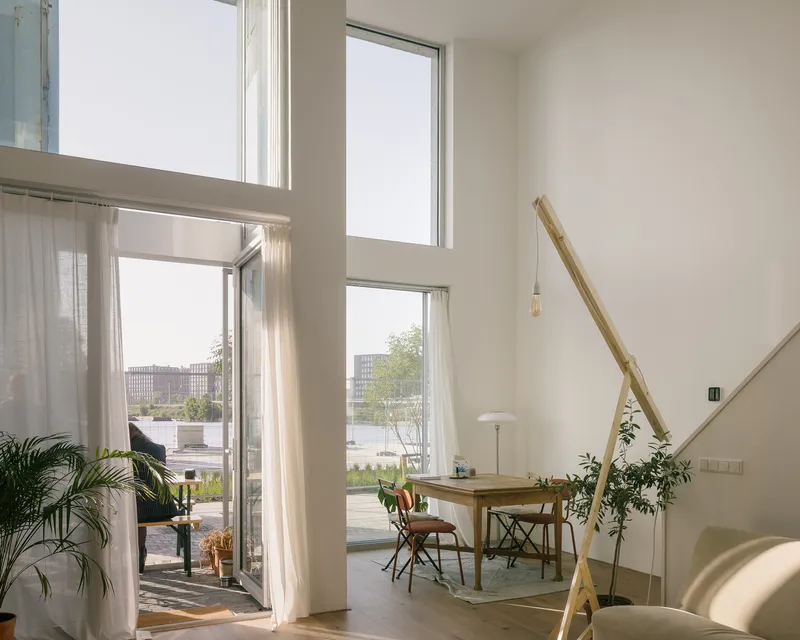
The communal program is distributed vertically rather than concentrated on a single floor. At the lower level, a library lounge features a slatted timber ceiling and floor-to-ceiling glazing that looks out over neighboring rooftops, offering a quiet space for reading or working that feels genuinely domestic. At mid-height, a double-height dining space with tall windows opens onto a planted terrace, establishing a kitchen and winter garden where residents can cook and eat together. At the top, a sky lounge provides panoramic views over Amsterdam.
What makes this arrangement effective is not just the quality of the individual rooms but their spacing. Each communal space sits far enough from the others to require a deliberate journey, close enough that the journey is short. Residents moving between them pass through lobbies and along staircases where informal encounters are almost unavoidable. The building manufactures serendipity.
Ground Floor: Threshold and Transition
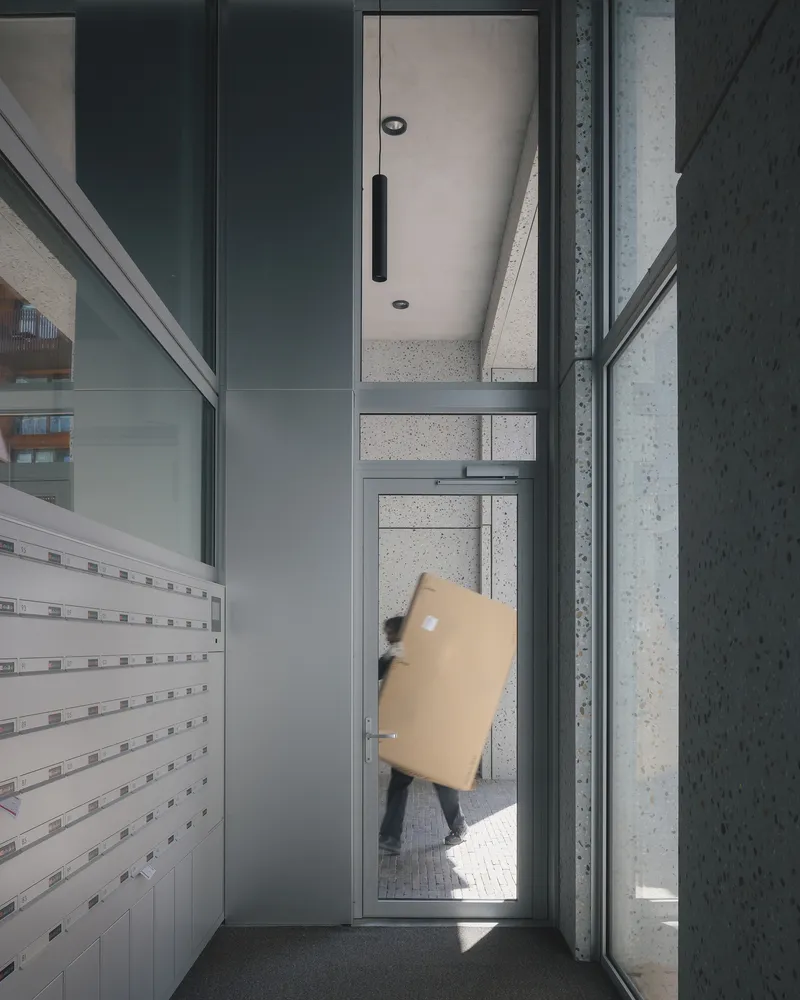
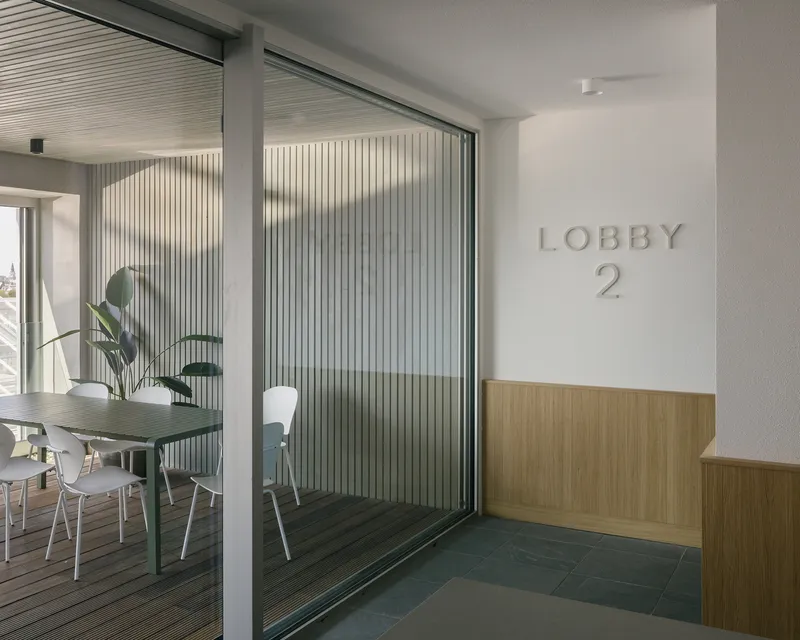
The entrance sequence compresses the shift from city to home into a few careful moves. A narrow glass corridor channels arriving residents through bright daylight before opening into a lobby where a translucent corrugated partition separates the reception area from a communal room visible just beyond. The partition is semi-transparent, acknowledging the collective life of the building without forcing it on anyone. You can see activity on the other side; whether you engage is your choice.
This calibrated ambiguity is central to the project's character. BETA understands that community cannot be mandated, only enabled. The lobbies function as collective spaces in their own right, generous enough for a conversation but not so large that they feel like empty plazas. The polished concrete at the entrance provides a tactile cue: you have crossed from the rough industrial texture of the street into something more refined.
Living in the Tower
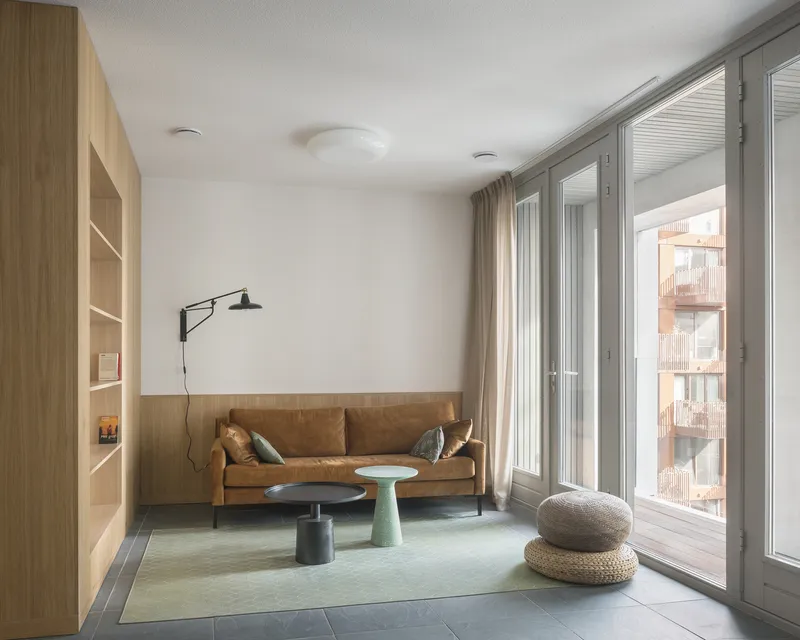
Inside the apartments, the material palette remains robust but warm. Built-in timber shelving, glazed doors opening to private terraces, and views of adjacent balconies create a layered sense of proximity. Lower floors hold larger units suited to families, compensating for reduced daylight with intelligent spatial planning. Upper floors offer more flexible layouts that capitalize on light and views. The loggia balconies on the studio apartments respond specifically to the proximity of the historic crane, orienting residents toward a landmark that connects them to the site's industrial memory.
The variety of unit types across 95 apartments suggests a building that can absorb a genuine cross-section of urban life rather than catering to a single demographic. This is important in a district undergoing the kind of wholesale transformation that Oostenburg is experiencing. A building that accommodates diversity is more likely to foster the organic social fabric that BETA's communal spaces are designed to support.
Why This Project Matters
Draaier op Oostenburg is not the first residential tower to include shared amenities, but it is unusually rigorous about integrating them into the architecture rather than tacking them onto a standard floor plate. The vertical distribution of communal rooms, the deliberate investment in staircase quality, and the semi-transparent lobby partitions all reflect a design philosophy that treats social interaction as something to be structured through space, not just programmed through management. BETA's Active Design research gives the project an intellectual backbone that elevates it above the vague promises of "community" that pepper most residential marketing.
The building also manages its relationship to Oostenburg's industrial heritage with restraint. The blue facade, the coarse plinth concrete, and the careful massing relative to the Werkspoorhal all acknowledge the site's history without resorting to pastiche. As one of the last significant urban infill projects in Amsterdam's city center, Draaier op Oostenburg carries the responsibility of demonstrating that density and sociability are not opposites. On the evidence of what BETA has built here, they are not.
Draaier op Oostenburg Apartments by BETA Office for Architecture, Amsterdam, the Netherlands. 95 apartments. Photography by Stijn Bollaert, MWA Hart Nibbrig, and Tim Stet.
About the Studio
Share Your Own Work on uni.xyz
If projects like this are the kind of work you want to make, uni.xyz is a place to publish your own, find collaborators, and enter design competitions.


Popular Articles
Popular articles from the community


Opera on the Sea: Driftwood Logic Shapes a Timber Opera House on Estonia's Coast
Trevor Orgill's opera house translates the entangled drift of floating timber into a civic building where wood, water, and music converge.

Manzana Morphosis: Stretching Barcelona's Grid into a Living Landscape for 2050
A radical reworking of the Eixample manzana turns density into a tool for generous public space, vertical ecology, and environmental performance.

The Amber Palace Opera: A Geological Fiction Surfaces on Tallinn's Baltic Waterfront
Pierre Brillard reimagines a Baltic legend as a public landscape, opera house, and waterfront promenade rooted in Tallinn's coastal identity.

Singing Woman: An Opera House That Performs Before the Curtain Rises
Ovidiu Cristian Pavel's conceptual opera house translates Estonia's choral identity into a sculpted waterfront landmark facing the Baltic Sea.

Similar Reads
You might also enjoy these articles


Hodi-Mandai Geram
Project Function: Preservation and revitalization of the Intangible heritage and socio-spatial identity of the Hodi by Housing, Cultural Memory Center, Sacred Grove, landscape, local tourism economy


Olio Towers: A Mid-Rise for Performers That Fuses Housing, Rehearsal, and Stage
Located blocks from Houston's Theater District, this modular tower stacks living units around a central performance atrium.

Oasis: Modular Green Housing Carved into Dhaka's Urban Fabric
A shortlisted Plugin Housing entry reclaims unauthorized settlements in Dhaka with stepped concrete volumes, green roofs, and ventilation-driven design.

Black Hole: A Floating Megastructure for the Post-Physical Era
Emiliano Mazzarotto envisions a spherical, self-scaling arena where e-sports, digital hotels, and holographic stadiums replace traditional public space.

Explore Architecture Competitions
Discover active competitions in this discipline

Challenge to reimagine the Iron Throne

Photograph architecture without architects

Illustrate the lost glory of Angkor Wat - Render Challenge

Design challenge to reuse E-waste
Comments (0)
Please login or sign up to add comments
No comments yet. Be the first to comment!