
Eavesdropping the Future: A Sustainable Architecture Memorial Confronting Climate Change
A subterranean journey through time, this sustainable architecture memorial urges action by confronting climate change through immersive spatial storytelling.

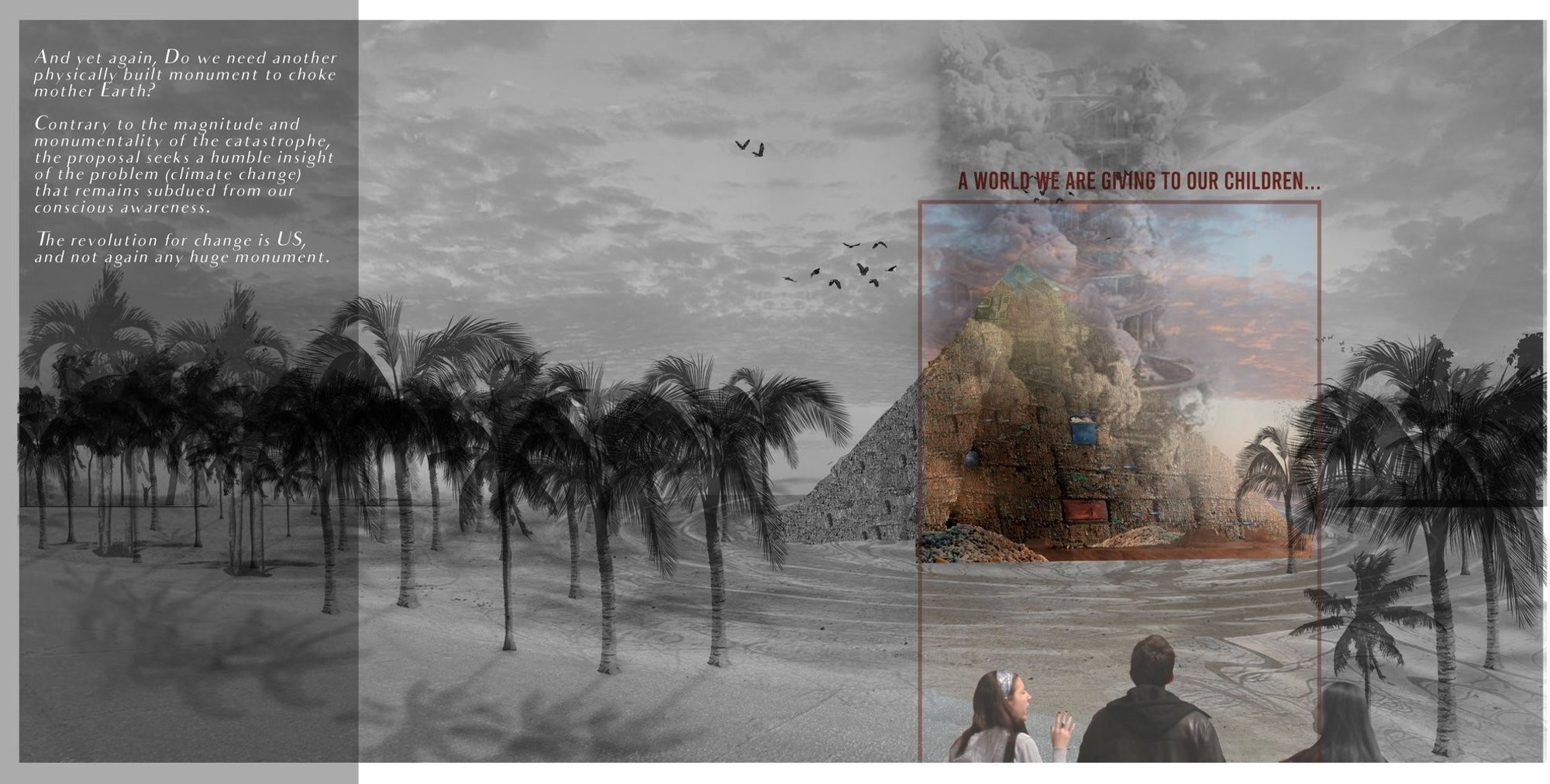
In an era where climate change increasingly shapes both natural and built environments, architecture is evolving beyond function and form into a powerful medium of awareness. Eavesdropping the Future, a compelling project by Urvashi Garg, challenges the conventional notion of monumental architecture by questioning its necessity while simultaneously redefining its purpose.
Rather than contributing another surface-level structure to an already burdened planet, this proposal embraces sustainable architecture by minimizing physical impact and maximizing experiential depth. It invites visitors into a narrative-driven spatial journey that exposes the realities of environmental degradation and compels reflection on the future we are constructing.
Concept: A Journey Across Time and Consciousness
The project is rooted in a philosophical and environmental inquiry: Do we truly need more monuments, or do we need more awareness?
Drawing inspiration from the symbolic landscape of Egypt, particularly the pyramids, the design constructs a metaphorical bridge between three temporal dimensions:
- The forgotten and harmonious past
- The polluted and unstable present
- The inevitable and catastrophic future
This temporal transition is not merely visual but spatially embedded within the architecture. Visitors descend into the earth, moving through a sequence of immersive environments that gradually reveal the consequences of human actions.
Spatial Narrative: Architecture Beneath the Surface
One of the most critical aspects of this sustainable architecture proposal is its decision to build below ground. By preserving the surface for vegetation and community engagement, the design avoids further disruption of the natural landscape while creating a controlled, introspective environment underground.
The section reveals a layered progression of spaces, each representing a stage of ecological collapse:
- Reflection: A contemplative entry space that disconnects visitors from the external world
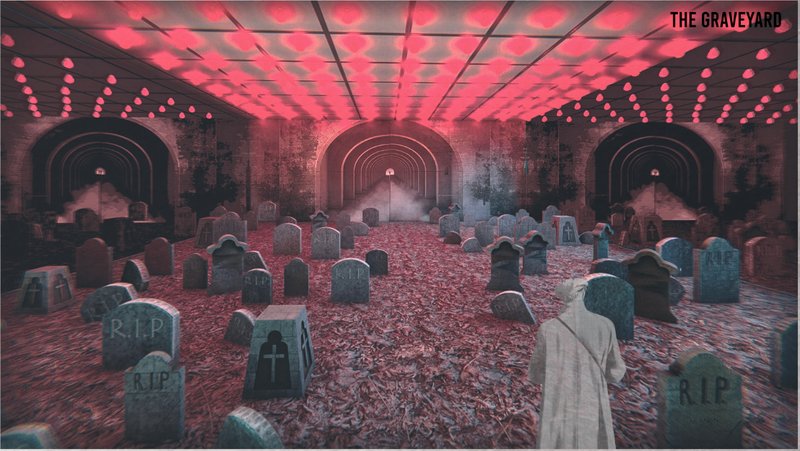
- The Graveyard: A symbolic representation of loss and irreversible damage
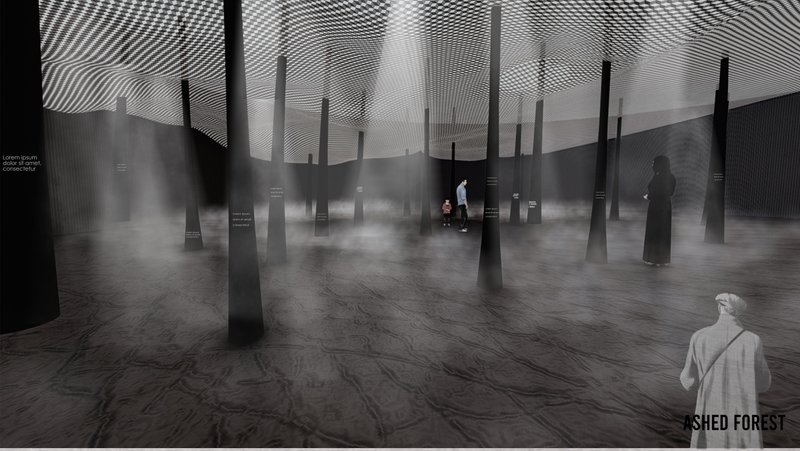
- The Burn: Evoking destruction through heat and smoke
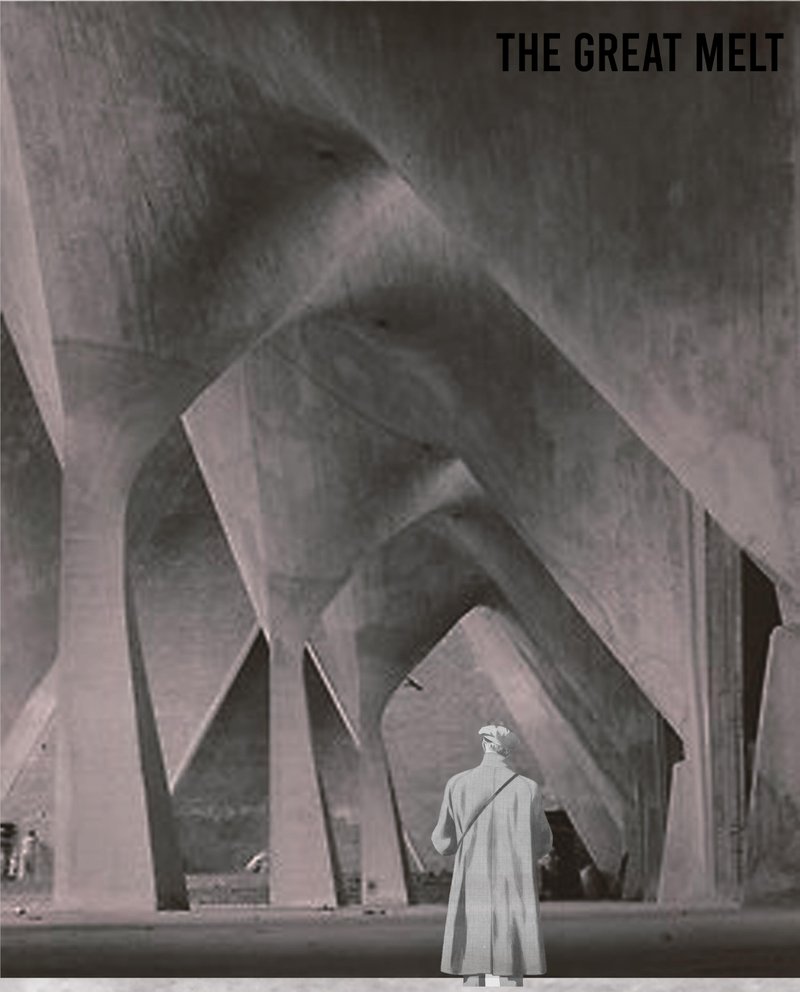
- The Great Melt: Addressing glacial collapse and rising temperatures
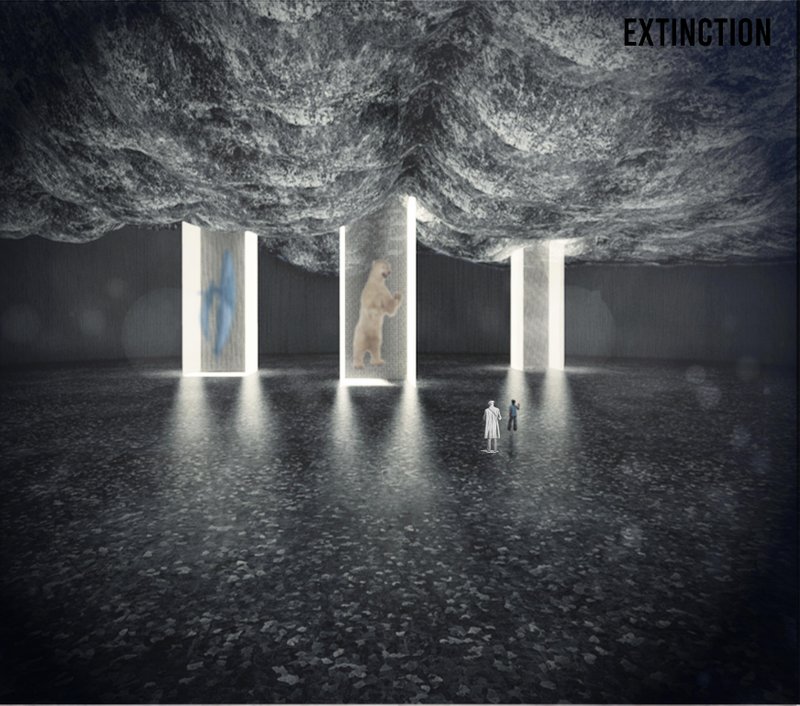
- Extinction: Highlighting biodiversity loss
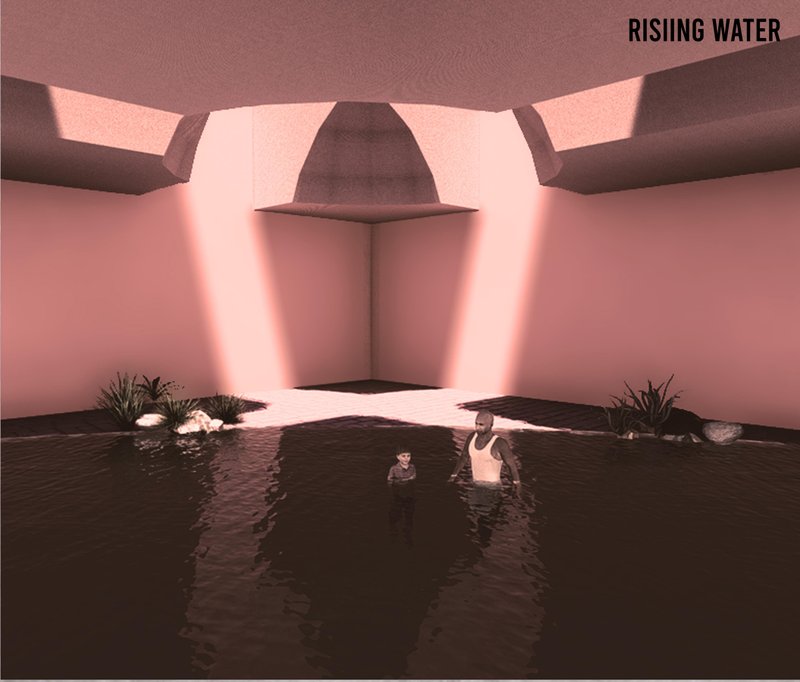
- Rising Water: Immersing visitors in the reality of sea-level rise
- Apocalypse: A culmination of environmental failure
This sequence transforms architecture into a didactic experience, where emotion becomes a tool for awareness.
The Power of Experiential Sustainable Architecture
Unlike traditional memorials that rely on static symbolism, Eavesdropping the Future leverages immersive architecture to create a visceral connection with its audience. The use of light, shadow, materiality, and spatial compression amplifies the psychological impact of each stage.
The visitor does not simply observe climate change; they experience it.
This approach aligns with contemporary trends in sustainable architecture, where the focus shifts toward behavioral influence and environmental education rather than purely aesthetic expression.
Minimal Intervention, Maximum Impact
A defining principle of the project is restraint. Instead of imposing a dominant structure on the landscape, the design adopts a strategy of minimal surface intervention:
- The ground plane remains largely untouched
- Vegetation is preserved and encouraged
- Built form is concealed underground
- Environmental impact is significantly reduced
This positions the project within a growing movement of low-impact sustainable architecture, where ecological sensitivity drives design decisions.
Community Engagement and Collective Responsibility
The project extends beyond individual experience to foster collective awareness. A key feature is the integration of symbolic actions that represent personal commitment to environmental change.
Each visitor participates in a ritual of reflection and contribution, reinforcing the idea that:
The future is not predetermined but shaped by cumulative individual actions.
This participatory dimension transforms the memorial into a living system of engagement, where architecture becomes a platform for societal transformation.
Symbolism and Emotional Resonance
The narrative of Eavesdropping the Future is deeply poetic. It draws upon fear, memory, and hope to construct an emotional arc that mirrors the trajectory of climate change itself.
- Fear of apocalypse becomes a catalyst for awareness
- Memory of the past highlights what has been lost
- Hope emerges as a possibility through conscious action
The final space, often represented as a sanctum or refuge, reintroduces light, nature, and life, suggesting that redemption is still within reach.
Reimagining the Role of Memorial Architecture
Traditionally, memorials commemorate the past. This project challenges that paradigm by memorializing the future.
It asks a critical question: What if we could witness the consequences of our actions before they fully unfold?
By doing so, it redefines sustainable architecture as not only a response to environmental challenges but also a predictive and preventive tool.
Eavesdropping the Future stands as a powerful example of how sustainable architecture can transcend physical boundaries and operate within the realm of perception, emotion, and consciousness.
Through its subterranean design, narrative sequencing, and minimal ecological footprint, the project demonstrates that impactful architecture does not require grand gestures, but rather thoughtful, intentional interventions.
In confronting visitors with a possible future, it ultimately redirects them back to the present, urging immediate action.
Because the future is not something we wait for.




Popular Articles
Popular articles from the community

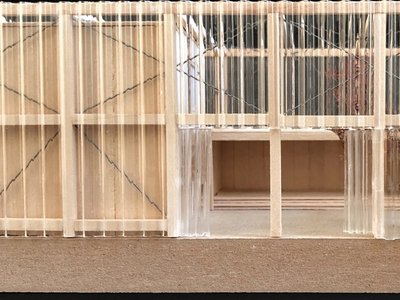
Kaffeebühnen: Coffee Shop Architecture Designed as a Civic Stage Between Vienna’s City and Park
Kaffeebühnen turns coffee shop architecture into a civic stage, linking Vienna’s park edge, urban life, warm timber yards, and coffee craft.

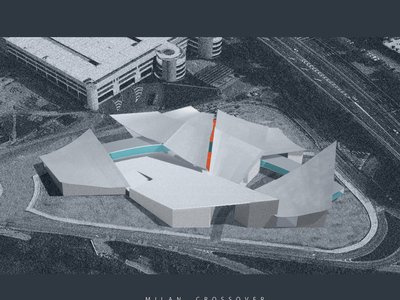
Milan Crossover: Sustainable Architecture for a New Fashion Culture in Milan
Milan Crossover transforms fashion culture through sustainable architecture, linking material libraries, remake studios, and public runways.

Kerry Kounnapis Packs 800 Daily Coffees into a 43-Square-Metre Melbourne Laneway Bar
Palace Coffee channels Pellegrini's and European standing bars through oxide-red steel and spotted gum timber in a Ridgway Place sliver.
The Faith: Modular Architecture for Play, Learning, and Hope in Kutupalong Refugee Camp
A modular playground architecture project in Bangladesh where play, learning, safety, and hope rebuild childhood inside a refugee camp anew.


Similar Reads
You might also enjoy these articles
Eco Chapel: A Green Architecture Pavilion Designed in Symbiosis with the Forest
Eco Chapel uses green architecture to weave prayer, learning and reuse into a forest pavilion shaped by modular hexagonal canopies for life.
Kaffeebühnen: Coffee Shop Architecture Designed as a Civic Stage Between Vienna’s City and Park
Kaffeebühnen turns coffee shop architecture into a civic stage, linking Vienna’s park edge, urban life, warm timber yards, and coffee craft.
Healing Façade: Sustainable Architecture for Reforestation, Community, and Sacred Ecology in Ethiopia
Healing Façade reimagines sustainable architecture as a living wall that restores soil, catches water and renews Ethiopia's forest churches.


Urban Forest: A Vertical Ecosystem for 5,000 Workers in Singapore's Changi Business Park
Radially stacked pods and layered green decks turn a 7-acre plot into 47 acres of ecological workspace projected for 2040.


Explore Sustainable Design Competitions
Discover active competitions in this discipline




The International Standard for Design Portfolios


The Global Benchmark for Architecture Dissertation Awards


The Global Benchmark for Graduation Excellence


Challenge to reimagine the Iron Throne
Comments (0)
Please login or sign up to add comments
No comments yet. Be the first to comment!