
Eco-Chapel: Sustainable Architecture Rooted in Faith, Forest, and Community
Eco-Chapel blends sacred worship, forest restoration, bamboo construction, and climate-responsive design in Ethiopia’s living landscape.


A Sacred Vision for Sustainable Architecture in Ethiopia
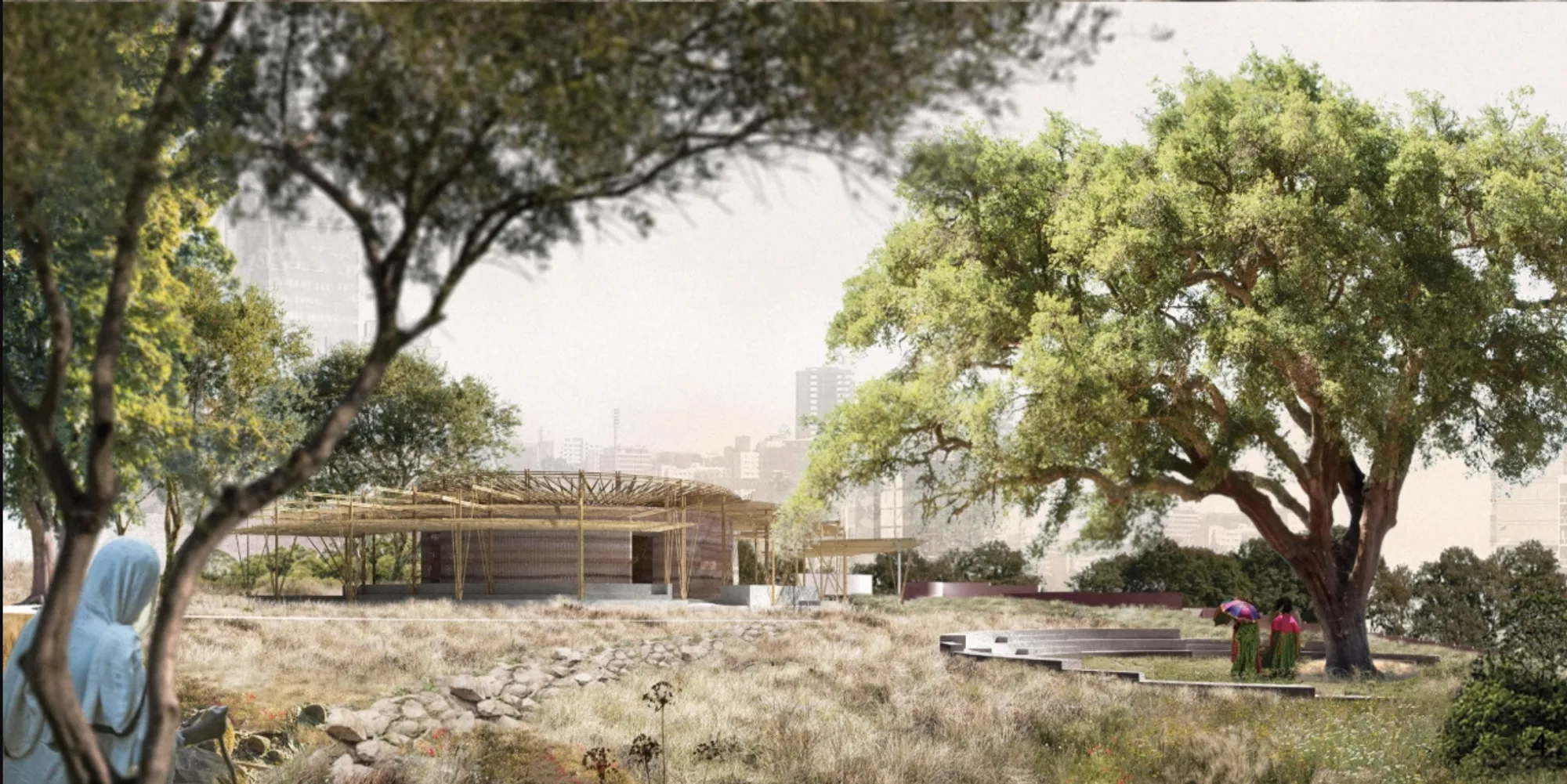
Eco-Chapel by Sharon Davisis a deeply layered architectural proposal that brings together spirituality, ecology, and public education through the language of sustainable architecture. Conceived as a sacred Forest Chapel and Forest Outreach Center, the project places religious life within an urban botanical garden that reflects Ethiopia’s diverse ecological identity.
Rather than treating the chapel as an isolated object, the design expands it into a living system. It becomes a place of prayer, conservation, learning, food production, public gathering, and ecological repair. The project is shaped around the belief that architecture can support both spiritual continuity and environmental stewardship.
Set within a forested landscape, Eco-Chapel responds to Ethiopia’s climate vulnerability by combining passive design, local materials, water management, agroecological planting, and community-led land care. The chapel is not only a worship space. It is a catalyst for reforestation, biodiversity preservation, and public awareness around environmental conservation.
As an Editor’s Choice entry of Eco-Chapel, the project demonstrates how sustainable architecture can move beyond technical efficiency and become culturally specific, spiritually meaningful, and socially productive.


The Concept Behind Eco-Chapel
The central concept of Eco-Chapel is the integration of environmental and religious functions. The design creates a sacred chapel within a public forest setting, while also introducing a Forest Outreach Center that supports education, training, and community engagement.
The site is imagined as a microcosm of Ethiopia’s diverse ecology. Its planting strategy reflects multiple agroecological zones, allowing visitors to understand the relationship between climate, soil, vegetation, water, and cultural life. Through this approach, the project turns the landscape into a teaching environment.
Clergy, monks, and nuns are envisioned as permanent stewards of the site. Their resident housing allows them to live within the landscape and lead outreach activities related to reforestation, conservation, and sustainable agriculture. This creates a meaningful connection between religious practice and ecological responsibility.
The project also includes a public plaza and market where edible fruits and vegetables grown within the urban forest can be sold. This gives the chapel an income-generating function while strengthening community participation. The result is a place where worship, food systems, education, and environmental care operate together.
A Chapel Designed Around Ethiopian Spiritual Traditions
Eco-Chapel draws from the spatial logic of traditional Ethiopian religious architecture. The chapel is organized around a central secluded space reserved for the tabot, with worship space arranged around it. This sacred center gives the building its spiritual hierarchy and preserves the ritual structure of Ethiopian worship.
The chapel is set apart from the more public functions of the site. This separation protects the sacred atmosphere of the building and gives worshippers a sense of withdrawal from the urban bustle of Addis Ababa. The surrounding forest strengthens this sense of spiritual enclosure by creating a calm, shaded, and contemplative environment.
Nearby, a mausoleum provides a sacred burial place for the religious community. An Adbar Tree, an indigenous Warka tree with cultural and religious importance, becomes a central outdoor gathering point. In Ethiopian spiritual practice, such trees often serve as places of assembly, memory, and reverence. In Eco-Chapel, the Adbar Tree becomes both a symbolic and functional anchor for the landscape.
Bamboo Construction as a Sustainable Architecture Strategy
One of the strongest sustainable architecture strategies in Eco-Chapel is its use of bamboo. The chapel uses bamboo as an alternative to steel for the roof structure and pergola. Bamboo is rapidly renewable, lightweight, strong, and carbon-sequestering, making it suitable for a project focused on reducing embodied carbon.
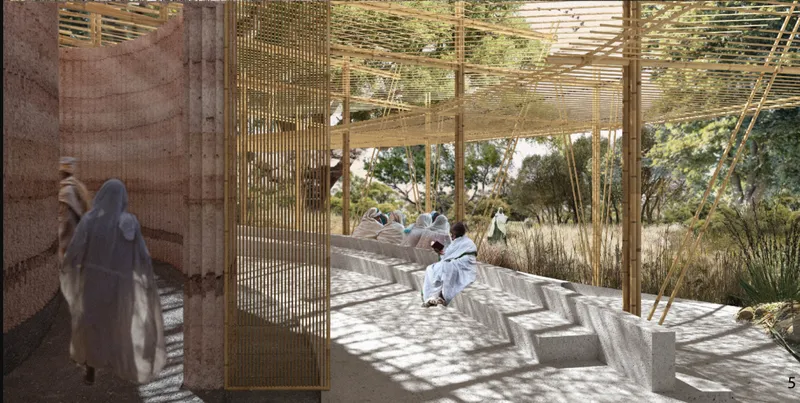
The bamboo roof creates a delicate yet powerful architectural expression. In the renderings, the structure forms a woven canopy that filters sunlight and casts intricate shadows across the prayer hall. This gives the interior a spiritual quality while also responding to the climate through shading and ventilation.
The project positions bamboo not as a decorative material but as a serious structural and environmental resource. Ethiopia is described in the project as the largest producer of bamboo on the African continent, yet its bamboo industry remains underdeveloped relative to its potential. Eco-Chapel therefore proposes bamboo as both a construction material and an economic opportunity.
By using bamboo in the roof and pergola, the project reduces reliance on high-carbon materials while celebrating a renewable resource already available within the region. This makes the chapel a persuasive example of sustainable architecture grounded in local material intelligence.
Rammed Earth Walls and Thermal Comfort
The chapel walls are made from rammed earth, another locally available and environmentally responsible material. Rammed earth gives the building a tactile, grounded quality that connects it visually and physically to the landscape.
The wall texture is formed through bamboo formwork, creating scalloped surfaces that echo the rhythm of the bamboo roof above. This detail gives the chapel a unified material language. The roof and walls are not separate design gestures. They speak to each other through pattern, craft, and environmental logic.
Rammed earth also improves thermal comfort. Its mass helps moderate interior temperatures by absorbing and releasing heat slowly. This is particularly important in Addis Ababa, where daytime and nighttime temperature swings can be significant. By using passive thermal mass, the chapel reduces the need for mechanical heating and cooling.
The design also proposes mortared stone footings rather than conventional reinforced concrete footings. This further reduces embodied carbon while responding to seismic requirements. The project acknowledges that reinforcing rammed earth often depends on steel rebar, but it points toward more environmentally responsible alternatives such as basalt, fiberglass, and woven-strand bamboo reinforcement.
Water Harvesting and Climate-Responsive Design
Water is central to Eco-Chapel’s environmental performance. The chapel roof collects rainwater and channels it downhill toward the nearby Adbar Tree. This transforms rainfall into a sacred and ecological resource.
The site is organized to capture runoff, reduce erosion, and support groundwater recharge. The lowest area of the site is carved to retain excess rainwater, encouraging the growth of lowland plant species associated with wetter Ethiopian agroecological zones. This strategy responds to Ethiopia’s rainfall variability and the broader risks of drought, flooding, and food insecurity.
All paving is permeable, allowing water to enter the ground rather than flow away as surface runoff. The project also uses topographic manipulation to shape microclimates across the site. Dry, moist, and wet zones are created through changes in slope, soil, planting, and water movement.
This makes the project highly climate responsive. Instead of imposing a fixed architectural object onto the site, Eco-Chapel uses landscape design, planting, water flow, and passive building systems to generate a living environmental framework.
The Urban Botanical Garden as Ecological Infrastructure
Eco-Chapel is not only a building. It is a botanical and educational landscape. The project maps Ethiopia’s agroecological zones and translates them into planting areas within the site. These zones are based on rainfall, altitude, temperature, soil, and vegetation patterns.
The landscape includes non-invasive species selected from Ethiopia’s diverse ecological regions. The site strategy introduces different planting conditions, from dry areas to moist zones and wet lowland areas. This allows visitors to experience ecological diversity within a compact urban setting.
The diagrams show a careful study of forest succession, annual water needs, soil types, existing trees, and microclimates. This research-driven approach gives the project credibility as sustainable architecture. It does not rely only on symbolic greenery. It studies how forest systems grow, how species interact, and how architecture can support ecological development over time.
The design also increases biodiversity through the shape of the site boundary. The outer wall has a meandering form that elongates the perimeter and strengthens edge effects. This creates more habitat along the boundary and supports richer ecological interaction.
Forest Outreach Center and Community Programs
The Forest Outreach Center gives Eco-Chapel a strong public role. It supports community training in reforestation, public events, and environmental education. This makes the project both spiritual and civic.
The program includes:
Forest Outreach Center for training and public eventsMarket for forest garden harvestsMausoleum for religious burialResident housing for clergy, monks, and nunsMahabir pavilions for church congregantsSacred chapel for worship and ritualSeed Bank for conserving Ethiopia’s biodiversity
The Seed Bank is one of the most important programmatic elements. Located beneath or within the chapel system, it preserves biodiversity while reinforcing the chapel’s mission of ecological care. The architecture therefore becomes a vessel for both spiritual memory and biological continuity.
The public market extends this idea into everyday life. By allowing the sale of edible produce grown in the urban forest, the project builds a relationship between conservation and livelihood. Sustainability becomes visible, usable, and economically active.

Earth-Sheltered Buildings and Green Roofs
All buildings besides the Eco-Chapel are earth-sheltered and integrated into the hillside. This reduces their visual impact while improving thermal performance. Green roofs allow these structures to merge with the landscape, making the architecture feel embedded rather than imposed.
This approach also supports passive heating and cooling. Earth-sheltered construction benefits from the stable temperature of the ground, reducing indoor temperature fluctuations. Green roofs add insulation, manage stormwater, and increase vegetation cover.
The chapel remains the centerpiece of the site, while the other buildings recede into the terrain. This creates a hierarchy between sacred architecture and support functions. The chapel is visible and symbolic, while the supporting programs are quiet, grounded, and landscape-driven.
Architectural Form, Light, and Atmosphere
The spatial quality of Eco-Chapel is defined by circular geometry, filtered light, and material warmth. The plan centers around a sacred core, with worship spaces arranged in a ring. The circular form gives the building a sense of continuity, gathering, and spiritual focus.
The bamboo canopy creates one of the most powerful visual moments in the project. Its woven structure filters sunlight into shifting patterns, animating the interior throughout the day. The result is a prayer hall where light becomes part of the ritual experience.
The renderings show a warm interior with rammed earth walls, bamboo overhead, religious imagery, and simple seating. The material palette is earthy, tactile, and restrained. It avoids monumental excess and instead creates a sacred environment through shadow, texture, and proximity to nature.
Outside, the chapel sits within a restorative landscape of grasses, trees, stone paths, and gathering areas. The building is experienced as part of a broader ecological journey rather than as a single destination.
Sustainable Architecture as Cultural Continuity
What makes Eco-Chapel compelling is its ability to combine climate strategy with cultural sensitivity. The project does not treat sustainability as a universal checklist. Instead, it connects environmental performance to Ethiopian religious traditions, local materials, landscape ecology, and community life.
The chapel form respects sacred spatial customs. The Adbar Tree supports outdoor congregation. The mausoleum provides a place for religious burial. The resident clergy become stewards of the land. The Seed Bank preserves biodiversity. The market connects ecological production with public exchange.
These elements work together to show that sustainable architecture can preserve tradition while preparing communities for environmental change. Eco-Chapel is not a futuristic object detached from place. It is a place-based model of resilience.
Why Eco-Chapel Matters
Eco-Chapel is significant because it reimagines sacred architecture as ecological infrastructure. It shows how a chapel can become more than a building for worship. It can become a forest, a school, a seed archive, a water-harvesting system, a market, a burial ground, and a community platform.
The project also addresses urgent climate and environmental concerns. Ethiopia faces high rainfall variability, drought risk, flood risk, erosion, deforestation, and food insecurity. Eco-Chapel responds to these challenges through coordinated land use, forest restoration, passive design, local materials, and public education.
As a work of sustainable architecture, it is both technical and poetic. Its bamboo canopy and rammed earth walls reduce embodied carbon. Its forest garden restores biodiversity. Its rainwater systems support plant life. Its sacred geometry preserves religious practice. Its outreach programs engage the public.
This balance of performance and meaning gives the project lasting architectural value.
Eco-Chapel presents a powerful model for sustainable architecture in Ethiopia. Through bamboo construction, rammed earth walls, rainwater harvesting, earth-sheltered buildings, agroecological planting, and religious spatial traditions, the project creates a sacred environment that is also an engine of ecological repair.
As an Editor’s Choice entry of Eco-Chapel, the project stands out for its ability to merge faith, forest, climate resilience, and community life into one integrated architectural proposal. It demonstrates that sacred architecture can be both contemplative and productive, both rooted in tradition and responsive to the future.
Eco-Chapel is not simply a chapel in a forest. It is a living landscape of worship, stewardship, and renewal.




Popular Articles
Popular articles from the community


The Ocean Hive: Sustainable Architecture for a Self-Sufficient Civilization at Sea
The Ocean Hive imagines sustainable architecture at sea, where modular habitats, algae, wave power and ocean waste sustain a growing colony.

Co-Life: Senior Housing Design That Reconnects Older Adults With the City
Co-Life reimagines senior housing design through healing gardens, shared streets, workshops, and a sustainable community across generations.

Hill & Cross Opera: Sculptural Opera House Architecture Shaped by Tallinn’s Landscape and Identity
Hill & Cross Opera reimagines opera house architecture in Tallinn through its sculptural hill, civic plaza, glass wave and a luminous cross.
EW PARK: Sustainable Architecture Reimagines the Future of Urban Parking
EW PARK reimagines city parking as a modular wooden tower combining automation, solar energy, electric mobility, and adaptable urban design.


Similar Reads
You might also enjoy these articles

Eco Chapel: A Green Architecture Pavilion Designed in Symbiosis with the Forest
Eco Chapel uses green architecture to weave prayer, learning and reuse into a forest pavilion shaped by modular hexagonal canopies for life.
Kaffeebühnen: Coffee Shop Architecture Designed as a Civic Stage Between Vienna’s City and Park
Kaffeebühnen turns coffee shop architecture into a civic stage, linking Vienna’s park edge, urban life, warm timber yards, and coffee craft.
Healing Façade: Sustainable Architecture for Reforestation, Community, and Sacred Ecology in Ethiopia
Healing Façade reimagines sustainable architecture as a living wall that restores soil, catches water and renews Ethiopia's forest churches.


Urban Forest: A Vertical Ecosystem for 5,000 Workers in Singapore's Changi Business Park
Radially stacked pods and layered green decks turn a 7-acre plot into 47 acres of ecological workspace projected for 2040.





Comments (0)
Please login or sign up to add comments
No comments yet. Be the first to comment!