

Eco Favelas: A DNA Helix Skyscraper Reframes São Paulo's Informal Settlements
Twin rotating towers connected by sky bridges propose a vertical mixed-use community that replaces urban segregation with shared social infrastructure.


What if the favela were not a problem to be solved but a prototype to be scaled? In a city where 19 million people navigate the daily collision between gleaming corporate towers and sprawling informal settlements, the Eco Favelas project proposes a vertical community that borrows the organic density of the favela and reroutes it through a DNA helix. Twin residential towers rotate three degrees every three floors, linked by mid-air bridges that double as communal gathering spaces. The result is a skyscraper that refuses to separate living from working, healthcare from housing, or one social class from another.
Designed by Justyn Poczek, Natalia Gielo, and Oliwia Getka, the project received an Honorable Mention in the CityScraper competition. Sited in the heart of São Paulo, Brazil, it takes on the city's defining spatial contradiction: the hard edge between wealth and poverty that runs through nearly every neighborhood. Rather than demolishing and displacing, the designers propose an integrated vertical city that layers affordable housing, medical clinics, retail, office space, and public recreation into a single interconnected structure.
Planted Balconies and Timber Louvers as a New Favela Facade
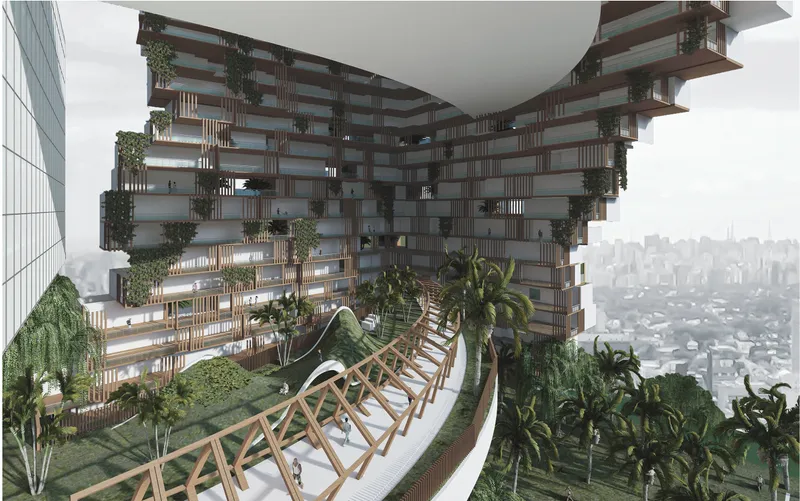
The opening rendering makes an immediate argument: high-density affordable housing does not have to look institutional. Terraced residential volumes step back as they rise, each level lined with planted balconies that cascade greenery down the facade. Timber louvers screen private spaces while allowing cross-ventilation, a critical consideration in São Paulo's subtropical climate. At ground level, a curved trellis walkway draws pedestrians into the base of the building, signaling that this tower belongs to the street as much as the sky. The palette of exposed timber, concrete, and vegetation consciously avoids the glass curtain wall vocabulary of the corporate towers that dominate São Paulo's skyline.
Stacking Programs: From Clinics to Sky Bridges
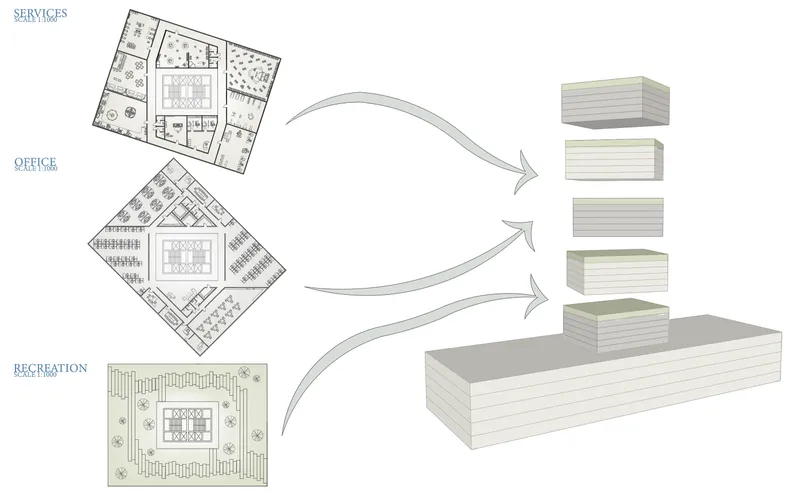
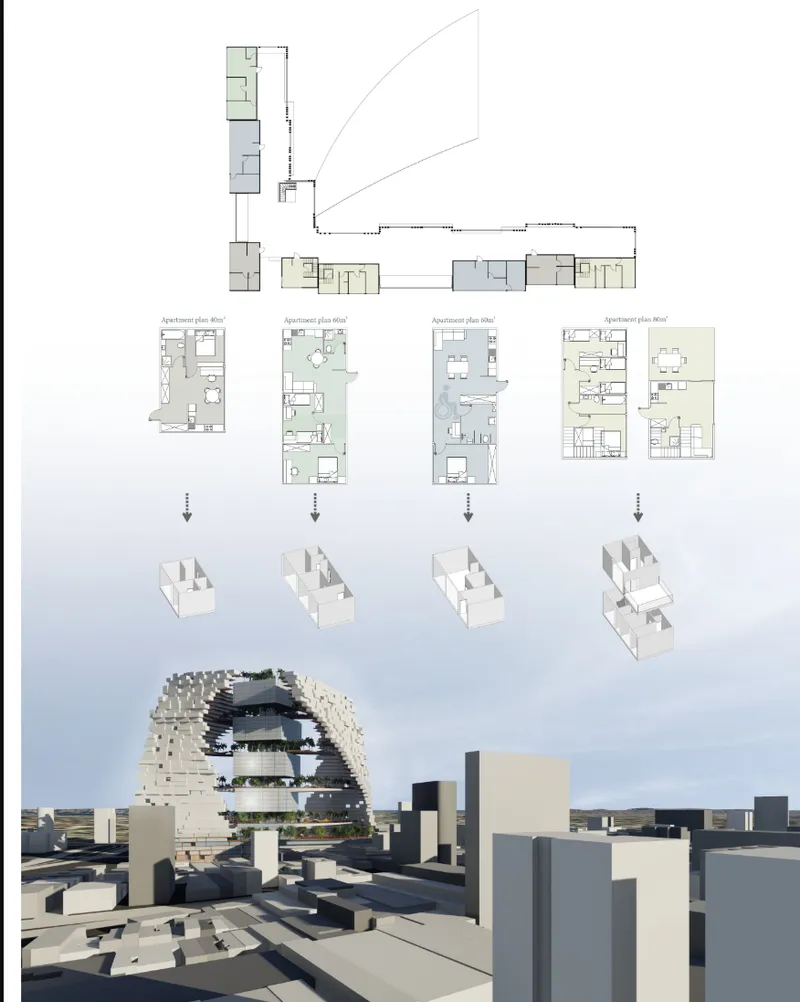
The programmatic diagram reveals how the designers decompose the building into legible layers. A multi-functional base occupies the first floors, housing medical, dental, and veterinary clinics alongside shopping centers, office spaces, and rentable units for neighborhood businesses. A public playground, sports field, and shaded gathering spaces complete the ground-plane activation. Above the sixth level, the twin residential towers emerge, each containing a mix of unit types: 40 square meter apartments for singles, 60 and 80 square meter units for medium and large families, and universal-access apartments with barrier-free features for elderly and disabled residents.
The composite drawing below pairs site plan, apartment floor plans, and axonometric views with a neighborhood rendering that situates the tower within its urban context. What stands out is the range of unit sizes deployed across the towers. The designers are not offering a single housing template; they are building a population cross-section into the floor plates. This strategy directly targets urban segregation by ensuring that different household types, income levels, and accessibility needs coexist within the same structural frame.
The Stepped Facade Meets the Street
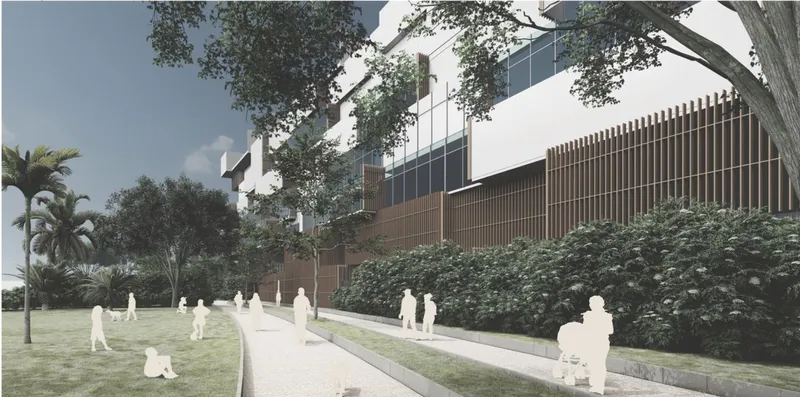
At eye level, the building reads as a series of vertical timber screens stepping back from a generous public lawn. People gather, children play, and the boundary between building and city dissolves. The stepped section creates a gradient from fully public at ground level to semi-private on the upper terraces, a spatial strategy borrowed from the informal settlement's own logic of incremental thresholds. Vertical timber elements provide shade and rhythm without closing off the facade, maintaining visual permeability between interior life and the surrounding neighborhood. The gesture is deliberate: this is not a gated compound but a porous piece of city.
Assembly Logic: Rotating Modules and Structural Bridges
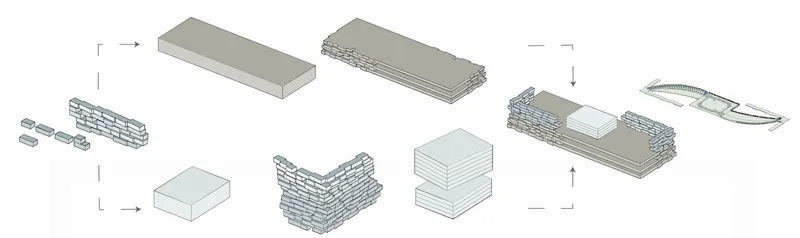
The final axonometric diagram unpacks the assembly sequence. Modular residential volumes stack and rotate incrementally, generating the helical form that defines the tower's silhouette. The three-degree rotation every three floors is not decorative; it optimizes daylight penetration, improves natural airflow through the units, and creates terraced surfaces where green space can accumulate. Structural bridges span between the twin towers at regular intervals, housing shared program spaces in what would otherwise be dead air. A central core of stacked offices and service spaces provides the vertical spine, while the bridges extend horizontally to stitch the residential zones into a continuous network.
The DNA helix metaphor works on two levels. Structurally, it explains the rotational geometry and the paired tower configuration. Socially, it frames the building as a living organism capable of growth, adaptation, and continuity. The bridges are the critical detail: they transform the towers from two isolated residential slabs into a single interlocked community where encounters between residents are embedded in the circulation system rather than left to chance.
Why This Project Matters
The skyscraper competition genre is saturated with proposals that chase spectacle over substance. Eco Favelas distinguishes itself by starting from a real urban condition, São Paulo's entrenched spatial inequality, and working through it with specific programmatic commitments: barrier-free housing, community health clinics, rentable commercial units sized for neighborhood businesses. The unit mix alone signals a level of social ambition that most vertical city proposals skip over in favor of parametric flourishes.
Poczek, Gielo, and Getka demonstrate that the favela's density, mixed-use character, and social intensity are not flaws to be erased but qualities to be designed with. By translating these qualities into a vertical framework equipped with green building strategies and a helical structural logic, they propose a building type that could reshape how Latin American cities approach informal settlement redevelopment. The project does not romanticize poverty; it takes the spatial intelligence embedded in informal urbanism and gives it the infrastructure, the services, and the structural integrity it has always deserved.
View the Full Project
About the Designers
Designers: Justyn Poczek, Natalia Gielo, Oliwia Getka
Enter a Design Competition on uni.xyz
uni.xyz runs architecture and design competitions year-round that reward proposals with spatial conviction and real site intelligence.
Project credits: Eco Favelas by Justyn Poczek, Natalia Gielo, Oliwia Getka CityScraper (uni.xyz).


Popular Articles
Popular articles from the community


Cube Design Draws an Ecological Corridor Between Two Shenzhen Hills with the Nankai Building
Beside Shenzhen's container docks, the Nankai Building pairs stacked balconies with a climbing green screen to connect two hillsides across its height.

David Macias Steps a Doorless Stone and Plaster House Down a Tropical Colombian Hillside
In the humid hills of Colombia, Threshold House replaces the front door with an open void and terraces its 850 m² down the slope instead of fighting it.

David Ortega Stacks a Two-Story Mexico City Penthouse Around a Steel Stair and a Pergola-Shaded Roof Terrace
In Colonia Roma, a 300 m² penthouse uses oak joinery, a planted steel stair and a slatted roof pergola to make a new-build apartment feel like a house.

GROUP A Strips a 1969 Rotterdam Harbor Headquarters to Its Frame and Wraps It in Timber Louvers
In Rotterdam's M4H harbor district, Ferro Offices reuses a 1969 frame, adds one timber storey and reaches BREEAM-NL Outstanding.

Similar Reads
You might also enjoy these articles

Gil Mello Arquitetura Tilts a Single Roof Toward the Waterfalls on a Plateau Above Aiuruoca, Brazil
In Aiuruoca, Minas Gerais, a 200 m² house of local labor and reclaimed poles pairs a low valley veranda with a tall mountain one.

U.GA Architects Wraps an Oval Rooftop Pool in Curved Board-Formed Concrete on Busan's Jeollidan-gil
In Busan's Jeonpo-dong, a 454 m² mixed-use block stacks a neighborhood facility, guest rooms and an oval rooftop pool inside spiraling concrete walls.

Felipe Hess Arquitetos Turns a Blind Stone Wall to the Street and Opens a Brazilian House onto a Courtyard and Canal
A canal-front house in Brazil hides behind painted stone and planting, then opens to an olive-tree courtyard, a reed-ceilinged porch and a curving pool.
David Macias Steps a Doorless Stone and Plaster House Down a Tropical Colombian Hillside
In the humid hills of Colombia, Threshold House replaces the front door with an open void and terraces its 850 m² down the slope instead of fighting it.

Explore Sao Paulo Competitions
Discover active competitions in this discipline

Challenge to design locus for the upliftment of human rights

Design challenge to reuse E-waste
Comments (0)
Please login or sign up to add comments
No comments yet. Be the first to comment!