

Elephant House: An Un-Common Boundary Where Architecture Mediates Between Humans and Elephants
Sneha Lakshmi's thesis replaces the wildlife fence with a layered spatial gradient, organising a conservation campus around the elephant's path.


Most conservation architecture begins with a fence. Elephant House begins by asking what happens if you refuse to build one. Instead of a line that separates people from animals, the project proposes an Un-Common Boundary: a spatial condition that serves humans and elephants at once while protecting the dignity, safety and ecological balance of both. Architecture here acts as a mediator, and the result is a campus organised around coexistence.
Developed as a thesis by Sneha Lakshmi, the project is set within a sensitive ecological landscape and pushes against the human-centric habits of the discipline. It treats a conservation site as shared territory, a place for research, learning and sustainable tourism, and frames the built form as an environmental and experiential catalyst rather than an object placed on the land.
A Campus That Sits Between Enclosure and Wilderness
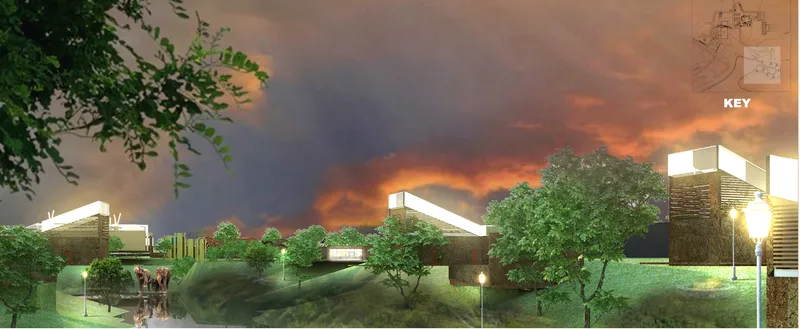
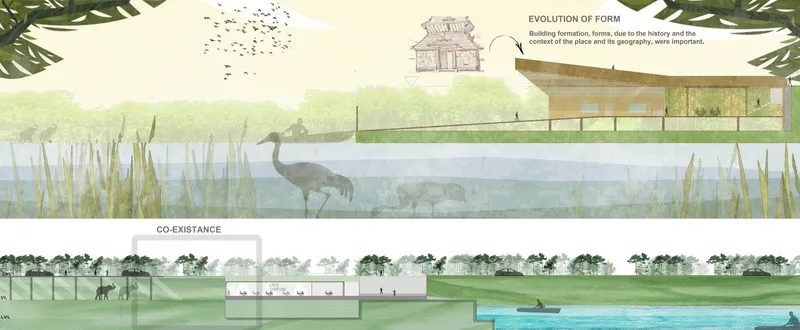
Wildlife reserves tend to fall into one of two categories: strict enclosure or untouched wilderness. Lakshmi rejects that binary and proposes a typology she calls wildlife conservation architecture, built on coexistence. The programmes form an interconnected campus supporting conservation, education, tourism and rehabilitation, arranged so that the natural behaviour and movement of elephants remain uncompromised.
What stands out is the restraint. The buildings do not take over the terrain; they settle into it, shaped by topography, water systems, tree cover and existing wildlife corridors. Human occupation is introduced carefully into ecological patterns that were there first, which is a more honest starting point than most visitor-facing conservation projects manage.
The Elephant Path as the Site's Organising Spine
The project's sharpest move is to reinterpret the fence as a layered gradient instead of a physical obstruction. Enclosure becomes negotiation, and the architectural language shifts from opposition to overlap. The elephant movement zone is the organising spine of the entire site, setting circulation, orientation and the placement of programme.
Human routes adapt to that spine rather than the other way around. Pathways are elevated, bridged or recessed depending on where they meet elephant territory, which keeps visitors safe without sealing them off from the experience. Safety is produced through section and level change, not through walls, and that is the design's central argument made spatial.
Water, Rainfall and Ground as the Master Plan's Framework
The master plan treats the landscape as infrastructure. Water retention ponds, check dams and seasonal rainfall patterns are built into the architectural strategy from the outset, so sustainability is foundational rather than an add-on. In a landscape where elephants depend on water and seasonal cycles, this is not a green credential so much as a precondition for the project working at all.
Climate responsiveness serves two ends: it supports human comfort and stabilises the ecology the campus exists to protect. The value of the plan lies in how those goals reinforce each other rather than compete.
Ascent, Pause and Descent: Learning by Watching
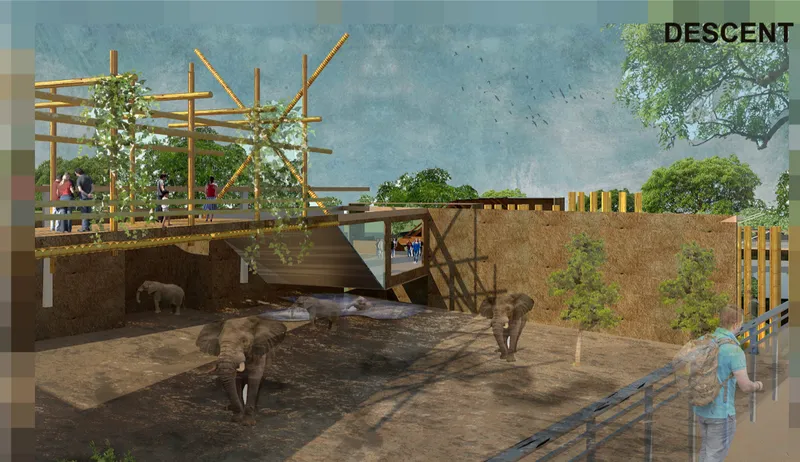
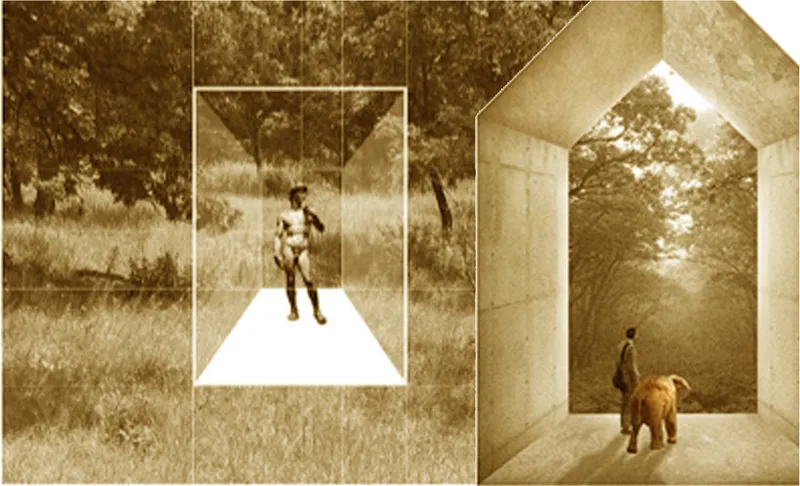
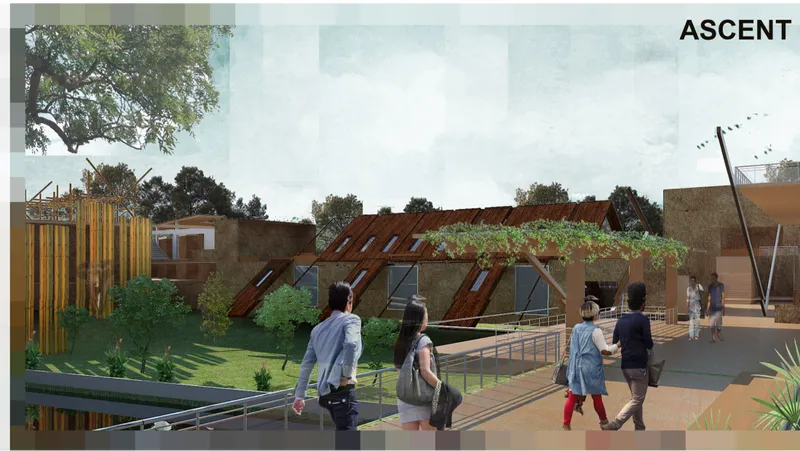
The Interpretation Centre is choreographed as a narrative of ascent, pause and descent, tracing a shift from curiosity to awareness. Elevated walkways offer views into elephant enclosures without intrusion, and workshops overlook the elephant pit, so learning happens through quiet observation rather than spectacle. The building recedes into earth berms, green roofs and natural textures, keeping its visual footprint minimal and presenting the elephant as a co-inhabitant rather than an exhibit.
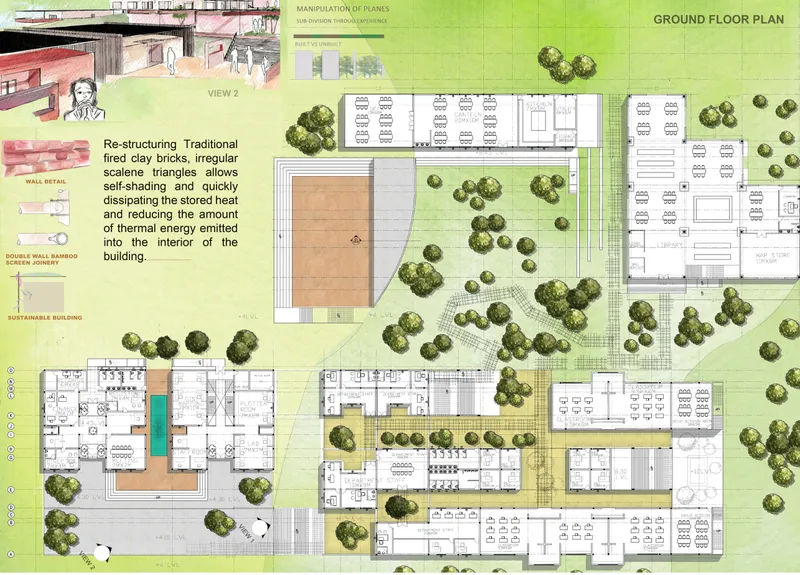
The Wildlife Research Institute, the academic core of the campus, draws on patterns from nature: node, axis, threshold and layered relationships between built and unbuilt space. Taking cues from tree canopies and organic growth, its plan interweaves courtyards and laboratories to bring light, ventilation and visual continuity through the working spaces, extending the campus logic of porosity into the places where research takes shape.
Why This Project Matters
Human and wildlife conflict is usually framed as a problem to be solved by separation. Elephant House offers a different reading: the boundary itself can be designed as a shared, graduated space, and architecture can carry the burden of mediation through section, elevation and landscape rather than barbed wire. Making the elephant's movement the generator of the plan is a simple decision with far-reaching consequences, and it gives the thesis real conceptual clarity.
For students working on conservation and ecological sites, the project shows how to give non-human users equal standing in a brief. Its lessons travel beyond elephants: begin with the patterns already on the land, let infrastructure such as water shape the plan, and design observation as a form of respect. Lakshmi's work makes a persuasive case that coexistence is something architecture can build.
View the Full Project
About the Designers
Designer: Sneha Lakshmi
Enter a Design Competition on uni.xyz
uni.xyz runs architecture and design competitions year-round that reward proposals with spatial conviction and real site intelligence.
Project credits: Elephant House by Sneha Lakshmi.


Popular Articles
Popular articles from the community

Faces of the Soviet Avant-Garde: Turning Moscow's Street Names into an Open-Air Museum
A network of sculptural installations across a Moscow residential district transforms forgotten architect names into spatial encounters with cultural memor
Tsunami Convergenics: Turning Catastrophic Ocean Forces into Underwater Housing Infrastructure
A speculative underwater settlement off the coast of Onagawa, Japan, treats tsunamis and typhoons as energy sources rather than threats.

Opera on the Sea: Driftwood Logic Shapes a Timber Opera House on Estonia's Coast
Trevor Orgill's opera house translates the entangled drift of floating timber into a civic building where wood, water, and music converge.

The Amber Palace Opera: A Geological Fiction Surfaces on Tallinn's Baltic Waterfront
Pierre Brillard reimagines a Baltic legend as a public landscape, opera house, and waterfront promenade rooted in Tallinn's coastal identity.

Similar Reads
You might also enjoy these articles

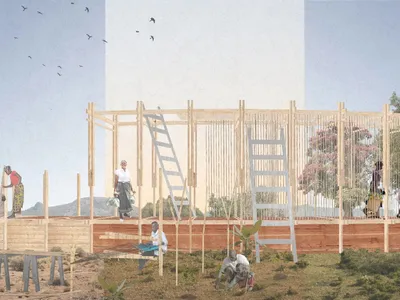
Healing Façade: A Modular Chapel System That Restores Ethiopia's Sacred Forests
Winner of the Eco-Chapel competition, this circular timber façade collects water from air to rebuild soil and reforest degraded Ethiopian landscapes.
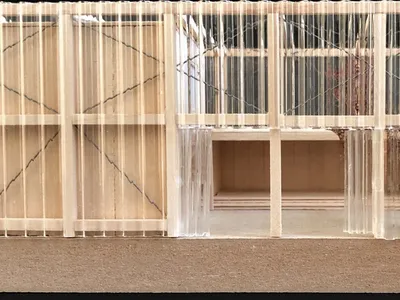
Kaffeebühnen: Where Coffee Shop Architecture Becomes a Civic Stage in Vienna
A linear sequence of timber boxes, transparent shells, and open yards turns the Viennese café tradition into a public performance space.
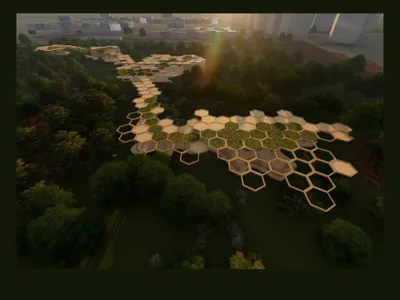
Eco Chapel: A Modular Forest Pavilion That Grows Like the Landscape It Protects
Hexagonal timber modules weave through existing trees, turning a chapel into a living system for prayer, education, and reforestation.


Urban Forest: A Vertical Ecosystem for 5,000 Workers in Singapore's Changi Business Park
Radially stacked pods and layered green decks turn a 7-acre plot into 47 acres of ecological workspace projected for 2040.


Comments (0)
Please login or sign up to add comments
No comments yet. Be the first to comment!