
ellevuelle architetti Weaves a Stone Extension into the Rural Layers of Modigliana
A former barn and stone house in the Italian hills gain a restrained new volume that speaks the dialect of the existing landscape.


The best refurbishments refuse to declare where the old ends and the new begins. Effevu House, completed by ellevuelle architetti in 2025 on a hillside near Modigliana in Emilia-Romagna, operates exactly in that register. The project takes a stratified rural compound, a stone house and a former barn, and adds a new volume that reads less as an addition than as something the hill decided to produce on its own. Stone, timber, and concrete appear in proportions that feel genuinely earned rather than styled.
What makes Effevu House worth close attention is the discipline with which ellevuelle architetti negotiate between mass and openness. The existing buildings carry weight: thick walls, small apertures, pitched roofs. The new intervention is flatter, more horizontal, more porous, yet it borrows the same local stone and timber vocabulary so thoroughly that the whole ensemble reads as a single gesture unfolding across time. The result is a house that can host a covered terrace overlooking the valley without ever feeling like a resort pavilion.
Settling Into the Hill

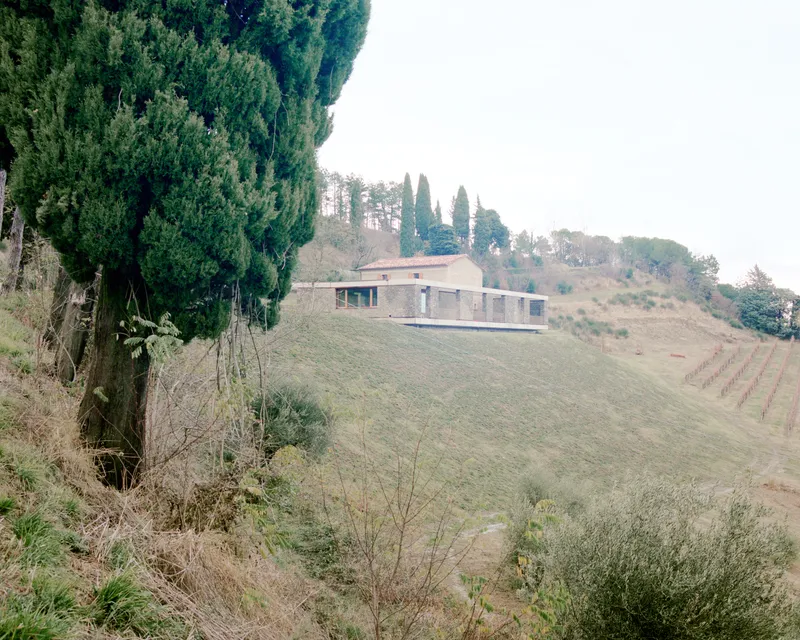
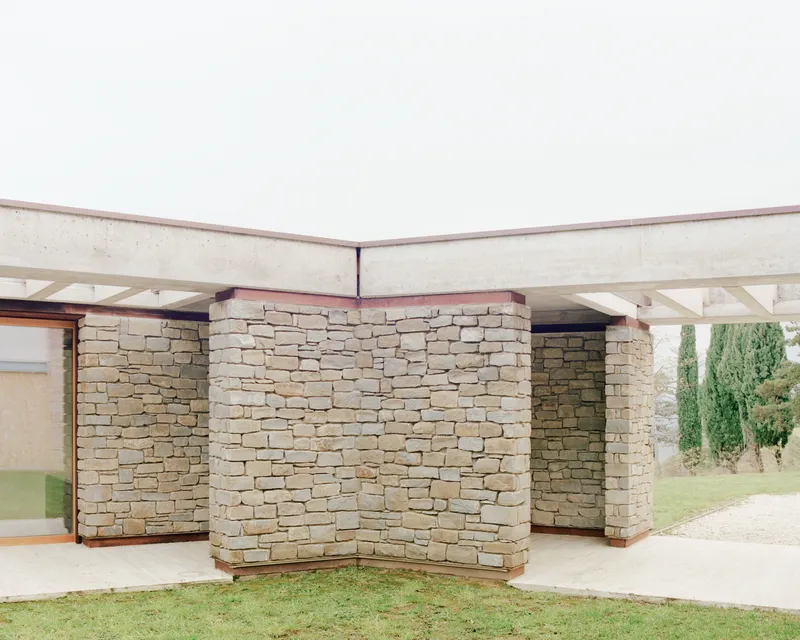
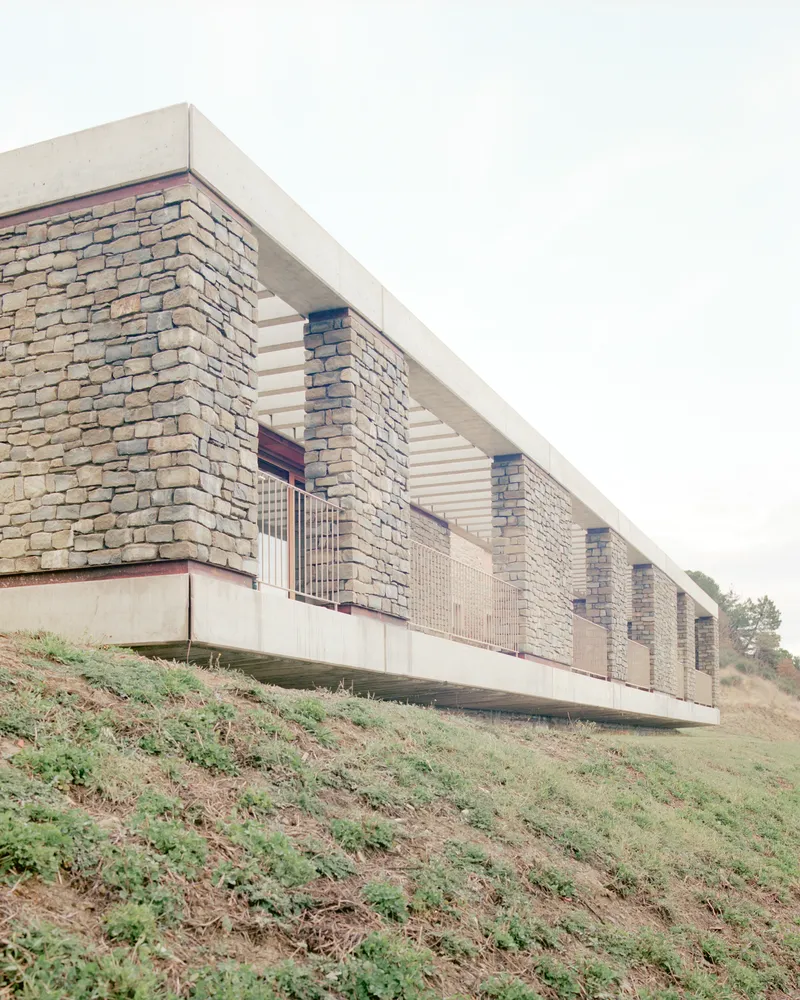
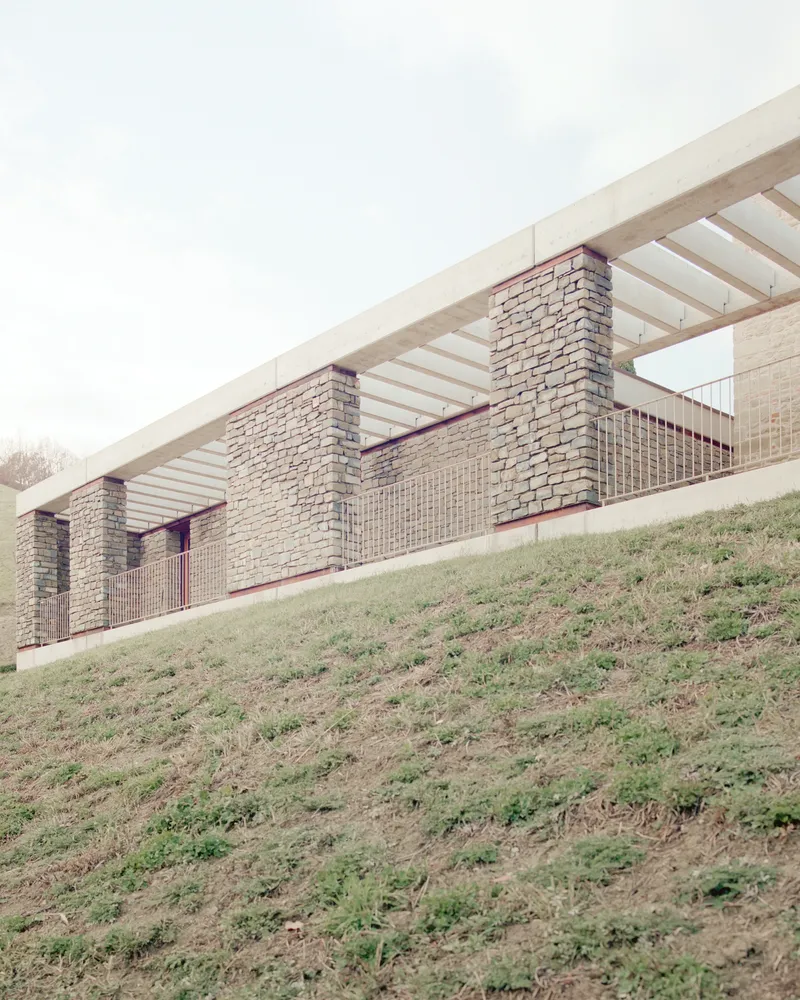
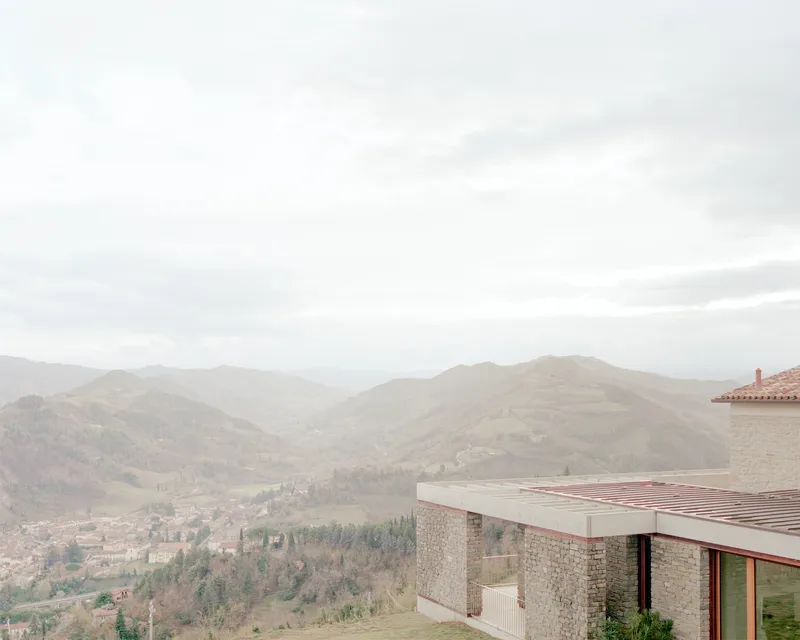
Seen from a distance, the compound barely registers against the rolling terrain. The linear volume tucks itself into the hillside, its flat roof and stone cladding keeping the profile low while cypress trees punctuate the skyline around it. The original stone house, with its pitched tile roof, acts as a vertical anchor; the new extension defers to this height, spreading laterally instead. A flat concrete overhang marks the threshold where constructed ground meets natural slope, and the layered stone walls below it appear almost geological.
The siting is deliberate. The buildings are scattered across the property as four distinct footprints rather than consolidated into a single mass, which preserves the character of an agrarian hamlet and avoids the problem of a single oversized volume on a small hill. Each piece holds its ground independently while the spaces between them, gardens, terraces, paths, do the real compositional work.
The Stone House as Anchor

The existing two-storey stone house is the project's gravitational center. Its facade is spare: narrow windows punched through thick masonry, a small balcony tucked beneath the roofline. There is nothing picturesque about it; this is a working building that has simply been maintained with care. The brick facade of what appears to be the former barn carries a timber slatted canopy that signals the shift toward the newer interventions without abandoning the material register.
Structurally, the elevated portions of the new volume rest on stacked stone columns and concrete soffits that step across the sloped terrain. These piers are handlaid, clearly not machine-cut ashlar, and their irregularity gives the structure the tactile honesty that distinguishes good rural architecture from mere countryside cosplay.
The Covered Terraces

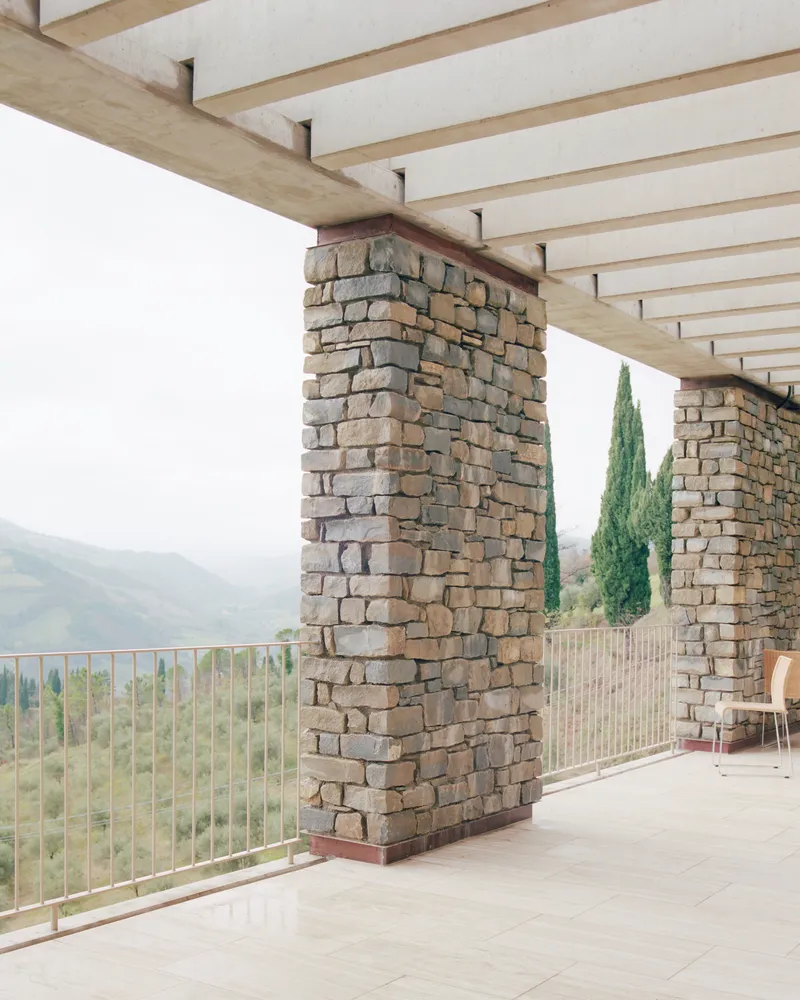
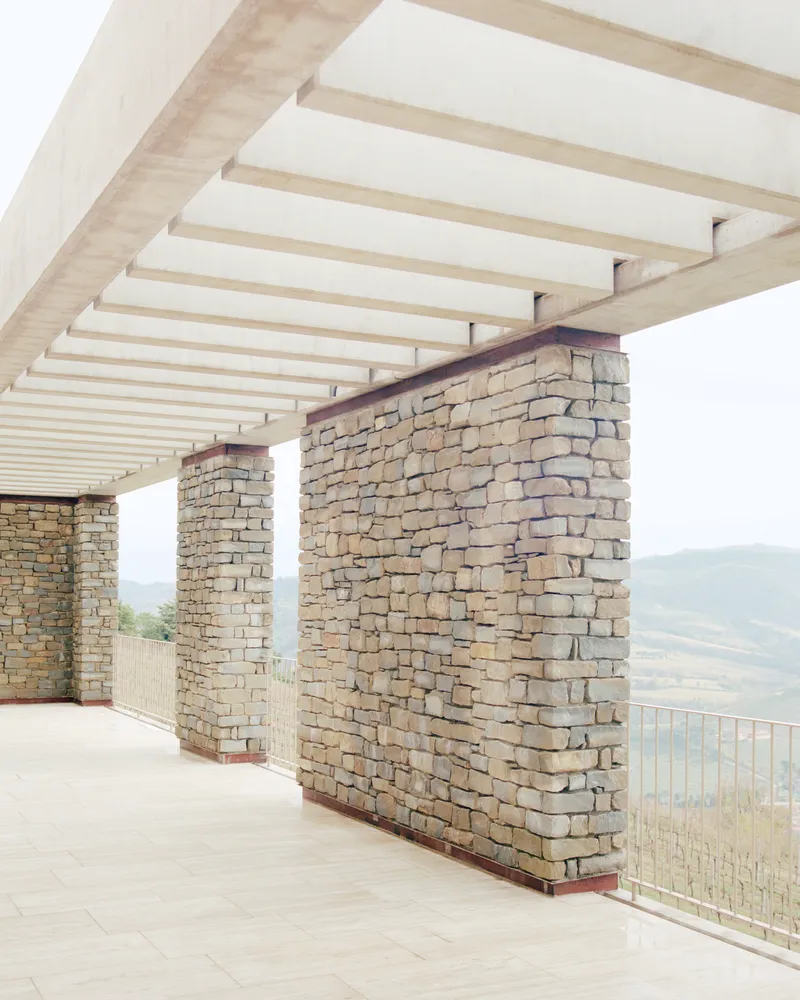
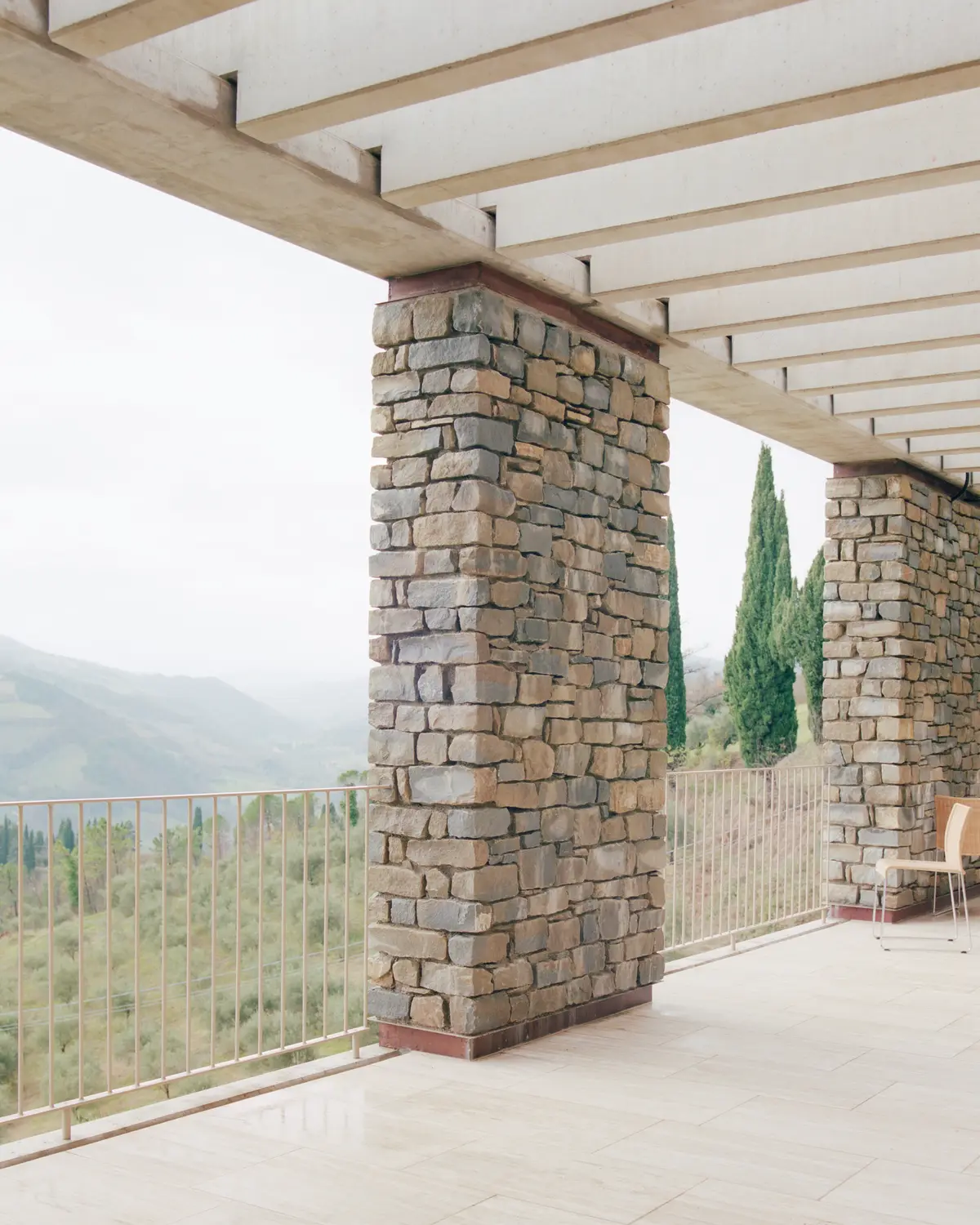
If the house has a signature moment, it is the covered terrace. Stone piers support exposed timber beams and joists that run overhead, creating a rhythm of shade and filtered light. The view is the Emilia-Romagna valley in full recession: fields, ridgelines, haze. The timber battens overhead do not try to mimic a pergola's romance; they are structural members doing structural work, and their spacing produces a crisp pattern of shadow on the stone floor.
From the flat roof terrace above, the same valley unfolds with even less mediation. Timber decking and low battens frame the panorama without railings or glass, a move that only works because the parapet height is generous enough to feel safe while staying invisible from the approach. It is one of the quietest roof terraces you will find in recent Italian residential work, and that restraint is the whole point.

Interior: Timber, Light, and White Walls
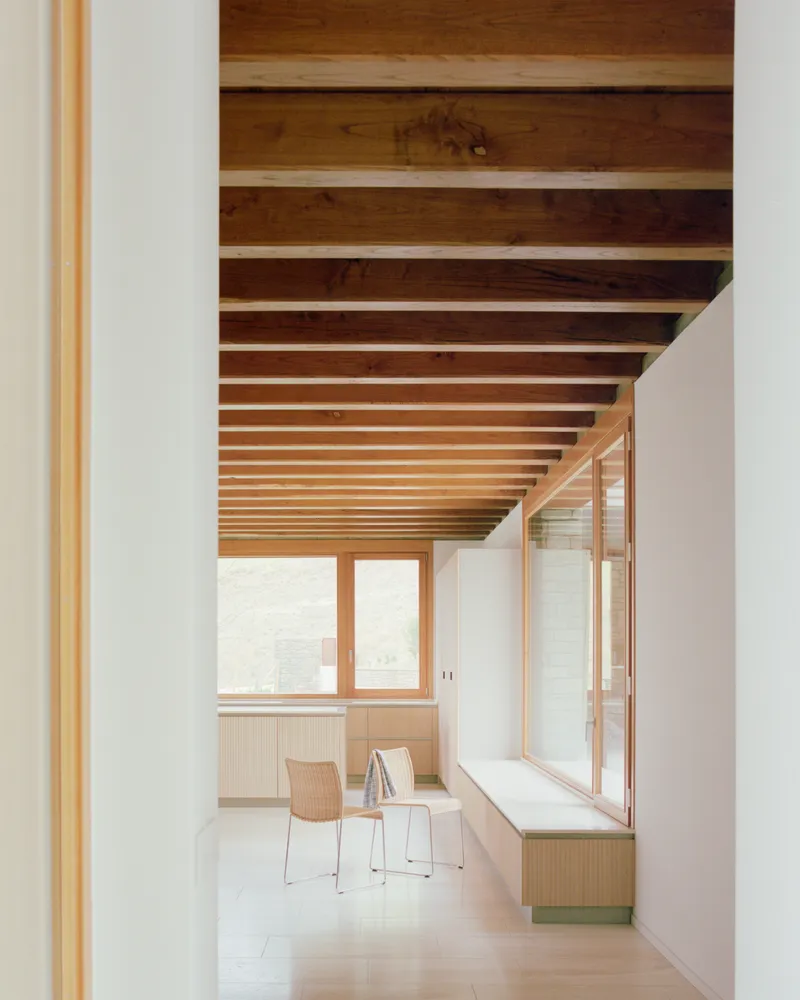
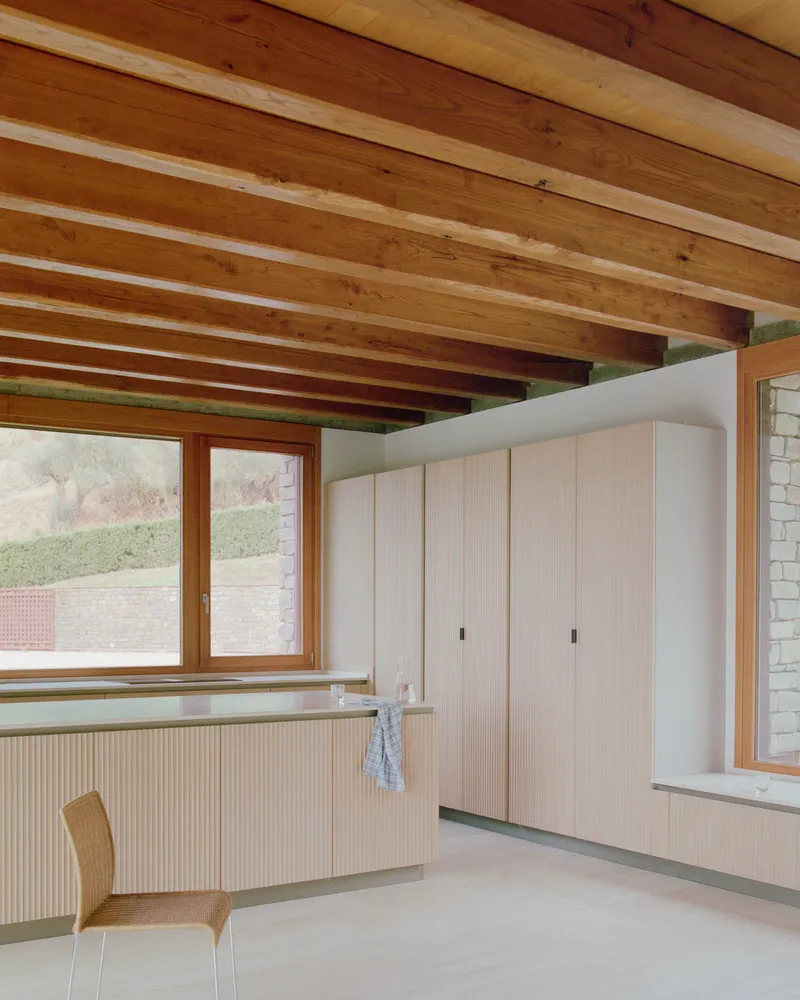
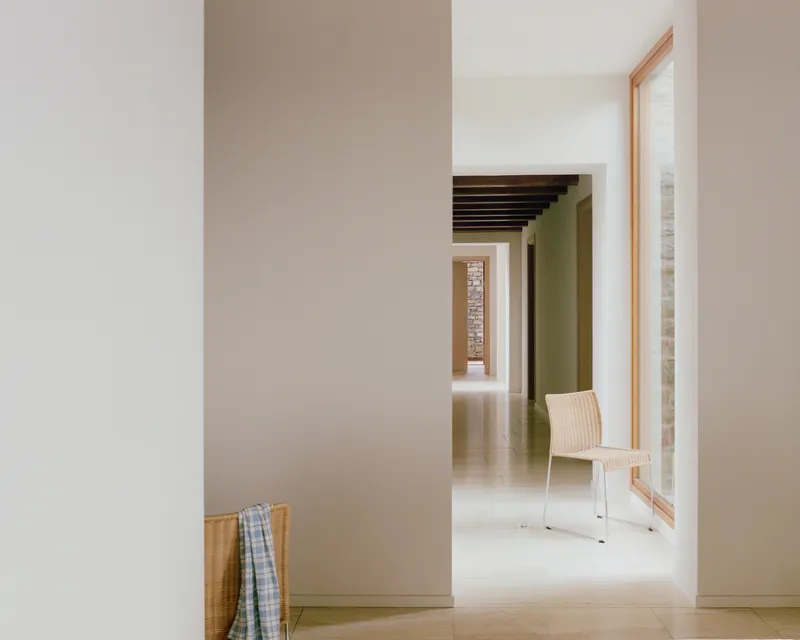
Inside, ellevuelle architetti strip the palette back to three elements: exposed timber ceiling beams, white plaster walls, and pale wood joinery. The hallway on the ground floor is a lesson in controlled daylight: a window bench catches soft light from the side, and the corridor terminates in a stone column visible through layered doorways. There is a deliberate avoidance of the open plan here. Rooms are rooms, connected by thresholds that frame views rather than dissolving boundaries.
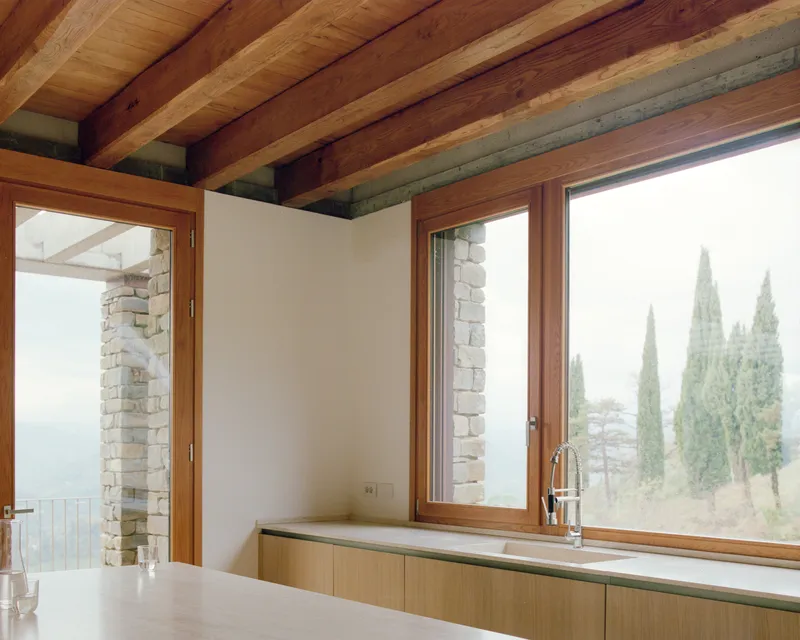
Built-in cabinetry along the walls reads as furniture rather than architecture, keeping the interiors from feeling overly resolved. The kitchen continues this approach: timber base units sit below windows that frame cypress trees in the misty landscape beyond. The countertop meets the glass at a height that makes cooking and looking outward simultaneous activities, a small detail that says more about the architects' understanding of domestic life than any grand spatial gesture could.
Vertical Connections
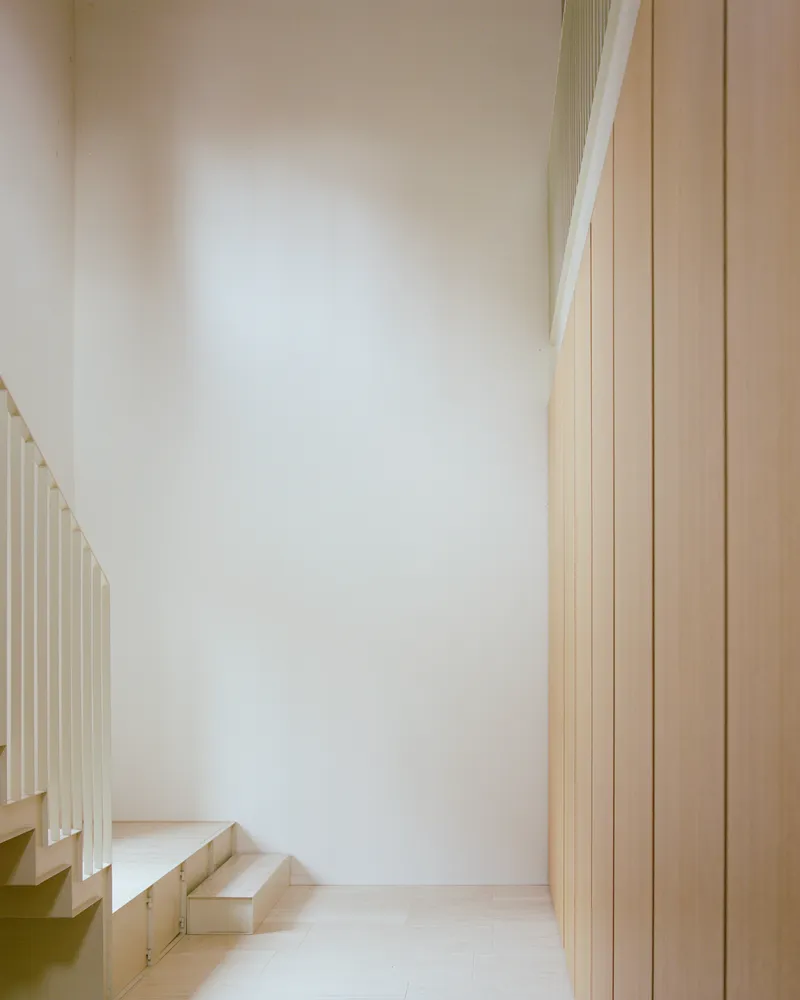


The stairwell is one of the project's most carefully composed sequences. Pale stone steps ascend past vertical wood paneling and white plaster in a tight section that forces you to look up. At the top, a double-height space opens with exposed timber beams overhead and a white metal balustrade that traces the edge of the upper floor. The railing is deliberately thin, almost graphic, so that the timber structure above reads as the primary element.
From below, the upward view through the balustrade and into the ceiling planking is one of those moments where the construction logic becomes the ornament. The beams are not decorative; they span real distances and carry real loads. Their spacing creates a pattern that the architects clearly calibrated with an eye to proportion, but the honesty of the system is what keeps it from feeling contrived.
Material Detail
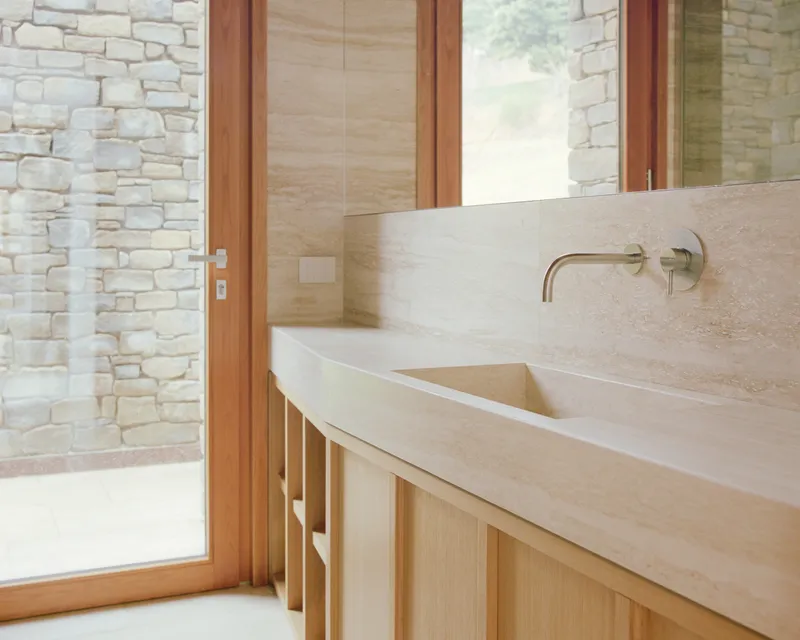
The bathroom distills the material strategy to its essence. A vanity carved from pale stone with an integrated sink sits beside a stacked stone wall, and timber cabinetry provides the only warm surface. There is no tile, no glass mosaic, no marble slab posing as luxury. The stone is local, the joinery is precise, and the combination feels inevitable rather than designed. It is a room that would be equally at home in a renovated farmhouse or a contemporary gallery, which is exactly the ambiguity the architects seem to be cultivating throughout.
Plans and Drawings
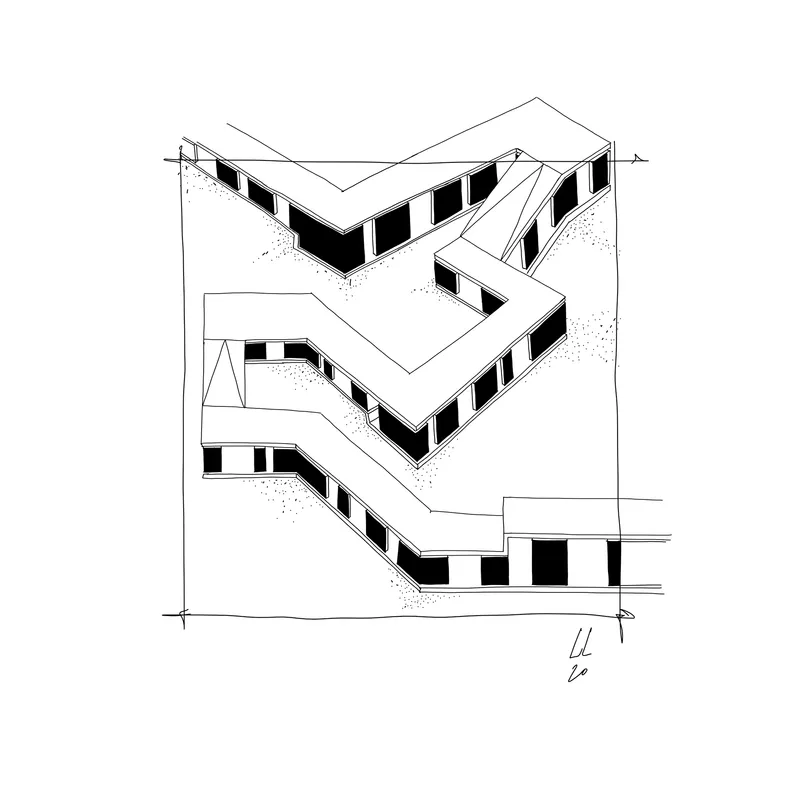
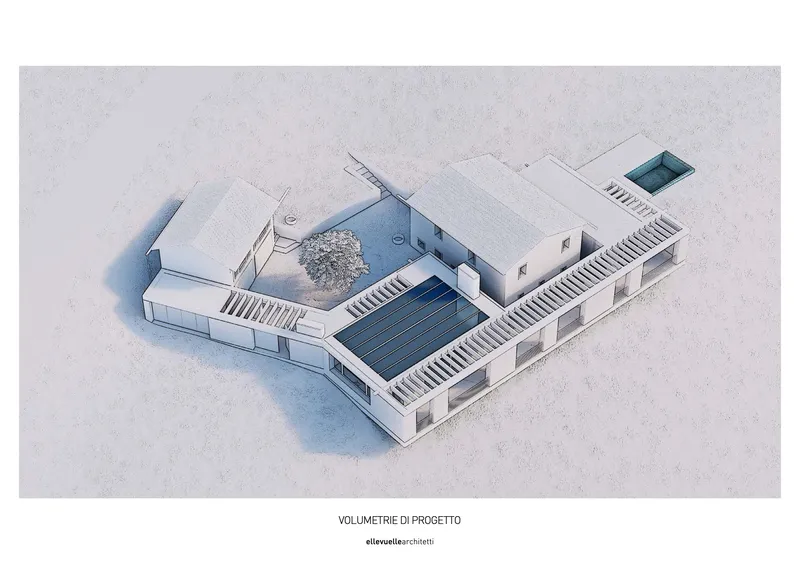
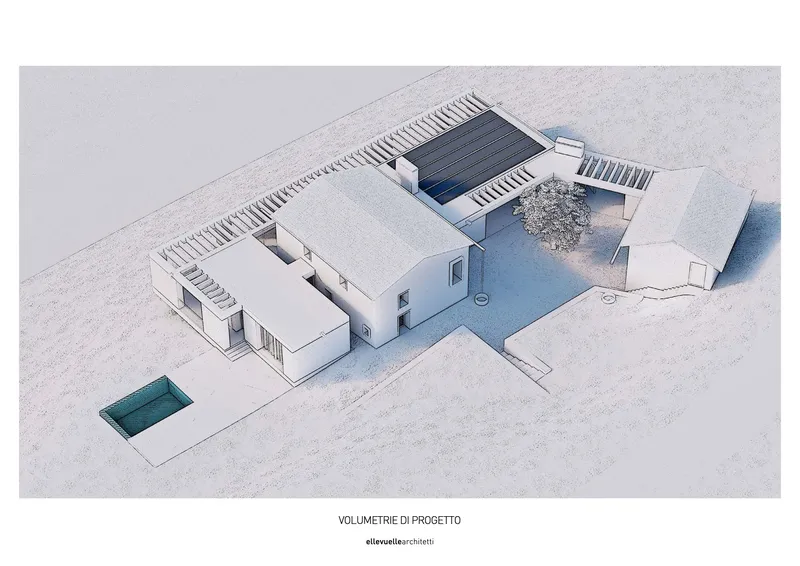
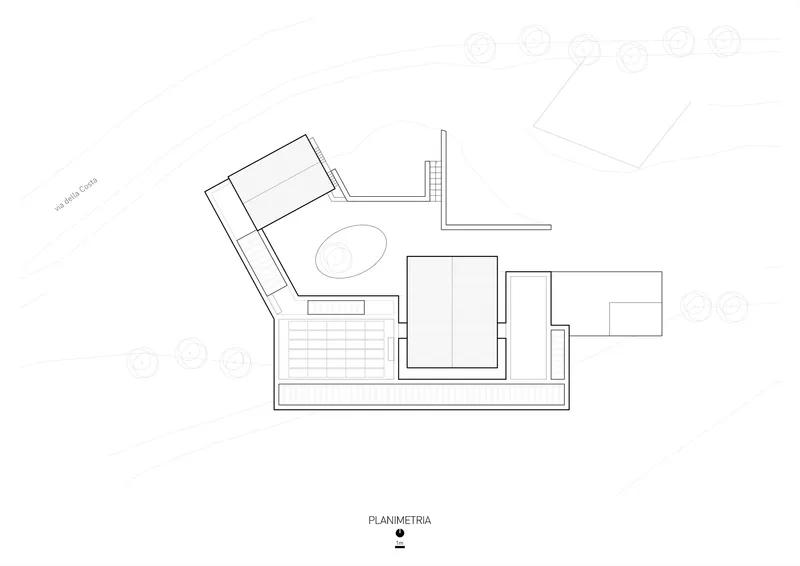
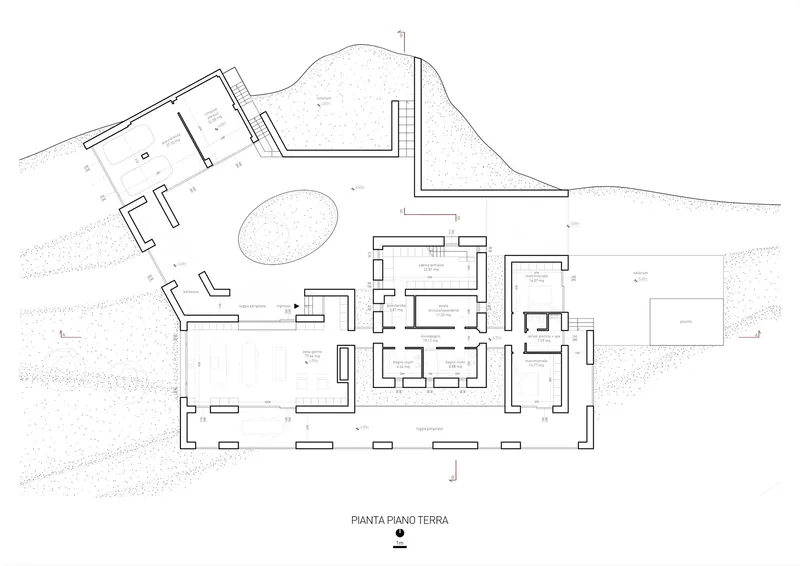
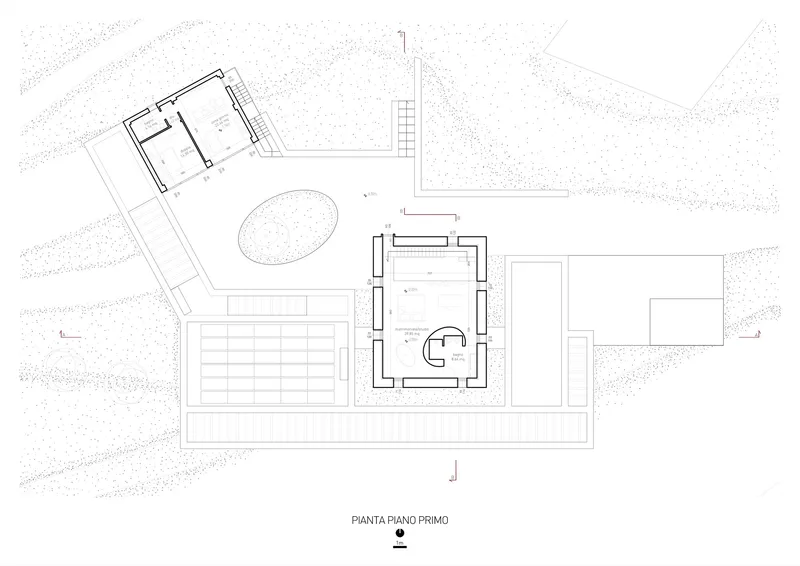
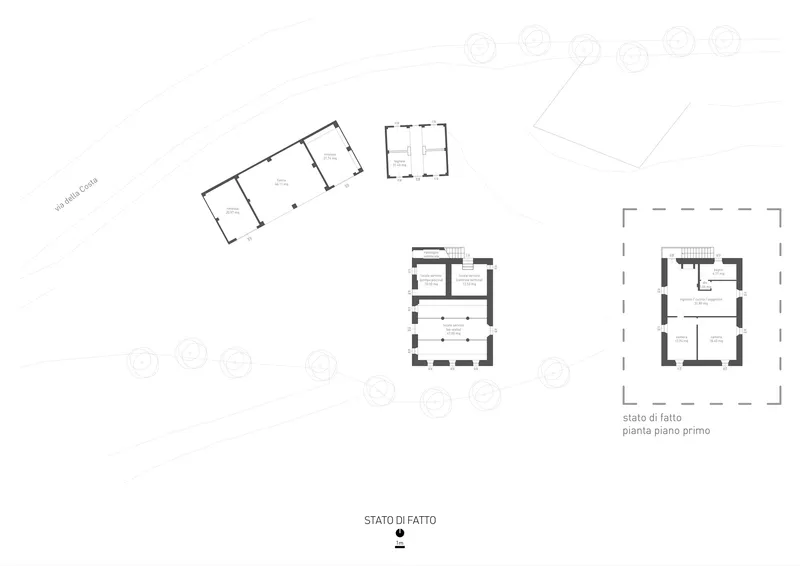
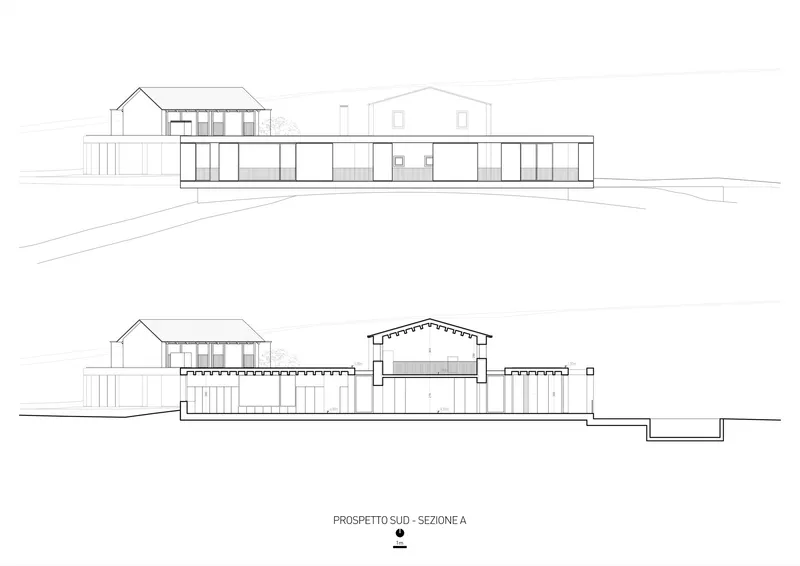
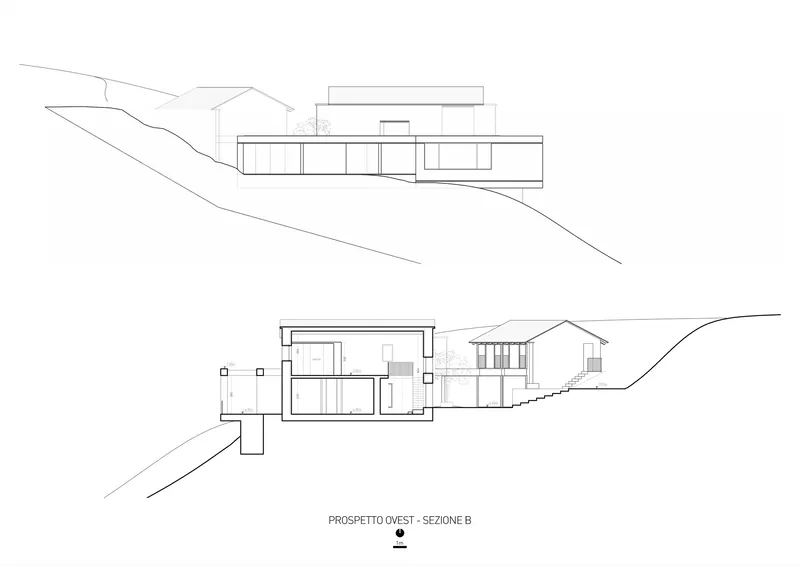
The drawings reveal what the photographs only hint at: the compound is not one building but a constellation of four volumes organized around a central courtyard with an oval pool. The axonometric views show pergola-covered walkways connecting the volumes, creating a circuit that turns circulation into outdoor living. Solar panels sit discreetly on one roof, and the courtyard hosts a single tree, a compositional anchor for the whole ensemble.
The sections are particularly instructive. One shows the new horizontal volume with glazed openings and a gabled form rising above it, clarifying the relationship between the flat extension and the pitched original. The other section illustrates how the building steps across the slope, each level finding its own grade. The ground floor plan shows the oval pool engaging with topographic contours, while the first floor plan includes a spiral staircase that links the upper levels of the compound. These are not diagrams dressed as architecture; they are evidence of a project worked through in section from the very beginning.
Why This Project Matters
Rural refurbishment in Italy is a genre burdened by cliché. At one extreme, stone houses get gutted and replaced with white minimalist interiors that could be anywhere. At the other, preservation nostalgia keeps everything intact while rendering the spaces unlivable by contemporary standards. ellevuelle architetti have found a middle path that is neither nostalgic nor amnesiac. They use local stone and timber not as costumes but as structural systems, and the new volumes are legible as new without being aggressive about their modernity.
Effevu House also demonstrates something increasingly rare: the value of the small compound over the single large house. By distributing the program across four footprints, the architects preserve the social and spatial logic of the original farmstead while giving every room a relationship with the landscape that a consolidated plan could never achieve. It is an argument for patience, for reading a site's existing intelligence before imposing a new one, and it is convincingly made.
Effevu House by ellevuelle architetti. Modigliana, Italy. Completed 2025. Photography by Simone Bossi.
About the Studio
Share Your Own Work on uni.xyz
If projects like this are the kind of work you want to make, uni.xyz is a place to publish your own, find collaborators, and enter design competitions.


Popular Articles
Popular articles from the community


LT2A and OPEN Architectes Thread a Brick and Glass High School Through a Wooded Belgian Campus
In Braine-l'Alleud, a 3,000 m² wing for Collège Cardinal Mercier pairs pale brick with a glazed colonnade, deferring to a small chapel and a dense wood.

Juan García Correa, John González and Claudia Rueda Sink a Circular Amphitheater into a Manizales Engineering Building
On the La Nubia campus in Manizales, Colombia, the S1 Building folds labs and offices into a hillside of ramped lawns that double as a campus route.

Architekt Andreas Gruber Scatters 23 Dark Timber Chalets Across a South Tyrolean Forest Edge
In Molini di Tures, Amonti Chalets breaks a resort into a hamlet of gabled timber houses, with parking, storage and services pushed into the slope.

David Ortega Stacks a Two-Story Mexico City Penthouse Around a Steel Stair and a Pergola-Shaded Roof Terrace
In Colonia Roma, a 300 m² penthouse uses oak joinery, a planted steel stair and a slatted roof pergola to make a new-build apartment feel like a house.

Similar Reads
You might also enjoy these articles


LAVA Architecten Gives Vocational Education a Sawtooth-Roofed Face on a Mechelen School Campus
In Mechelen, Belgium, a 2,053 m² STEM school on a 6×6 m grid turns workshops and classrooms into rooms that can be rearranged as teaching changes.

KEMA Studio Turns a Derelict Marvila Attic into a 60 m² Lighthouse Apartment Above Lisbon
In Lisbon's Marvila district, a rebuilt roof, four skylights and two plywood volumes turn an unlivable attic into a bright home facing the Tagus.

Pixel Gardens: One Repeated Module Stacked Into a Terraced Social Housing Tower for Famagusta
Salem Bader's shortlisted housing tower builds a vertical neighbourhood from one repeated module, offsetting units to carve terraces, light and air.

Bao Huynh Watercolor Atelier: A Serene Art Retreat in Hội An
Bao Huynh Watercolor Atelier in Hội An blends multifunctional art spaces, sustainable design, local materials, and family-friendly living in a serene environment.

Comments (0)
Please login or sign up to add comments
No comments yet. Be the first to comment!