
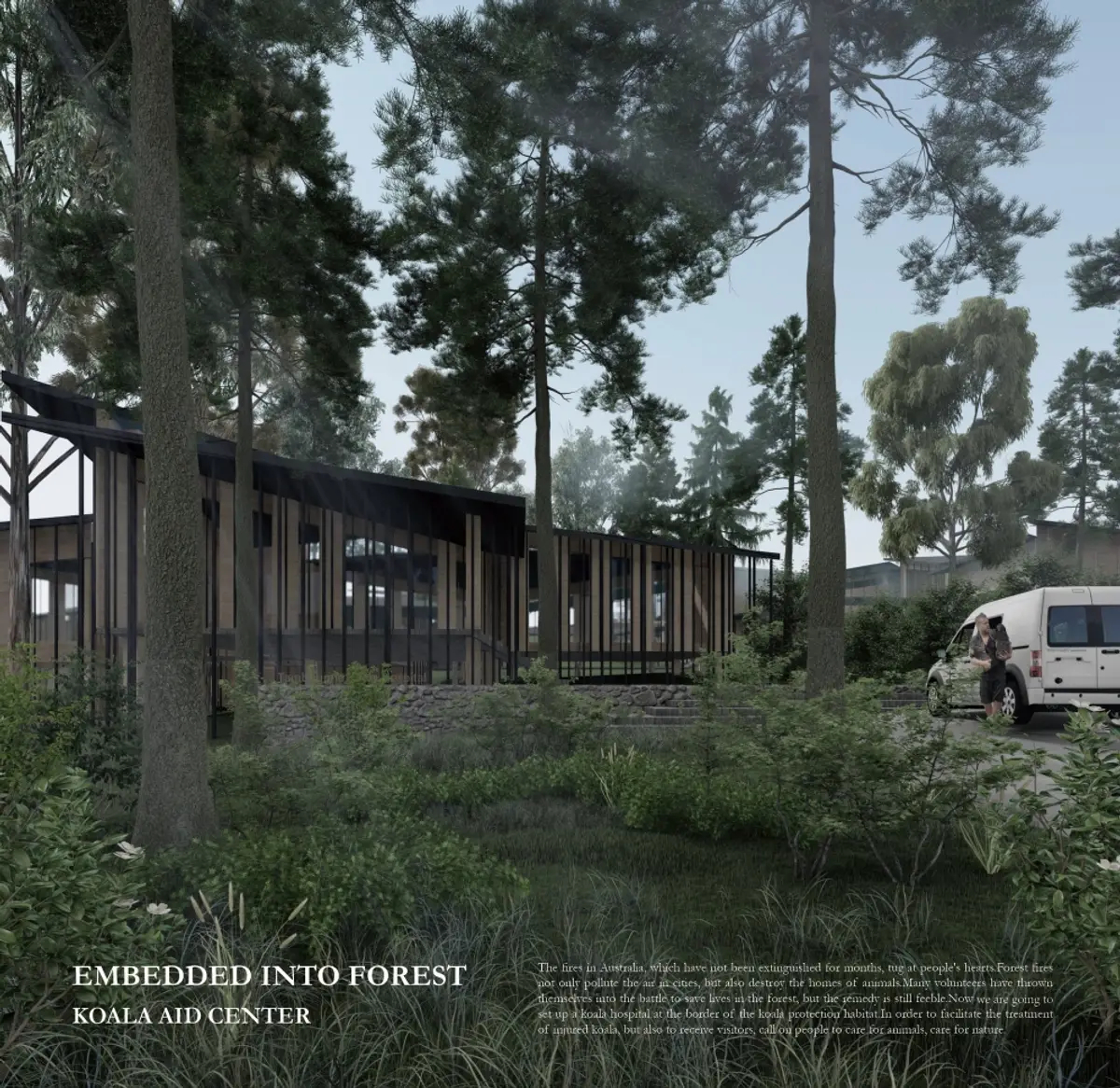
Embedded into Forest: Koala Aid Center | A Sustainable Wildlife Architecture for Conservation and Care
A sustainable wildlife architecture project where forest, healing, conservation, and education unite to protect Australia's koalas.


As climate change, habitat destruction, and bushfires continue to threaten Australia's wildlife, architecture is increasingly being called upon to play a role beyond human habitation. The project "Embedded into Forest: Koala Aid Center" by LIU RUICHUN Rachel team, presents a compelling vision of sustainable wildlife architecture, creating a dedicated environment where conservation, rehabilitation, education, and public engagement coexist within a protected forest ecosystem.
Located at the border of a koala conservation habitat, the project establishes a specialized medical and rehabilitation facility for injured koalas while simultaneously creating opportunities for visitors to learn about wildlife protection and environmental stewardship. Rather than imposing a building onto nature, the design carefully embeds itself within the existing forest, allowing architecture and landscape to function as a unified ecological system.
Editor's Choice entry ofHaven 2020
Rethinking Wildlife Conservation Through Architecture
The decline of koala populations across Australia has highlighted the urgent need for integrated conservation infrastructure. Traditional wildlife facilities often prioritize medical treatment while overlooking the importance of public awareness and habitat restoration.
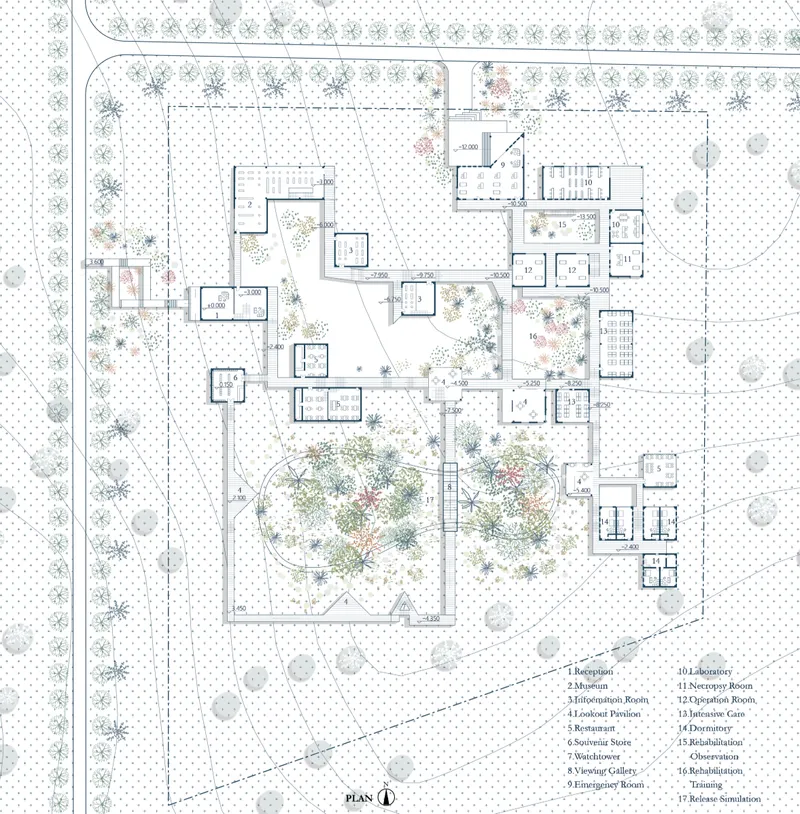
The Koala Aid Center addresses these challenges through a holistic architectural strategy. It combines a veterinary hospital, rehabilitation spaces, observation areas, educational facilities, and visitor amenities into a single ecological campus designed to support both animals and people.
By placing conservation activities within public view, the project transforms wildlife care into an educational experience, encouraging visitors to develop a deeper understanding of environmental responsibility.
Architecture Embedded Within the Forest
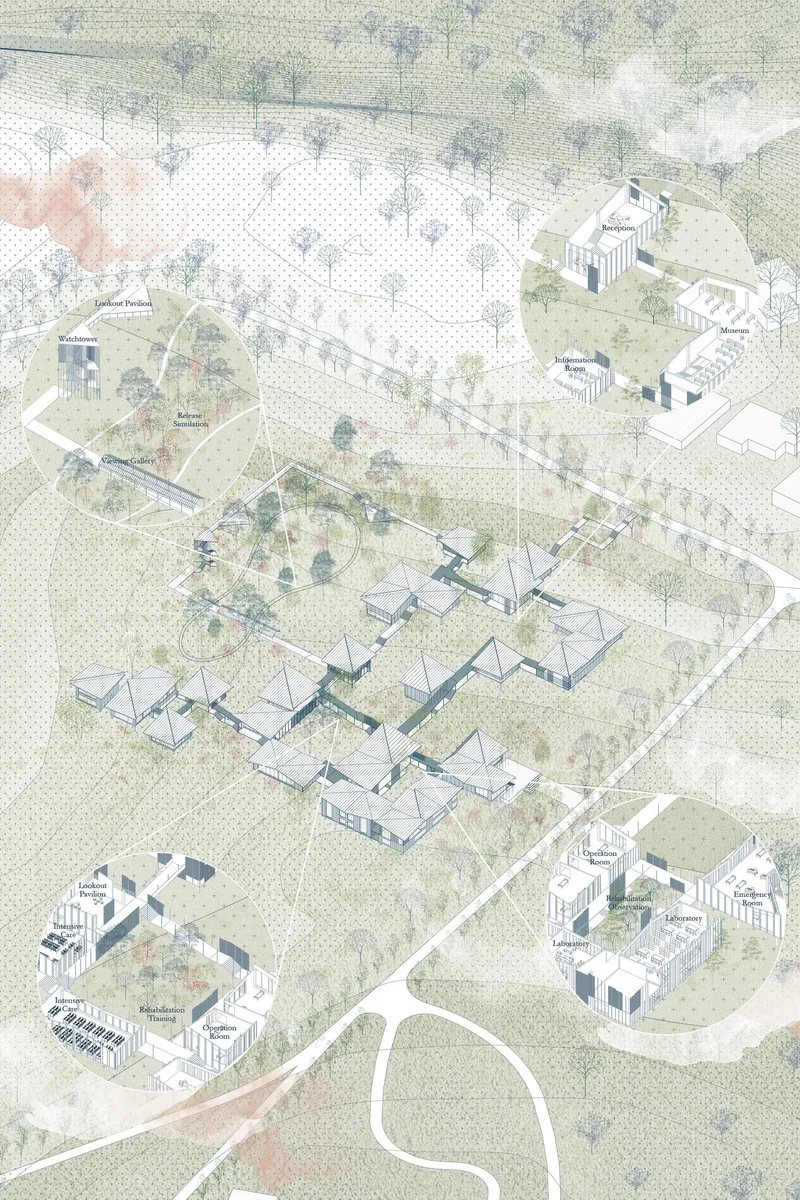
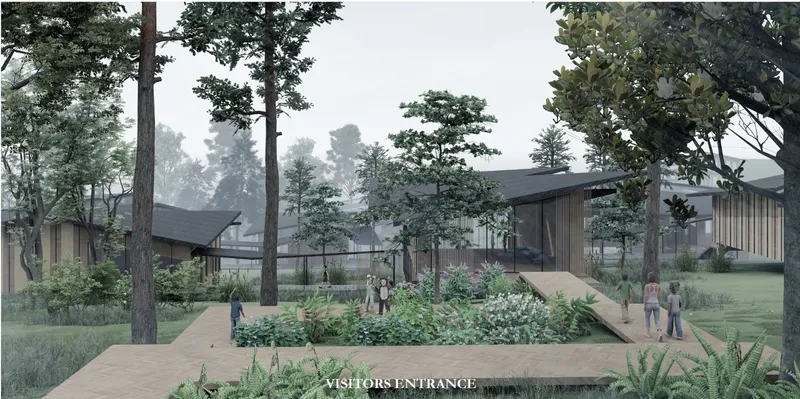
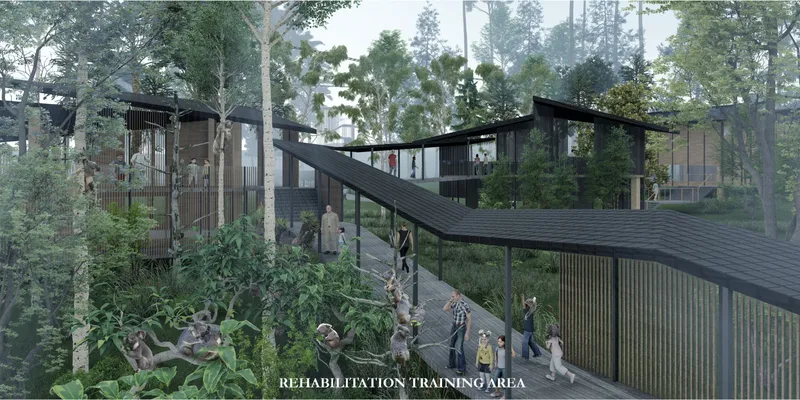
One of the most striking aspects of the proposal is its relationship with the surrounding landscape. Instead of clearing large areas of vegetation, the buildings are carefully dispersed throughout the site and connected by elevated pathways.
The architectural language follows the contours of the terrain, minimizing disruption to existing ecosystems. Low-rise pavilions with sloped roofs blend naturally into the forest environment, reducing visual impact while maximizing environmental performance.
The fragmented arrangement creates a village-like composition that allows wildlife habitats to remain uninterrupted between buildings. This approach ensures that the forest remains the dominant element of the site, with architecture acting as a supporting framework rather than the focal point.
A Healing Environment for Koalas
At the heart of the project lies a comprehensive veterinary and rehabilitation facility dedicated to the treatment of injured koalas.
The medical complex includes:
- Emergency treatment rooms
- Veterinary laboratories
- Observation areas
- Intensive care units
- Surgical operation rooms
- Rehabilitation facilities
- Training and release preparation spaces
The spatial organization follows the recovery journey of each animal. Koalas move through a carefully designed sequence of treatment, observation, rehabilitation, and eventual reintroduction into the wild.
This process-oriented design minimizes stress while creating optimal conditions for recovery and long-term survival.
Rehabilitation as a Public Learning Experience
A key innovation of the project is its integration of rehabilitation spaces with public observation routes.
Visitors can experience the rehabilitation process from designated viewing galleries and elevated walkways without disturbing the animals. These carefully controlled interactions transform the center into a living educational environment.
Through direct observation, visitors gain insight into:
- Wildlife rescue operations
- Veterinary care procedures
- Habitat conservation efforts
- Species recovery programs
- Ecological restoration strategies
The architecture acts as a bridge between humans and wildlife, fostering empathy and encouraging environmental awareness.
Educational Facilities for Conservation Advocacy
Beyond medical treatment, the center serves as a public institution dedicated to conservation education.
The project includes:
- A reception center
- Information rooms
- Exhibition galleries
- Museum spaces
- Viewing platforms
- Observation towers
- Educational programs
These facilities provide visitors with a deeper understanding of Australia's unique biodiversity and the challenges facing koala populations.
The museum and exhibition spaces document the ecological significance of koalas while highlighting the impacts of urbanization, climate change, and habitat fragmentation.
The Release Training Landscape
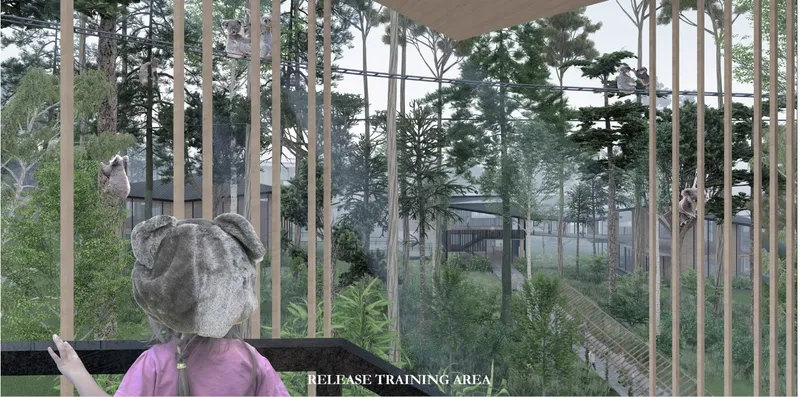
One of the most memorable components of the proposal is the release simulation environment.
Before returning to the wild, rehabilitated koalas are introduced to controlled outdoor environments that replicate natural habitat conditions. These spaces allow animals to redevelop essential survival behaviors while remaining under observation.
The release training landscape includes:
- Native vegetation zones
- Climbing structures
- Forest canopy pathways
- Protected observation points
- Transitional habitats
This intermediate stage improves the likelihood of successful reintroduction and reinforces the project's commitment to long-term conservation outcomes.
Sustainable Wildlife Architecture and Environmental Integration
The design demonstrates a strong commitment to sustainability through passive environmental strategies and ecological sensitivity.
Key sustainable features include:
Forest Preservation
Existing vegetation is retained and incorporated into the overall site planning strategy.
Minimal Site Disturbance
Distributed building volumes reduce the need for extensive excavation and land modification.
Natural Ventilation
Open circulation routes and carefully positioned structures maximize airflow throughout the campus.
Daylighting
Large openings and strategic orientation reduce dependence on artificial lighting.
Ecological Connectivity
The arrangement of buildings maintains habitat continuity for wildlife moving throughout the site.
Landscape-Based Design
Architecture works alongside natural systems rather than replacing them.
Together, these strategies position the project as an exemplary model of sustainable wildlife architecture.
Creating a New Relationship Between Humans and Nature
The Koala Aid Center is more than a hospital. It is an architectural statement about coexistence.
By integrating treatment, education, rehabilitation, and conservation into a single environment, the project encourages visitors to become active participants in protecting wildlife and natural ecosystems.
The design demonstrates how architecture can move beyond serving human needs alone and contribute meaningfully to ecological restoration and species preservation.
A Forest Sanctuary for the Future
"Embedded into Forest: Koala Aid Center" proposes a future where architecture becomes an instrument of environmental stewardship. Through sensitive site planning, immersive educational experiences, and dedicated wildlife care facilities, the project creates a sanctuary where humans and koalas can coexist in mutual respect.
As an Editor's Choice Entry of Haven 2020, the proposal by Rachel Team and LIU RUICHUN showcases the transformative potential of sustainable wildlife architecture, offering a powerful vision for conservation-focused design in an increasingly fragile world.


Popular Articles
Popular articles from the community

ALGAL REALM: A Bio-Integrated Lunar Habitat Design for Life Beyond Earth
ALGAL REALM reimagines lunar habitat design with algae-powered life support, 3D-printed regolith, and vertical living for a lunar future.

Play: Fragments of Their World
Familiar architecture becomes modular playground design, creating safe spaces where displaced children can learn, connect, imagine and play.

Co-Life: Senior Housing Design That Reconnects Older Adults With the City
Co-Life reimagines senior housing design through healing gardens, shared streets, workshops, and a sustainable community across generations.

Co-life: Sustainable Architecture for Age-Friendly Community Living
Co-life reimagines sustainable architecture for seniors through courtyards, rammed earth, shared gardens, and spaces designed for belonging.

Similar Reads
You might also enjoy these articles

Eco Chapel: A Green Architecture Pavilion Designed in Symbiosis with the Forest
Eco Chapel uses green architecture to weave prayer, learning and reuse into a forest pavilion shaped by modular hexagonal canopies for life.
Kaffeebühnen: Coffee Shop Architecture Designed as a Civic Stage Between Vienna’s City and Park
Kaffeebühnen turns coffee shop architecture into a civic stage, linking Vienna’s park edge, urban life, warm timber yards, and coffee craft.
Healing Façade: Sustainable Architecture for Reforestation, Community, and Sacred Ecology in Ethiopia
Healing Façade reimagines sustainable architecture as a living wall that restores soil, catches water and renews Ethiopia's forest churches.


Urban Forest: A Vertical Ecosystem for 5,000 Workers in Singapore's Changi Business Park
Radially stacked pods and layered green decks turn a 7-acre plot into 47 acres of ecological workspace projected for 2040.

Comments (0)
Please login or sign up to add comments
No comments yet. Be the first to comment!