
Plan Architects Office Builds a Color-Coded Multigenerational House in Yeongcheon
A house for three brothers in a dense South Korean neighborhood uses teal accents and layered volumes to carve out shared and private life.


Three brothers sharing one house is not the typical residential brief. It pushes domestic architecture into territory that is part commune, part compound, and entirely dependent on how well the building negotiates between togetherness and autonomy. In Yeongcheon, a mid-sized city in South Korea's Gyeongsang Province, Plan Architects Office took on that challenge and produced a house that treats the multigenerational program not as a constraint but as a spatial generator. The result is a white volume with a teal heart, slotted into a tight residential block and organized around a central courtyard.
What makes the project genuinely interesting is how it uses section rather than plan as its primary tool for managing privacy. Double-height spaces, mezzanines, and a rooftop terrace create a vertical gradient from shared to intimate. The ground floor is porous and communal. The upper levels fragment into bedrooms and private retreats. And a recurring turquoise ceiling soffit, visible from the street and the sky alike, threads through the whole building as a kind of chromatic glue, signaling where the family's collective identity lives.
A White Box with a Secret Color
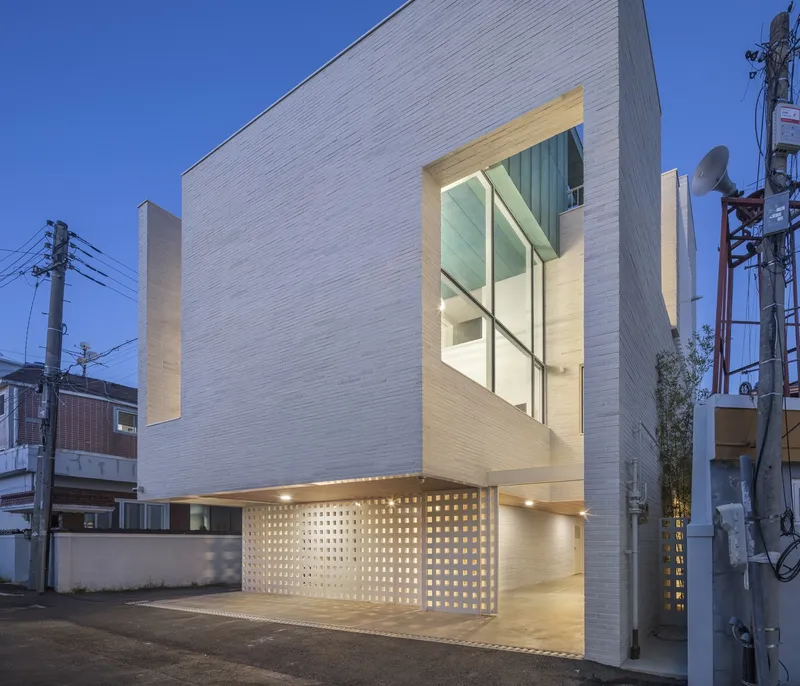
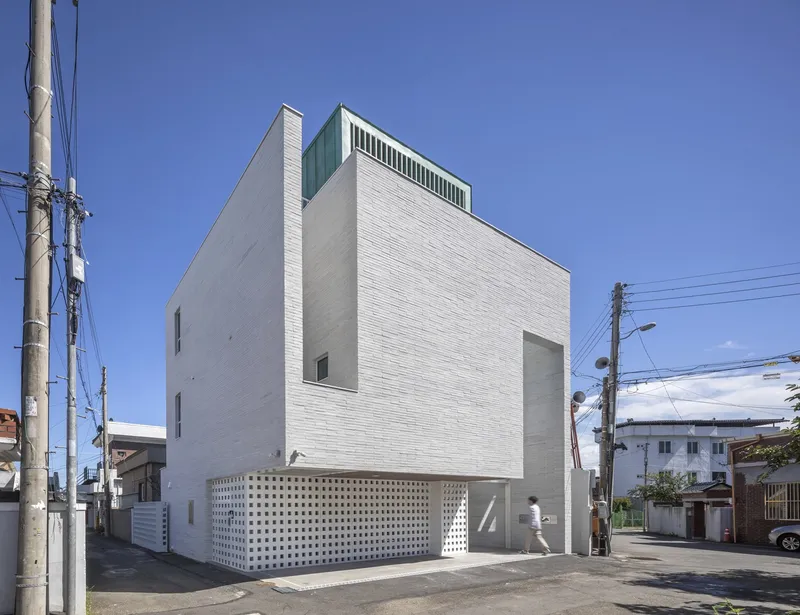
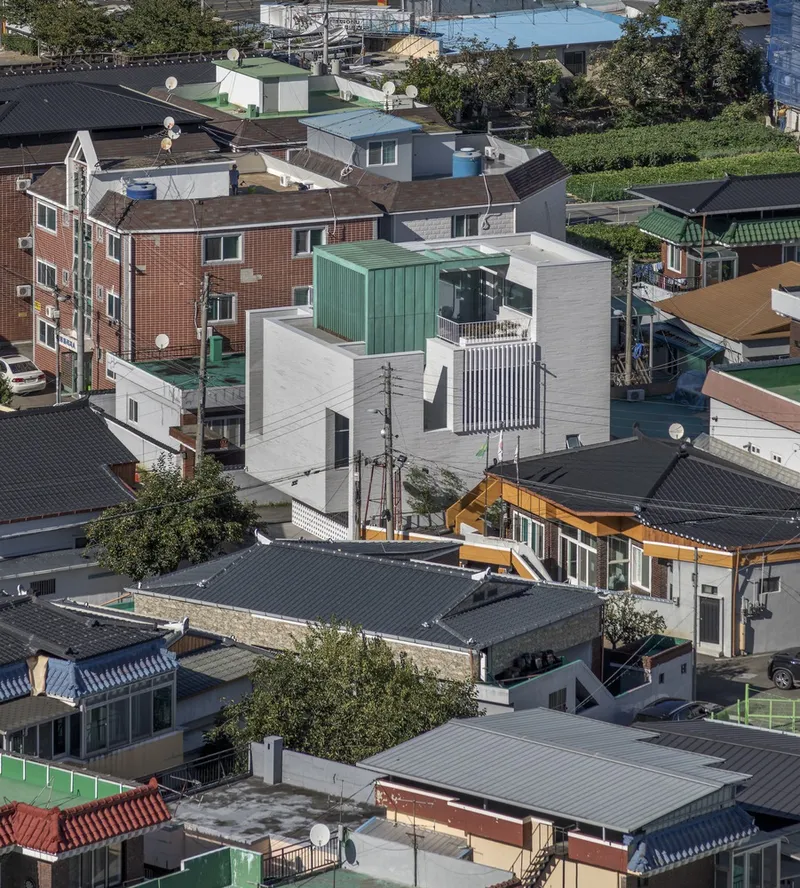
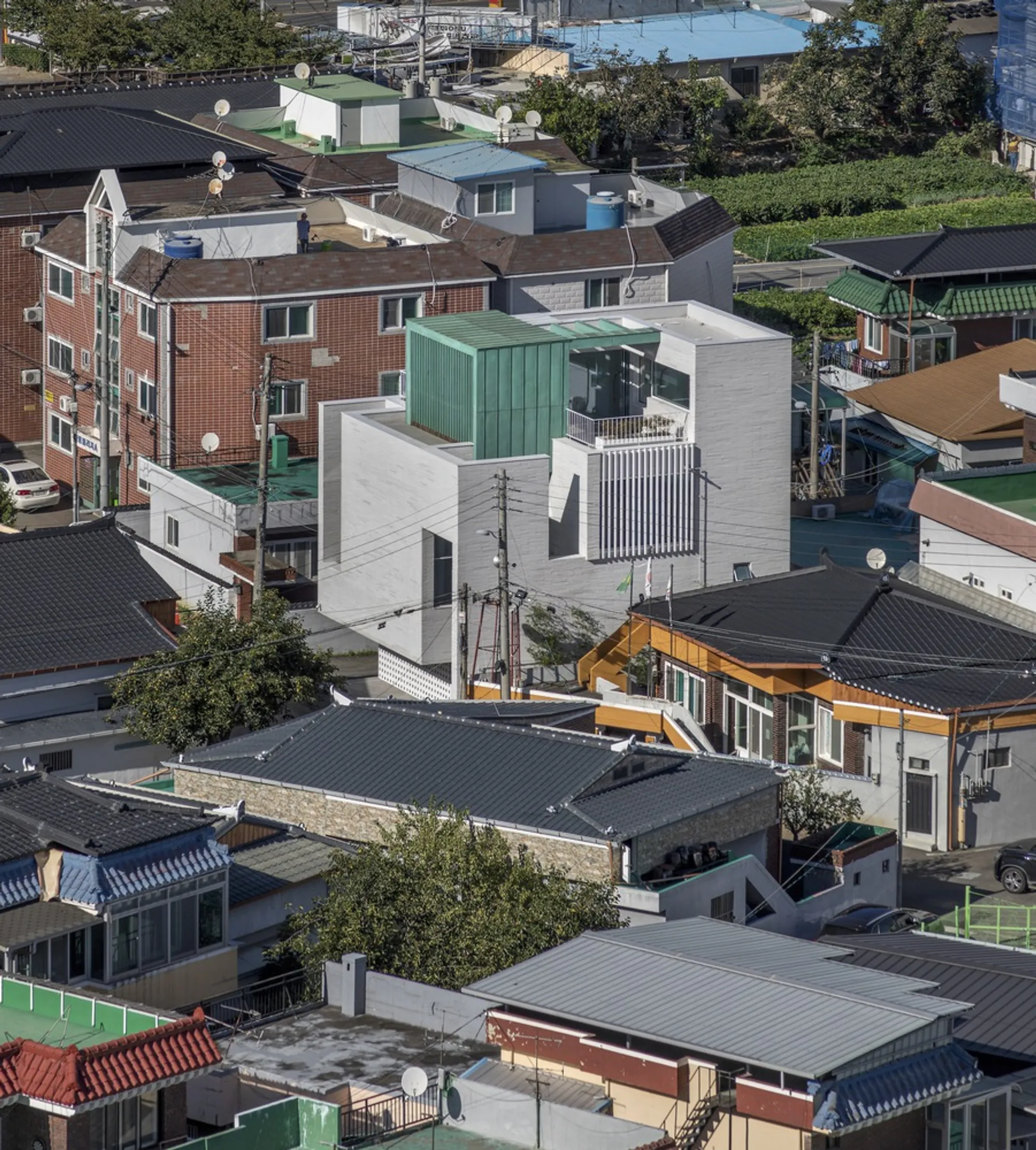
From the street, the house reads as a restrained white brick volume. Horizontal cladding and a perforated screen at the base give the facade a quiet rhythm without announcing anything extravagant. The base lets light bleed outward at dusk, hinting at activity inside while maintaining a degree of urban reserve. It is only from above, in the aerial view, that the turquoise rooftop enclosure reveals itself, a splash of color concealed from pedestrians but legible from the neighborhood's upper floors and the sky.
The perforated base is doing important work. In a dense residential fabric where setbacks are minimal and neighboring walls crowd in, it provides ventilation and filtered daylight to the ground level without opening the house to direct views. It is a practical screen that doubles as an identity marker, distinguishing the house from its stuccoed neighbors.
The Double-Height Living Core
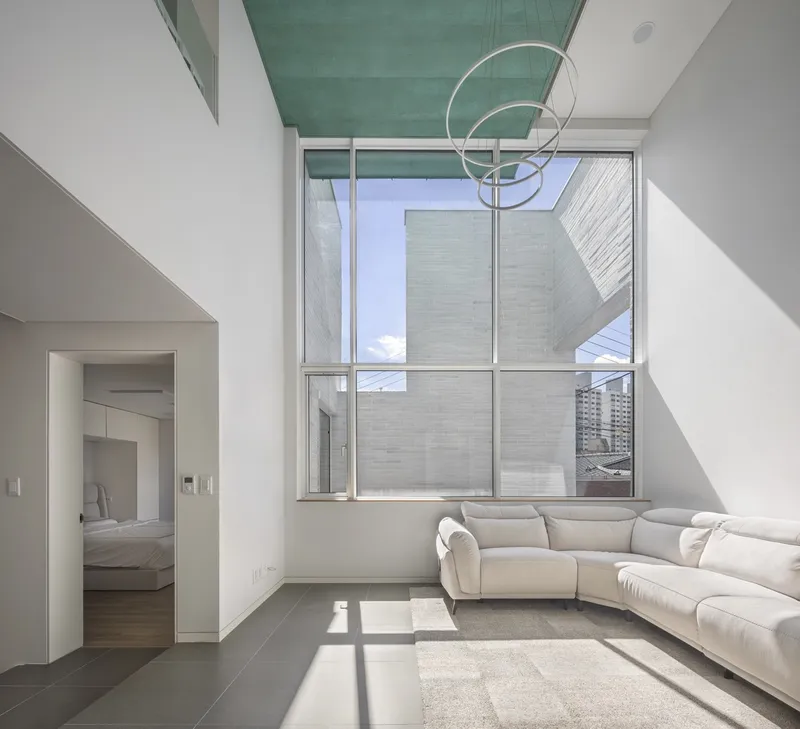
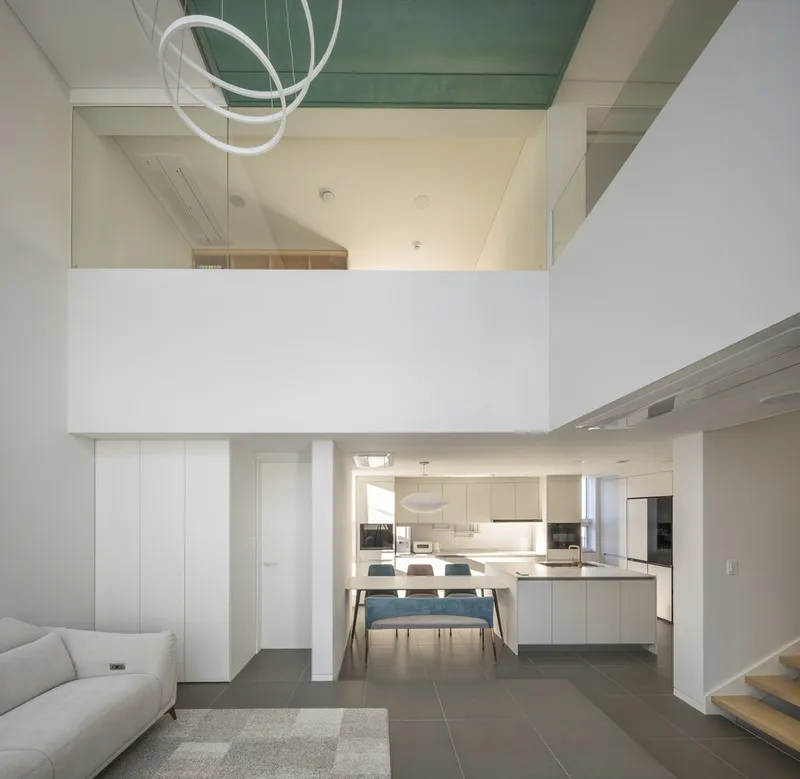
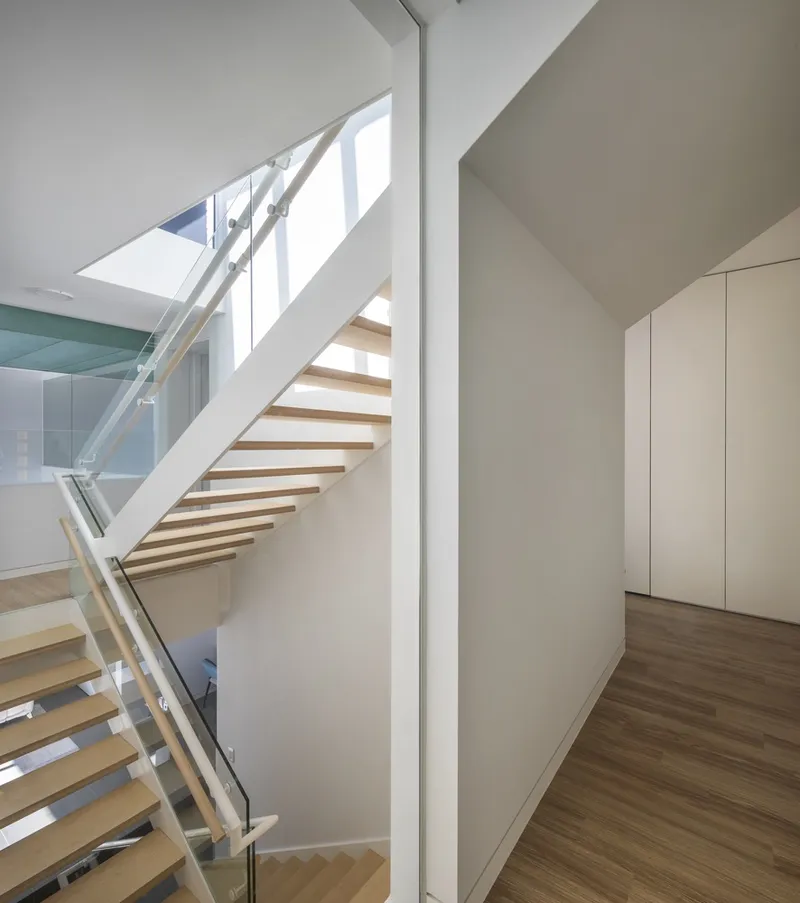
The heart of the house is a generous double-height living room that connects visually to the open kitchen, dining area, and mezzanine above. The teal ceiling panel hovers overhead like a canopy, marking this zone as the family's commons. Floor-to-ceiling windows on one side pull afternoon light deep into the volume, while the open timber staircase with glass railings rises through the space beneath a skylight, ensuring that even the upper landing feels part of the collective room below.
Sectional generosity is the real luxury here. Rather than distributing square meters evenly across identical floors, Plan Architects Office concentrated volume where it matters most, in the space where three families eat, talk, and coexist. The mezzanine overlook means a parent upstairs can glance down at children in the kitchen. The skylight above the stair bathes the vertical circulation in natural light, turning what could be a utilitarian shaft into the building's brightest moment.
Screens, Corridors, and Filtered Light
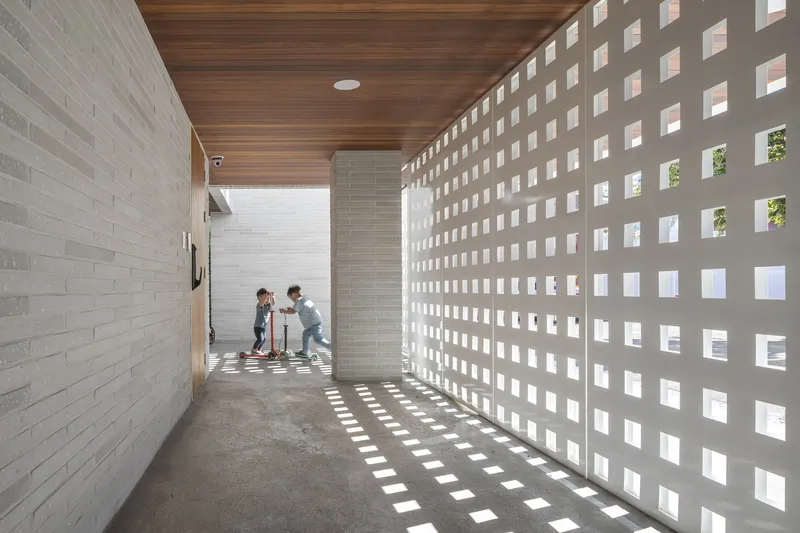
A corridor lined with perforated concrete blocks creates one of the house's most atmospheric moments. The grid of openings casts a shifting mosaic of light across the floor, transforming a simple circulation spine into a sensory event. It is a reminder that in tightly packed sites, borrowed light and pattern can substitute for the broad glazing that detached houses take for granted.
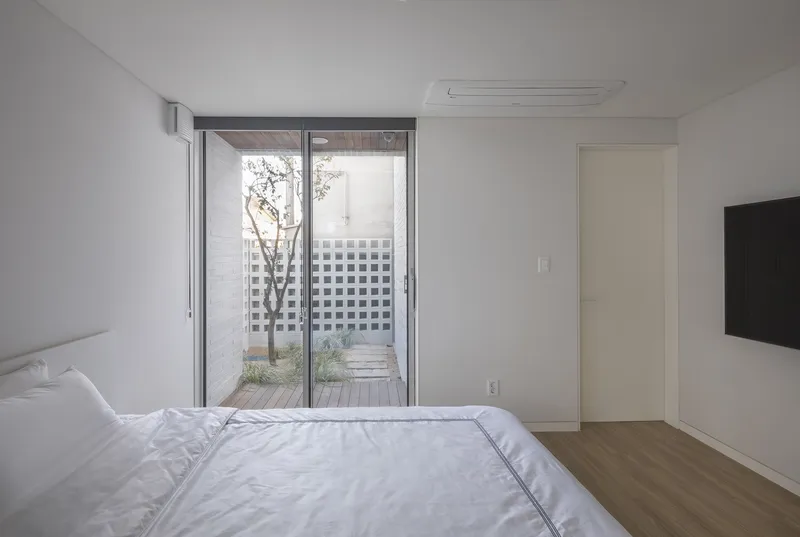
The same logic extends to the bedrooms. A sliding glass door opens from one bedroom to a small courtyard with a single tree and a lattice screen. The courtyard is tiny, but it delivers daylight, ventilation, and a sliver of nature to a room that would otherwise face a party wall. Plan Architects Office clearly understood that in a multigenerational house on a constrained site, every pocket of open air counts.
A Rooftop for Three Families
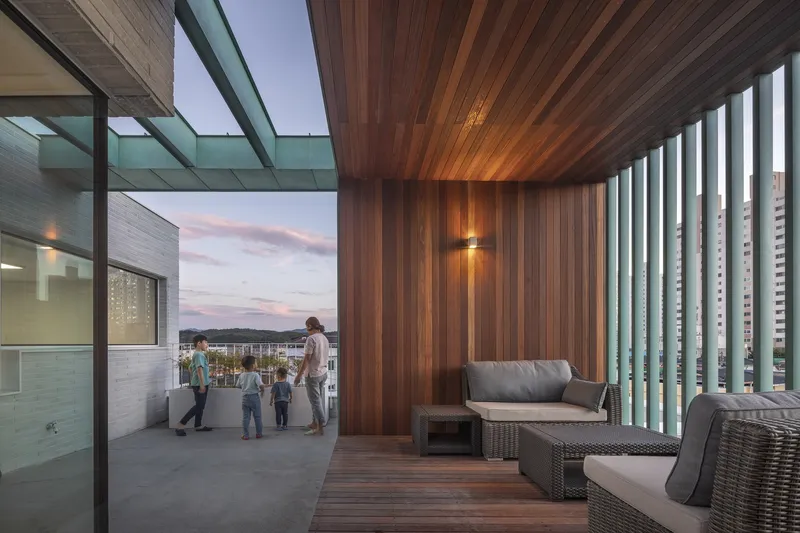
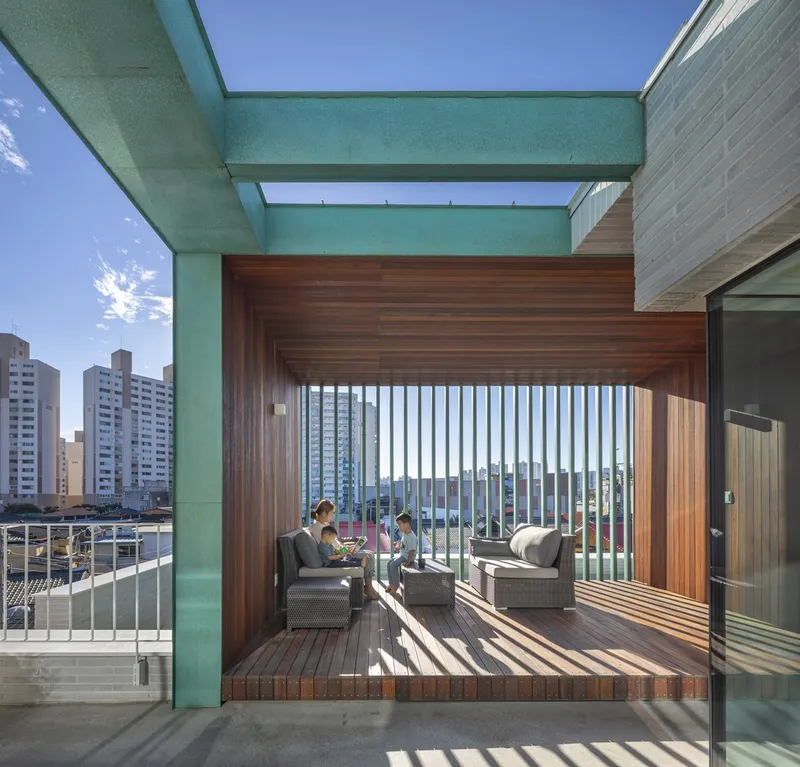
The rooftop terrace is the project's social release valve. Framed by vertical timber louvers and sheltered by a timber-clad ceiling, it offers a semi-outdoor room where the extended family can gather at dusk without leaving the building's footprint. The covered deck pavilion, with its teal-painted beams and seated figures, reads as a kind of domestic veranda lifted to the sky, an elevated version of the front porch culture still common in Korean rural towns.
Vertical louvers control views out toward the neighborhood while allowing breezes through. The timber warmth at the top of the building provides a material counterpoint to the white brick and concrete below, signaling that you have arrived at a more relaxed register. It is where the house exhales.
Spaces Scaled for Children
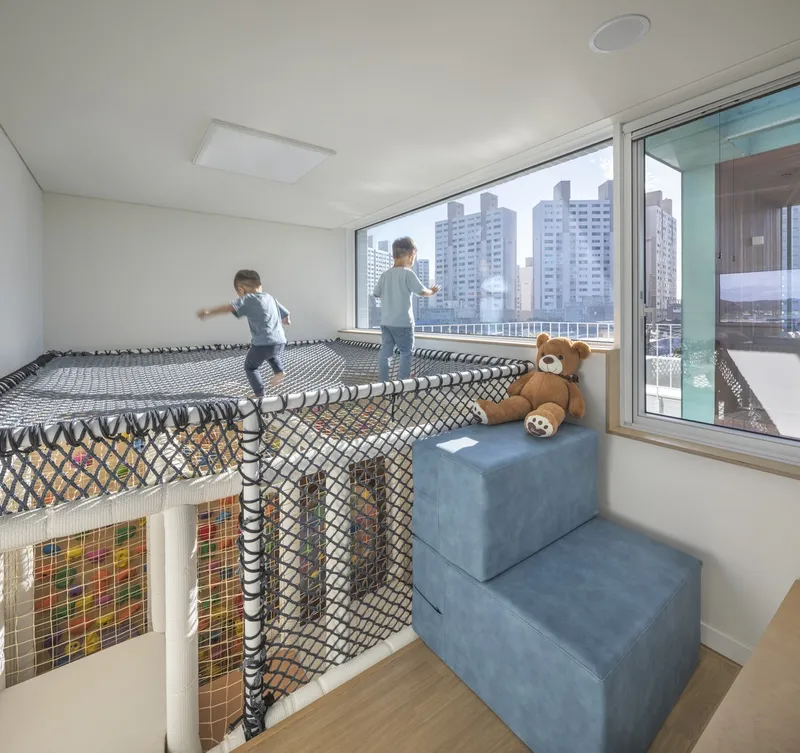
A play loft with rope mesh safety netting gives the youngest residents their own territory within the sectional stack. Two children are visible through glazed balcony doors, occupying a space that is both protected and visually connected to the rest of the house. The rope net is a smart, low-tech detail: it prevents falls while keeping sightlines open and avoiding the institutional feel of solid barriers.
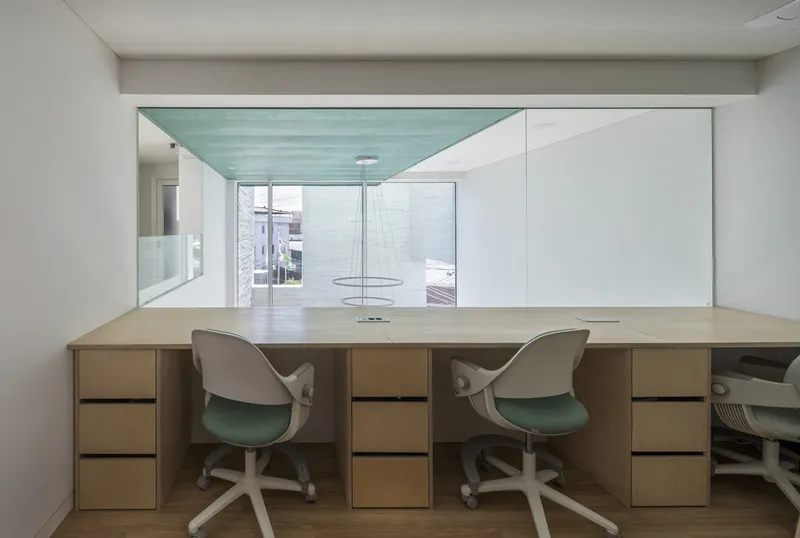
Elsewhere, a built-in desk with drawers and chairs faces a glazed opening capped by a turquoise ceiling panel, creating a study nook that belongs to the house's color family. These child-scaled moments suggest that the architects took the multigenerational brief literally, designing not just for adults who share a mortgage but for the different ages and daily routines that coexist under one roof.
Plans and Drawings
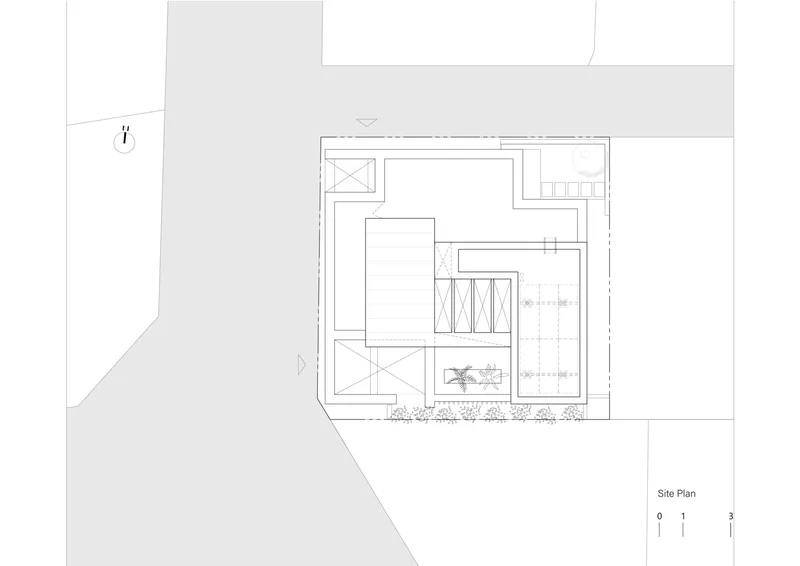
The site plan confirms the tight constraints. A rectangular building footprint sits within a diagonal site boundary, and a central courtyard punches light and air into the plan's center. The geometry is straightforward, a necessity on a lot this compact, but the courtyard placement is the key decision. It ensures that interior rooms on every side have access to daylight without relying solely on perimeter windows, which would face neighboring structures at close range.
Why This Project Matters
Multigenerational housing is increasingly discussed as a housing typology of the future, but most built examples rely on separate units stacked or placed side by side. The Yeongcheon house takes a more radical position: one building, shared spaces at the core, private retreats at the periphery and the top. It trusts that architecture can mediate family proximity without resorting to subdivision. That trust is evident in the open sightlines, the play loft visible from the mezzanine, and the rooftop terrace that belongs to no single household.
The project also demonstrates that color, when deployed with precision, can do serious architectural work. The teal ceiling panels are not decoration. They are wayfinding devices that mark communal zones and give the house a legible identity, both from inside and from the air. In a neighborhood of anonymous white and beige volumes, that chromatic signature is a small but meaningful assertion: this is one house for three families, and it is designed to feel like it.
Yeongcheon House of Three Brothers by Plan Architects Office, Yeongcheon, South Korea. Photography by Yoon, Joonhwan.
About the Studio
Share Your Own Work on uni.xyz
If projects like this are the kind of work you want to make, uni.xyz is a place to publish your own, find collaborators, and enter design competitions.


Popular Articles
Popular articles from the community


Hill & Cross Opera: Sculptural Opera House Architecture Shaped by Tallinn’s Landscape and Identity
Hill & Cross Opera reimagines opera house architecture in Tallinn through its sculptural hill, civic plaza, glass wave and a luminous cross.

Conexión: Biophilic Design Reimagines High-Rise Living in Hong Kong
Conexión reimagines high-rise living in Hong Kong through biophilic design, green facades, shared spaces, daylight, water and nature within.

The Ocean Hive: Sustainable Architecture for a Self-Sufficient Civilization at Sea
The Ocean Hive imagines sustainable architecture at sea, where modular habitats, algae, wave power and ocean waste sustain a growing colony.

The Musturak Paradise: Senior Living Architecture for a Connected Future in Temara, Morocco
The Musturak Paradise reimagines senior living architecture in Temara via private homes, social spaces, culture, community, and shared care.


Similar Reads
You might also enjoy these articles


Hodi-Mandai Geram
Project Function: Preservation and revitalization of the Intangible heritage and socio-spatial identity of the Hodi by Housing, Cultural Memory Center, Sacred Grove, landscape, local tourism economy


Olio Towers: A Mid-Rise for Performers That Fuses Housing, Rehearsal, and Stage
Located blocks from Houston's Theater District, this modular tower stacks living units around a central performance atrium.

Oasis: Modular Green Housing Carved into Dhaka's Urban Fabric
A shortlisted Plugin Housing entry reclaims unauthorized settlements in Dhaka with stepped concrete volumes, green roofs, and ventilation-driven design.

Black Hole: A Floating Megastructure for the Post-Physical Era
Emiliano Mazzarotto envisions a spherical, self-scaling arena where e-sports, digital hotels, and holographic stadiums replace traditional public space.

Explore Architecture Competitions
Discover active competitions in this discipline



Challenge to reimagine the Iron Throne


Photograph architecture without architects


Illustrate the lost glory of Angkor Wat - Render Challenge


Design challenge to reuse E-waste
Comments (0)
Please login or sign up to add comments
No comments yet. Be the first to comment!