
Ephemeral Living: Reversible Architecture for India's Pilgrimage Landscapes
A thesis project proposes modular, cyclical architecture that assembles for pilgrims and dissolves back into the land when they leave.


Every year, millions of pilgrims move through India's sacred corridors, and entire cities materialize along their routes. Shelters, kitchens, sanitation blocks, and gathering spaces rise from open ground, serve their purpose for days or weeks, then vanish. These are among the most sophisticated temporary urban environments on the planet, yet architecture as a discipline rarely treats them as anything more than logistical footnotes. Ephemeral Living flips the script: it takes the pilgrimage landscape as a legitimate design problem and argues that impermanence is not a limitation to overcome but a spatial intelligence to learn from.
Designed by Akshay Lunawat, Ephemeral Living is a thesis-driven project that studies the pilgrimage route through Igatpuri, a town positioned along a major sacred corridor in Maharashtra. Rather than proposing a fixed masterplan, Lunawat develops a time-based architectural framework of modular, reversible structures that expand during high-density pilgrimage seasons, contract for everyday use, and disappear entirely to allow ecological recovery. It is architecture calibrated to the calendar, not the cadastral map.
A Plaza That Appears and Dissolves
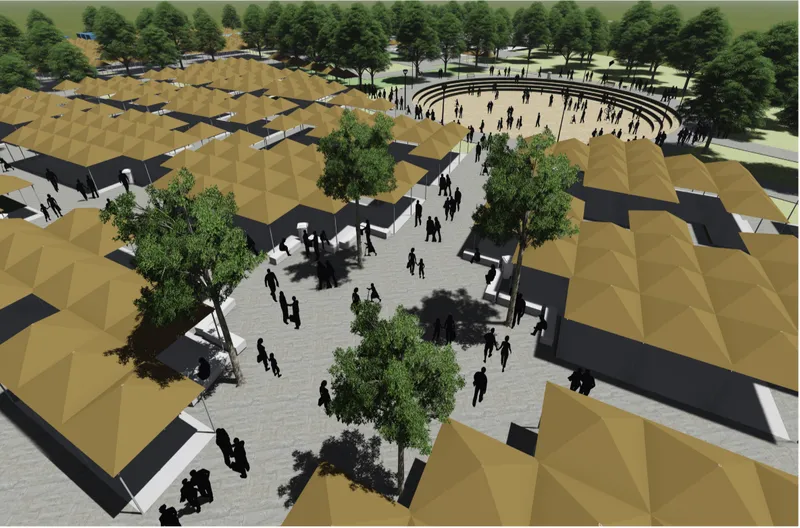
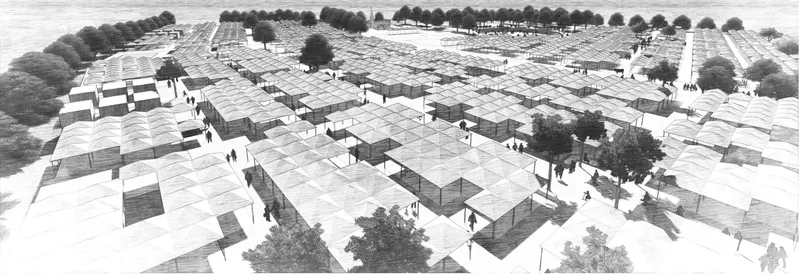
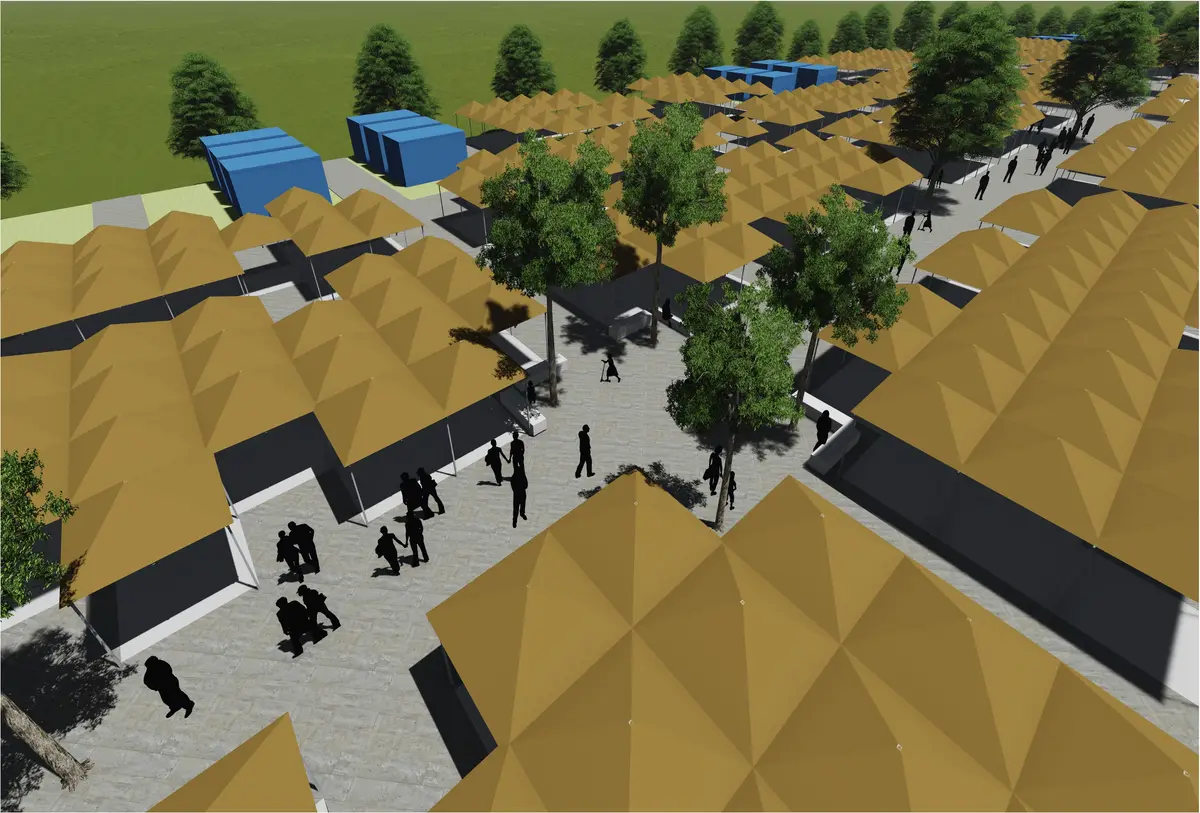
The aerial renderings reveal two states of the same landscape. In one, gold-roofed pavilion structures frame a central plaza dense with trees and visitors, creating a recognizable civic space. In the other, a white canopy grid stretches across open ground, with dark volumes scattered beneath it, suggesting a sparser, more porous configuration suited to everyday or transitional use. The contrast between these two conditions is the project's core proposition: that a site does not need a single identity but can cycle through multiple spatial personalities depending on seasonal demand.
Lunawat's strategy hinges on dry connections, lightweight materials, and minimal foundations, enabling manual assembly without heavy machinery. Each module can serve as a shelter, a market stall, a resting space, a social gathering node, or a prayer area. The architecture is less a building and more a kit of parts that a community deploys, inhabits, then packs away.
Reading the Pilgrimage as Spatial System

Pilgrimage in India is a spatial phenomenon before it is a religious one. Pilgrims walk for days carrying minimal possessions, relying on shared infrastructure for shelter, food, sanitation, and social gathering. The architecture that emerges along their routes is defined not by walls but by paths, pauses, and people. Lunawat's research traces how temporary settlements form, how social integrity holds without permanent structure, and how belief itself becomes the organizing force behind spatial arrangement. The festival crowd, captured mid-celebration beneath a sky filled with kites and colored powder, illustrates the density and intensity these landscapes must accommodate.
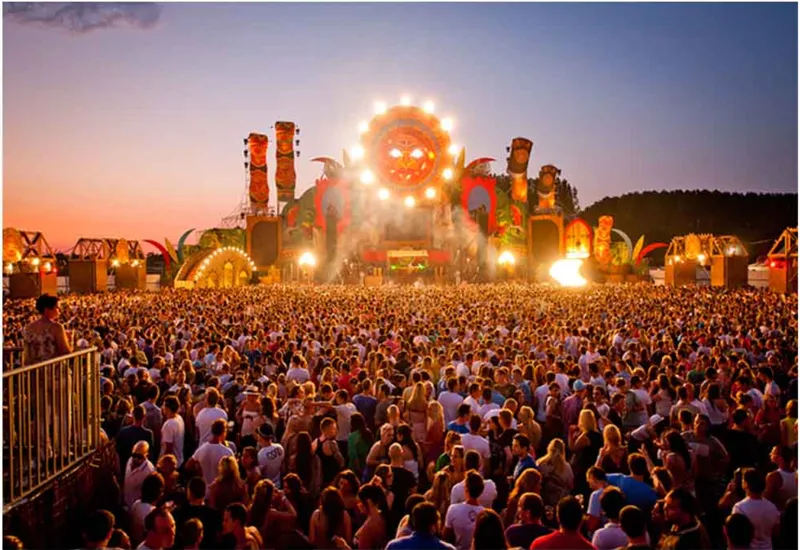
The illuminated stage structure with its curved arched elements rising above a crowd at dusk captures the other register of these gatherings: the collective, the performative, the sacred. Lunawat treats such moments not as spectacles external to architecture but as the very programme the architecture must serve. Infrastructure here means dignity, comfort, and communal experience delivered at scale, then withdrawn.
Cycles of Growth and Recovery

A circle of fallen leaves resting on stone beside turquoise water serves as a quiet metaphor for the project's philosophical engine: the idea that architecture, like natural systems, can participate in cycles of presence and absence. Lunawat's site strategy for Igatpuri alternates between three states: high-density pilgrimage occupation, low-activity everyday use, and complete disassembly with ecological recovery. The third state is crucial. By designing for disappearance, the project ensures that the land is not degraded by repeated occupation but allowed to regenerate, making the next cycle viable.
This cyclical logic extends to the project's sanitation and infrastructure systems. Eco-san toilets provide decentralized, hygienic sanitation for fluctuating populations without permanent plumbing networks. Water management, food distribution, and waste handling are all integrated through temporary yet efficient systems. The result is social infrastructure that performs at the level of a city during peak use while leaving near-zero permanent footprint.
Structure as Instruction Manual
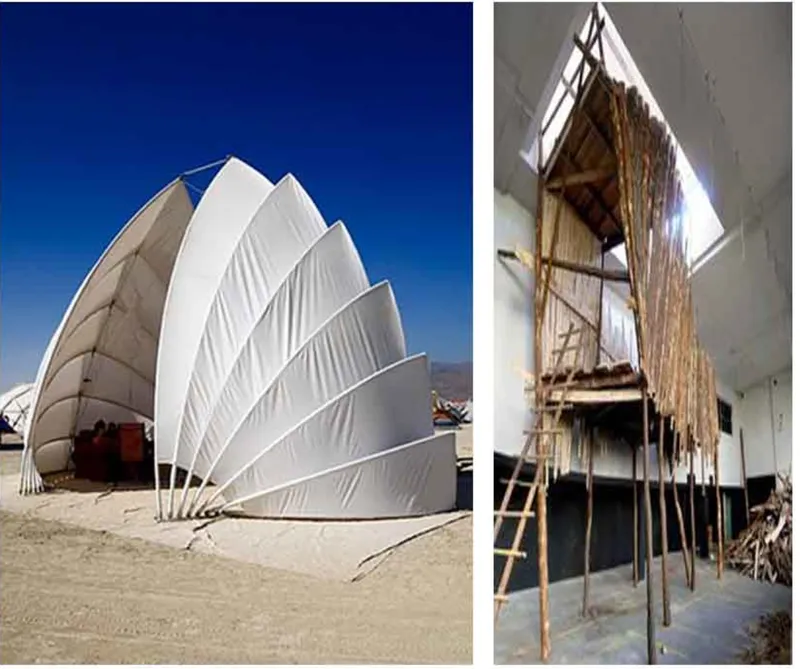
The side-by-side image of a white tensile fabric shell and its exposed timber-and-steel framework reads like an architectural exploded diagram made real. One half is inhabitable enclosure; the other is the legible logic of how that enclosure comes together. The pairing communicates something essential about Lunawat's approach: the construction system is designed to be understood, replicated, and operated by the community itself. Manual assembly without heavy machinery is not a constraint but a design decision that distributes agency and reduces dependence on centralized construction logistics.
The material palette, lightweight frames with tensile fabric skins, reinforces the project's commitment to rapid deployment and minimal ecological disturbance. These are not flimsy structures; they are engineered for reuse across multiple cycles. The framework survives disassembly, the fabric can be replaced, and the connections are dry, meaning no wet concrete, no excavation, no residue. Permanence, Lunawat suggests, is the architecture that can be assembled and reassembled without loss.
Why This Project Matters
Ephemeral Living matters because it reframes a question most architecture schools rarely ask with sufficient rigor: what if impermanence is not a failure mode but a design criterion? Lunawat does not romanticize temporality. The project is grounded in real pilgrimage logistics, real site conditions at Igatpuri, and real infrastructure challenges like sanitation for millions. It takes the Kumbh Mela and other sacred gatherings seriously as precedents for a reversible urbanism that conventional planning has largely ignored.
At a moment when climate change, resource scarcity, and population displacement are forcing architecture to reconsider its relationship with time, a thesis built around cyclical assembly and ecological recovery feels neither speculative nor nostalgic. It feels urgent. Lunawat's contribution is to demonstrate, through modular systems and site strategy, that architecture can be present when needed and absent when it should be, and that both conditions require equal design intelligence.
View the Full Project
About the Designers
Designer: Akshay Lunawat
Enter a Design Competition on uni.xyz
uni.xyz runs architecture and design competitions year-round that reward proposals with spatial conviction and real site intelligence.
Project credits: Ephemeral living by Akshay Lunawat.


Popular Articles
Popular articles from the community

Extended Shell: Retrofitting Kolkata's Balconies as Living Urban Thresholds
A modular retrofit system recovers the social and environmental intelligence of Kolkata's historic verandas for contemporary Park Street residents.
Temporary Home for Dogs: A Reversed Zoo Rethinks Animal Shelter Architecture
In Bucharest, a sinuous corridor and freed landscape flip the logic of containment, designing a shelter that works to make itself unnecessary.

Opera on the Sea: Driftwood Logic Shapes a Timber Opera House on Estonia's Coast
Trevor Orgill's opera house translates the entangled drift of floating timber into a civic building where wood, water, and music converge.
Opera by the Sea Estonia: Three Shells Dissolving Architecture into Tallinn's Coastline
A winning opera house proposal replaces monumental form with interconnected shells that blur the boundary between building, park and Baltic Sea.

Similar Reads
You might also enjoy these articles
Sustainable Architecture Design: Embracing Nature and Modernity at Villa Solsidan
The article explores Villa Solsidan by AndrénFogelström, showcasing its sustainable architecture design and integration with the natural surroundings in Saltsjöbaden, Sweden.
Scientific and Educational Monitoring Center of the Yenisei, Krasnoyarsk
Architecture as an instrument for ecological research, education, and environmental awareness along Russia’s largest river.
Development of Andretta Artist’s Village, Palampur, Himachal Pradesh, India
Reimagining Andretta as a living cultural landscape where art, architecture, and community converge to shape a global creative village.
Street Children Rehabilitation Center: A Model of Social Architecture for Community Rehabilitation
An inclusive social architecture project that transforms streets into nurturing environments, restoring dignity, identity, and opportunity for vulnerable children.

Comments (0)
Please login or sign up to add comments
No comments yet. Be the first to comment!