
Orosy Studio Designs a Café That Becomes a Wine Bar After Dark in Jung-gu
Ernest Café and Wine Bar uses split levels, vaulted ceilings, and glass walls to host two identities in 148 square meters.


A café that moonlights as a wine bar is not, on its own, a novel idea. Plenty of hospitality venues swap menus and dim the lights when the sun goes down. What makes Ernest Café and Wine Bar worth examining is the way Orosy Studio built the architecture itself around that temporal shift. Located in Jung-gu, South Korea, the 148 square meter space deploys split levels, vaulted volumes, and generous glazing to create zones that read differently depending on the hour, the light, and the reason you walked in.
The studio describes the project's guiding idea as "liberation from everyday life," which could sound like marketing if the spatial moves didn't back it up. Recessed floors, raised platforms, and a courtyard that punches green light deep into the plan all work together to make a compact footprint feel genuinely varied. You move through the space not along a single axis but across subtle thresholds, each one calibrated to shift your posture and attention. It is a project about mood as much as material.
Vaulted Glazing and Street Presence
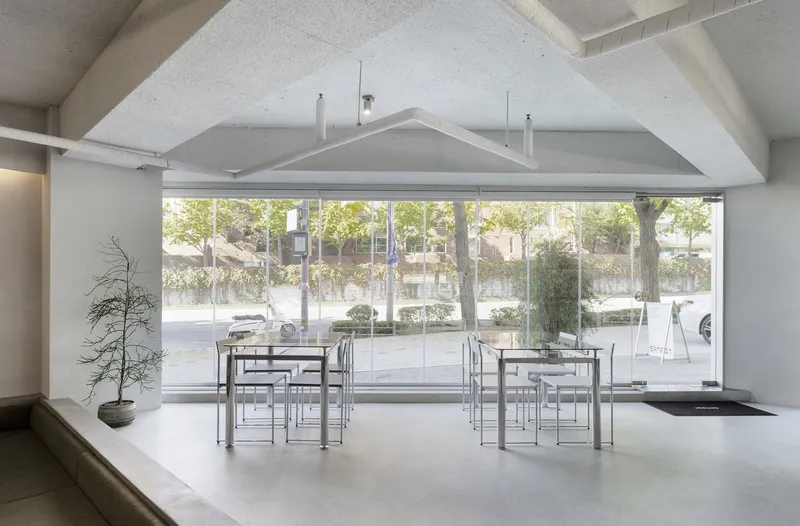
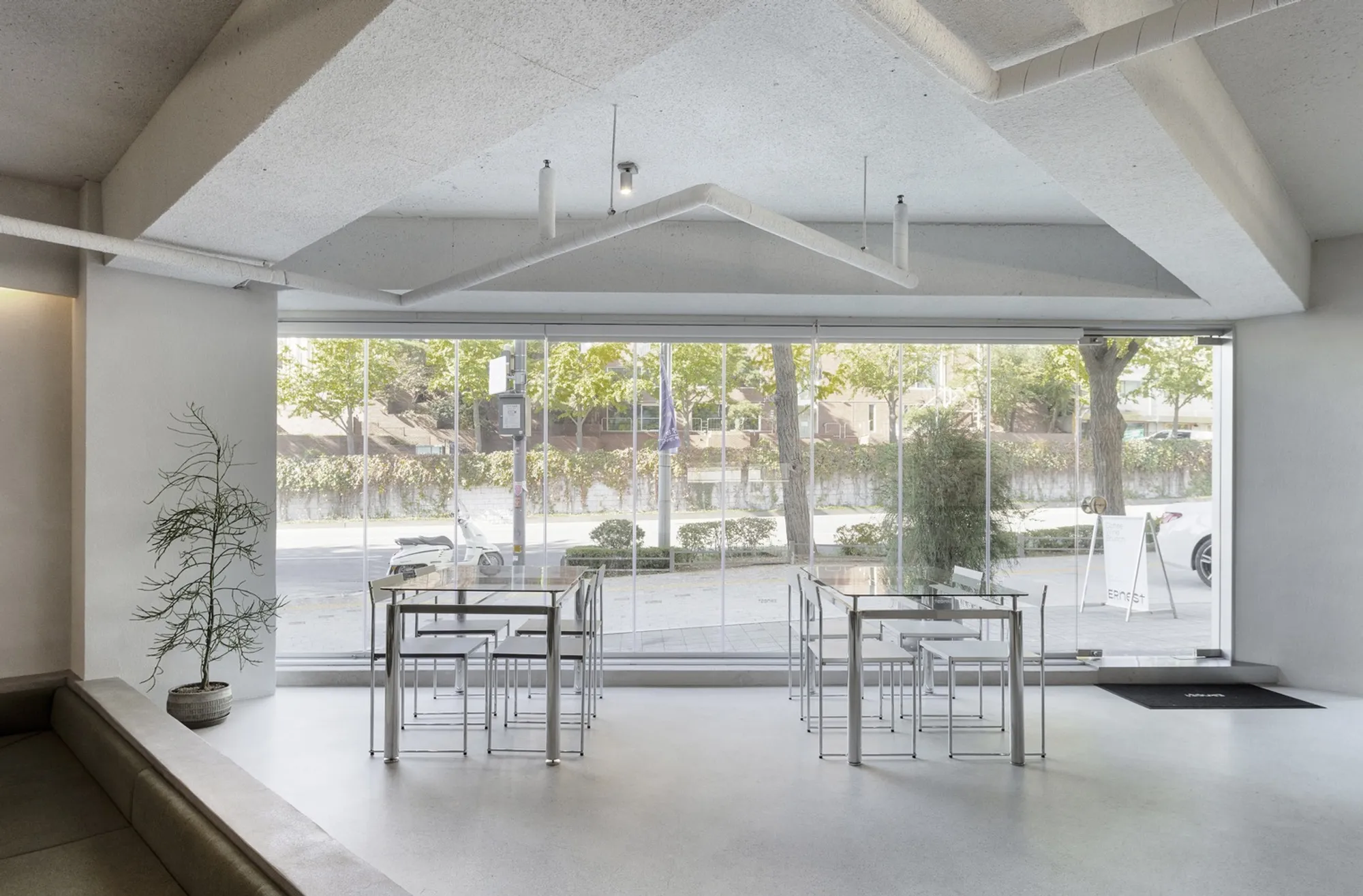
The most immediately striking element is the wide storefront glazing set beneath a vaulted ceiling. From the street, passersby see trees framed in a generous arc of glass, while from inside, the vault draws the eye upward and outward simultaneously. This is not a standard shopfront punched into a wall; the curve gives the threshold a sense of ceremony without making it intimidating. During the day, sunlight floods the interior and the street feels like an extension of the room. At night, the dynamic reverses: warm interior light spills outward, turning the venue into a lantern on the block.
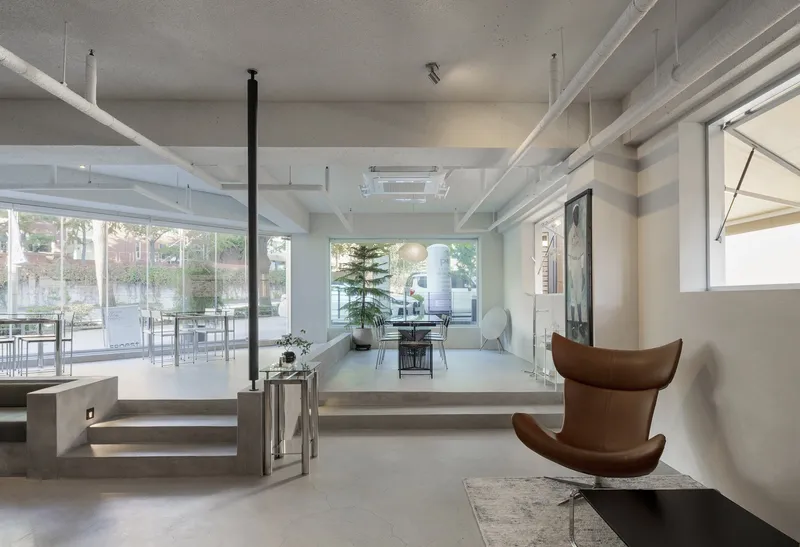
On the opposite side, a glazed wall faces a planted courtyard, pulling greenery into the composition. The split-level section visible here, with its raised platform and exposed ceiling beams, introduces a more intimate register. Where the street-facing vault is public and expansive, the courtyard edge is sheltered and semi-private. Two conditions, two moods, one compact plan.
Level Changes as Spatial Dividers
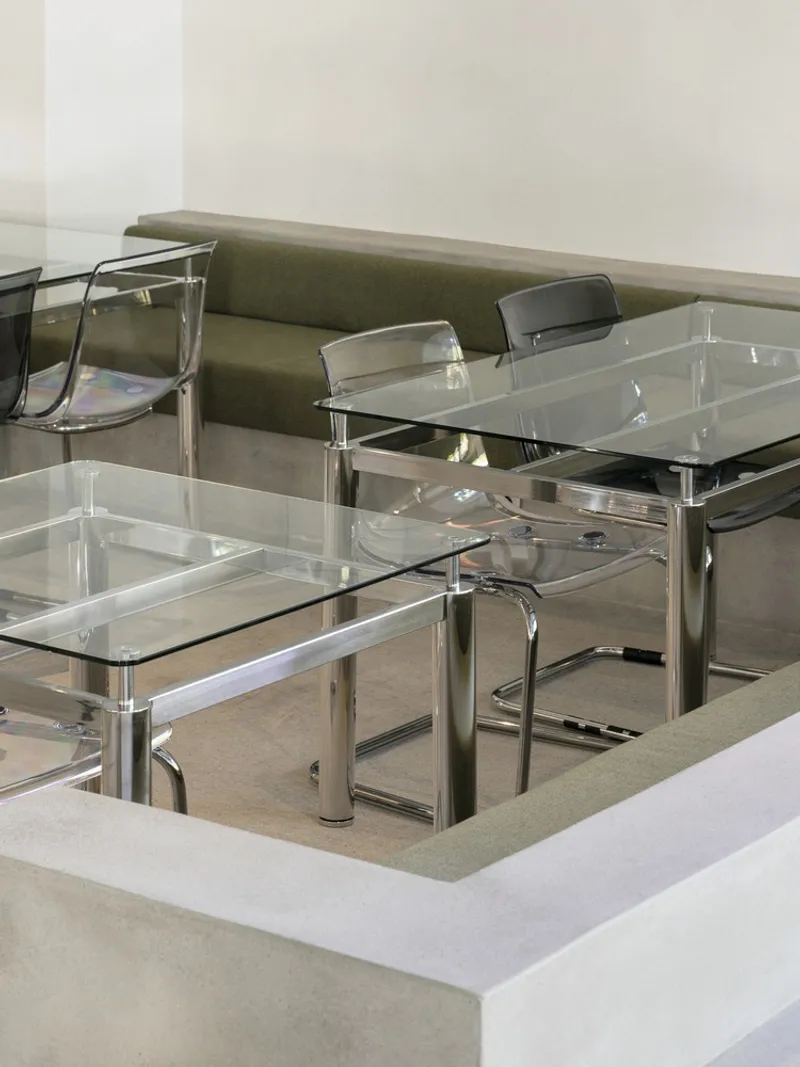
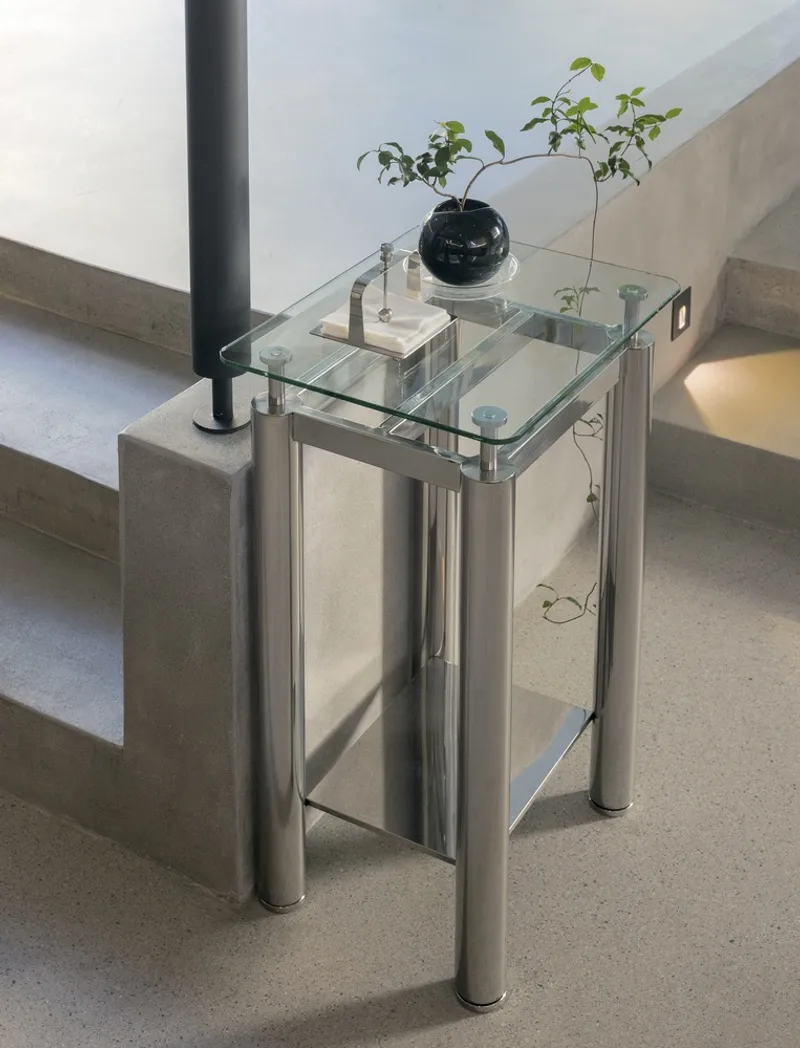
Orosy Studio avoids conventional partition walls almost entirely. Instead, changes in floor level do the work of separating zones. A recessed concrete floor cradles the glass-topped dining table and its transparent chairs, subtly lowering occupants below the surrounding grade. The effect is that of a room within a room: you are still in the open plan, still part of the larger volume, but you sit at a different altitude and therefore in a different psychological register.
Concrete steps nearby reinforce this language of topography rather than partition. A glass and steel side table perched beside the stairs, holding a simple black vase with green foliage, turns a circulation element into a still-life moment. These small gestures matter. They tell you the designers were thinking at the scale of a hand reaching for a glass, not just at the scale of a building section.
The Bar Counter and Service Core
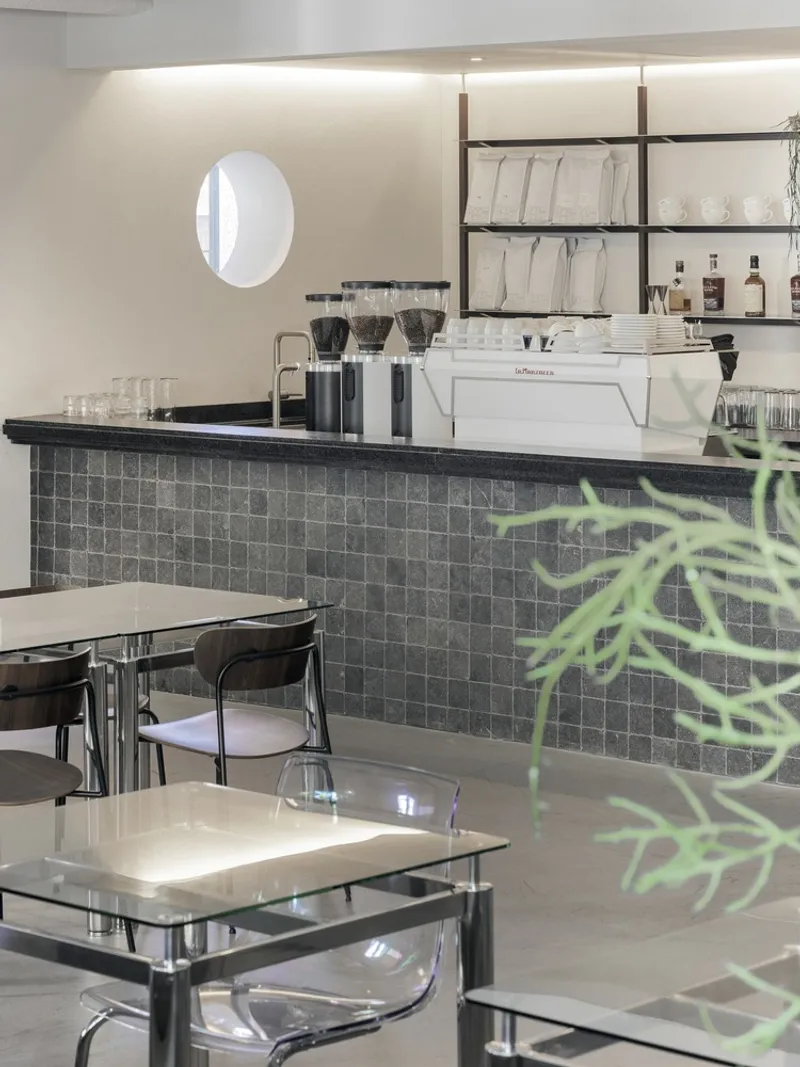
The coffee bar counter, clad in dark grey tile with an espresso machine and open shelving above, anchors the daytime identity of Ernest. Its material palette is deliberately muted: charcoal surfaces, stainless steel equipment, and restrained display shelving that could belong to a serious specialty coffee shop anywhere in Seoul. Nothing competes with the drink being made. The counter's low-profile design keeps sightlines open across the plan, so even when you are ordering, you remain visually connected to the rest of the space.
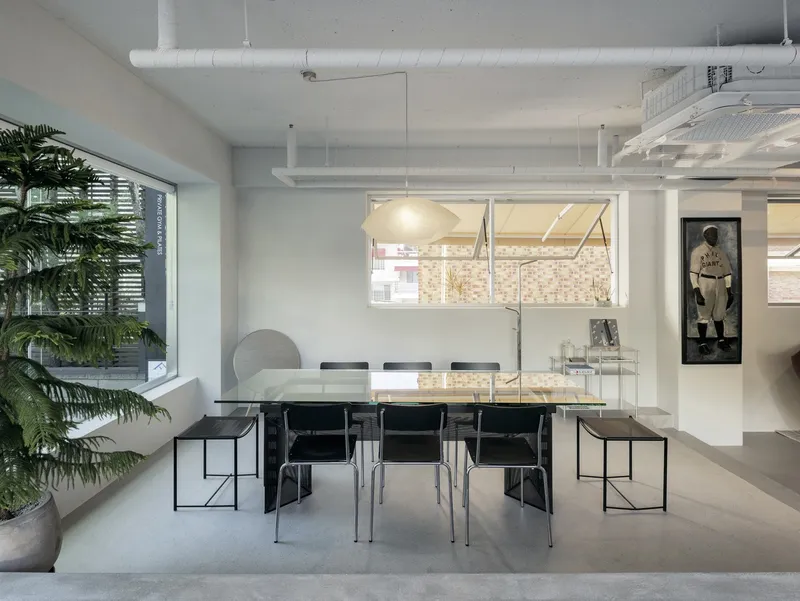
Nearby, a white-walled dining area with exposed ductwork and a glass dining table sits beneath a clerestory window. The clerestory is a smart move in a project that needs to feel airy during coffee hours and enclosed during wine hours. High-placed light washes the ceiling without glaring directly into eyes, and at night the window becomes a dark strip that recedes, letting the lower ambient lighting take over the room's character.
Furnishings as Architecture
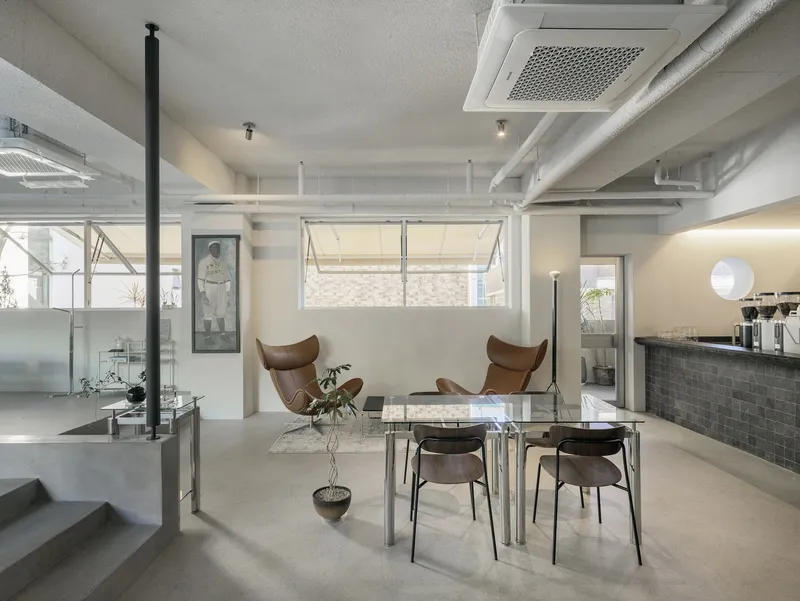
The furniture selection here is not decorative afterthought; it is structural to the spatial experience. Brown leather lounge chairs clustered near the dining zone signal a shift from upright café posture to a more reclined, social mode. These are pieces sourced from manufacturers like BoConcept, L&C Stendal, and Mario Botta, chosen less for brand prestige than for the specific way each object occupies and defines space. A suspended column and exposed ducts overhead keep the ceiling plane industrial and honest, letting the warmth come from the seating rather than from the shell.
Transparent chairs at the glass-topped table do the opposite: they dissolve, letting the recessed concrete floor and the table itself carry the visual weight. Two furniture strategies, one for the café hours and one for the bar hours, coexist without conflict. The open plan makes this possible, but it is the careful curation of objects that makes it legible.
Why This Project Matters
Hospitality design in dense Korean urban districts often defaults to one of two modes: hyper-minimalist white boxes or maximalist themed interiors. Ernest Café and Wine Bar takes neither path. Orosy Studio built a space that earns its versatility through section, level change, and material contrast rather than through scenography or gimmick. The architecture does the heavy lifting so the programming can shift without requiring a costume change.
At 148 square meters, this is a small project. That is precisely why it deserves attention. Every decision here is legible, every move has consequence, and the result is a venue that genuinely feels like two places compressed into one address. For designers working on compact hospitality briefs, Ernest is a useful case study in how topography, light, and material can do what walls and signage usually attempt.
Ernest Café and Wine Bar, designed by Orosy Studio. Located in Jung-gu, South Korea. Area: 148 m². Completed in 2023. Photography by Yongjoon Choi.
About the Studio
Orosy Studio
Official website of Orosy Studio, one of the studios behind this project.
orosystudio.comShare Your Own Work on uni.xyz
If projects like this are the kind of work you want to make, uni.xyz is a place to publish your own, find collaborators, and enter design competitions.



Popular Articles
Popular articles from the community


Conexión: Biophilic Design Reimagines High-Rise Living in Hong Kong
Conexión reimagines high-rise living in Hong Kong through biophilic design, green facades, shared spaces, daylight, water and nature within.

The Ocean Hive: Sustainable Architecture for a Self-Sufficient Civilization at Sea
The Ocean Hive imagines sustainable architecture at sea, where modular habitats, algae, wave power and ocean waste sustain a growing colony.

Co-Life: Senior Housing Design That Reconnects Older Adults With the City
Co-Life reimagines senior housing design through healing gardens, shared streets, workshops, and a sustainable community across generations.

Play: Fragments of Their World
Familiar architecture becomes modular playground design, creating safe spaces where displaced children can learn, connect, imagine and play.


Similar Reads
You might also enjoy these articles


Hodi-Mandai Geram
Project Function: Preservation and revitalization of the Intangible heritage and socio-spatial identity of the Hodi by Housing, Cultural Memory Center, Sacred Grove, landscape, local tourism economy


Olio Towers: A Mid-Rise for Performers That Fuses Housing, Rehearsal, and Stage
Located blocks from Houston's Theater District, this modular tower stacks living units around a central performance atrium.

Oasis: Modular Green Housing Carved into Dhaka's Urban Fabric
A shortlisted Plugin Housing entry reclaims unauthorized settlements in Dhaka with stepped concrete volumes, green roofs, and ventilation-driven design.

Black Hole: A Floating Megastructure for the Post-Physical Era
Emiliano Mazzarotto envisions a spherical, self-scaling arena where e-sports, digital hotels, and holographic stadiums replace traditional public space.


Explore Interior Design Competitions
Discover active competitions in this discipline


Challenge to design luxury tourism on rails


Challenge to reimagine the Iron Throne


Photograph architecture without architects


VR headsets Storefront design competition
Comments (0)
Please login or sign up to add comments
No comments yet. Be the first to comment!