
Espacio Común Builds a Floating Stage on a Rising Amazon River for Iquitos' Muyunafest
A 14-meter circular platform of topa logs, hand-built by fishermen and boat makers in the floodwaters of Belén, Iquitos, Peru.

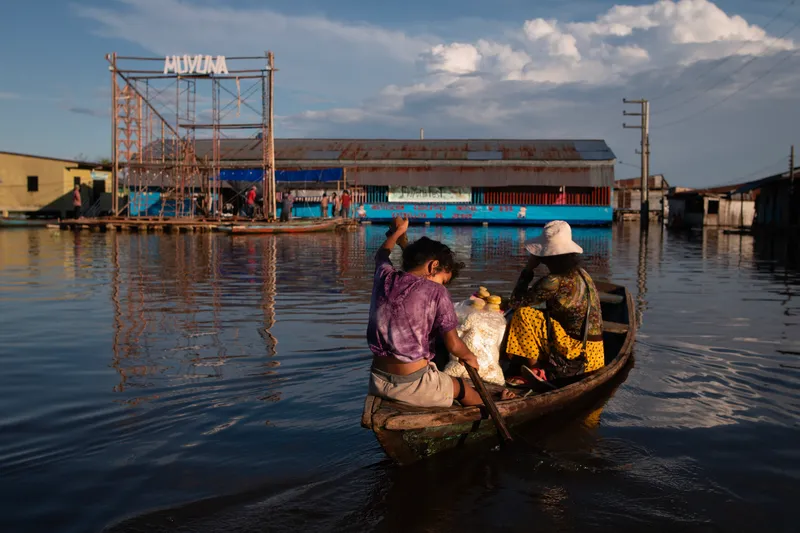
Every year between January and June, the Itaya River rises and swallows the streets of Belén, a neighborhood on the edge of Iquitos. Sidewalks become waterways. Canoes replace motorbikes. Houses perch on stilts or simply float. In May 2025, Espacio Común arrived in this amphibious district and, alongside local fishermen and boat makers, hand-built a 175 m² floating stage from more than 70 topa logs, rope, nails, and not a single piece of machinery. The structure served as the main stage for Muyunafest, a cultural festival whose name references the muyuna, the whirlpool that forms where river currents collide, understood in Kukama cosmology as a passage between worlds.
What makes this project worth studying is not the spectacle of a cinema screen rising seven meters above floodwater, though that image is arresting. It is the methodology. The circular platform's geometry, its flotation logic, its anchoring system were not designed in an office and imposed on a site. They were negotiated in real time with a master builder whose empirical knowledge of the river dictated every structural decision. After the festival ended, the stage stayed in place for six weeks as a floating plaza, open-air classroom, and dock for the adjacent Estrellita de Jesús school. When it was finally dismantled, its materials were redistributed into walkways and paths for the transitional season. Nothing was wasted. Nothing was foreign.
A Circle on the Water
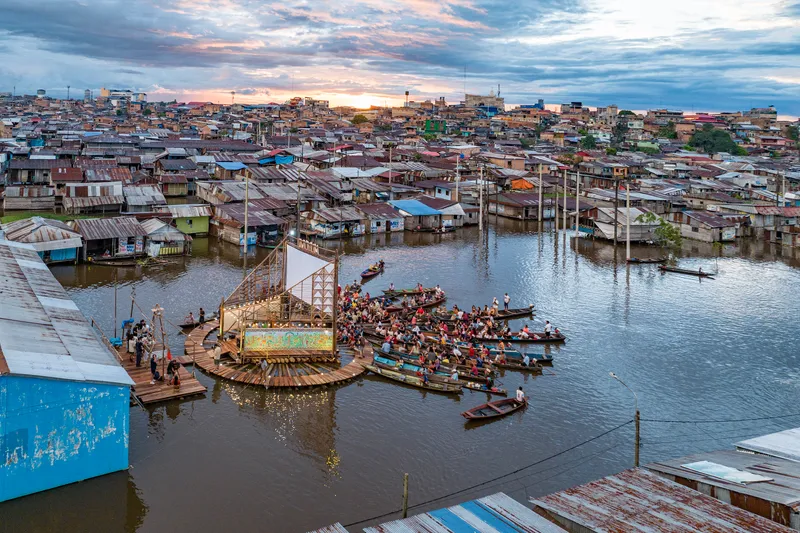
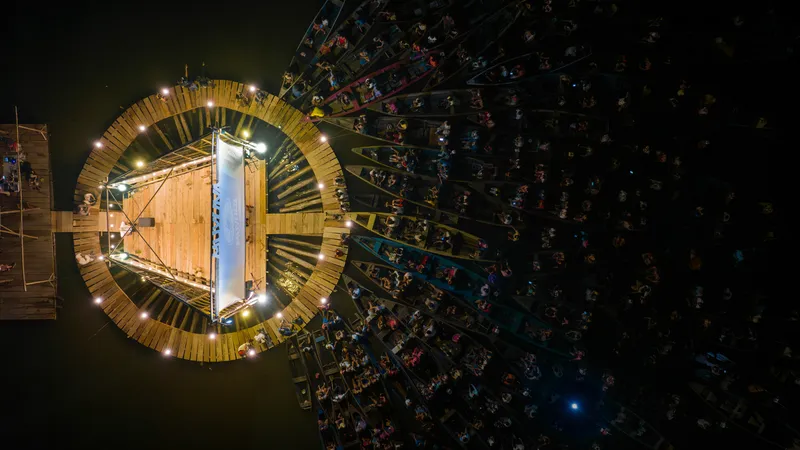
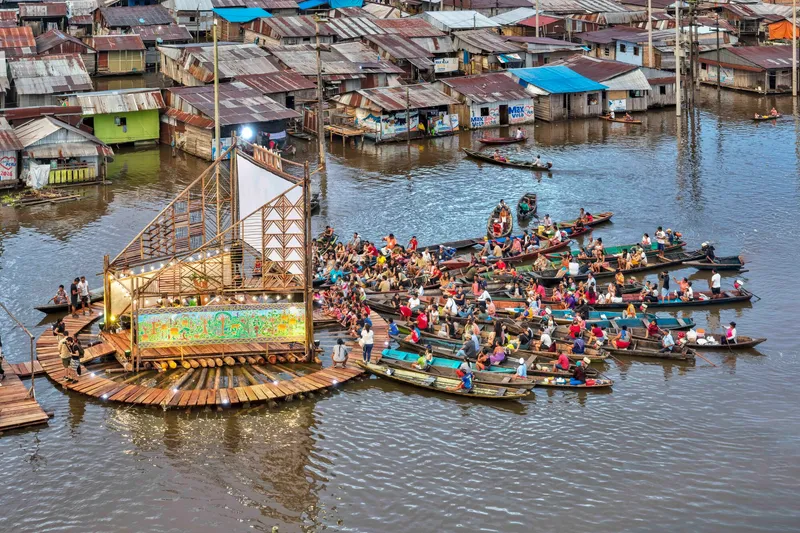
The primary spatial gesture is a 14-meter-diameter circular platform floating on bundled topa logs. Seen from above, the geometry is immediately legible: a disc of warm timber surrounded by dozens of canoes arranged radially, forming what amounts to a floating amphitheater. The circle is not arbitrary. It references the muyuna, the spiral formed at the confluence of rivers, a figure loaded with cosmological meaning for the Kukama people. At sunset and after dark, more than 50 canoes gathered around the platform each evening, their occupants becoming both audience and spatial boundary.
The plan works because it has no front or back. Water access is 360 degrees, so the audience self-organizes. Canoes arrive and cluster where they find space, the way boats always have in Belén. The architecture does not choreograph movement so much as it provides a center of gravity.
Construction Without Electricity
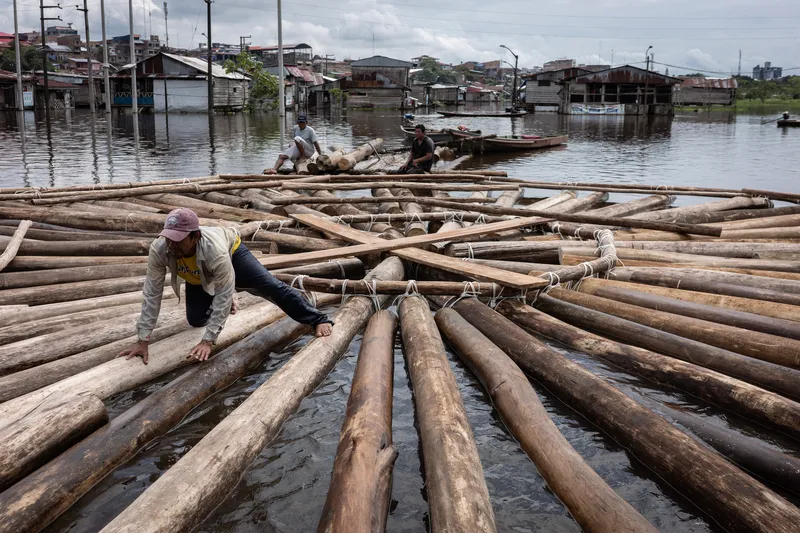
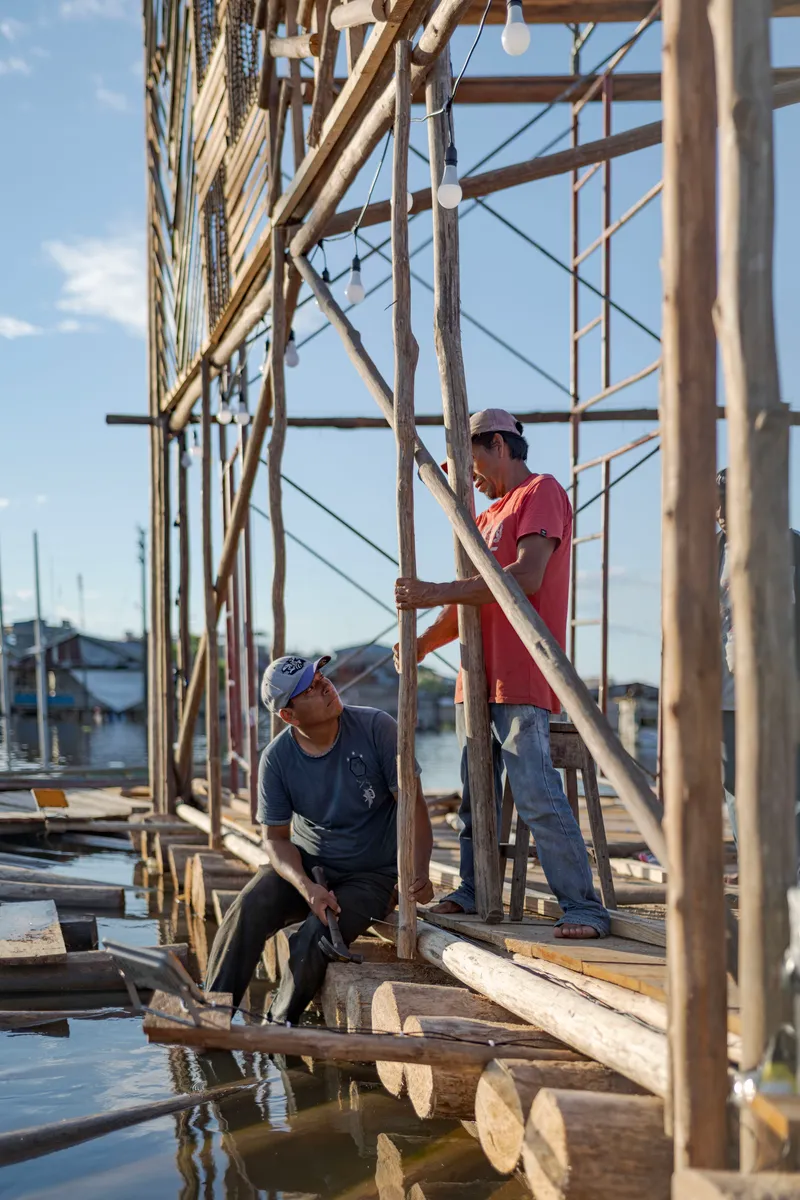
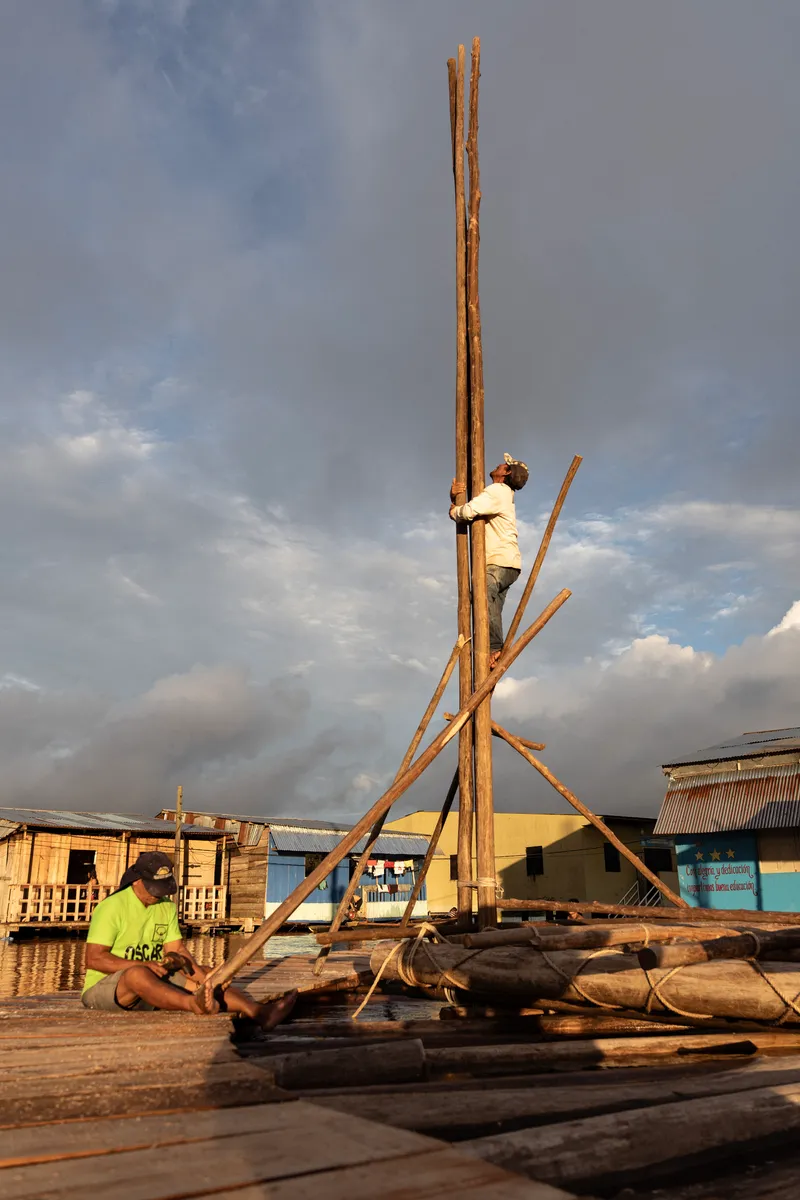
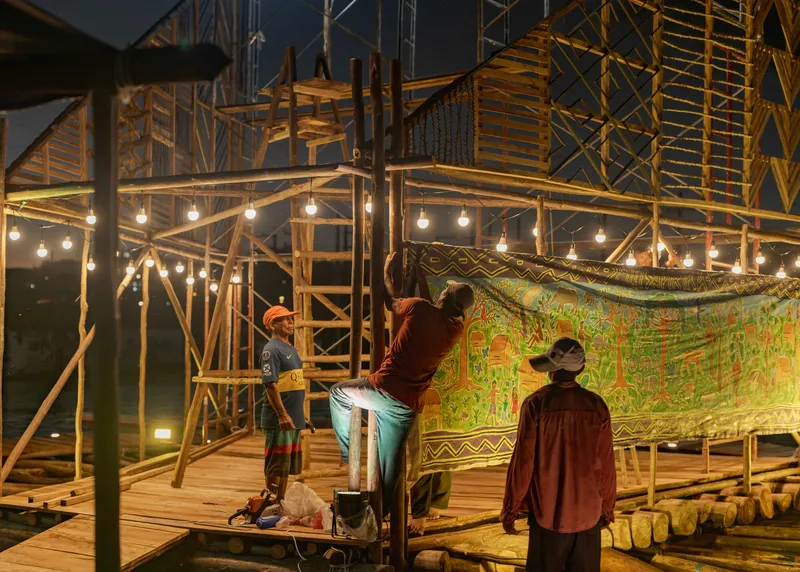
The construction photographs are the real argument of this project. Workers stand knee-deep or waist-deep in floodwater, lashing topa logs together with rope, fitting timber members into a bamboo framework by hand. There is no crane, no generator, no electric saw. The entire platform was completed in two weeks using only basic tools and the physical knowledge of people who build boats and floating structures for a living. This is not a romantic gesture toward vernacular methods. It is the only practical way to build in a neighborhood where the ground is underwater.
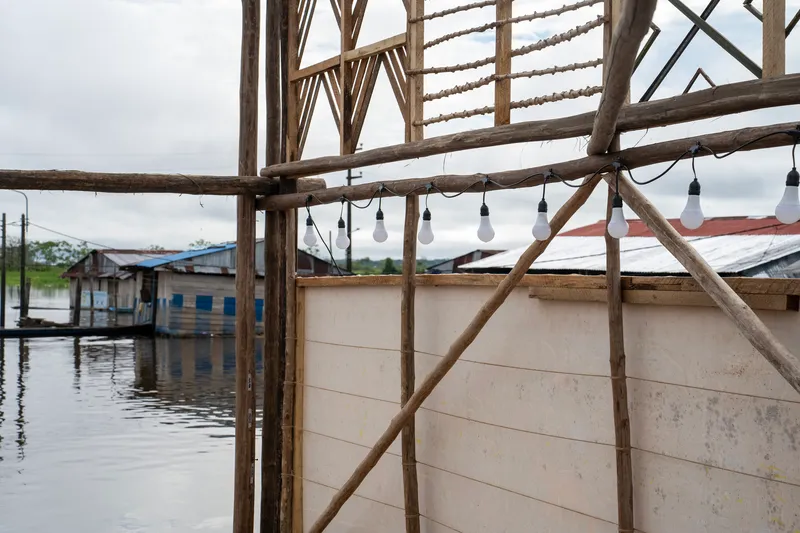
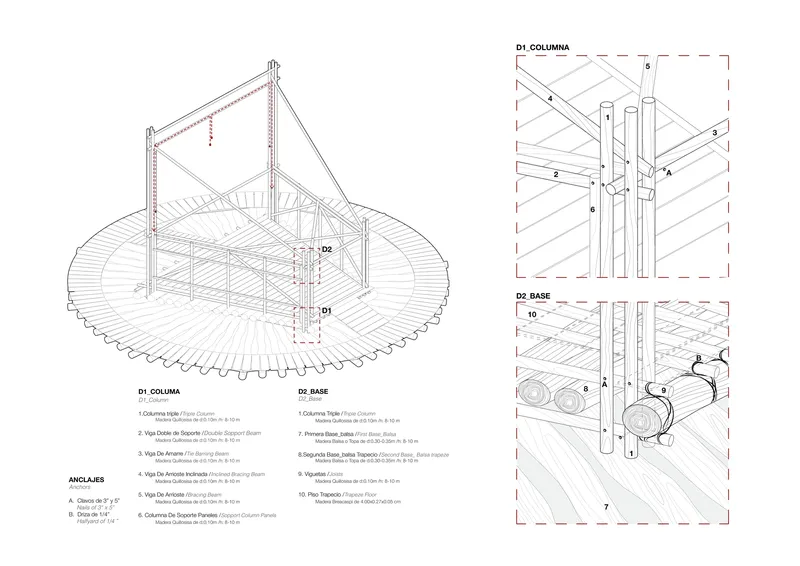
The construction system was defined by observing the water level daily and incorporating technical input from a local master builder. Flotation, balance, and anchoring were calibrated empirically, not calculated remotely. The trapezoidal frame that shapes the stage and supports the cinema screen at seven meters' height was erected as a tripod, hoisted into place on the floating base. The simplicity of the joinery, visible in the notched column connections, reflects a building culture where every component must be assembled, disassembled, and reused.
The Screen as Landmark
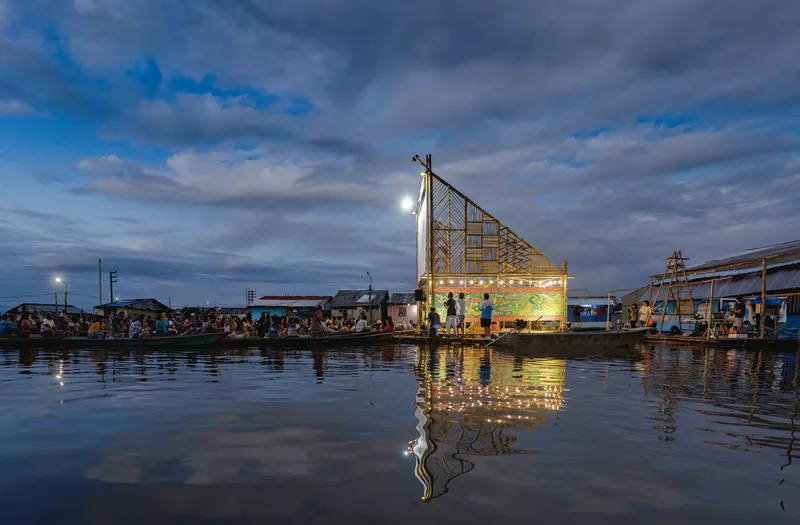
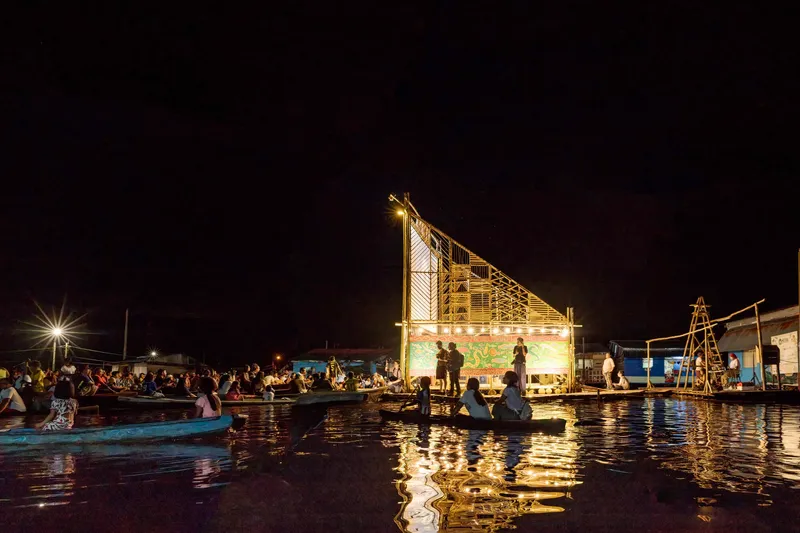
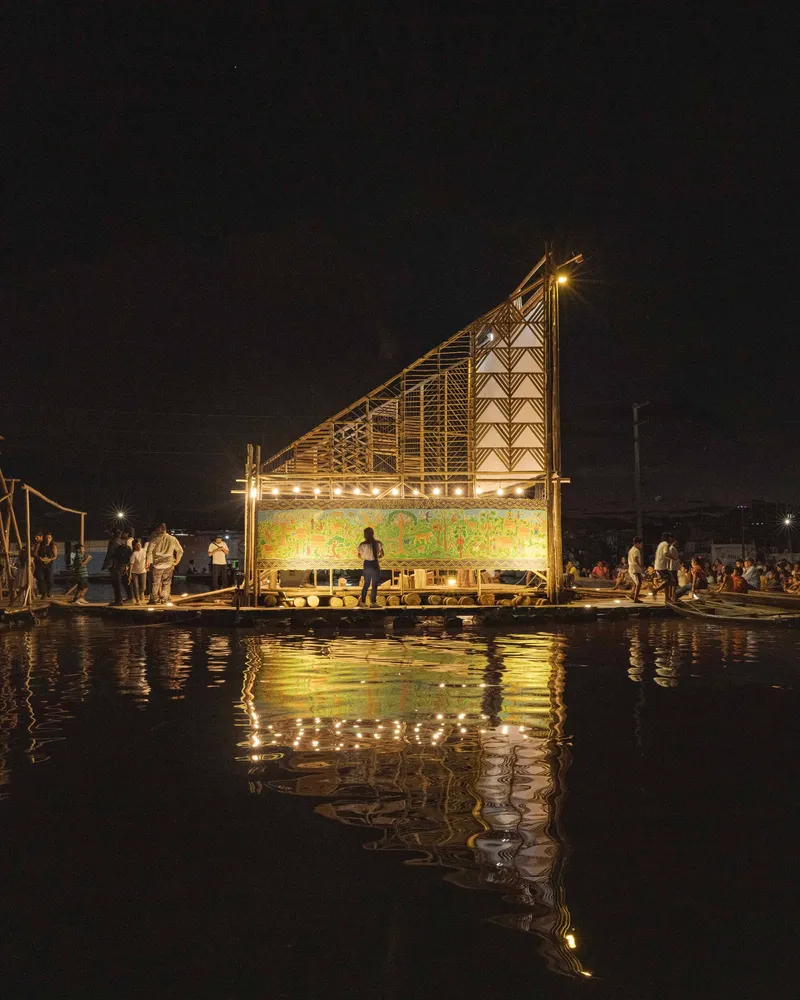
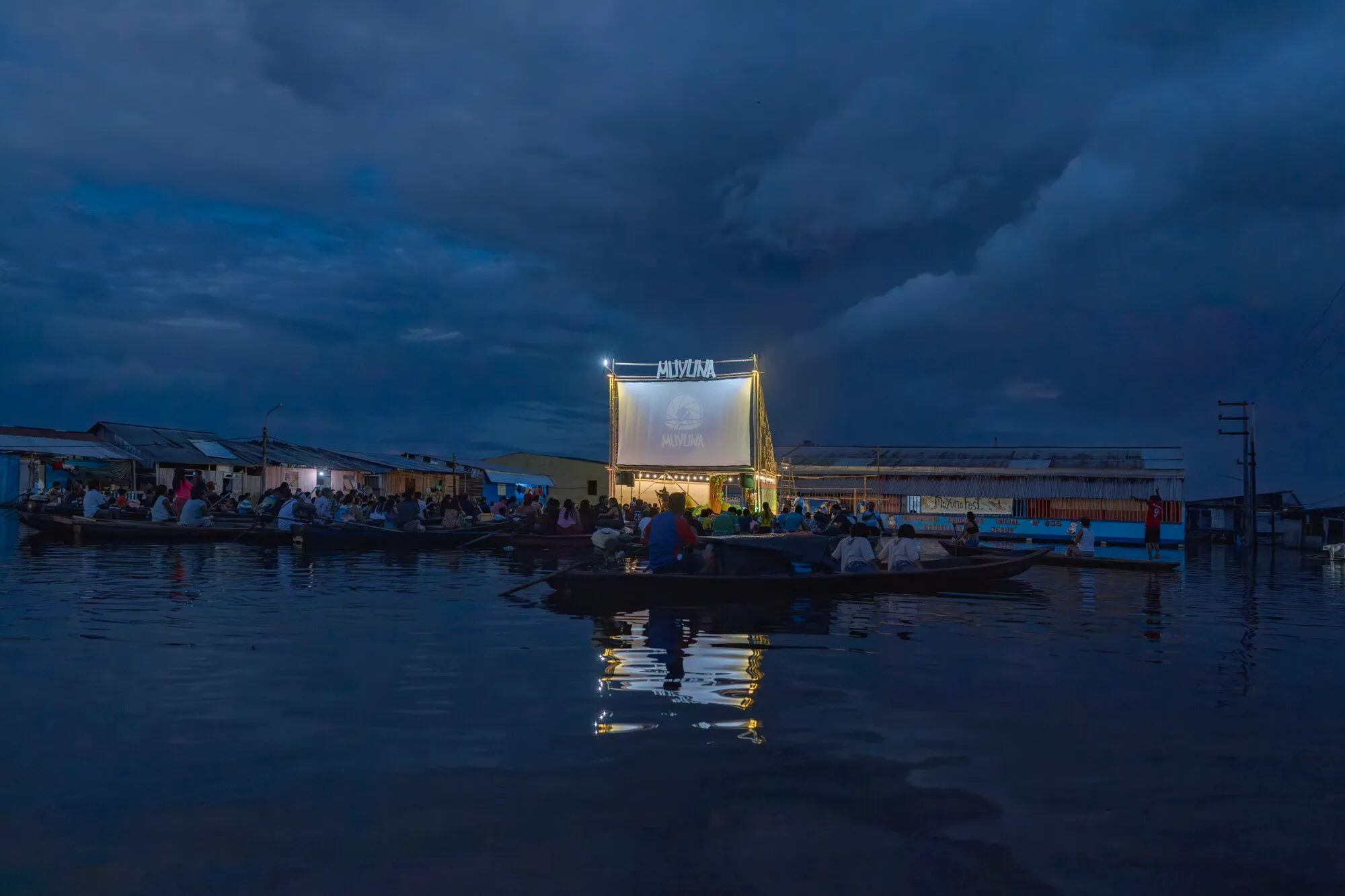
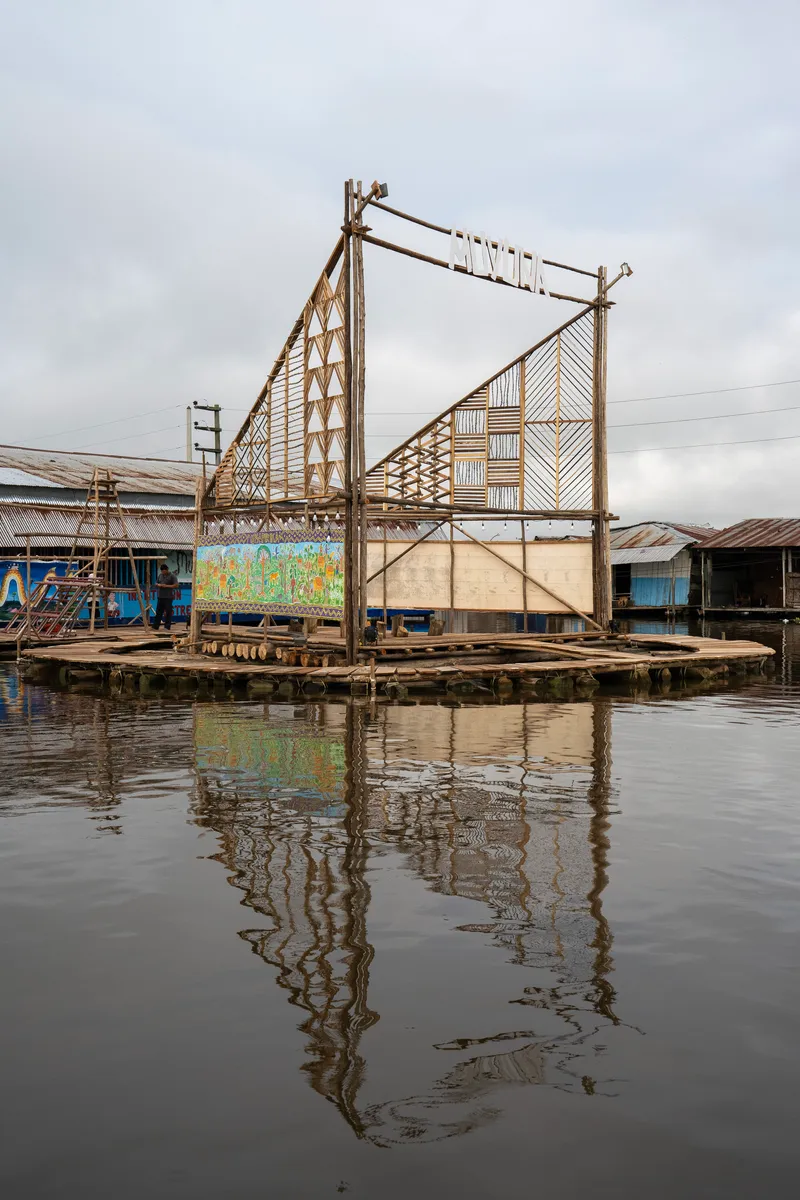
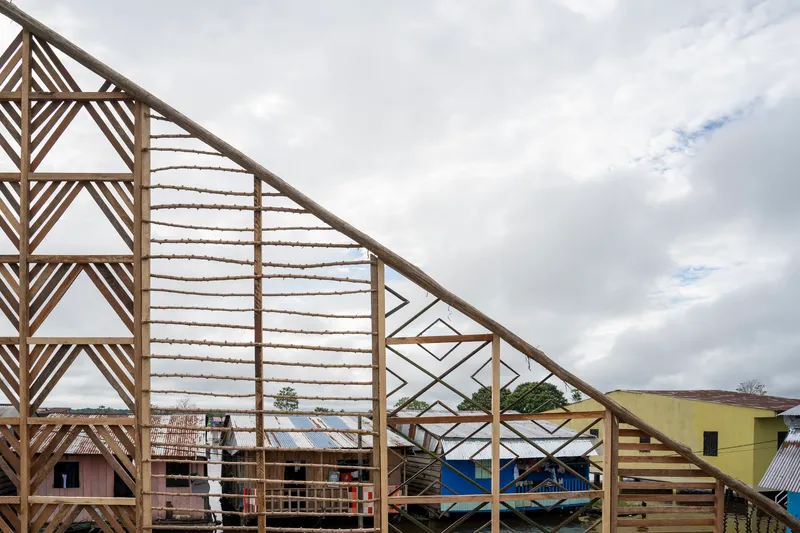
Rising seven meters above the water, the trapezoidal projection screen doubles as an urban landmark in a neighborhood where the built environment rarely exceeds two stories. At night, its illuminated surface becomes a beacon visible across the flooded district. The screen's bamboo lattice infill, with its diagonal and geometric patterning, gives the structure a textile quality even when unlit. It catches and scatters light differently depending on the angle, functioning as much as a lantern as a projection surface.
The reflection is worth noting. Belén's floodwater acts as a mirror, doubling the screen and the string lights strung along the structure. The architects did not design this effect, but they clearly understood it. The platform sits low enough that the water surface reads as continuous with the deck, and the reflected geometry extends the visual presence of the stage far beyond its physical 175 square meters.
Festival Nights on the Floodwater
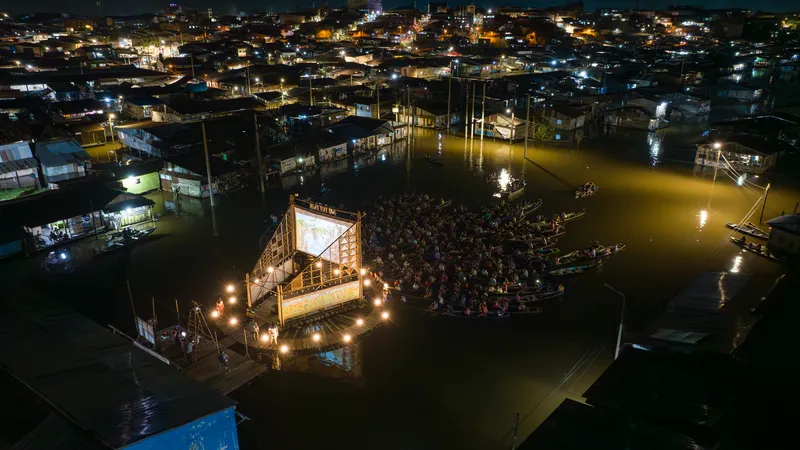
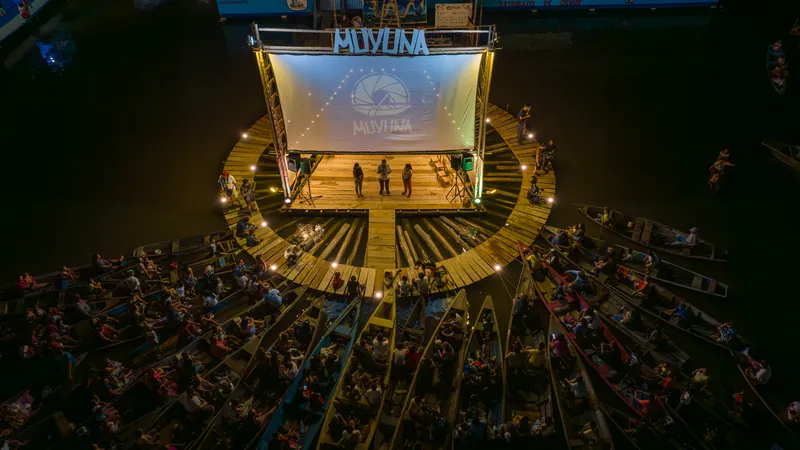
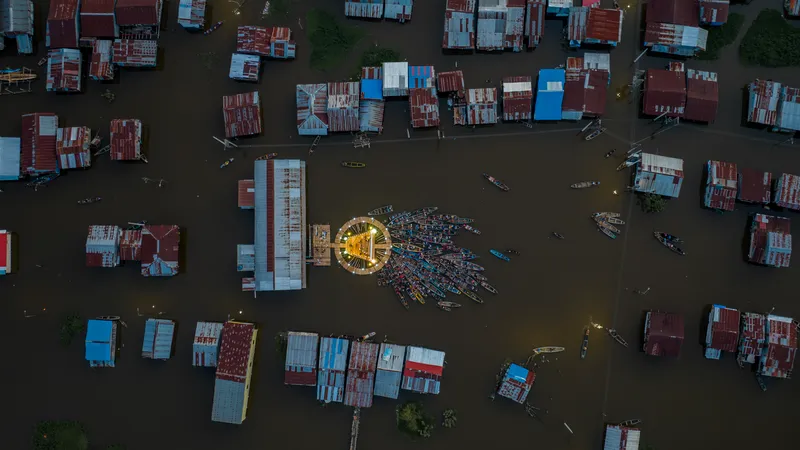
The aerial night photographs capture the full spatial logic of Muyunafest in action. The circular platform glows at the center of a constellation of canoes, the corrugated metal roofs of Belén extending in every direction, themselves partially submerged. The scale is striking: the stage is tiny relative to the neighborhood, yet it organizes everything around it. Light radiates outward from the screen and the string bulbs, establishing a social territory on water that has no curbs, no walls, no fixed edges.
What the drone images also reveal is context. The floating stage is not set in a picturesque lagoon. It sits in front of a school, surrounded by houses with tin roofs, in the middle of a working neighborhood that happens to be underwater for half the year. The architecture does not extract itself from this condition. It is produced by it.
Material Detail and Surface
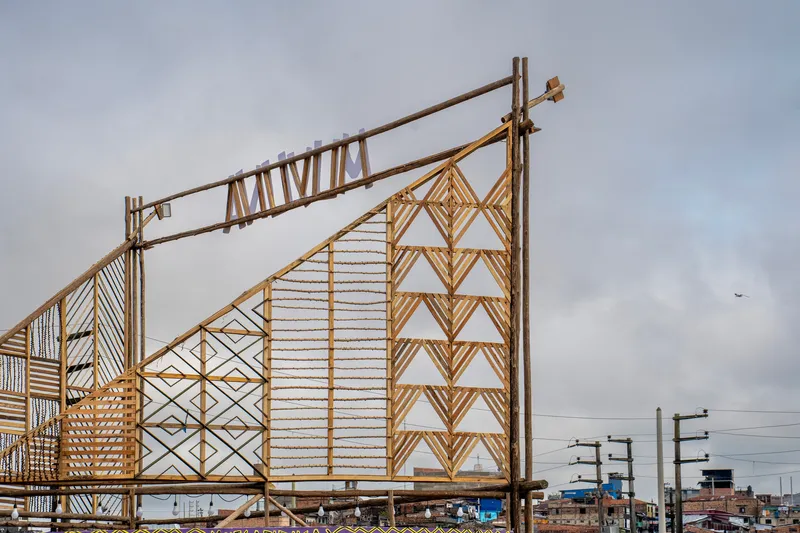
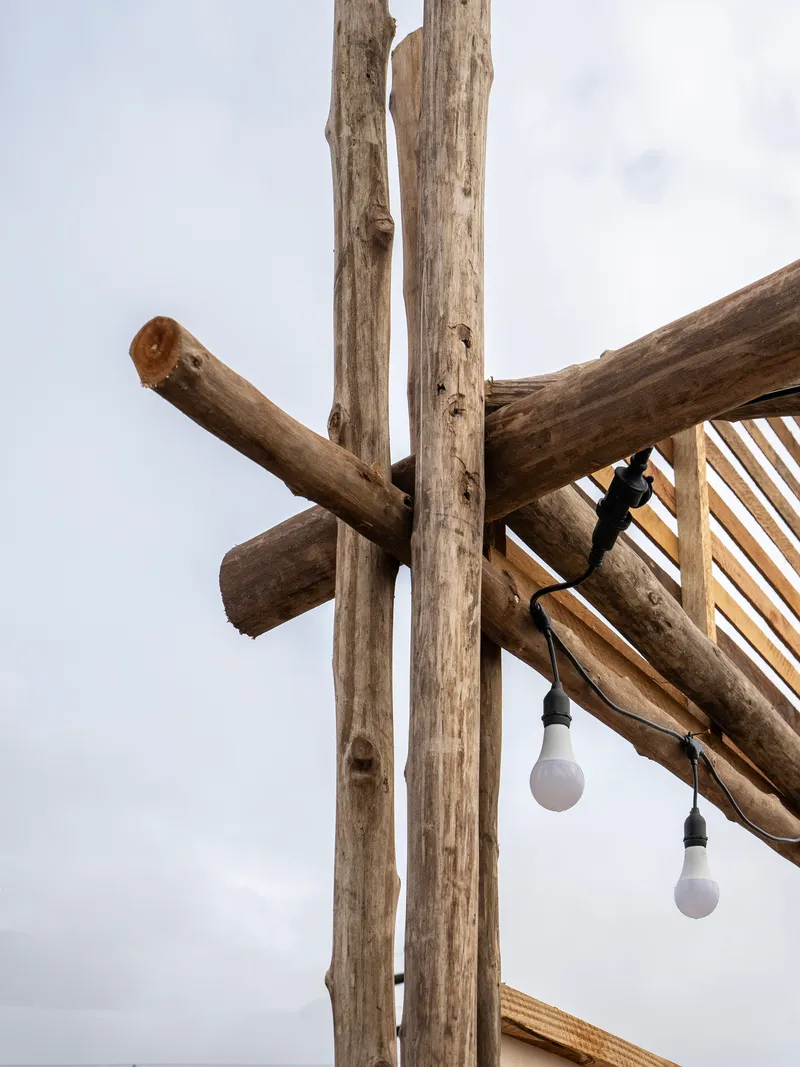
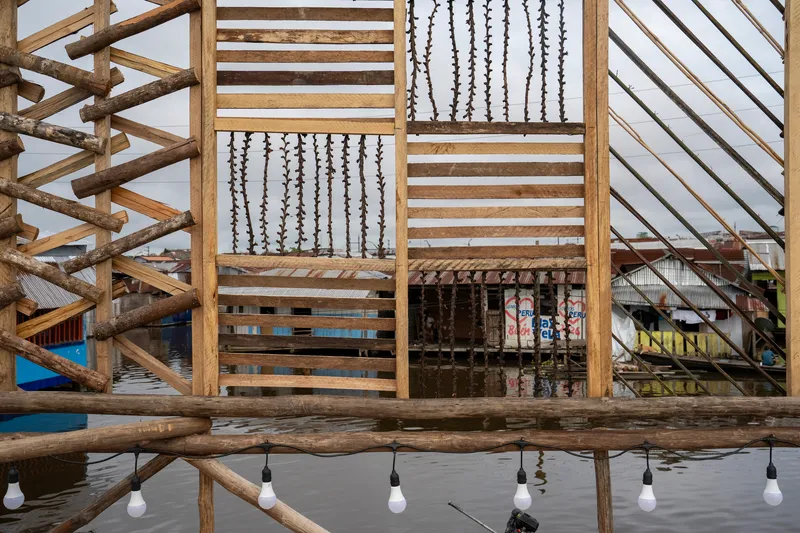
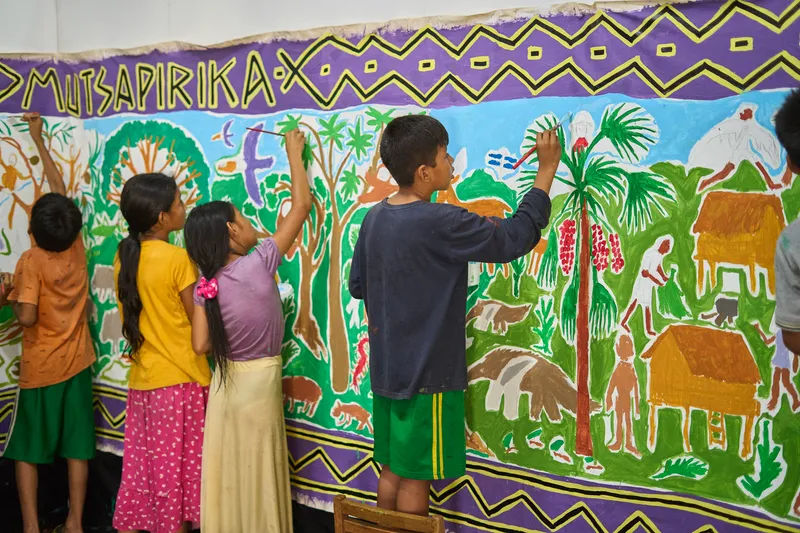
Up close, the structure reveals its craft. The bamboo lattice panels use diagonal and horizontal patterns that recall woven textiles, a common reference in Amazonian material culture. Notched timber joints hold columns together with the directness of boat construction. Shell decorations hang from the frame alongside string lights, and a painted textile backdrop introduces color and narrative where the bamboo framework meets the stage. These are not decorative afterthoughts. They are the contributions of residents who treated the structure as a communal canvas.
The children's mural painted on an interior wall panel, depicting tropical vegetation and animals, underscores the point. The platform was not a finished object delivered to a community. It was a substrate that people continued to work on, claim, and personalize throughout its six-week life.
Afterlife as Infrastructure
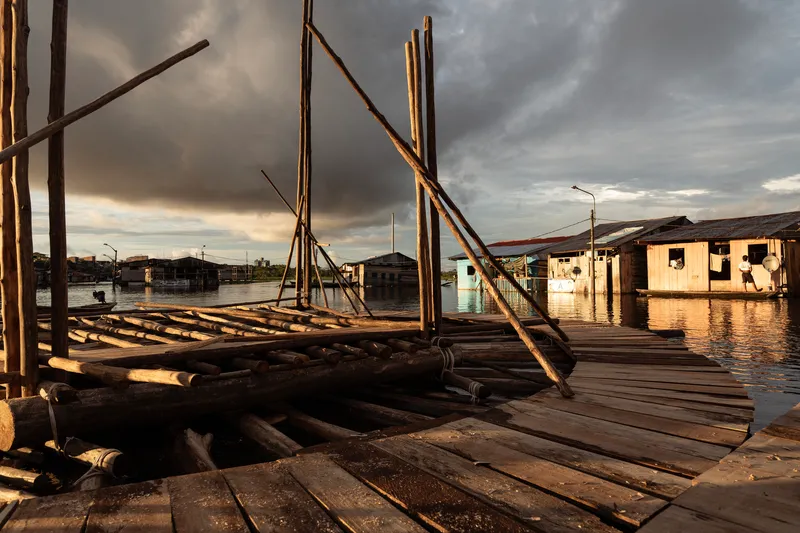
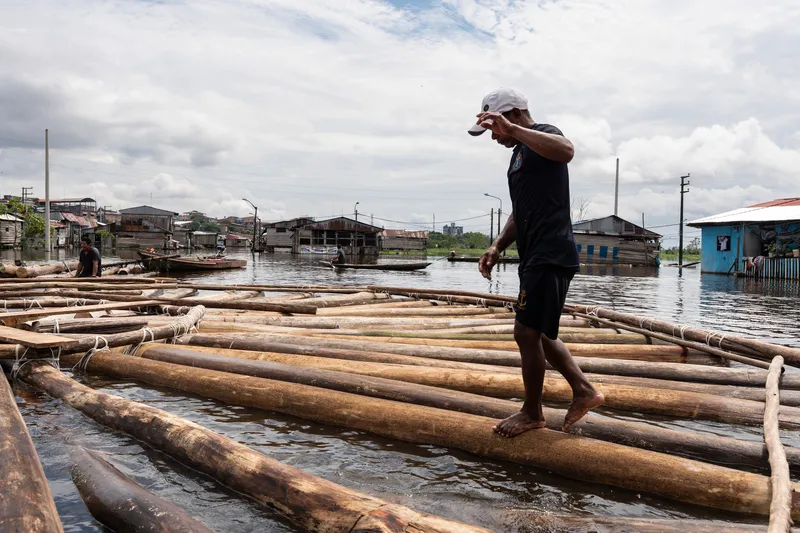
The most quietly radical aspect of this project is what happened after the festival. The platform remained in front of the Estrellita de Jesús school for approximately six weeks, functioning as a floating plaza, a classroom, and a dock. When the water level finally dropped, the materials were not discarded. They were redistributed and reused locally, forming walkways and paths adapted to the in-between season when Belén is neither land nor water but something of both.
This circular economy of materials mirrors the broader logic of life in Belén, where structures are perpetually assembled, adapted, and repurposed in response to the river's rhythms. The floating stage was never meant to be permanent. Its value was precisely in its ability to serve multiple purposes across its lifespan, then dissolve back into the material inventory of the neighborhood.
Plans and Drawings
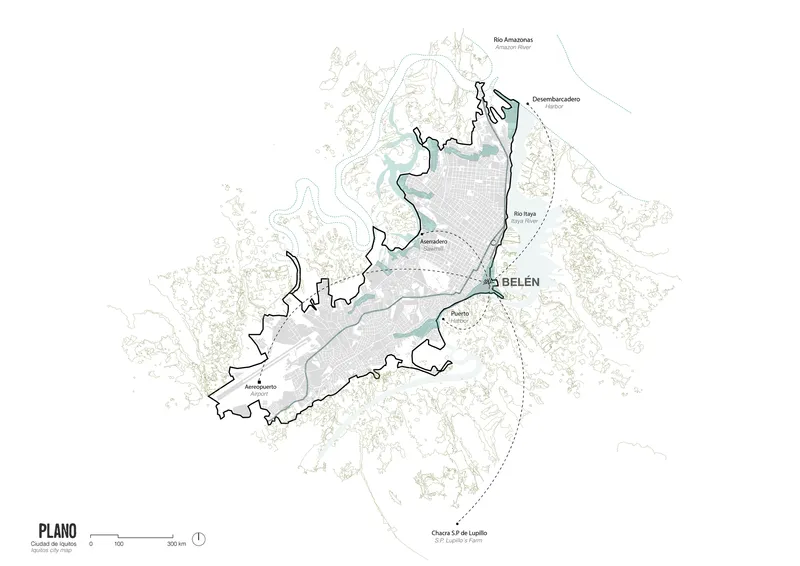
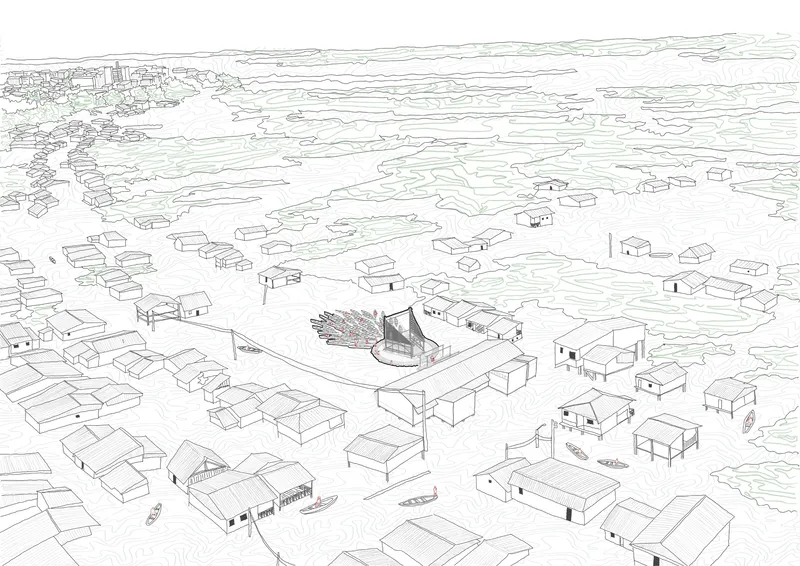
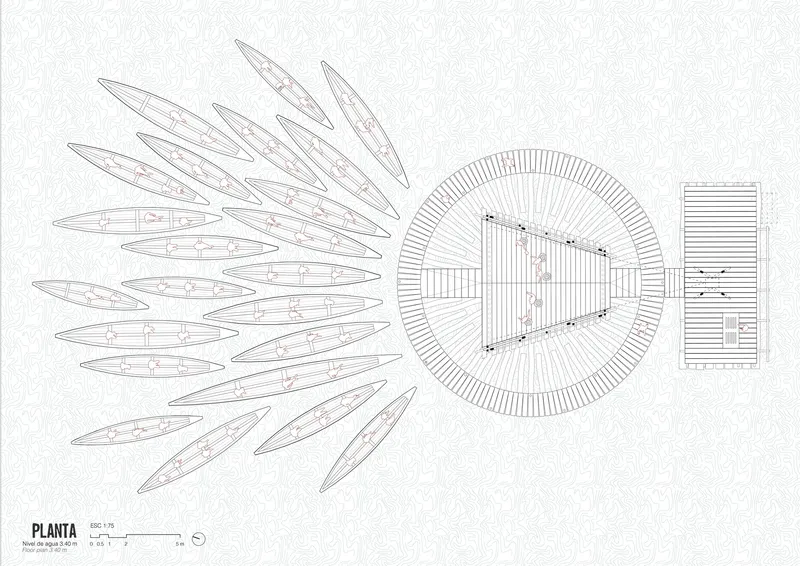
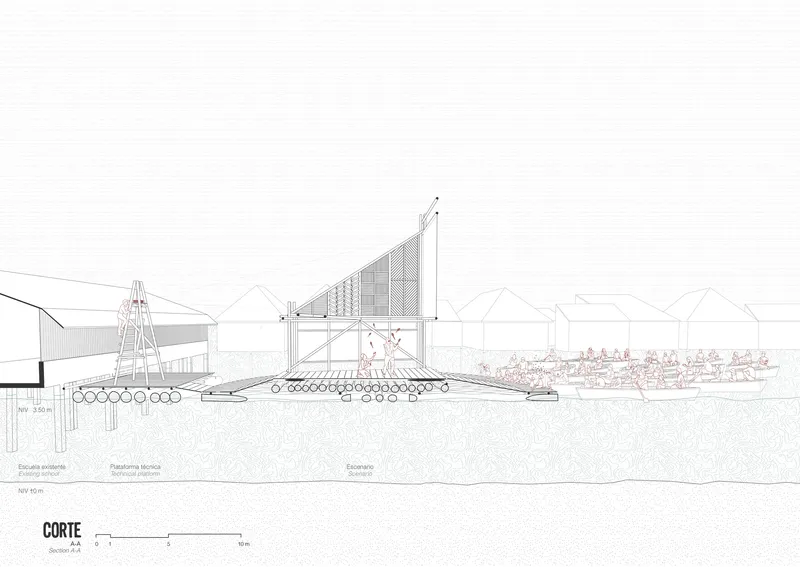
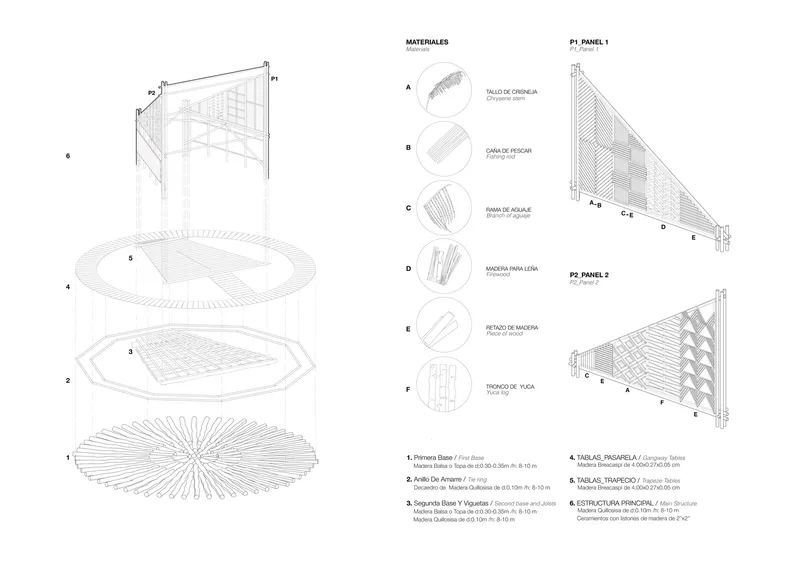
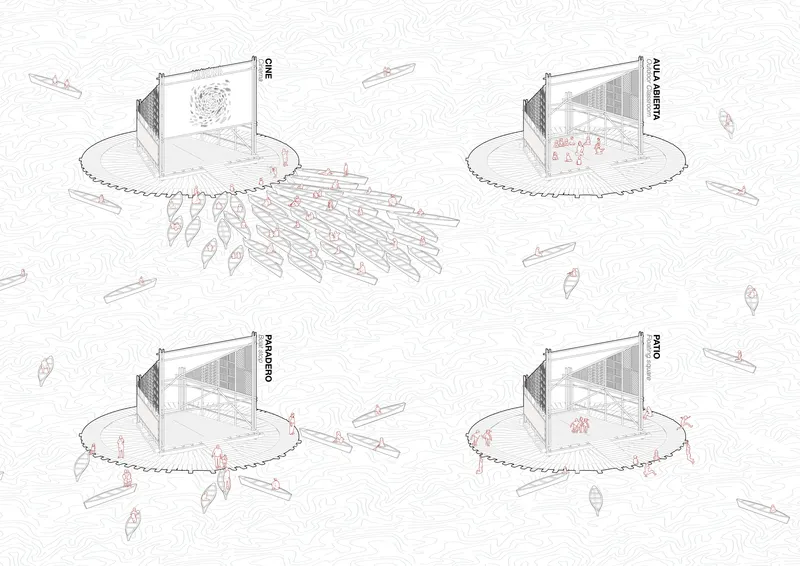
The drawing set reveals a project that was rigorously conceived even if flexibly executed. The site plan locates the platform within the floodplain's network of waterways and settlements. The floor plan shows the radial organization clearly: a central circular platform ringed by canoe-shaped elements, with a rectangular service block attached. The section drawing illustrates the trapezoidal screen's proportions and the bleacher seating facing the water. Perhaps most instructive is the exploded axonometric, which breaks the structure into its layered construction sequence: bundled log base, timber deck, bamboo framework, and infill panels, each called out with material notations.
The four sequential assembly diagrams are a construction manual in miniature, showing how the platform grew from a bare raft to a fully equipped stage. The structural detail drawing of the column connections and cable anchoring system confirms the hybrid logic at work: traditional lashing and joinery techniques supplemented by cable stays and anchoring points engineered to handle fluctuating water levels. These are not presentation drawings designed to impress a jury. They are working documents that had to communicate clearly to people building while standing in a river.
Why This Project Matters
Floating architecture is usually a technology showcase: engineered pontoons, marine-grade hardware, projects that treat water as a problem to be solved with expense. Espacio Común's Muyunafest stage inverts that logic entirely. Water is not a problem here. It is the medium, the context, and the reason the project exists. The construction method, from topa logs to hand-lashed joints, belongs to a building culture that has operated on floodwater for generations. The architects' contribution was organizational and geometric, proposing the muyuna-inspired circle and the trapezoidal screen, then stepping back to let local expertise determine how those forms would actually stand.
The result is a project that does not merely "respond to context" in the way that phrase usually gets deployed in architecture culture. It is produced by context, and it returns to context when its purpose is served. A floating plaza becomes a classroom becomes a dock becomes walkways. That lifecycle, more than the striking nighttime photographs, is the real design. In a discipline increasingly anxious about permanence, resource extraction, and the gap between architects and the communities they serve, a temporary timber disc floating in a Peruvian river makes a quietly forceful case for another way of working.
Muyunafest 2025 Main Floating Stage, designed by Espacio Común in collaboration with residents of Belén. Iquitos, Peru. 175 m². Completed 2025. Photography by Eleazar Cuadros, Daniel Martínez-Quintanilla, Enzo Burga, Helena Perelló, Daniel Canchán, and Alfonso Silva Santisteban.
About the Studio
Share Your Own Work on uni.xyz
If projects like this are the kind of work you want to make, uni.xyz is a place to publish your own, find collaborators, and enter design competitions.



Popular Articles
Popular articles from the community

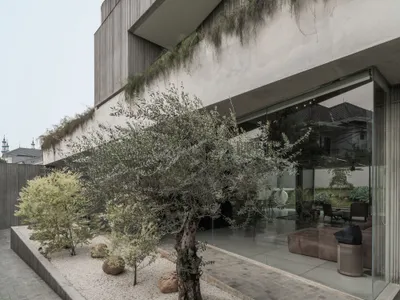
Wiyoga Nurdiansyah Composes Three Volumes into a Quiet Family Compound in South Jakarta
RJH House splits domestic life across a cube, a cylinder, and a service block, laced together by courtyards and raw concrete.
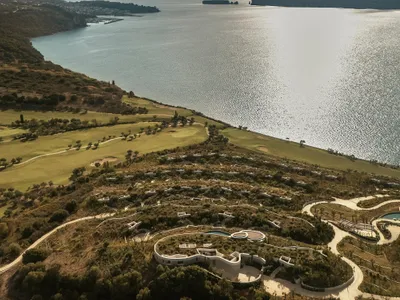
A.N. Tombazis and K-Studio Bury a Luxury Resort into a Peloponnese Hillside
Mandarin Oriental Costa Navarino scatters 99 earth-sheltered rooms across 140 hectares above the Bay of Navarino in Pilos, Greece.
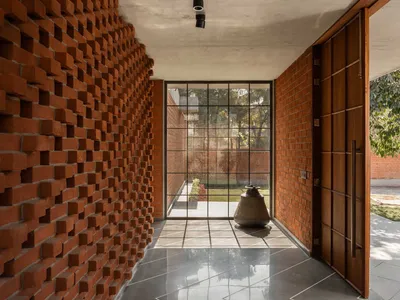
Vaissnavi Shukl Wraps a Single-Storey Ahmedabad Home Around a Courtyard That Breathes
Malhaar Residence uses perforated brick, translucent canopies, and an L-shaped plan to turn a quiet suburban plot into an inward world.
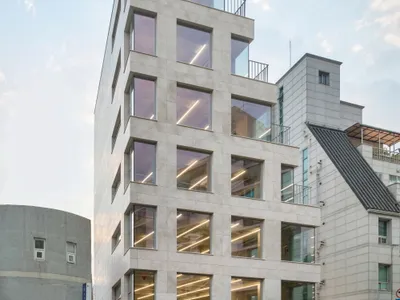
Simplex Architecture Steps a Seoul Mid-Rise Tower to Negotiate Between Low-Rise Commerce and High-Rise Housing
In Seocho-dong, a gridded stone tower of terraces and sunken courtyards mediates between two radically different urban scales.


Similar Reads
You might also enjoy these articles

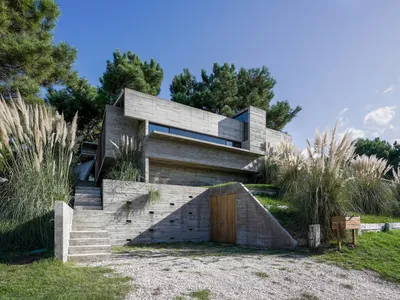
Loma House by Besonias Almeida Arquitectos: Modern Coastal Living in Costa Esmeralda
Loma House by Besonias Almeida Arquitectos is a modern coastal home in Costa Esmeralda, blending exposed concrete, wood, and natural dunes.
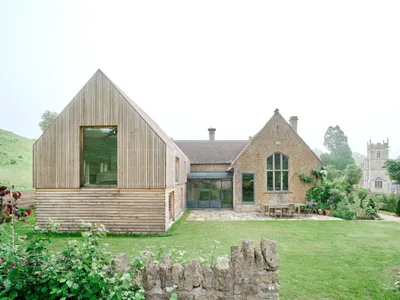
“Pitcombe’s Old School House Renovation by Bindloss Dawes: Blending Heritage and Contemporary Design”
Bindloss Dawes transformed Pitcombe’s 19th-century Somerset schoolhouse with a sustainable timber extension, blending historic charm, contemporary design, and panoramic countryside views.
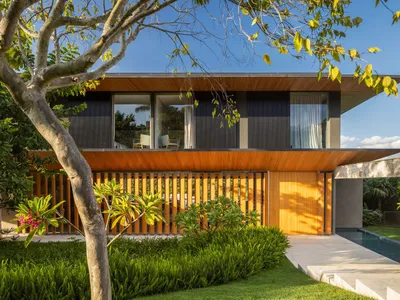
F3 Residence by Belluzzo Martinhão Arquitetos: Contemporary Luxury in São Paulo’s Countryside
F3 Residence in São Paulo blends contemporary design, natural materials, multigenerational living, hillside integration, expansive glass, infinity pool, and seamless indoor-outdoor flow.
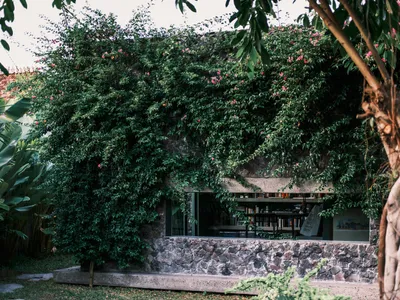
Private Villa in Ubud by BAMM ARCHITECTS: Contemporary Design Amidst Bali’s Jungle
Private Villa in Ubud blends contemporary design with tropical landscape, featuring open-air pavilion, stone and wood materials, suspended master bedroom, and jungle pool views.


Explore Installations Competitions
Discover active competitions in this discipline




The International Standard for Design Portfolios


The Global Benchmark for Architecture Dissertation Awards

The Global Benchmark for Graduation Excellence

Challenge to design a portable theatre
Comments (0)
Please login or sign up to add comments
No comments yet. Be the first to comment!