
ESTUDIO Ignacio Urquiza Ana Paula de Alba Steps a Concrete House Down a Forested Slope in Valle de Bravo
In Avándaro's dense forest canopy, a 537-square-meter residence negotiates steep terrain through linked concrete volumes and timber ceilings.


Valle de Bravo sits about two hours west of Mexico City, a lake town surrounded by steep pine and oak forests where weekenders from the capital have built homes for decades. The forests of Avándaro, on the town's southern edge, are particularly dense: ferns blanket the slopes, eucalyptus and conifers compete for canopy space, and rainwater courses downhill through natural channels. It is a landscape that punishes careless building. ESTUDIO Ignacio Urquiza Ana Paula de Alba treats that difficulty as the project's organizing logic, designing a house whose volumes step and split across the terrain rather than leveling it.
What makes this project worth studying is not the concrete itself, which is ubiquitous in Mexican residential architecture, but how the architects use topographic descent as a spatial sequence. Each linked volume lands at a different elevation, creating half-level shifts that feel intuitive rather than contrived. The result is a house where you are always slightly above or slightly below the room you just left, always reoriented toward a different slice of the forest. The architecture does not sit on the site; it steps through it.
Following the Slope
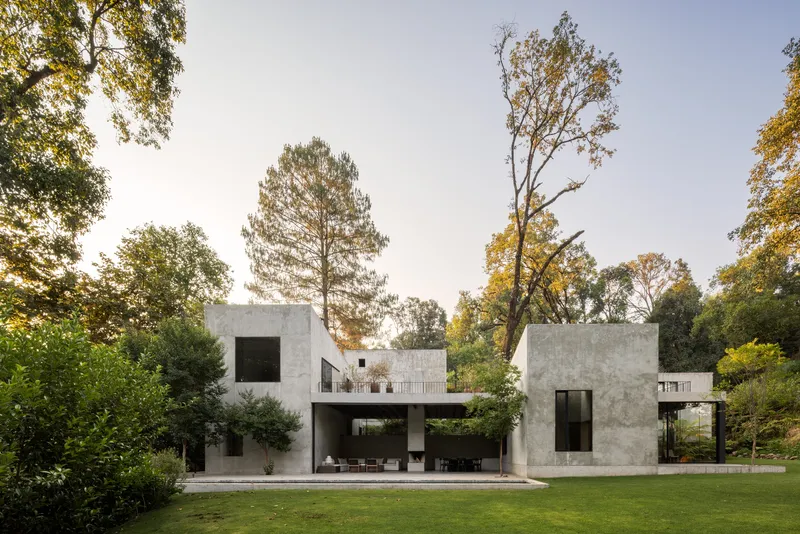
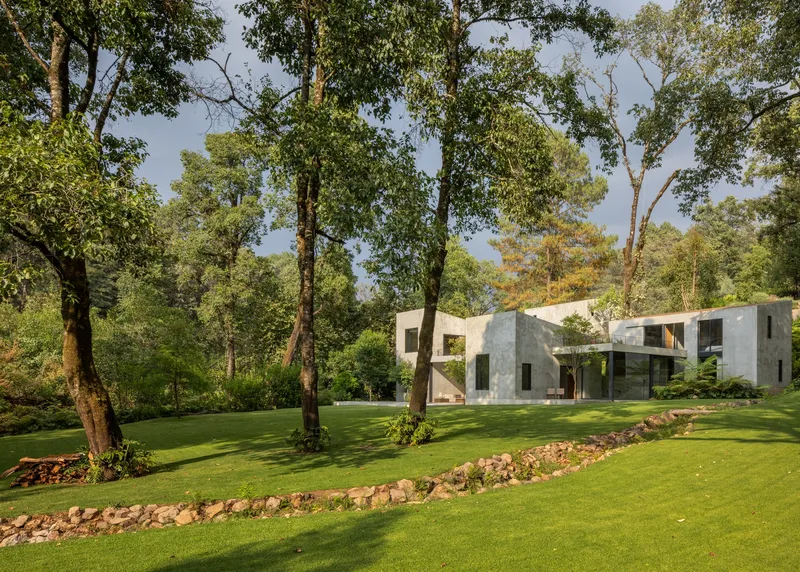
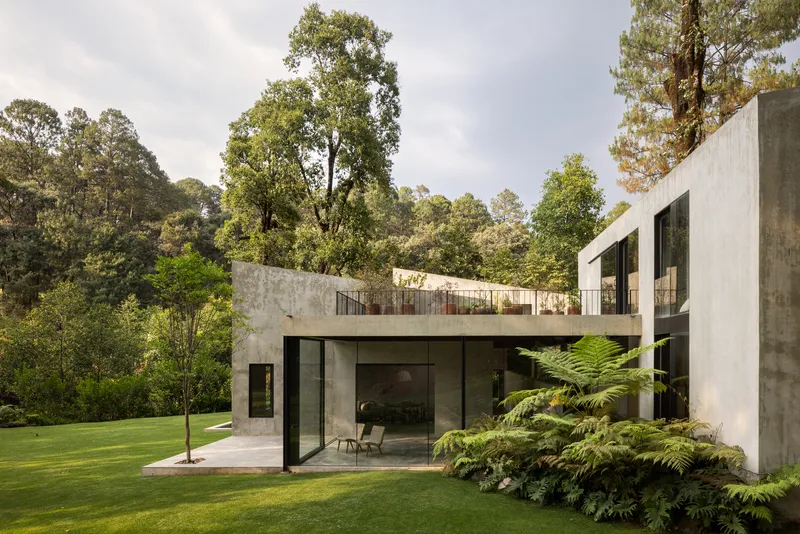
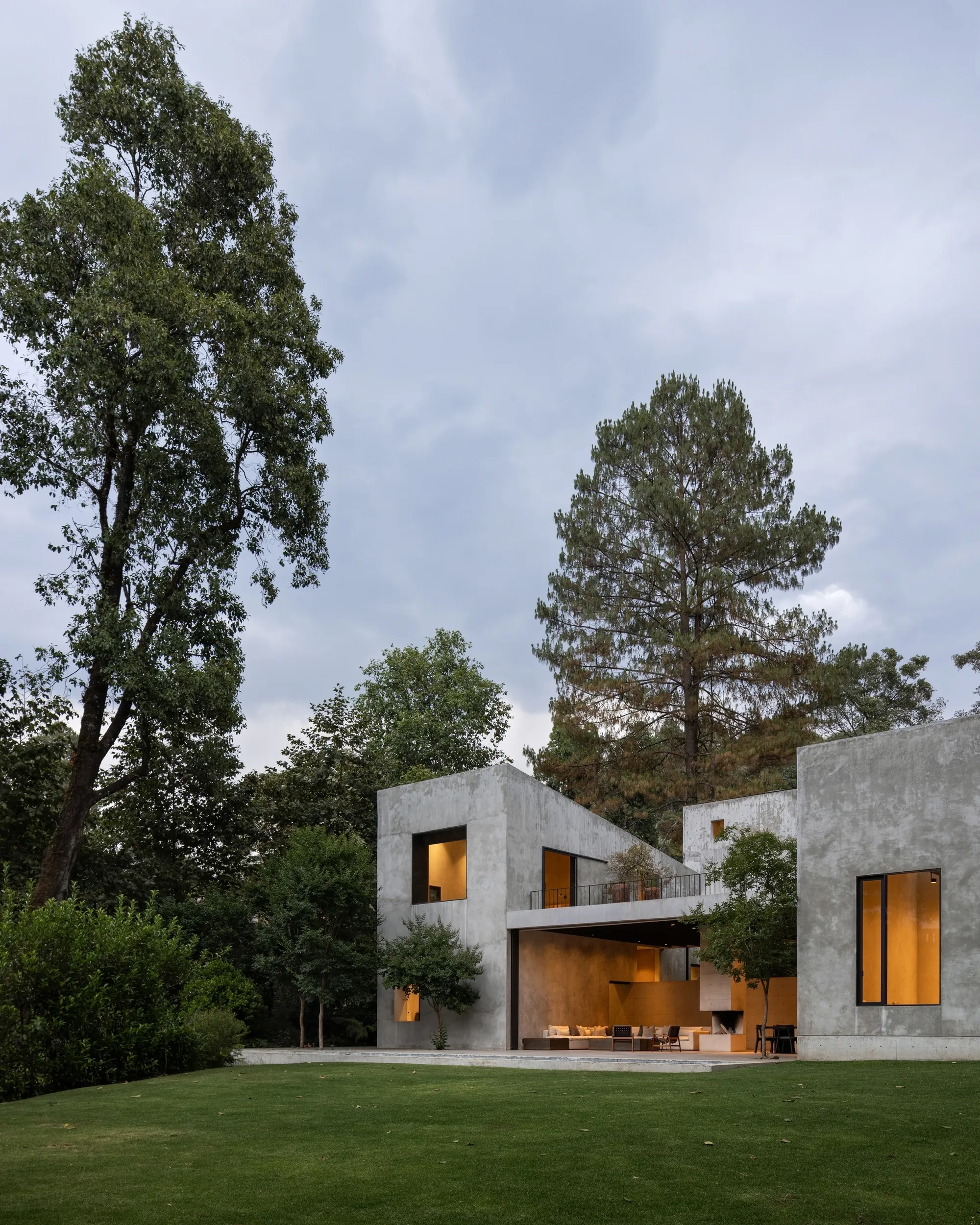
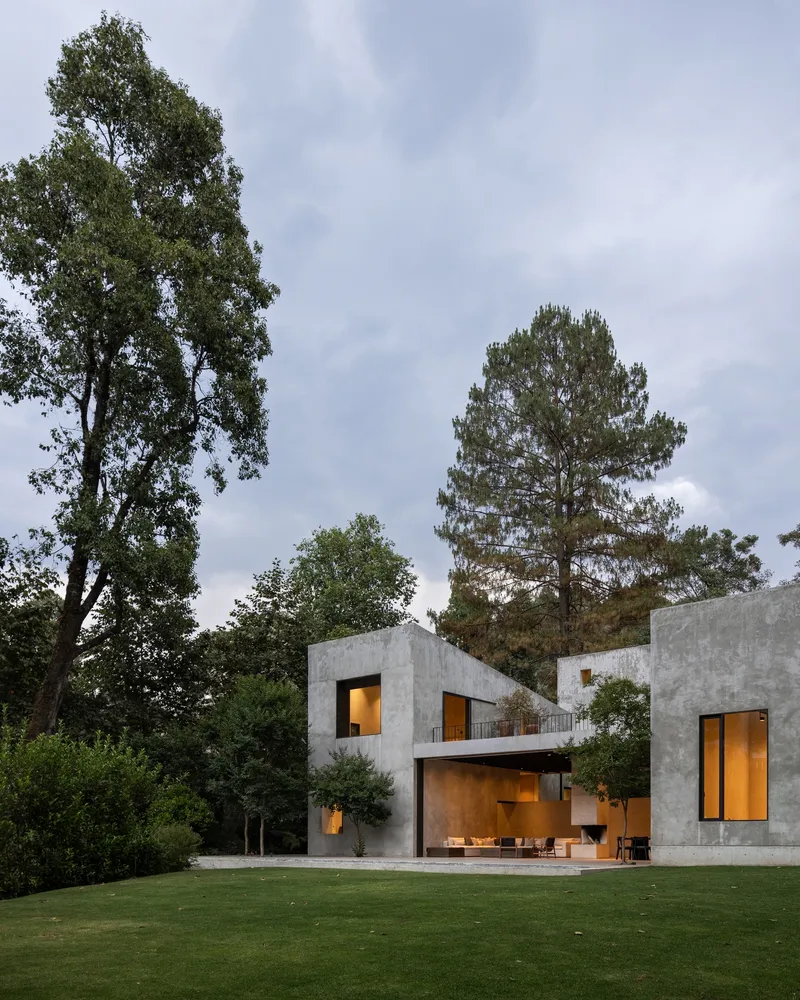
Seen from the garden, the house reads as a cluster of concrete boxes at staggered heights, each one responding to the natural grade. The volumes are not identical: some cantilever forward, others pull back, and the gaps between them admit light and views of the surrounding trees. A curved stone border at the base of the lawn gently separates the domestic ground plane from the wilder terrain below.
The architects avoided a single monolithic block in favor of articulated pieces that reduce the visual mass. From a distance, the house appears to be several structures gathered among the trees. The mown lawn acts as a clearing, a controlled green room that makes the surrounding forest feel denser by contrast.
Arrival and Threshold
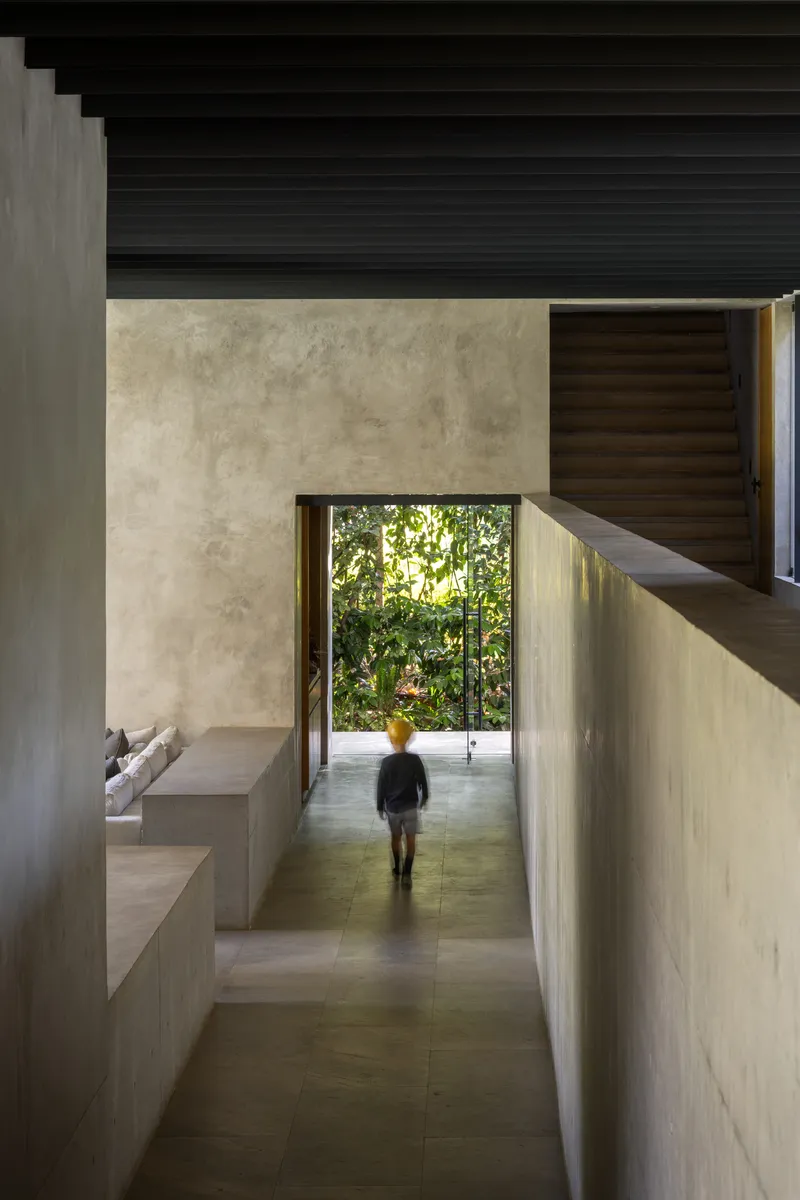
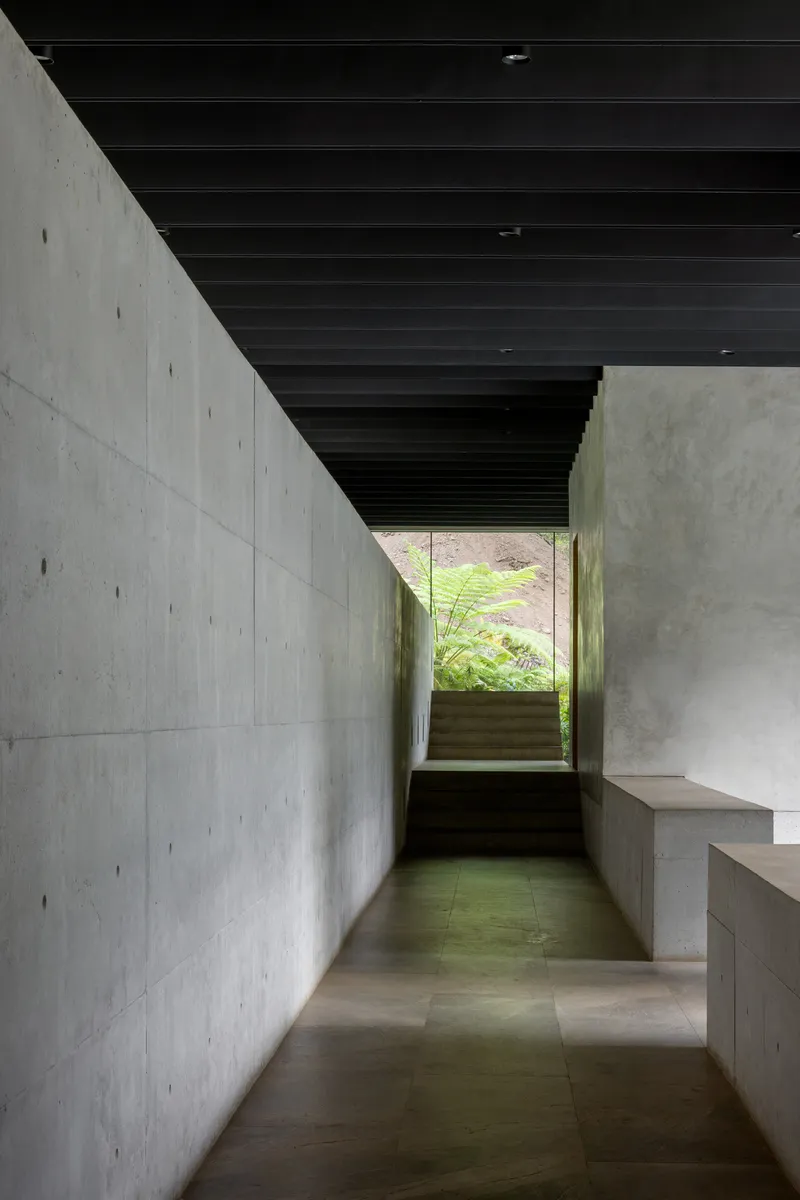
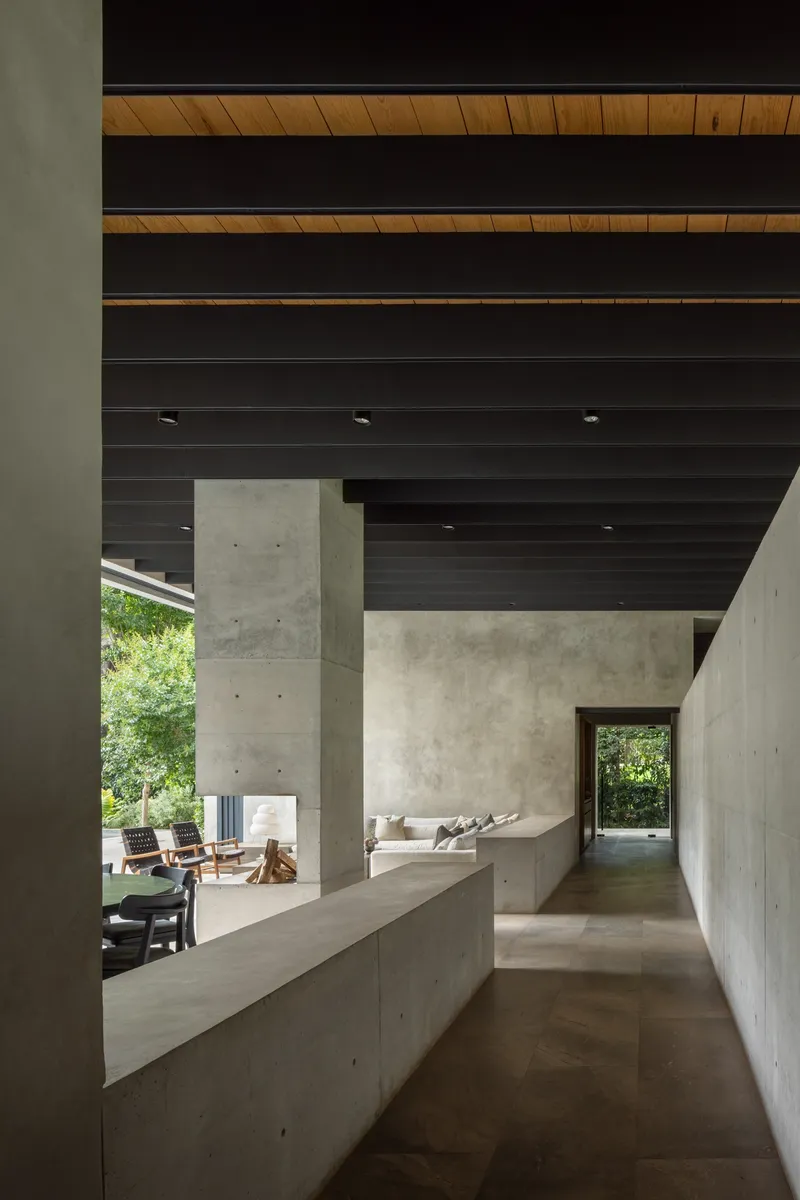
The entry sequence is deliberately compressed. A narrow corridor framed by raw concrete walls and a dark timber ceiling channels movement toward a bright garden view at the far end. It is a classic architectural device, the pinch before the release, but it works especially well here because the forest beyond the opening is so vivid. The corridor doubles as a light instrument: dappled sun filters through overhead vegetation and plays across the concrete surfaces, marking time throughout the day.
A parallel corridor on the upper level repeats the strategy. Black steel beams march overhead, their rhythm drawing the eye toward a sunlit window framing nothing but green. These passages are not mere circulation; they are calibrated pauses between the house's larger rooms.
Living Under Timber and Steel
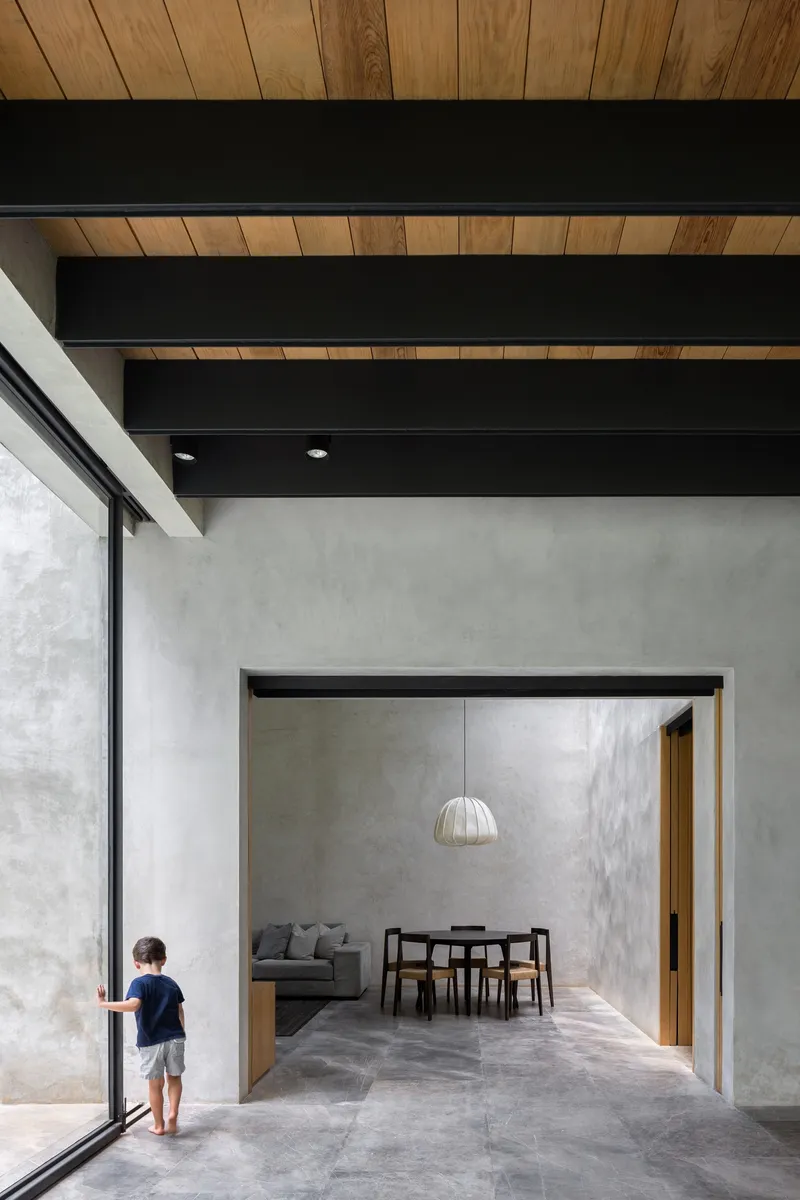
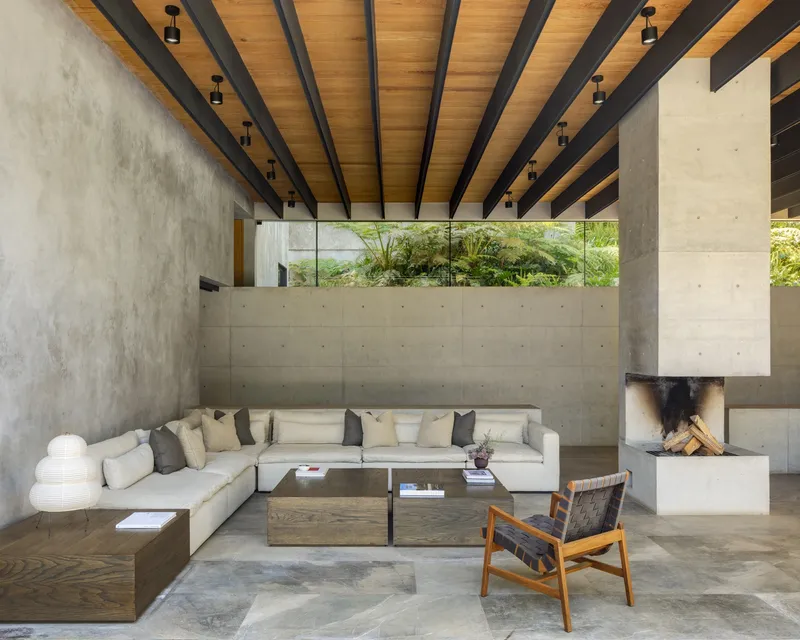
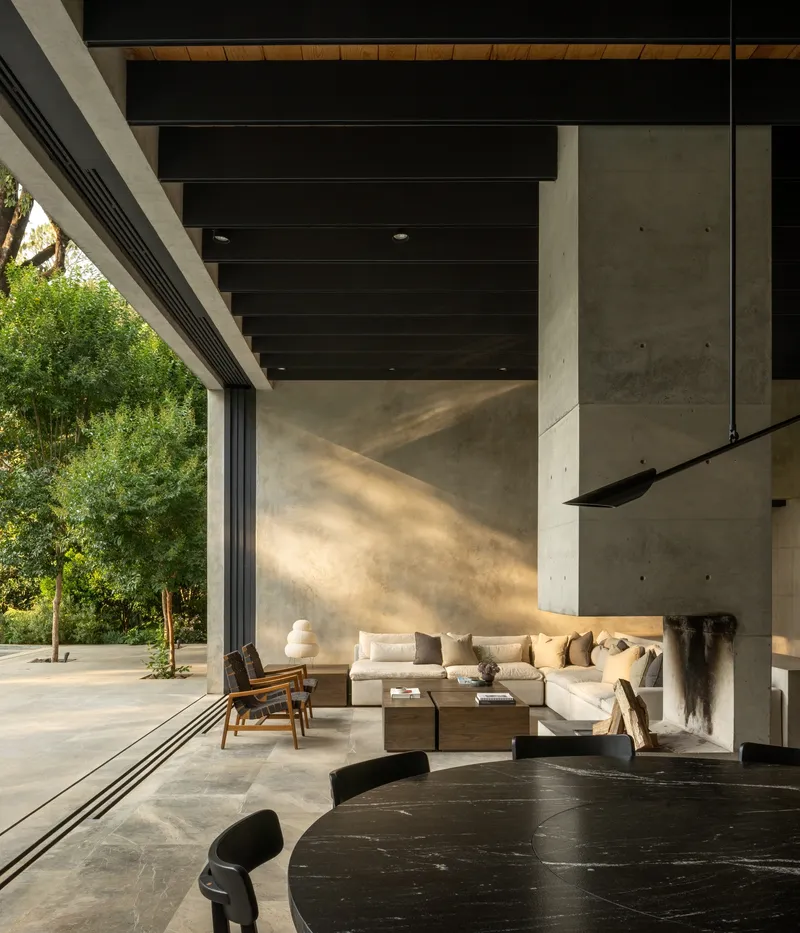
The main living spaces are defined by their ceiling, not their walls. Exposed black steel beams support warm timber panels, creating a taut overhead plane that contrasts sharply with the raw concrete surfaces below. The palette is deliberately restrained: concrete, steel, timber, stone flooring. Color comes from the forest outside and from the quality of light that shifts through full-height glazing.
A concrete fireplace anchors the living room on one side, while a sectional sofa and low furnishings occupy the opposite wall. The room is generous but not cavernous. Warm afternoon light spills across the polished stone floor, softening the mineral severity of the concrete. The effect is a room that feels sheltered without feeling enclosed, a quality that depends entirely on the proportions of the glazed openings relative to the solid walls.
The Double-Height Section
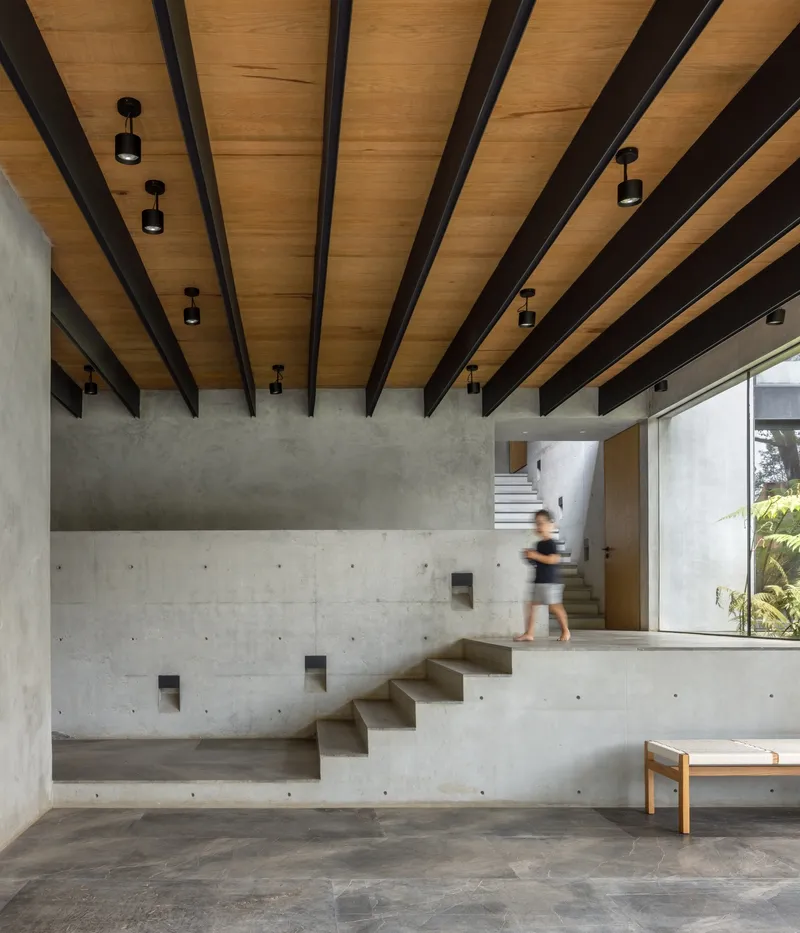
A double-height stair hall connects the house's split levels. The stair itself is concrete, cantilevered from one wall, while the ceiling above reveals the full timber-and-steel structural system. The tall volume pulls cool air upward and admits high light that reaches deep into the plan. It is the most architecturally charged moment in the house, where you grasp how the section works across the slope.
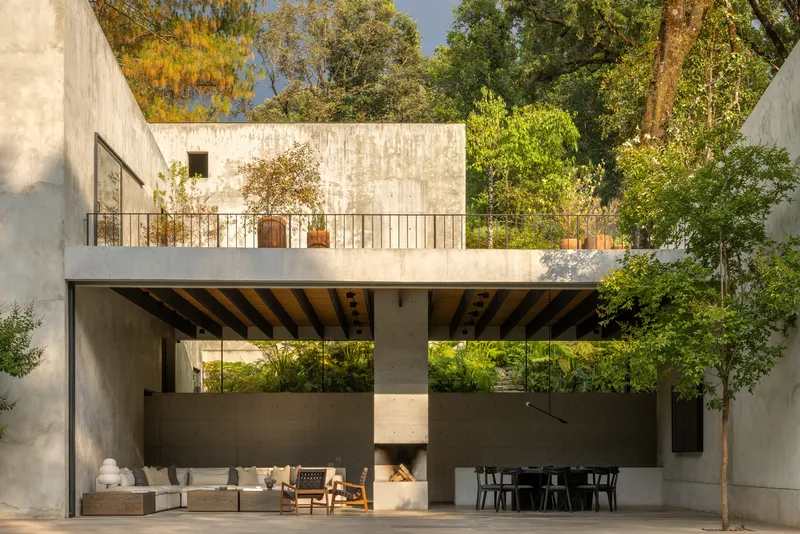
Outside, a double-height covered terrace mirrors this vertical emphasis. A concrete fireplace rises through the full height, flanked by exposed beams and an upper-level balcony. The terrace blurs the boundary between interior and exterior: it has a roof and a hearth but no glazing, making it inhabitable in rain and sun alike. In a climate as temperate as Valle de Bravo's, this kind of in-between space is arguably more valuable than any enclosed room.
Outdoor Rooms and Forest Edge
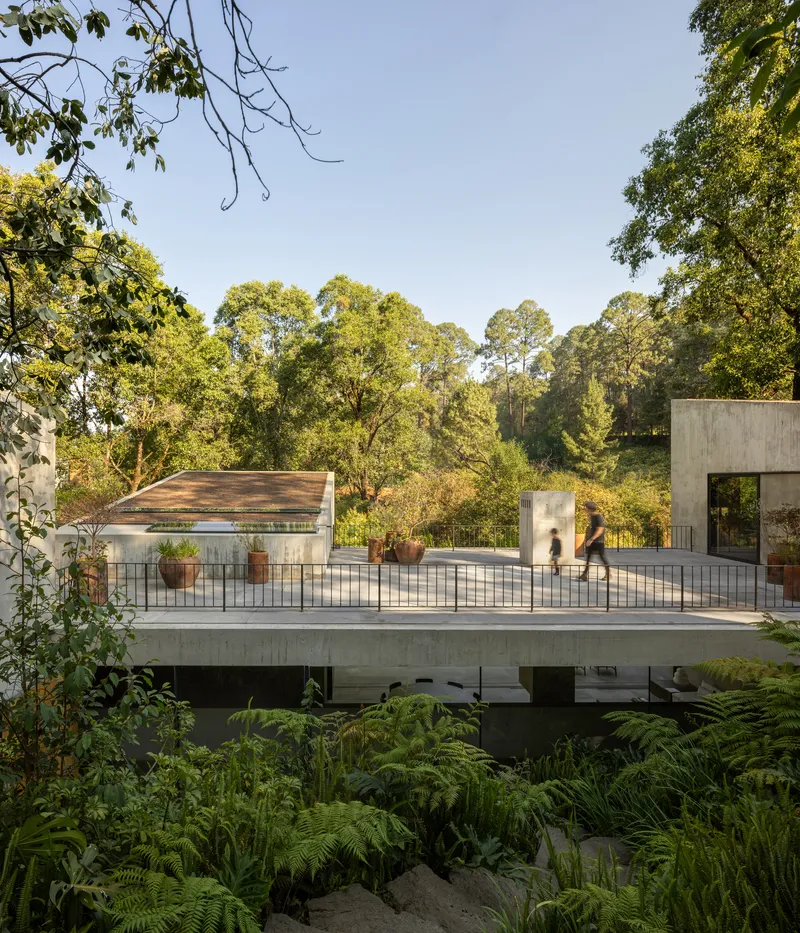
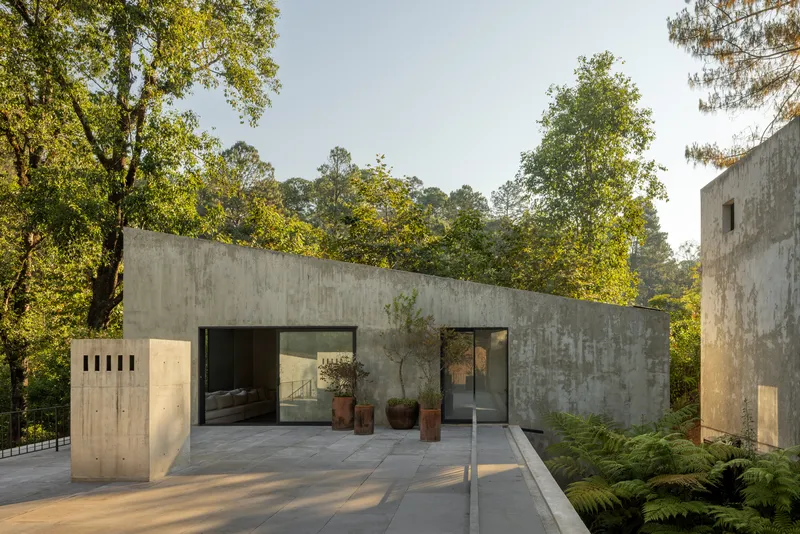
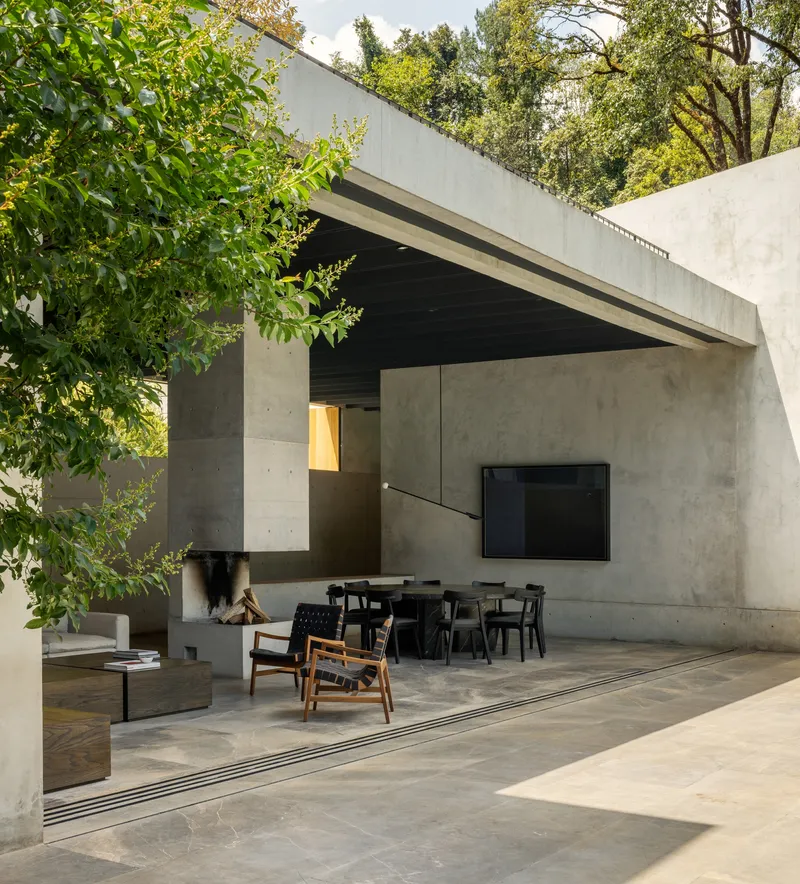
Several outdoor rooms extend the living space into the landscape. An elevated concrete deck with metal railings provides a lookout point above the fern canopy. A pavilion with large glazed openings and terracotta planters catches afternoon light beneath the dappled shade of the trees. A covered terrace with a cantilevered concrete roof and stone flooring frames the trunks and branches of mature trees as if they were structural columns in their own right.
These outdoor spaces are not afterthoughts. They are sized and detailed with the same care as the interior rooms. The concrete edges are clean, the stone floors are flush, and the planting is integrated rather than decorative. The house treats the forest not as scenery but as program, allocating square meters to it the way a conventional plan allocates them to bedrooms.
Material and Light
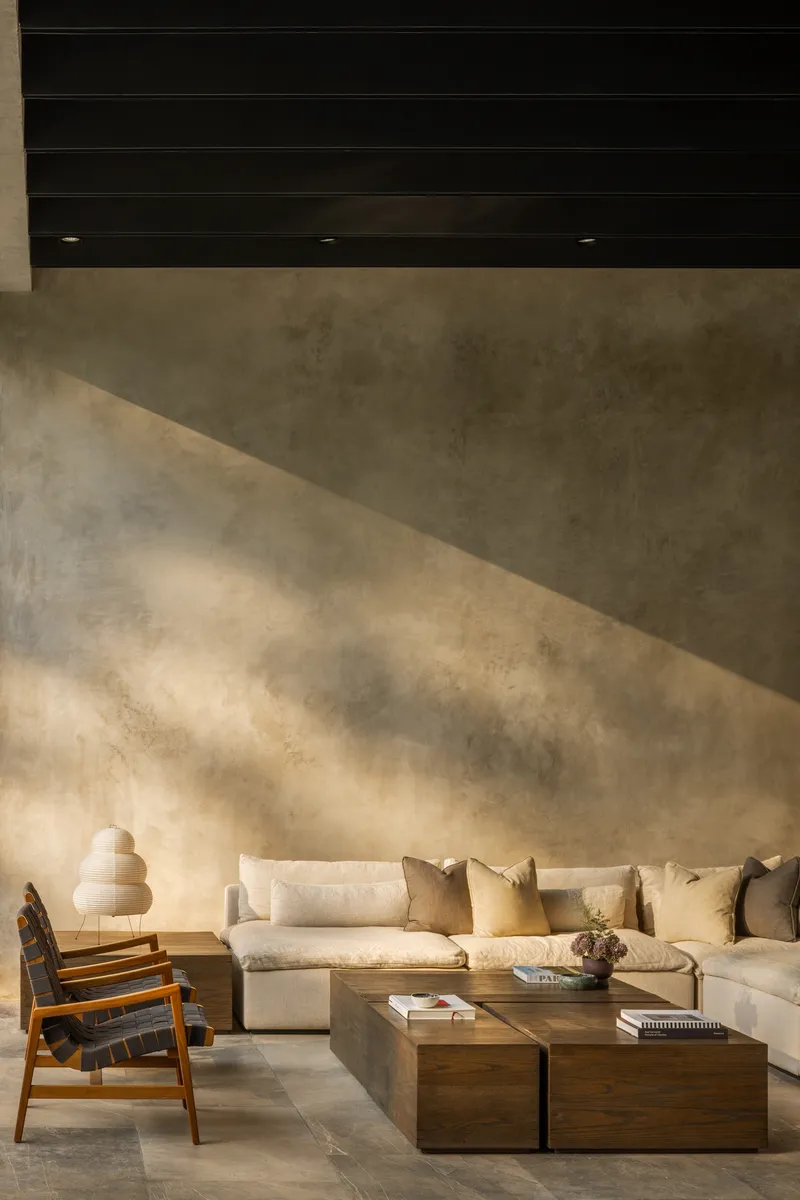
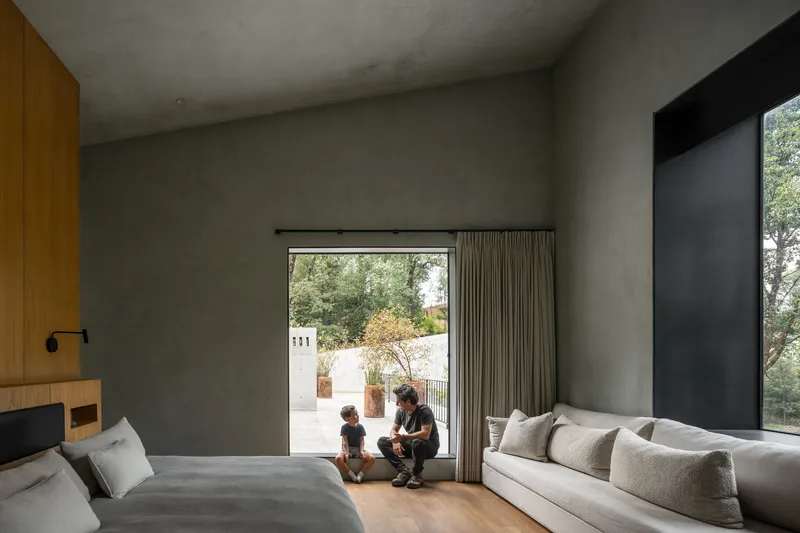
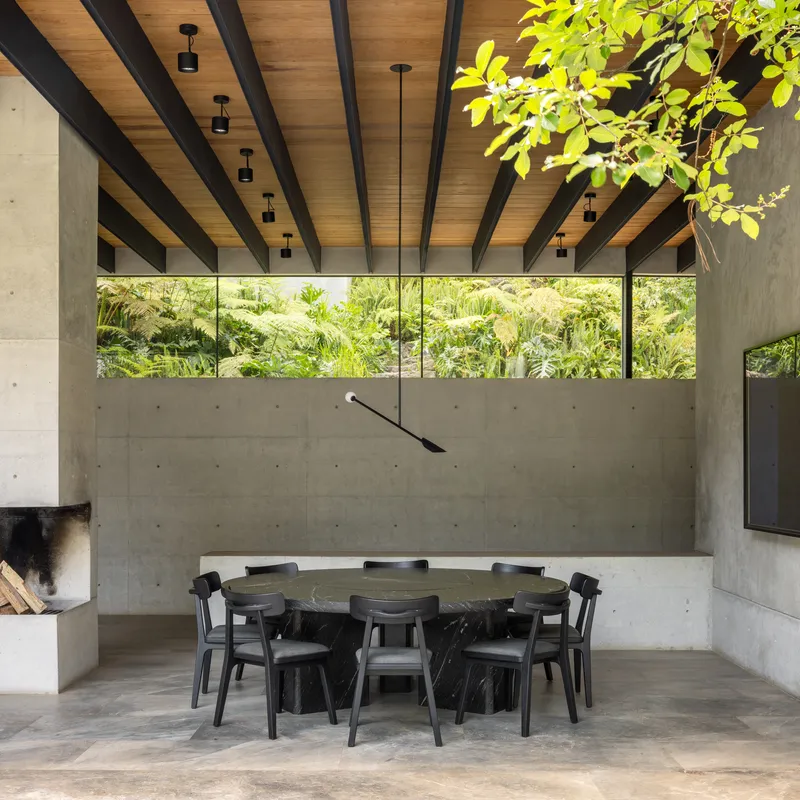
Concrete is the dominant material, and the architects let it do real work. One wall becomes a canvas for dappled tree shadows, its surface registering the movement of branches throughout the day. In the bedrooms, polished concrete walls catch reflected garden light, giving the rooms a cool, diffuse glow. The dining area uses clerestory windows above a dense planted wall to filter light downward through vegetation before it enters the space.
These are not decorative gestures. Each one manages solar gain, visual privacy, and spatial atmosphere simultaneously. The house controls light the way a forest does: through layers of material that filter, redirect, and soften it before it reaches the ground plane.
Dusk Presence
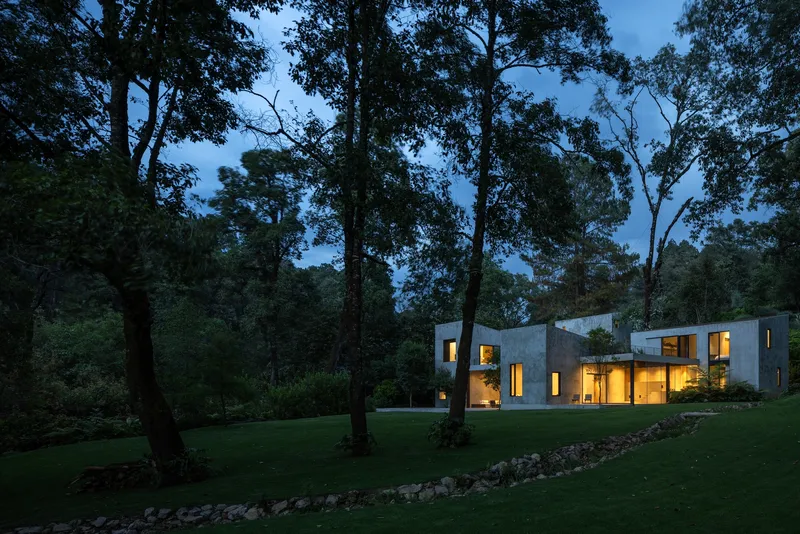
At dusk, the house transforms. The concrete volumes darken to near-black silhouettes, while warm light glows from the glazed openings, revealing the interior life of the building. The eucalyptus trees surrounding the house become ghostly vertical lines against a cloudy sky. It is a moody scene, and it demonstrates something important: the house's massing was designed for this moment as much as for daylight hours. The proportions of solid to void, which feel generous during the day, become intimate and lantern-like after sunset.
Plans and Drawings
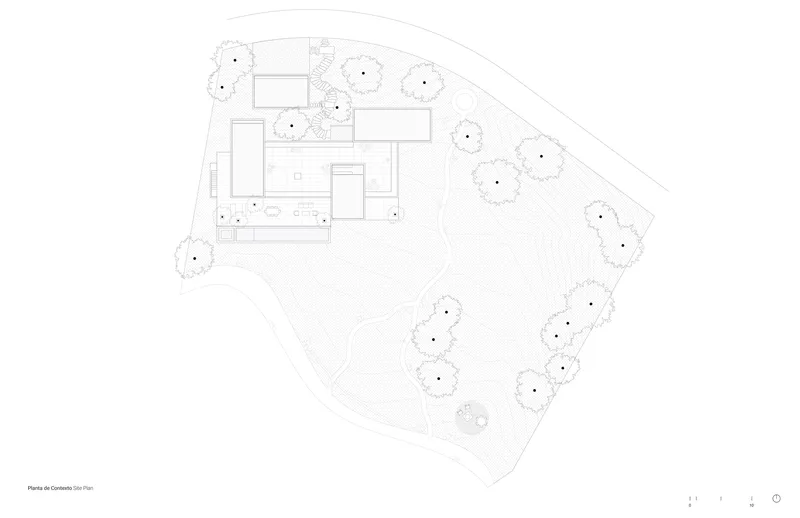
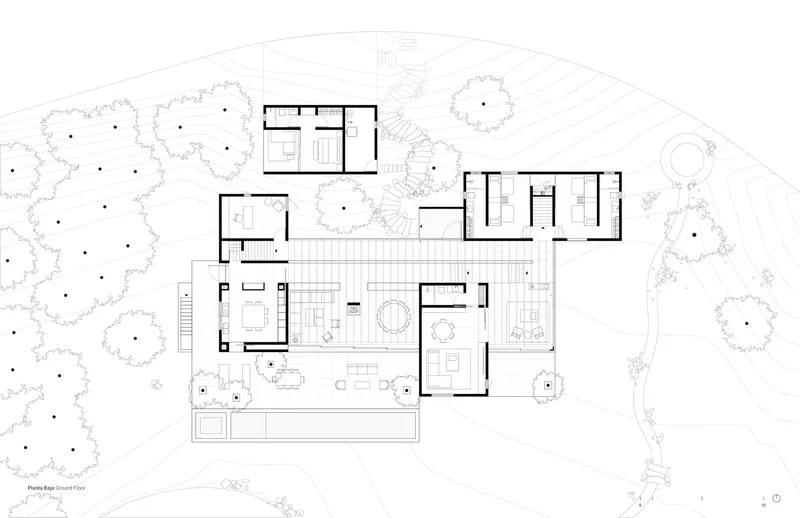
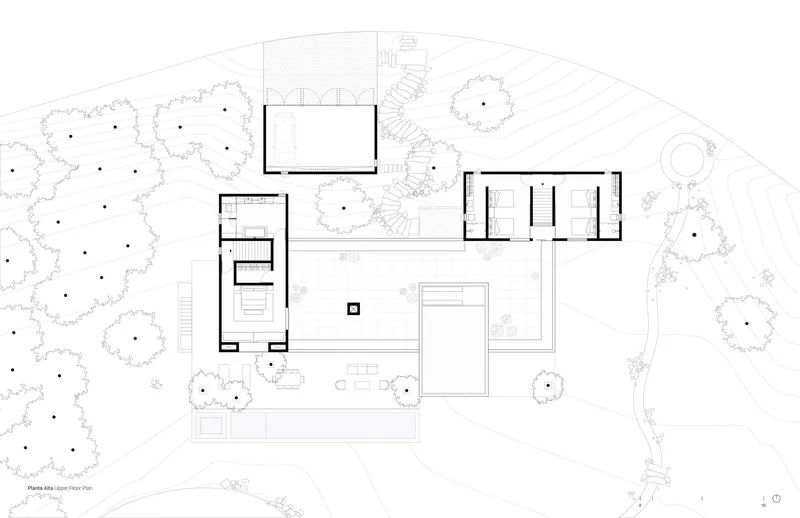
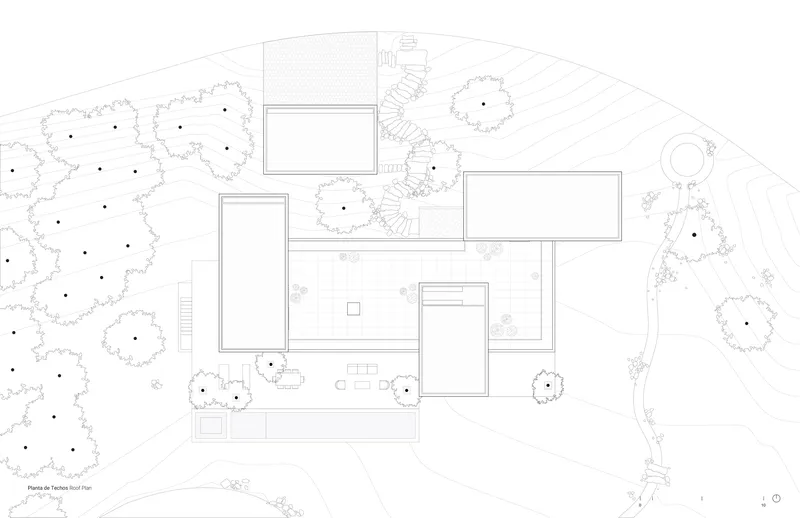
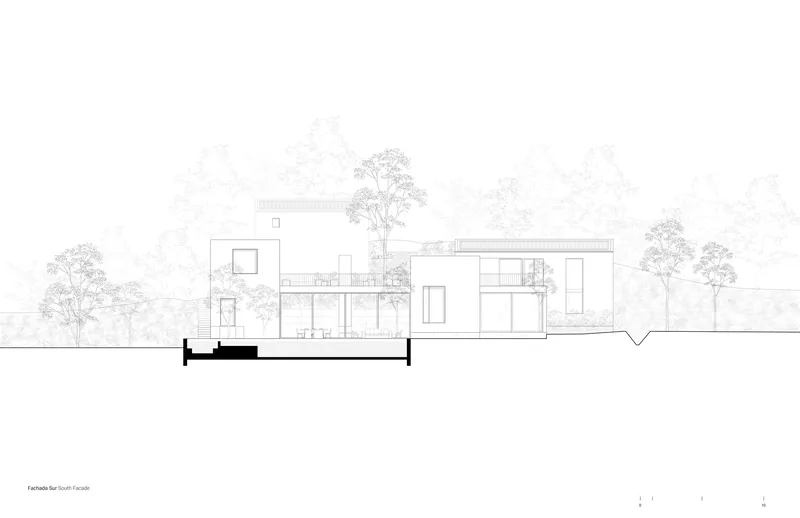
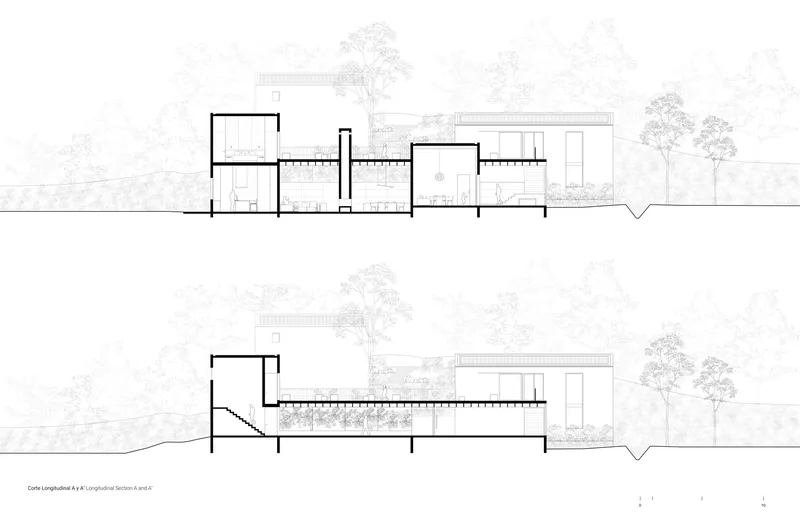
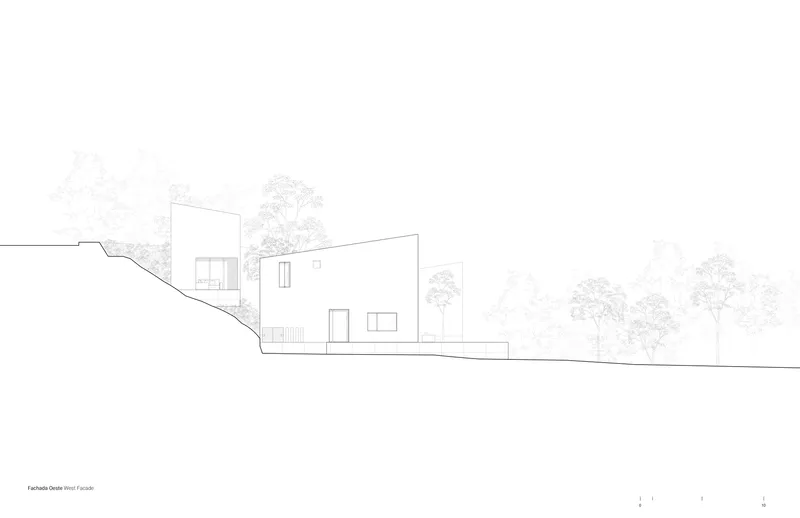
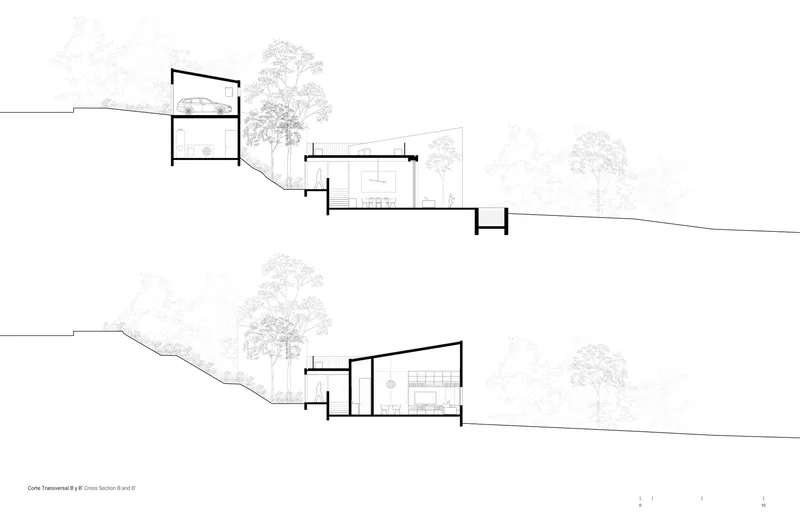
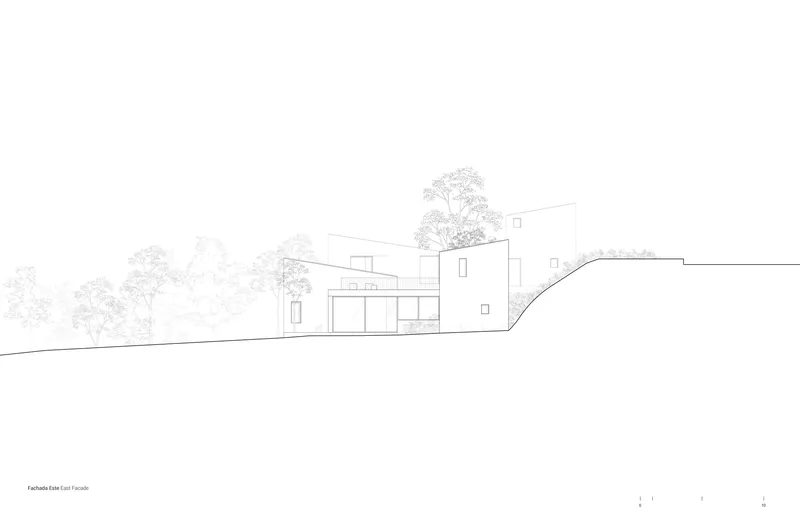
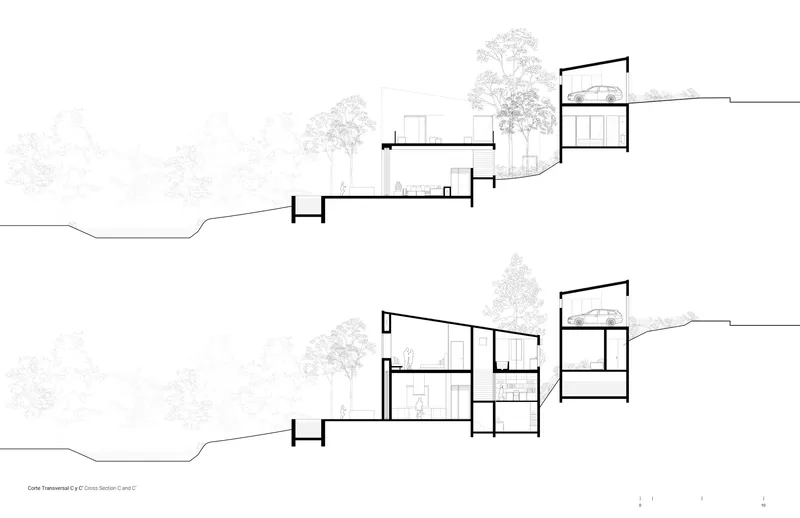
The site plan reveals how carefully the architects mapped existing tree canopies before placing the building footprint. The house threads between the largest trees, preserving their root zones and allowing their canopies to shade the roof. The floor plans show a linear sequence of linked volumes: living spaces occupy the center, bedrooms extend into wings on either side, and covered terraces mediate between interior and exterior at every level.
The sections are where the project's logic becomes clearest. The longitudinal section shows volumes stepping down the slope in half-level increments, connected by short stairs rather than full flights. The transverse sections reveal how interior spaces are stacked and offset to create double-height voids and upper-level balconies. Every volume is dimensioned to fit between existing trees. The architecture is, in the most literal sense, shaped by what was already there.
Why This Project Matters
The temptation on a steep, forested site is either to cut a flat platform and build on it or to elevate the entire structure on stilts. Both approaches treat the terrain as a problem to be solved. This house takes a third path: it accepts the slope as a spatial resource and uses it to generate a section that would have been impossible on flat ground. The result is a sequence of rooms that feel varied and surprising despite an extremely disciplined material palette.
Ana Paula de Alba and Ignacio Urquiza have produced a house that respects its forest context without romanticizing it. The concrete is unapologetically man-made. The steel beams are painted black, not hidden. The architecture announces itself as architecture, then steps aside to let the trees, the light, and the slope do their work. That balance, confident intervention without domination, is harder to achieve than it looks.
House in Avándaro by ESTUDIO Ignacio Urquiza Ana Paula de Alba (lead architects: Ana Paula de Alba and Ignacio Urquiza). Valle de Bravo, Mexico. 537 m². Completed 2024. Photography by ESTUDIO Ignacio Urquiza Ana Paula de Alba.
About the Studio
Share Your Own Work on uni.xyz
If projects like this are the kind of work you want to make, uni.xyz is a place to publish your own, find collaborators, and enter design competitions.




Popular Articles
Popular articles from the community


Play: Fragments of Their World
Familiar architecture becomes modular playground design, creating safe spaces where displaced children can learn, connect, imagine and play.

The Earth Pod: 3D Printed Homes for Resilient Refugee Communities
The Earth Pod reimagines refugee housing through 3D printed homes made from clay, combining resilience, self-sufficiency, and rapid shelter.

Conexión: Biophilic Design Reimagines High-Rise Living in Hong Kong
Conexión reimagines high-rise living in Hong Kong through biophilic design, green facades, shared spaces, daylight, water and nature within.

Riyadh For All: Intergenerational Urban Design for Active Aging in Rabat
Riyadh For All reimagines urban design in Rabat with intergenerational co-living, adaptive courtyards, and Moroccan cultural exchange today.

Similar Reads
You might also enjoy these articles

Bao Huynh Watercolor Atelier: A Serene Art Retreat in Hội An
Bao Huynh Watercolor Atelier in Hội An blends multifunctional art spaces, sustainable design, local materials, and family-friendly living in a serene environment.

Atelier Macri Concept Store Interior Design by CASE-REAL
Atelier Macri store features a "ko" counter, walnut wood details, cork displays, blending retail, gallery, and seamless customer experiences.

Manuel Vargas Izquierdo Stadium and High-Performance Sports Center: Architectural Excellence in Jalpa de Méndez
The Manuel Vargas Izquierdo Stadium blends sustainable design, inclusive sports facilities, and cultural-inspired architecture, revitalizing Jalpa de Méndez’s public spaces.

KAKR Buluh Awar Hall: Revitalizing Community and Ecology Through Bamboo Architecture
Community built bamboo hall revitalizes Buluh Awar village, empowering youth, restoring ecology, celebrating vernacular craftsmanship through sustainable architecture and culture.




Comments (0)
Please login or sign up to add comments
No comments yet. Be the first to comment!