
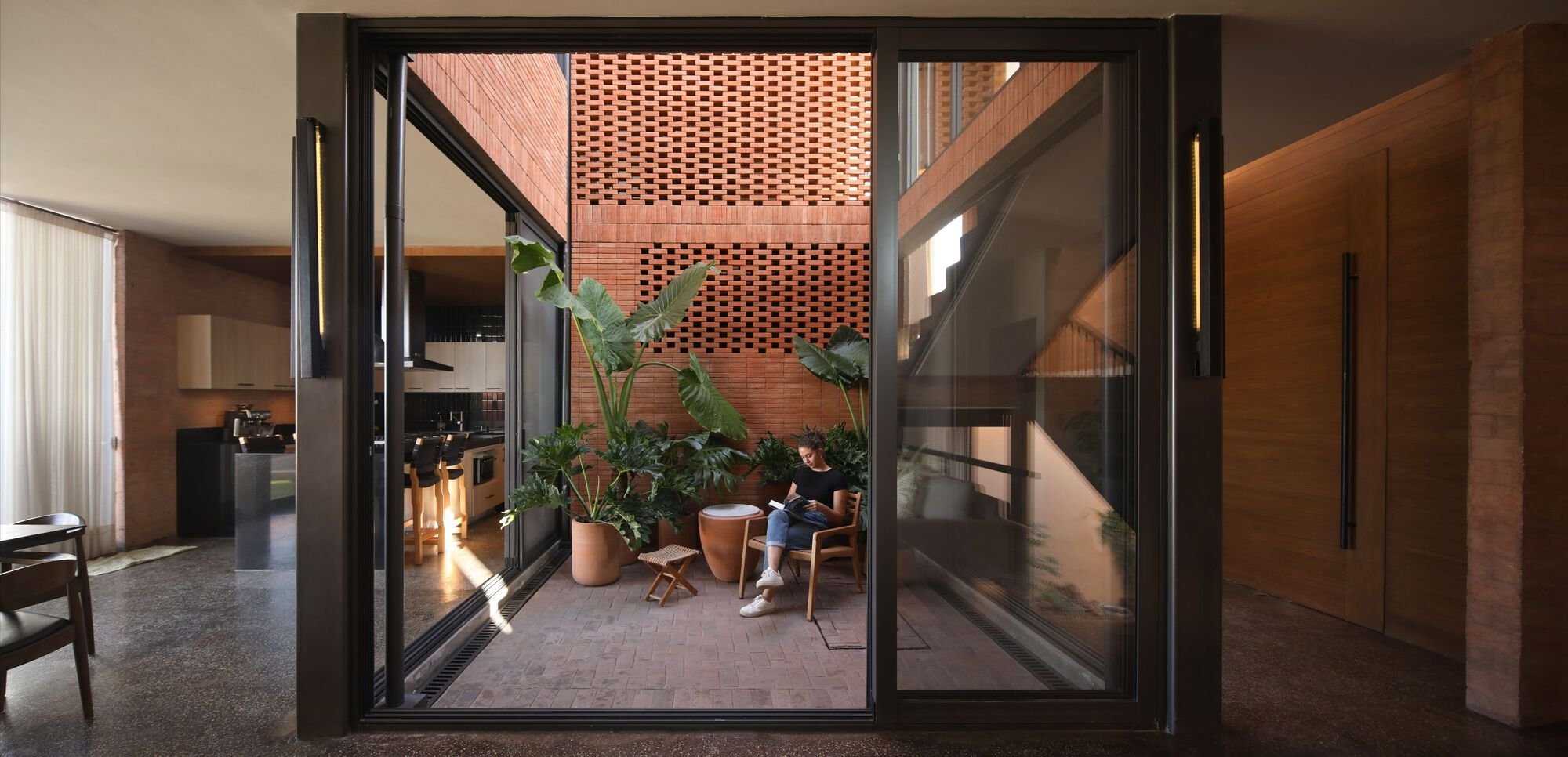
Estudio Mero Builds a Terracotta House Around a Central Patio in Querétaro's White Suburbs
Juriquilla House uses adobe brick, split levels, and a nine-quadrant plan to revive the Mexican courtyard tradition north of Querétaro.

In a small subdivision north of Querétaro where compact white houses repeat themselves lot after lot, Juriquilla House arrives like an argument for what Mexican residential architecture could still be. Designed by Estudio Mero and led by architects Horacio Gutiérrez Merediz and Rodrigo Degetau Vom Hovel, the 350 square meter house is organized entirely around one idea: the patio. Not the patio as decorative leftover space, but the patio as the generative center from which everything else, ventilation, circulation, light, social life, radiates outward.
What makes the project genuinely interesting is the collision between this deeply traditional spatial logic and the material specificity of the site. Juriquilla sits in a region known for its significant partition brick production, and Estudio Mero leaned into that context with terracotta colored adobe walls, perforated brick screens, and an ochre palette that makes the house look as though it emerged from the steppe rather than being dropped onto it. The result is a house that stands out precisely because it belongs.
A Terracotta Presence in a White Neighborhood
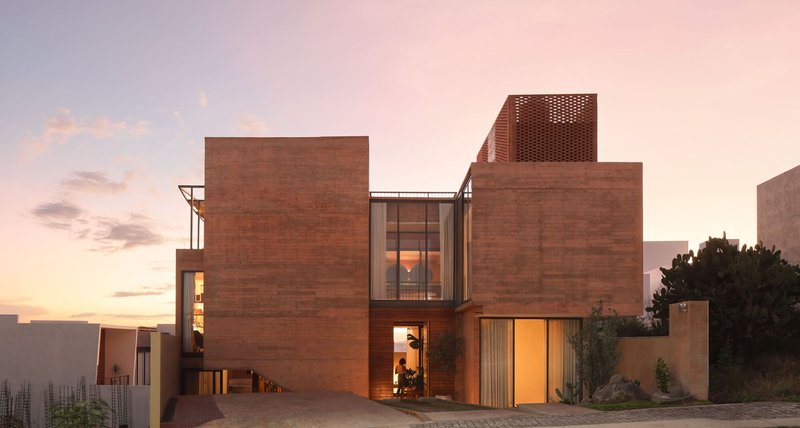
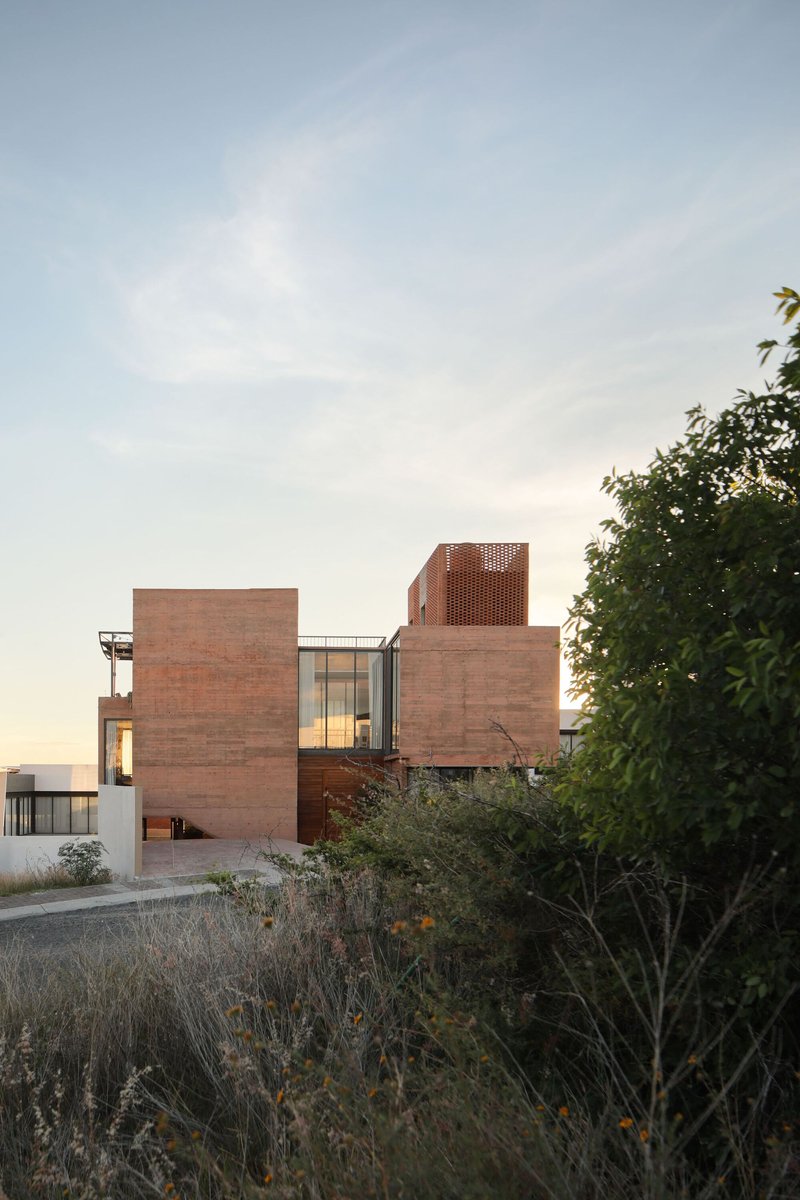
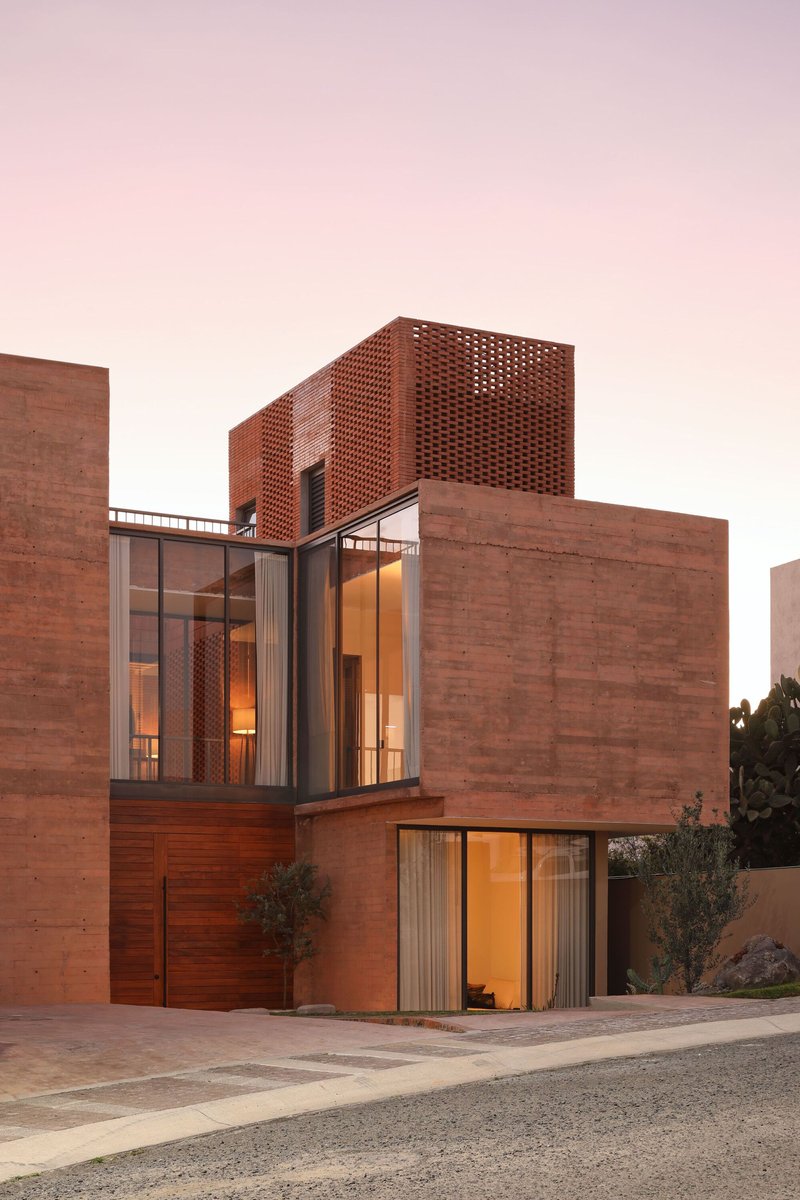
From the street, the house reads as a composition of stacked volumes in warm earth tones: adobe walls, timber cladding at ground level, and a perforated brick tower that rises above native grasses. Against the predominantly white residential context, the color choice is deliberate and almost confrontational. Estudio Mero chose materials that reference the Queretan landscape, the dry steppe, the red soil, the local brick yards, rather than the default developer palette of the neighborhood.
The perforated brick screen at the upper level does double duty. It gives the street facing elevation texture and depth while filtering light into the rooms behind. At dusk, when the interior glow bleeds through the brick lattice, the tower becomes a lantern, signaling the house's presence without aggression.
The Patio as Engine
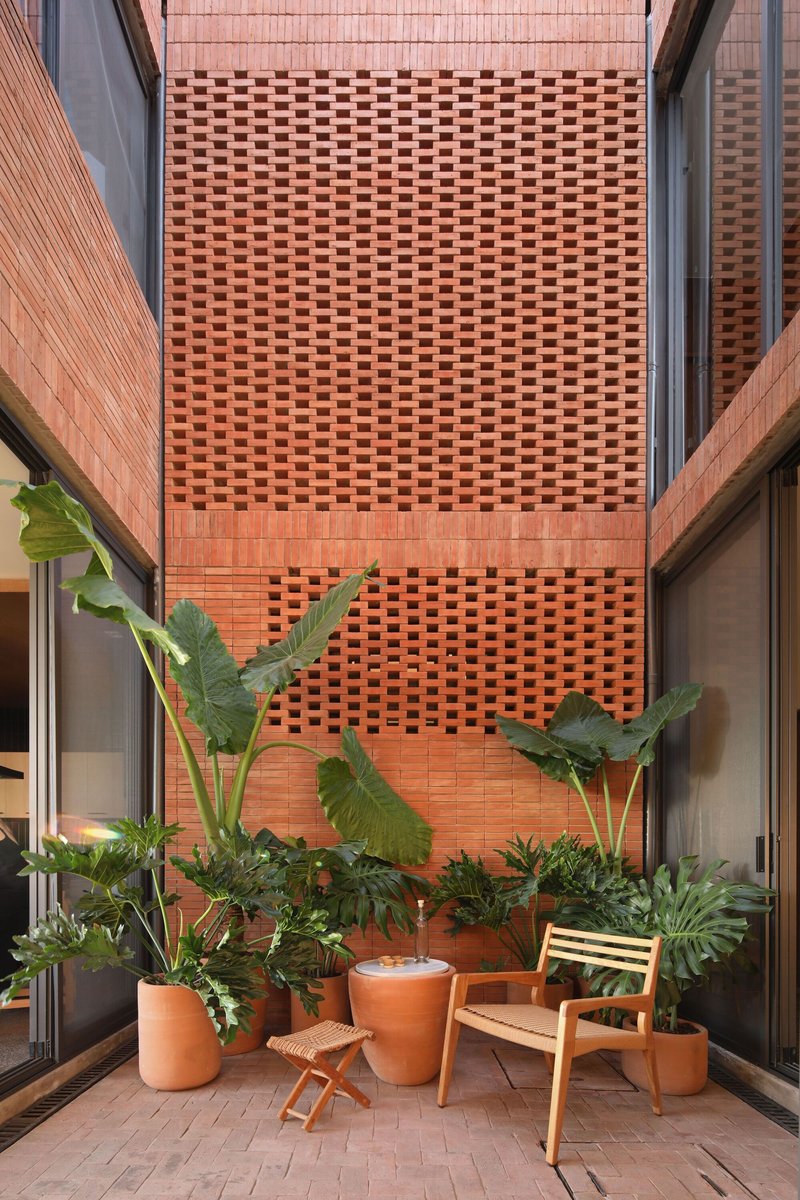
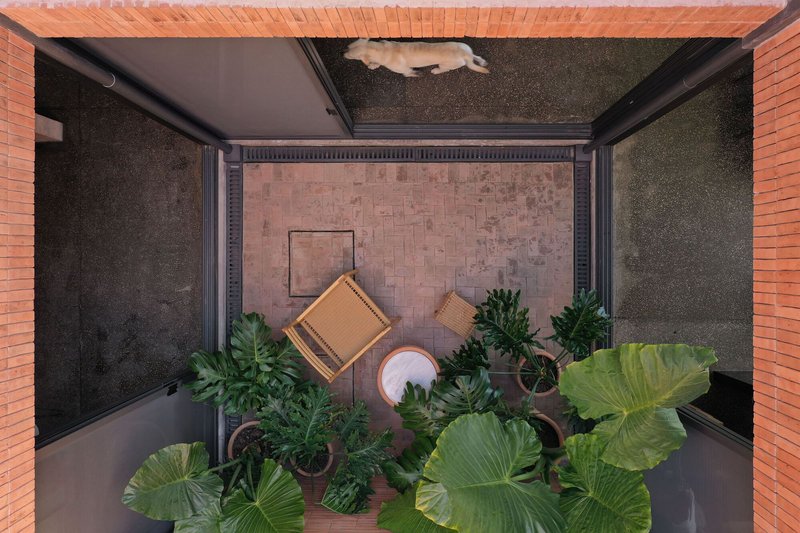
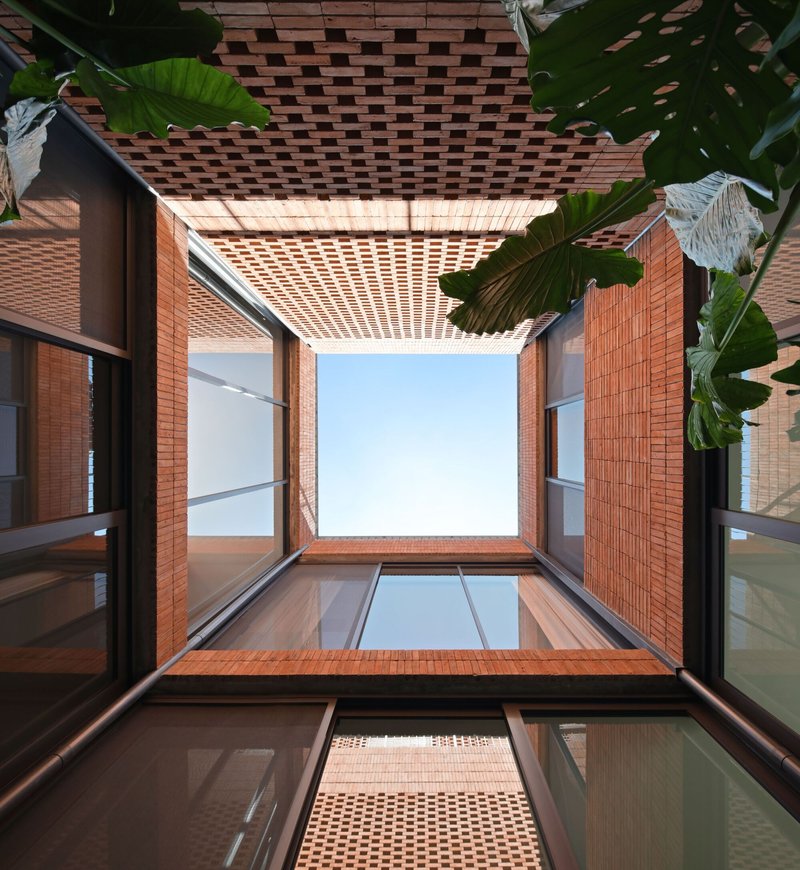
The plan is organized on a nine-quadrant grid, with the central courtyard occupying the core. This is a direct reinterpretation of the traditional Mexican patio house, where the courtyard is not merely a void but the primary room around which all domestic life orbits. Perforated brick walls define two sides of the courtyard, creating a filtered enclosure that allows air to move freely through the house.
Looking straight up through the courtyard reveals the lattice ceiling and framed sky, with banana leaves and tropical plantings pushing into the frame from below. The patio functions as a passive ventilation chimney, drawing cool air through the adobe brick walls, which themselves contribute thermal mass to moderate interior temperatures. In a region where summers press hard, this is architecture doing real climatic work.
Entry Sequence and Material Transition
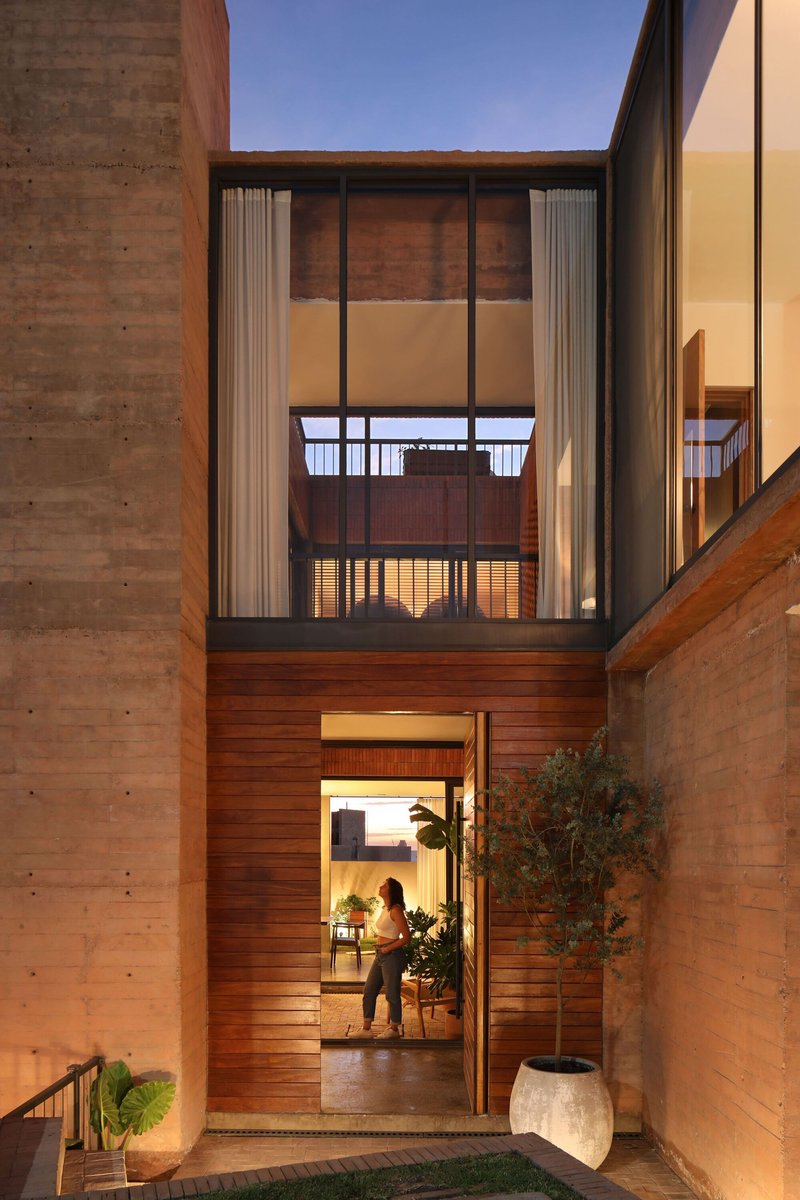
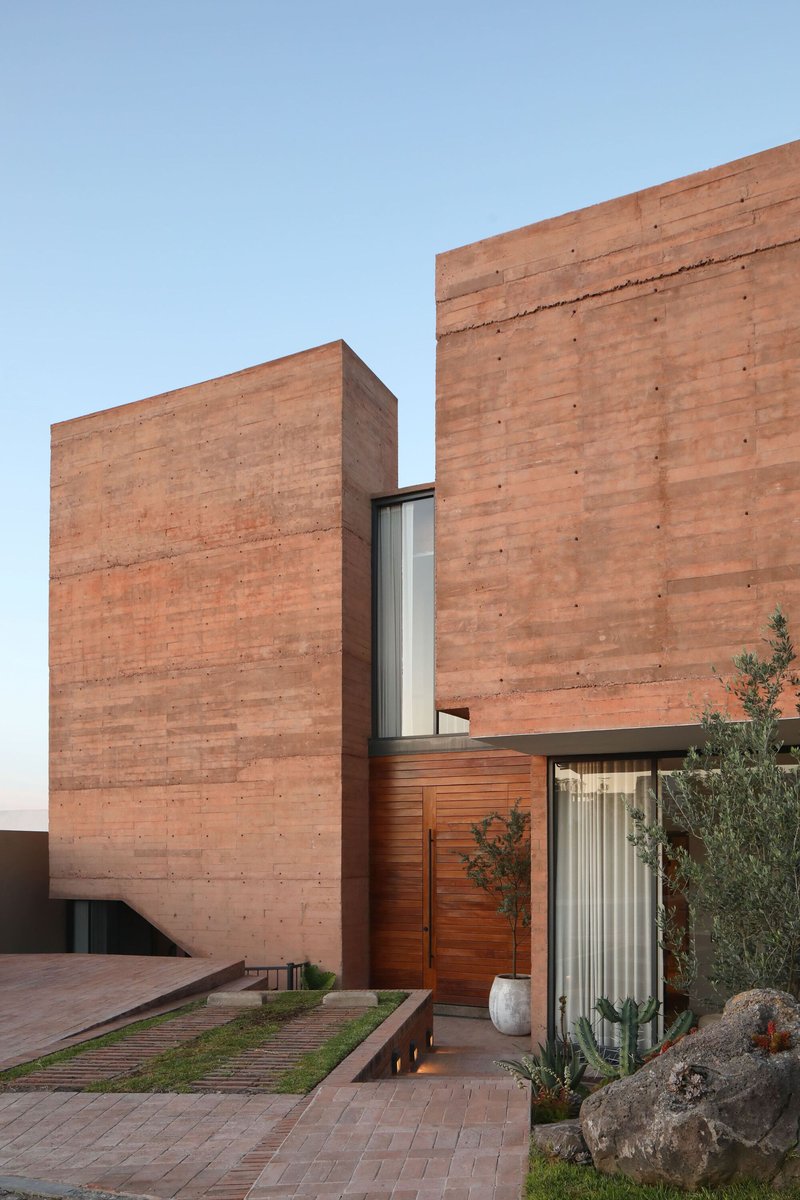
The approach to the house is carefully staged. A rammed earth wall channels you into a compressed entry courtyard where timber cladding, planted beds, and an illuminated doorway frame the threshold between public and private. The material palette shifts subtly as you move inward: from the rough earth walls of the exterior to warmer timber surfaces that signal arrival.
This sequencing matters because it slows you down. The house does not open itself up at the street; it pulls you through layers. By the time you reach the central patio, you have already left the subdivision behind.
Living Spaces That Extend into Landscape
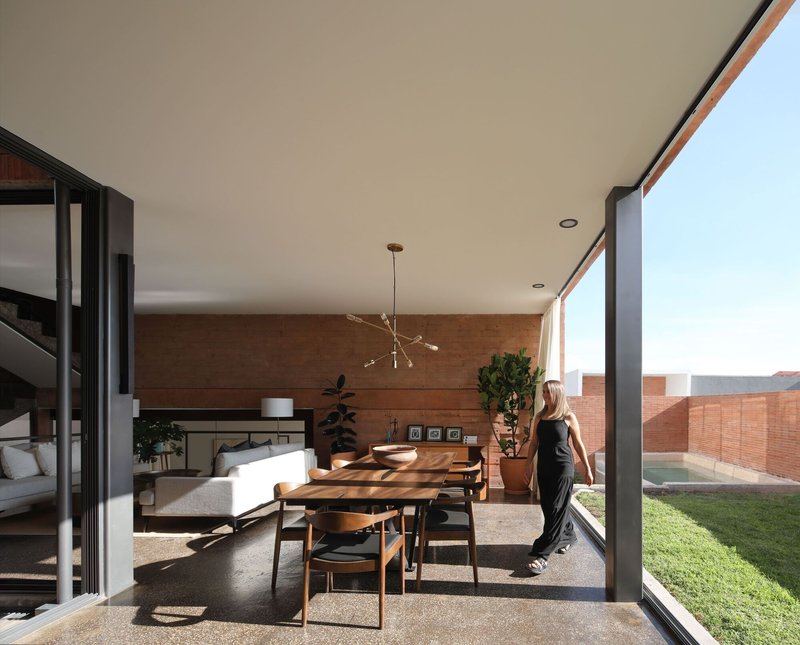
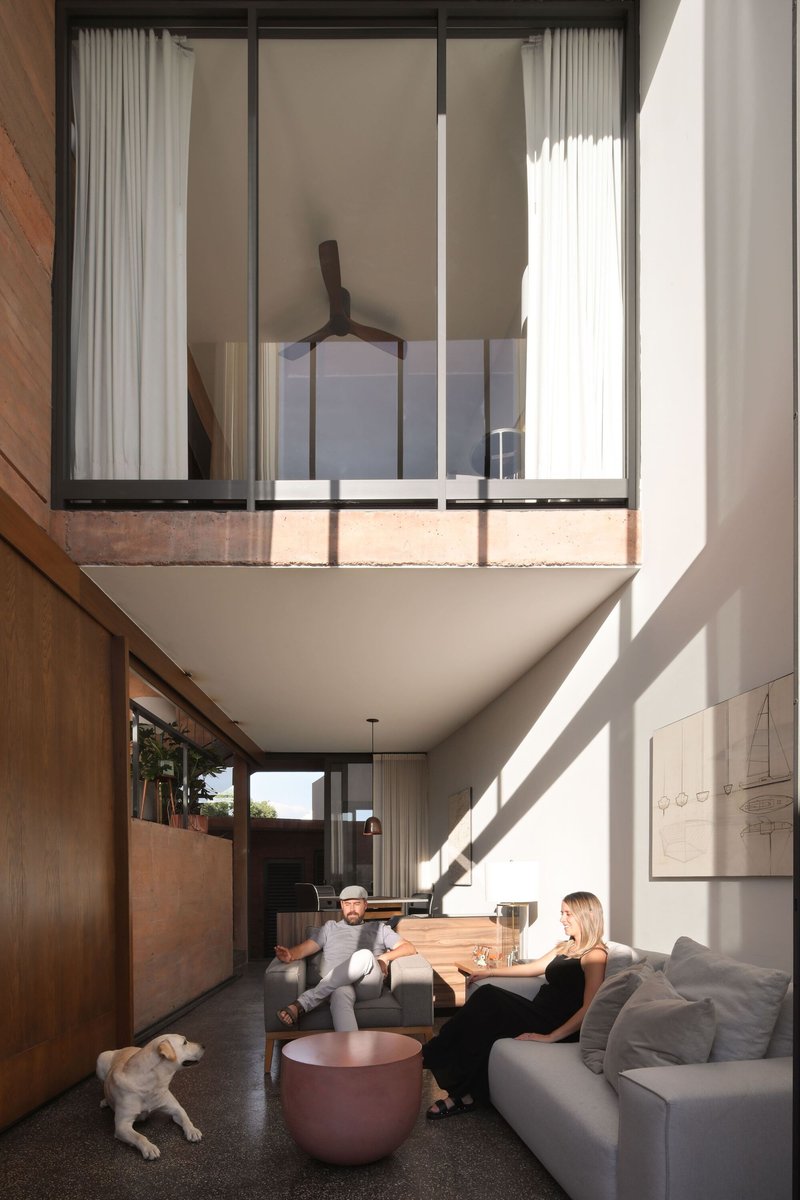
The ground floor living and dining area opens through full-height glazing onto a lawn, dissolving the boundary between interior and garden. A sliding aluminum panel with clear glass manages the transition, allowing the room to function as either enclosed or semi-outdoor depending on season and mood. The double-height living room, with its cantilevered mezzanine bedroom overhead, gives the main social space a vertical generosity that the 350 square meter footprint would not otherwise suggest.
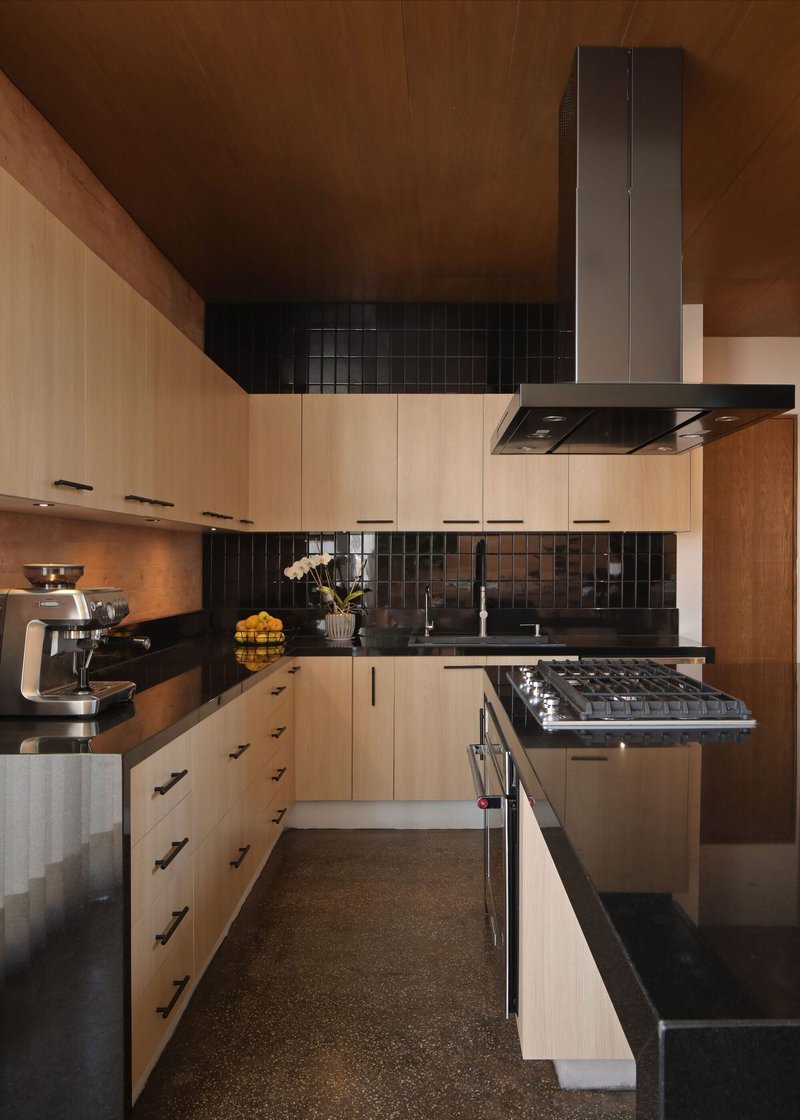
The kitchen, by contrast, is deliberately compressed: a galley layout with pale timber cabinetry, black tile backsplash, and terrazzo flooring under a warm ceiling. It reads as the most contemporary room in the house, where the traditional material language recedes in favor of clean surfaces and domestic efficiency.
Private Rooms and the Garden Pool
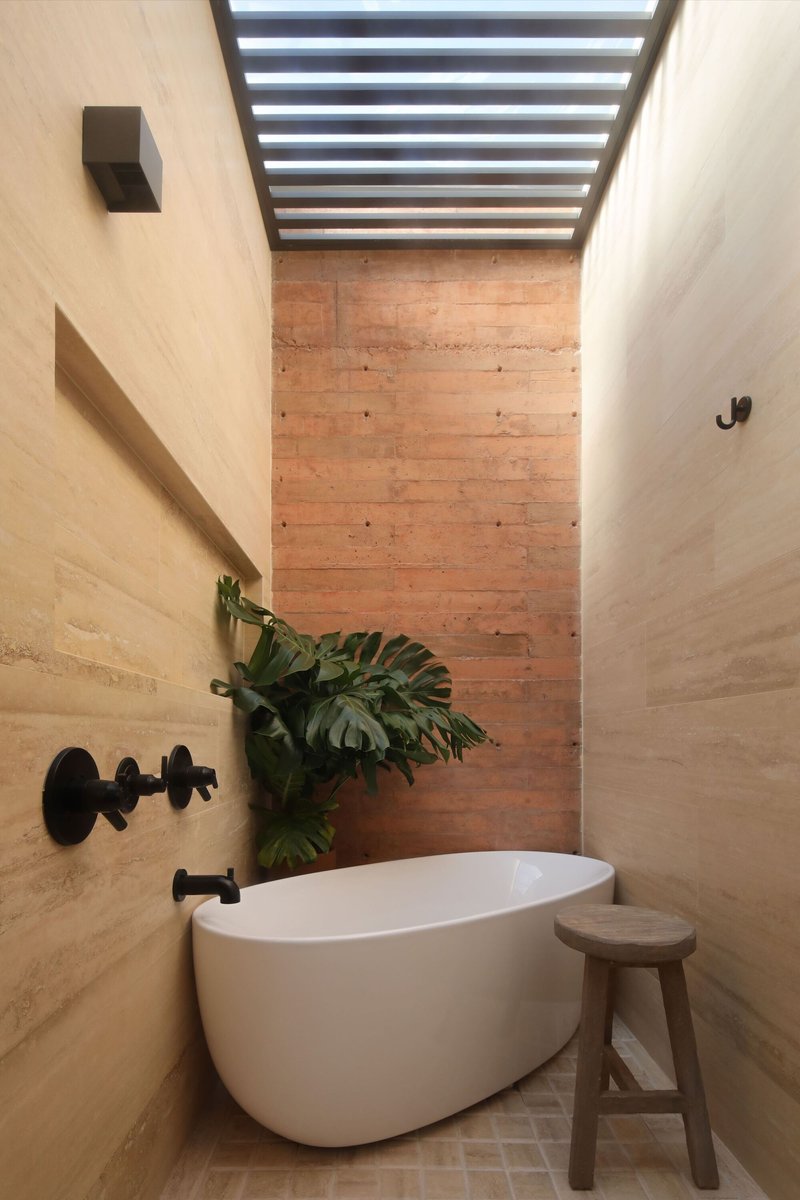
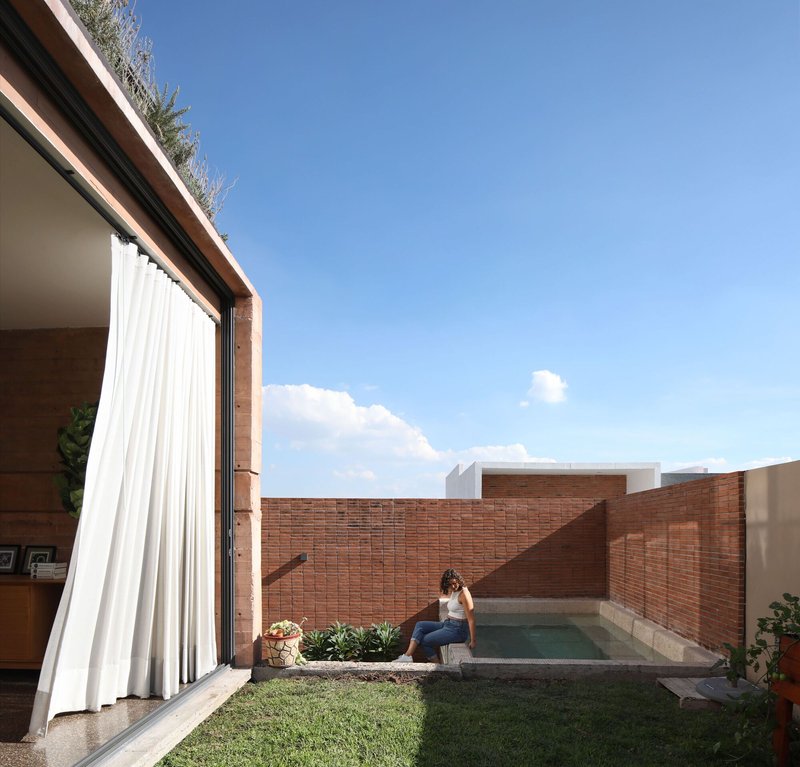
Upstairs, the master bedroom, study, and terrace enjoy views over the garden and pool. A den room opens onto a terrace that overlooks the planted rear yard, where a simple lap pool sits against a brick wall. The bathroom is perhaps the most quietly luxurious space in the house: a freestanding tub positioned beneath a horizontal slatted skylight, with a rammed earth wall as backdrop. Light arrives in controlled stripes, making the act of bathing feel deliberate and architectural.
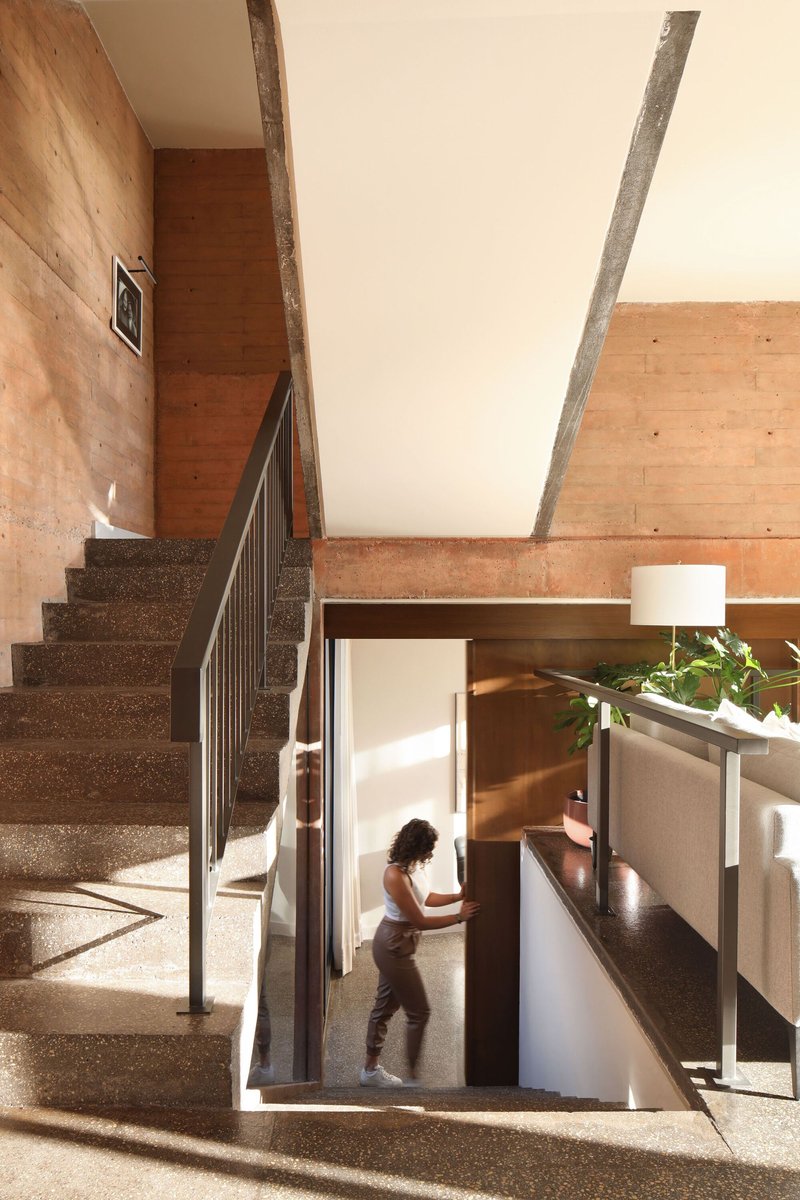
The stairwell that connects the split levels is an honest space. Exposed concrete beams, natural light falling through an opening above, and the simple experience of a figure descending through sunlight. The half-level organization, adapted to the natural slope of the site, means these transitions between floors are gentle rather than abrupt. You move through the house on a topographic logic rather than a purely geometric one.
Courtyard Life
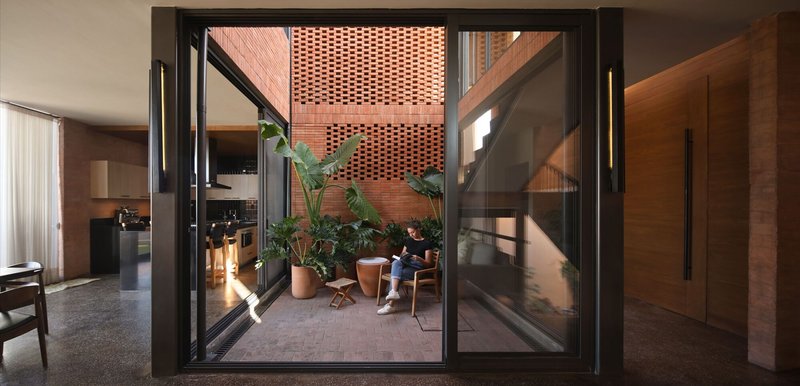
The image of a resident reading in the afternoon light of the courtyard, surrounded by potted palms and the warm glow of the perforated brick screen, captures exactly what this house is about. The patio is not a formal gesture or an architectural citation. It is a room people actually use. The brick screen modulates the harsh Querétaro sun into dappled shade, and the courtyard plants soften the acoustic and visual character of the space. Rainwater collection and photovoltaic panels handle the house's environmental responsibilities behind the scenes, allowing the courtyard to focus on what it does best: making domestic life feel unhurried.
Plans and Drawings
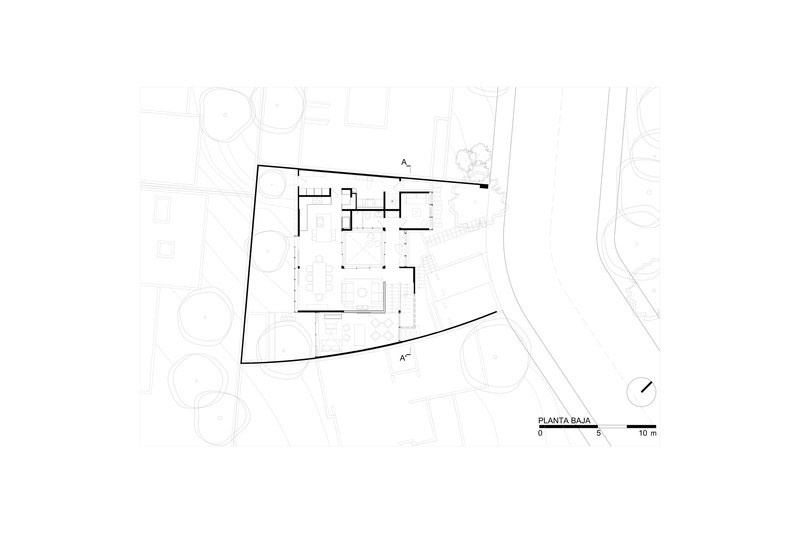
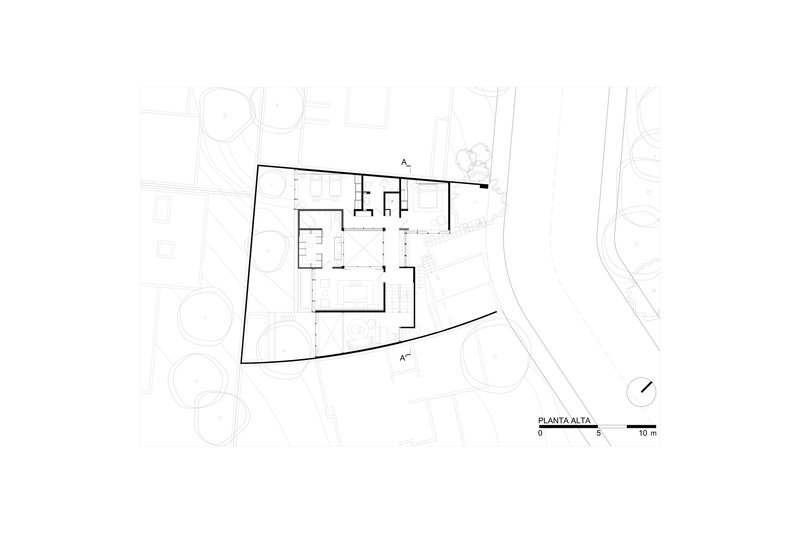
The ground floor plan reveals the nine-quadrant organization clearly, with the central courtyard pulling rooms into orbit around it. The curved site boundary adds a tension to the otherwise rational grid, forcing the landscape to mediate between geometric order and the irregularity of the lot. The upper floor clusters bedrooms on two sides of the courtyard, maintaining visual and climatic connection to the void below.
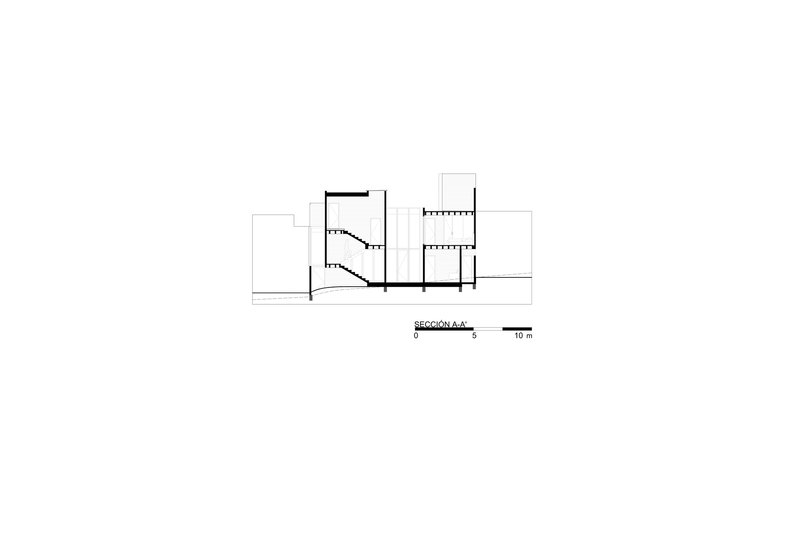
The section drawing is where the split-level strategy becomes legible. The house steps with the terrain rather than fighting it, connecting ground and upper floors through a stair sequence that creates half-level thresholds. These in-between zones, not quite one floor, not quite the next, add spatial variety to a compact footprint and allow the architects to modulate ceiling heights without resorting to double-height theatrics everywhere.
Why This Project Matters
Juriquilla House matters because it takes an architectural idea, the Mexican patio, that could easily become nostalgic shorthand and makes it structurally and environmentally essential to how the building works. The courtyard ventilates, lights, organizes, and socializes. It is not decoration; it is infrastructure. In a residential development where the path of least resistance is a sealed white box with air conditioning, Estudio Mero built a house that breathes through its center.
The material choices reinforce the argument. Adobe brick from local yards, ochre stone for the staircase, a color palette drawn from the Queretan steppe: these are not style decisions, they are regional commitments. When every house on the street defaults to white render, building in terracotta is itself a form of resistance. Juriquilla House demonstrates that specificity, to place, to climate, to building tradition, remains the most productive starting point for domestic architecture in Mexico.
Juriquilla House by Estudio Mero, led by Horacio Gutiérrez Merediz and Rodrigo Degetau Vom Hovel. Located in Querétaro, Mexico. 350 m². Completed in 2024. Photography by Dane Alonso.
About the Studio
Share Your Own Work on uni.xyz
If projects like this are the kind of work you want to make, uni.xyz is a place to publish your own, find collaborators, and enter design competitions.


Popular Articles
Popular articles from the community

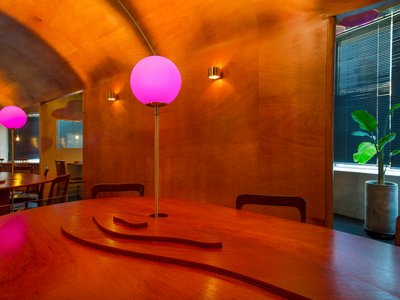
Indiesalon Carves a Plywood Cave into a Seoul Bistro's Second Floor
Munhwa Bistro's second Seongsu branch wraps diners in a laminated timber vault laced with colored light and mirror illusions.
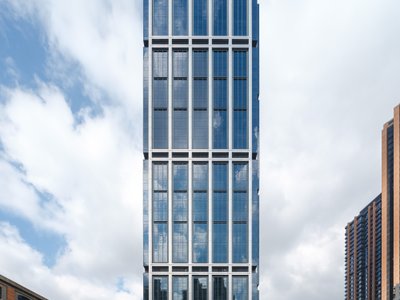
Foster + Partners Wraps a 200-Meter Shanghai Tower in Stainless Steel and Industrial Memory
The Suhe Centre Office Tower anchors a regenerated waterfront district in Shanghai with an all-steel structure that nods to local warehouse heritage.
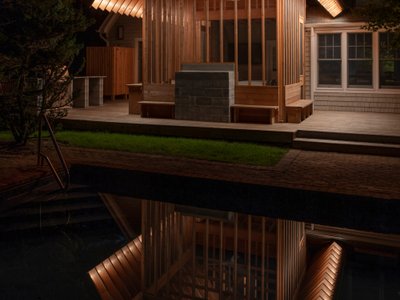
BLDUS Turns a 250-Square-Foot Screened Porch into a Pine Forest Temple in East Hampton
A gabled cedar pavilion mimics the rhythm of surrounding pines, anchoring a 1990s wooded home to its hollow in Long Island.
Constanti Architects Builds a Fortress of Privacy in Nicosia with House 345
A concrete and timber residence in Cyprus reinterprets the traditional introverted courtyard house for a new urban landscape.

Similar Reads
You might also enjoy these articles

127af Flips a Tiny Bagnolet Rowhouse Upside Down with a Handcrafted Roof Extension
A 55-square-meter terraced house on the edge of Paris gains a luminous upper living floor through lightweight timber and steel.
1.61 Design Workshop Wraps a 600-Square-Meter Café in Vietnam in Sculptural Burgundy Drama
Reden Café & Bistro pairs a helical staircase, mosaic floors, and deep red interiors to rethink Vietnamese hospitality space.

The Unbound Brain: A School Shaped by Cognitive Architecture
Cylindrical learning pods radiate like neurons from a central cortex, turning the floor plan into a spatial model of human thought.
Revival Vernacular Architecture: Rammed Earth Settlements for the Sahara
A modular desert community in Mauritania that fuses passive cooling techniques with earthen construction and local craftsmanship.


Explore Sustainable Design Competitions
Discover active competitions in this discipline




The Global Benchmark for Architecture Dissertation Awards


Challenge to design mud housing for contemporary communities


Design challenge to reuse E-waste
Comments (0)
Please login or sign up to add comments
No comments yet. Be the first to comment!