

Estudio ODS Converts a 19th-Century Sporting Club in Loulé into a Cultural Association
Reversible timber insertions and a careful reading of existing rooms transform a heritage building in southern Portugal's Algarve region.


Loulé, a market town in Portugal's Algarve, holds a compact historic center where 19th-century buildings sit cheek to cheek along narrow streets. Among them is the former Atlético Sporting Clube, a two-story stucco structure with wrought iron balconies and a terracotta roof that once served as the headquarters of a local sports club. Estudio ODS, led by Bruno Oliveira, Marlene dos Santos, and João Soares, was tasked with rehabilitating the first floor and converting it into a functioning cultural association. The project, designed between 2018 and 2019 and built through 2021, occupies 480 square meters.
What makes the intervention worth studying is its discipline. Rather than gutting the interior and imposing a new plan, Estudio ODS accepted the building's existing organic layout of interconnecting rooms, then threaded a new program through it using reversible elements clearly distinguished by their materiality. The result is a space where heritage walls, painted ceilings, and woven reed vaults coexist with birch plywood cabinetry and light pine flooring, each layer legible as a distinct moment in the building's life.
Reading the Street

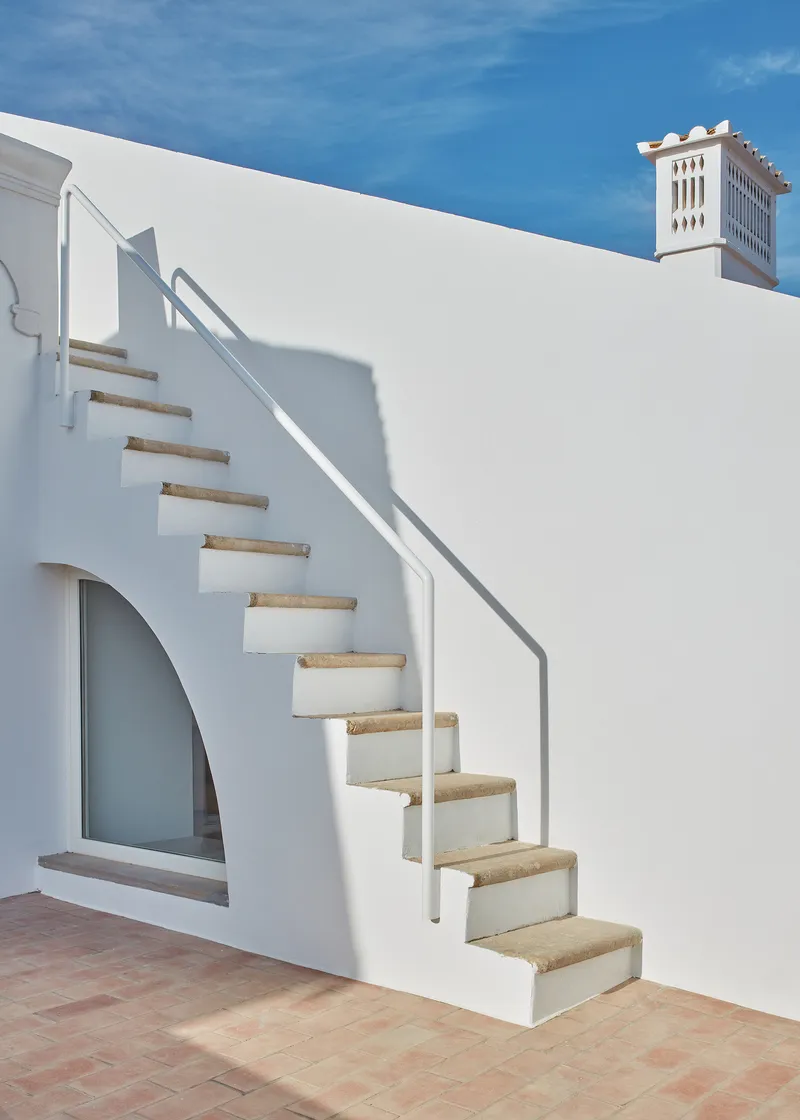
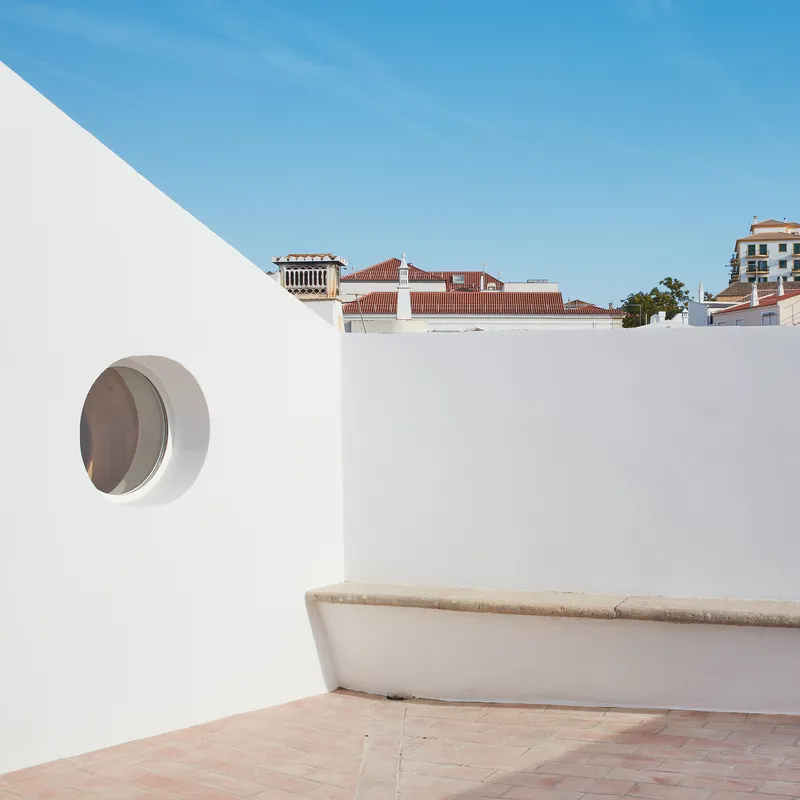
From the street, the building reads as a typical Algarve townhouse: white stucco walls, tall proportions, and decorative ironwork on the upper balcony. The facade is restrained, offering no signal of the transformation inside. That is the point. In a dense urban fabric like Loulé's, maintaining the exterior's continuity with its neighbors is not conservatism but responsibility.
An exterior stone staircase leads up along a courtyard wall, its treads worn and its shadows sharp against the whitewash. Above, a rooftop terrace with a circular oculus window provides views across the terracotta roofscape. These transitional spaces, neither fully interior nor fully exterior, set up the material dialogue that continues inside: stone, plaster, and tile on one side; timber and plywood on the other.
The Enfilade and the Logic of Interconnecting Rooms

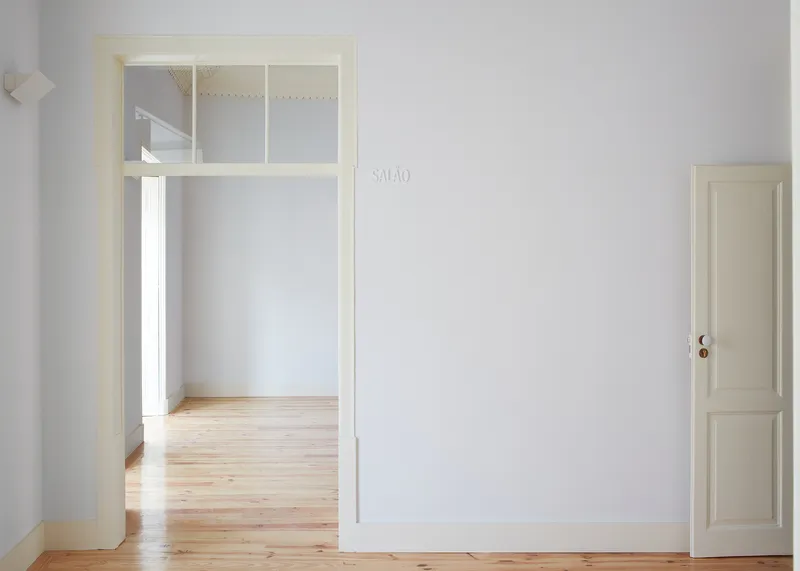
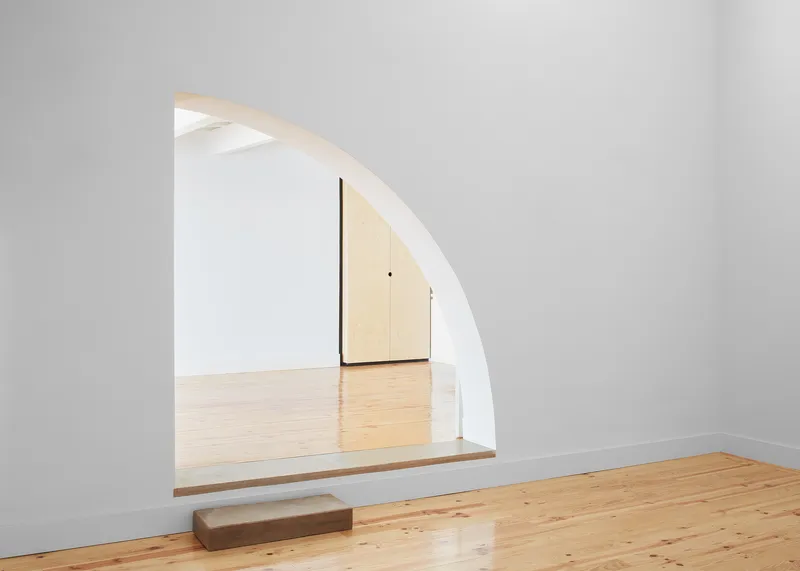
The building's first floor was originally organized as a series of interconnecting rooms, a layout common in southern European domestic architecture. Estudio ODS preserved this arrangement entirely, allowing rooms to open onto one another through arched doorways and double doors with transom windows above. Walking through the space feels sequential, almost processional: each room frames the next, drawing natural light deeper into the plan.
Pine floorboards run continuously through the sequence, unifying the spatial experience without erasing the thresholds between rooms. The doors, many of them restored, include glazed panels that maintain visual connection even when closed. It is an approach that treats the existing plan not as a constraint but as a resource, one that already knew how to move people and light through a deep building.
Timber Insertions as a Second Language
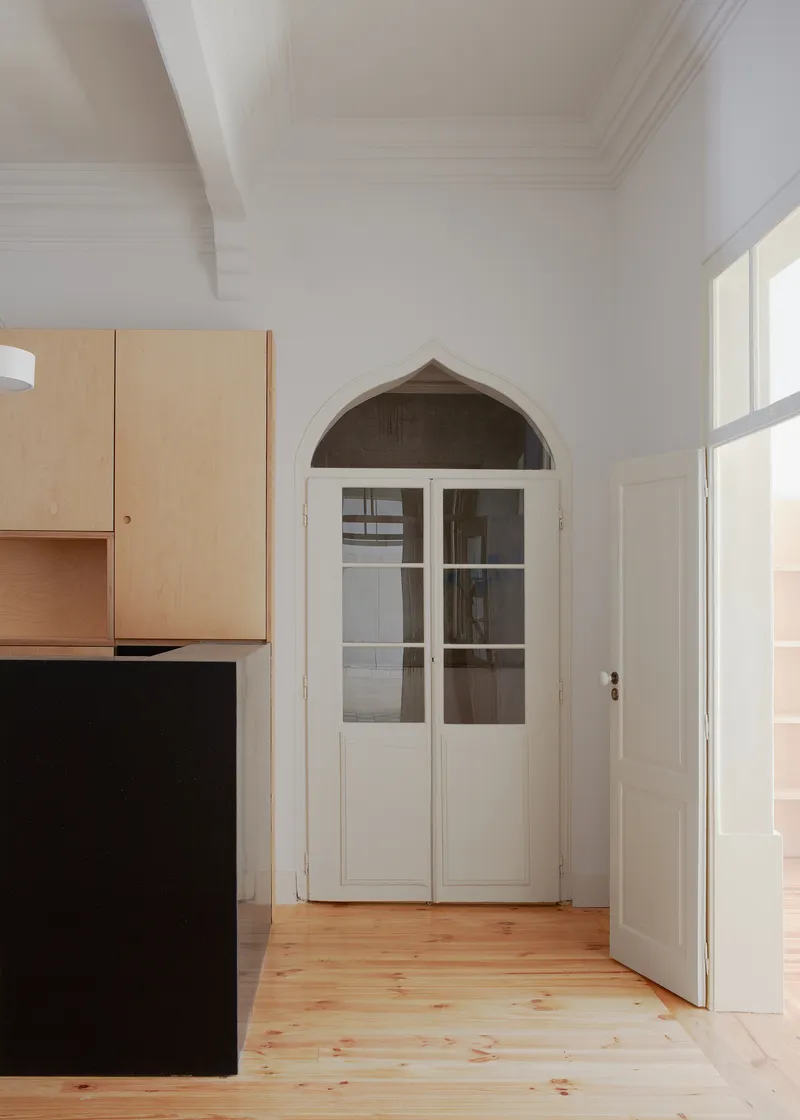


The new program, which includes a reception area, bar, library, sanitary facilities, and dressing room, required elements the 19th-century building never had. Estudio ODS introduced these through birch plywood cabinetry, built-in shelving grids, and timber-lined volumes that sit within the existing rooms without touching the heritage fabric in any permanent way. The materiality is deliberately distinct: warm plywood against cool white plaster, clean edges against ornamental moldings.
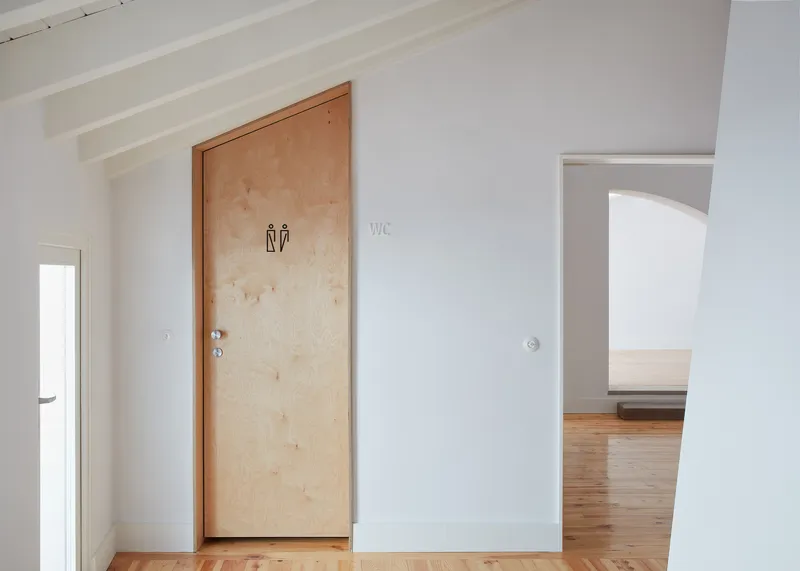
Reversibility is the guiding principle. A plywood shelving unit along a white wall could, in theory, be removed without scarring the room behind it. Restroom doors with simple pictogram signage are framed in timber, not carved into masonry. This is a project that takes the idea of reversible intervention seriously, not as a regulatory checkbox but as an ethical position toward a building that has already outlived one program and may well outlive another.
Ceilings Tell the History


Look up. The ceilings are where the building's history is most vividly written. In one room, a restored painted ceiling in blue and gold features a star pattern that speaks to the craftsmanship of 19th-century Algarve decorative traditions. In another, a vaulted woven reed ceiling, a technique specific to southern Portugal, arches above built-in wardrobes. Elsewhere, exposed timber rafters are left visible, their grain darkened with age.
Estudio ODS made the smart decision to let each ceiling remain as found, without imposing a single treatment across the building. The variation from room to room reinforces the sequential character of the plan and gives each space its own identity. The restored painted ceiling, in particular, is a reminder that heritage is not just structure but also surface, color, and pattern.
Circulation and the New Staircases

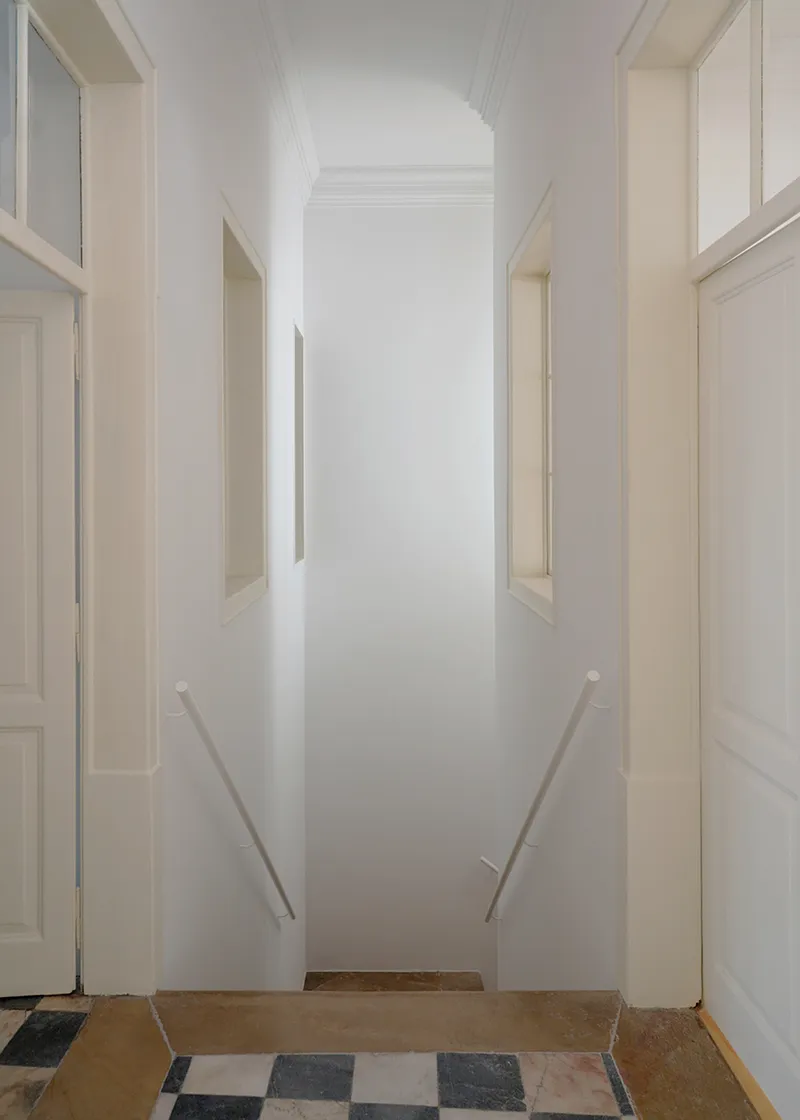

Two new staircases provide access from the first floor to the second floor and attic, a functional addition required by the cultural program. These are handled as timber constructions, visible through horizontal transom glazing and integrated into the rhythm of the existing rooms. A cantilevered stair glimpsed through a doorway becomes a compositional element, not just a means of vertical movement.
Corridors are kept narrow and white, with vertical niches flanking the walls and simple handrails leading to timber steps. A light wood plank column with an integrated bench suggests that even structural additions were conceived as opportunities for inhabitation. The architects treated circulation as program, not leftover space.
Ornament and Detail
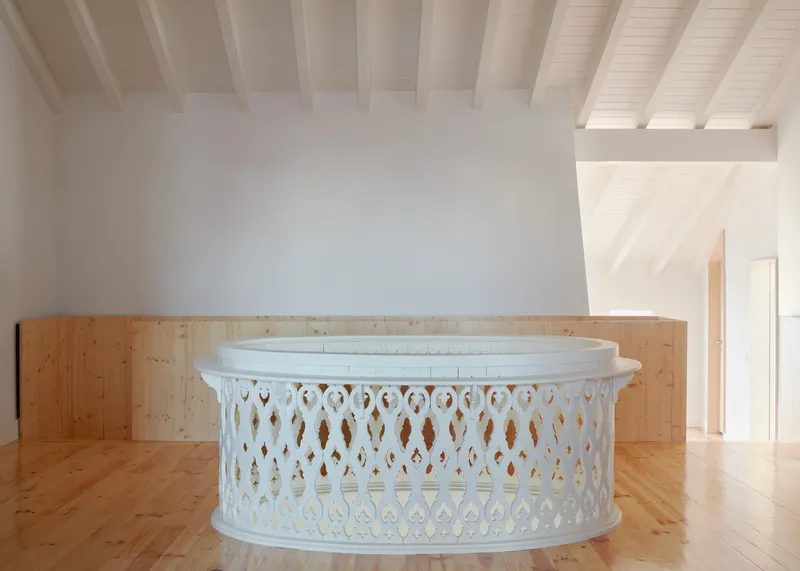

The building's ornamental balustrades, with their decorative cutout patterns, were preserved and backed with timber panels that protect them while allowing their silhouette to remain visible from inside. It is a small gesture, but a telling one: rather than replicating period detail or stripping it away, Estudio ODS chose to frame it. The balustrade becomes a kind of artifact displayed within the new interior, honored without being fetishized.
Elsewhere, arched window seats, glazed double doors, and transom windows are treated with similar care. The restroom doors, with their matter-of-fact pictogram signage, are perhaps the clearest statement of the project's position: contemporary insertions should be legible as contemporary, without apology.
Kitchen and Service Spaces


A glazed door opens to reveal a kitchen with terracotta tile flooring, one of the few spaces where the floor material shifts from pine to something harder and more functional. The transition is abrupt and honest. Service spaces are not dressed up to match the public rooms; they are allowed to be what they are. Through timber-framed doorways and transom windows, views connect back to the main sequence of rooms, keeping even the back-of-house spaces visually linked to the whole.
Plans and Drawings

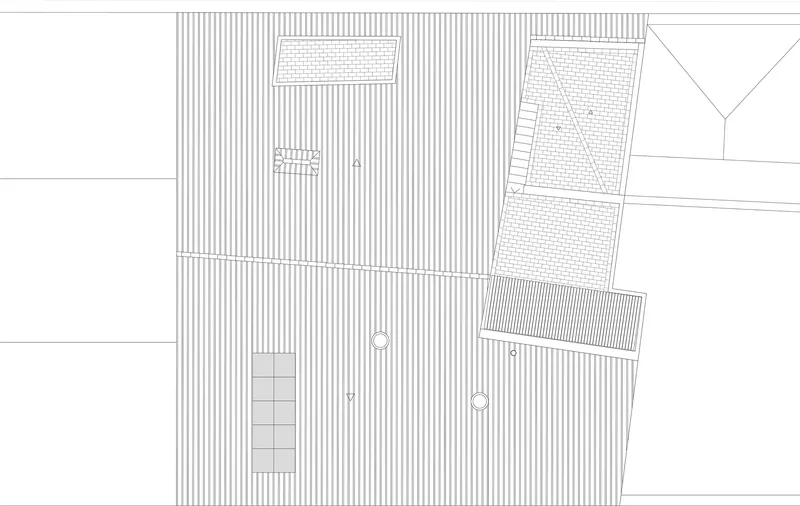


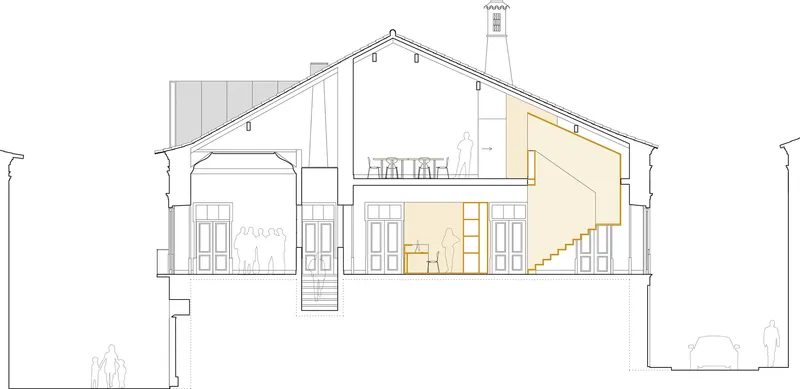


The site plans reveal the building's tight position within Loulé's urban block, hemmed in on three sides with a courtyard providing the only outdoor relief. Floor plans show how the yellow-highlighted circulation zones trace a central corridor through the angular layout, connecting the terrace and stair access to the enfilade of interior rooms. The sections are the most revealing drawings: they expose the double-height spaces beneath the pitched roof and tower, the arched ceiling vaults over certain rooms, and the external stair connecting courtyard to upper levels. Together, the drawings make clear that the apparent simplicity of the interior is the result of careful negotiation between a complex existing section and a restrained new program.
Why This Project Matters
Rehabilitation projects in southern European towns often fall into one of two traps: either they gut the interior and insert a generic white-box program, or they over-restore, freezing the building in an imagined past. Estudio ODS avoids both. By maintaining the organic room layout, preserving the variety of ceiling treatments, and introducing new elements in a clearly differentiated material palette, the firm produced a cultural space that feels both historically grounded and genuinely usable.
The project's most transferable lesson is its commitment to reversibility as design discipline. Every plywood cabinet, every timber staircase, every shelving grid is conceived so it could be removed without damaging the host building. In a moment when adaptive reuse is increasingly discussed in abstract terms, this 480-square-meter project in Loulé offers a concrete, modest, and convincing demonstration of what it actually looks like to take a 19th-century building seriously while asking it to serve a 21st-century program.
Rehabilitation Atlético Sporting Club, designed by Estudio ODS (Bruno Oliveira, Marlene dos Santos, João Soares), Loulé, Portugal. 480 m², completed 2021. Photography by Estudio Peso Arquitectura.
About the Studio
Share Your Own Work on uni.xyz
If projects like this are the kind of work you want to make, uni.xyz is a place to publish your own, find collaborators, and enter design competitions.


Popular Articles
Popular articles from the community


Juan García Correa, John González and Claudia Rueda Sink a Circular Amphitheater into a Manizales Engineering Building
On the La Nubia campus in Manizales, Colombia, the S1 Building folds labs and offices into a hillside of ramped lawns that double as a campus route.

LT2A and OPEN Architectes Thread a Brick and Glass High School Through a Wooded Belgian Campus
In Braine-l'Alleud, a 3,000 m² wing for Collège Cardinal Mercier pairs pale brick with a glazed colonnade, deferring to a small chapel and a dense wood.

David Ortega Stacks a Two-Story Mexico City Penthouse Around a Steel Stair and a Pergola-Shaded Roof Terrace
In Colonia Roma, a 300 m² penthouse uses oak joinery, a planted steel stair and a slatted roof pergola to make a new-build apartment feel like a house.

David Macias Steps a Doorless Stone and Plaster House Down a Tropical Colombian Hillside
In the humid hills of Colombia, Threshold House replaces the front door with an open void and terraces its 850 m² down the slope instead of fighting it.

Similar Reads
You might also enjoy these articles


LAVA Architecten Gives Vocational Education a Sawtooth-Roofed Face on a Mechelen School Campus
In Mechelen, Belgium, a 2,053 m² STEM school on a 6×6 m grid turns workshops and classrooms into rooms that can be rearranged as teaching changes.

KEMA Studio Turns a Derelict Marvila Attic into a 60 m² Lighthouse Apartment Above Lisbon
In Lisbon's Marvila district, a rebuilt roof, four skylights and two plywood volumes turn an unlivable attic into a bright home facing the Tagus.

Pixel Gardens: One Repeated Module Stacked Into a Terraced Social Housing Tower for Famagusta
Salem Bader's shortlisted housing tower builds a vertical neighbourhood from one repeated module, offsetting units to carve terraces, light and air.

Bao Huynh Watercolor Atelier: A Serene Art Retreat in Hội An
Bao Huynh Watercolor Atelier in Hội An blends multifunctional art spaces, sustainable design, local materials, and family-friendly living in a serene environment.

Explore Rehabilitation Competitions
Discover active competitions in this discipline

Challenge to reimagine the Iron Throne

Photograph architecture without architects

Illustrate the lost glory of Angkor Wat - Render Challenge

Design challenge to reuse E-waste
Comments (0)
Please login or sign up to add comments
No comments yet. Be the first to comment!