
Event Office Converts a Traditional Babol House into a Psychotherapy Clinic Built Around Calm
Nafas-e-No, meaning New Breath, preserves the brick identity of an old Iranian house while carving out serene clinical interiors in white and sage green.

A psychotherapy clinic needs to do something most buildings never have to: create a sense of psychological safety through architecture alone. Nafas-e-No, which translates to New Breath, takes on that challenge by converting an old traditional house in the center of Babol, Iran, into a 1,000 square meter clinical facility. Designed by Event office under lead architect Meysam Hatami, the project preserves a buff brick facade rich with arched openings and perforated screens while completely rethinking the interior as a series of vaulted, luminous spaces that encourage stillness, dialogue, and recovery.
What makes the project interesting is how literally it interprets its own name. The old house gains a new respiratory system: light pours through latticed brick, vaulted ceilings create generous volumes from modest footprints, and a restrained palette of white surfaces, pale timber, and soft sage green keeps every room breathing. The adaptive reuse strategy is not nostalgic. It treats the existing structure as a psychological asset, a familiar shell that reduces anxiety for patients entering a clinical setting for the first time.
A Facade That Belongs to the Street
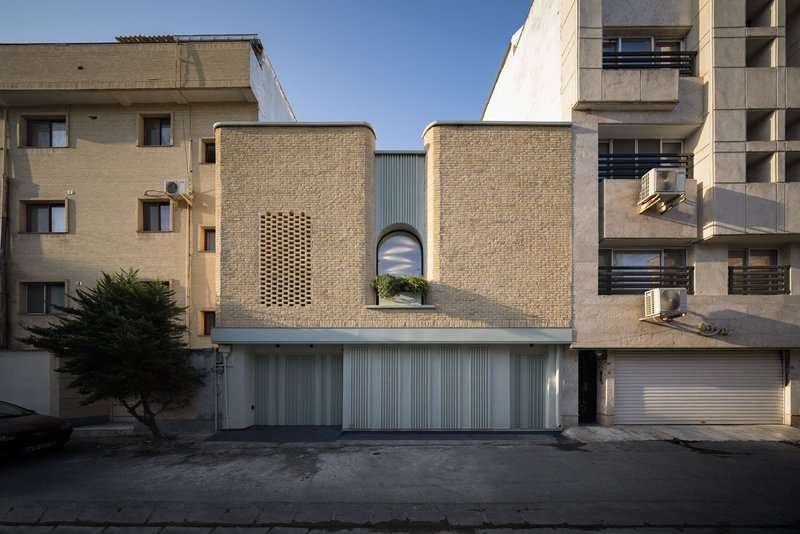
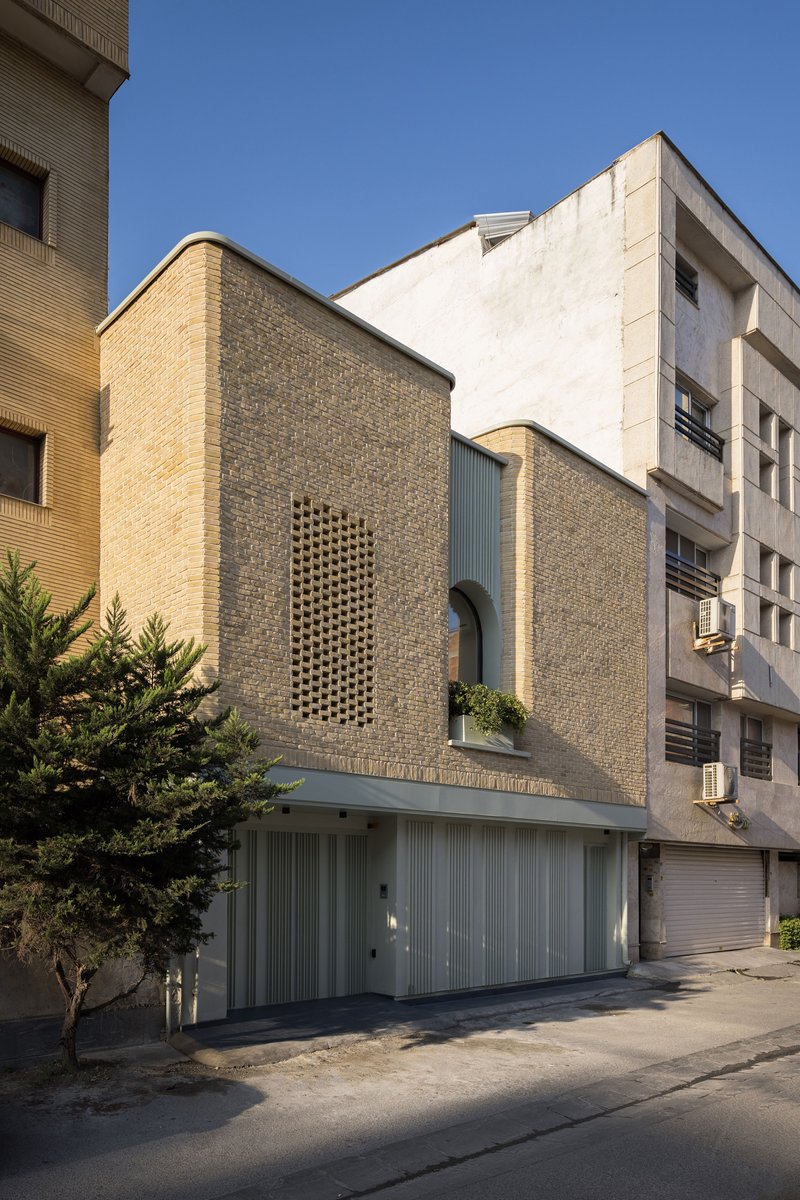
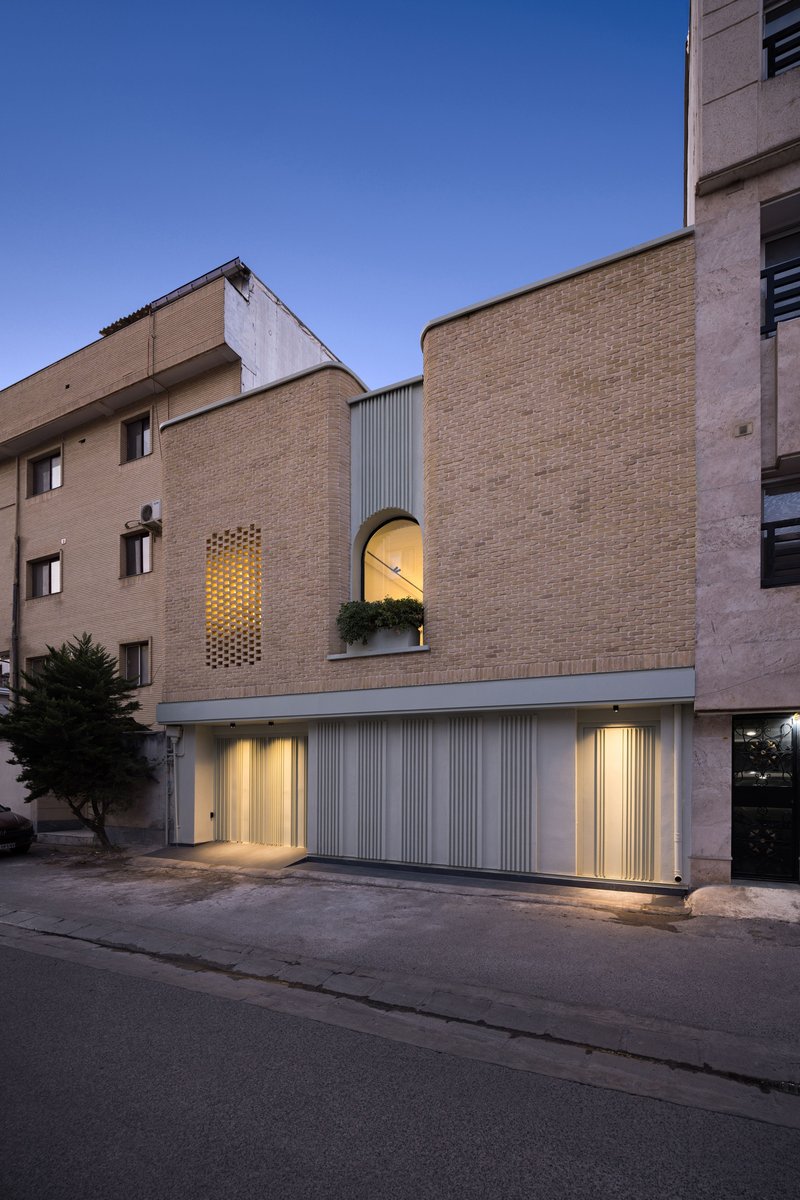
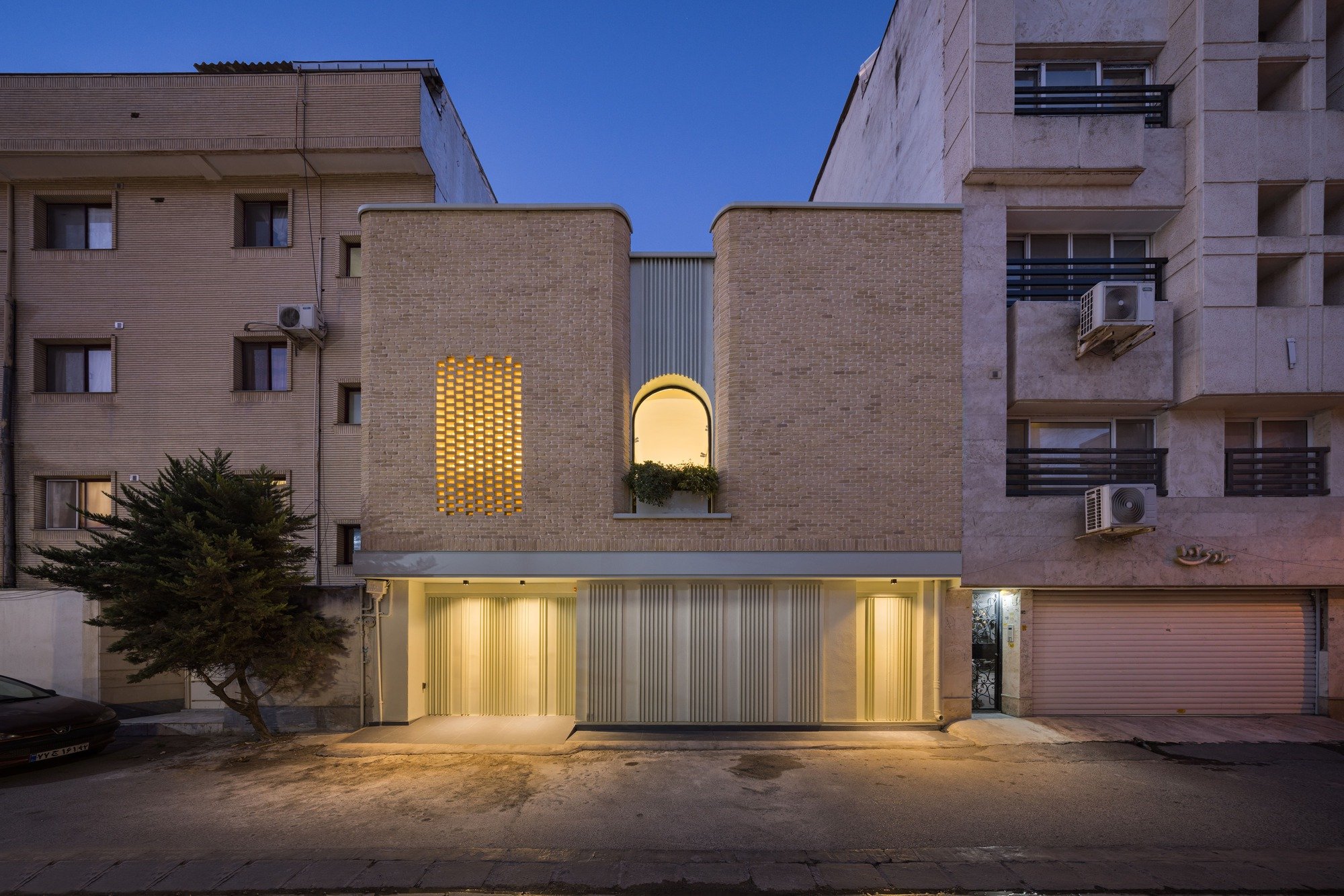
The street elevation is a careful act of civic politeness. The buff brick facade sits between neighboring buildings without asserting itself, reading almost as if it had always been there. A curved wall holds twin arched openings on the upper level while a corrugated metal garage door occupies the ground floor, a blunt, functional move that prevents the building from looking precious. The proportions defer to the surrounding residential fabric of Babol, and the brickwork carries a warmth that commercial cladding simply cannot replicate.
Preserving this facade was a strategic decision, not just an aesthetic one. For a psychotherapy clinic, the threshold between street and interior is loaded with meaning. A building that looks like a house, nestled in a neighborhood rather than set apart in a medical district, lowers the social barrier to seeking help. The facade communicates approachability before a patient even walks through the door.
Perforated Brick as Light Filter
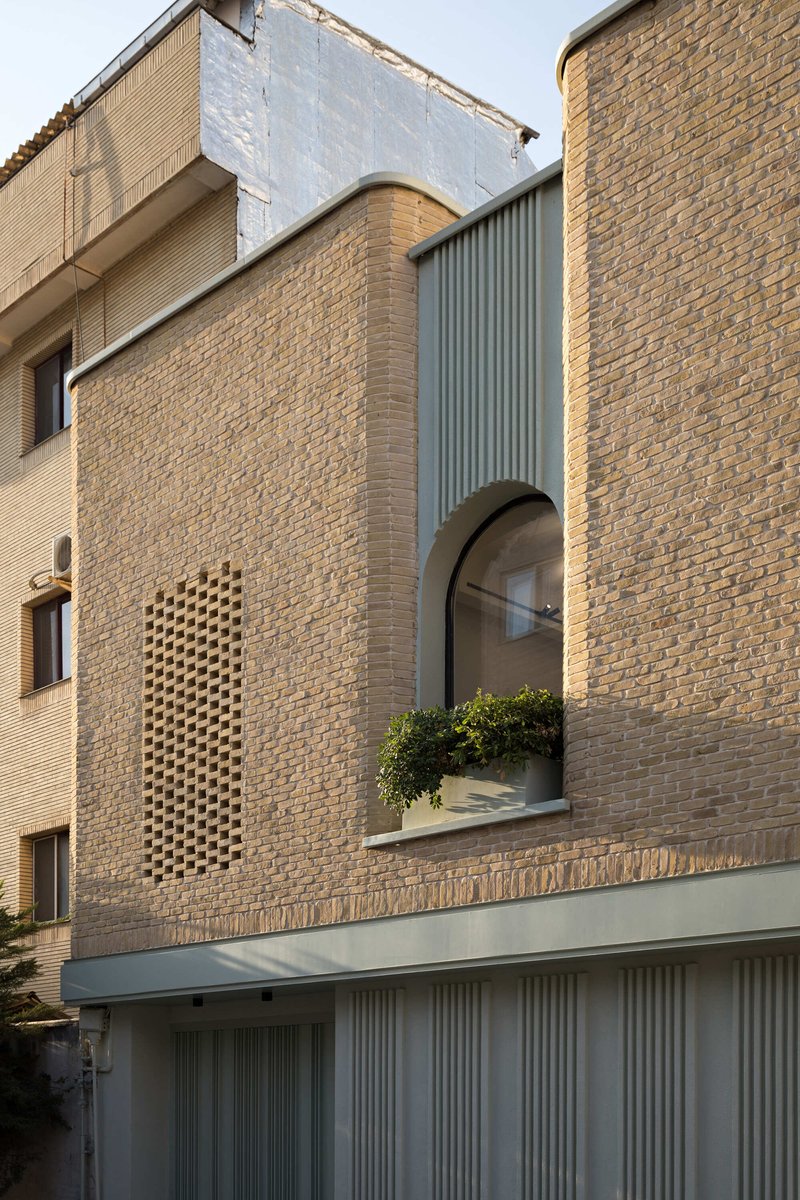
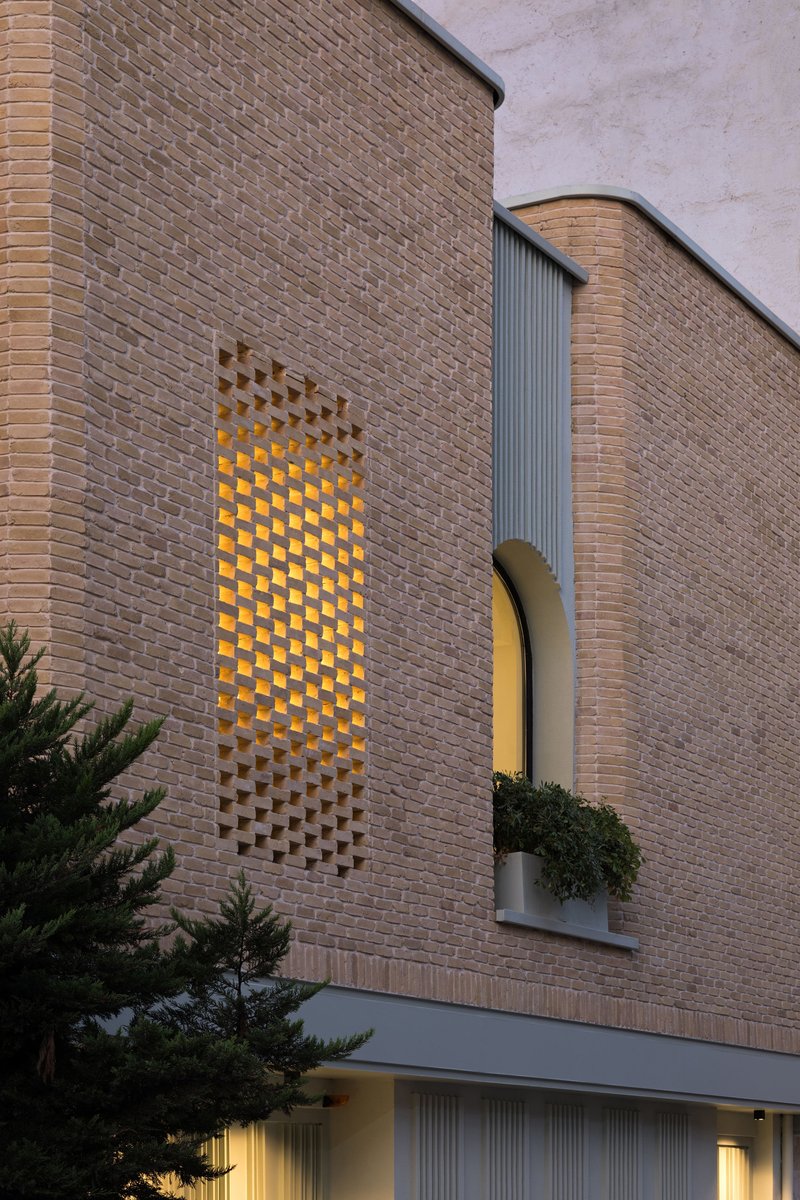
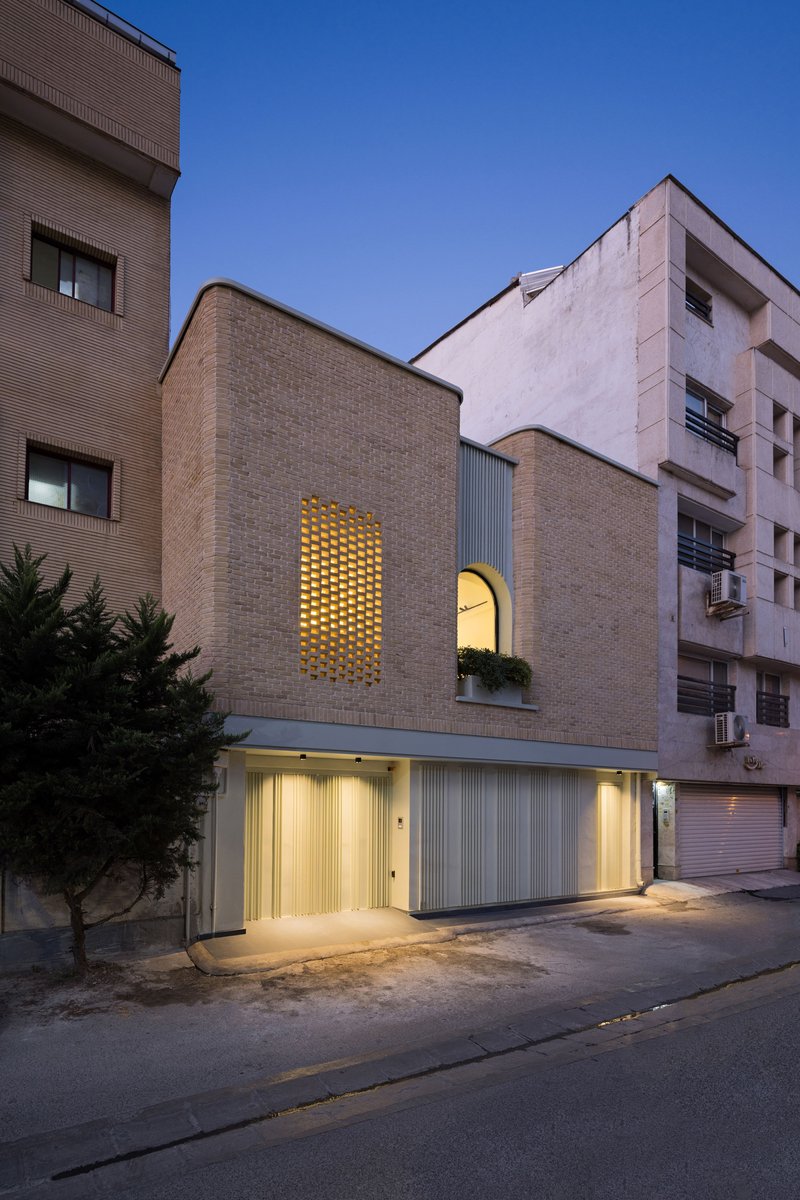
The most expressive element of the exterior is the perforated checkerboard screen that appears at different points along the facade. At dusk, these panels glow from within, transforming the building into a lantern. During the day, they filter harsh sunlight into soft, patterned light that enters the interior without glare. It is a technique rooted in traditional Iranian brickwork, updated here with a graphic boldness that gives the clinic its own identity.
The arched window niche above the screen, paired with a small planter box, adds a domestic touch that reinforces the building's origins as a house. These moments of craft, brick laid by hand in alternating open and closed patterns, are the project's quiet argument for adaptive reuse over demolition. The material already knows how to perform in this climate and this culture. The architects simply gave it a new arrangement.
Vaults, Arches, and the Interior Atmosphere
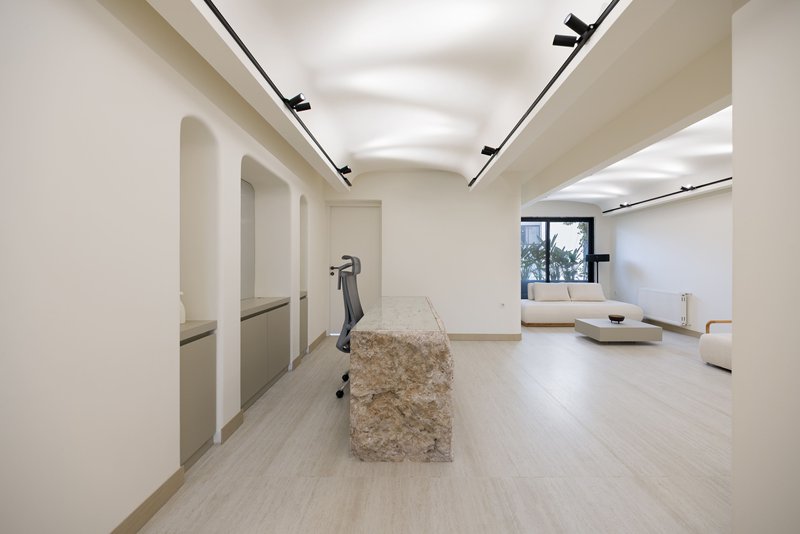
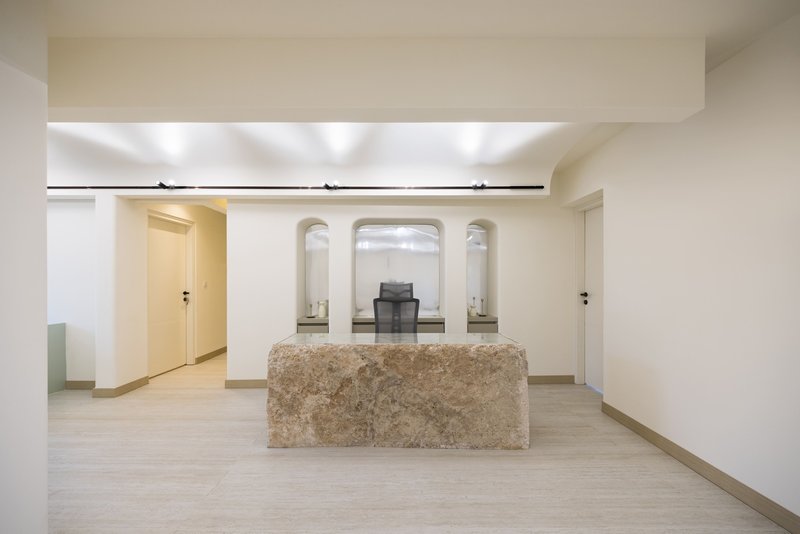
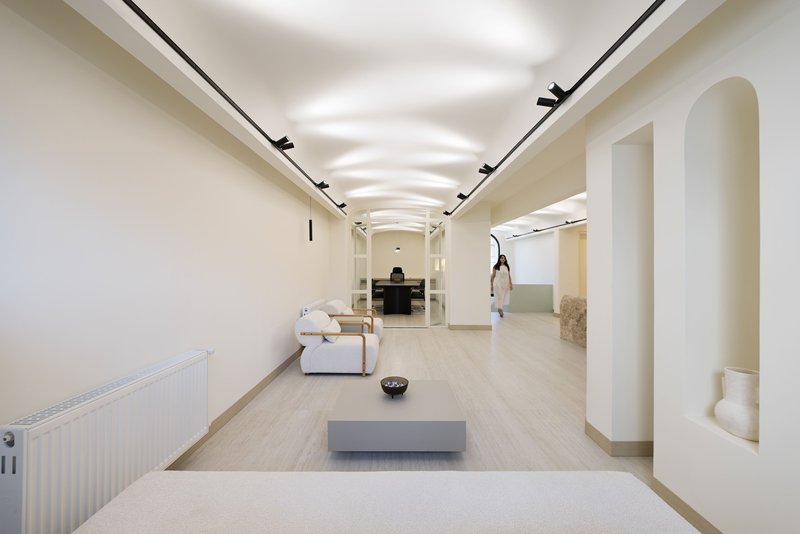
Inside, the arched openings of the original house are echoed and amplified into a full spatial language. Vaulted ceilings run continuously through corridors and gathering spaces, creating a sense of flow and expansion that a flat ceiling could never achieve. The lobby space is anchored by a freestanding stone reception desk that sits beneath layered archways, framing views deep into the building. The effect is both monumental and intimate, like entering a hammam rather than a medical facility.
A rough stone bench in one of the open living spaces introduces texture and weight, counterbalancing the otherwise minimal palette. Track lighting follows the curve of the vaults, washing surfaces with even illumination that avoids the clinical harshness of fluorescent fixtures. Every material decision, from the pale plaster to the exposed ceiling, serves the goal of creating a neutral environment that supports focus without inducing sterility.
Staircases as Transitional Spaces
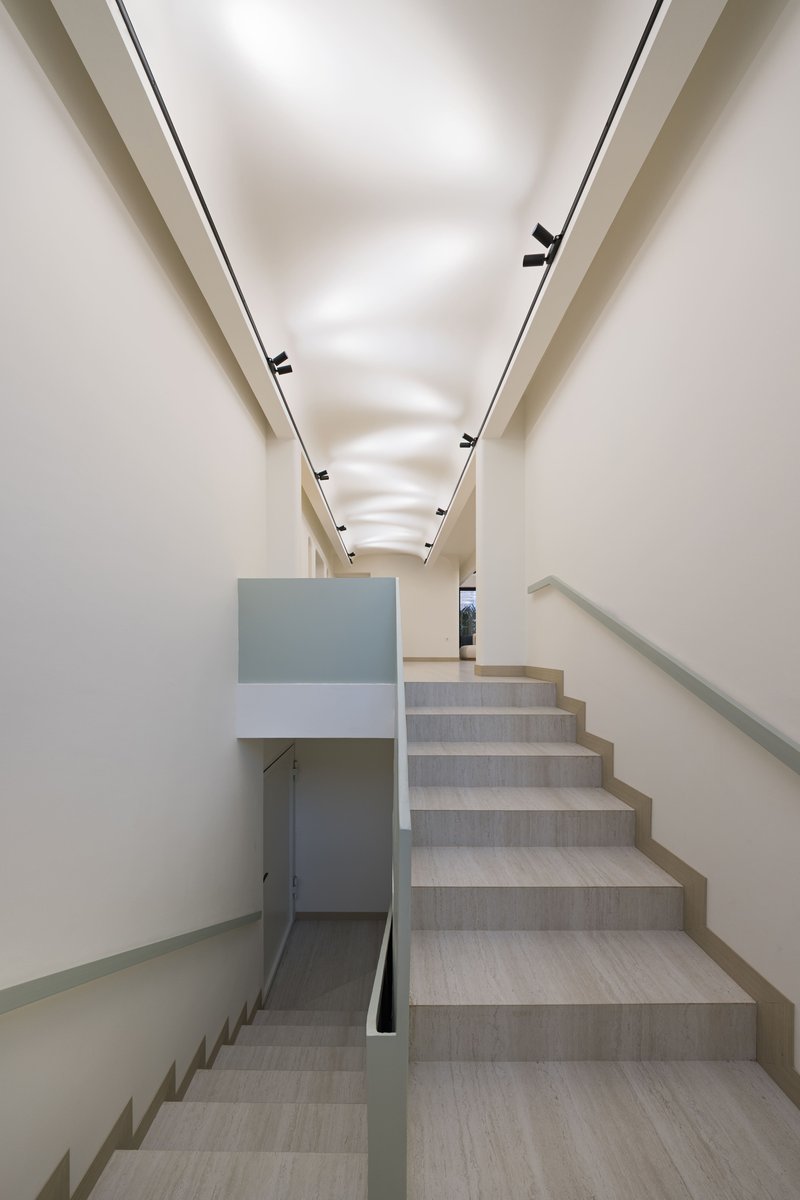
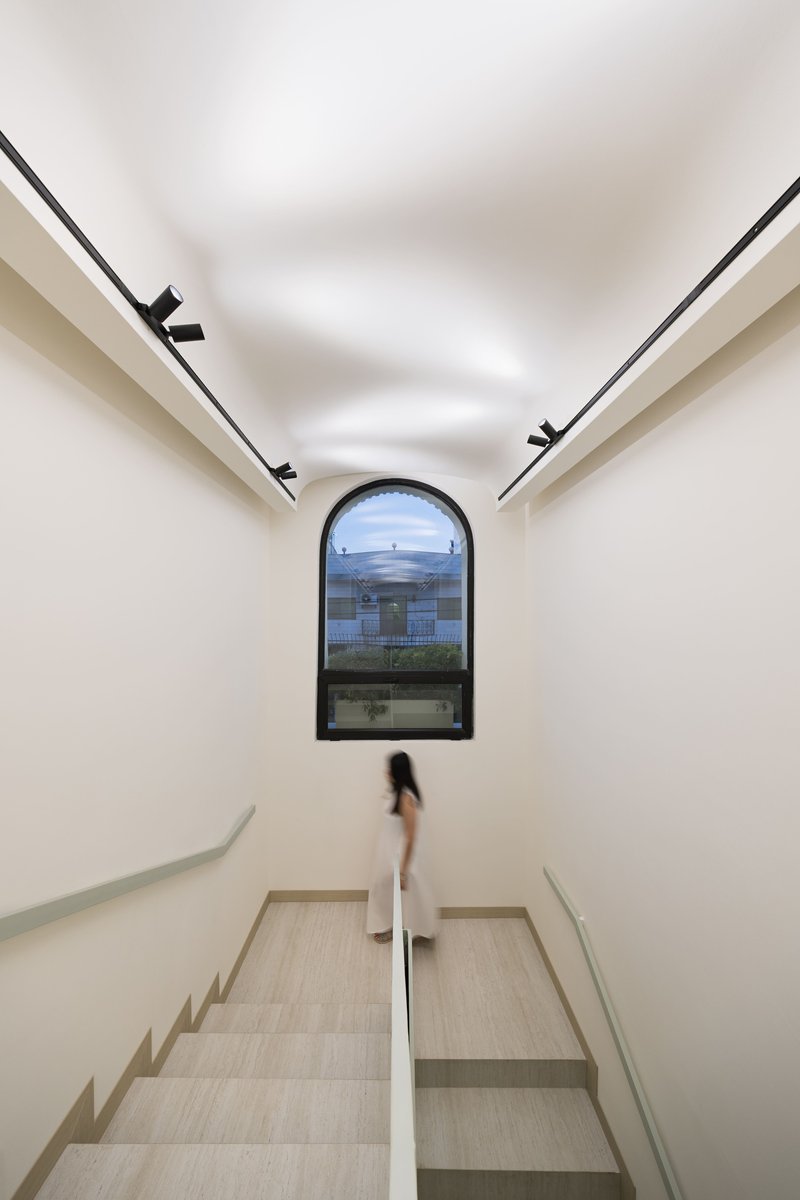
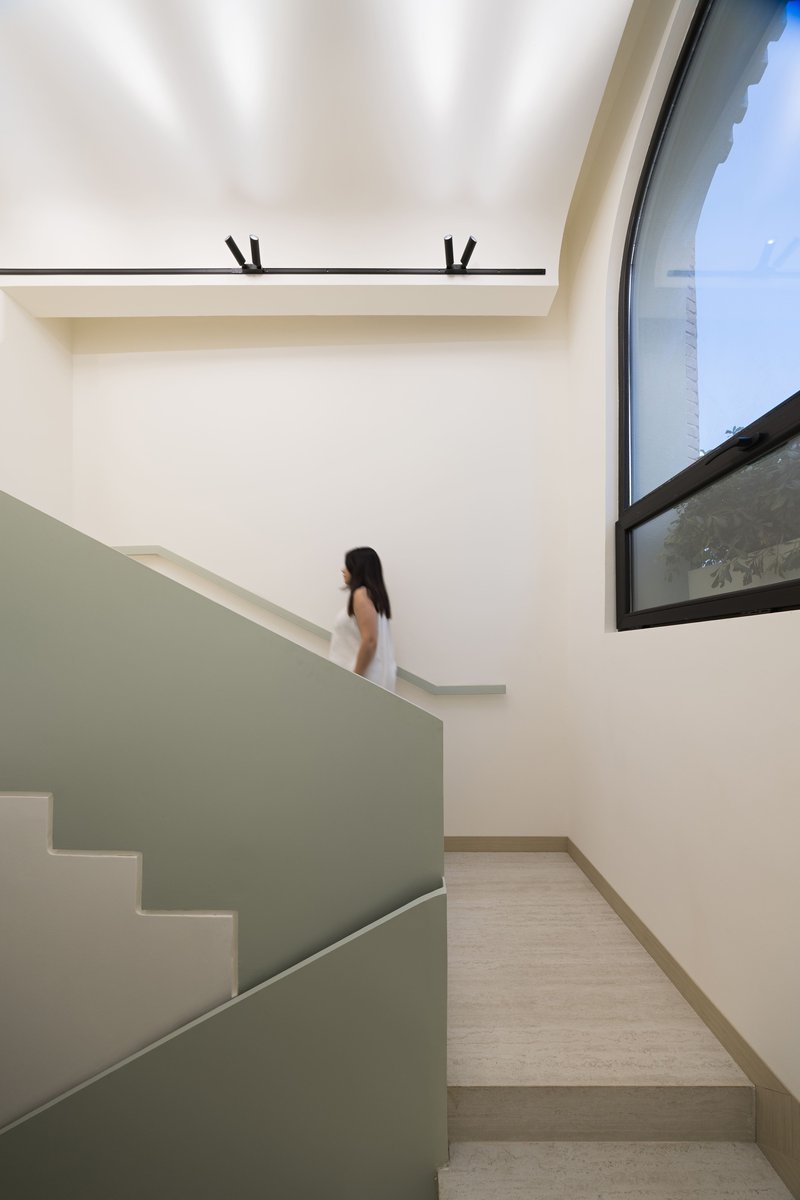
The stairwells receive an unusual level of attention, and rightly so. In a psychotherapy clinic, moving between floors is not a neutral act. It is a transition between states of mind, from arrival to consultation, from public to private. The main staircase features light wood treads set against white walls, with a linear recessed light running along the vaulted ceiling that guides movement upward. At the landing, an arched window provides a moment of pause and orientation, connecting the interior back to daylight.
A second stair introduces the project's signature color: sage green wall panels that line the ascent beneath a linear skylight. The green is soft enough to register as calming rather than decorative, and the natural light from above washes down the walls, creating a gradient that shifts throughout the day. These are not corridors to rush through. They are decompression chambers between one room and the next.
Clinical Rooms Without the Clinical Feel
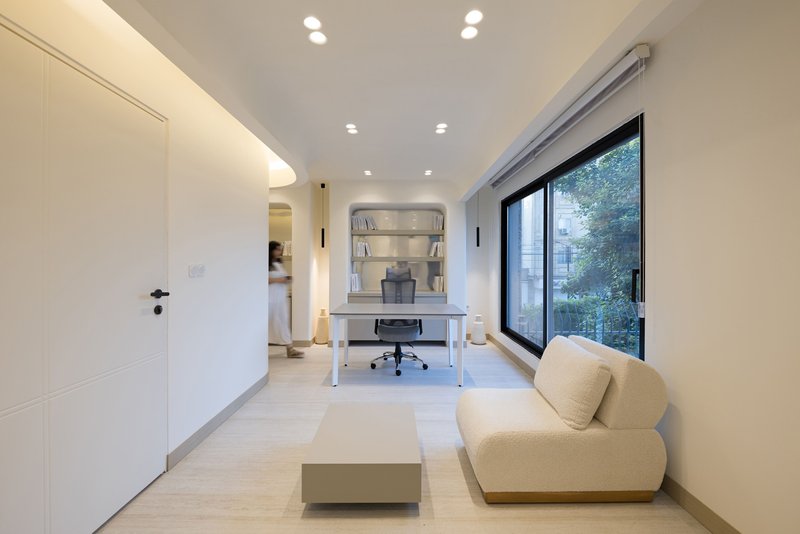
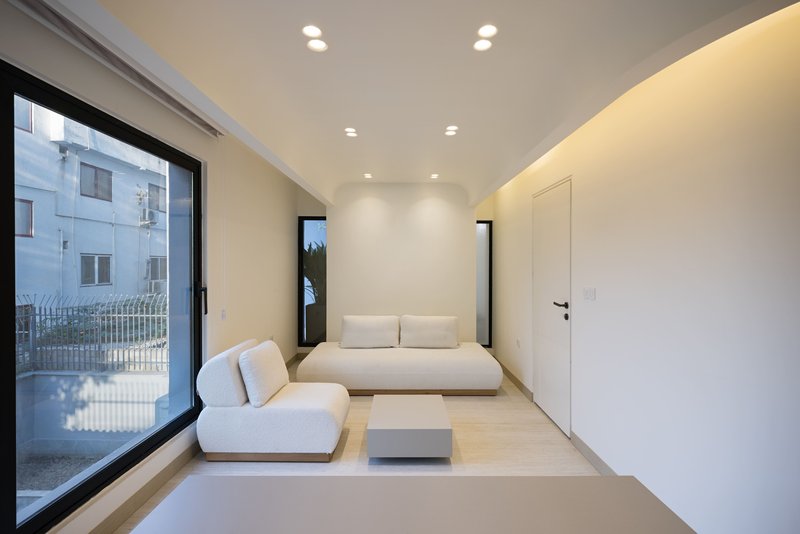
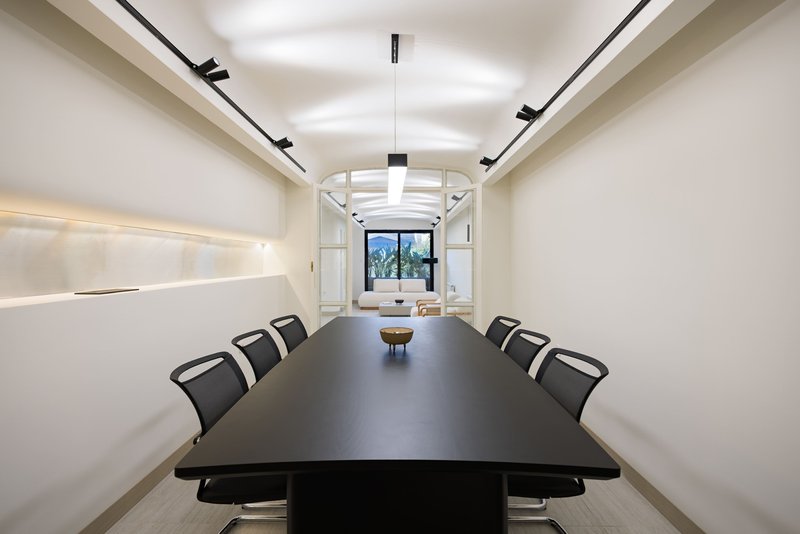
The consultation and therapy rooms strip back to essentials. One room features built-in shelving and a large glazed door that opens onto green foliage, collapsing the boundary between interior and garden. Another presents a minimalist composition of white walls, a large sliding glass panel, and a narrow vertical window that admits a controlled slice of light. The conference room, with its dark table and mesh chairs beneath linear track lights, is the most conventionally furnished space in the building, yet it still benefits from the cove lighting that softens every edge.
What unites these rooms is their refusal to impose mood. White walls and natural light create a blank canvas that allows patients to project their own emotional state onto the space rather than being directed by it. The architects understood that a healing environment does not need to look therapeutic. It needs to feel neutral, open, and undemanding.
Corridors and Circulation as Continuous Experience
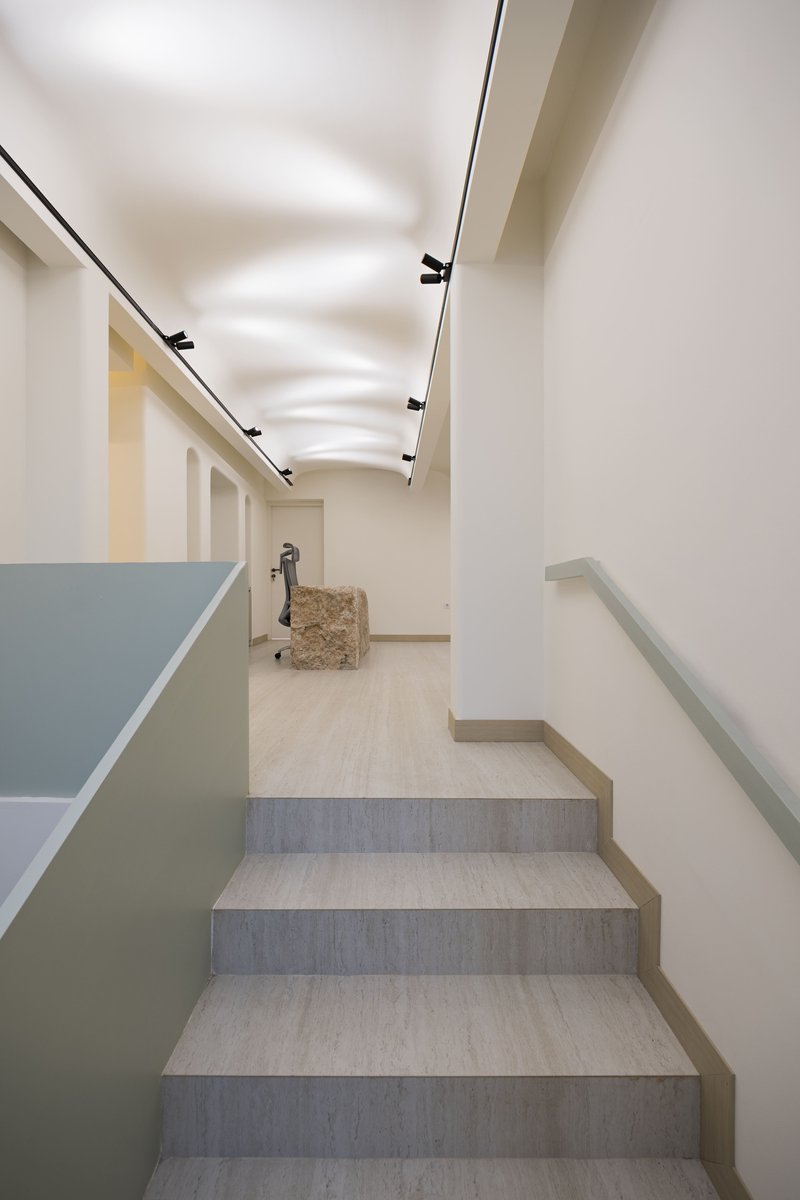
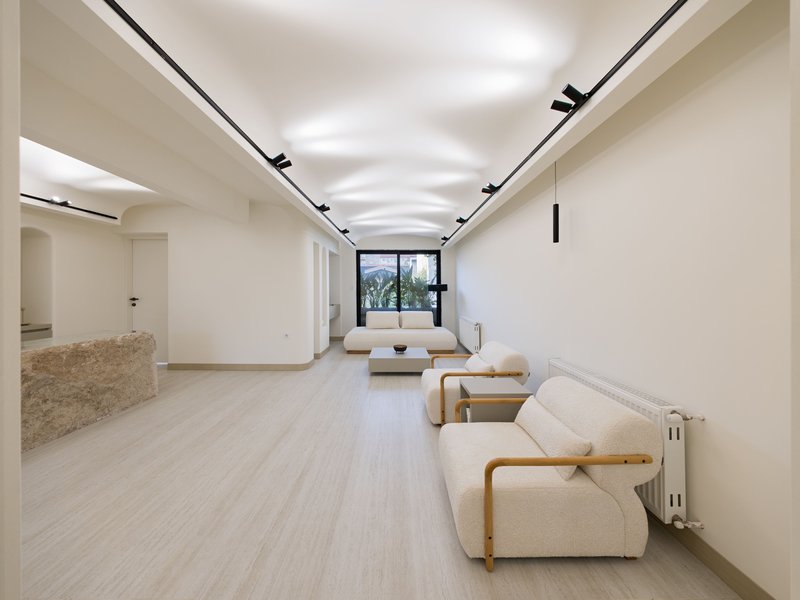
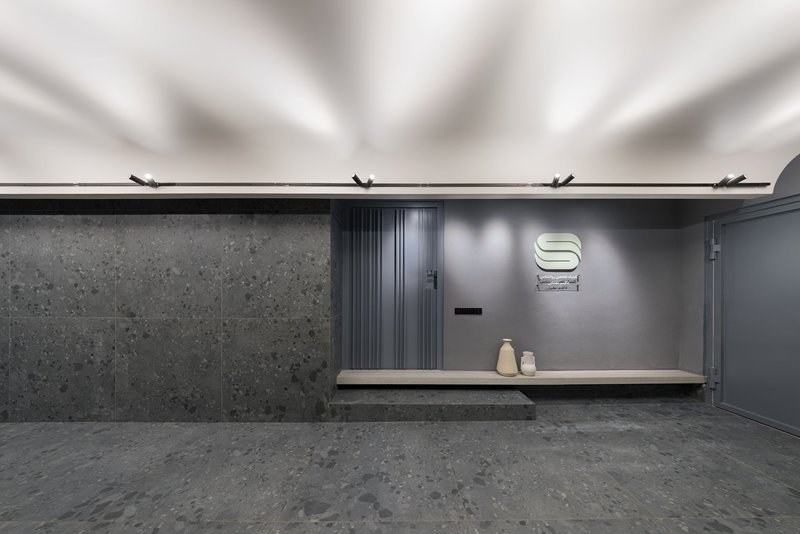
The upper landing extends into a long corridor with pale wood flooring and continuous black track lighting that reads as a single, unbroken line receding into depth. The proportions are generous for a building of this size, avoiding the compressed feeling that often plagues adaptive reuse projects where new program is squeezed into old structure. The reception desk, backed by a concrete wall and lit signage, provides a clear anchor point at arrival, orienting visitors before they move deeper into the plan.
Throughout, the material palette remains disciplined: timber, white plaster, concrete, and the occasional sage green accent. There are no decorative distractions. The architecture itself carries the emotional weight, relying on proportion, light quality, and spatial sequence to do what posters on a wall never could.
Why This Project Matters
Nafas-e-No demonstrates that adaptive reuse is not only an ecological or economic strategy; it can be a therapeutic one. By preserving the familiar shell of a traditional Babol house, Event office created a clinical environment that feels grounded in its neighborhood rather than imposed upon it. For a psychotherapy practice, this is not a minor point. The architecture actively reduces stigma by looking like a place people already know how to enter.
The project also offers a compelling model for healthcare design in dense urban contexts across Iran and beyond. Rather than seeking a suburban site with ample parking and blank walls, the architects worked within the constraints of a tight urban lot and an existing structure, proving that a thousand square meters of calm, light-filled clinical space can be carved from what was already there. The new breath the name promises is real: it moves through perforated brick, along vaulted ceilings, and down staircases washed in green light, arriving exactly where it is needed.
Nafas-e-No (New Breath) Clinic by Event office, lead architect Meysam Hatami. Located in Babol, Iran. 1,000 m². Completed 2025. Photography by Mohammad Hassan Ettefagh.
About the Studio
Share Your Own Work on uni.xyz
If projects like this are the kind of work you want to make, uni.xyz is a place to publish your own, find collaborators, and enter design competitions.



Popular Articles
Popular articles from the community

Inside a Timeless Mumbai Residence by Aether Studio
Aether Studio's 2,250 sq ft apartment in Malad, Mumbai uses marble, brass, boucle, and disciplined restraint to build a quiet retreat from the city.
Healing Façade: Sustainable Architecture for Reforestation, Community, and Sacred Ecology in Ethiopia
Healing Façade reimagines sustainable architecture as a living wall that restores soil, catches water and renews Ethiopia's forest churches.
Etea and Ghostframe Carve a Surreal Domestic World from Arches and Circles in Mérida
Casa Eclipse wraps 385 square meters of sculptural living space around a lush courtyard pool in Mexico's Yucatán Peninsula.
Kaffeebühnen: Coffee Shop Architecture Designed as a Civic Stage Between Vienna’s City and Park
Kaffeebühnen turns coffee shop architecture into a civic stage, linking Vienna’s park edge, urban life, warm timber yards, and coffee craft.
Similar Reads
You might also enjoy these articles

Freebird Residence by Alexis Dornier: A Tropical Modernist Sanctuary in Bali
Floating living pavilion above pool anchors H-shaped tropical villa, blending Japanese minimalism, sustainable strategies, lush landscape, and sculptural interiors.
127af Flips a Tiny Bagnolet Rowhouse Upside Down with a Handcrafted Roof Extension
A 55-square-meter terraced house on the edge of Paris gains a luminous upper living floor through lightweight timber and steel.
1.61 Design Workshop Wraps a 600-Square-Meter Café in Vietnam in Sculptural Burgundy Drama
Reden Café & Bistro pairs a helical staircase, mosaic floors, and deep red interiors to rethink Vietnamese hospitality space.

The Unbound Brain: A School Shaped by Cognitive Architecture
Cylindrical learning pods radiate like neurons from a central cortex, turning the floor plan into a spatial model of human thought.


Explore Public Building Competitions
Discover active competitions in this discipline




The Global Benchmark for Architecture Dissertation Awards


Challenge to design locus for the upliftment of human rights


Challenge to re-imagine a department store in present times


Design challenge fostering public involvement in wildlife research
Comments (0)
Please login or sign up to add comments
No comments yet. Be the first to comment!