

Everyone's Rights School: Finnish Access Law Becomes a Building
A shortlisted competition entry translates Finland's "Everyman's Right" into a school where corridors become public streets and nature becomes curriculum.


What if the legal right to roam freely through forests, lakes, and open land could be translated into architecture? Everyone's Rights School takes Finland's "Everyman's Right," a principle granting universal access to nature regardless of nationality or status, and uses it as the organizing logic for an entire educational building. The result is a school that refuses to distinguish between student and stranger, inside and outside, classroom and commons.
Designed by Jae Wan Park (재왈 박) and shortlisted in the Learn Better competition, the project reimagines the school not as a sealed institution but as civic infrastructure. A central corridor operates as a public street, open to community members and students alike, collapsing the boundary between educational facility and shared urban resource.
A White Sculptural Facade That Invites Rather Than Excludes
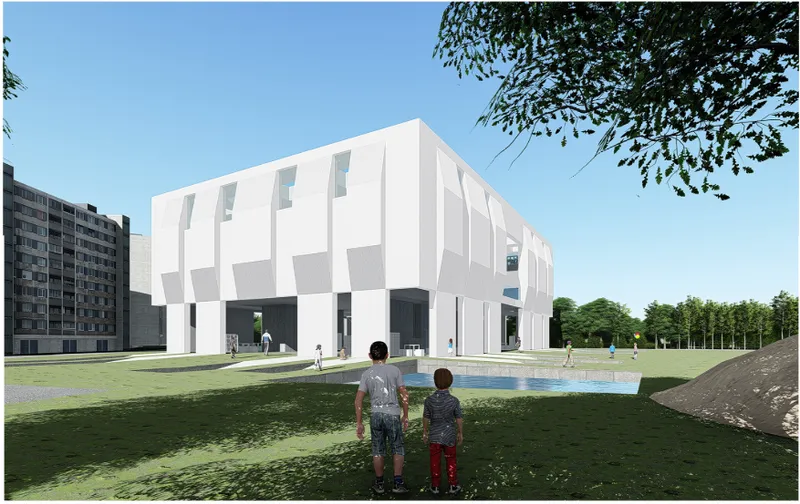
The building's street-facing elevation is a field of vertical white fins, rhythmic and semi-transparent, standing behind a reflecting pool and open lawn. Two children occupy the foreground, their scale reinforcing just how generous the setback is. There is no gate, no fence, no raised threshold. The facade reads as permeable: light passes through the fins, views slip between them, and the lawn functions as an extension of the interior program. The reflecting pool does double duty, evoking the Finnish lakeland landscape while grounding the "Everyman's Right" metaphor in a tangible material presence.
The Corridor as Public Street
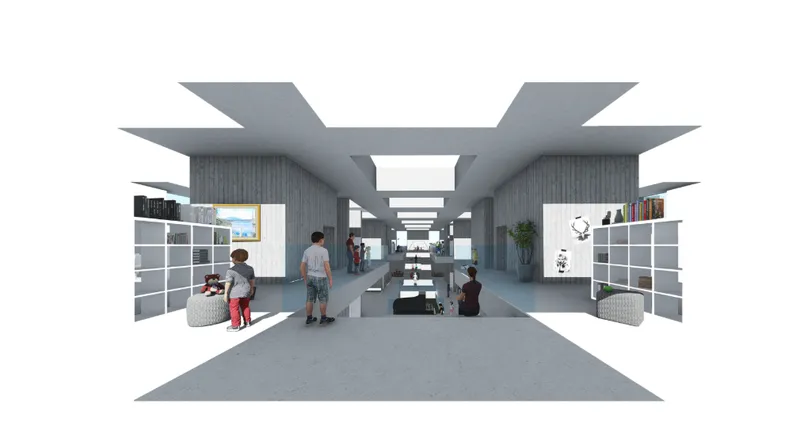
Step inside and the central corridor stretches long and generous, lined with storage units along its walls and punctuated by cantilevered ceiling planes that create varying heights overhead. Visitors and students move through this space together. It is not a hallway in the conventional school sense; it is a street with a roof, designed to host informal encounters, community activity, and the kind of unplanned interaction that rigid classroom plans typically suppress. The spatial strategy decentralizes authority. There is no front office controlling entry, no reception desk filtering access. The building simply opens.
Split Levels and Suspended Volumes Shape a Layered Section
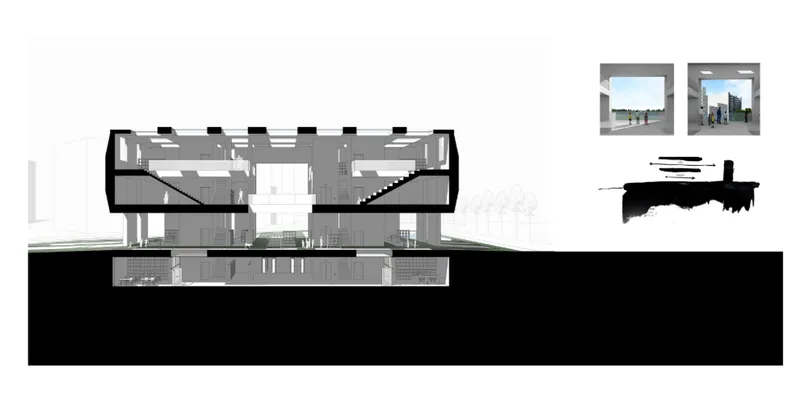
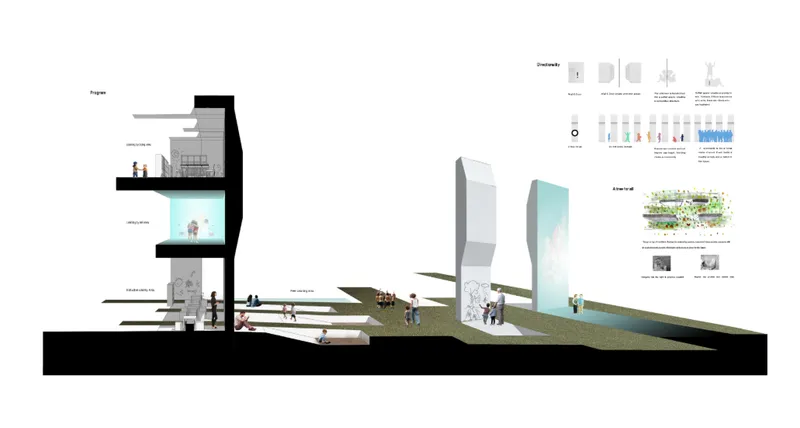
The section drawing reveals how the school's interior stacks and staggers its program across split levels. Stairs connect classrooms, learning lounges, and communal hubs at different elevations, while upper volumes appear to be suspended within the larger structural frame. This vertical layering creates sightlines between floors and allows natural daylight to penetrate deep into the plan, reinforcing the project's commitment to transparency and visual connection.
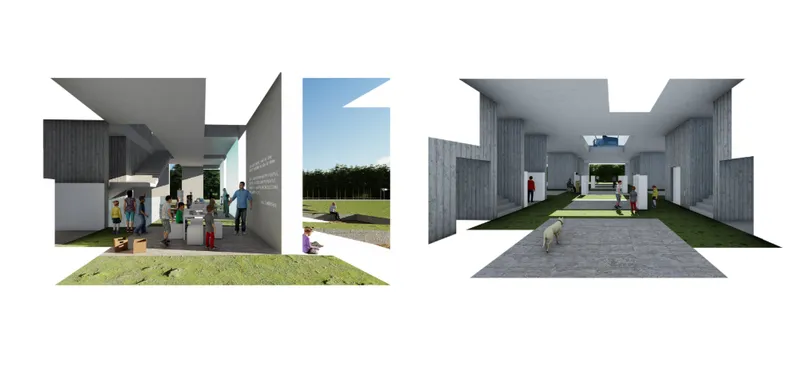
A pair of interior perspectives shows how these sectional moves feel at eye level. Board-formed concrete walls frame large openings that function as thresholds between gallery-like spaces. Visitors appear throughout, their presence reinforcing the idea that these interiors belong to everyone. The material palette stays restrained: raw concrete, timber, and generous glazing. No surface competes for attention. The architecture lets the activity of its occupants become the primary visual event.
A Rectangular Footprint Organized Around Openness
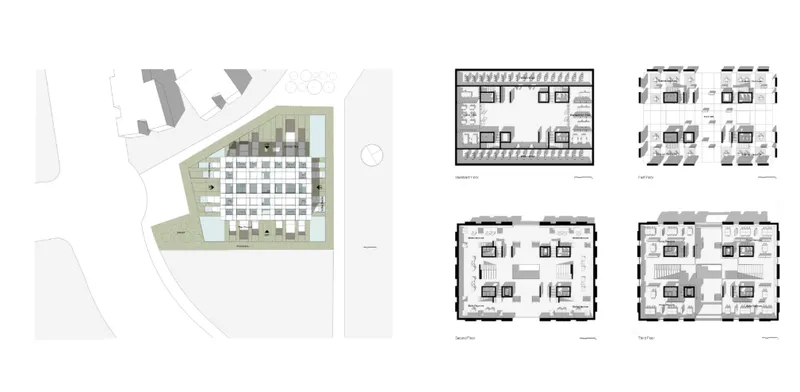
The site plan and four floor plans confirm the building's rectangular footprint, within which rooms and corridors are arranged to maximize connectivity. Open courtyards and green patches interrupt the plan at strategic intervals, pulling landscape into the heart of the building. These are not decorative gestures; they are spatial tools that reinforce the Finnish wilderness metaphor. Just as trees cluster to form a forest, the rooms cluster around shared open space to form a learning community.
A second section drawing, accompanied by detail diagrams, clarifies the vertical organization further. Two tall fin elements rise from grade level, anchoring the composition and providing structural rhythm. The diagrams suggest a modular logic that could adapt to different programmatic needs over time, supporting the project's ambition to serve not just current students but future generations and shifting community demands.
Why This Project Matters
Most school designs begin with security protocols and end with a building that treats its occupants as liabilities to be managed. Everyone's Rights School inverts this logic entirely. It begins with a legal and philosophical principle about universal access and derives every architectural decision from that starting point: the porous facade, the street-corridor, the split-level section that refuses to hide any program behind closed doors. The conceptual framework is not decoration layered onto a conventional plan; it is the plan.
Jae Wan Park's entry demonstrates that inclusive architecture does not require spectacular form or technological novelty. It requires a clear idea about who a building is for, pursued with consistency through every scale of design. By grounding the project in Finland's Everyman's Right, the proposal connects education to landscape, civic life to personal freedom, and architecture to the kind of equitable society it claims to serve. That coherence is what earned it a shortlist position, and it is what makes it worth studying long after the competition closes.
View the Full Project
About the Designers
Designer: 재왈 박
Enter a Design Competition on uni.xyz
uni.xyz runs architecture and design competitions year-round that reward proposals with spatial conviction and real site intelligence.
Project credits: Everyone's Rights School by 재왈 박 Learn Better (uni.xyz).


Popular Articles
Popular articles from the community


The Ocean Hive: Sustainable Architecture for a Self-Sufficient Civilization at Sea
The Ocean Hive imagines sustainable architecture at sea, where modular habitats, algae, wave power and ocean waste sustain a growing colony.
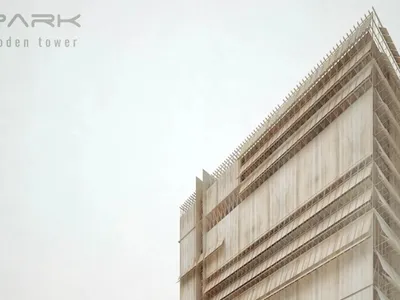
EW PARK: Sustainable Architecture Reimagines the Future of Urban Parking
EW PARK reimagines city parking as a modular wooden tower combining automation, solar energy, electric mobility, and adaptable urban design.

Riyadh For All: Intergenerational Urban Design for Active Aging in Rabat
Riyadh For All reimagines urban design in Rabat with intergenerational co-living, adaptive courtyards, and Moroccan cultural exchange today.

Co-life: Sustainable Architecture for Age-Friendly Community Living
Co-life reimagines sustainable architecture for seniors through courtyards, rammed earth, shared gardens, and spaces designed for belonging.
Similar Reads
You might also enjoy these articles

Day and Night Park: A Time-Based Urban Newsstand in Beijing
A temporary urban newsstand in Beijing blending travel, light, and reading through poetic colors, compact form, and community-focused design.

Modernist Patio Renovation in El Masnou, Barcelona by Oliver Segura Arquitectura + Cebrià Arquitectura
Modernist patio renovation blending tradition and innovation with a movable pool, leveled floors, and Catalan materials in El Masnou.

Alto Residencial Coop: Cooperative Housing Development in Santiago de Compostela by Carbajo Barrios Arquitectos
A linear cooperative housing complex blending white volumes and perforated metal façades, enhancing community living, natural light, privacy, and urban integration.
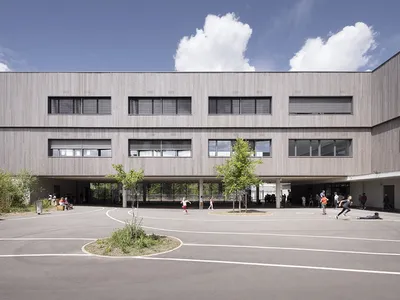
Vil Genis School by BPA ARCHITECTURE – Massy, France
Vil Genis School in Massy, France, features sustainable design, south-facing classrooms, community integration, accessible spaces, and modern educational architecture.




Comments (0)
Please login or sign up to add comments
No comments yet. Be the first to comment!