

Stay Di Home: A Stadium That Flips Its Grandstands Into Housing
A modular prefabrication strategy transforms three-tiered stadium seating into courtyard housing, commercial floors, and urban parkland.


What if a stadium's grandstands could literally fold over to become apartment blocks? Stay Di Home proposes exactly that: a three-tiered seating arrangement whose middle tier flips over the lower section, creating open courtyards flanked by residential and commercial volumes. It is a provocation against the global pattern of mega-event infrastructure decaying into expensive relics, and the mechanism is disarmingly simple, inspired by lifting a car hood and locking it in place.
Designed by Karthik Raja Raju and Mohit Raj, this shortlisted entry in the Staydium 2020 competition rethinks the stadium as a permanent urban asset rather than a single-use spectacle. The competition asked designers to imagine stadiums that could serve communities long after the final whistle. Stay Di Home answers with a prefabricated, synchronized modular system that converts grandstands into housing blocks, repurposes the pitch as a central courtyard park, and weaves commercial programming through former circulation corridors.
From Grandstand to Courtyard: The Flip Mechanism
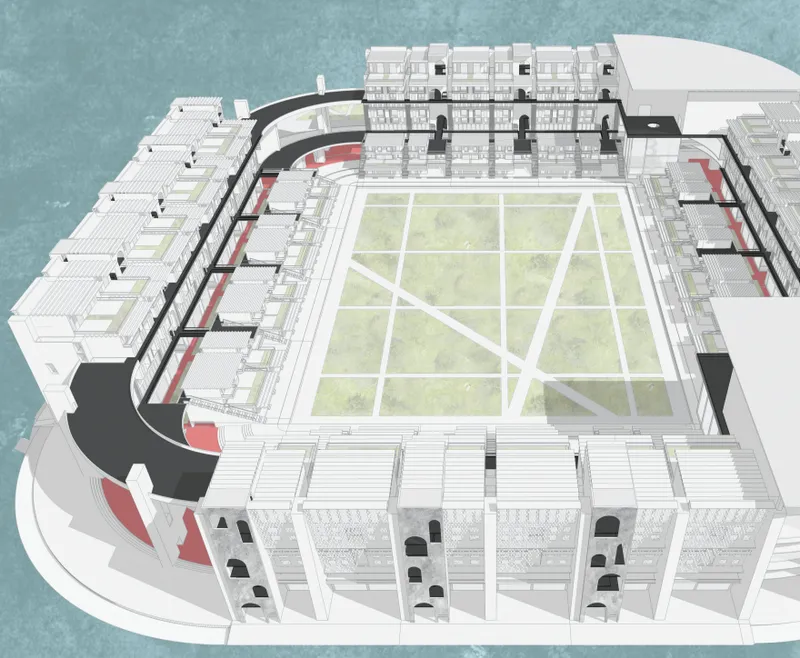
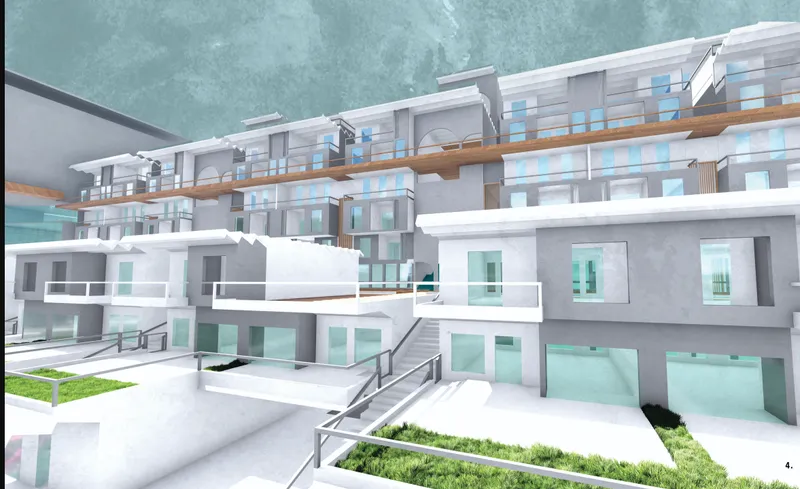
The transformation hinges on a modular seating system with standard stairs positioned every 16 meters, establishing a regular rhythm that doubles as the structural module for residential units. During conversion, cranes lift the middle tier and rotate it over the lower section, opening up a courtyard between two parallel housing blocks. The axonometric drawing reveals the post-transformation state: white residential volumes frame a geometrically patterned garden, with the curved footprint of the original stadium still legible in the building's plan. Planted green roofs and glass facades replace the stepped concrete of spectator terraces.
The rendered courtyard view shows what daily life looks like after the stadium disappears. Terraced housing units step back to allow daylight deep into the courtyard, while the former pitch becomes shared green space. The porosity that the designers emphasize, shifting from a solid, isolated arena to a connected, breathable structure, is visible in the layered setbacks and generous openings between volumes.
Urban Integration: Pitch Becomes Park, Corridors Become Bridges
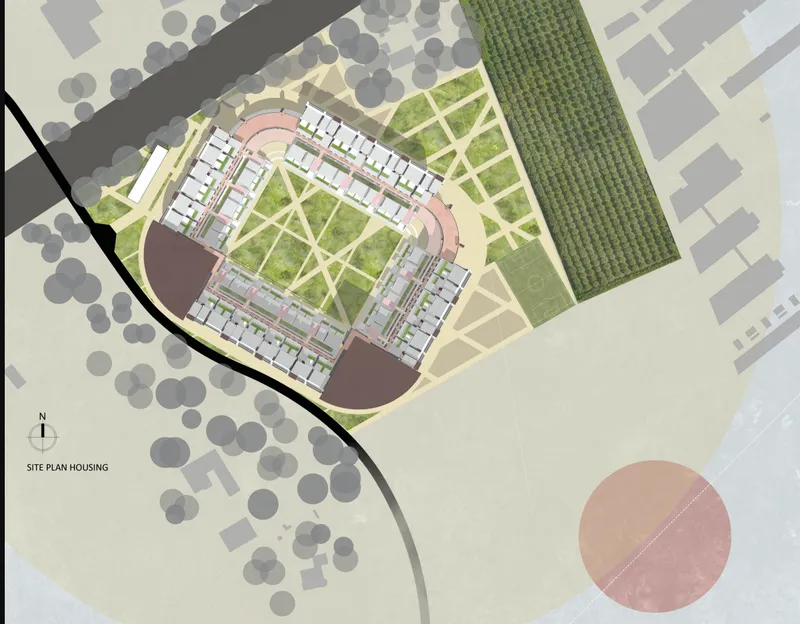
The site plan makes the post-event urban strategy legible at a glance. The curved housing block encloses a central courtyard garden, and an adjacent orchard extends the green network beyond the stadium's original perimeter. Former stadium access zones, which once managed crowd flow for tens of thousands, remain functional as connective tissue: corridors act as pedestrian bridges linking residential, commercial, and leisure zones. The designers describe a mixed-use approach where shopping areas, restaurants, and homes coexist within the repurposed structure, turning what would have been a dormant concrete bowl into a neighborhood.
Translucent Concrete and Structural Modularity


The diagram series breaks down the structural logic. Stacked floor plates, a regular column grid interspersed with trees, and textured concrete wall assemblies form the building's kit of parts. Translucent concrete walls are specified to enhance natural lighting and reduce energy consumption in the housing units, an interesting material choice that preserves the massive, civic character of stadium architecture while introducing domestic qualities of diffused light.
The exploded axonometric drawing separates the curved building into its component layers: roof shells, floor slabs, and column arrays. Each element is prefabricated and synchronized in pattern, meaning the same structural module that supports spectators during an event can support residents afterward. Cost efficiency comes from minimizing intervention during transformation; the structure does not need to be demolished and rebuilt, only reconfigured.
Assembly Logic: Slatted Roofs and Curved Facades
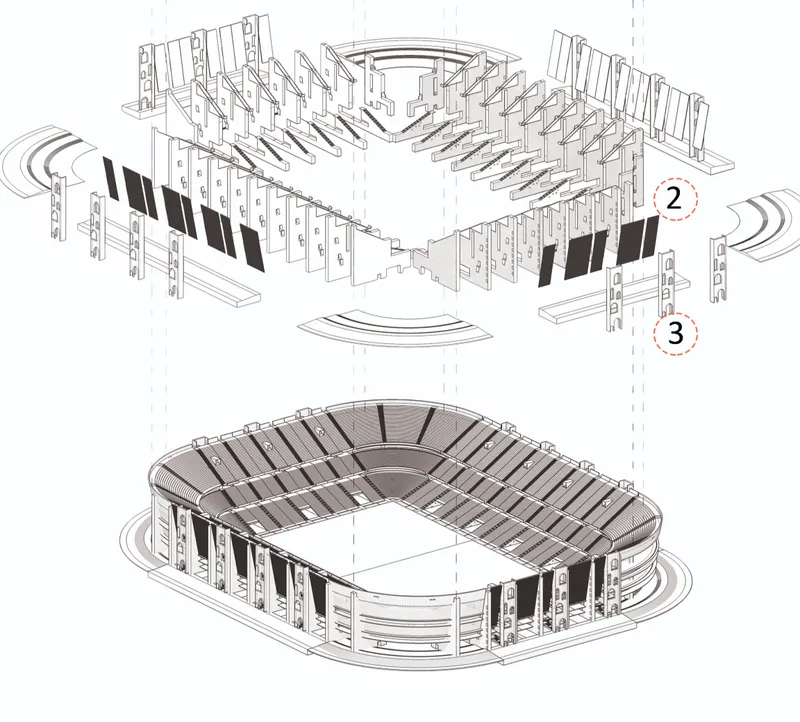
The final exploded axonometric labels every component of the facade and roof system. A structural frame supports a slatted roof that controls solar gain, while the curved facade assembly wraps the former grandstand in a new skin appropriate for residential occupation. Retaining key stadium elements, such as the original access zones and ventilation pathways, means the building carries a memory of its first life. The labeled components suggest a construction sequence designed for crane-based assembly, consistent with the project's core premise that transformation should be mechanical, not demolition-based.
Why This Project Matters
Stay Di Home confronts a real and growing problem. Cities around the world host mega-events, build stadiums at enormous public expense, and then struggle with what to do with 50,000-seat arenas that sit empty 350 days a year. Most post-event adaptive reuse proposals treat the stadium as a container to be filled with new programming. Karthik Raja Raju and Mohit Raj go further by proposing a physical transformation of the structure itself, flipping tiers and reconfiguring modules so the building's geometry changes to match its new purpose.
The strength of the proposal lies in its specificity: the 16-meter stair intervals, the car-hood hinge analogy, the translucent concrete, the crane-based assembly sequence. These are not vague sustainability gestures but concrete (literally) design decisions that make the transformation plausible. Whether every detail would survive engineering scrutiny is less important than the clarity of the idea: that a stadium and a neighborhood can share the same bones, if you design the bones right from the start.
View the Full Project
About the Designers
Designers: Karthik Raja Raju, Mohit Raj
Enter a Design Competition on uni.xyz
uni.xyz runs architecture and design competitions year-round that reward proposals with spatial conviction and real site intelligence.
Project credits: STAY DI HOME" by Karthik Raja Raju, Mohit Raj Staydium 2020 (uni.xyz).


Popular Articles
Popular articles from the community


Opera on the Sea: Driftwood Logic Shapes a Timber Opera House on Estonia's Coast
Trevor Orgill's opera house translates the entangled drift of floating timber into a civic building where wood, water, and music converge.

Cloaked Colonization: A Mobile Underwater Habitat That Moves Like a Fish
Micah Abaya's shortlisted EHC Pacific entry reimagines ocean settlement as a dispersed network of self-sustaining architectural organisms.

Extended Shell: Retrofitting Kolkata's Balconies as Living Urban Thresholds
A modular retrofit system recovers the social and environmental intelligence of Kolkata's historic verandas for contemporary Park Street residents.

Singing Woman: An Opera House That Performs Before the Curtain Rises
Ovidiu Cristian Pavel's conceptual opera house translates Estonia's choral identity into a sculpted waterfront landmark facing the Baltic Sea.

Similar Reads
You might also enjoy these articles

Shakur's House: Exposed Brick as an Interior Organiser in a 168 m² Mashhad Residence
Brick moves indoors in this Mashhad residence, where masonry walls, glass partitions and teal planes sequence a compact home without closing it off.

Day and Night Park: A Time-Based Urban Newsstand in Beijing
A temporary urban newsstand in Beijing blending travel, light, and reading through poetic colors, compact form, and community-focused design.

Modernist Patio Renovation in El Masnou, Barcelona by Oliver Segura Arquitectura + Cebrià Arquitectura
Modernist patio renovation blending tradition and innovation with a movable pool, leveled floors, and Catalan materials in El Masnou.

Alto Residencial Coop: Cooperative Housing Development in Santiago de Compostela by Carbajo Barrios Arquitectos
A linear cooperative housing complex blending white volumes and perforated metal façades, enhancing community living, natural light, privacy, and urban integration.

Explore Stadium Competitions
Discover active competitions in this discipline

Challenge to design a barrier free sports center

Challenge to design an outdoor ice-rink and park
Comments (0)
Please login or sign up to add comments
No comments yet. Be the first to comment!