
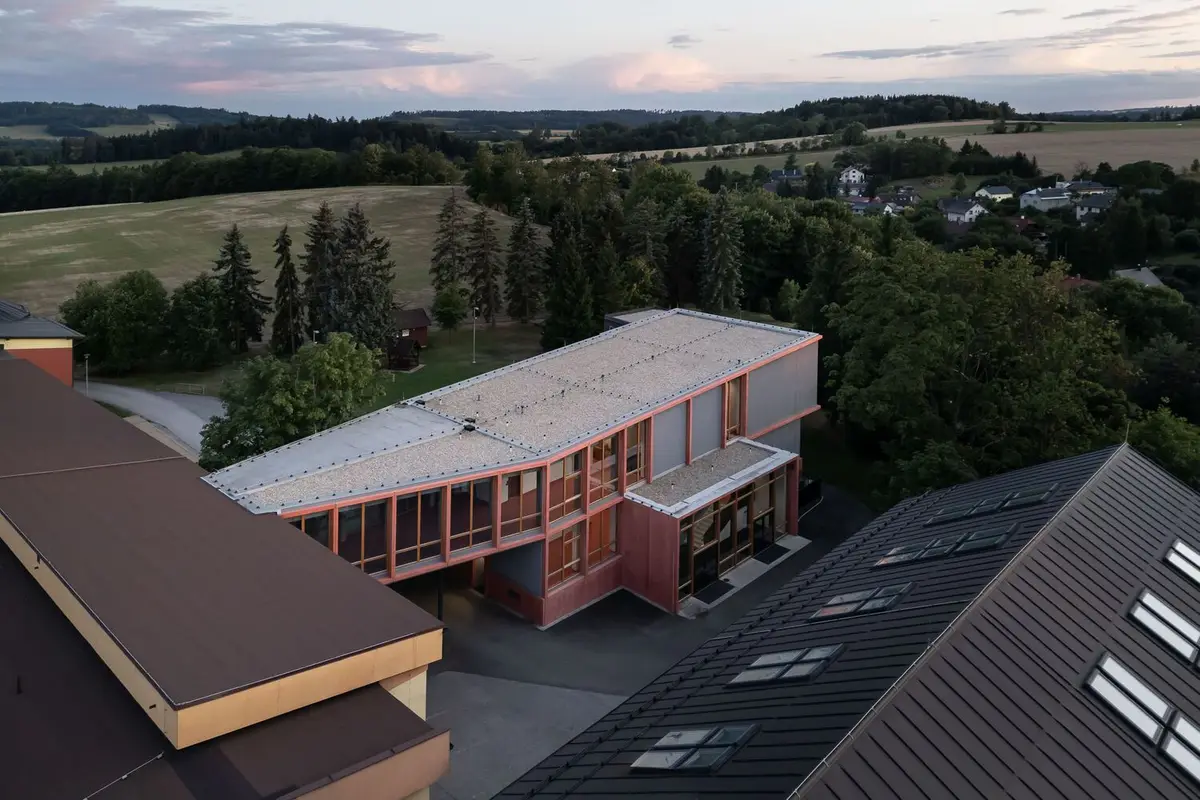
Extension of Elementary School and Kindergarten in Studenec Village by Chrama
Context-sensitive school extension in Studenec integrates courtyard, amphitheatre, natural light, wood interiors, and multipurpose community-focused educational spaces.


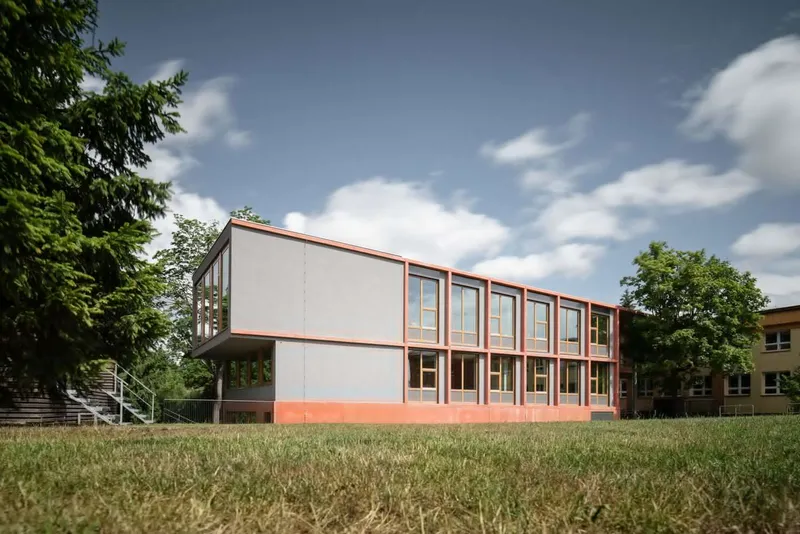
The Extension of the Elementary School and Kindergarten in Studenec Village is a contemporary educational architecture project designed by Chrama in 2021. Located in Studenec, Czechia, this 1,600 m² expansion strengthens the village’s central sports and education complex while reinforcing community identity through sensitive site integration and spatial clarity.
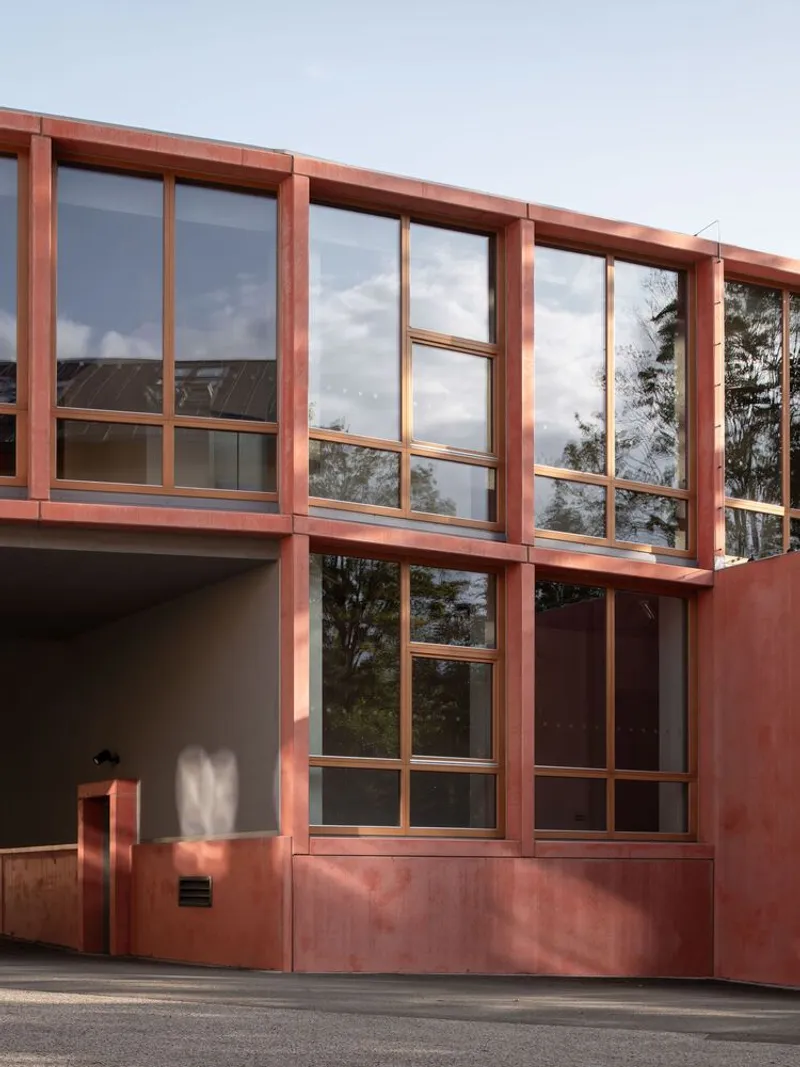
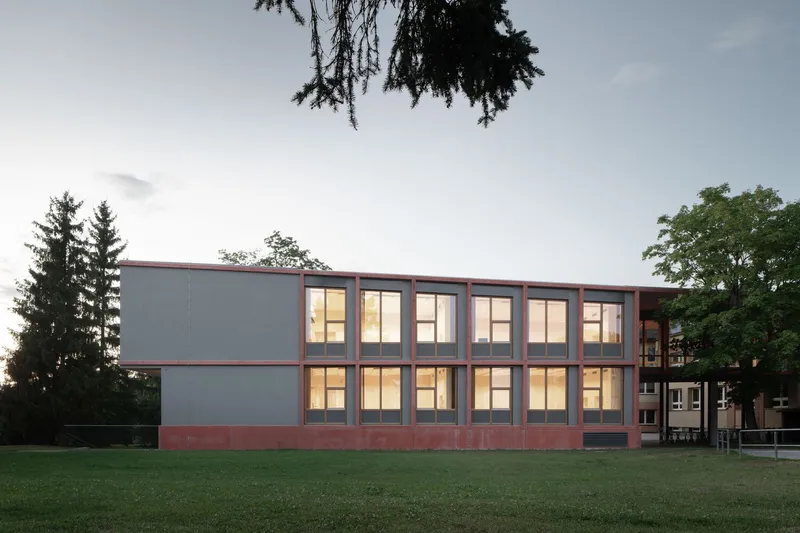
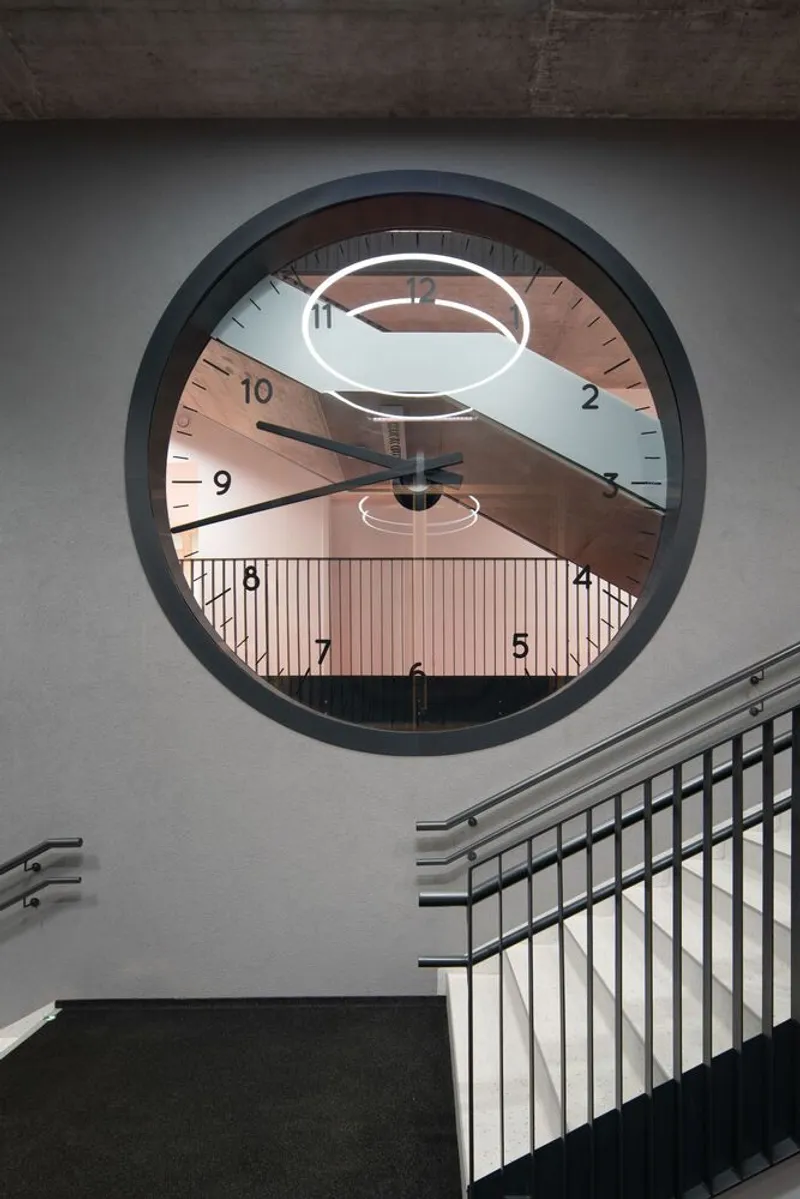
Designed by lead architects Martin Junek and Adam Cigler, the project redefines rural school architecture by blending contextual design, natural landscape integration, and modern educational space planning. Photographed by Tomáš Slavík, the building demonstrates how contemporary school extensions can support both academic and civic life.
Strategic Site Integration and Community-Oriented Design
Situated at the heart of Studenec Village, the extension carefully negotiates between existing school buildings, public cultural spaces, and the dramatic topography overlooking the Oleška River and the Krkonoše foothills.
Northern Façade: Formation of a Semi-Enclosed Courtyard
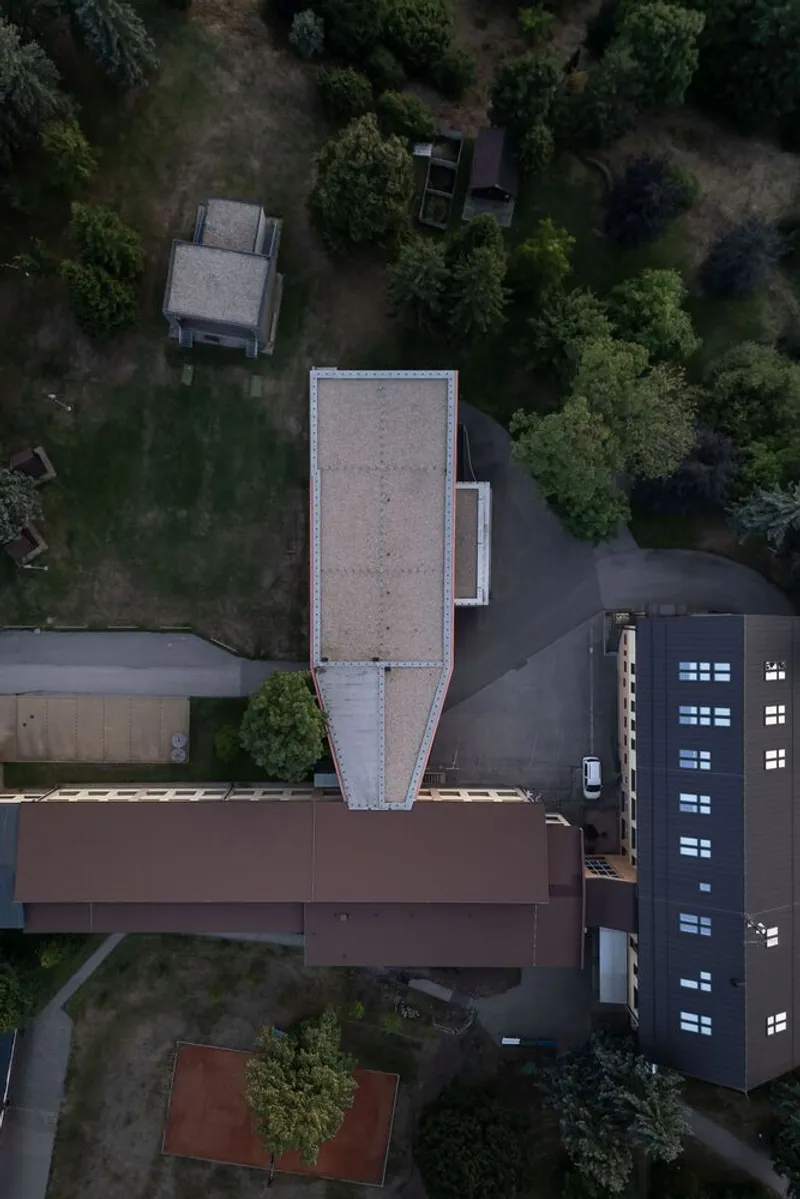
The northern façade seamlessly connects to the original school structures, forming a semi-enclosed courtyard. This protected outdoor space enhances student interaction while functioning as a transitional zone between old and new architecture. The courtyard reinforces community engagement and strengthens spatial continuity across the campus.
Southern Façade: Framing the Amphitheatre
On the opposite side, the southern façade defines the foreground of the village Amphitheatre, an important cultural venue used by both the municipality and the school. This orientation elevates the extension beyond a purely academic facility, transforming it into a civic anchor that supports social events, performances, and community gatherings.
Western Façade: Respecting the Natural Landscape
Facing a steep slope above the Oleška River, the western façade remains deliberately understated. This architectural restraint preserves unobstructed views toward the picturesque Krkonoše foothills, embedding environmental awareness into the daily learning experience. The building becomes an educational tool in itself, encouraging students to engage with the surrounding landscape.
Architectural Dialogue and Historical Continuity
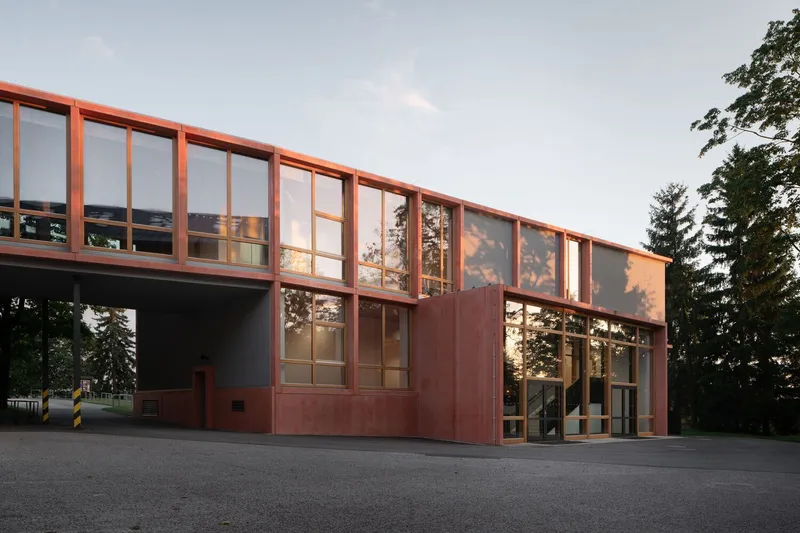
The eastern façade connects to the existing building via a footbridge, creating a physical and symbolic bridge between architectural generations. This side of the structure references the early work of renowned Czech architect Karel Hubáček, whose philosophy emphasized the integration of natural light into public buildings.
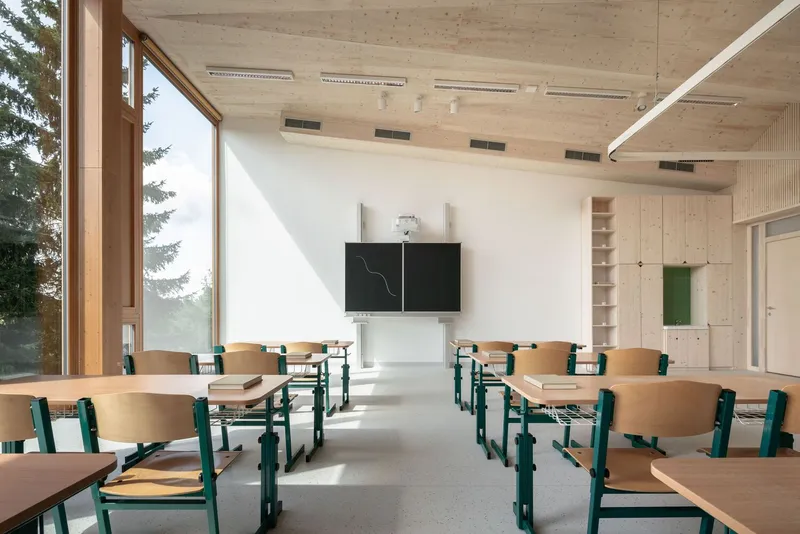
Daylight plays a central role in the extension’s design. Large windows and carefully positioned openings allow sunlight to penetrate deep into classrooms and circulation spaces, fostering openness, transparency, and a sense of spatial freedom, essential qualities in contemporary learning environments.
Interior Design: Functional Efficiency Meets Warm Materiality
Internally, the school extension prioritizes functional layout, spatial efficiency, and acoustic comfort, key elements in modern educational architecture.
Communal Spaces with Exposed Concrete
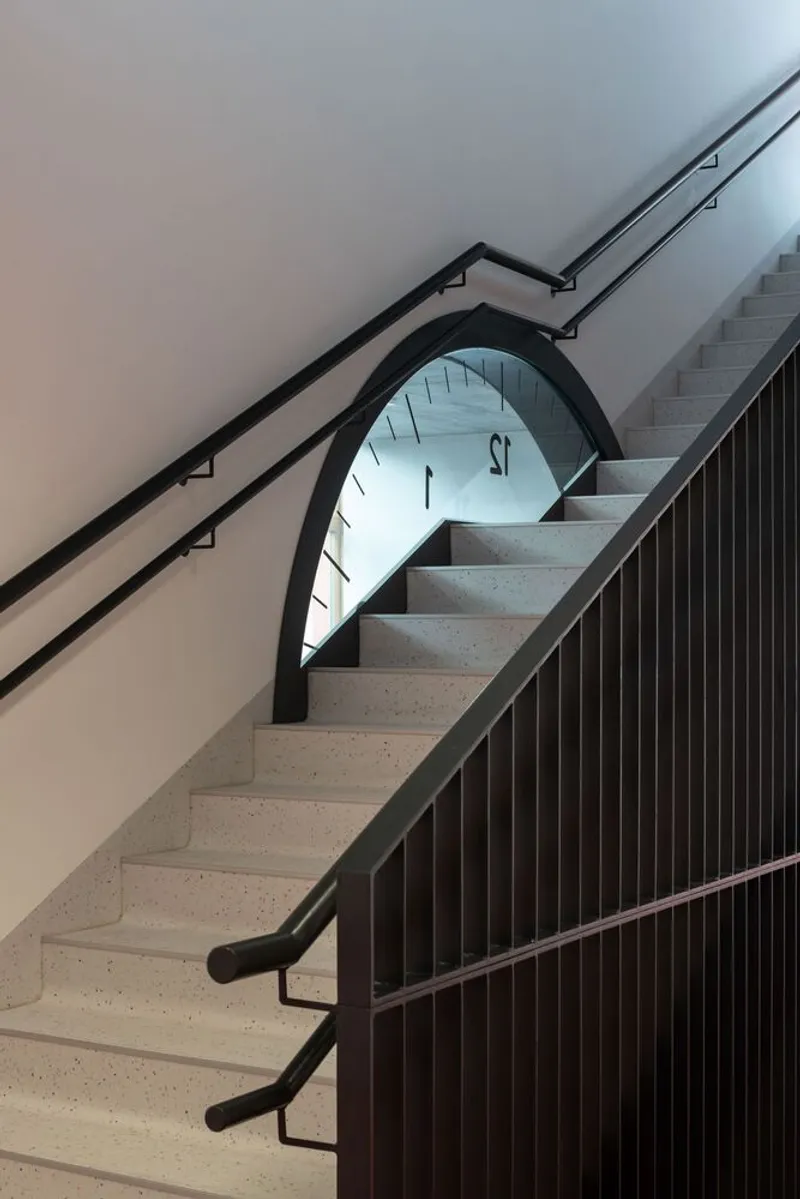
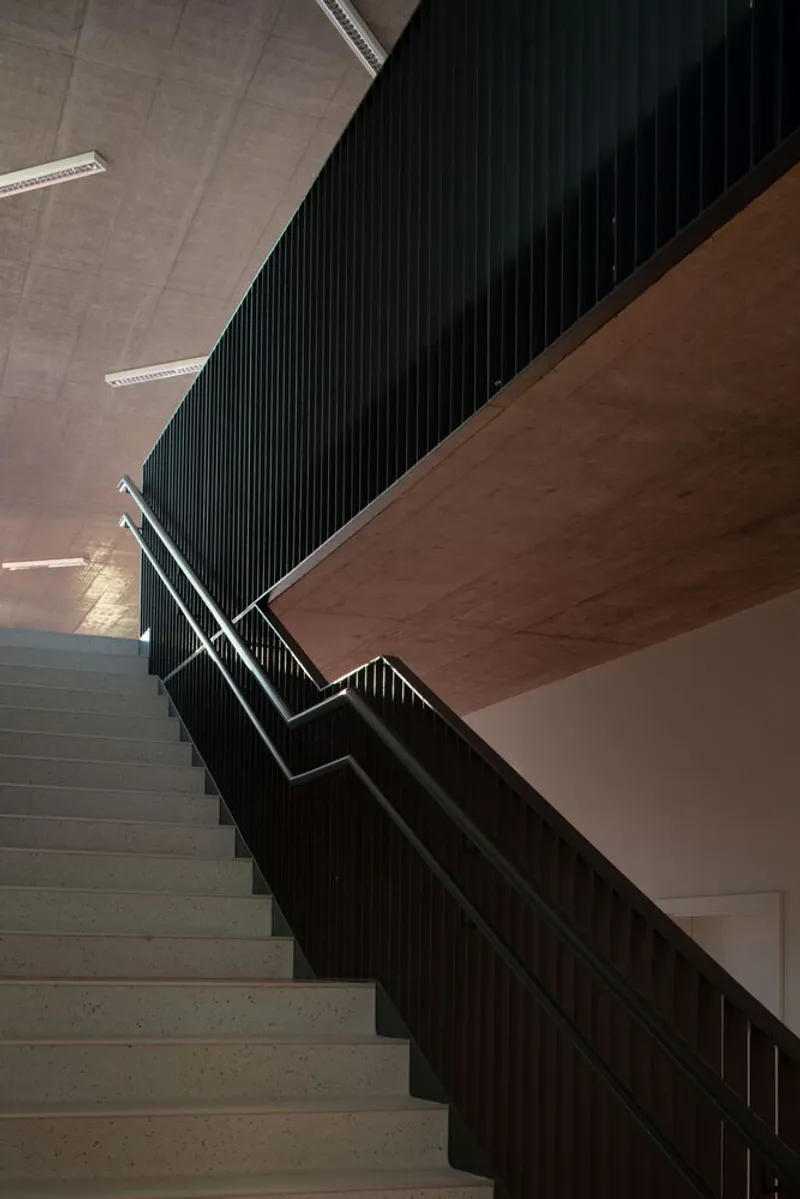
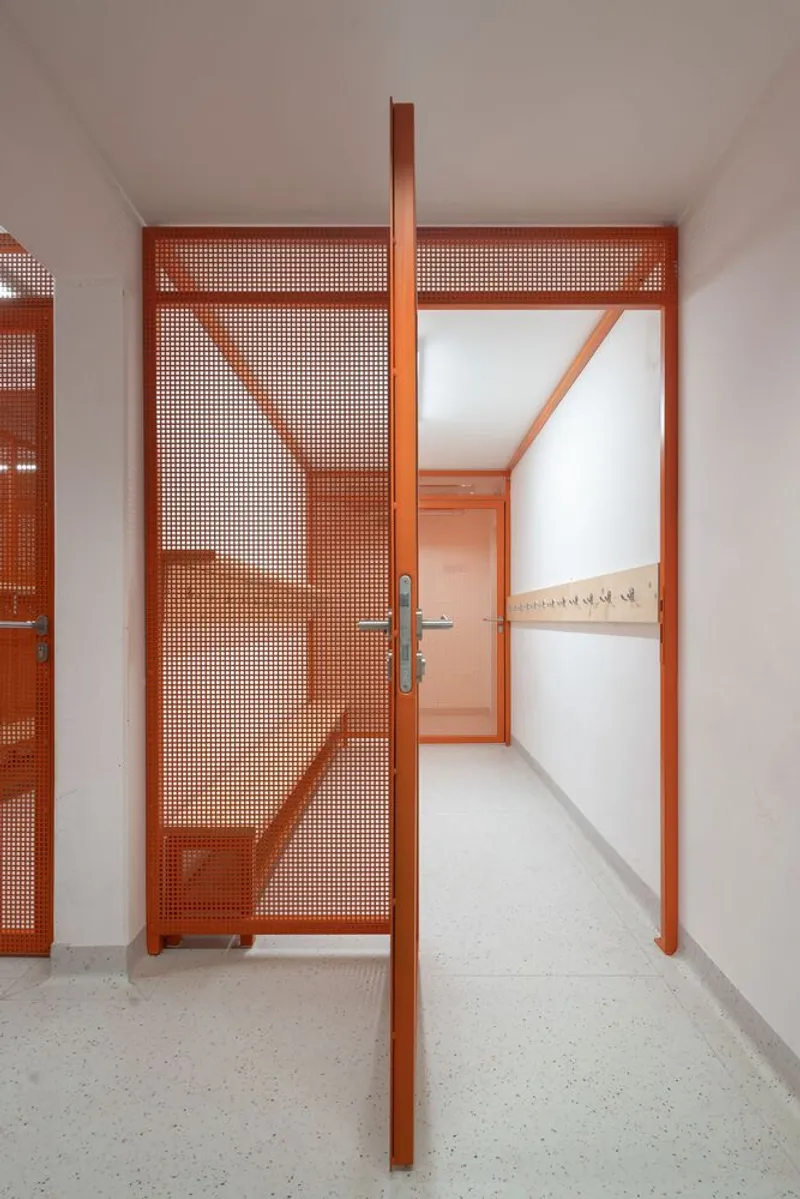
Shared areas feature exposed concrete surfaces, expressing structural clarity while ensuring durability and low maintenance. The raw material palette reinforces the building’s architectural honesty and creates a neutral backdrop for daily school activities.
Classrooms with Wood and Acoustic Optimization
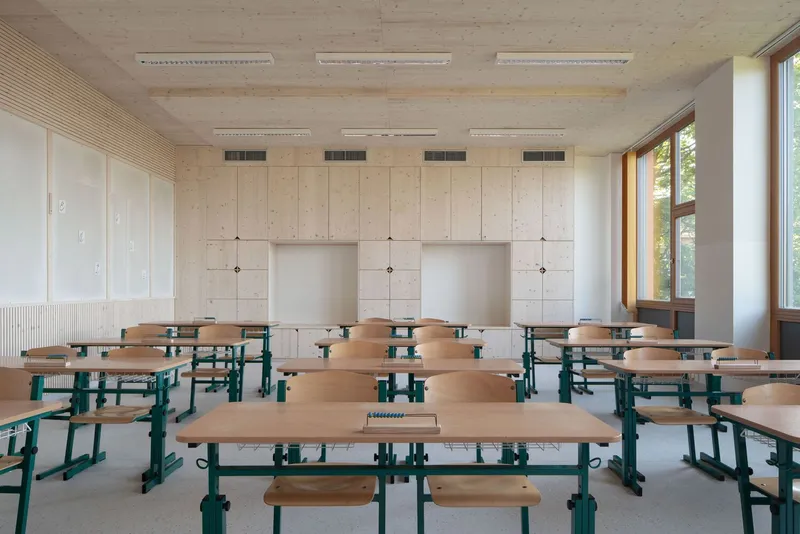
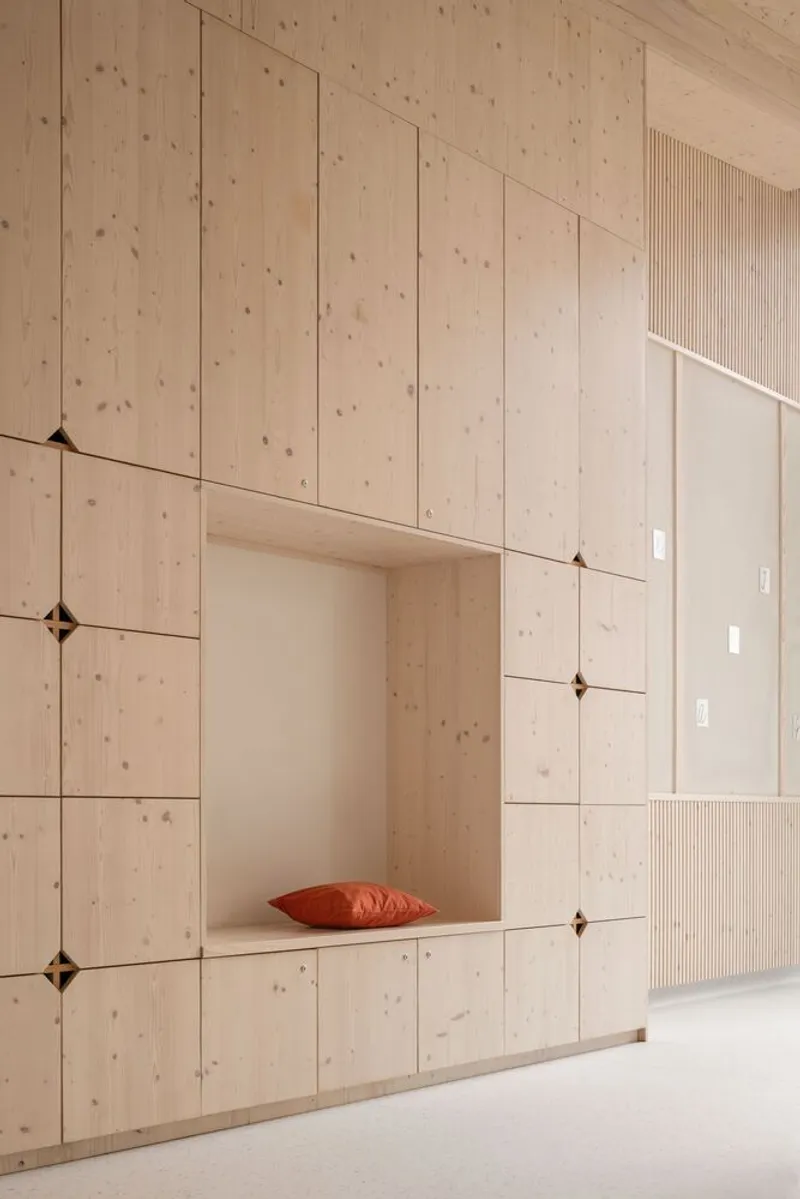
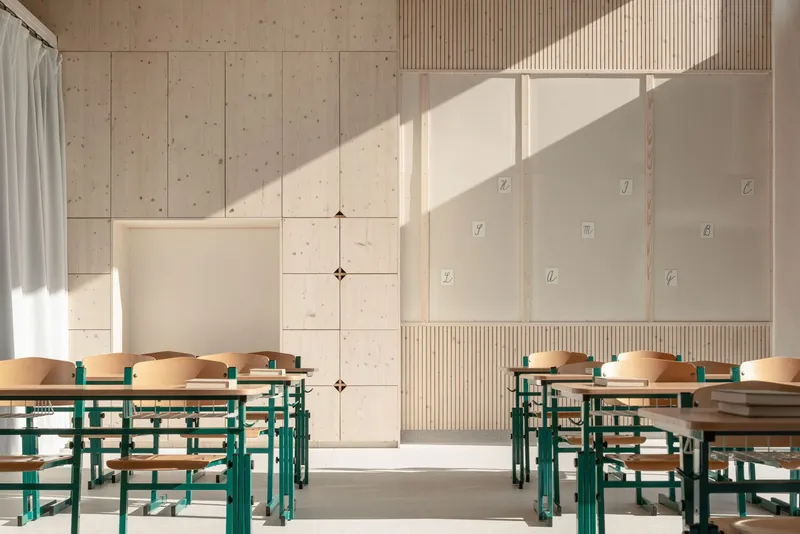
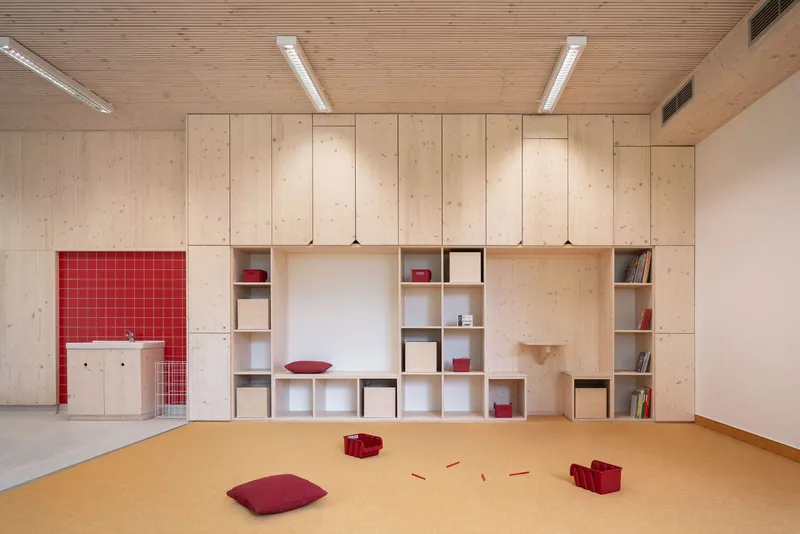
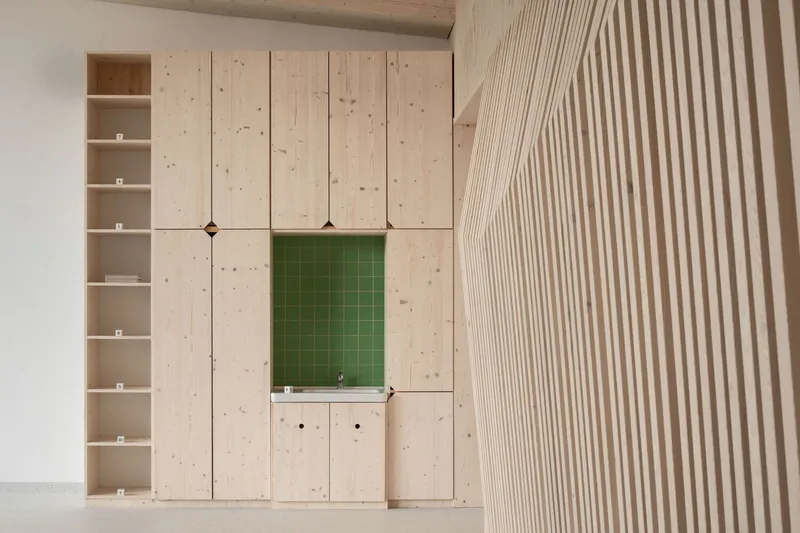
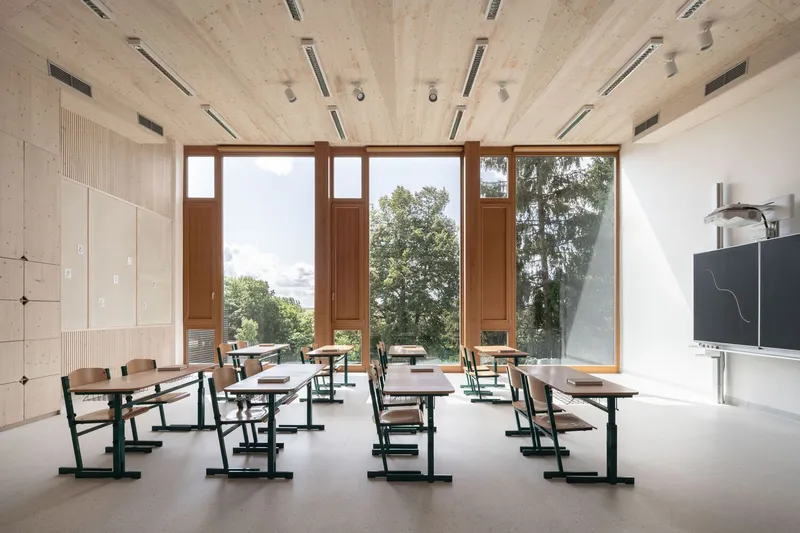
In contrast, classrooms introduce warmth through wooden paneling and refined detailing. Advanced acoustic treatments enhance concentration and overall well-being, aligning with best practices in contemporary school design. The combination of natural materials and technical performance creates a balanced, student-centered learning environment.
The Top-Floor Multipurpose Classroom: A Community Landmark
The highlight of the extension is the main classroom on the top floor, strategically oriented to capture expansive western views. This flexible space functions both as a classroom and as a community hall for cultural events.
A distinctive openwork wooden ceiling and carefully placed wall tiles optimize spatial acoustics, ensuring high-quality sound performance during lectures, performances, and gatherings. This dual-purpose design reflects a growing trend in rural educational architecture, spaces that extend beyond schooling to serve broader community functions.
Sustainable Rural School Architecture in Czechia
The Studenec school extension exemplifies how contemporary architecture can respectfully integrate with rural settings while addressing evolving educational needs. By combining contextual site planning, natural light optimization, durable materials, and flexible community spaces, the project sets a benchmark for sustainable school design in Central Europe.
More than an expansion, this building strengthens the cultural fabric of Studenec Village, reinforcing the school as both an academic institution and a social nucleus.
Project Details
Project: Extension of Elementary School and Kindergarten in Studenec Village Location: Studenec, Czechia Architects: Chrama Lead Architects: Martin Junek, Adam Cigler Area: 1,600 m² Year: 2021 Photographs: Tomáš Slavík Manufacturers: Archicad, Forbo, KŠ Prefa
The Extension of the Elementary School and Kindergarten in Studenec Village demonstrates how contextual architecture, educational innovation, and community integration can coexist within a single project. Through its sensitive landscape response, daylight-driven interiors, and multipurpose flexibility, the building elevates the standard for rural school extensions in Czechia and beyond.
All photographs are works of
Tomáš Slavík


Popular Articles
Popular articles from the community


The Ocean Hive: Sustainable Architecture for a Self-Sufficient Civilization at Sea
The Ocean Hive imagines sustainable architecture at sea, where modular habitats, algae, wave power and ocean waste sustain a growing colony.

Little Red Riding Hood: Architectural Design as a Journey Through Fear, Light, and Storytelling
Little Red Riding Hood reimagines the fairy tale through architectural design shaped by fear, light, scale, memory, uncertainty, and choice.

ALGAL REALM: A Bio-Integrated Lunar Habitat Design for Life Beyond Earth
ALGAL REALM reimagines lunar habitat design with algae-powered life support, 3D-printed regolith, and vertical living for a lunar future.

Play: Fragments of Their World
Familiar architecture becomes modular playground design, creating safe spaces where displaced children can learn, connect, imagine and play.

Similar Reads
You might also enjoy these articles

FAMM Arquitectura Organizes Ten Villas Around Courtyards and Jungle in Nosara, Costa Rica
El Molino pairs two elongated volumes with deep overhangs and timber louvers to build a compact coastal community five minutes from the beach.
Oscar Niemeyer's Ibirapuera Park Pavilions Define São Paulo's Cultural Identity in Concrete and Curve
A constellation of modernist volumes set within São Paulo's most important urban park, conceived for the city's 400th anniversary in 1954.
Sanjay Puri Architects Wraps a Jaipur Office Tower in Capsule-Shaped Green Buffers
A nine-level climate-responsive workplace near Jaipur Airport uses stacked planter terraces and aluminium screens to fight 40°C heat.
RHO Converts a Berlin Spree-Side Industrial Courtyard into Enkime's 1,000 m² Agency Headquarters
A social media agency's new home in Charlottenburg trades glossy branding for concrete waffle ceilings, glazed tile, and sheer curtains.

Explore Architecture Competitions
Discover active competitions in this discipline

Challenge to design public laboratory

Challenge to reimagine the Iron Throne

Photograph architecture without architects

Illustrate the lost glory of Angkor Wat - Render Challenge
Comments (0)
Please login or sign up to add comments
No comments yet. Be the first to comment!