
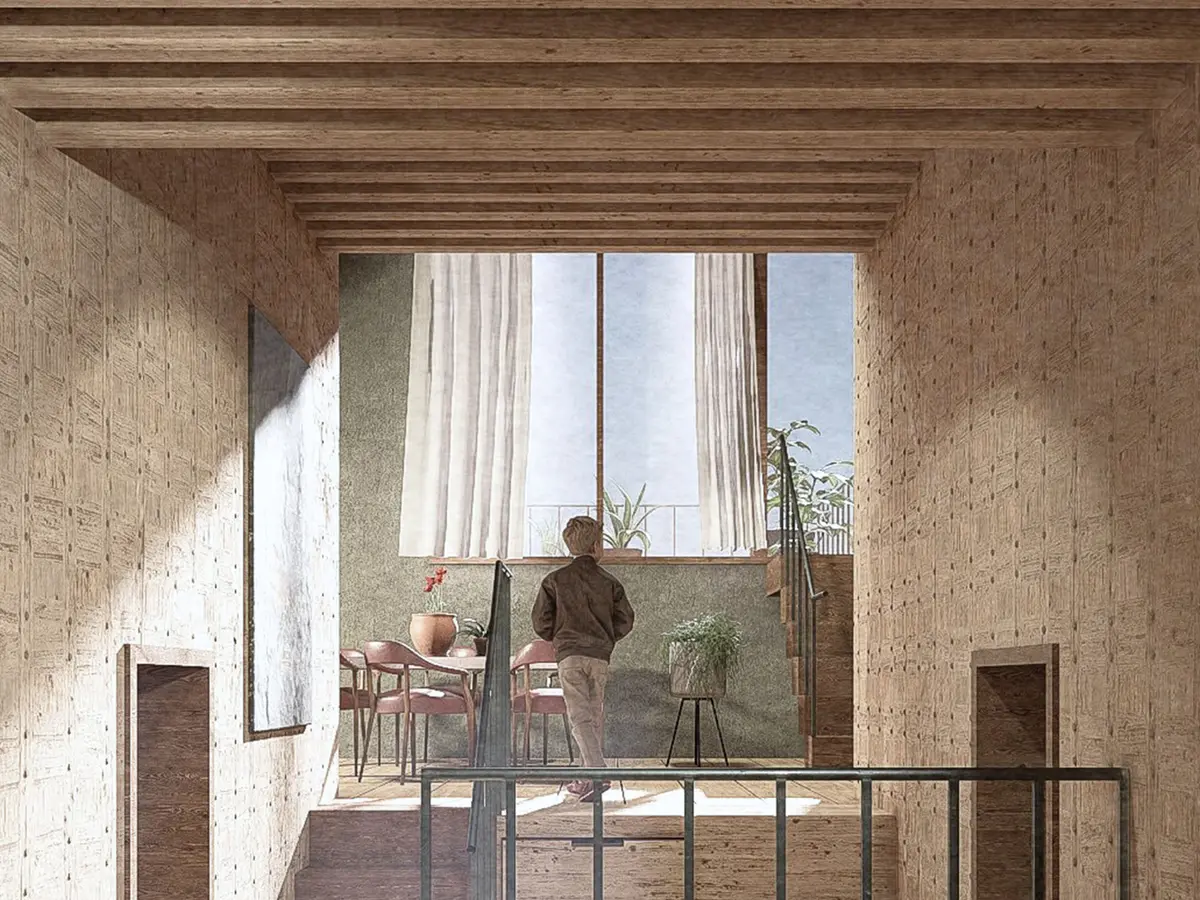
Extention
Sustainable housing

Overview
The aim of the project is to create high-quality living space through targeted vertical extensions of the existing residential buildings in the Schammatwiese neighborhood. In addition to providing new apartments, semi-public communal areas are created, while the existing façades are both aesthetically upgraded and energetically renovated.
The analysis of the existing buildings revealed a distinctive, standardized volumetry and a recurring floor plan principle: apartments of different sizes follow a similar spatial flow, with additional rooms simply attached to larger units. By breaking down the apartments into individual room modules, a structural grid of load-bearing walls emerges, which forms the basis of the new system. This grid makes it possible to develop new apartments of variable size and form, which integrate harmoniously into the existing structure.
A key element of the concept is the split-level arrangement within the building rows. Differentiated ceiling heights allow for innovative new housing typologies that respond to the existing topography. At the same time, the original silhouette of the buildings is preserved, creating a coherent ensemble where old and new merge. The extensions also generate both private terraces and shared outdoor spaces.
The principle is exemplarily implemented in the row of houses 22, 24, and 26. Here, eight new apartments are created for a total of 21 residents, designed for households of two to five people. Each apartment receives its own terrace, sized proportionally to the living area. Access is provided via the extended existing stairwells.
The floor plan of the new apartments follows a clear logic: from the entrance, the sequence of spaces transitions from communal areas to private rooms. By carefully adjusting ceiling heights, key living spaces such as dining and living rooms are spatially emphasized. The terraces are directly connected to these areas. Window and door openings are aligned with the existing façade but adapted to the new room heights.
The construction is based on a sustainable timber system: TRIQBRIQs – stackable wooden elements made from damaged timber – form the load-bearing walls. They are complemented by ceilings made of clay bricks, which, together with clay plaster, create a pleasant indoor climate. The façades are finished with lime plaster on reed insulation – a system that is also used to renovate the existing façades. This results in a monolithic overall impression, with variable openings becoming the defining design elements.
To provide barrier-free housing, an additional new building is planned. On the one hand, it offers a modern, wheelchair-accessible relocation option for existing residents; on the other hand, it functions as a social meeting point for the neighborhood. The ground floor houses community facilities, a café, and an office for neighborhood management. The upper floors accommodate small apartments for singles or couples, as well as shared housing units with communal kitchens, living, and sanitary areas. The new building is accessed via a central atrium. Constructively, it follows the same sustainable principle as the vertical extensions but is complemented in the upper floors by wooden slats, creating a design differentiation from the public ground floor.
Sustainability concept
The project’s sustainability concept is based on the consistent use of natural, recyclable, and circular materials as well as the resource-efficient reuse of the existing structures. The aim is not only to create new living spaces, but also to establish a permanently flexible, healthy, and ecologically responsible building system.
- TRIQBRIQs – Modular Timber System At the core of the load-bearing structure are TRIQBRIQs – solid timber blocks made from regional calamity wood (e.g. damaged wood from drought or bark beetle infestations). They are stacked like masonry in stretcher bond and connected with integrated wooden dowels rather than glue. This creates a highly stable yet fully demountable system that can be dismantled and reused elsewhere if needed. Industrial prefabrication of the TRIQBRIQs ensures high precision with minimal waste.
- Clay Block Ceilings and Clay Plaster with Jute Reinforcement The ceilings are made of clay blocks, which provide excellent thermal and hygroscopic performance. Clay regulates humidity, stores heat, and improves room acoustics. They are complemented by clay plaster reinforced with jute mesh, applied to interior walls and ceilings. This combination creates a natural, toxin-free indoor climate, particularly suitable for sensitive user groups (e.g. children, the elderly).
- Thermal Renovation of Existing Façades with Lime Plaster on Reed Insulation The thermal renovation of the existing buildings is carried out with reed insulation, mounted externally onto the façades. A lime plaster system is applied on top – a proven, vapor-permeable material that balances moisture, prevents algae and mold growth, and contains no synthetic additives. Applied over reed insulation, the lime plaster can also be removed and reused. This renovation not only improves the buildings’ energy performance but also creates a homogeneous, high-quality appearance.

Popular Articles
Popular articles from the community


Cube Design Draws an Ecological Corridor Between Two Shenzhen Hills with the Nankai Building
Beside Shenzhen's container docks, the Nankai Building pairs stacked balconies with a climbing green screen to connect two hillsides across its height.

GROUP A Strips a 1969 Rotterdam Harbor Headquarters to Its Frame and Wraps It in Timber Louvers
In Rotterdam's M4H harbor district, Ferro Offices reuses a 1969 frame, adds one timber storey and reaches BREEAM-NL Outstanding.

Juan García Correa, John González and Claudia Rueda Sink a Circular Amphitheater into a Manizales Engineering Building
On the La Nubia campus in Manizales, Colombia, the S1 Building folds labs and offices into a hillside of ramped lawns that double as a campus route.

Architekt Andreas Gruber Scatters 23 Dark Timber Chalets Across a South Tyrolean Forest Edge
In Molini di Tures, Amonti Chalets breaks a resort into a hamlet of gabled timber houses, with parking, storage and services pushed into the slope.

Similar Reads
You might also enjoy these articles

The Rhythm of Seasons
A Farmers' Market Connecting Nature and the City

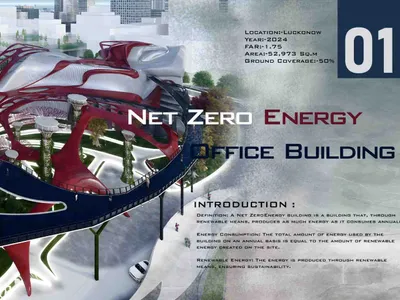
More Than a Building-Designing a Living System
More Than a Building-Designing a Living System
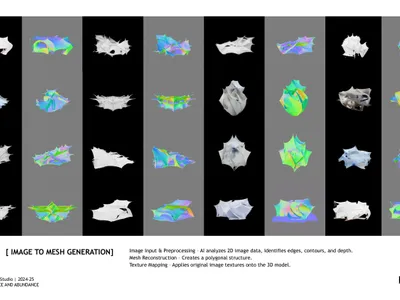
Base Beyond
DESERT COMPOUND ARID: TOURISM OF ABSENCE AND ABUNDANCE

Explore Building Extension Competitions
Discover active competitions in this discipline


Challenge to reimagine the Iron Throne

Photograph architecture without architects

Illustrate the lost glory of Angkor Wat - Render Challenge

Design challenge to reuse E-waste
Comments (0)
Please login or sign up to add comments
No comments yet. Be the first to comment!