
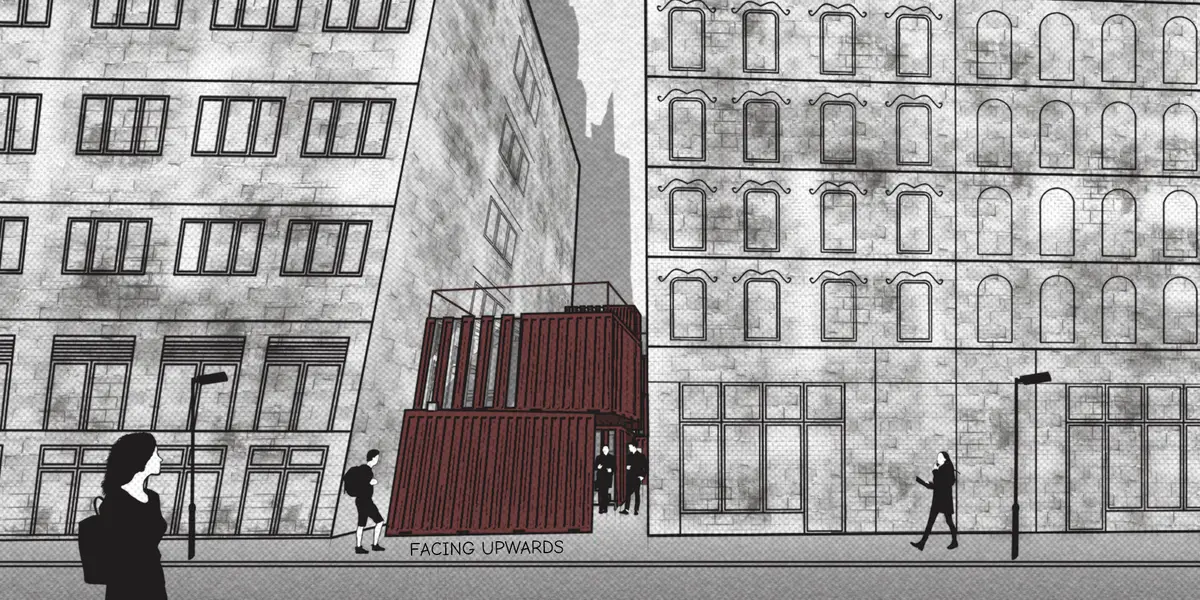
Facing upwards
Modular housing facility
1. The main concept
Considering the density of architecture that surrounds our location our form is supposed to be more well-spaced. That is why our modules fit between 7-meters narrow gap just like toy blocks parallelly maintaining space between them to provide air circulation. Also, the adjustment to the cardinal points was important for the placement of modules. In consequence, the layout of the windows follows the movement of sun rays what causes the impression of flowing.

2. The motivation for the arrangement of components at multiple levels
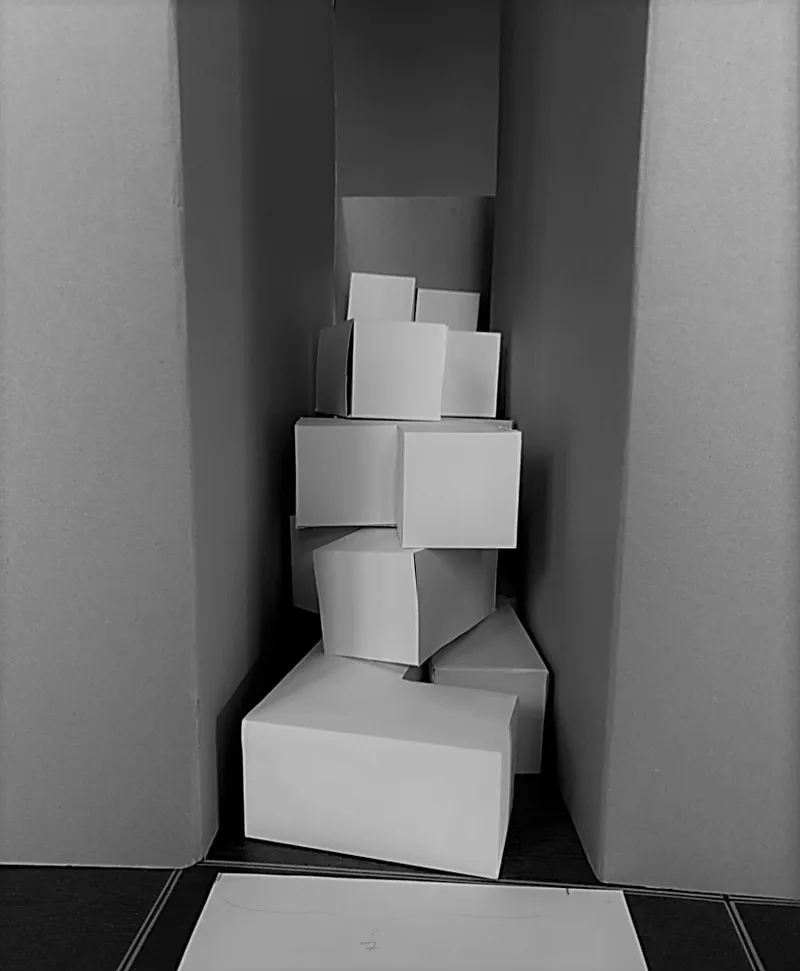
The fundamental problem of this project was to get enough sunlight in a narrow and dimmed space of street hollow and simultaneously meet conditions of the given task: fitting twelve living modules in the limited area. Solving the problem of insufficient sunlight may be creating a piling-up form - only one unit at the front does not cast a shadow and lets the sunlight into the rest of the form, which is getting taller. Moreover, we move the components by different angles so that they can get the most of the poor lighting (we set them as we checked in the computer model how we can adjust the modules to the angle of falling sun rays). Accumulated cubicles also remind of New York’s architectural structure - a little bit like toy blocks put on each other like skyscrapers of different heights. The first module lacks windows from the front of the building for residents’ privacy. Between the cubes runs a metal staircase which connotes a characteristic point of New York’s urban landscape. Thanks to the resulting space left on the ground level, there is also a place at the end of the ground corridor where inhabitants can leave their bicycles or scooters in order to provide them more mobility in work-home transport. The last module on the ground floor is joined to the reception which provides comfort to the person in charge of the security of the object.
An atypical answer is putting reception at the very end of the parcel - this room does not need as much sunlight as the inhabitants of the place. Interiors are defined by compatible windows adjusted to the sunlight - to increase the flow of the light we added glazing roofs. Furniture in every flat is altered to the placement of windows and doors. Throughout the unit crops up a metal net enabling to personalize space of storage.
3. Iterations made and methods used to arrive at the final result
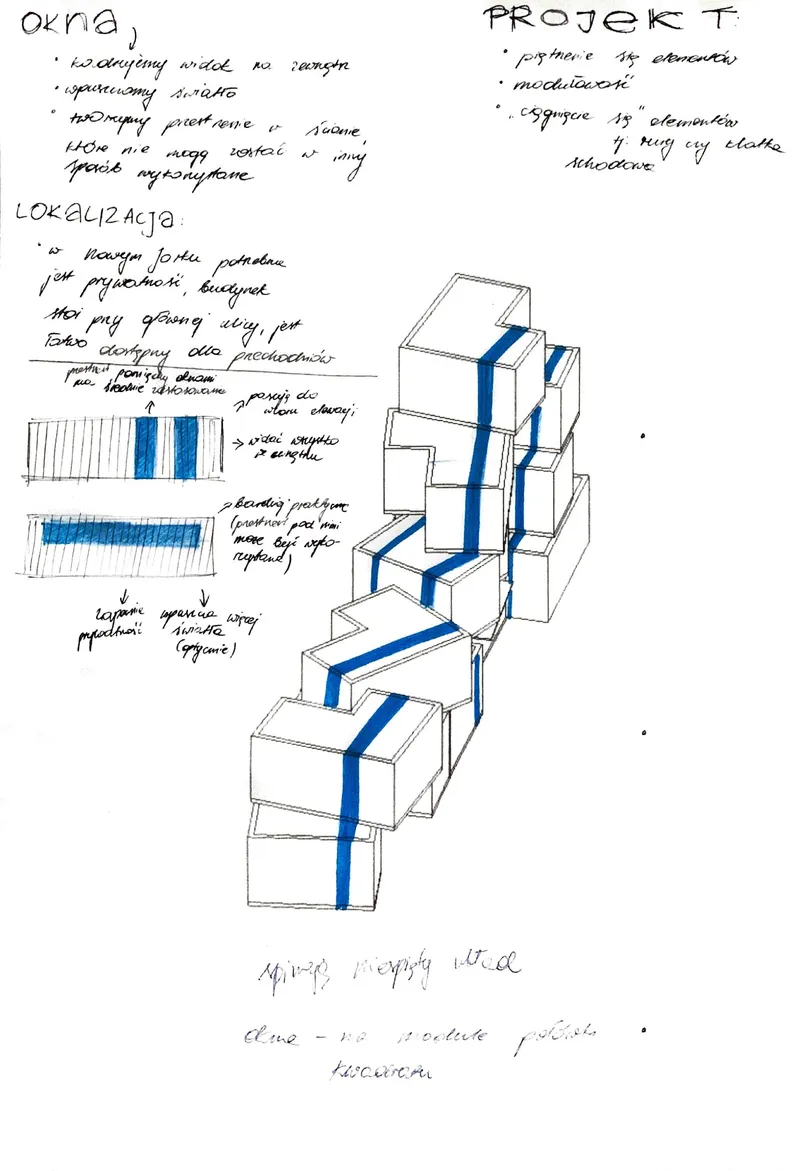
As we began our journey we thought of this place as a void which we were trying to fill. We were searching for a form that would be repetitive. Our first endeavor was to make boxes of some type. We built the first working models and used a flashlight to see the light fall, which is one of the most challenging issues here. Our objective was to create a shape and observe how it would seem in an actual model. We investigated a variety of element shapes and configurations. One of our thoughts was to build a complex structure made of modules as if it were growing from deep inside out and higher and higher We felt that we were getting closer to our goal and began to make some sketches on how the structure would look from outside. When we finally agreed on a module, we built a model in Revit that allowed us to precisely specify our location and examine how the modules are lit at different times.
4. Material solutions
Nowadays we are facing climate change. The production of building materials pollutes the planet to a large extent, so we decided to use already made second-hand products. Container sheets have a lot of advantages: they are light, easy to transport, and recyclable. Moreover, since the solution proposed must be temporary there will not be a problem with the assembly and disassembly of the housing units. The color of the facade refers to the architectural and urban context of the parcel (red brick buildings). The interior is made of wood-based materials which, combined with sheet metal and steel, create an industrial character typical for this region. To improve the comfort of living we decided to use reflective glass which not only increases the sense of privacy but also reduces overheating of the building.
5. Simple solutions for complex problems
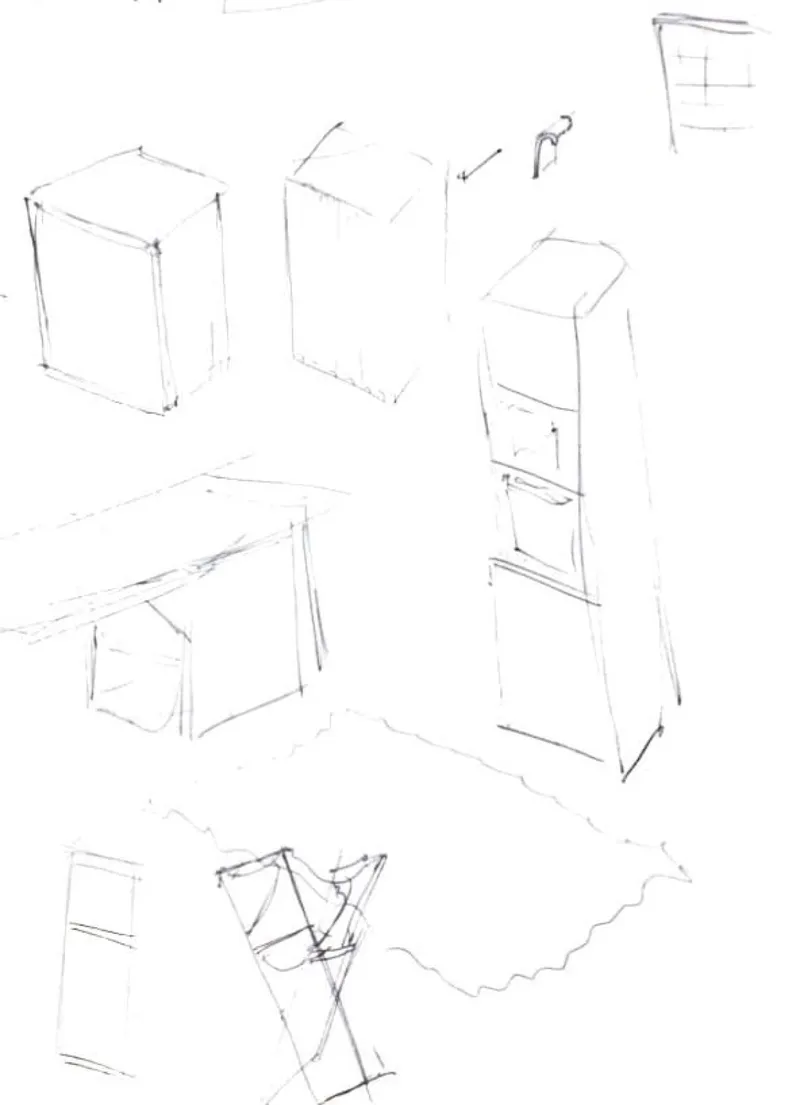
First of all, we took on the target difficulty to find enough place to live for 12 living modules. There was a consideration of whether the final form should be more horizontal or vertical. Parallelly came up with the issue with the shape of a particular module, how to make it easy to modify, reuse and replace in case. We wanted to create it as adjustable and functional as possible. That is why verticality and squared shape prevailed. The concept of using container forms appeared to be an optimal solution. Reusability, adjustment for short-term residency, and modularity are in their nature. Our task was only to design the shape of the container and adjust it to the area. Because of the small square footage and the unique shape of windows, interiors are supposed to be created by tenants to let them decide which solution would be the optimal one for them. In consequence, almost all furniture is movable, hinged on steel grills (besides immobile pawn in the kitchen consisted of the most important equipment like fridge, oven, and microwave). The unusual configuration of living modules influences the staircases that climb between containers leading the curved path through levels.
6. The development of the temporary project
If necessary, the containers may be simply adjusted or even demolished as time passes. The container's structure allows for easy replacement. Since the task stated that the land may be vacant for a brief duration, the usage of containers assists in the short utilization of that land. Sheet metal is a recyclable material, which means that after demolition, the leftovers may be reused in another building project. The simplicity of the design also makes it easier for demolition. The aforementioned reasons all point to why modular, prefabricated container structures are a suitable choice for this task.

Popular Articles
Popular articles from the community


Architekt Andreas Gruber Scatters 23 Dark Timber Chalets Across a South Tyrolean Forest Edge
In Molini di Tures, Amonti Chalets breaks a resort into a hamlet of gabled timber houses, with parking, storage and services pushed into the slope.

Cube Design Draws an Ecological Corridor Between Two Shenzhen Hills with the Nankai Building
Beside Shenzhen's container docks, the Nankai Building pairs stacked balconies with a climbing green screen to connect two hillsides across its height.

Juan García Correa, John González and Claudia Rueda Sink a Circular Amphitheater into a Manizales Engineering Building
On the La Nubia campus in Manizales, Colombia, the S1 Building folds labs and offices into a hillside of ramped lawns that double as a campus route.

longwave studio Reorganizes a 112 m² Tainan Apartment Around the Daily Routines of a Family and Two Cats
In Tainan, Taiwan, birch plywood, rust-red furniture and a freestanding plaster wall link arrival, storage, work and family life in one apartment.

Similar Reads
You might also enjoy these articles
The Rhythm of Seasons
A Farmers' Market Connecting Nature and the City

More Than a Building-Designing a Living System
More Than a Building-Designing a Living System
Base Beyond
DESERT COMPOUND ARID: TOURISM OF ABSENCE AND ABUNDANCE

Explore Modular Housing Competitions
Discover active competitions in this discipline


Challenge to design mud housing for contemporary communities

Design challenge to equip cities with modern furniture
Comments (0)
Please login or sign up to add comments
No comments yet. Be the first to comment!