

Faith-Based Nursing Foundation Community Center by Ford 3 Architects
Transparent community center blends worship and flexible gathering, integrating landscape, daylight, concealed systems, and wood interiors for inclusive faith-based use.


Architects: Ford 3 Architects Located in Princeton, the Faith-Based Nursing Foundation Community Center is a contemporary religious and community architecture project that balances modesty, flexibility, and deep environmental engagement. Completed in 2023, the 6,400-square-foot building was conceived as a unifying space for worship, education, and communal gatherings, responding to the Foundation’s growing population of staff, students, and local residents.

Community-Centered Religious Architecture
Rather than relying on symbolic monumentality, the design emphasizes openness, adaptability, and connection to nature. Ford 3 Architects developed a simple, restrained architectural language that allows the building to act as both a spiritual gathering space and a multifunctional community center. The flexible interior accommodates worship services, dining, educational programs, and recreational use, reinforcing the building’s role as a shared civic resource.

Site Strategy and Landscape Integration
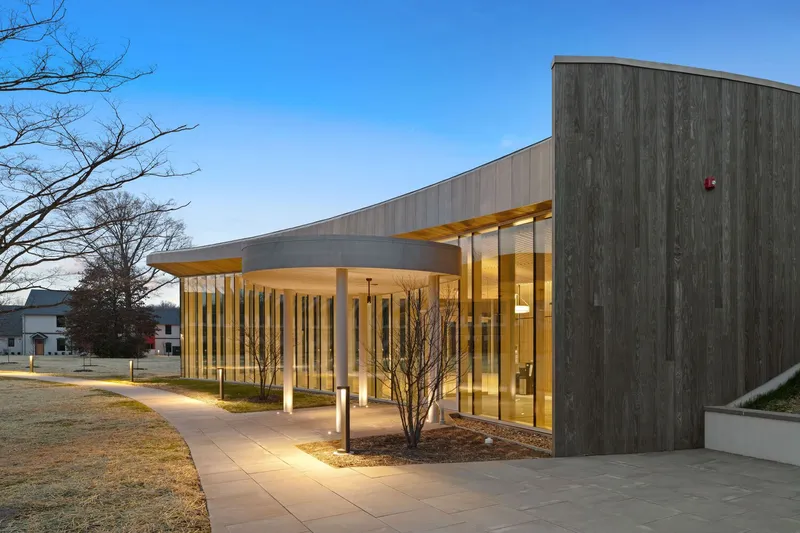
The project is carefully sited on a flat portion of a larger campus, positioned between wetlands and existing roadways. To preserve visual calm and maintain privacy, building utilities are placed along the main road and concealed beneath a planted grass mound. This landscaped berm doubles as an outdoor amphitheater, subtly extending the program outdoors while reflecting the client’s ethos of humility and stewardship. The approach ensures the center remains engaged with the campus without asserting visual dominance.

Transparency, Light, and Spatial Experience
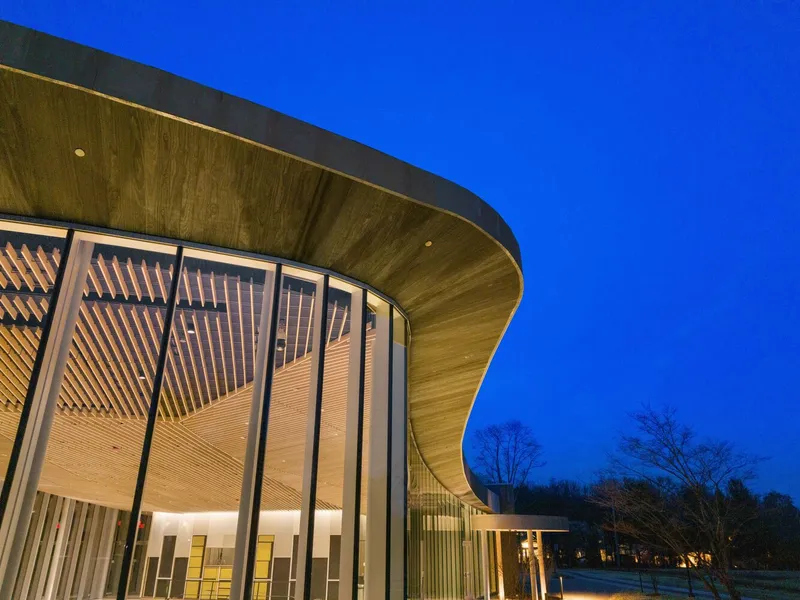
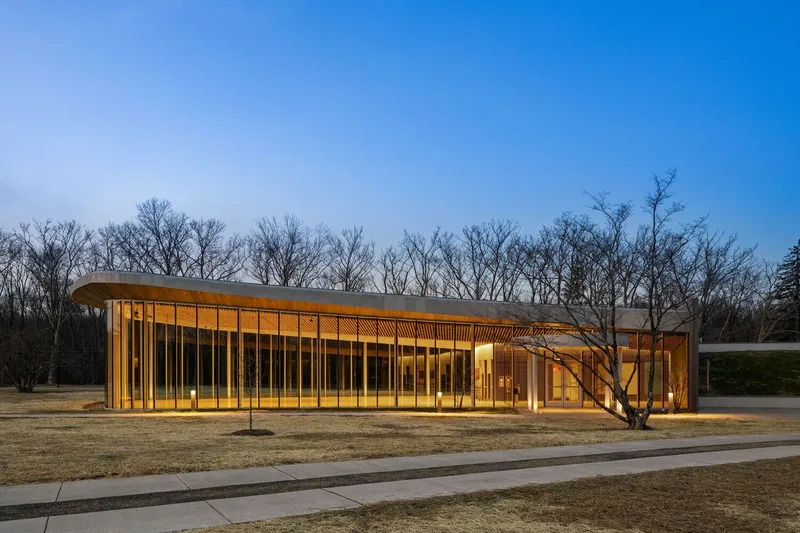
Wraparound floor-to-ceiling glazing defines the primary gathering space, dissolving boundaries between interior and exterior. Northern daylight is maximized through carefully calibrated overhangs, while deeper projections mitigate harsh summer sun. In winter, the pitched roof welcomes low-angle sunlight, casting long, expressive shadows across the interior and reinforcing seasonal rhythms within the space.
The visual continuity extends outward to a fescue meadow, whose soft, slumping growth evokes the atmosphere of a park pavilion or bandshell. Despite being fully enclosed, the building retains the openness and informality of an outdoor communal structure.
Materiality and Interior Atmosphere
Warmth and acoustic comfort are achieved through a wall-to-wall maple plank athletic floor paired with a wood-blade acoustic ceiling system. These natural materials enhance the daylight-filled interior while supporting diverse activities. The ceiling, suspended on a perimeter array of slender pipe columns, subtly angles upward from the core, creating a forced perspective that visually expands the space and strengthens the connection to the surrounding landscape.
Bluestone pavers flow seamlessly from exterior paths into vestibules, bathrooms, the music room, and kitchenette before transitioning to maple flooring in the main hall. This continuity reinforces the indoor-outdoor relationship and emphasizes the building’s pavilion-like character.
Integrated Systems and Architectural Precision
Close collaboration with civil and structural engineers, landscape architects, acousticians, and lighting designers enabled the seamless integration of complex systems. Mechanical equipment, audio-visual infrastructure, acoustic foam, and even a retractable basketball hoop are concealed within the ceiling assembly. Bespoke detailing allows these elements to disappear when not in use, ensuring the space remains visually calm and adaptable.
Supplementary heating coils are hidden beneath flush-mounted grilles along the glazed perimeter, maintaining thermal comfort without disrupting the architectural clarity. Throughout the project, meticulous flush detailing underscores the architects’ commitment to restraint, craft, and long-term durability.

A Contemporary Model for Faith-Based Community Design
The Faith-Based Nursing Foundation Community Center demonstrates how religious architecture can move beyond iconography to support everyday community life. Through transparency, landscape integration, and flexible design, the project offers a calm yet powerful environment for collective gathering, worship, and care: rooted in place, humility, and shared experience.


All photographs are work of
OM Media


Popular Articles
Popular articles from the community


Opera on the Sea: Driftwood Logic Shapes a Timber Opera House on Estonia's Coast
Trevor Orgill's opera house translates the entangled drift of floating timber into a civic building where wood, water, and music converge.

Aquadapt: An Underwater Habitat That Rewrites Its Rooms by the Hour
Curved modules ring the seabed while one shell shifts from breakfast room to cinema, farm and football pitch as residents' needs change.

The Amber Palace Opera: A Geological Fiction Surfaces on Tallinn's Baltic Waterfront
Pierre Brillard reimagines a Baltic legend as a public landscape, opera house, and waterfront promenade rooted in Tallinn's coastal identity.


FCC Arquitectura Expands a Portuguese Granite House with a Board-Marked Concrete Wing
In Portugal, JV House pairs a cleaned-up whitewashed and granite dwelling with a timber-shuttered concrete extension, courtyards and a garden pool.

Similar Reads
You might also enjoy these articles

Cube Design Draws an Ecological Corridor Between Two Shenzhen Hills with the Nankai Building
Beside Shenzhen's container docks, the Nankai Building pairs stacked balconies with a climbing green screen to connect two hillsides across its height.

Praksis A and Studio Sted Bend a Red Timber Cabin Across the Granite of Norway's Southern Coast
On the southern Norwegian coast, a 105 m² cabin follows the rock on slender posts, pairing red cladding outside with pine, brick and plywood within.

David Ortega Stacks a Two-Story Mexico City Penthouse Around a Steel Stair and a Pergola-Shaded Roof Terrace
In Colonia Roma, a 300 m² penthouse uses oak joinery, a planted steel stair and a slatted roof pergola to make a new-build apartment feel like a house.

PARALELA and LB2 Thread a Public Walkway Through the Base of a Las Condes Residential Tower
In Las Condes, Santiago, the Hamlet Building gives its fenceless ground floor to a 70-metre wooded passage linking two streets and the metro.

Explore Blocs Competitions
Discover active competitions in this discipline

Design Challenge - Contemporary interpretation of a religious complex

Challenge to reimagine the Iron Throne

Photograph architecture without architects

Illustrate the lost glory of Angkor Wat - Render Challenge
Comments (0)
Please login or sign up to add comments
No comments yet. Be the first to comment!