

Farmscape: Submerging Architecture Beneath London's Agricultural Heritage
A pixelated green roofscape transforms a London market site into a continuous productive landscape shaped by historic farmland patterns.


What if a building didn't sit on a landscape but became one? Farmscape takes this question literally, submerging infrastructure, zoning, and programmatic functions beneath a continuous green roofscape that reads, from above, like the patchwork farmland that once defined London's periphery. Buildings range from 4m to 24m in height, yet none of them break the agricultural surface. The result is a site where vertical farming modules, community plazas, and market halls coexist without ever interrupting the productive terrain above.
Designed by Sadaf Khan, Rafia, Syed Saif, and Khalifa Sampad, the project earned an Honorable Mention in the Urban Meal Mine competition. The brief called for sustainable urban farming solutions, and this team responded by proposing a radical transformation of an existing London market site adjacent to railway infrastructure, replacing conventional built form with a landscape-driven architectural ecosystem.
A Pixelated Canopy Over the City Grid
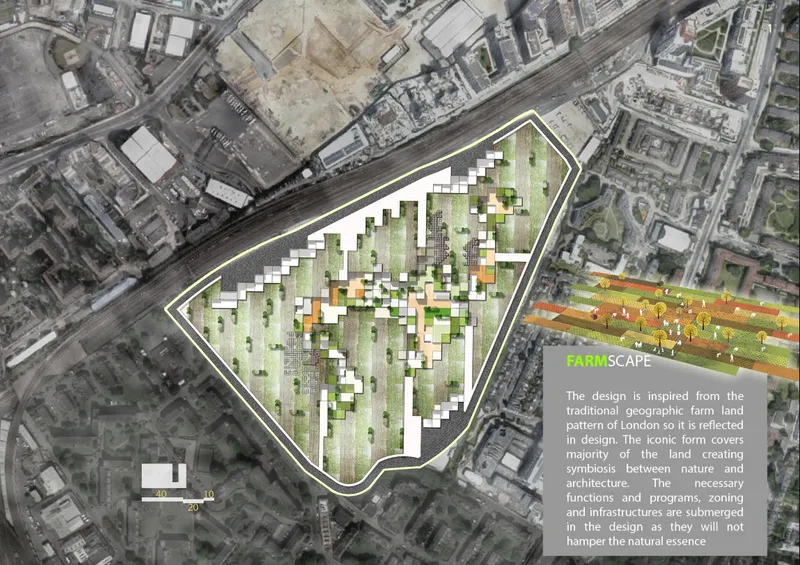
Seen from above, Farmscape's most striking move is its pixelated green roof masterplan, an abstraction of traditional geographic farmland patterns rendered in modular blocks of varying green tones. The aerial rendering reveals how this continuous agricultural surface drapes over the majority of the site, absorbing the built environment beneath it. What's visible at ground level is not walls and facades but terraced planting zones, open farm plots, and pedestrian pathways. The adjacency to railway tracks and existing urban fabric makes the contrast deliberate: the project doesn't retreat from the city but reshapes the city's surface into something productive.
Phased Demolition and Gradient-Driven Growth
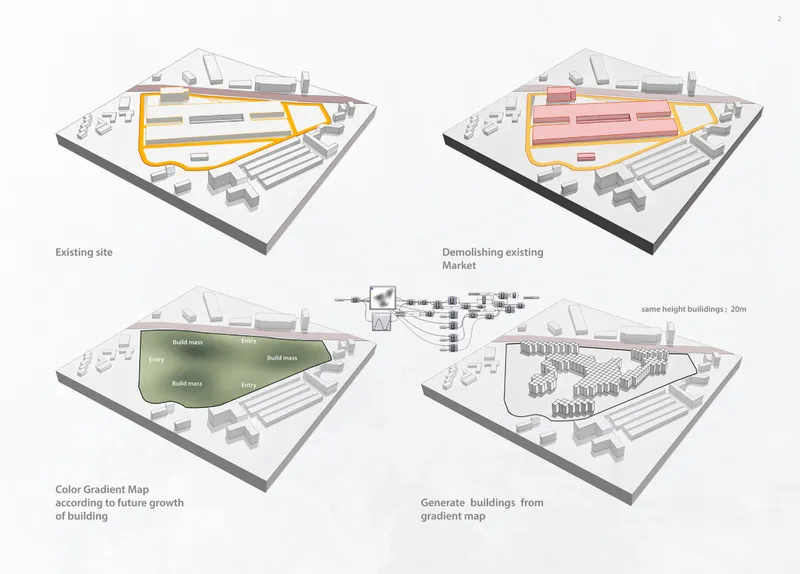
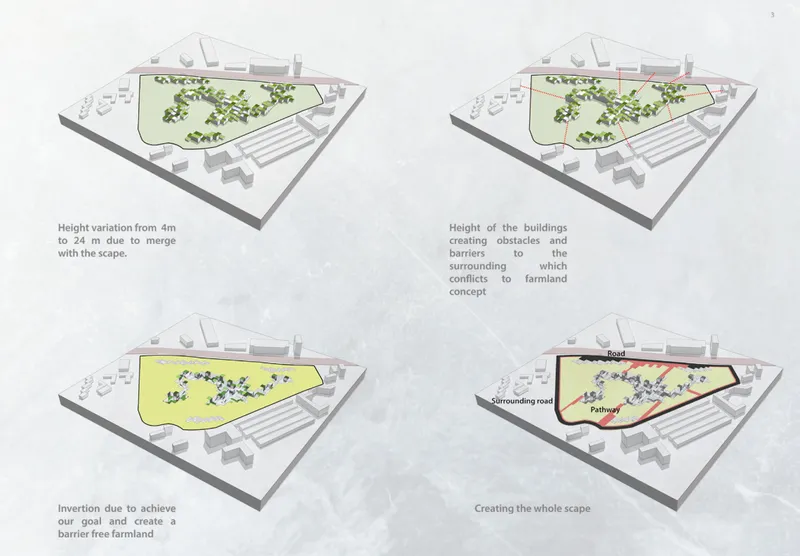
The designers don't propose a clean-slate intervention. Instead, the axonometric diagrams trace a carefully phased transformation from the existing market configuration to modular building clusters that emerge incrementally across the site. Demolition and regeneration happen in stages, allowing portions of the site to remain functional during construction. The building forms themselves are generated from color gradient maps, a technique that ties massing decisions to natural growth patterns rather than arbitrary volumetric logic.
Height variations across the stepped roofscape serve a dual structural and agricultural purpose. By inverting the site profile so that taller volumes sit lower in the terrain, the design prevents built forms from obstructing agricultural zones at the surface. Surrounding roads and internal pathways weave through this terrain as a pedestrian-friendly network, connecting plazas, open farms, and community spaces without relying on conventional street frontages. The circulation reads more like a hiking trail through productive land than a corridor between buildings.
Nutrient Film Technique at Architectural Scale
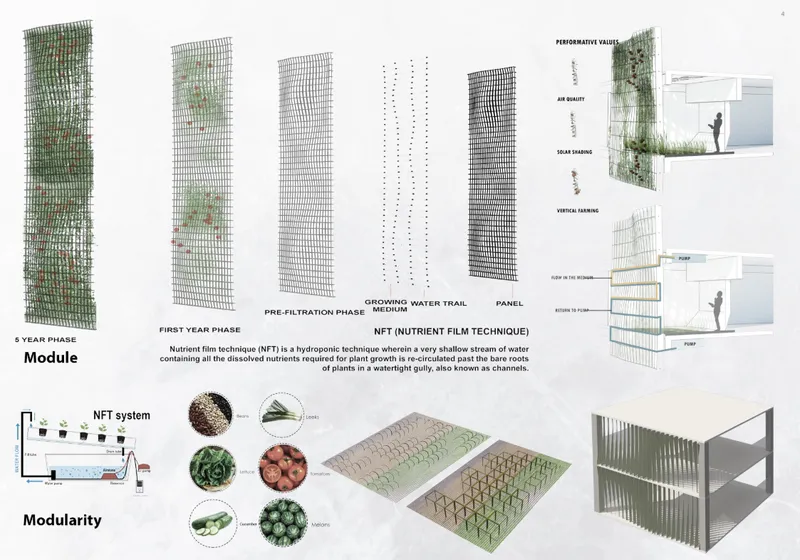
At the core of the project's productive ambition is an advanced vertical farming strategy built around hydroponic technology, specifically the Nutrient Film Technique (NFT). The technical diagrams break down how nutrient-rich water circulates continuously to plant roots across modular panel systems, enabling efficient growth with minimal resource input. The modularity is critical: these systems can be scaled and reconfigured to accommodate diverse crops including beans, lettuce, tomatoes, cucumbers, and melons, all within the same structural framework.
Beyond the hydroponic modules, Farmscape layers additional agricultural programs: open farm lands for community-driven agriculture and animal husbandry, organic agriculture zones adaptable to portable and biodynamic practices, and plant industry integration that connects food production directly with on-site processing. The ambition is not a token rooftop garden but a full-spectrum food system embedded in the architecture.
A Central Market Plaza as Urban Anchor
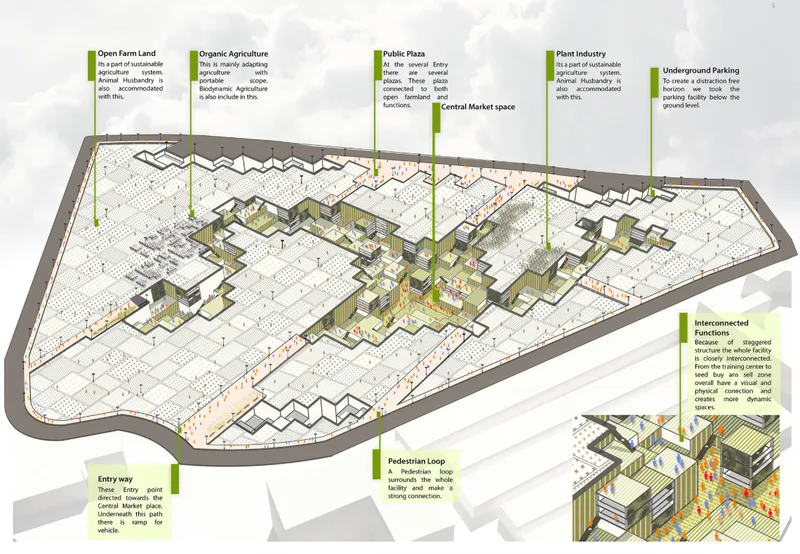
The final axonometric site plan reveals the organizational logic that holds Farmscape together. Interconnected pavilions radiate around a central market plaza, which serves as both the cultural and economic hub of the complex. Labeled program zones show training centers, seed-buying areas, and processing facilities arranged in a staggered configuration that encourages visual and physical connections between education, commerce, and food production. Public plazas at multiple entry points foster social interaction and market activity, while underground parking frees the surface entirely for green and communal functions.
The staggered structure is more than a formal gesture. By ensuring that no single program is isolated, the design fosters what the team describes as dynamic exchanges: a visitor buying seeds encounters the training center; a shopper in the market overlooks the vertical farms. Every movement through the site reinforces awareness of the food cycle, from cultivation to consumption.
Why This Project Matters
Farmscape's most compelling proposition is its refusal to treat architecture and agriculture as separate categories. Where most urban farming proposals attach productive systems to conventional buildings, this project dissolves the building entirely into the agricultural surface. The gradient-driven massing, the site inversion strategy, and the continuous roofscape all serve a single argument: that food production should not be an afterthought bolted onto the city but a foundational condition that shapes its form.
For a student team working at a conceptual scale, the level of systemic thinking here is notable. The phased demolition strategy acknowledges the messiness of real urban transformation. The NFT hydroponic integration goes beyond diagrammatic gesture into specific technical territory. And the social programming, from pedestrian loops to market plazas, recognizes that productive landscapes only succeed when people want to inhabit them. Farmscape suggests that London's agricultural past isn't something to memorialize; it's something to rebuild, one pixelated module at a time.
View the Full Project
About the Designers
Designers: Sadaf Khan, Rafia, Syed Saif, Khalifa Sampad
Enter a Design Competition on uni.xyz
uni.xyz runs architecture and design competitions year-round that reward proposals with spatial conviction and real site intelligence.
Project credits: Farmscape by Sadaf Khan, Rafia, Syed Saif, Khalifa Sampad Urban Meal Mine (uni.xyz).


Popular Articles
Popular articles from the community


Singing Woman: An Opera House That Performs Before the Curtain Rises
Ovidiu Cristian Pavel's conceptual opera house translates Estonia's choral identity into a sculpted waterfront landmark facing the Baltic Sea.
Cloaked Colonization: A Mobile Underwater Habitat That Moves Like a Fish
Micah Abaya's shortlisted EHC Pacific entry reimagines ocean settlement as a dispersed network of self-sustaining architectural organisms.

The Amber Palace Opera: A Geological Fiction Surfaces on Tallinn's Baltic Waterfront
Pierre Brillard reimagines a Baltic legend as a public landscape, opera house, and waterfront promenade rooted in Tallinn's coastal identity.
Extended Shell: Retrofitting Kolkata's Balconies as Living Urban Thresholds
A modular retrofit system recovers the social and environmental intelligence of Kolkata's historic verandas for contemporary Park Street residents.

Similar Reads
You might also enjoy these articles

Play: Fragments of Their World: Remembered Architecture Rebuilt as a Modular Playground for Refugee Camps
Tom Gardner abstracts domes, arches and towers from the homelands of displaced families into a kit of child-scaled play parts for camp settlements.
REBIRTH: A Circular Settlement Where Afghan Widows and Their Children Rebuild Life Together
A shortlisted Resile entry turns the circle into a protective ring of timber and brick, gathering homes, classrooms and gardens around a shared landscape.
The Main Dream: A Recycled Plastic Kit That Lets Refugee Children Build Their Own Playground
Thirty-centimetre interlocking cubes that connect on three axes turn play into construction, letting children author the spaces they occupy.

Lunar Spiral: A Fibonacci-Driven Moon Settlement Rising from Shackleton Crater
Golden-spiral geometry organises buried infrastructure and orbiting habitable spheres into a lunar base designed to grow as life on the Moon expands.

Comments (0)
Please login or sign up to add comments
No comments yet. Be the first to comment!