
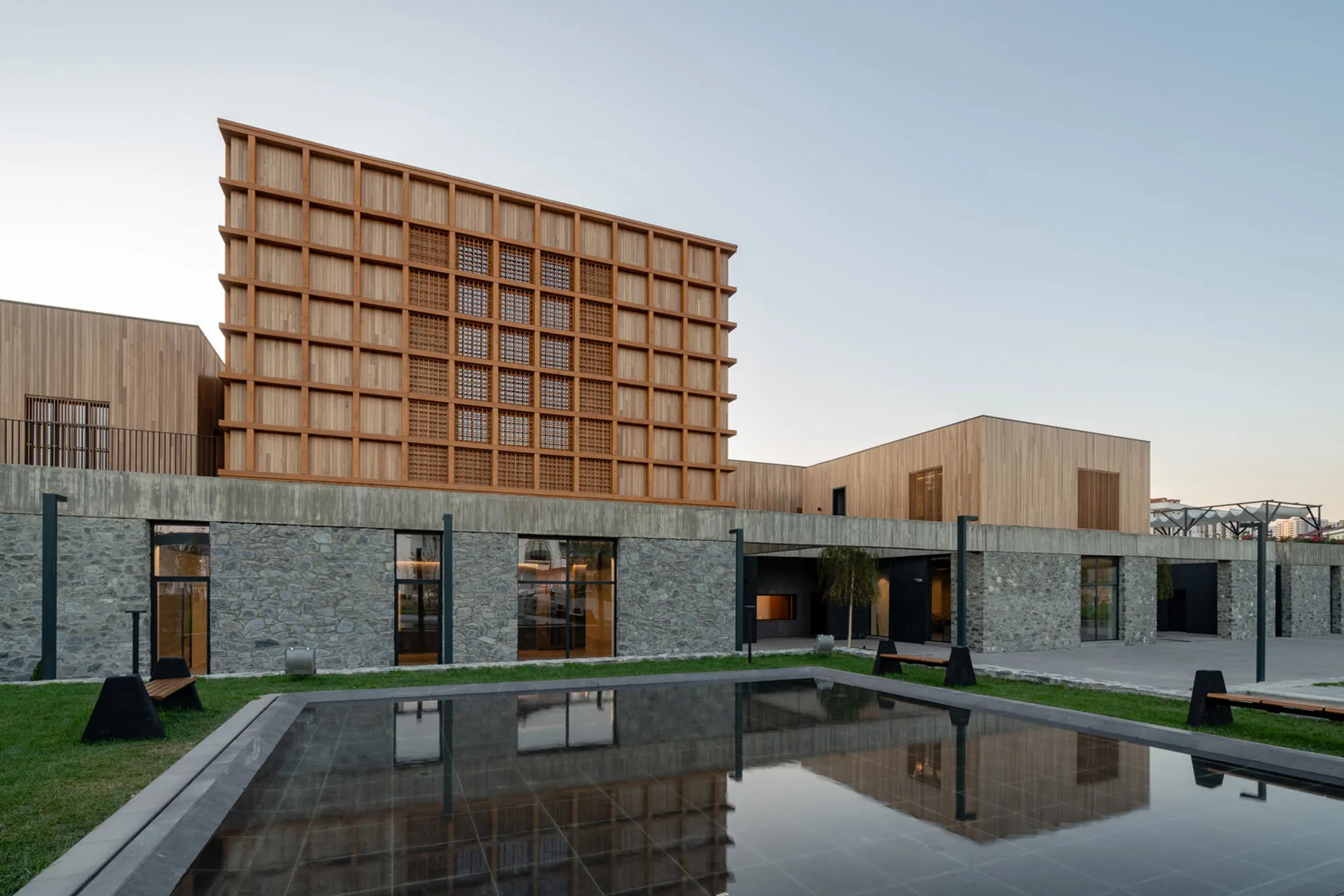
9016 Builds Turkey's First Competition-Won Cemevi as a Civic Anchor in Istanbul
A sacred Alevi gathering place and culture center in Beylikdüzü uses stone, timber, and concrete to make a minority faith visible.


A Cemevi is the communal worship space of Turkey's Alevi-Bektashi community, a religious minority whose built presence in the country's cities has historically been limited. The Fatma Ana Cemevi and Culture Center in Istanbul's Beylikdüzü district is the first Cemevi in Turkey to be realized through an open architectural competition, selected from 82 entries in 2015 and completed five years later by Istanbul-based studio 9016. That origin story matters. It signals that a building type once marginalized from mainstream discourse can enter it through the same institutional channels as any courthouse or concert hall.
What makes the project compelling is not simply its symbolic significance but the architectural problem it solves. The brief demanded a space that could serve as a sacred interior for Alevi cem rituals while simultaneously acting as a public cultural facility open to the wider neighborhood. 9016's response was to split the program vertically: cultural center and park on the ground floor, Cemevi above, and a generous plaza between them. The result is a building that is both introverted and extroverted, both visible and sheltering, both stone and timber.
Three Prisms, One Community
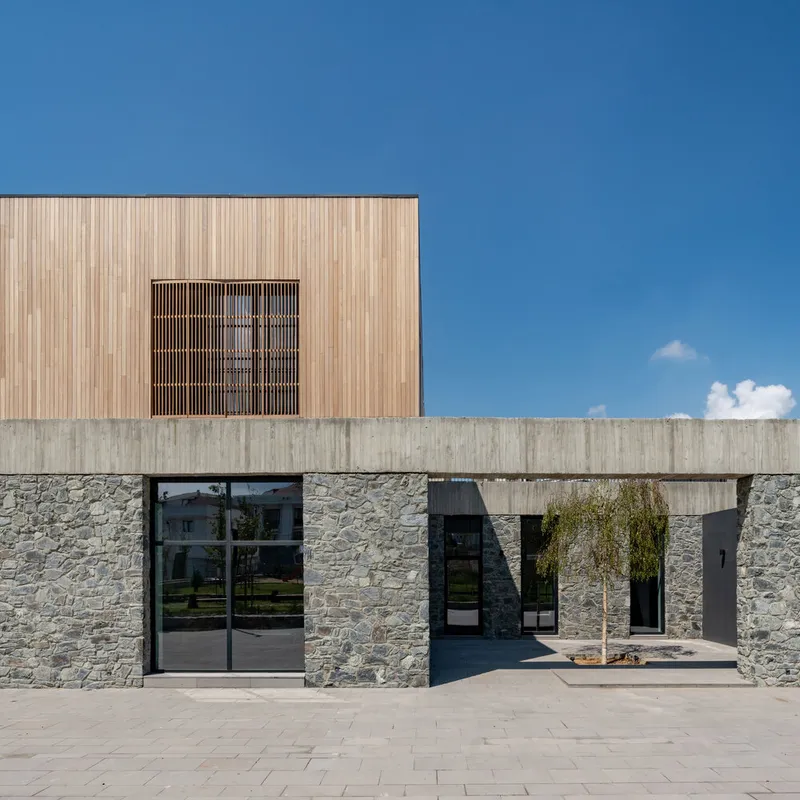
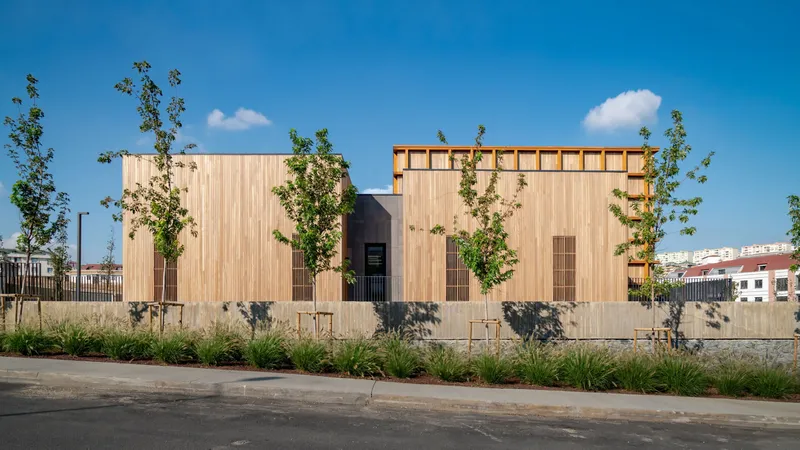
The massing reads as three distinct prismatic volumes arranged within a rectangular landscape framework on a 7,800 square meter plot. From the street, the building doesn't announce itself as a singular monolith. Instead, the three blocks appear separate but connect internally, creating a continuous spatial sequence. This is a deliberate metaphor for the Alevi principle of togetherness: plurality that functions as unity. The vertical timber cladding wrapping the upper volumes contrasts with the heavy stone base, making the functional split legible from every approach.
Residential towers loom in the background, and the building wisely does not try to compete with their scale. It sits low, emphasizing horizontality at ground level and reserving its vertical gestures for the timber grid tower, which rises to 7.5 meters at the entrance plaza. The effect is a building that asserts presence without domination, a quality appropriate to its civic ambitions.
The Weight of Stone
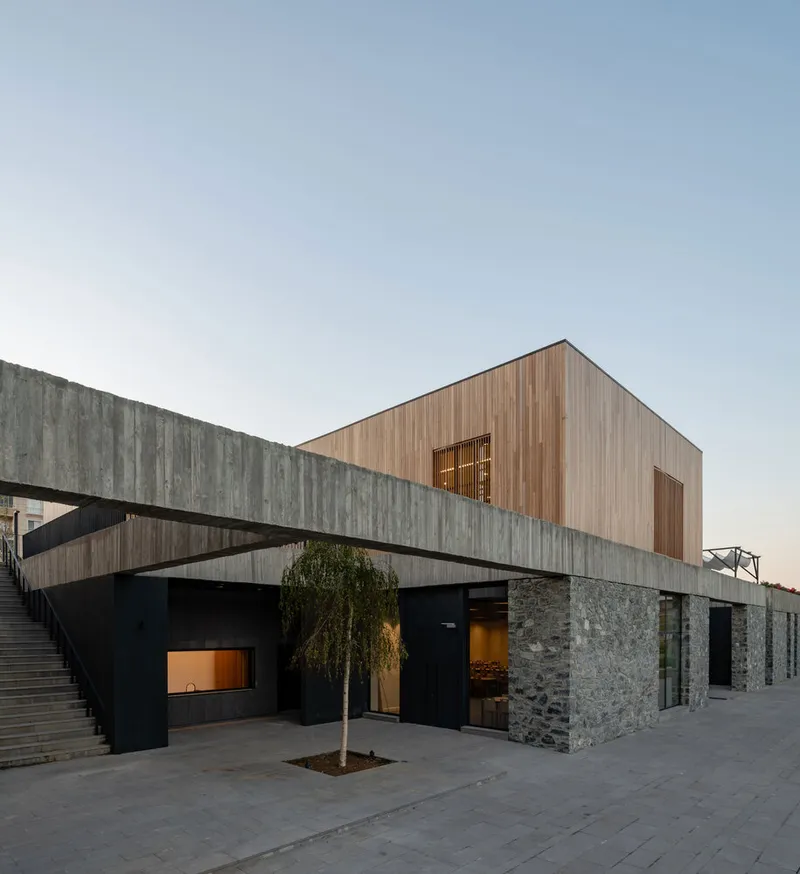
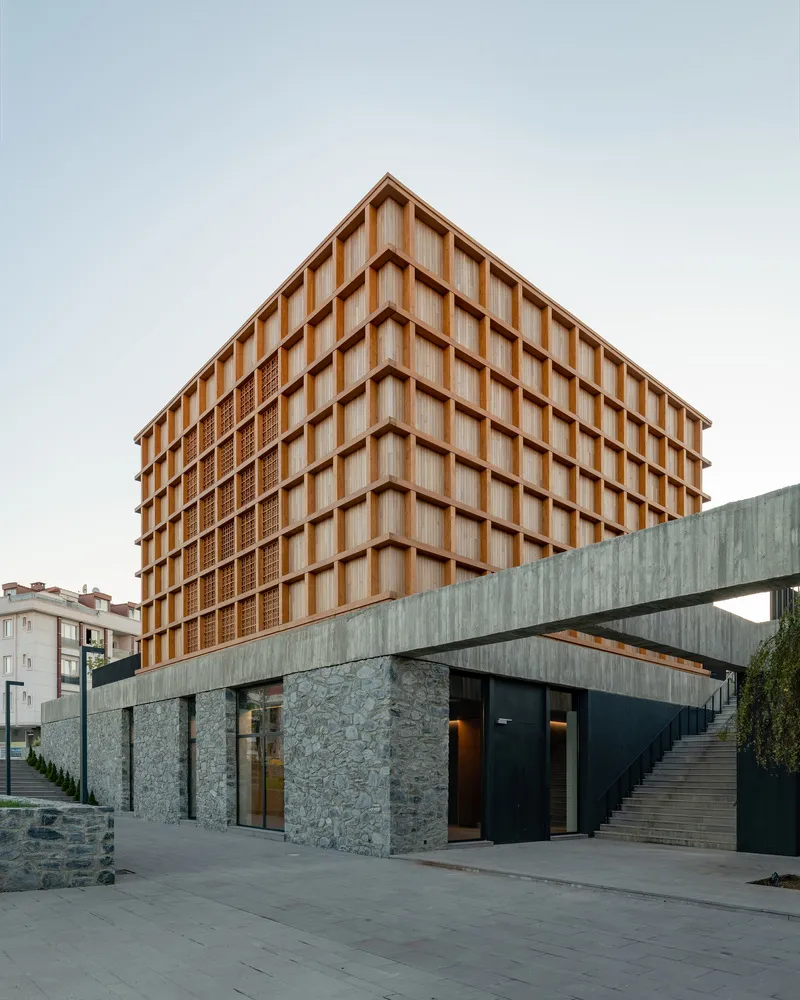
The base of the building is clad in Gebze rag-stone, a local natural stone sourced from the Gebze region east of Istanbul. The walls are 60 centimeters thick and 450 centimeters high, constructed using a single-sided technique against the reinforced concrete structure. This is not decorative veneer. The mass of the stone is real, and it registers physically as you move through the ground-level plaza. Steps, retaining walls, and paving extend the same material into the landscape, dissolving the boundary between building and park.
The site sits on the Kavaklı Dere river basin adjacent to Yaşam Valley, and the stone creates material continuity between the building and its topographic context. 9016 describes the site as a "public corridor," and the stone groundwork reinforces that reading. You don't so much enter the building as drift into it through a landscape of ascending planes.
Timber as Sacred Register
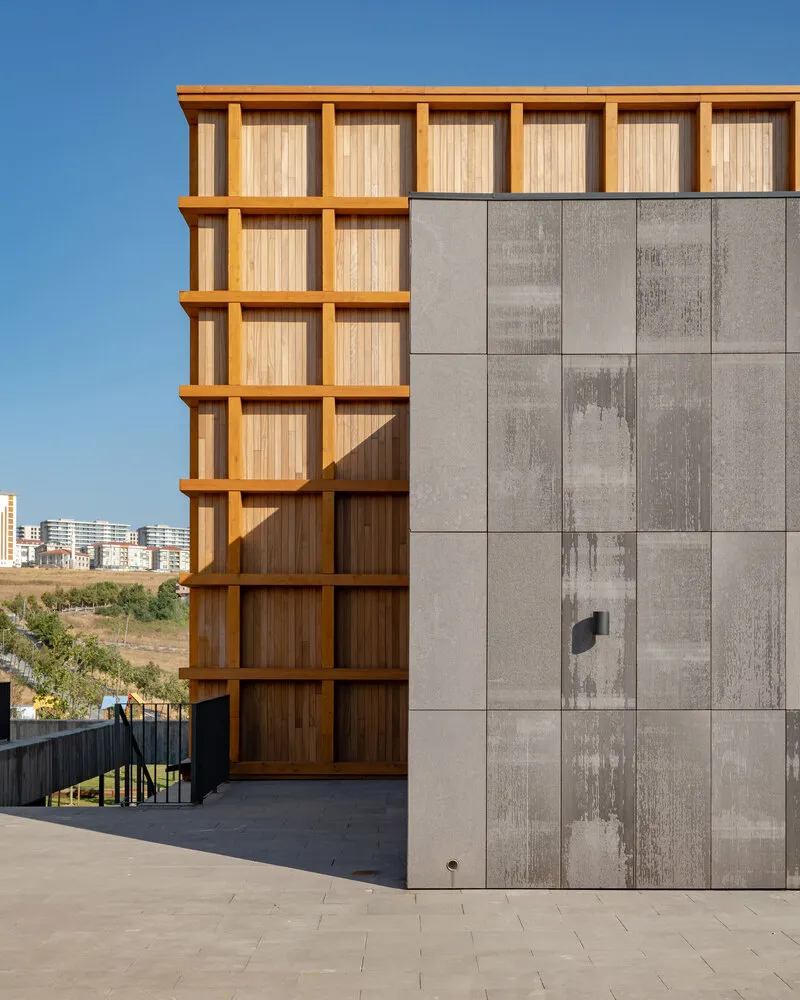
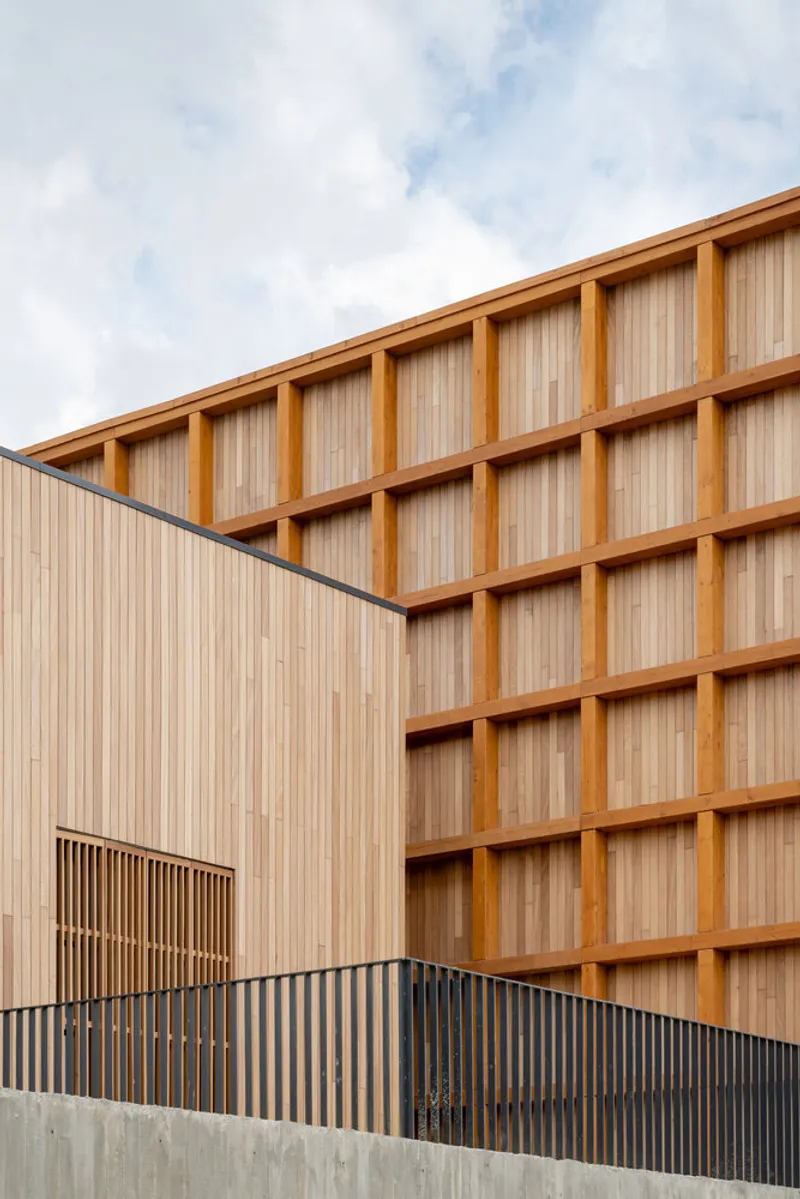
If stone anchors the building to the earth, timber lifts it toward something else. The Cemevi worship spaces on the upper floor are defined by wood, distinguishing the sacred program from the public one below through material rather than form alone. The original design proposed an entirely timber structure, but economic constraints led to a hybrid system of reinforced concrete with timber elements. That compromise is handled honestly: the concrete is board-formed and left exposed, and the timber grid structure reads as an additive layer rather than a disguise.
The open timber grid tower at the entrance plaza is the most expressive element. Its lattice pattern filters light and frames the sky, creating a threshold condition that is neither fully enclosed nor open. It functions as a kind of secular minaret, marking the building's presence in the neighborhood skyline without any of the formal associations of a mosque. For a community whose built identity has been historically understated, the gesture is both precise and generous.
Material Junctions
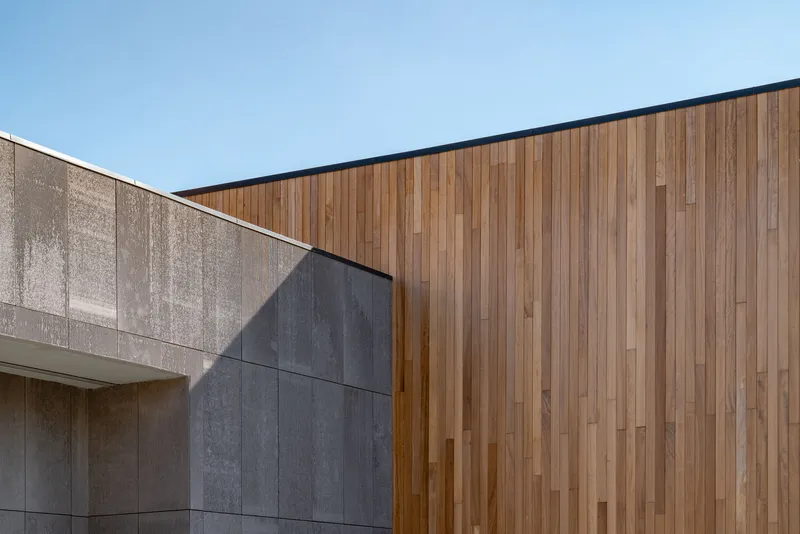
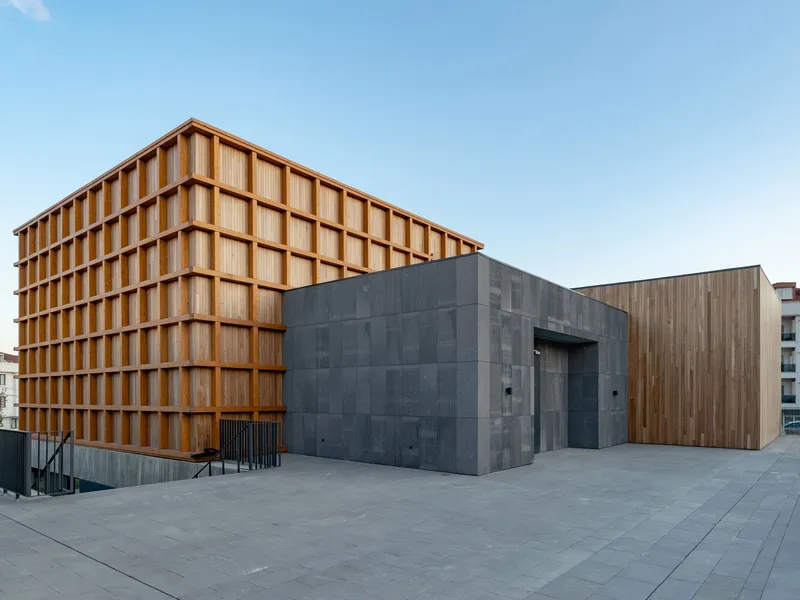
The detailing at material transitions tells you a lot about the architects' intentions. Where board-formed concrete meets vertical timber cladding, the junction is clean and unmediated. There is no trim piece, no gasket, no attempt to smooth over the collision. Each material is expressed in what 9016 calls its "rawest, most natural form." The shadow lines at these junctions become the ornament, reinforcing the legibility of the structural and programmatic logic beneath.
At dusk, this material clarity pays dividends. The dark concrete panels absorb light while the timber glows warm, and the stone base becomes a luminous shelf. The rooftop terrace, visible in several views, extends the palette into a social space with the timber grid tower as its backdrop. It is a controlled palette of three materials deployed with discipline.
The Plaza as Threshold
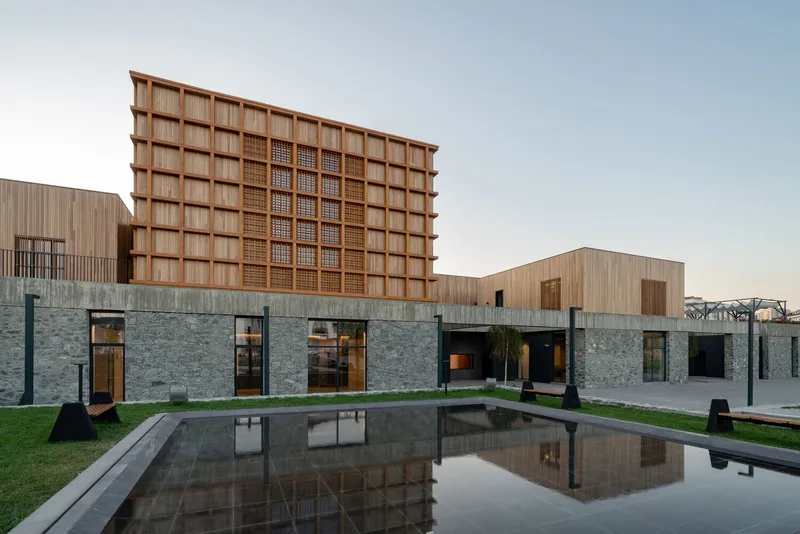
The Cemevi Square at the center of the composition is the project's social engine. A reflecting pool catches the timber tower and stone walls in its surface, collapsing the building's verticality into the horizontal plane. At twilight, with interior lighting visible through the ground floor glazing, the plaza becomes a lantern for the neighborhood. It is public space in the most literal sense: open, unprogrammed, and available.
The plaza also resolves a topographic challenge. The site slopes, and the Cemevi Square creates a horizontal datum that mediates between the park to one side and the residential zone above. Vertically, it generates what amounts to a public layer sandwiched between landscape and sacred space. The Alevi concept of togetherness is not just expressed in form here; it is built into the section.
Why This Project Matters
The Fatma Ana Cemevi and Culture Center matters first as a precedent. It demonstrates that religious architecture for minority communities can emerge through the same competitive, transparent processes that produce the best civic buildings. The fact that it was Turkey's first competition-won Cemevi to be built is not a footnote; it is the project's political core. Architecture competitions are instruments of legitimacy, and this one deployed that instrument for a community that has often been denied it.
It matters second as architecture. 9016 found a way to make a dual-identity building legible without resorting to pastiche or excessive symbolism. The stone is local. The timber is warm. The concrete is honest. The program is split vertically so that sacred and public can coexist without either compromising the other. In a metropolitan district of undistinguished residential towers, this building offers something rarer than spectacle: it offers dignity, specificity, and an open door.
Fatma Ana Cemevi and Culture Center by 9016. Located in Beylikdüzü, Istanbul, Turkey. Approximately 2,857 m² built area on a 7,800 m² site. Completed in 2020. Photography by Yercekim Architectural Photograph.
About the Studio
Share Your Own Work on uni.xyz
If projects like this are the kind of work you want to make, uni.xyz is a place to publish your own, find collaborators, and enter design competitions.


Popular Articles
Popular articles from the community


The Musturak Paradise: Senior Living Architecture for a Connected Future in Temara, Morocco
The Musturak Paradise reimagines senior living architecture in Temara via private homes, social spaces, culture, community, and shared care.

The Ocean Hive: Sustainable Architecture for a Self-Sufficient Civilization at Sea
The Ocean Hive imagines sustainable architecture at sea, where modular habitats, algae, wave power and ocean waste sustain a growing colony.

Lunar Spiral: Space Architecture Shaped by the Mathematics of the Universe
Lunar Spiral reimagines space architecture through Fibonacci geometry, lunar regolith, levitating habitats, and self-sustaining Moon living.

Conexión: Biophilic Design Reimagines High-Rise Living in Hong Kong
Conexión reimagines high-rise living in Hong Kong through biophilic design, green facades, shared spaces, daylight, water and nature within.

Similar Reads
You might also enjoy these articles

FAMM Arquitectura Organizes Ten Villas Around Courtyards and Jungle in Nosara, Costa Rica
El Molino pairs two elongated volumes with deep overhangs and timber louvers to build a compact coastal community five minutes from the beach.
Oscar Niemeyer's Ibirapuera Park Pavilions Define São Paulo's Cultural Identity in Concrete and Curve
A constellation of modernist volumes set within São Paulo's most important urban park, conceived for the city's 400th anniversary in 1954.
How Henri Picq's 1889 Paris Pavilion Traveled 11,000 Kilometers to Become Santiago's Artequín Museum
A prefabricated iron and glass pavilion built for the Paris Universal Exposition found a second life as a children's art museum in Chile.
Sanjay Puri Architects Wraps a Jaipur Office Tower in Capsule-Shaped Green Buffers
A nine-level climate-responsive workplace near Jaipur Airport uses stacked planter terraces and aluminium screens to fight 40°C heat.


Explore Architecture Competitions
Discover active competitions in this discipline


Design Challenge - Contemporary interpretation of a religious complex


Challenge to reimagine the Iron Throne


Photograph architecture without architects


Illustrate the lost glory of Angkor Wat - Render Challenge
Comments (0)
Please login or sign up to add comments
No comments yet. Be the first to comment!