
FELT Architecture Transforms a Belgian Villa into a Mental Health Care Home of Quiet Individuality
In Merksplas, a stripped-back villa becomes a cluster of gabled rooms that balance collective care with personal dignity.

On the road between Turnhout and Merksplas, in the Antwerp province, an unremarkable residential villa has been gutted, extended, and reconceived as a care home for sixteen people living with mental health challenges. The project, designed by FELT architecture & design and led by Karel Verstraeten and Jasper Stevens for the client Emmaus vzw, reads from the street as a single house under one roof. From the garden side, it reveals its true nature: a rhythmic sequence of individual gabled volumes, each marking a private room. The duality is deliberate. It integrates the building into its villa district while giving residents something that institutional architecture almost never provides: a sense of personal address.
What makes Care Villa worth studying is the clarity of its structural idea. The architects stripped the original villa to its bare bones, exposing a system of parallel load-bearing walls. Rather than fighting that logic, they adopted it as the organizing framework for the entire plan, extending it into a new wing that doubles the capacity of the original house. The result is an 850 square meter building that houses two communes of eight inhabitants each, connected by generous corridors, yet subdivided into a grain fine enough to feel domestic. Every move here, from the repeated gables to the deep window reveals, serves a single argument: that collective care and individual living are not in opposition.
A Street Face That Fits the Neighborhood
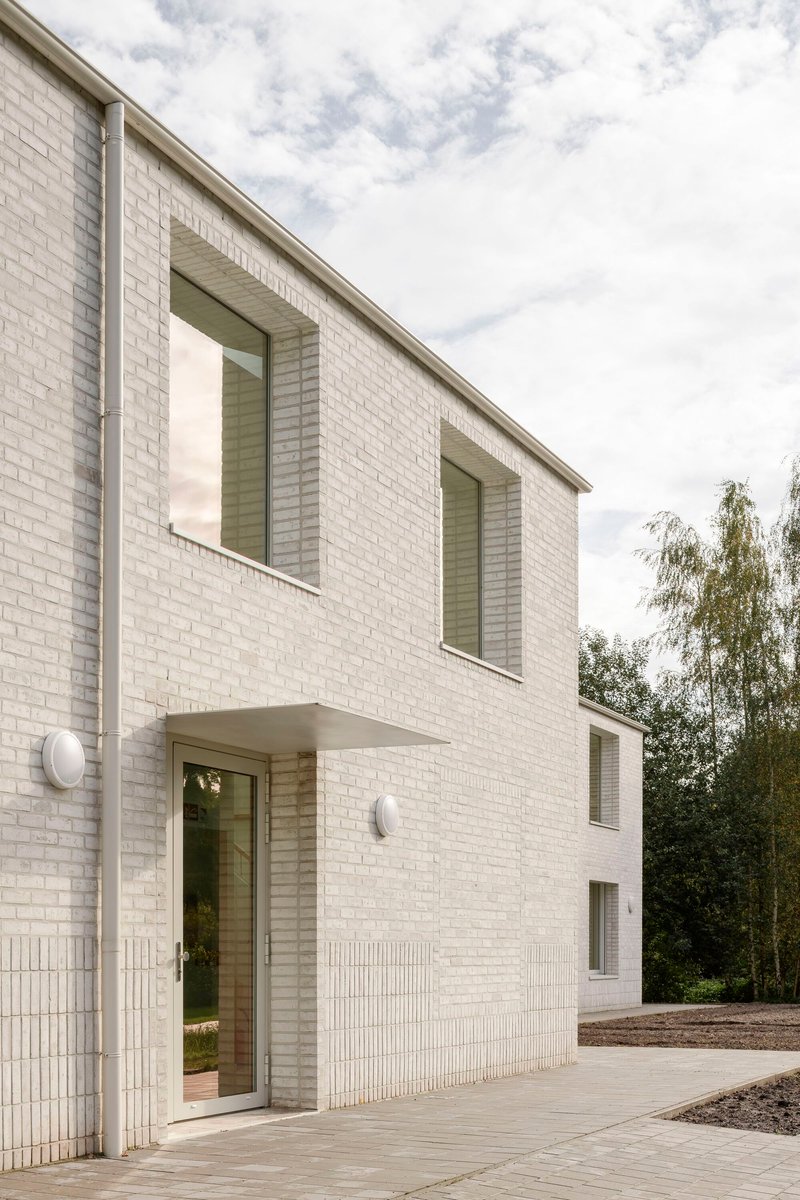
Care facilities often announce themselves with a conspicuous otherness, a scale or materiality that signals institutional purpose. FELT's street elevation does the opposite. A subtle shift in the façade plane helps the building sit within the proportions of its villa district neighbors. White brick, slate, and finely detailed joinery in light grey create a restrained material palette. Gutters and downpipes are integrated so cleanly that the front reads as a composed, almost civic face. The cantilevered canopy at the entrance and the vertically ribbed brick base panels add just enough texture to prevent blandness without tipping into fuss.
The recessed entry, flanked by ribbed panels, manages to be both welcoming and protected, a threshold that acknowledges the vulnerability of its residents without dramatizing it. A single pitched roof unifies the composition. You would have to walk around the building to understand that this apparently singular volume is, in fact, many.
The Garden Side: Sixteen Houses in One
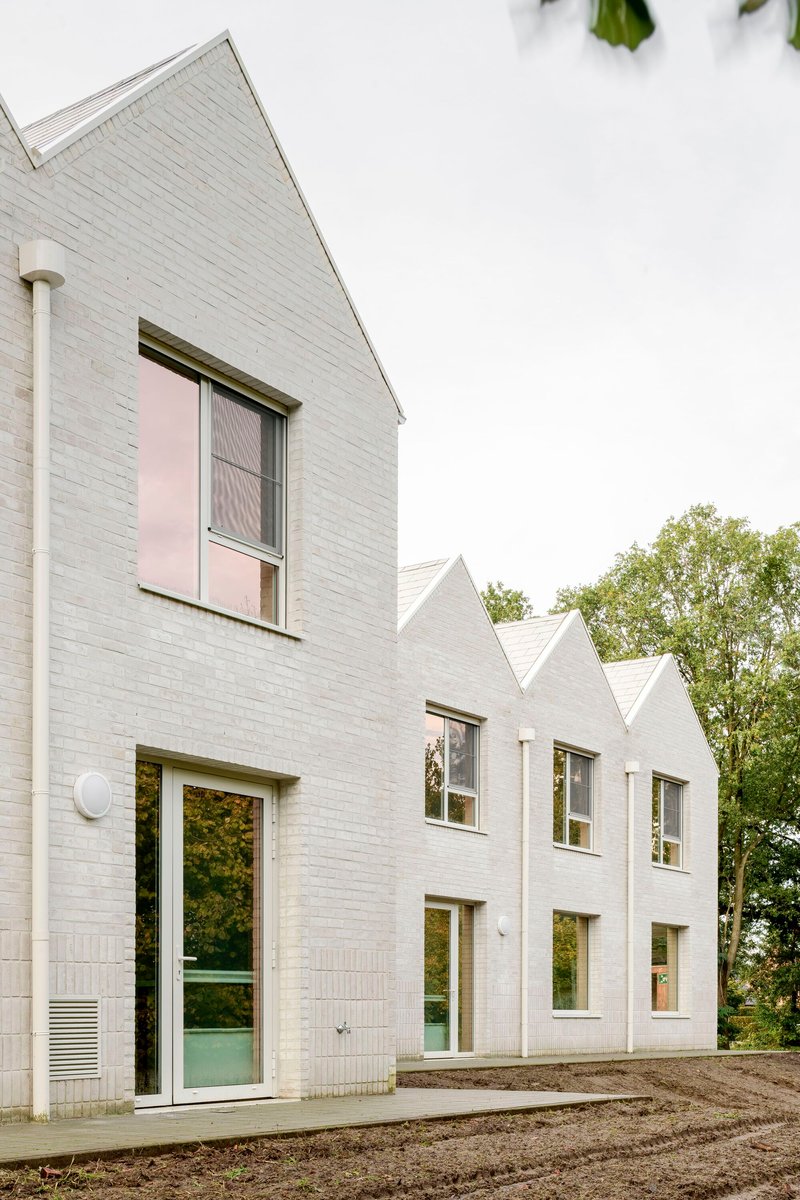
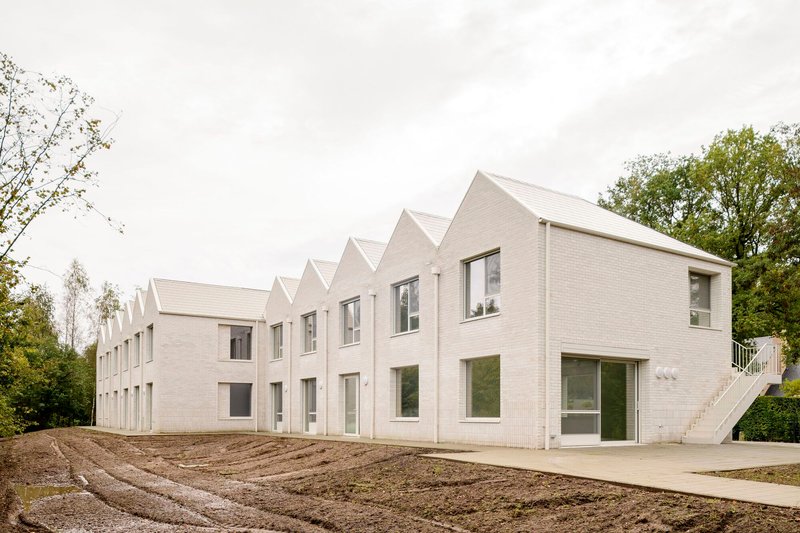
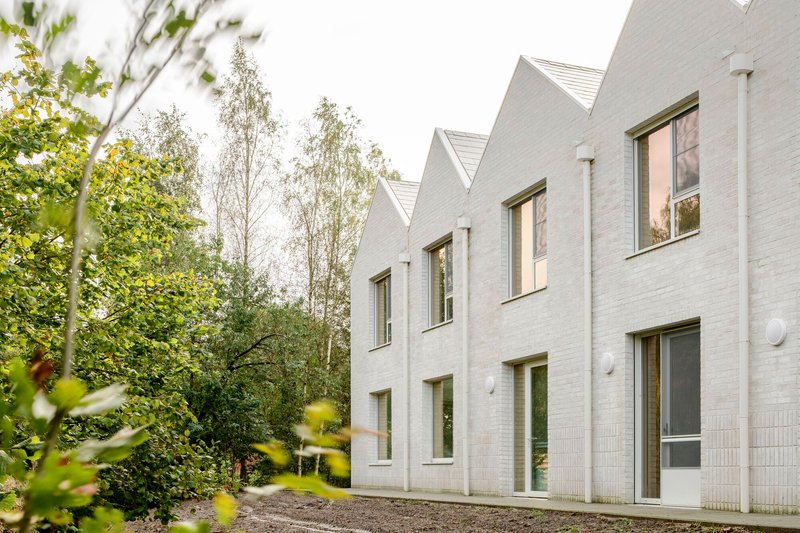
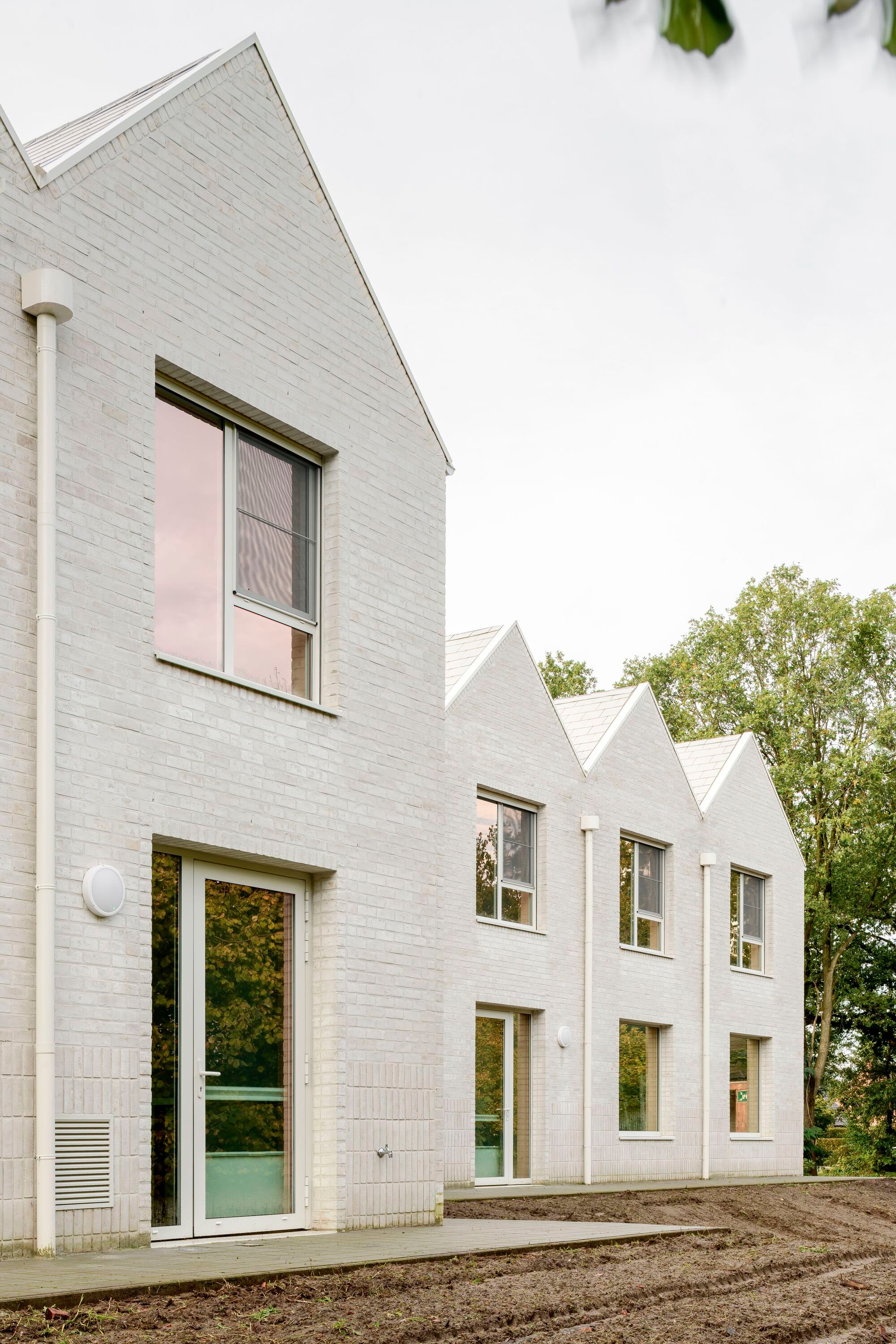
The rear elevation is where the project's core idea becomes visible. A sawtooth roofline of repeating gabled forms breaks the mass into a scale that reads as a row of small houses gathered into one collective home. Each gable corresponds to an individual studio, and each has its own glazed door opening to the garden. The effect is closer to an almshouse or a beguinage than to a medical ward, drawing on a long Flemish tradition of communal housing that respects personal boundaries.
The framing matters here. Birch trees and mature deciduous planting soften the pale brick, and the freshly graded earth around the building suggests landscape work still to mature. When it does, the repeating gables will sit within greenery rather than dominating it. The generous, rhythmic openings frame views of the garden from the inside, making the outdoor space part of the therapeutic program rather than mere scenery.
Materiality and Detail at Close Range
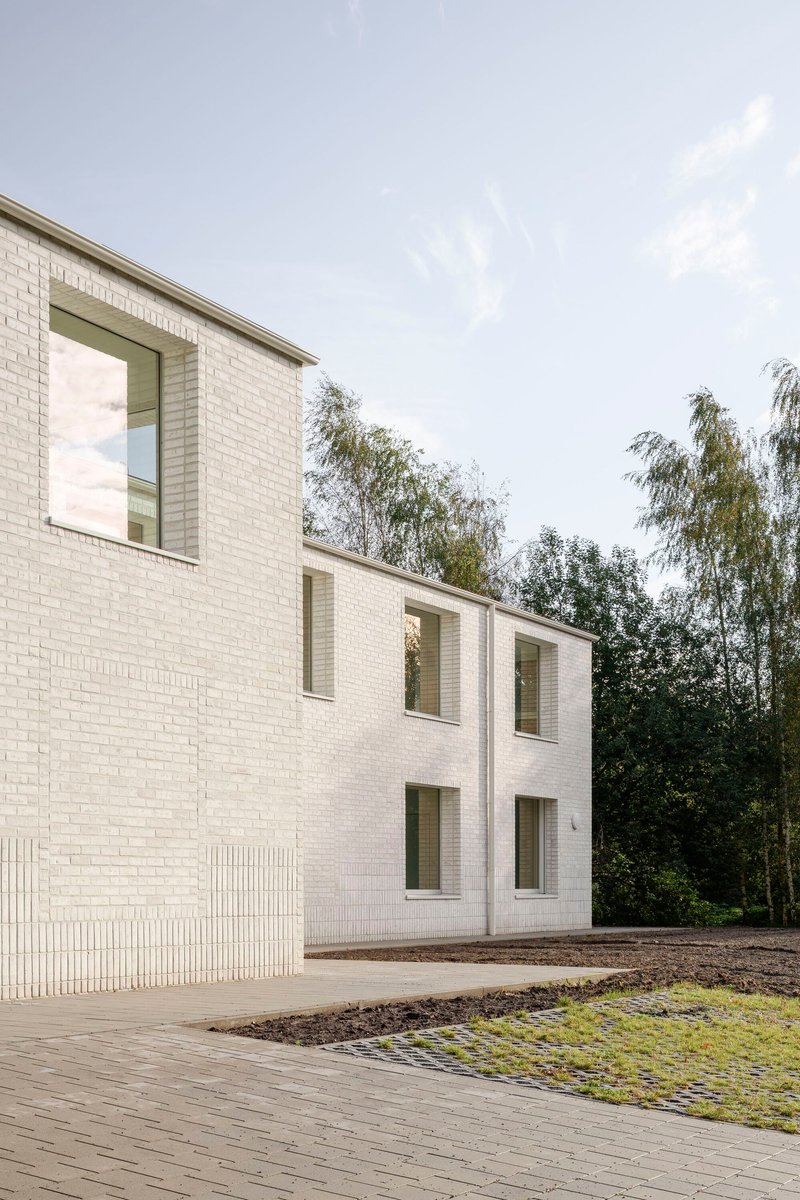
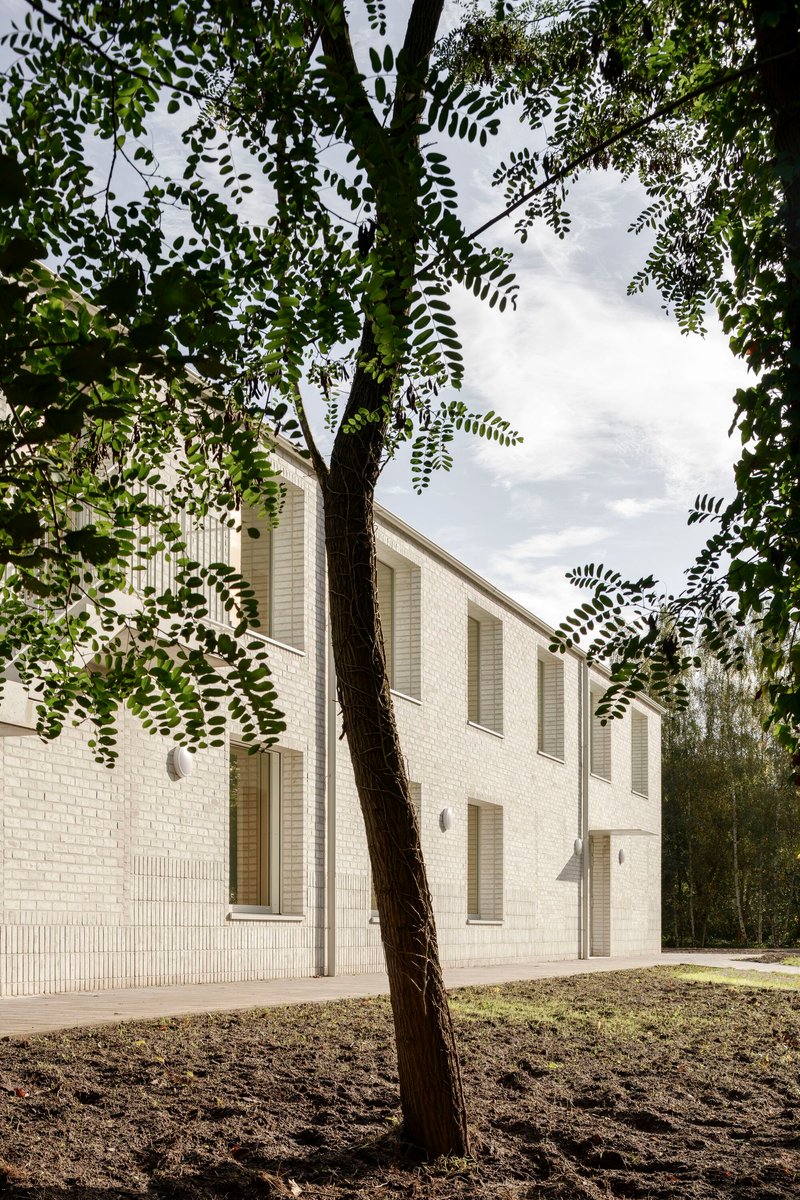
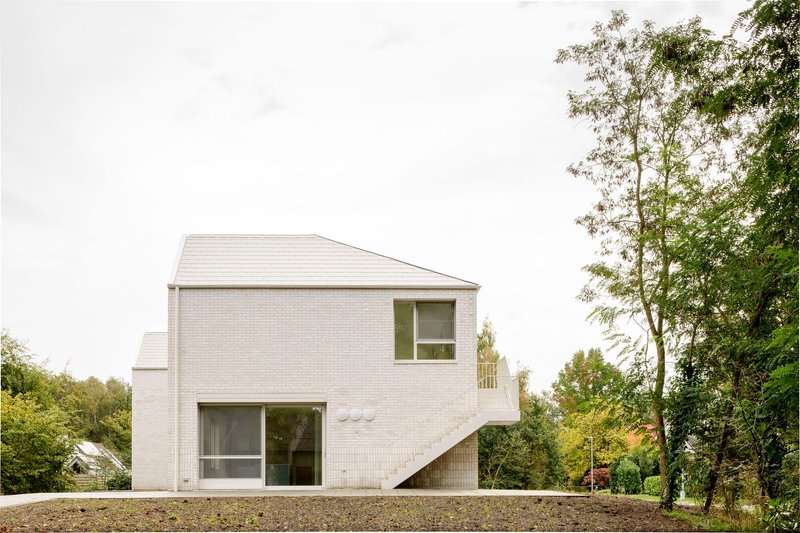
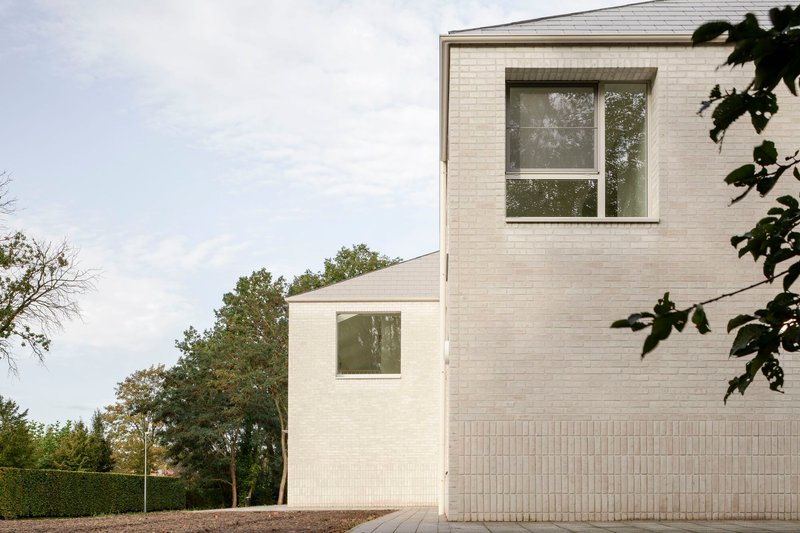
Pale brick is doing a lot of work in this project. It ties old and new together, gives the rear gables the same family resemblance as the street façade, and ages gracefully under Belgium's grey skies. Vertical brick detailing and recessed window frames add depth without requiring color or pattern changes. Alongside one elevation, a timber deck introduces a warmer surface at body level, a place to sit, a shift in material that signals a domestic zone rather than a circulation route.
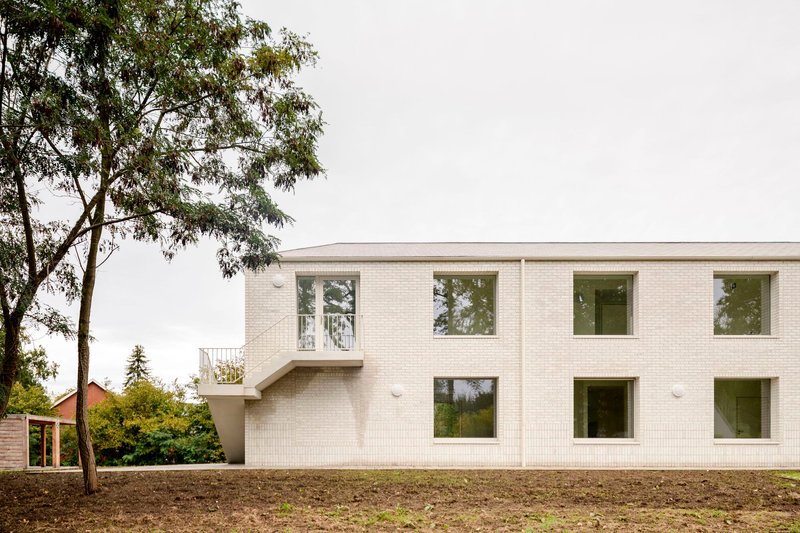
The external staircase on the side elevation and the shuttered openings suggest a building that manages daylight and access with care. Nothing is left unresolved. Even the gravel surrounding the base appears considered: practical for drainage, visually quiet, and consistent with the restrained tone of the whole.
Interior Atmospheres: Light, Volume, and Color
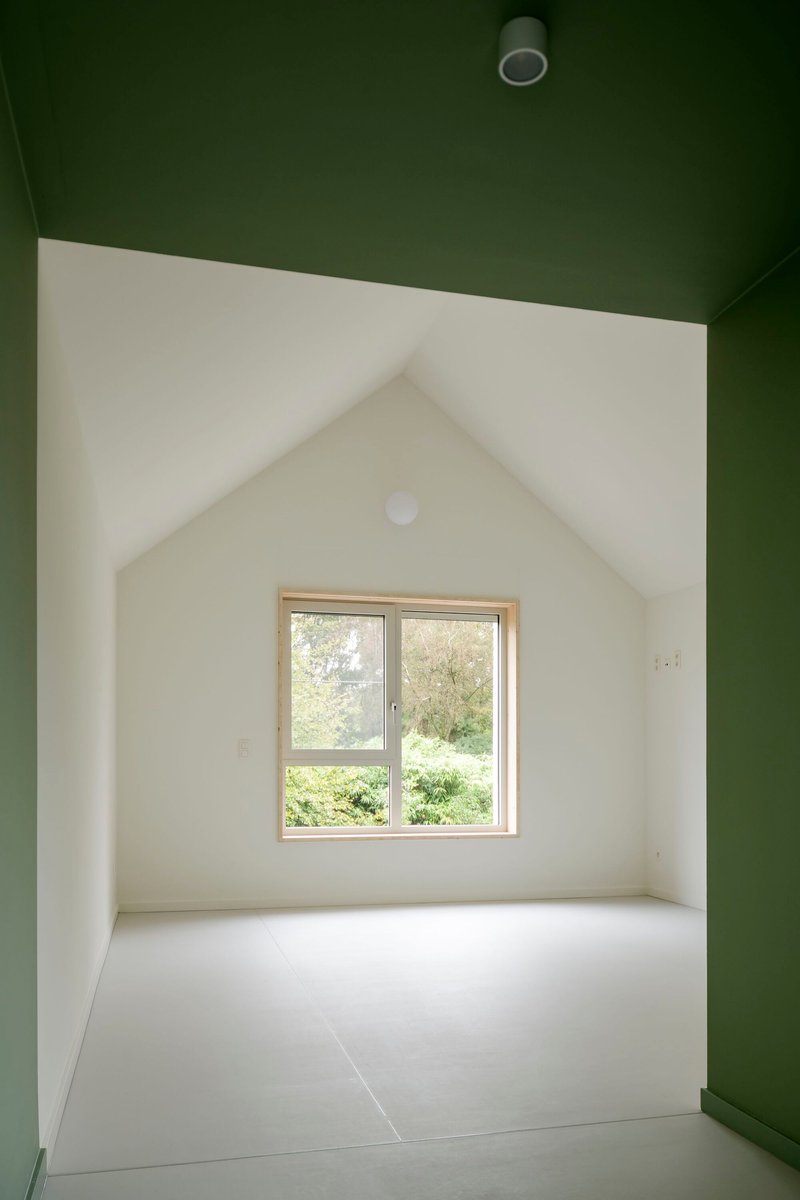
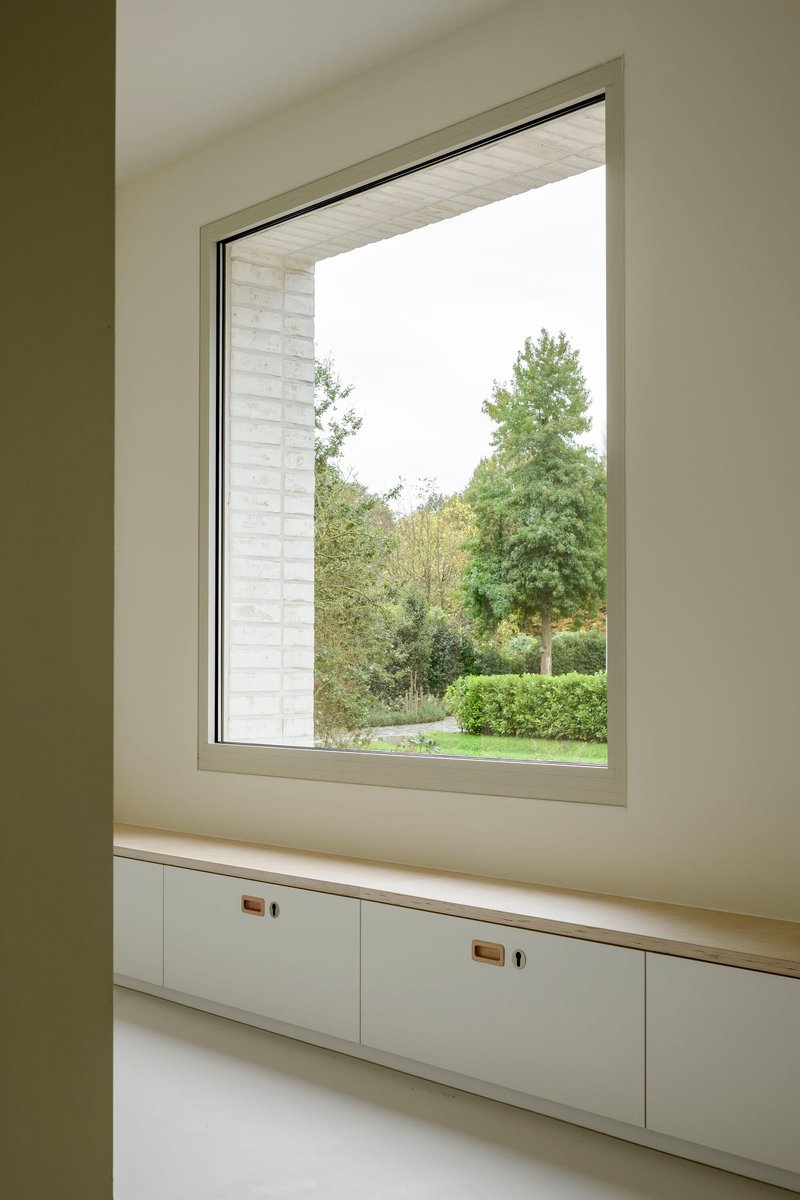
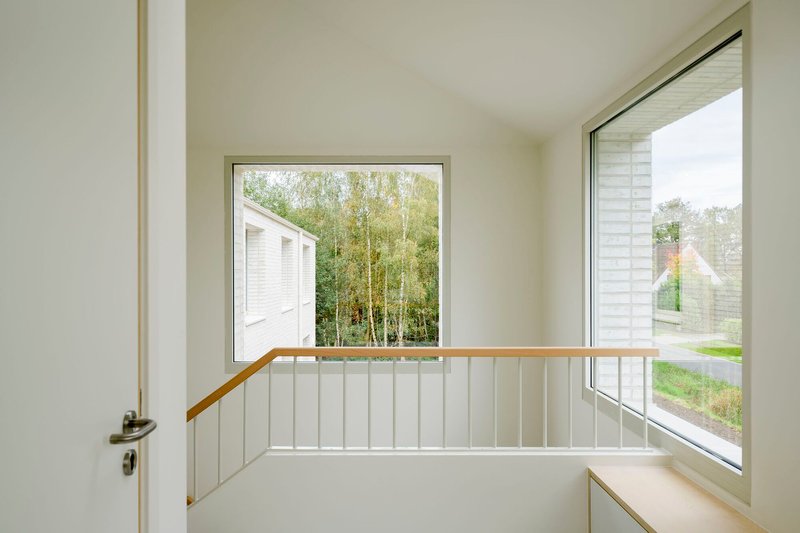
Inside, the vaulted white ceilings of the individual rooms lift the spatial experience beyond what 850 square meters split among sixteen residents might suggest. A green accent wall in one of the rooms introduces a note of color that feels personal rather than prescribed, the kind of decision that could be changed by a future occupant. Natural daylight washes across surfaces from generous openings, and the deep brick window reveals create inhabitable niches: a window seat with built-in drawers becomes a place to read, to sit, to look out at the garden.
On the upper landing, timber handrails and corner windows frame views of the neighboring gabled roofline, so that even the circulation spaces offer orientation and a connection to the building's external identity. These are not corridors you hurry through. They are calibrated to encourage pause, to make moving through the building a series of small, reassuring moments.
Facade Rhythm and the Side Elevations
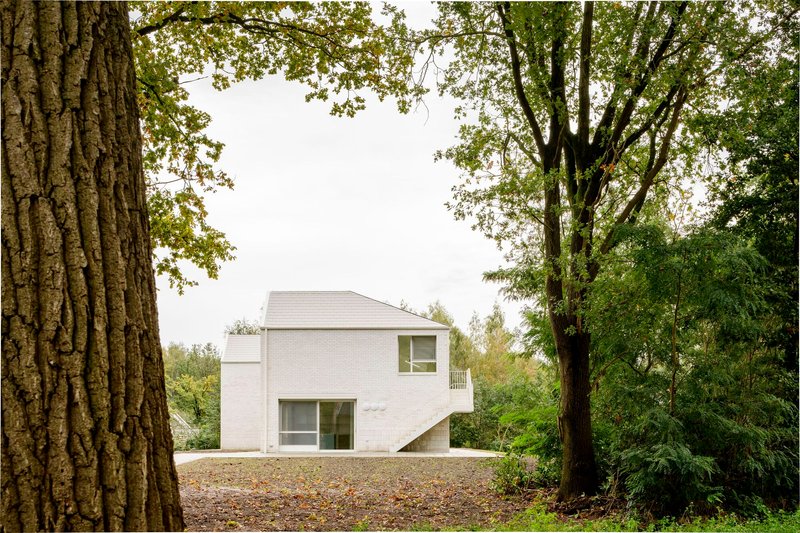
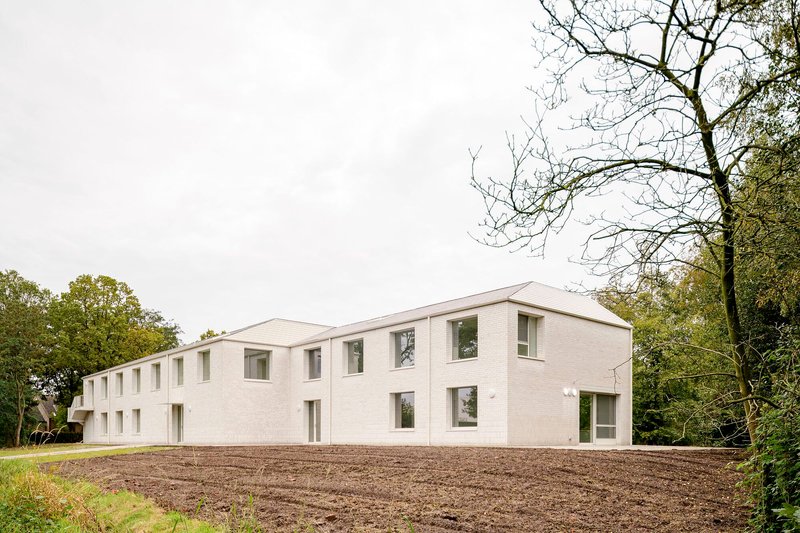
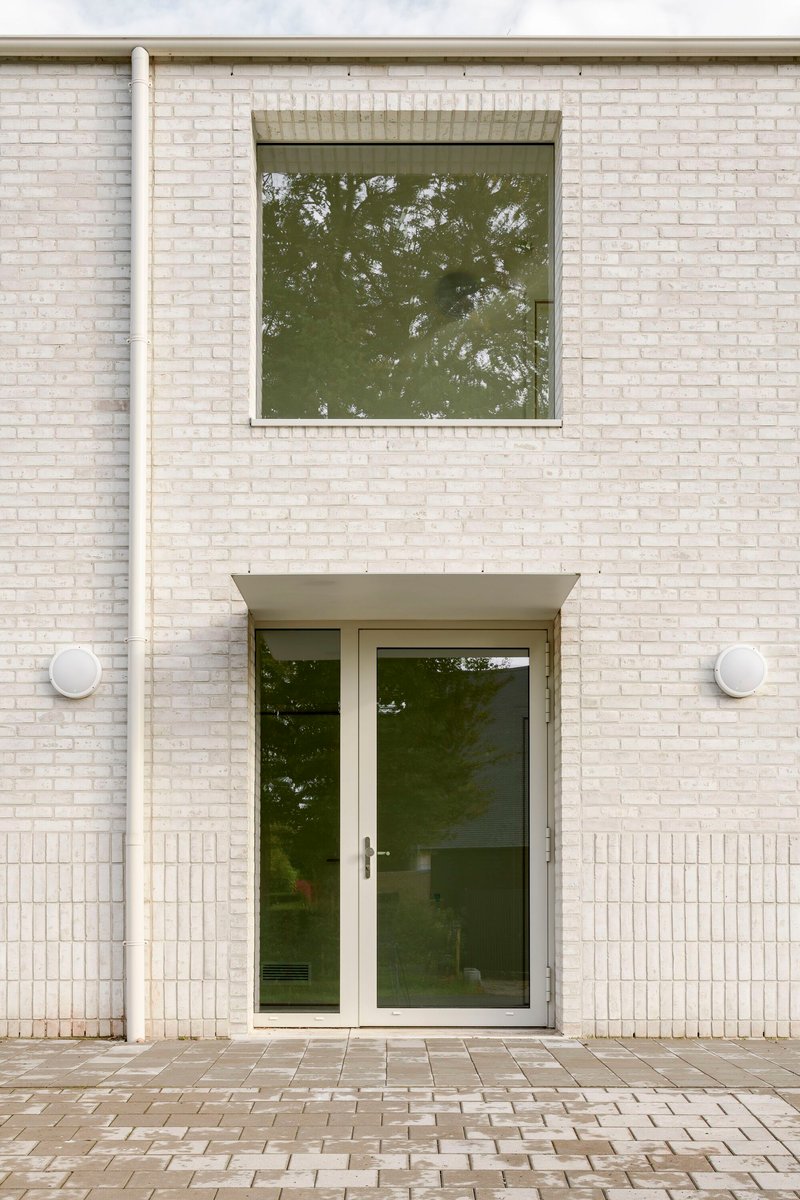
Seen through the canopy of bare winter trees, the side and rear elevations reveal the project's compositional discipline. The long white brick facade with its gabled roofline stretches across freshly tilled earth with the quiet confidence of a building that knows its proportions are right. The front entry, seen at closer range, pairs a glass door with a simple square window, a composition so restrained it borders on the minimal.
What holds the project together across all these views is consistency of intention. Every elevation is legible, every joint resolved, every opening sized for a reason. The architecture does not perform empathy; it enacts it through careful spatial decisions. That is a harder thing to achieve and a more durable one.
Plans and Drawings
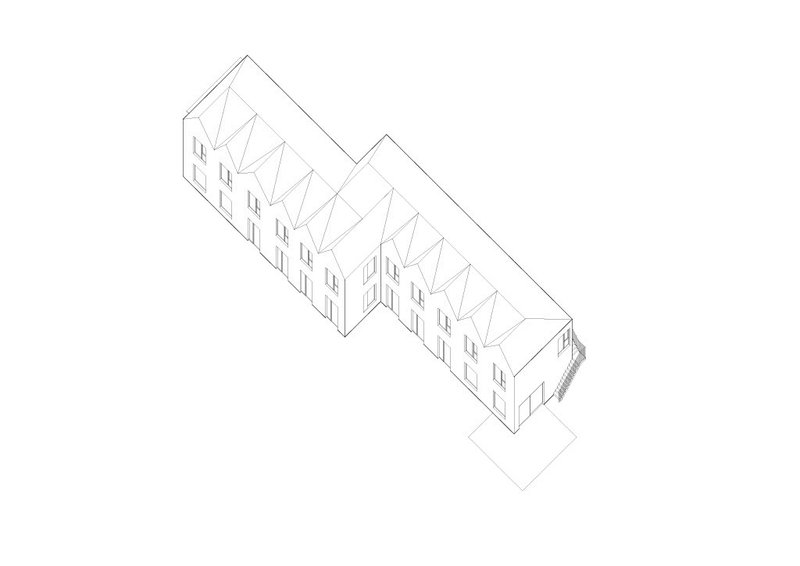
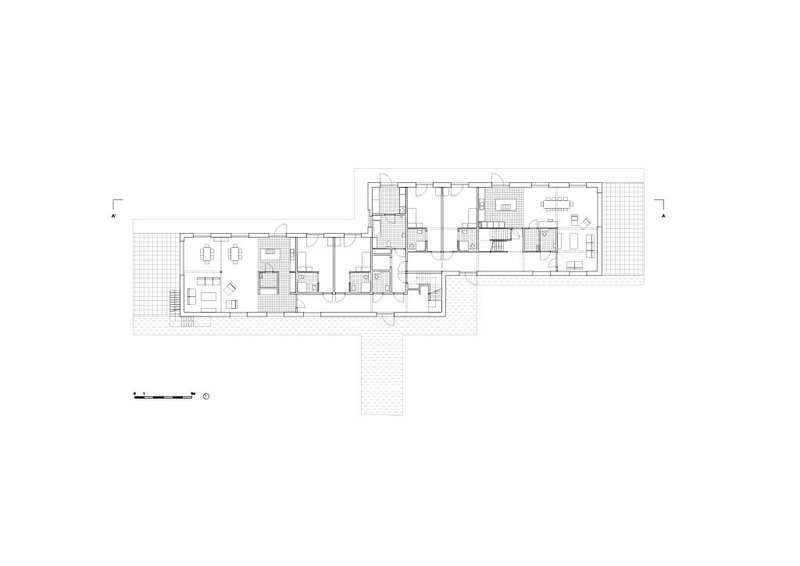
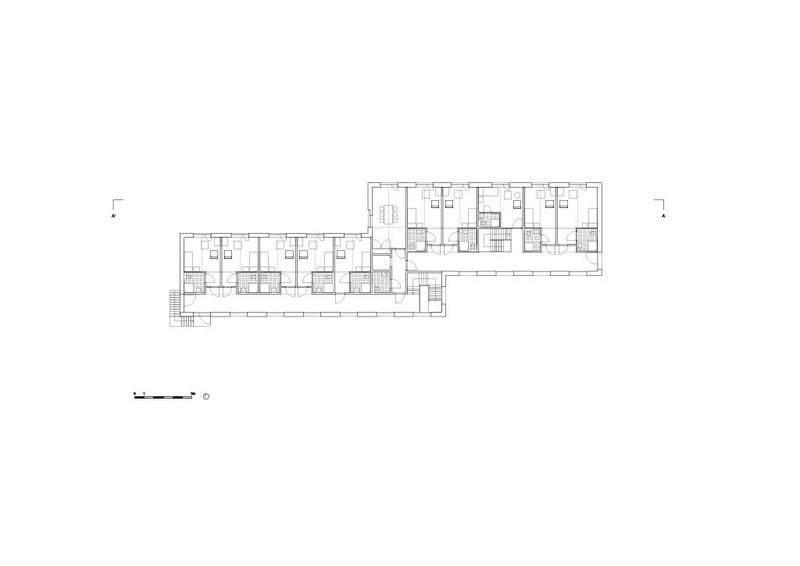
The axonometric drawing makes the organizational logic immediately legible: a linear building with repeating pitched roofs, each marking a studio, linked by a central circulation spine. The ground floor plan shows the double commune arrangement, with residential units flanking terraces and a central core that handles access and shared services. The upper floor mirrors this, arranging individual dwelling units along a linear corridor. The parallel wall structure of the original villa is visible as a generative diagram, extended and multiplied to accommodate the new program.
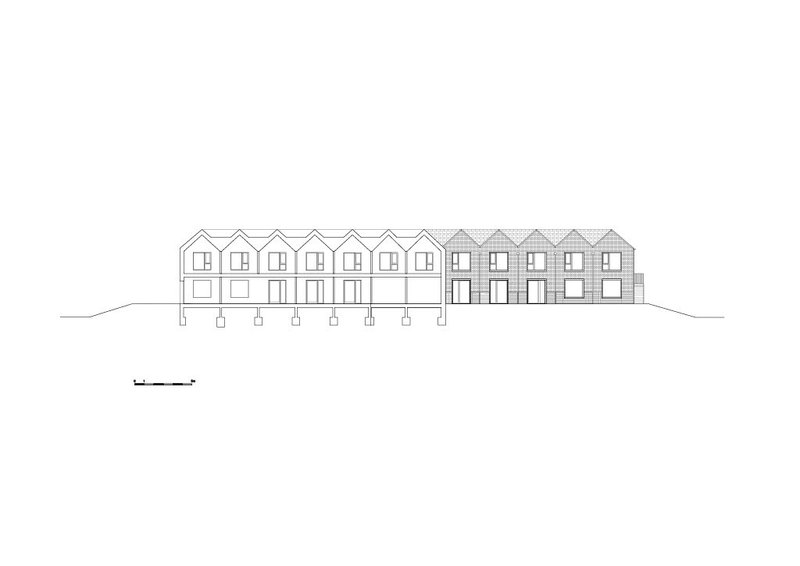
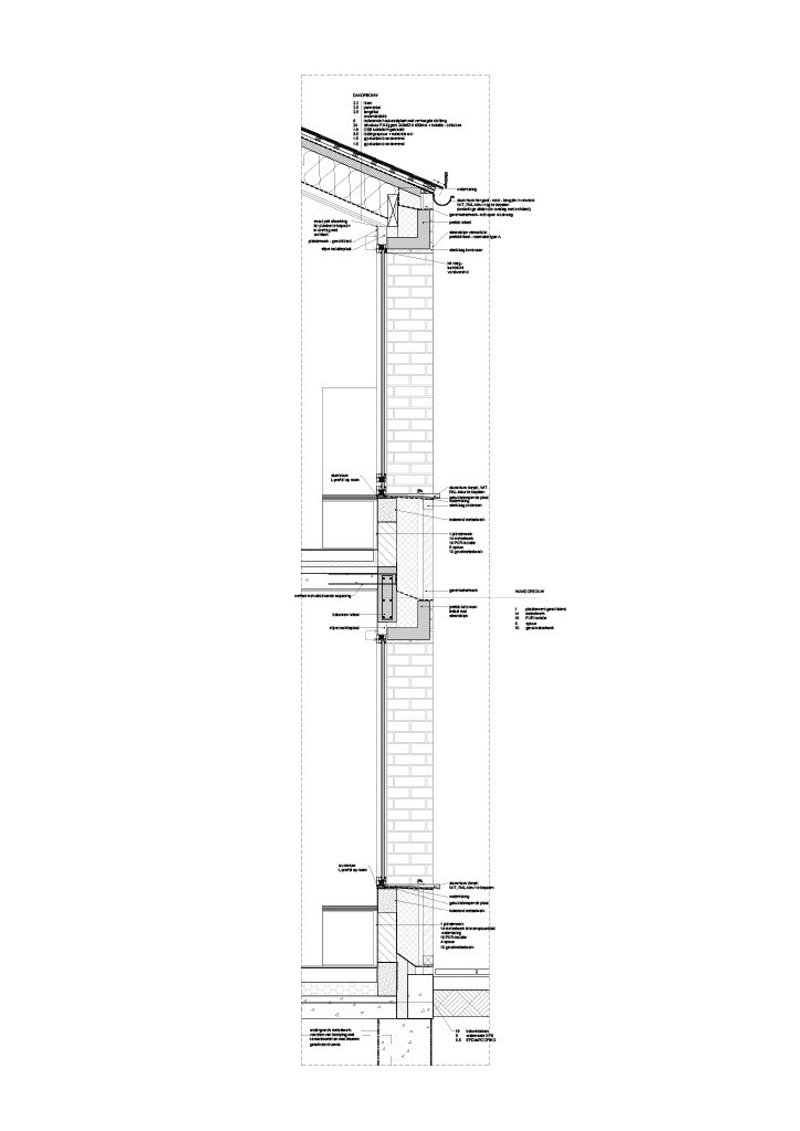
The elevation drawing confirms what the photographs suggest: a unified street presence composed of gabled forms with varying façade treatments that introduce just enough variation to avoid monotony. The wall section detail is perhaps the most revealing drawing of all. It shows a brick cavity wall assembly with insulation, carefully detailed window connections, and a robust foundation. The architecture here is not symbolic; it is built. The section demonstrates that the warmth and domesticity of the interiors rest on a technically rigorous envelope, an essential point for any building whose residents may be especially sensitive to thermal comfort, acoustics, and daylight quality.
Why This Project Matters
Care Villa matters because it refuses the false choice between domestic scale and institutional efficiency. Sixteen residents need clinical oversight, shared kitchens, accessible circulation, fire-rated construction. They also need a front door that feels like theirs, a window seat with a view of the garden, a roofline that tells them which room is home. FELT's design delivers both without aesthetic compromise, proving that healthcare architecture does not require the visual language of healthcare.
The broader lesson is about method. Starting from the structural logic of an existing building, reading its parallel walls as an opportunity rather than a constraint, and extending that logic into new volumes is a transferable strategy. It is the kind of intelligent reuse that avoids both nostalgic preservation and wasteful demolition. For architects working on similar briefs across Belgium and beyond, Care Villa offers a clear, replicable argument: strip back, understand the bones, and build forward with discipline and care.
Care Villa, designed by FELT architecture & design, led by Karel Verstraeten and Jasper Stevens. Located in Merksplas, Belgium. 850 m². Completed in 2025. Photography by Olmo Peeters.
About the Studio
Share Your Own Work on uni.xyz
If projects like this are the kind of work you want to make, uni.xyz is a place to publish your own, find collaborators, and enter design competitions.




Popular Articles
Popular articles from the community

The Flow: Coffee Shop Interior Design Where Time, People, and Process Intertwine
The Flow reimagines Viennese coffee culture through arched forms, warm interiors, music, reading, work, and social gathering.

ONA Threads Four Board-Formed Concrete Cabins Along a 260-Meter-Deep Site in Mendoza
At the edge of Argentina's wine country, a set of curved concrete lodges negotiate a razor-thin parcel between city and mountain.
Non Architecture's Horrible Houses Competition Asks AI to Design the Ugliest Home Possible
A free global competition invited participants to use AI image generators to produce the most hideous house they could imagine.
Inside a Timeless Mumbai Residence by Aether Studio
Aether Studio's 2,250 sq ft apartment in Malad, Mumbai uses marble, brass, boucle, and disciplined restraint to build a quiet retreat from the city.


Similar Reads
You might also enjoy these articles
Freebird Residence by Alexis Dornier: A Tropical Modernist Sanctuary in Bali
Floating living pavilion above pool anchors H-shaped tropical villa, blending Japanese minimalism, sustainable strategies, lush landscape, and sculptural interiors.
127af Flips a Tiny Bagnolet Rowhouse Upside Down with a Handcrafted Roof Extension
A 55-square-meter terraced house on the edge of Paris gains a luminous upper living floor through lightweight timber and steel.
1.61 Design Workshop Wraps a 600-Square-Meter Café in Vietnam in Sculptural Burgundy Drama
Reden Café & Bistro pairs a helical staircase, mosaic floors, and deep red interiors to rethink Vietnamese hospitality space.

The Unbound Brain: A School Shaped by Cognitive Architecture
Cylindrical learning pods radiate like neurons from a central cortex, turning the floor plan into a spatial model of human thought.


Explore Urban Design Competitions
Discover active competitions in this discipline




The Global Benchmark for Architecture Dissertation Awards


Challenge to design locus for the upliftment of human rights

Challenge to design a learning and healing center


Challenge to re-imagine a department store in present times
Comments (0)
Please login or sign up to add comments
No comments yet. Be the first to comment!