
Wuyang Architecture Wraps a Shanghai Elementary School in Striped Terracotta and Quiet Courtyards
Fengpu Elementary School negotiates urban renewal, a centuries-old ginkgo tree, and the needs of young learners in Fengxian New City.


Elementary schools in Chinese cities tend to follow a familiar script: fenced perimeter, ranked classroom blocks, a rubber track pinned to the leftover land. Fengpu Elementary School, completed in 2023 on the western edge of Shanghai's Fengxian New City, refuses that formula. Designed by Wuyang Architecture under lead architect Lu Feng, the 17,960 square meter campus reads less like an institution and more like a small urban quarter, organized around two courtyards that give children something most school plans deny them: spatial variety and real choices about where to run, sit, or simply look up at the sky.
What makes the project genuinely interesting is the tension it manages to hold. The site once belonged to an industrial district that has since become residential. A centuries-old ginkgo tree and a small pseudo-classic building from the 1970s still stand on the grounds, enclosed by a new perimeter wall that lets them exist as a kind of historical enclave within the campus rather than forcing a pastiche connection. Outside, the facades blaze with vertically striped terracotta panels. Inside, the palette drops to concrete and timber, creating interiors so muted they feel like a different building altogether. That deliberate contrast, vibrant city face versus calm study interior, is the core move here, and it works.
A Striped Signal in a Changing District
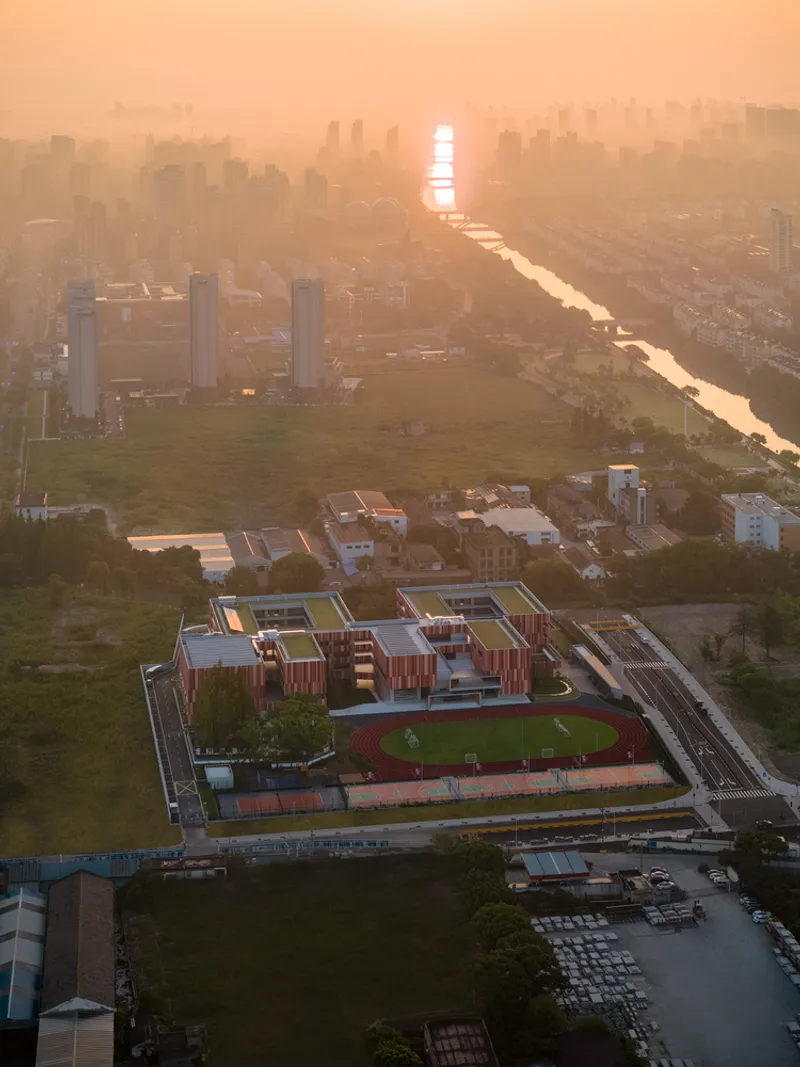
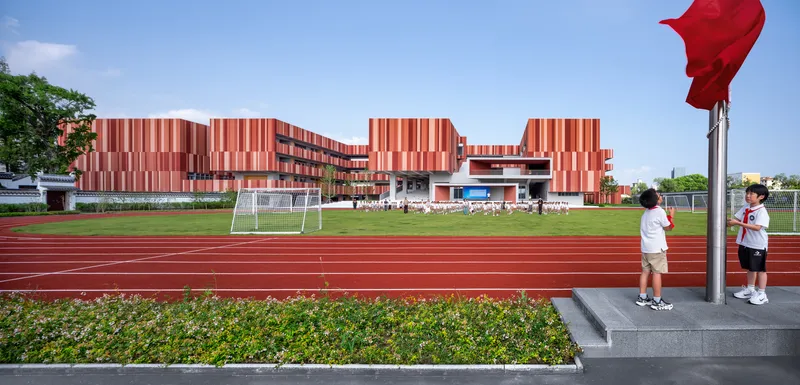
Seen from above at golden hour, the campus reveals its strategy: classroom volumes wrapped in narrow vertical stripes of terracotta sit to the east, facing a quiet stream, while a green rooftop sports field crowns the western half where the library, canteen, and sports hall are stacked. The striped cladding is assertive enough to announce the school from several blocks away without resorting to cartoon colors or novelty shapes. Against the bland residential towers rising around it, the building acts as a civic signal, a marker that something deliberate is happening on this block.
From the running track, students see the same striped facades framing their field of play. The proportions feel intentionally compressed, almost textile-like, so that the building reads as a woven surface rather than a monolithic wall. It is a subtle move that softens the institutional scale considerably.
Old Tree, New Fence, Honest Coexistence
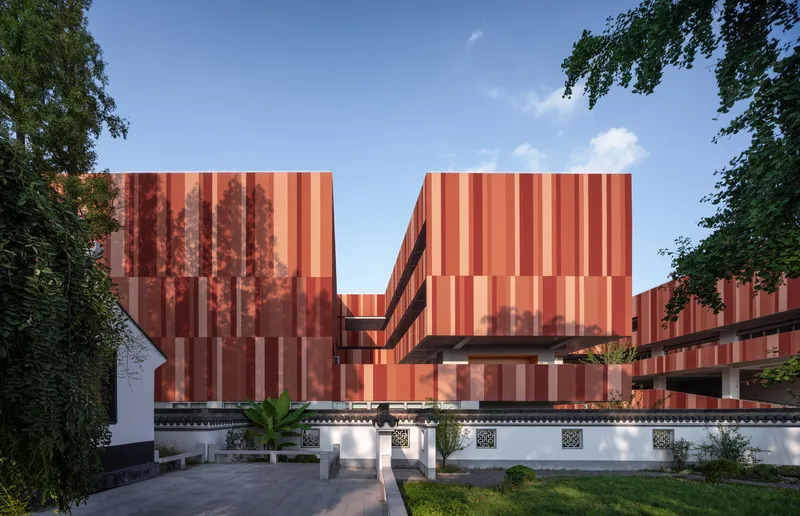
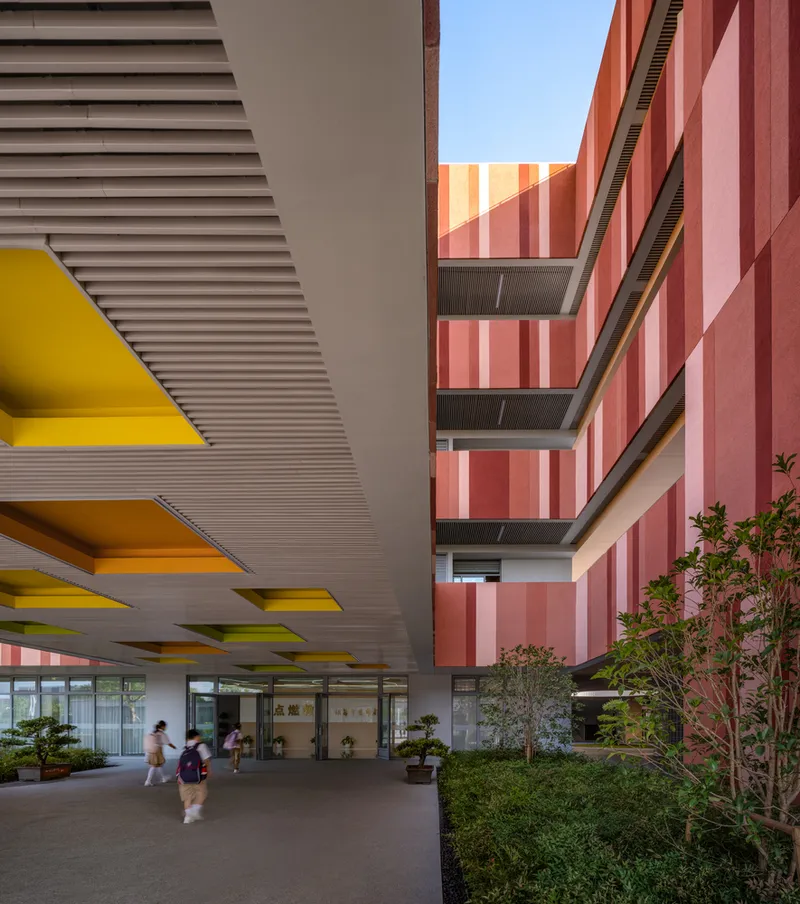
The relationship between the new school and the pre-existing ginkgo tree and its 1970s companion building is handled with refreshing honesty. Rather than wrapping the old courtyard in a glass atrium or grafting faux-historical detailing onto modern volumes, Wuyang Architecture simply drew a line. A white perimeter wall with ornamental motifs encloses the legacy elements, making them a pocket garden, visible but separate. The striped terracotta volumes rise directly behind this wall, and the juxtaposition is stark, almost confrontational. It acknowledges that the two eras belong to different architectural languages and that pretending otherwise would serve neither.
At the main entry passage, triangular yellow ceiling coffers punch color into the covered walkway between the striped volumes and a planted courtyard. The geometry is playful without being juvenile, giving children a memorable threshold between the street and school life. An overhanging corridor with outward-facing seats turns the boundary condition into a place of rest, a spot to watch the neighborhood and the old ginkgo simultaneously.
Courtyards as the Engine of Daily Life
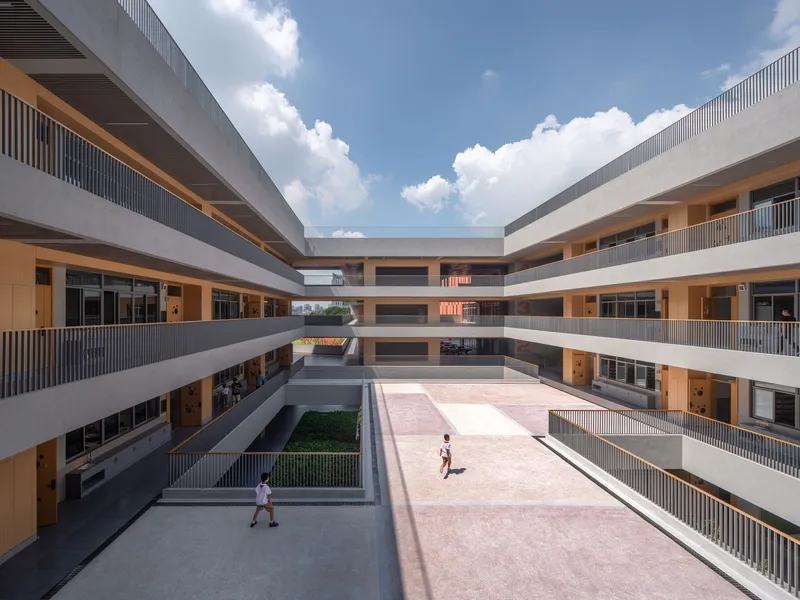
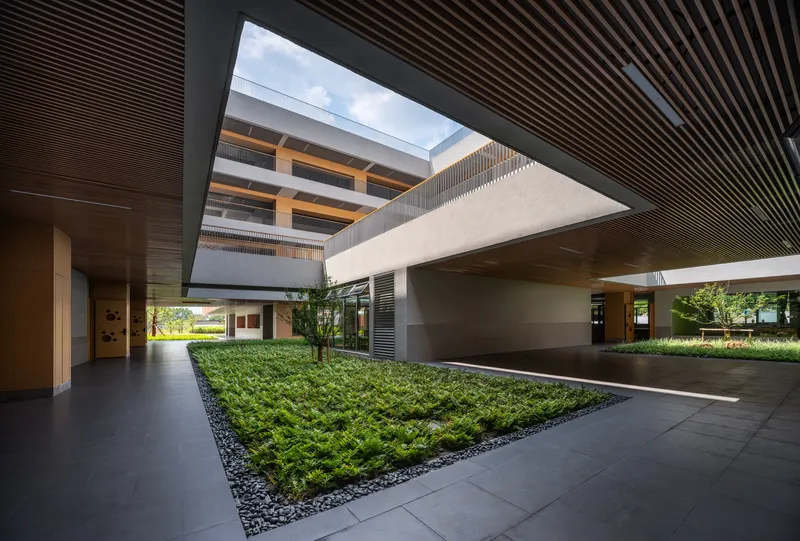
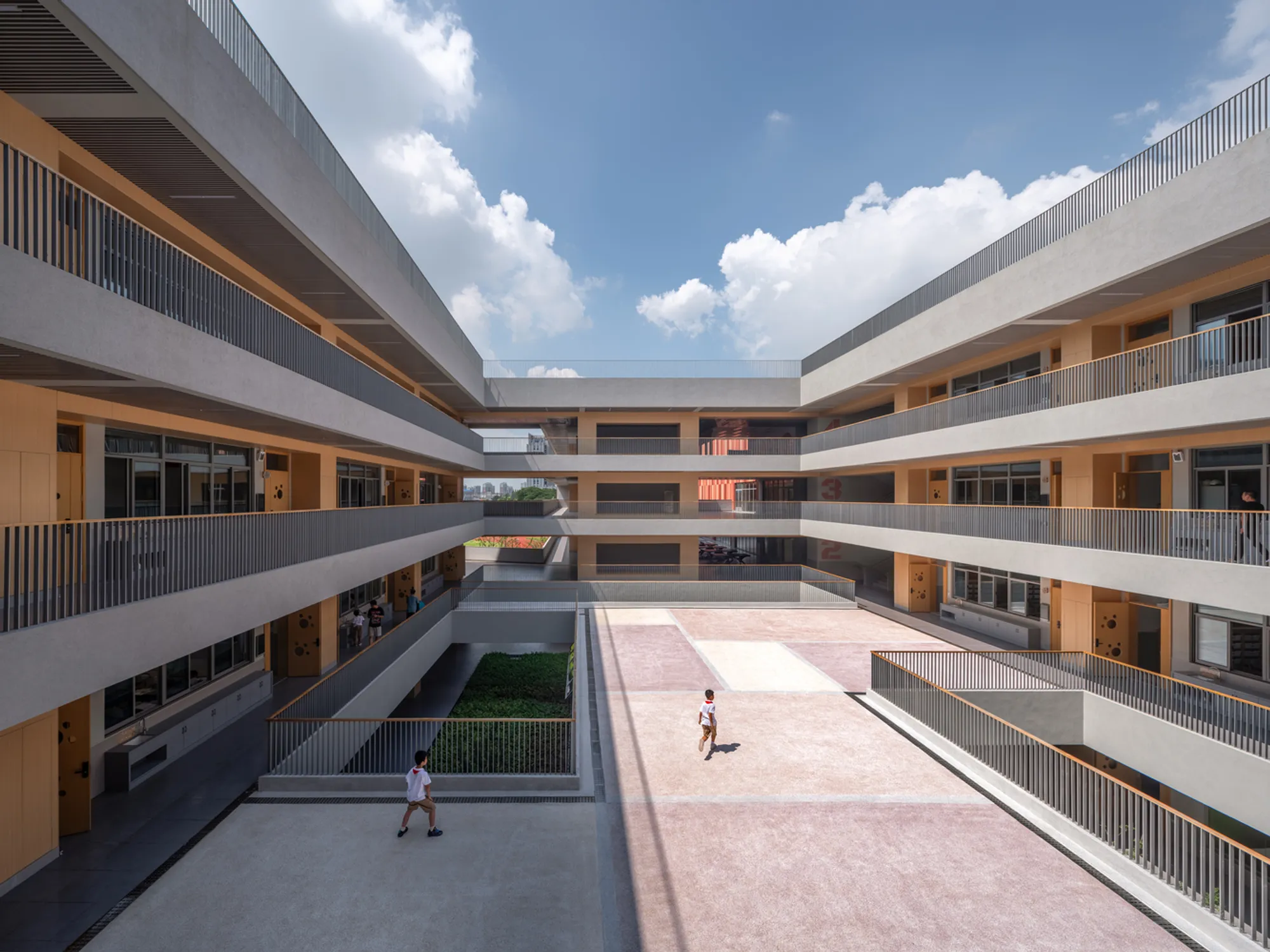
The twin courtyards on the campus's eastern side are the project's strongest spatial argument. Framed by concrete circulation galleries fitted with timber screens, they create a layered middle ground between classrooms and playground. One courtyard features planted beds and small trees beneath a rectangular skylight, turning what could have been a leftover void into a garden room that changes character with the seasons. The slatted timber ceilings above the surrounding corridors filter light into warm stripes on the floor, echoing the facade's vertical rhythm at a more intimate scale.
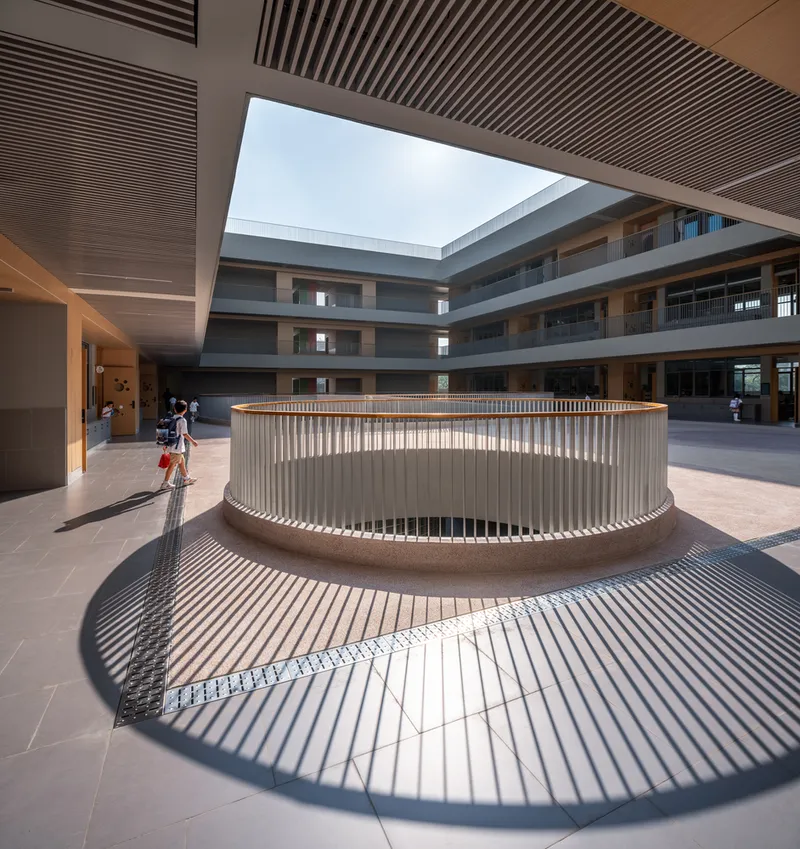
A circular opening cut into the courtyard floor sends a cone of radiating shadows downward under midday sun, a piece of architectural theater that costs almost nothing yet creates a moment children will remember long after they leave the school. It is details like this, calibrated to delight rather than impress, that separate the project from routine school design. The ground-floor courtyards and first-floor terraces combine into a continuous shared platform where the boundary between corridor and playground blurs. Ramps connect levels, so movement is fluid rather than bottlenecked at stairwells.
Loud Outside, Quiet Inside
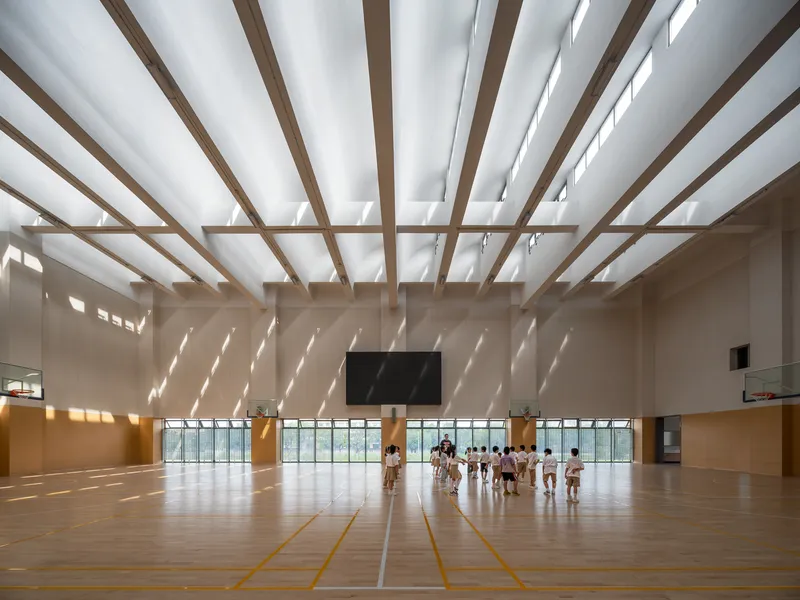
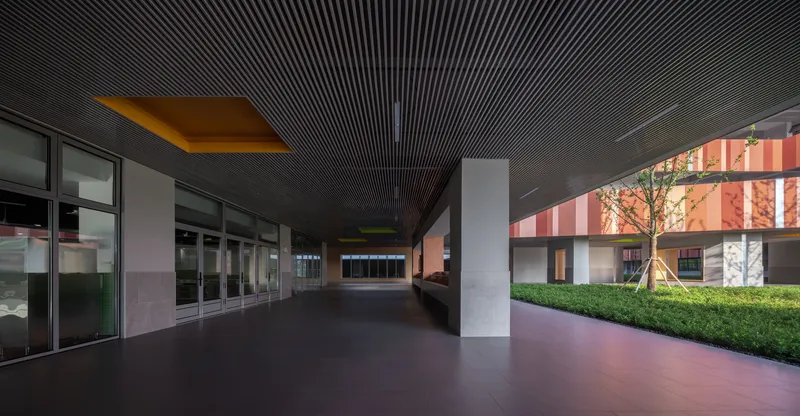
Step inside the sports hall and the tonal shift is immediate. A timber louvered ceiling stretches overhead, casting diagonal shadows across a polished wooden floor where students practice in near silence. The palette is warm but restrained: natural wood, gray concrete, controlled daylight. Compare this with the saturated terracotta and yellow coffers of the exterior, and you begin to understand the architects' thesis. The outside of the school belongs to the city, vibrant and participatory. The inside belongs to the children, calm and focused.
A covered corridor at dusk demonstrates the transition in miniature. Dark slatted ceilings and square columns create a rhythm of compression and release as you walk toward the illuminated courtyard facades beyond. The lighting is restrained, mostly reflected glow off the inner walls, which transforms the evening campus into something almost monastic. For a building that welcomes hundreds of energetic young students every morning, these moments of stillness are not incidental; they are designed.
Why This Project Matters
Fengpu Elementary School matters because it treats a public school in a suburban district as a legitimate design problem rather than a checkbox exercise. In a context where rapid urban renewal tends to flatten local specificity, the building holds its ground. It keeps the old ginkgo tree without fetishizing it, creates generous play spaces without sacrificing classroom quality, and uses a limited material vocabulary, terracotta, concrete, timber, to produce spatial experiences that shift from exuberant to contemplative within a few steps.
More broadly, the project asks a question that applies far beyond Shanghai: can a school building help define the identity of a newly formed neighborhood? Wuyang Architecture's answer is yes, provided the architecture takes its civic role seriously. The striped facades announce themselves to the district. The courtyards nurture the community within. And the centuries-old ginkgo tree, walled off but visible, reminds everyone that this land had a life before the cranes arrived. That layered awareness of time, place, and purpose is what lifts the project above the routine.
Fengpu Elementary School by Wuyang Architecture. Lead Architect: Lu Feng. Fengxian New City, Shanghai, China. 17,960 m². Completed 2023. Photography by Qingshan WU.
About the Studio
Wuyang Architecture
Share Your Own Work on uni.xyz
If projects like this are the kind of work you want to make, uni.xyz is a place to publish your own, find collaborators, and enter design competitions.




Popular Articles
Popular articles from the community


Co-Life: Senior Housing Design That Reconnects Older Adults With the City
Co-Life reimagines senior housing design through healing gardens, shared streets, workshops, and a sustainable community across generations.

Hill & Cross Opera: Sculptural Opera House Architecture Shaped by Tallinn’s Landscape and Identity
Hill & Cross Opera reimagines opera house architecture in Tallinn through its sculptural hill, civic plaza, glass wave and a luminous cross.

Play: Fragments of Their World
Familiar architecture becomes modular playground design, creating safe spaces where displaced children can learn, connect, imagine and play.

Co-life: Sustainable Architecture for Age-Friendly Community Living
Co-life reimagines sustainable architecture for seniors through courtyards, rammed earth, shared gardens, and spaces designed for belonging.


Similar Reads
You might also enjoy these articles


Hodi-Mandai Geram
Project Function: Preservation and revitalization of the Intangible heritage and socio-spatial identity of the Hodi by Housing, Cultural Memory Center, Sacred Grove, landscape, local tourism economy


Olio Towers: A Mid-Rise for Performers That Fuses Housing, Rehearsal, and Stage
Located blocks from Houston's Theater District, this modular tower stacks living units around a central performance atrium.

Oasis: Modular Green Housing Carved into Dhaka's Urban Fabric
A shortlisted Plugin Housing entry reclaims unauthorized settlements in Dhaka with stepped concrete volumes, green roofs, and ventilation-driven design.

Black Hole: A Floating Megastructure for the Post-Physical Era
Emiliano Mazzarotto envisions a spherical, self-scaling arena where e-sports, digital hotels, and holographic stadiums replace traditional public space.

Explore Educational Building Competitions
Discover active competitions in this discipline



Challenge to design public laboratory


Challenge to reimagine the Iron Throne


Photograph architecture without architects


Illustrate the lost glory of Angkor Wat - Render Challenge
Comments (0)
Please login or sign up to add comments
No comments yet. Be the first to comment!