
FIGR Architecture Inverts the Suburban Ha-Ha to Build a Fenceless Home in Alphington
A donut-shaped courtyard house in Melbourne's leafy north uses a landscaped mound instead of a front fence to redefine suburban privacy.


The ha-ha is one of landscape architecture's oldest tricks: a recessed ditch that keeps livestock out of a garden while preserving an unbroken view across the estate. FIGR Architecture & Design took that 18th-century device and flipped it upside down for suburban Melbourne. Instead of sinking a barrier into the ground, the studio pushed a planted mound up and out toward the street, burying the bulk of the house behind it and eliminating the front fence entirely. The result is Ha Ha Haus, a single-storey, 675-square-metre courtyard home in Alphington (Wurundjeri Country) that trades boundary walls for topography.
What makes this project genuinely interesting is not just the fence-removal gesture but the spatial logic that follows from it. Because the block's backyard faces south, the conventional plan would starve living spaces of northern light. FIGR's response was to flip the program front-to-back and wrap it into a donut around a central courtyard. That courtyard becomes the project's solar engine, pulling north light into every room while enabling cross ventilation on a site that would otherwise fight both orientation and privacy. The house was designed for intergenerational living and aging-in-place, accommodating frequent overseas visitors and shifting household compositions without dead-end corridors or afterthought guest quarters.
The Planted Mound and the Missing Fence
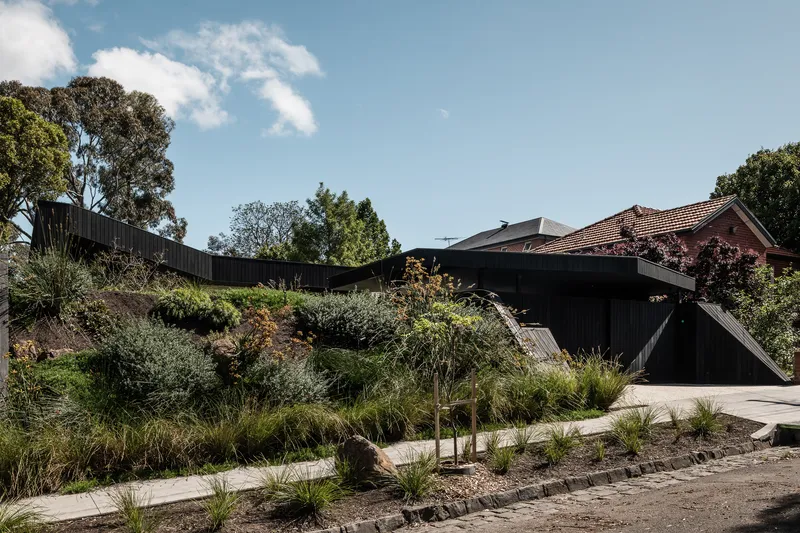
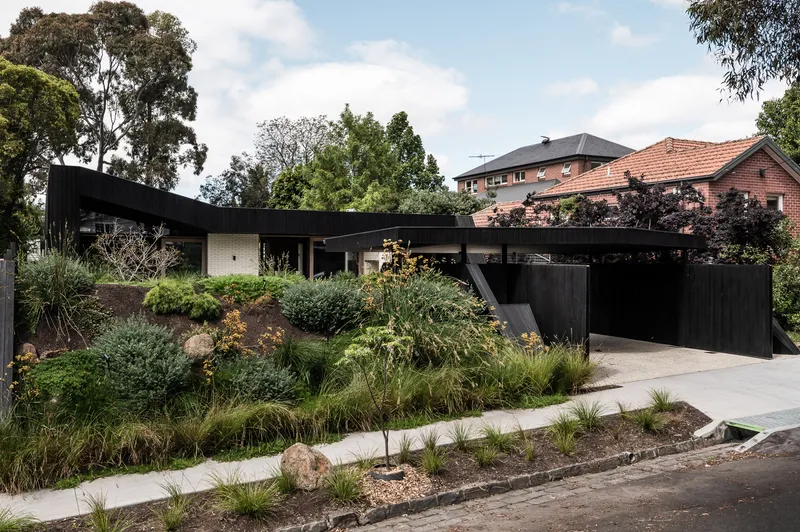
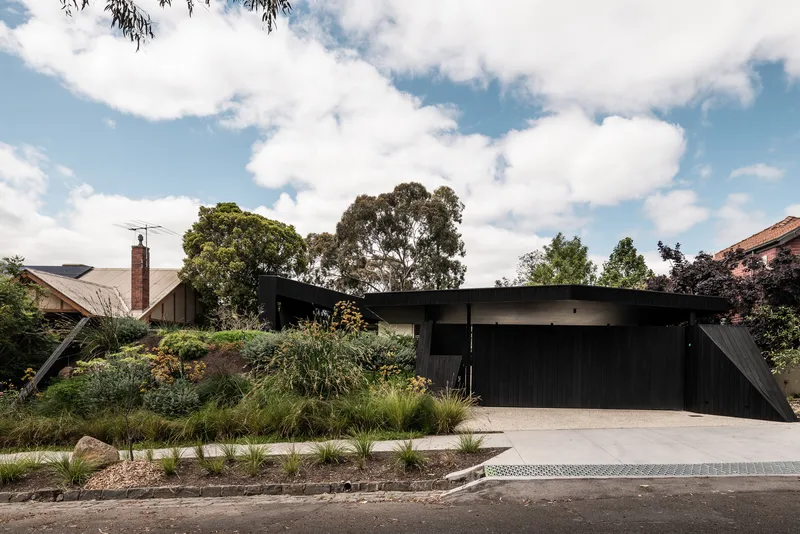
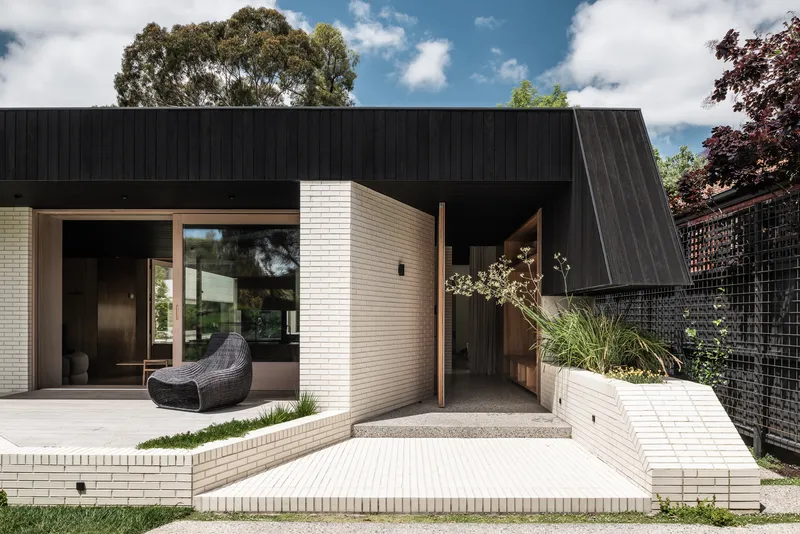
From the street, Ha Ha Haus barely reads as a house. Layered plantings of native grasses and groundcovers roll up a landscaped mound that conceals a 20,000-litre rainwater tank and absorbs the visual mass of the building behind it. The charred Blackbutt timber cladding crests above this green topography like a dark ridgeline, angular and assertive but never imposing. Alphington is one of those rare Melbourne suburbs where front fences are already uncommon, and FIGR leaned into that culture by making the landscape itself do the work of boundary-making.
The mound is not merely decorative. It establishes one of three distinct landscape zones designed by MUD Office: the green public frontage, the private internal courtyard, and a more structured rear yard. Each zone has a different character and a different relationship to the house, so the experience of moving through the property is never monotonous.
Arrival Under the Charred Canopy
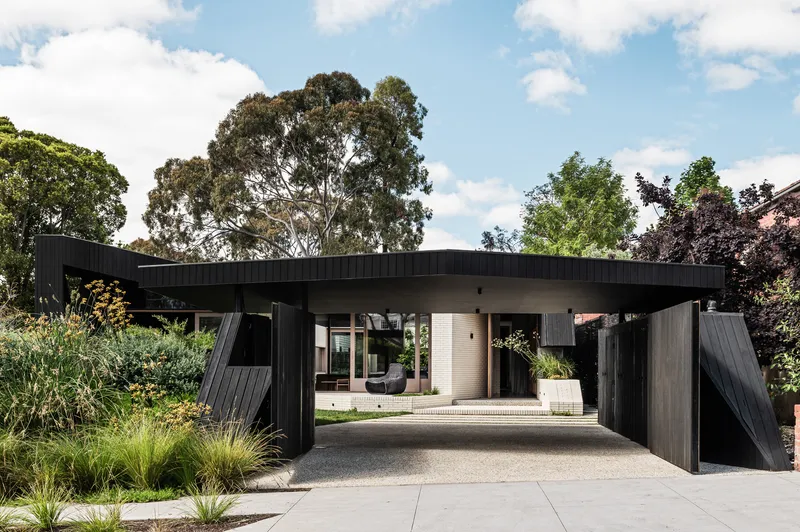
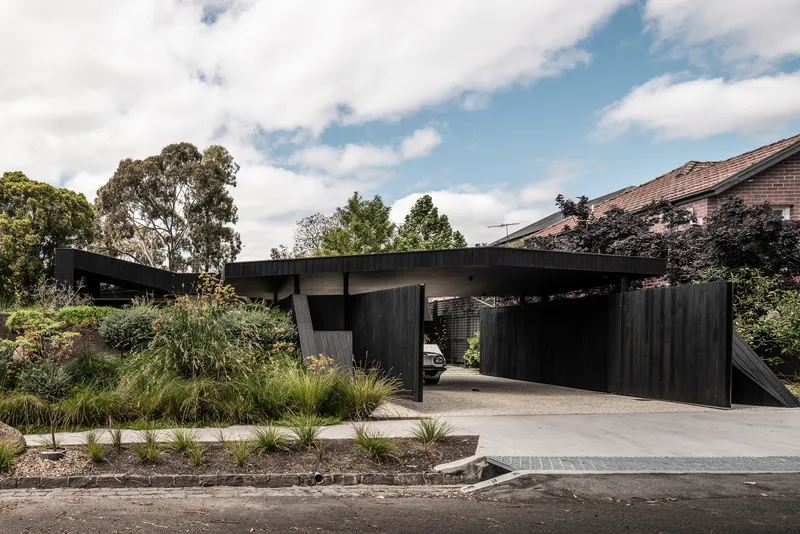
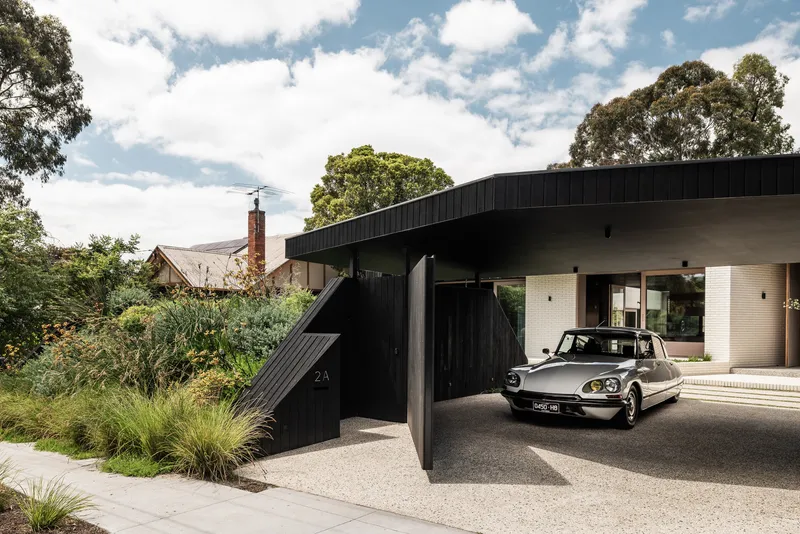
The arrival sequence pulls you off the street and under a broad, flat cantilevered roof supported by angular charred timber columns. The carport doubles as a threshold, compressing your view before releasing you into the house. A vintage sedan sits beneath the sweeping overhang in one image, and the scale feels deliberate: generous enough to shelter a car and its occupants without the closed-off feeling of a garage. Vertical timber cladding wraps the volume above, its deep carbonized grain catching light differently at every angle.
FIGR used Charred Silver Top Ash in ship-lap profile for the exterior cladding. The charring process, a controlled burn that carbonizes the surface layer, gives the timber natural resistance to rot and insects while producing that distinctive black texture. It is an old Japanese technique (shou sugi ban) adapted here to Australian hardwood, and it means the facade will weather in place rather than requiring paint or stain over time.
The Courtyard as Solar Engine
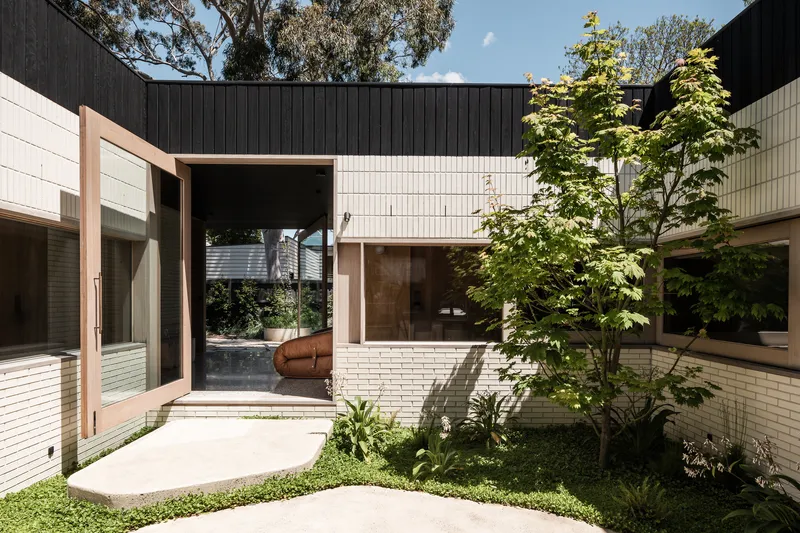
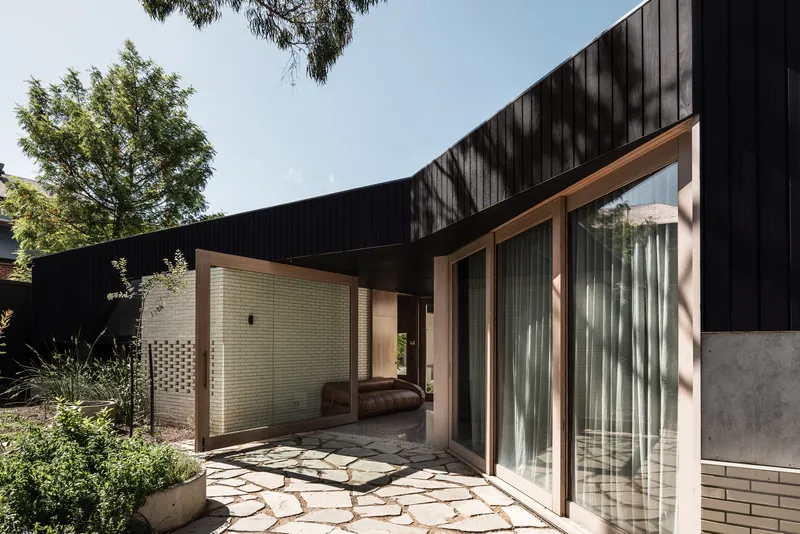
The donut plan is the heart of the project's environmental strategy. By wrapping rooms around a central landscaped courtyard, FIGR ensured that north-facing glazing lines the internal perimeter of the house, pulling winter sun deep into living, dining, and bedroom zones. The courtyard also drives cross ventilation: open windows on opposite sides of the ring draw air through the house via the courtyard's thermal stack, reducing reliance on mechanical cooling. On a south-facing block, this is not a luxury but a necessity.
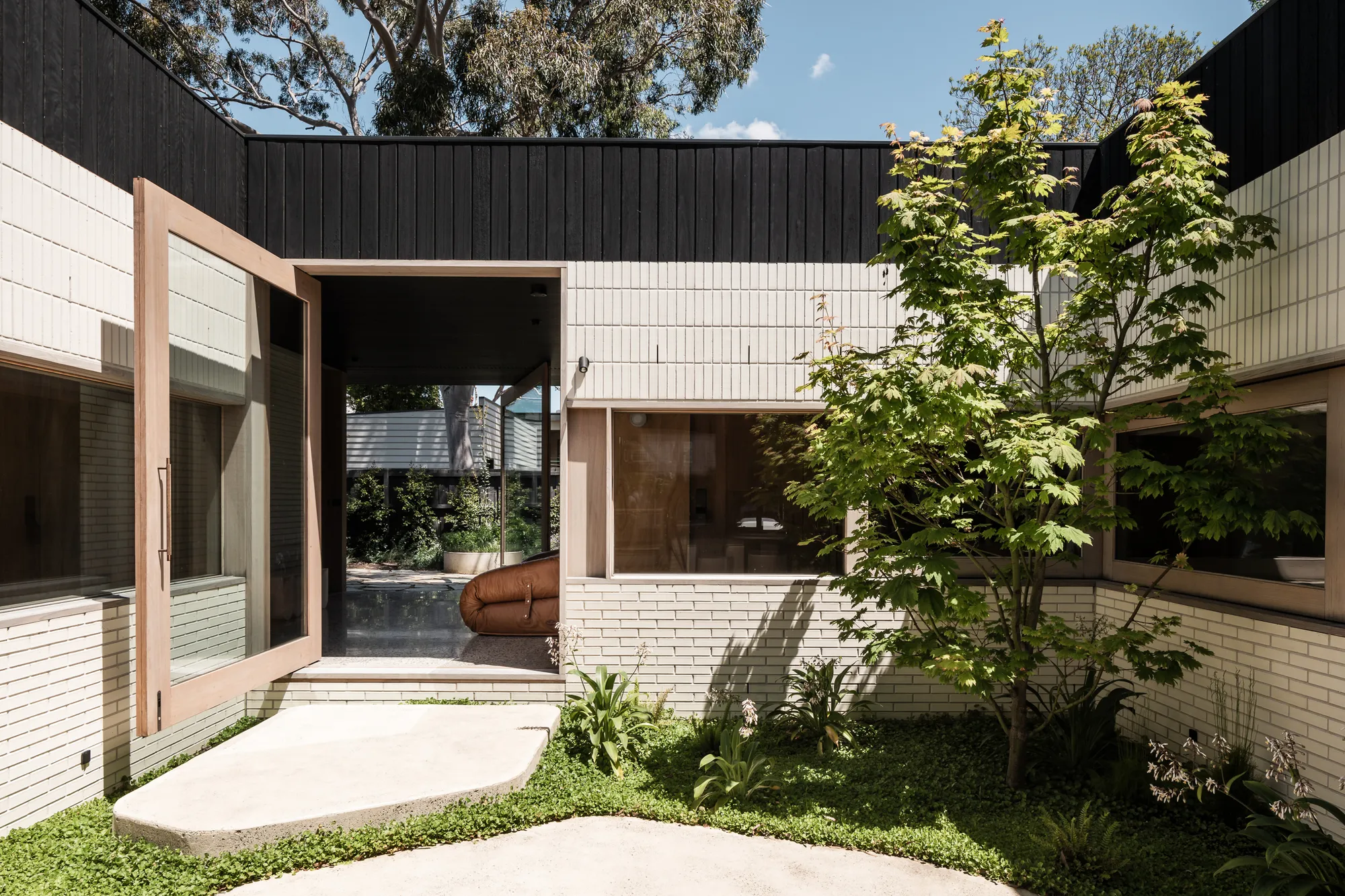
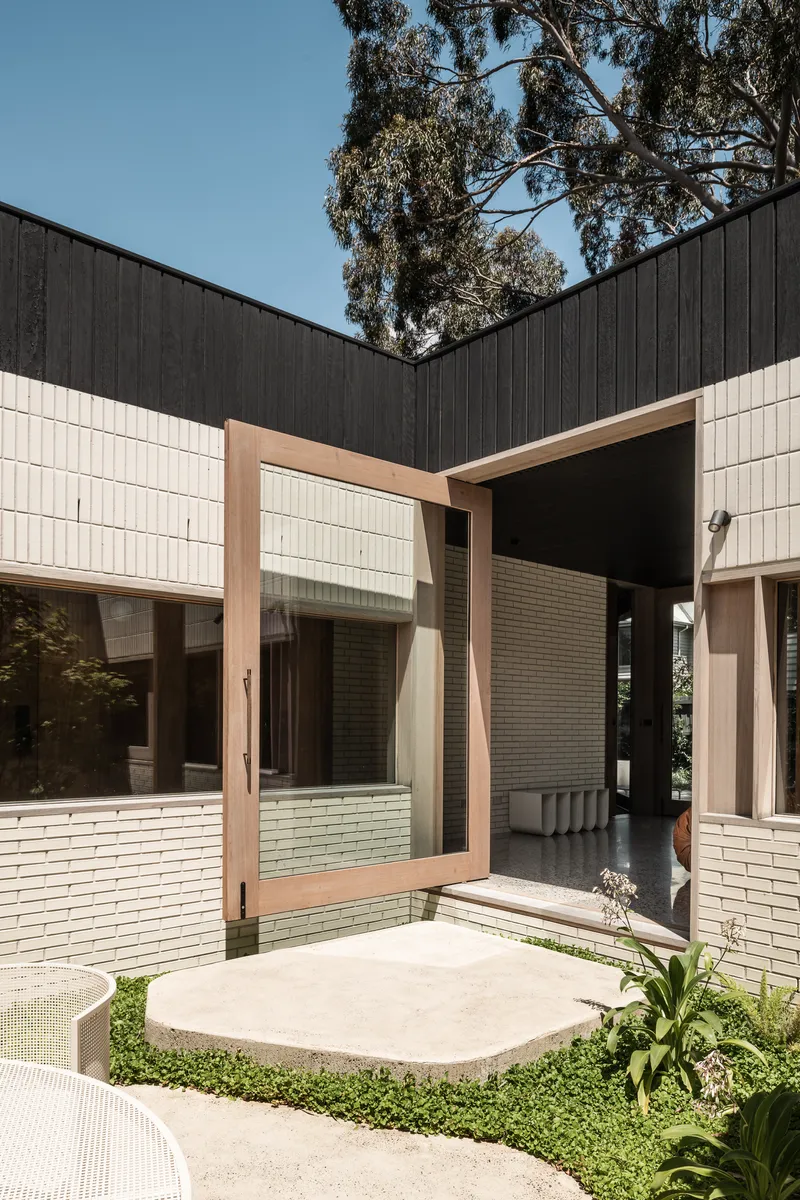
The courtyard itself is planted simply: a lawn panel, a young tree, and broken flagstone paving that softens the geometry of the surrounding cream brick walls. Those walls, built from Austral Brick's Lapaloma Series (Miro) with CSR Barestone, continue the same pale masonry from interior to exterior without a change in finish. The effect is that stepping outside feels less like leaving the house and more like entering another room.
Brick, Timber, and Terrazzo: Three Materials, Locally Sourced
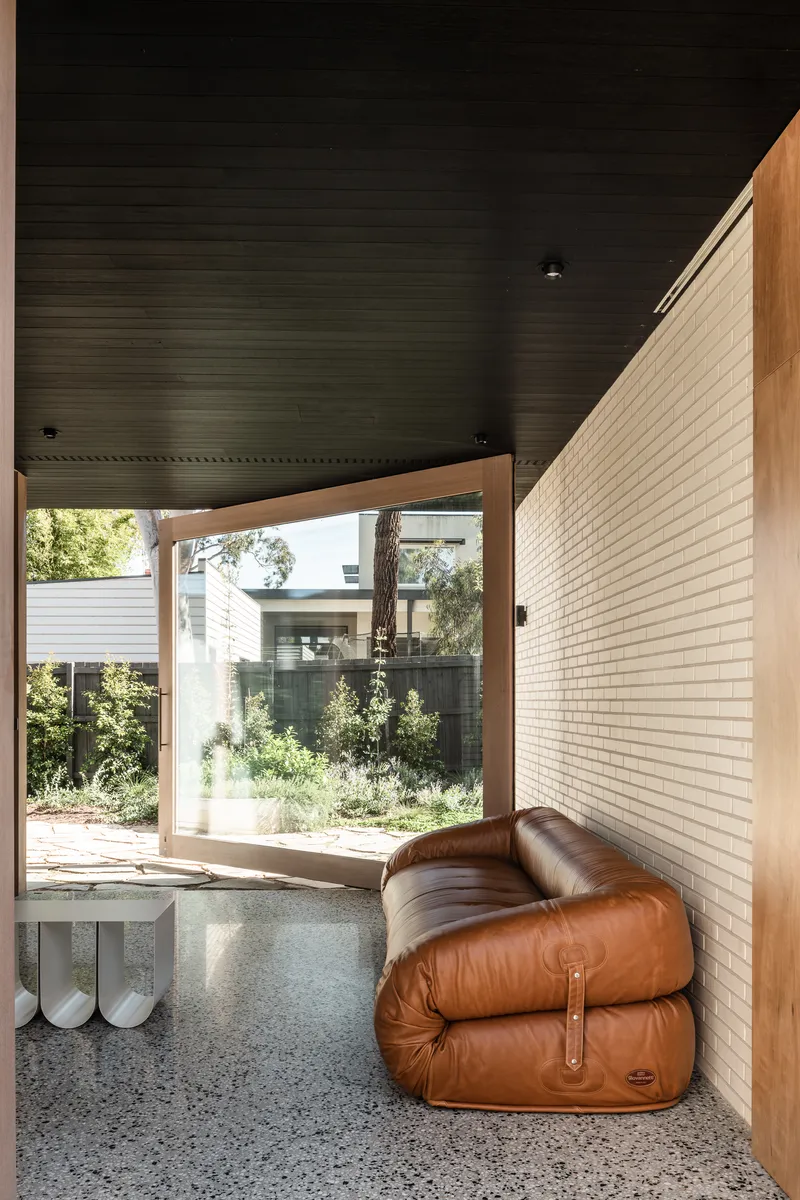
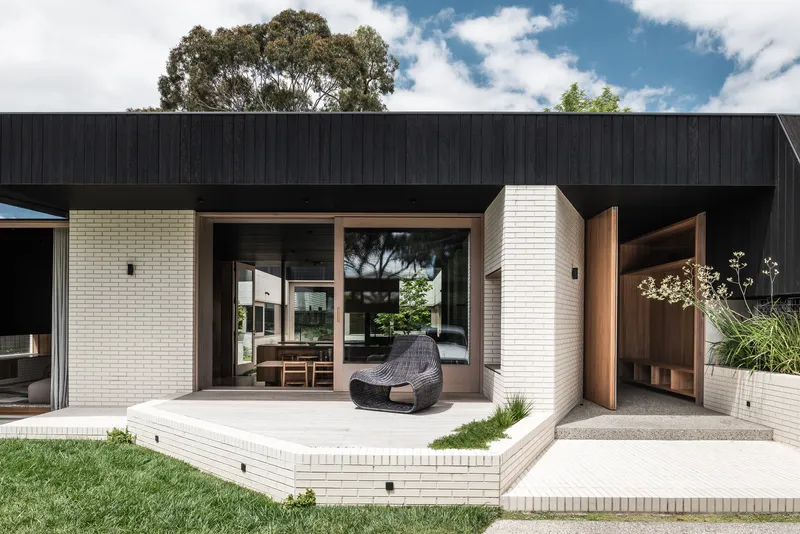
FIGR limited the material palette to three main finishes, all locally sourced to reduce embodied carbon. Pale brick forms the structural plinth and courtyard walls. Charred Blackbutt timber wraps the exterior and continues into ceilings and soffits. Terrazzo appears at key thresholds, including a covered entry nook with brown leather seating that reads like a generous porch folded into the plan. The discipline of the palette gives the house coherence across its considerable floor area; you are never confused about which building you are in.
Curved concrete paving inset with groundcover threads through the landscape zones, stitching inside and outside together. Vic Ash window frames, finished in Cutek Grey Mist, split the difference between the dark cladding and the pale brick, creating a warm mid-tone that reads as timber without competing with either major finish.
Living and Kitchen: The Inhabited Spine
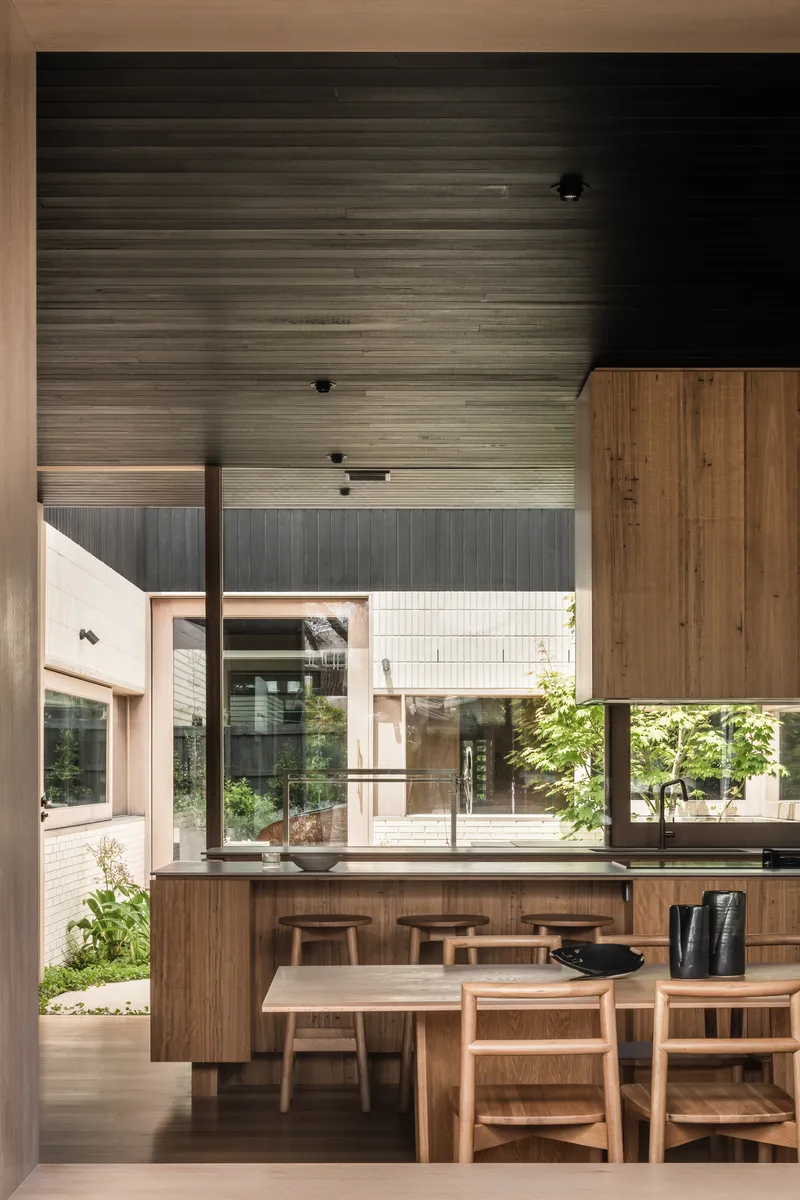
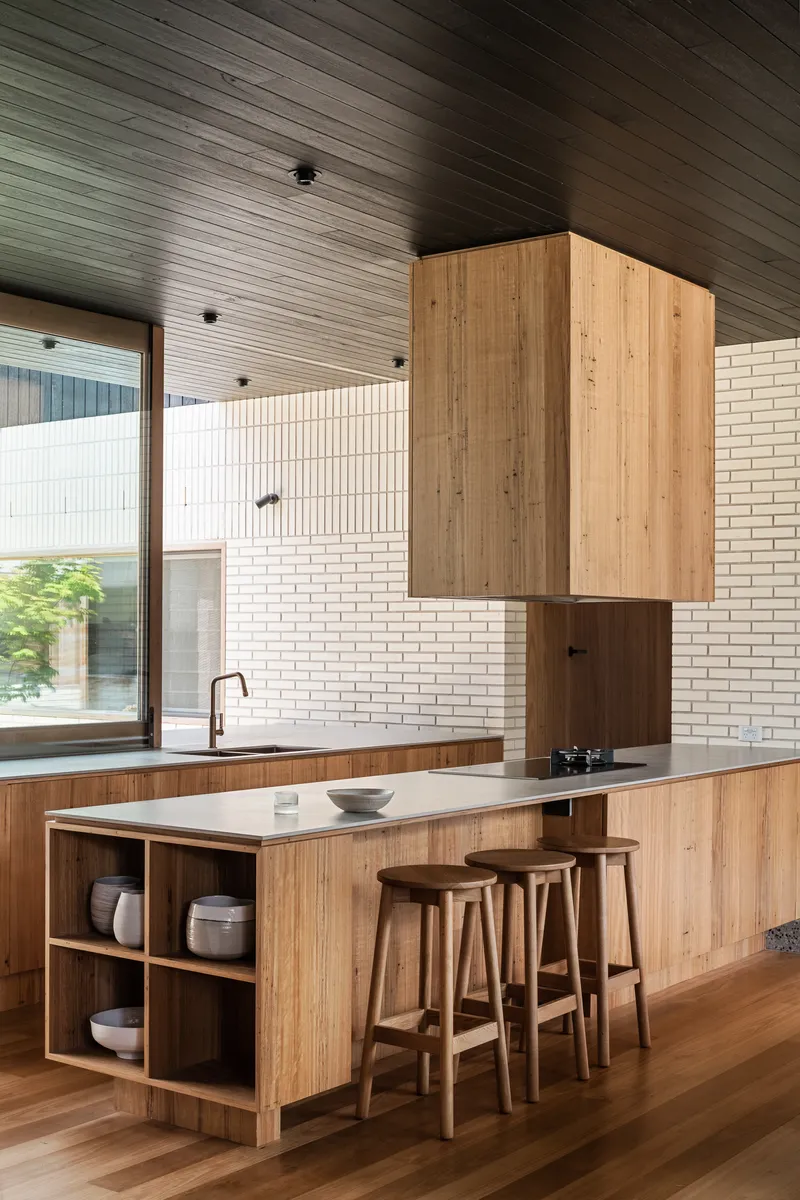
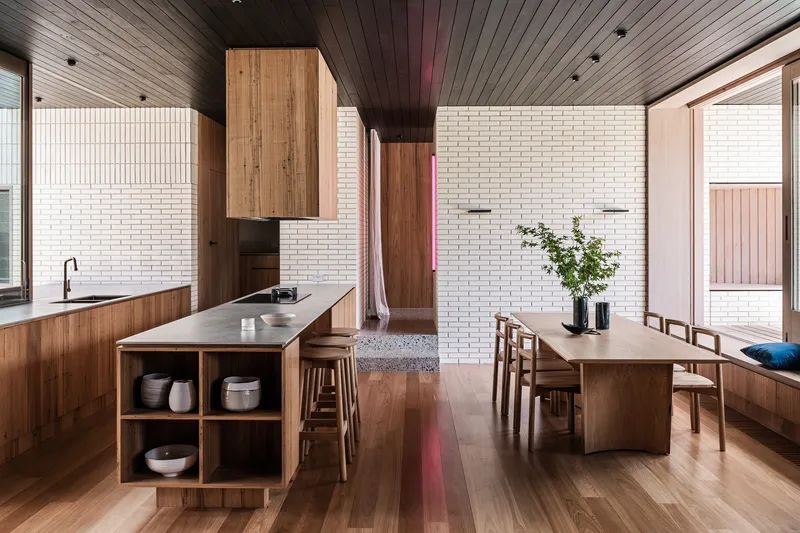
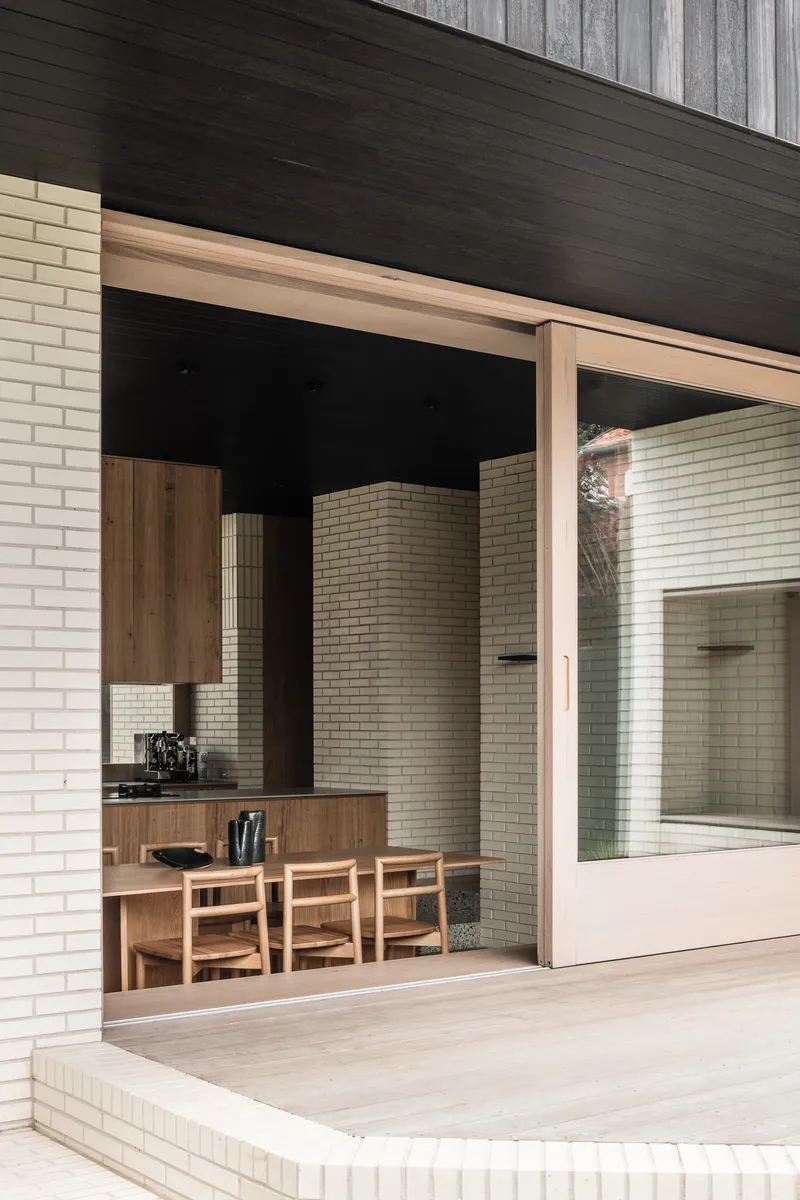
The kitchen and dining area occupies the northern arm of the ring, directly facing the courtyard through oversized sliding doors. Natural Blackbutt timber cabinetry runs the length of the kitchen island, topped with a suspended timber hood that drops from the charred slatted ceiling above. Three stools line up beneath it. The high ceiling lifts the space vertically while the courtyard view extends it horizontally, and the combination prevents the kitchen from feeling like a corridor despite its linear layout.
Big River Blackbutt panels treated in Osmo Polyx Oil line the internal walls, giving them a matte warmth that pairs well with the cream brickwork. The dining table sits against a brick wall beneath a skylight, receiving direct light from above while the courtyard glows through glazing to one side. It is a room designed for long meals and shifting daylight.
Living Room and Retreat Spaces
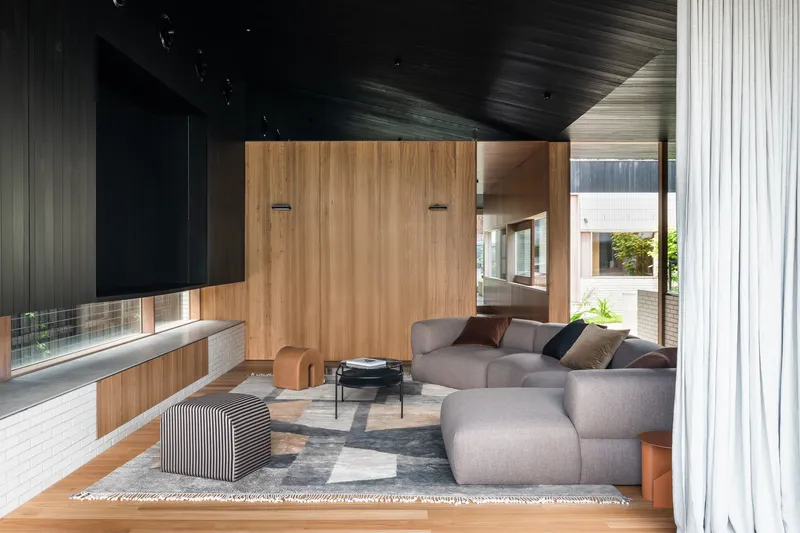
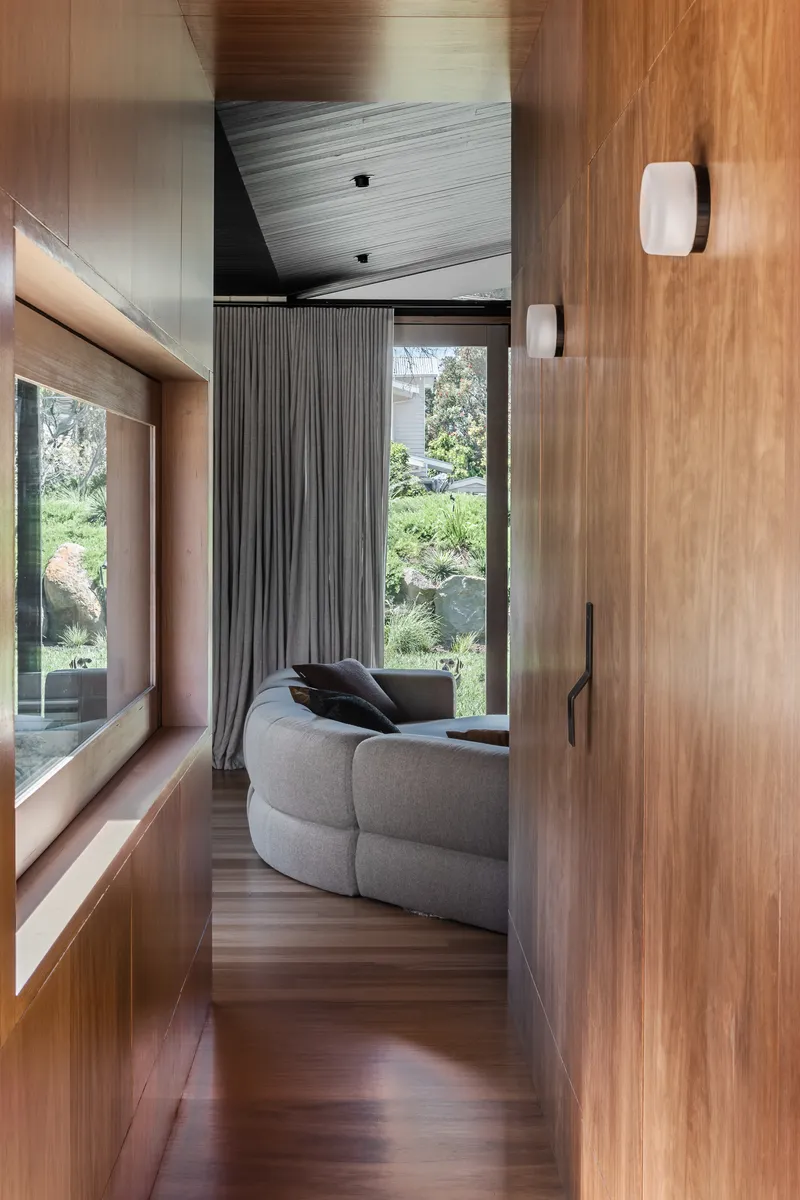
The continuous circulation plan means every room connects to at least two others, eliminating dead-end corridors. The living room anchors one end of the loop with a deep sectional sofa and a full-height timber storage wall. A slatted timber ceiling runs overhead, darkened to match the exterior cladding and creating a cave-like contrast with the bright courtyard visible through adjacent glazing. Framed openings punch through brick walls to reveal dining areas and courtyard views beyond, layering sightlines so that no room feels isolated.
A hallway with angled timber ceiling and walls leads from the retreat to the living area, its narrowing perspective terminating in a garden view. These transitional spaces matter in a house designed for aging-in-place: they are wide enough for comfortable movement, lit naturally, and free of level changes that would complicate accessibility.
Bedrooms and Bathrooms
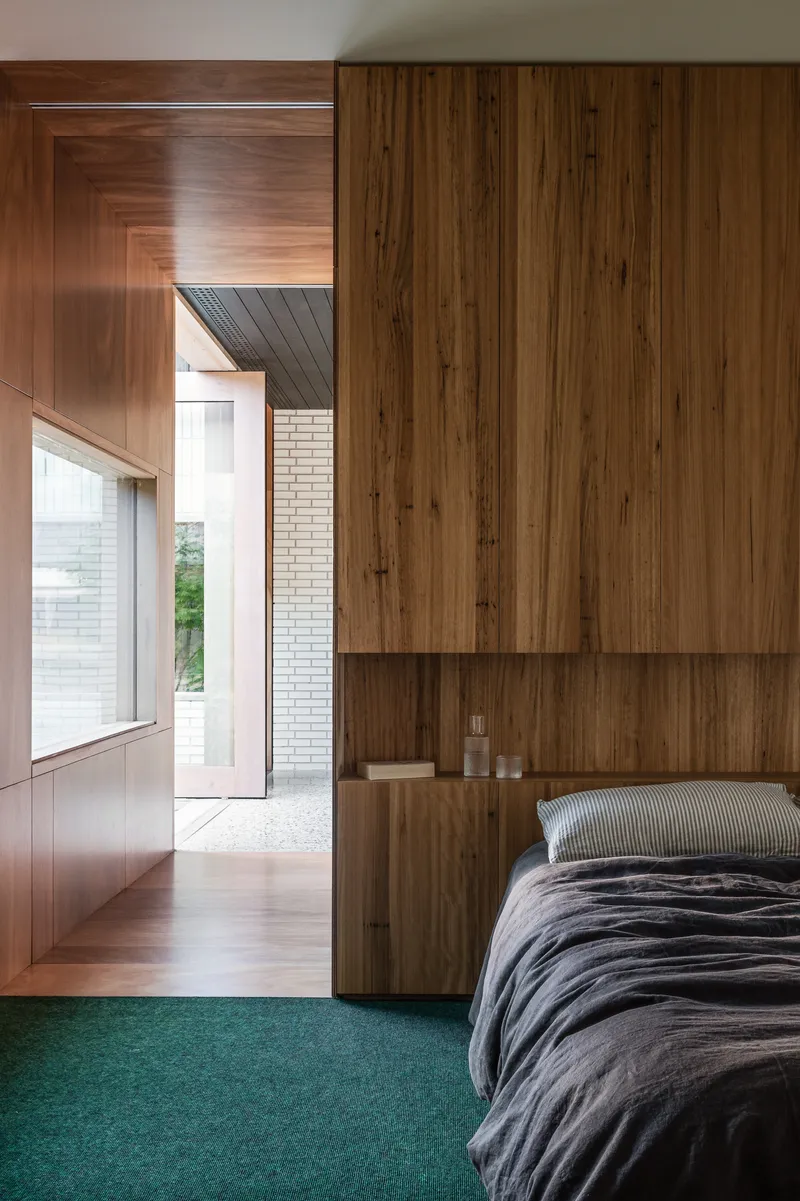
Bedrooms sit along the quieter edges of the ring, each with direct courtyard access. One bedroom features a full-height timber wardrobe wall and green carpet that continues the muted landscape palette indoors. The doorway frames the courtyard beyond, reinforcing the idea that every room in the house is a room with a garden.
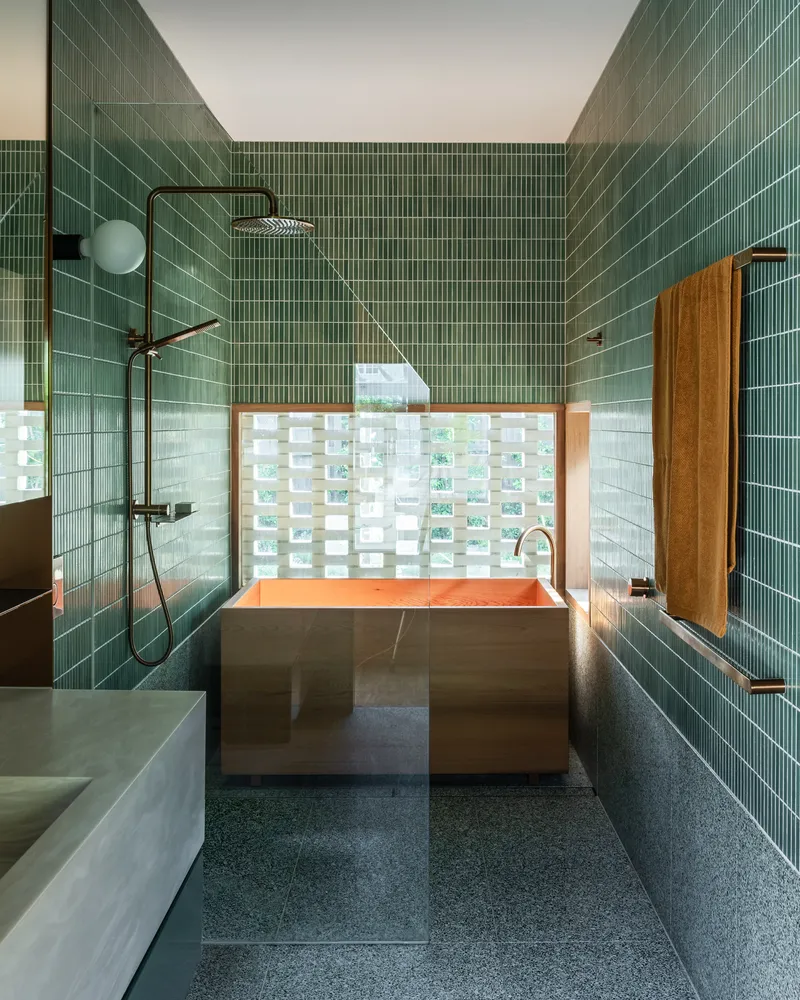
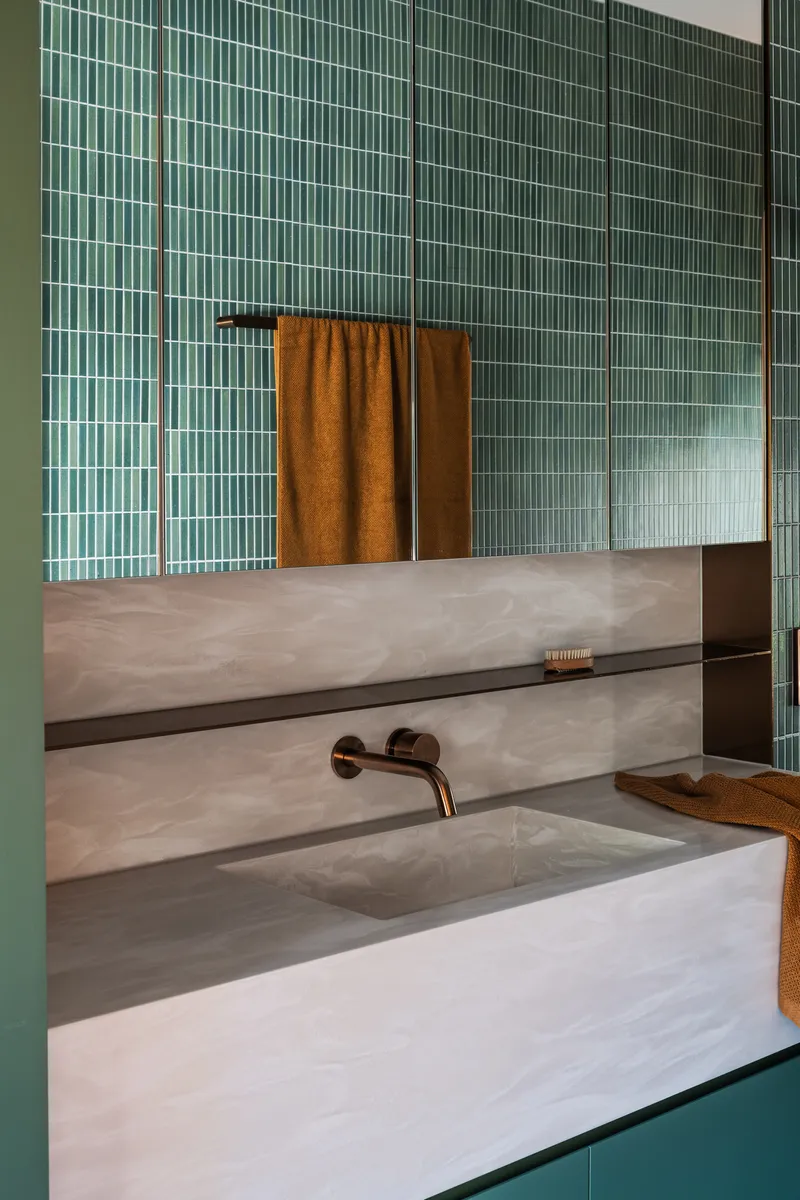
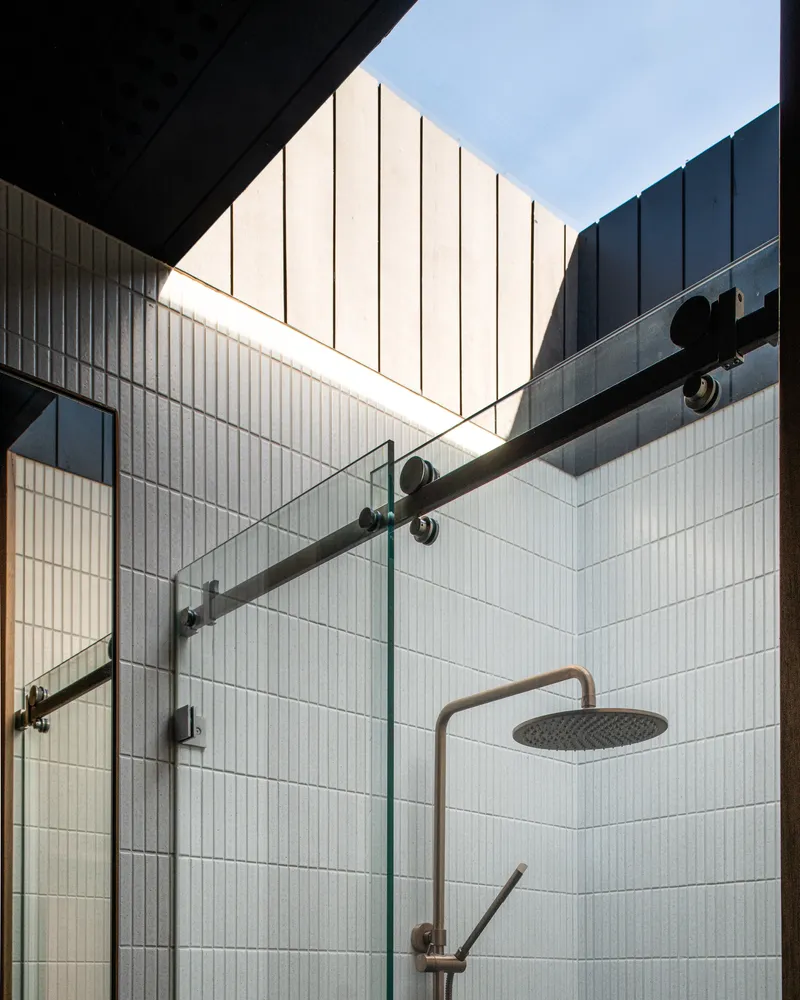
The bathrooms are where FIGR allowed a more expressive hand. Deep green vertical tiles wrap the walls, paired with copper fixtures and, in the main bathroom, a freestanding copper bathtub. A translucent glass block window filters light without sacrificing privacy. The vanity integrates a marble sink below bronze wall-mounted taps, and an open-air shower enclosure in another bathroom introduces a skylight above white vertical tile, bringing the courtyard logic of light-from-above into even the most private rooms.
Outdoor Rooms and the Rear Terrace
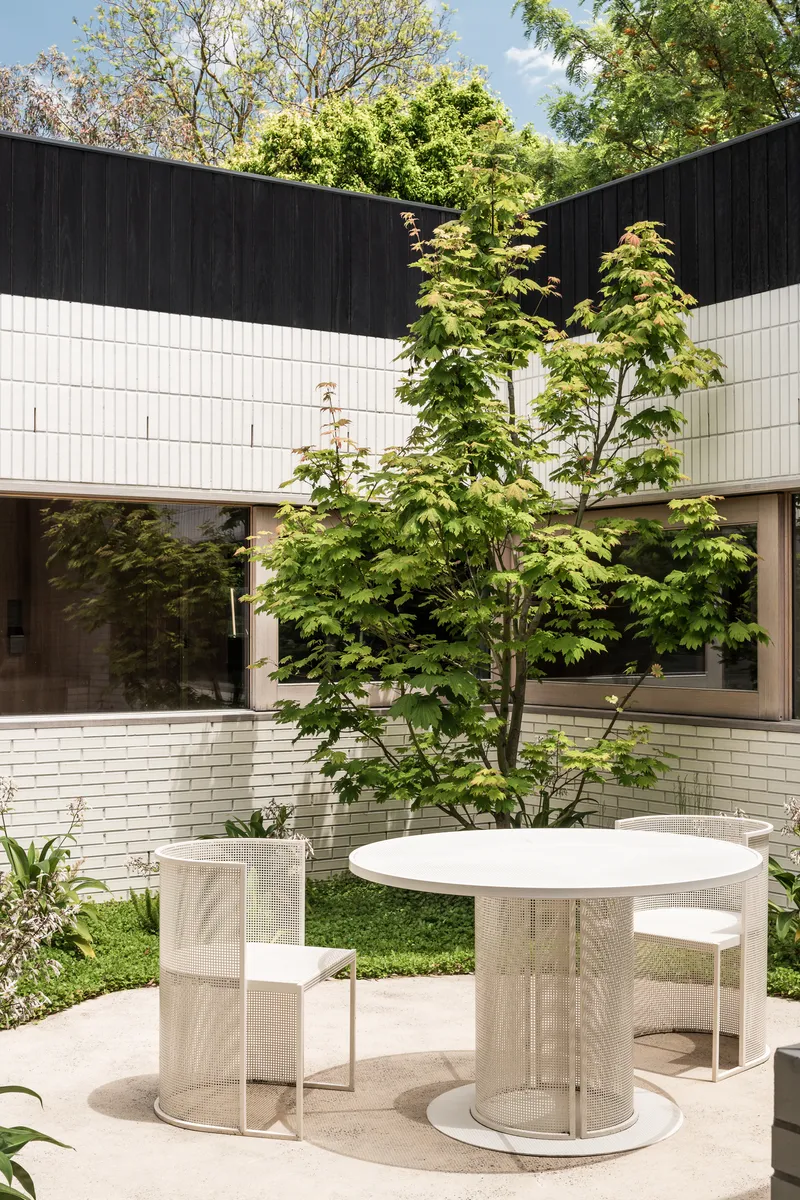
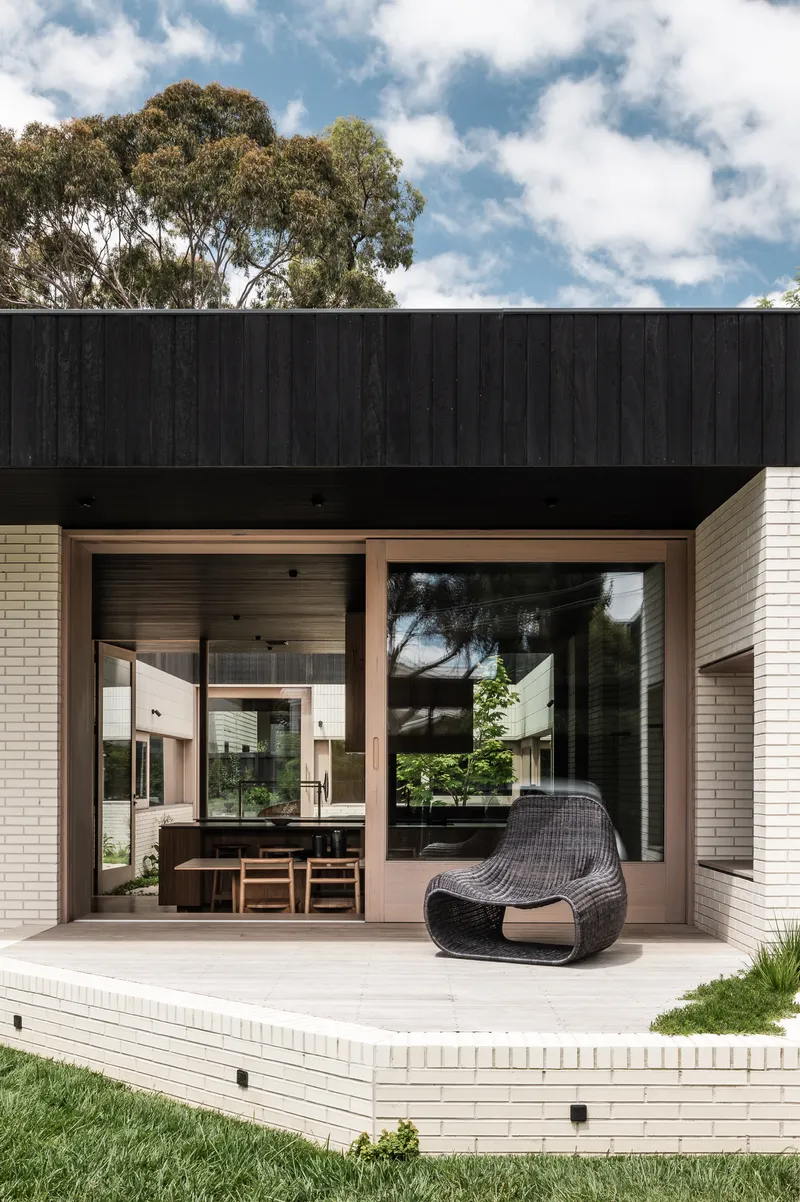
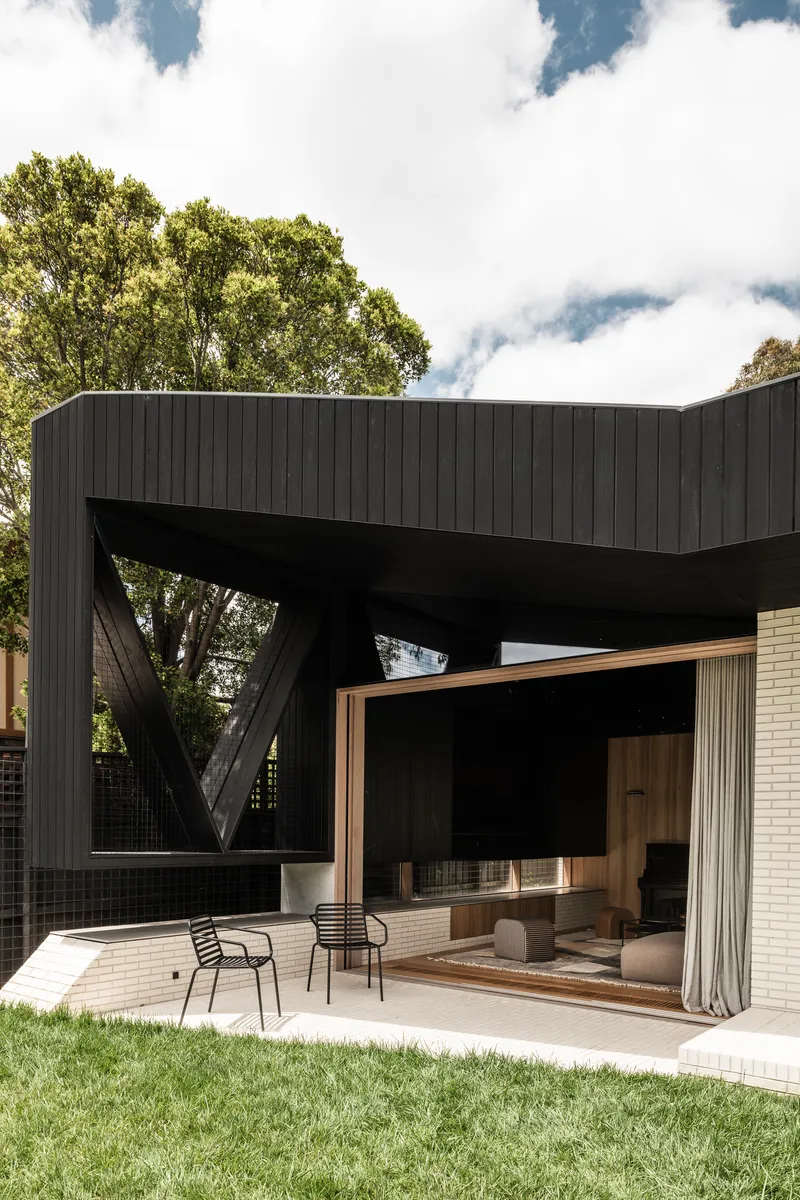
The courtyard is not the only outdoor room. A rear terrace extends from the living area beneath a deep timber overhang, its diagonal structural bracing left exposed as an honest expression of the cantilevered roof structure. Sliding glass doors open the living room fully to this covered zone, and a woven lounge chair occupies the transition between inside and out. On the courtyard side, a separate terrace shelters mesh-wrapped dining furniture beneath a Japanese maple, creating a shaded dining room that needs no walls.
These outdoor spaces are essential to the house's environmental performance. Deep eaves and canopies shade glazing from high summer sun while admitting low winter light, and the charred timber veil acts as a heat trap, absorbing solar energy before it reaches the glass behind. Combined with the 20,000-litre rainwater harvesting system, which provides recycled water at ten times the rate required by local building regulations, the passive strategies add up to a house that works hard without looking like it.
Street Presence and Landscape Integration
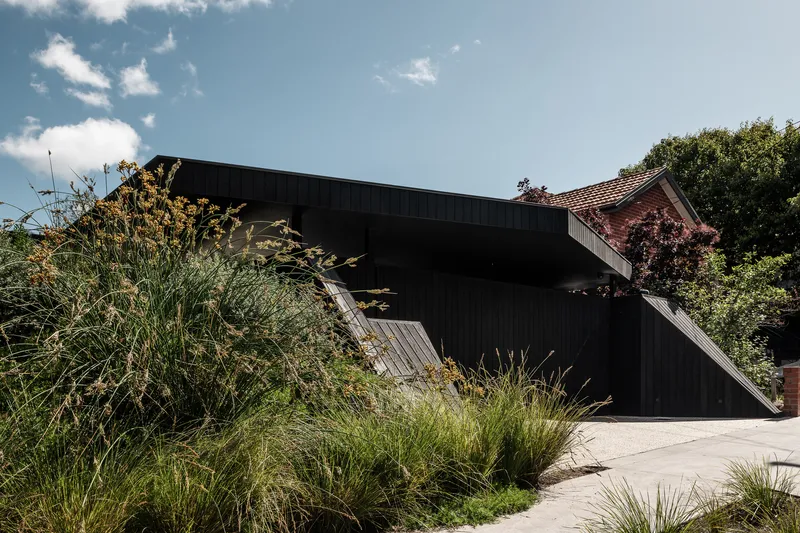
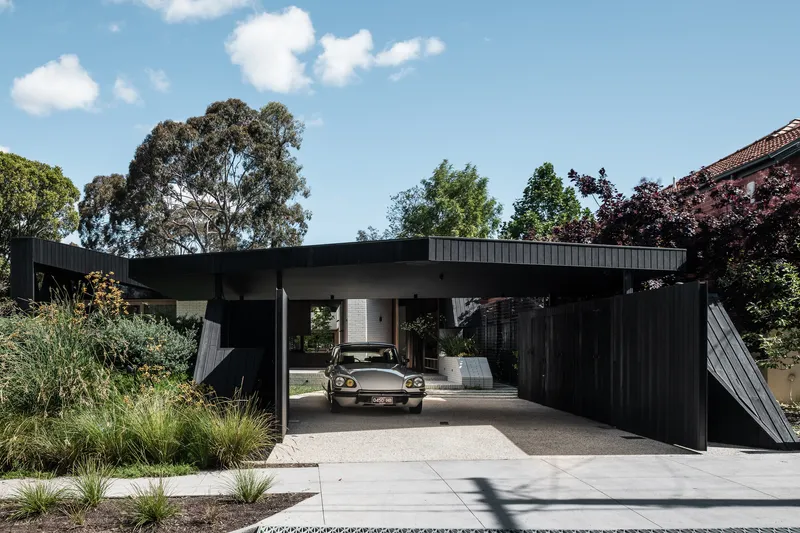
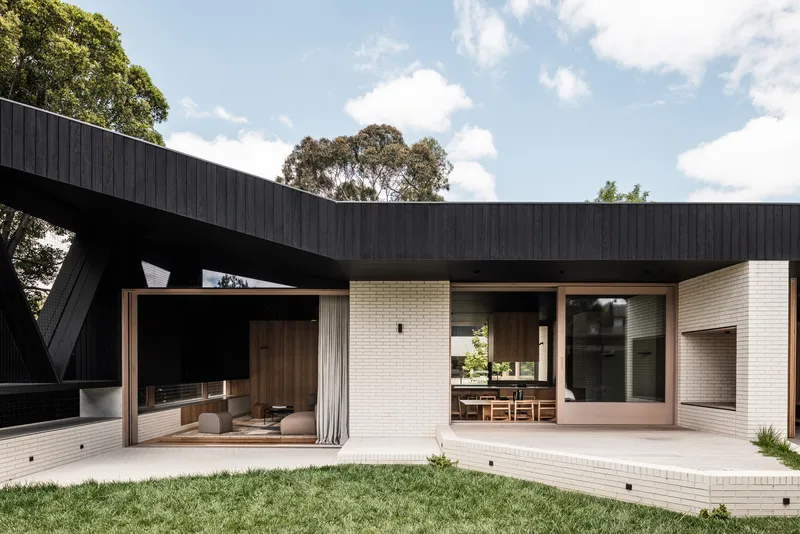
From various angles along the street, Ha Ha Haus reads differently. The angled timber-clad volume rises sharply above tall grasses, its geometry recalling agricultural sheds more than suburban homes. The open carport, with planted beds on either side, mediates between the public realm and the private interior. At the rear, cream brick walls and timber-framed glazing face a more domestic scene: the courtyard, the terrace, the garden beyond.
The landscape design by MUD Office deserves credit for making the transition between public and private feel inevitable rather than contrived. Native plantings along the front mound require minimal irrigation and maintenance, and they knit the house into the leafy character of the suburb rather than standing apart from it. The gravel beds and layered planting structure along the driveway are not ornamental borders but functional zones that manage stormwater runoff and direct pedestrian movement.
Interior Thresholds and Material Continuity
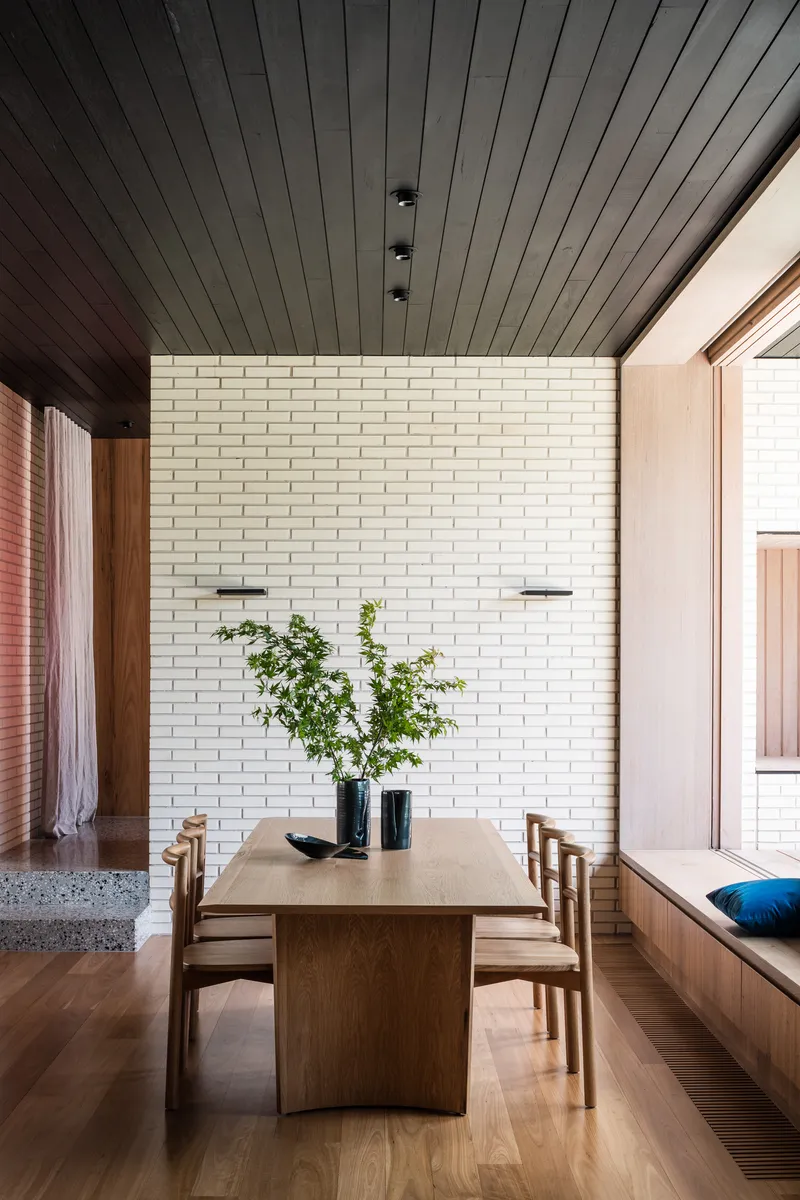
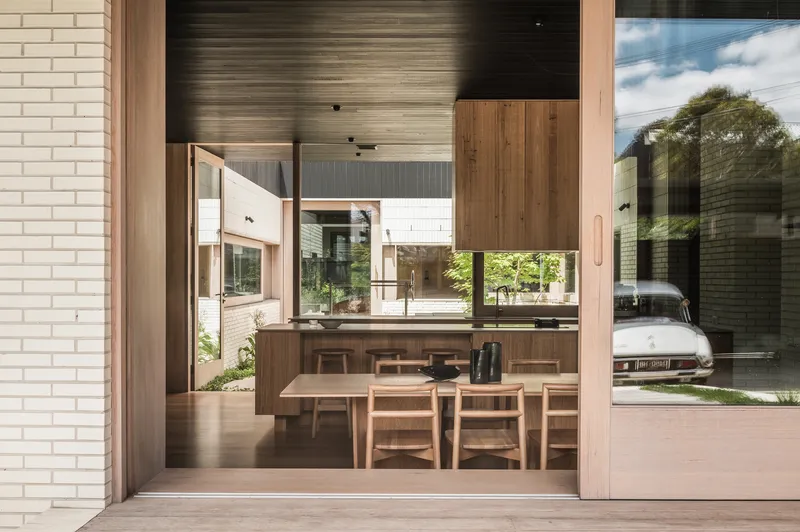
One of the project's most effective details is the way materials pass through thresholds without interruption. Light brickwork continues from courtyard walls into dining areas. Charred timber on the exterior soffit becomes the ceiling above the kitchen. Polished concrete flooring runs from covered terraces into interior living spaces. These continuities dissolve the boundary between inside and outside, reinforcing the courtyard house typology where enclosure is always partial and the garden is always present.
The oversized pivot doors connecting living spaces to the courtyard are the most dramatic expression of this idea. When open, they remove the wall plane entirely, turning the dining room into a pavilion. When closed, their timber frames align with the window joinery to maintain the rhythm of the facade. It is careful detailing that makes a big gesture feel calm.
Why This Project Matters
Ha Ha Haus matters because it takes a genuine problem, how to get north light and privacy on a south-facing suburban block, and solves it with a spatial idea rather than a technical gadget. The donut courtyard plan is not new, but applying it here, in a leafy Melbourne suburb where the default response would be a two-storey box with a south-facing backyard, demonstrates how much performance a simple typological move can unlock. The house stays single-storey, stays accessible, stays connected to its garden on all sides, and still manages 675 square metres of program without feeling oversized from the street.
More broadly, the project challenges the assumption that suburban privacy requires a fence. The planted mound is a more generous gesture than a paling boundary: it gives something back to the street while still protecting the inhabitants. For a house designed around intergenerational living and aging-in-place, that generosity extends inward too. The continuous circulation, the threshold-free floor plane, the multiple outdoor rooms at different scales, all of these decisions anticipate a household that will change over decades. FIGR has built a house that is ready for the long game, and it looks completely at ease while doing it.
Ha Ha Haus by FIGR Architecture & Design. Alphington, Victoria, Australia. 675 m². Completed 2022. Landscape design by MUD Office. Builder: Byde Constructions Pty Ltd. Photography by Tom Blachford.
About the Studio
Share Your Own Work on uni.xyz
If projects like this are the kind of work you want to make, uni.xyz is a place to publish your own, find collaborators, and enter design competitions.



Popular Articles
Popular articles from the community


Conexión: Biophilic Design Reimagines High-Rise Living in Hong Kong
Conexión reimagines high-rise living in Hong Kong through biophilic design, green facades, shared spaces, daylight, water and nature within.

The Earth Pod: 3D Printed Homes for Resilient Refugee Communities
The Earth Pod reimagines refugee housing through 3D printed homes made from clay, combining resilience, self-sufficiency, and rapid shelter.

Play: Fragments of Their World
Familiar architecture becomes modular playground design, creating safe spaces where displaced children can learn, connect, imagine and play.

Co-Life: Senior Housing Design That Reconnects Older Adults With the City
Co-Life reimagines senior housing design through healing gardens, shared streets, workshops, and a sustainable community across generations.


Similar Reads
You might also enjoy these articles

Bao Huynh Watercolor Atelier: A Serene Art Retreat in Hội An
Bao Huynh Watercolor Atelier in Hội An blends multifunctional art spaces, sustainable design, local materials, and family-friendly living in a serene environment.

Atelier Macri Concept Store Interior Design by CASE-REAL
Atelier Macri store features a "ko" counter, walnut wood details, cork displays, blending retail, gallery, and seamless customer experiences.

Manuel Vargas Izquierdo Stadium and High-Performance Sports Center: Architectural Excellence in Jalpa de Méndez
The Manuel Vargas Izquierdo Stadium blends sustainable design, inclusive sports facilities, and cultural-inspired architecture, revitalizing Jalpa de Méndez’s public spaces.

KAKR Buluh Awar Hall: Revitalizing Community and Ecology Through Bamboo Architecture
Community built bamboo hall revitalizes Buluh Awar village, empowering youth, restoring ecology, celebrating vernacular craftsmanship through sustainable architecture and culture.


Explore Architecture Competitions
Discover active competitions in this discipline



Challenge to reimagine the Iron Throne


Photograph architecture without architects


Illustrate the lost glory of Angkor Wat - Render Challenge


Design challenge to reuse E-waste
Comments (0)
Please login or sign up to add comments
No comments yet. Be the first to comment!