

Fine Line: Stacking Generations in a Vertical Istanbul Home
A four-story multigenerational residence in Istanbul uses a central void and cultural rituals to bind family life across levels.


What if the dining table, not the front door, were the threshold of a home? In 'Fine Line,' a four-story multigenerational residence in Istanbul, a deep vertical void is carved through the entire structure so that natural light can cascade directly onto the kitchen and dining area on every floor. The void is more than a daylighting strategy. It is a spatial declaration that Turkish family life orbits around food, conversation, and the rituals of gathering.
Designed by Betül Kahraman and published on uni.xyz, the project confronts two realities of contemporary Istanbul: the dense urban fabric that demands vertical living and the cultural expectation that a home must serve not just individuals but an entire extended family. The result is a compact residence that stacks four generations across four levels while keeping them connected through shared voids, terraces, and a central courtyard.
A Vertical Section That Reads Like a Family Tree
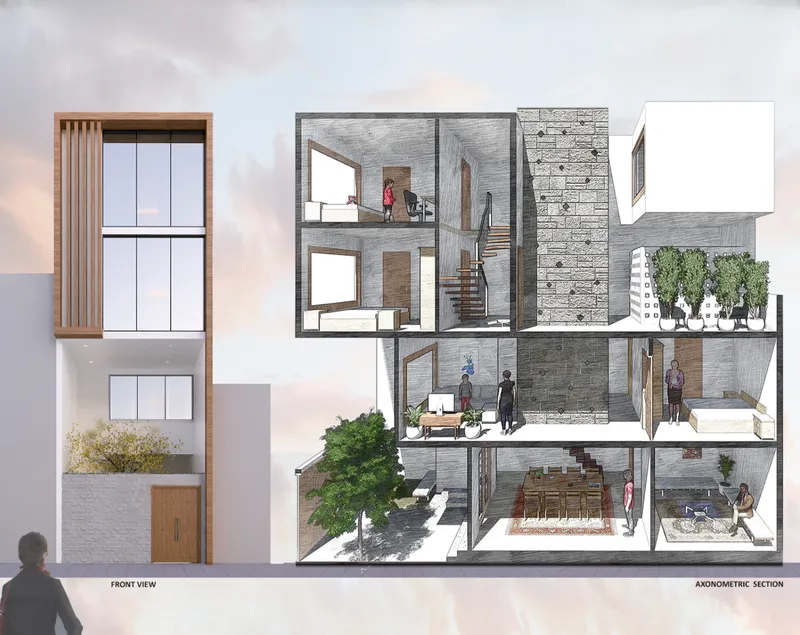
The axonometric section drawing reveals the logic of the entire project at a glance. The ground floor operates as shared communal territory: living, dining, and gathering space that belongs to no single generation. Above it, the first floor is given to the elderly couple, designed with minimal level changes and maximum accessibility. The second floor accommodates the younger couple alongside a terrace garden. The third floor, reserved for children, prioritizes privacy and room for play. Each level has its own bathrooms and seating areas, ensuring autonomy, while the central void and shared green zones pull inhabitants back into collective life.
This vertical stacking is not arbitrary. It mirrors the layered, shared character of traditional Turkish houses, where extended families lived under one roof with a clear hierarchy of private and communal zones. By distributing generations across floors rather than across plots, Kahraman turns Istanbul's real estate constraints into an opportunity for tighter familial bonds.
A Courtyard That Breathes Through the Building
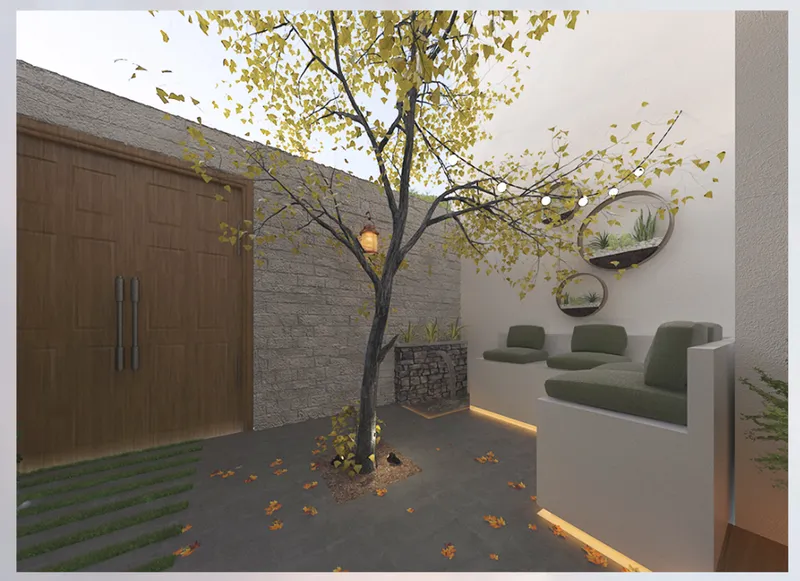
The interior courtyard is the thermal and emotional engine of the house. A deciduous tree anchors the space, its canopy filtering yellow autumn leaves against green upholstered seating below. This is not decorative landscaping. The courtyard provides cross-ventilation, thermal comfort through evaporative cooling and shading, and a visual connection to nature on every floor. The greenery, combined with water elements, creates a microclimate that reduces the need for mechanical cooling in Istanbul's hot summers.
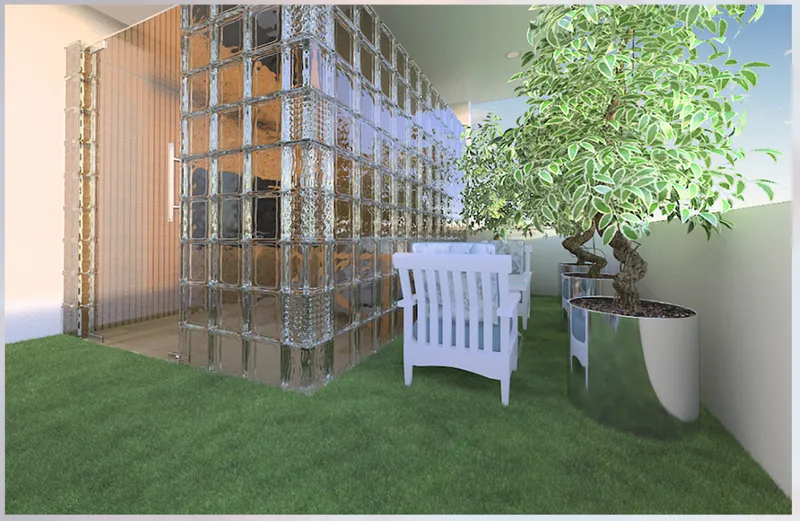
Up on the roof terrace, a glass block screen filters light into geometric patterns while a potted tree casts long shadows onto artificial turf. The terrace functions as a shared green zone, extending the livable area beyond the building's compact footprint. Glass block recurs throughout the project as a material that admits light while maintaining privacy, a critical move in a dense urban context where neighboring buildings crowd close.
Ottoman Sofas and Nazar Motifs in a Minimalist Shell
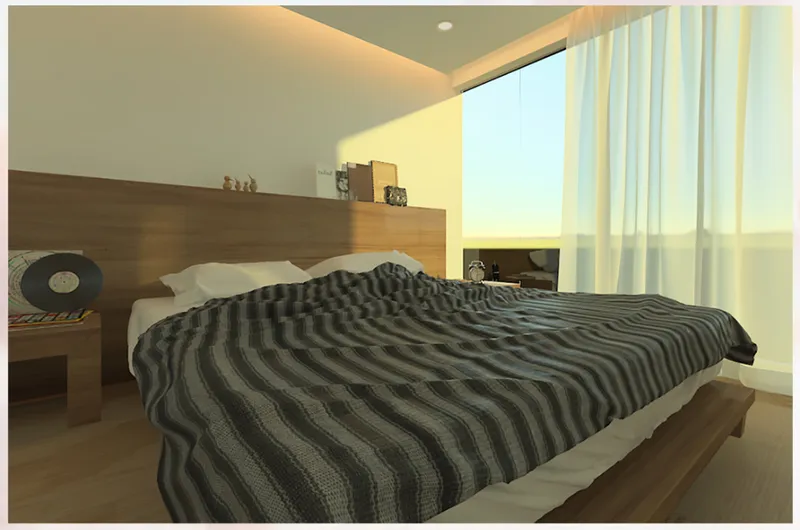
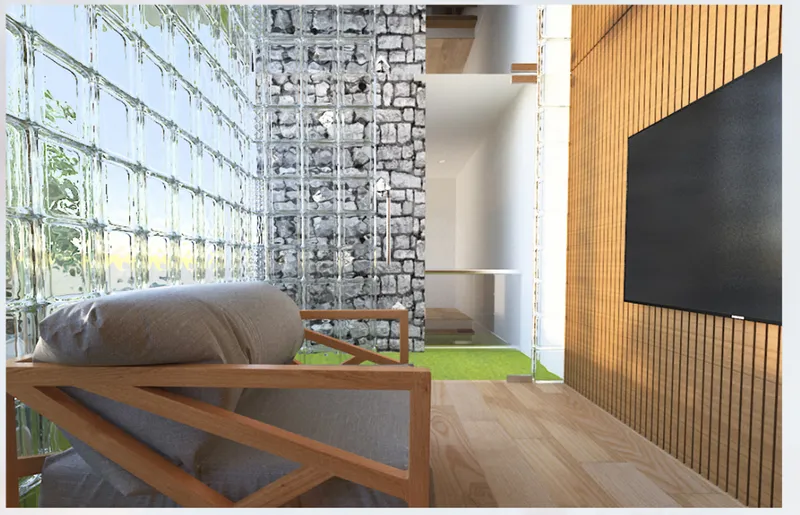
The interiors walk a fine line (the project earns its name) between contemporary minimalism and cultural specificity. A bedroom features a warm wooden headboard wall and striped bedding lit by afternoon sun, spare and calm. Nearby, a living space pairs a glass block wall with a timber slatted screen beside a media display. The palette is local: white concrete, natural stone, and timber, all sourced regionally. These materials age honestly and ground the house in its Istanbul context rather than floating in the placeless aesthetic of global modernism.
Kahraman threads traditional elements into these clean volumes with subtlety. Ottoman-style sofas appear in the lounge areas. "Nazar" motifs, protective eye symbols from Turkish folk culture, are embedded into the void wall. Custom furniture reflects Turkish craft traditions without resorting to pastiche. The effect is a home that feels specific to its place and family without being a museum of nostalgia.
A Staircase That Connects More Than Floors
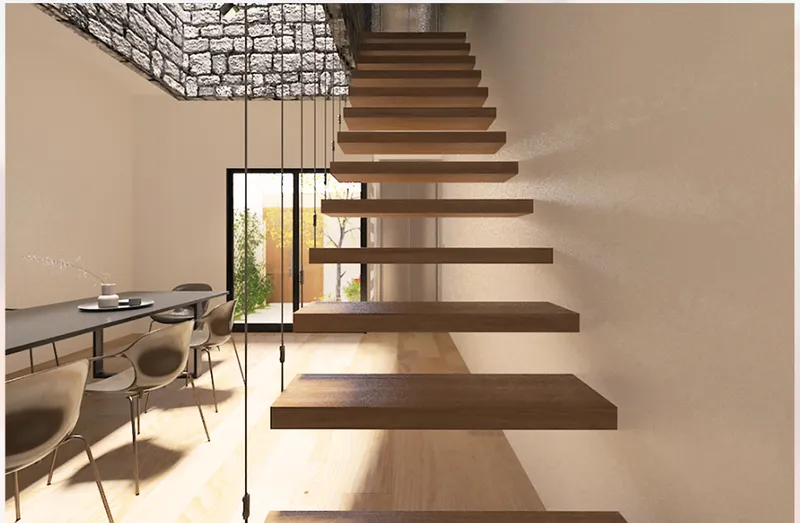
The cantilevered timber staircase with its glass railing is one of the project's most evocative moments. Caught in morning light, it overlooks the dining area below, reinforcing the idea that vertical circulation in this house is not just functional passage but a form of social connection. Standing on the stair, you see the family gathered at the table. The void opens up sightlines between levels, collapsing the isolation that typically accompanies stacked living. Every trip between floors becomes an encounter with the communal heart of the home.
Why This Project Matters
Multigenerational housing is often discussed in policy terms: affordability, elder care, cultural preservation. Rarely is it explored architecturally with this level of spatial precision. 'Fine Line' demonstrates that accommodating six people across four generations in a compact urban site does not require sacrificing comfort, privacy, or identity. The key move, the central void that unites all floors around the act of sharing a meal, transforms a practical constraint into an architectural idea worth remembering.
Kahraman's project also offers a quiet argument about sustainability. The cross-ventilation strategies, local materials, courtyard microclimate, and modular adaptability are not bolted-on green features. They emerge from the same cultural logic that places the family table at the center of the plan. Sustainability here is not a checklist; it is an outcome of designing for how people actually live. In a city like Istanbul, where tradition and density collide at every corner, that integration feels exactly right.
View the Full Project
About the Designers
Designer: Betül Kahraman
Enter a Design Competition on uni.xyz
uni.xyz runs architecture and design competitions year-round that reward proposals with spatial conviction and real site intelligence.
Project credits: Fine Line' by Betül Kahraman.


Popular Articles
Popular articles from the community


Cube Design Draws an Ecological Corridor Between Two Shenzhen Hills with the Nankai Building
Beside Shenzhen's container docks, the Nankai Building pairs stacked balconies with a climbing green screen to connect two hillsides across its height.

U.GA Architects Wraps an Oval Rooftop Pool in Curved Board-Formed Concrete on Busan's Jeollidan-gil
In Busan's Jeonpo-dong, a 454 m² mixed-use block stacks a neighborhood facility, guest rooms and an oval rooftop pool inside spiraling concrete walls.

LT2A and OPEN Architectes Thread a Brick and Glass High School Through a Wooded Belgian Campus
In Braine-l'Alleud, a 3,000 m² wing for Collège Cardinal Mercier pairs pale brick with a glazed colonnade, deferring to a small chapel and a dense wood.

David Ortega Stacks a Two-Story Mexico City Penthouse Around a Steel Stair and a Pergola-Shaded Roof Terrace
In Colonia Roma, a 300 m² penthouse uses oak joinery, a planted steel stair and a slatted roof pergola to make a new-build apartment feel like a house.

Similar Reads
You might also enjoy these articles


Vereda Arquitetos Renovates a 40-Square-Meter Apartment Inside Niemeyer's Copan Building
A compact unit in São Paulo's most iconic residential tower gets a material overhaul that pairs exposed concrete with bold blue Formica.

Shakur's House: Exposed Brick as an Interior Organiser in a 168 m² Mashhad Residence
Brick moves indoors in this Mashhad residence, where masonry walls, glass partitions and teal planes sequence a compact home without closing it off.

Day and Night Park: A Time-Based Urban Newsstand in Beijing
A temporary urban newsstand in Beijing blending travel, light, and reading through poetic colors, compact form, and community-focused design.

Modernist Patio Renovation in El Masnou, Barcelona by Oliver Segura Arquitectura + Cebrià Arquitectura
Modernist patio renovation blending tradition and innovation with a movable pool, leveled floors, and Catalan materials in El Masnou.

Explore Architecture Competitions
Discover active competitions in this discipline

Challenge to reimagine the Iron Throne

Photograph architecture without architects

Illustrate the lost glory of Angkor Wat - Render Challenge

Design challenge to reuse E-waste
Comments (0)
Please login or sign up to add comments
No comments yet. Be the first to comment!