

Shinta Hamada Architects Unfolds a Four-Lobed Plan Beneath a Hovering Pyramid in Rural Japan
House U places a circular, multi-room residence inside a rice field landscape, letting every corner frame a different horizon.

Most single-family houses in rural Japan default to the rectangle: efficient, predictable, easy to roof. Shinta Hamada Architects rejected that premise entirely with House U, a residence whose four-lobed plan radiates outward from a shared core, each wing oriented toward a different slice of the surrounding rice paddies. The result is a building that reads as a white pavilion from the fields and as a sequence of intimate timber-lined rooms from the inside.
What makes the project worth studying is its structural gamble: a single pyramidal roof, lifted at the center to create a clerestory lantern, covers the entire irregular plan without any internal load-bearing walls on the main level. That move gives the family the freedom to reconfigure rooms over time, sliding partitions and furniture into new arrangements as children grow, guests arrive, or needs shift. Flexibility here is not a marketing word. It is the architectural strategy.
A Pavilion in the Paddy
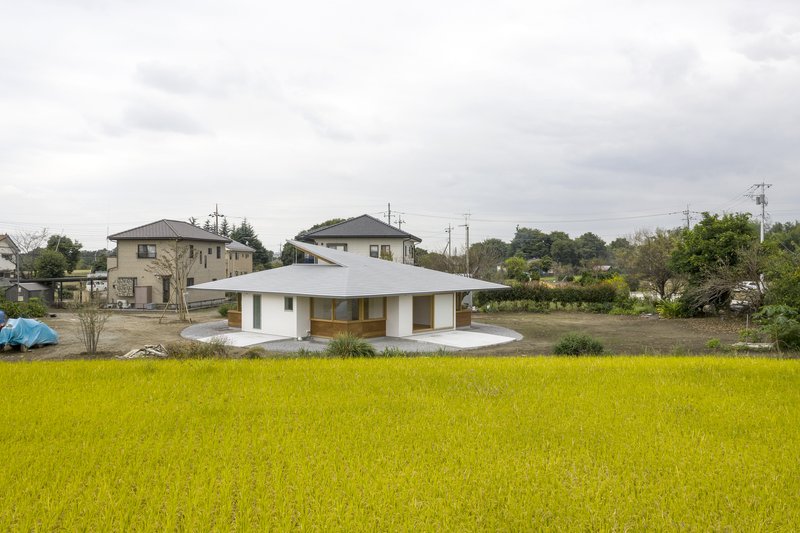
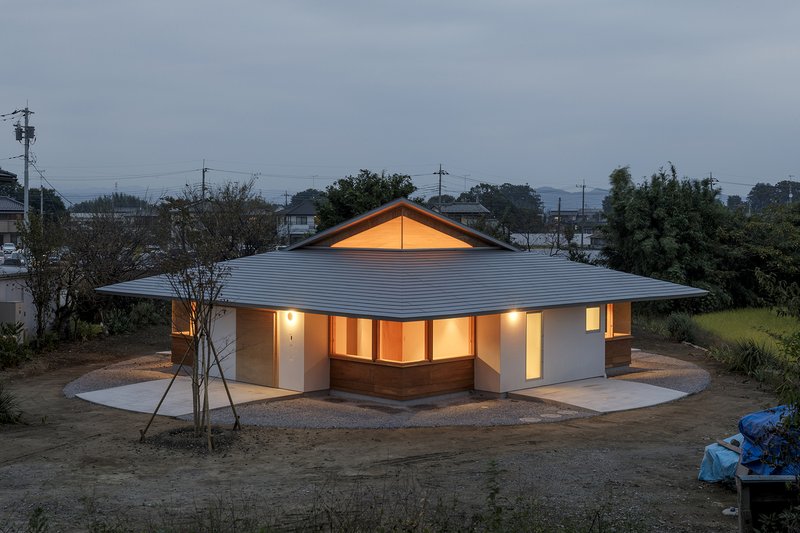
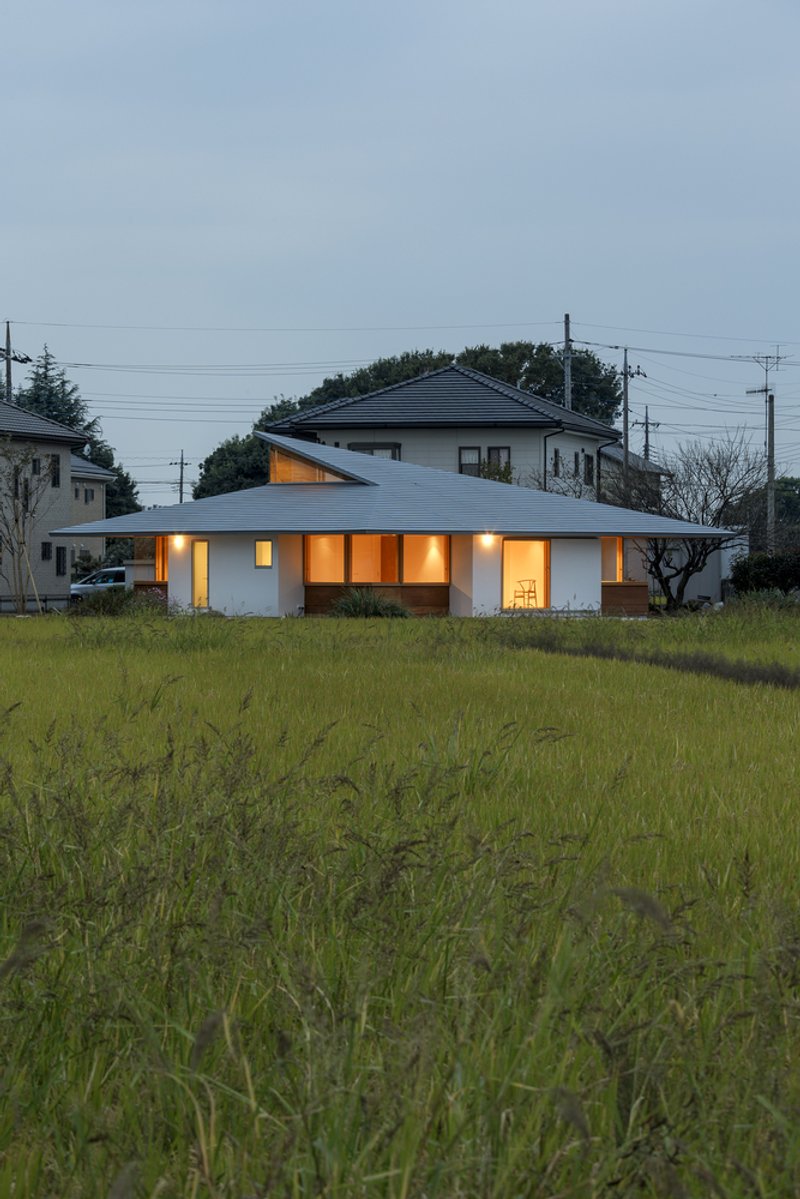
Seen from across the golden rice field, House U barely rises above the crop line. Its overhanging pyramidal roof and white walls give it the proportions of a rural shrine or market hall, something civic rather than domestic. The curved terrace softens the perimeter, eliminating hard corners that would compete with the gentle topography. At dusk, warm light leaks from the windows and transforms the building into a lantern, confirming its role as the only vertical event in a flat landscape.
The deliberate low profile keeps the house from asserting dominance over its neighborhood of modest two-story homes. From the aerial view, the circular footprint becomes legible, a plan form that maximizes perimeter contact with the outdoors while minimizing hallway length. Every room is a corner room.
The Roof as Unifier
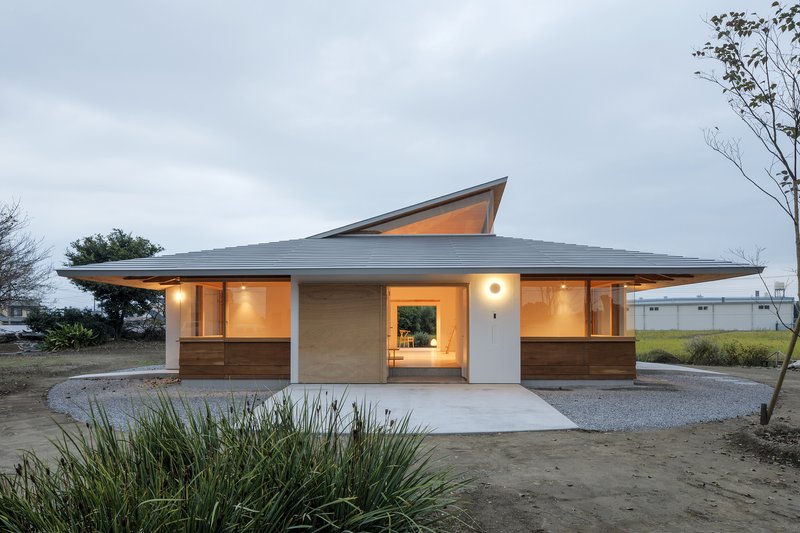
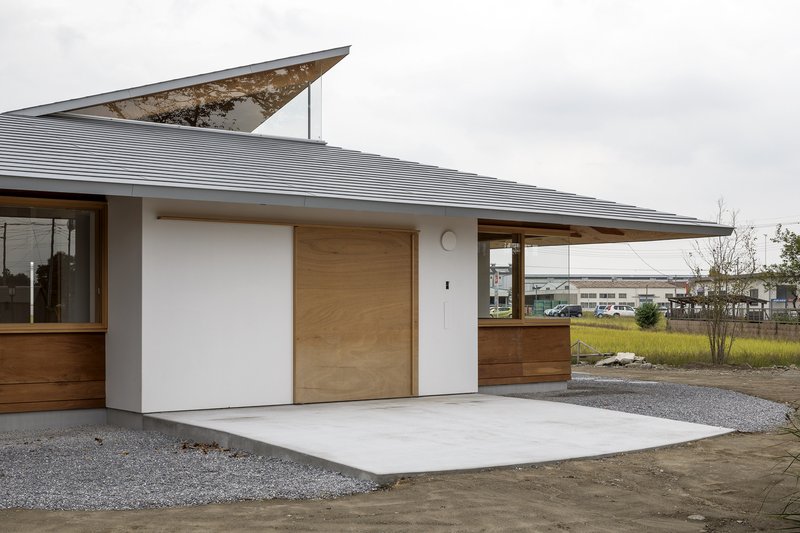
The angular skylight projection that breaks through the low-pitched roof is not decorative. It is the architectural hinge of the entire scheme: a clerestory volume that pulls daylight into the center of a plan that would otherwise be dark at its core. The corrugated metal roofing wraps over the terraces and folds up to meet this lantern, creating a continuous surface that reads as a single gesture from any exterior vantage point.
By concentrating all structural ambition in the roof plane, Shinta Hamada freed the floor plate from columns. The roof hovers, supported at the perimeter and the central core, and everything beneath it becomes negotiable space.
Plywood Vaults and Clerestory Light
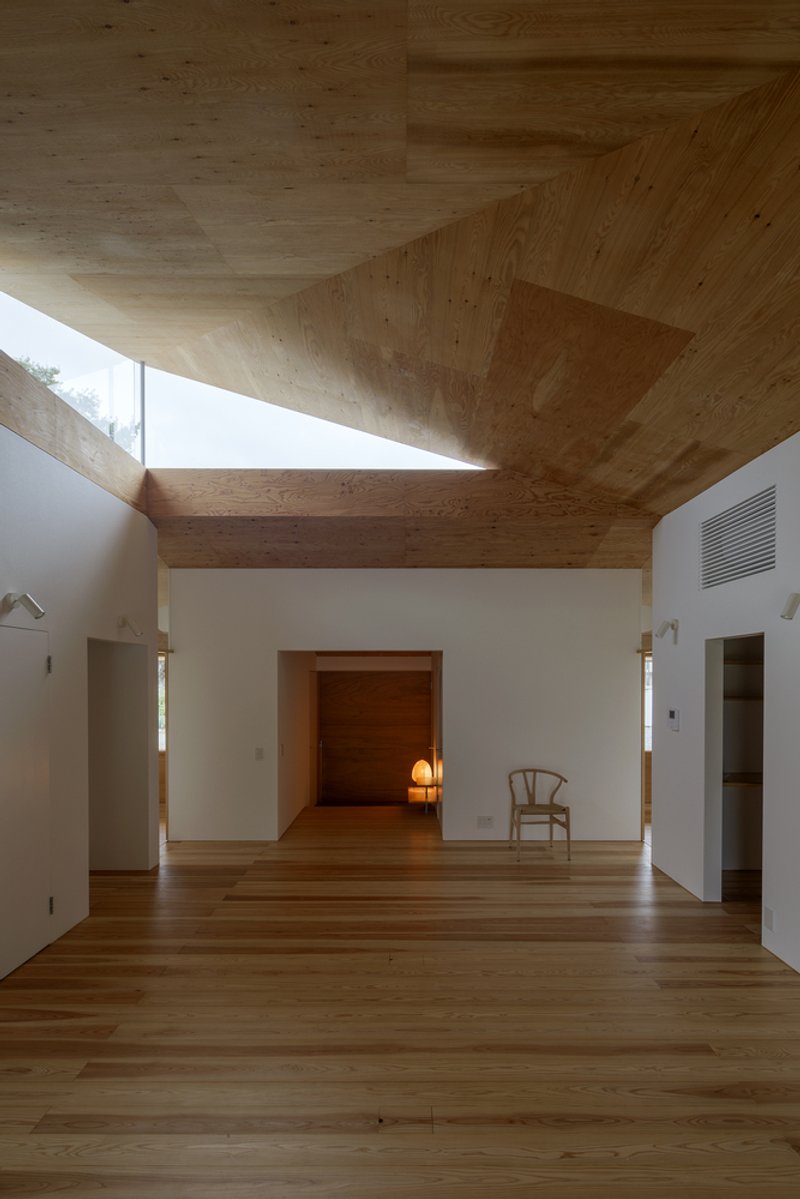
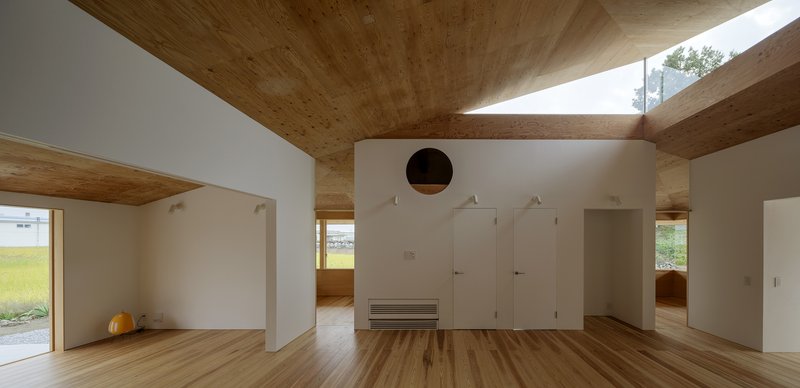
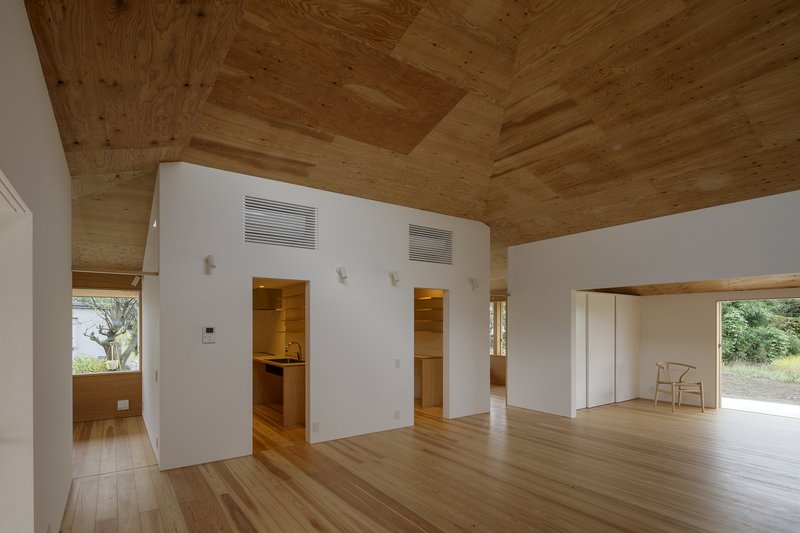
Inside, the pyramidal roof translates into a series of vaulted plywood ceilings that step upward toward the central clerestory. The effect is surprisingly generous for a single-story building: ceiling heights vary from intimate at the window seats to expansive at the core. Light enters from above through the clerestory band and washes down the white storage wall, whose circular opening functions as both a pass-through and a framing device.
The palette is restrained to three materials: birch plywood on ceilings and some walls, white-painted surfaces for the service core and storage zones, and natural timber flooring throughout. That discipline lets the changing quality of daylight do the atmospheric work. In the morning, the clerestory casts a sharp stripe across the floor; by afternoon, the corner windows fill individual rooms with soft, reflected light from the paddies.
Rooms That Frame the Horizon
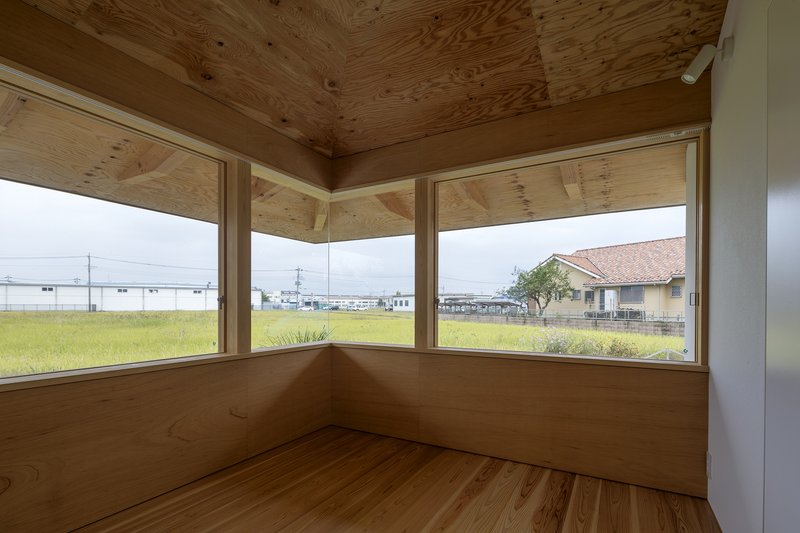
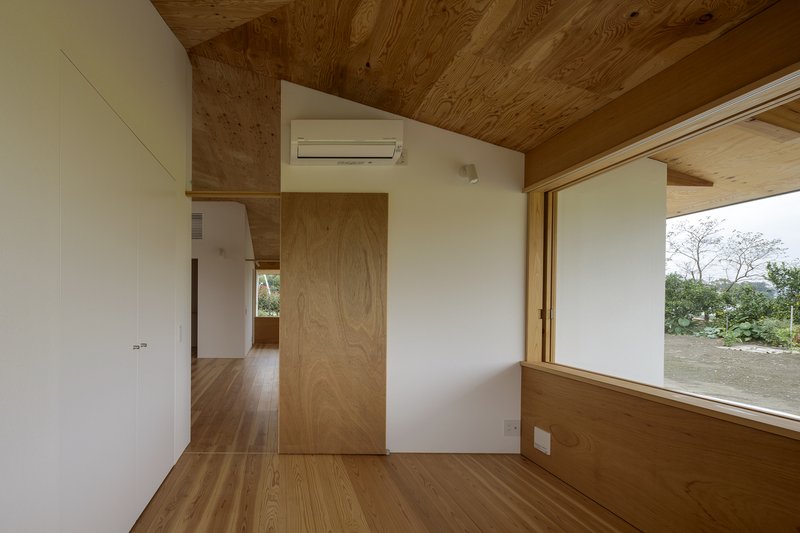
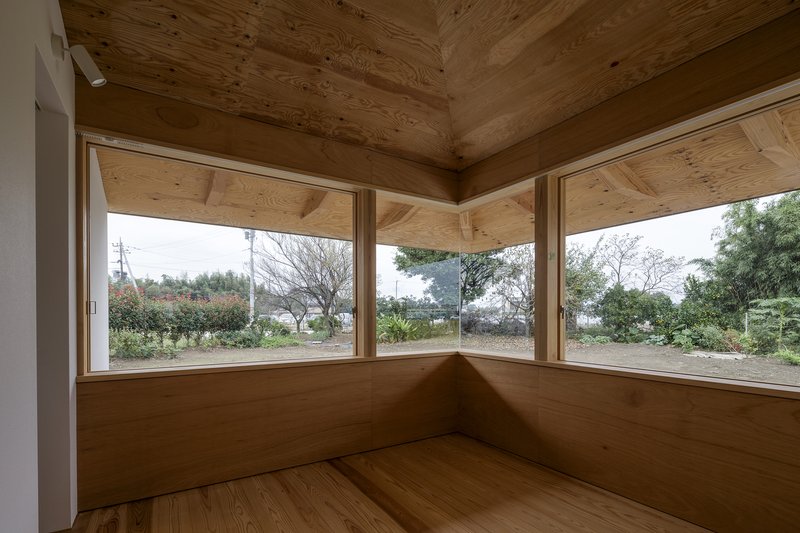
Each lobe of the plan terminates in a corner window that frames a distinct landscape: bare winter trees to one side, open fields to another, dense vegetation on a third. The window seats are deep enough to sit in, lined with timber to match the walls and ceilings so that they feel like small rooms within rooms. It is an old Japanese domestic idea, the alcove as a place of contemplation, executed here with modern detailing and generous glazing.
The corner placement of these windows is critical. By pulling glass to the building's outermost points, the architects ensure that you never look at a wall when you sit down. You look outward, and the room disappears behind you.
Thresholds and Aligned Views
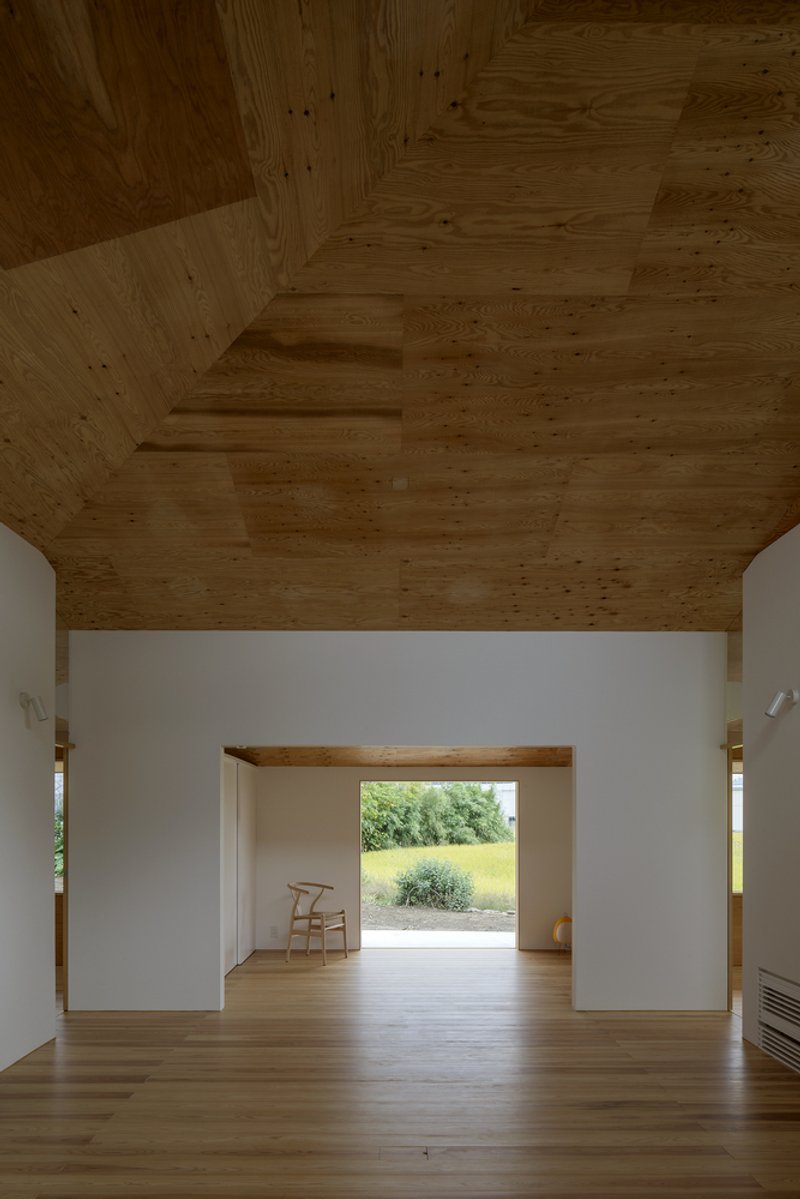
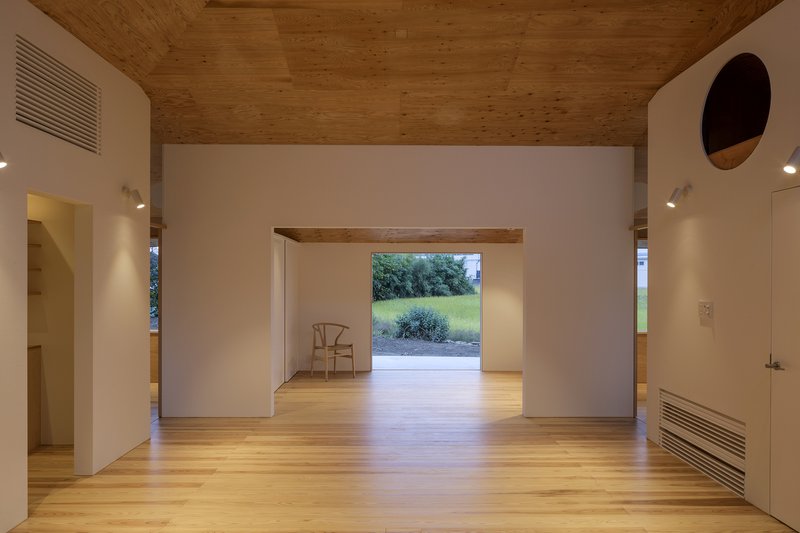
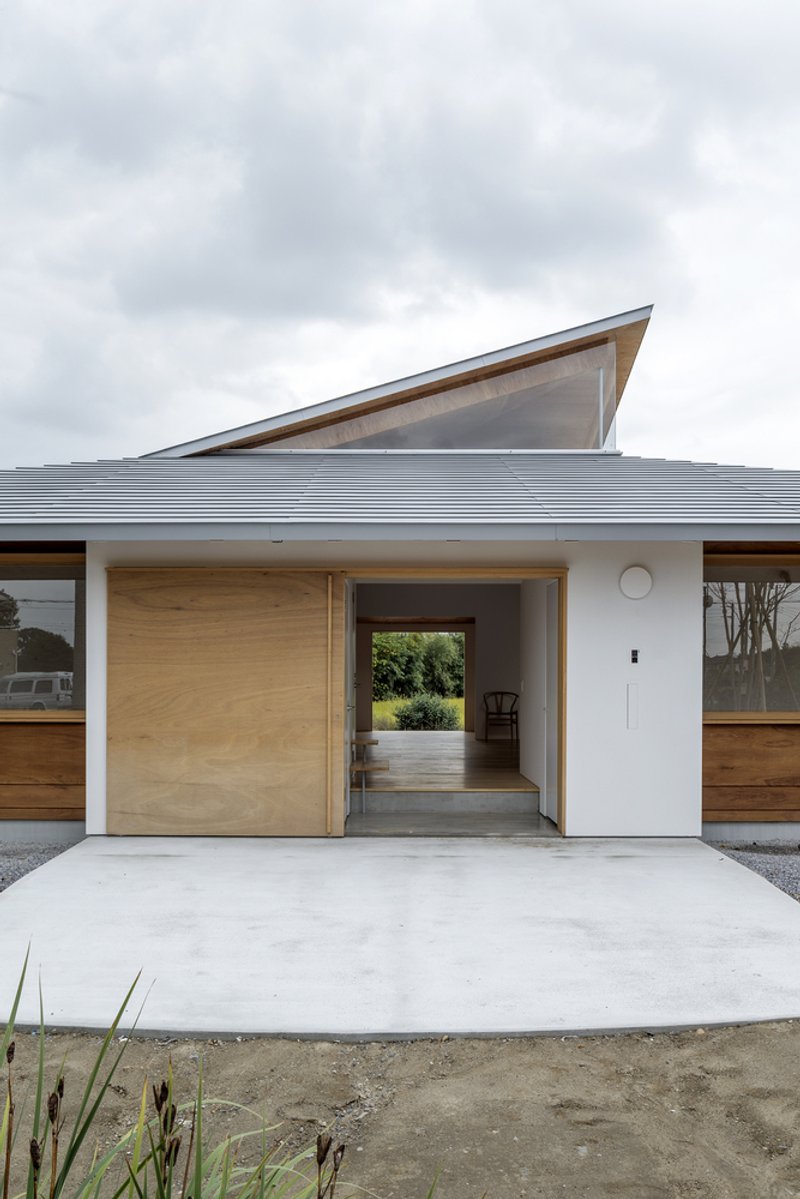
The interior is organized around a series of aligned doorways that create long sight lines from one end of the house to the other, terminating in landscape. Walking through the building, you experience an enfilade effect: rooms unfold sequentially, each framed by the timber lining of the previous threshold. The entry facade reinforces this with a sliding timber door that, when open, offers a straight shot through the house to the rear garden.
These visual connections compensate for the plan's deliberate compartmentalization. Rooms can be closed off for privacy or opened up for gatherings, but even when partitioned, the aligned openings ensure that daylight and garden views remain accessible from almost every position.
Entry and Terrace
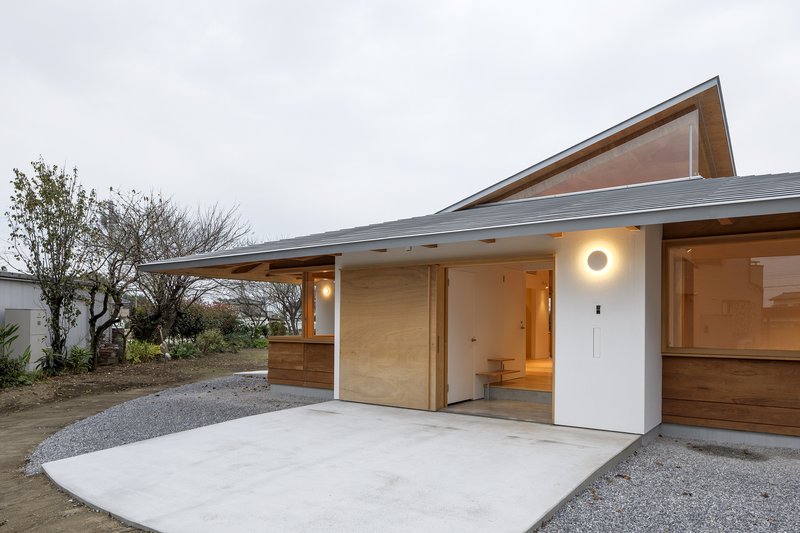
The entry courtyard is a controlled compression: concrete paving, a deep roof eave, and subdued lighting draw you inward before the plan opens up. The angled eave line hints at the geometry to come without revealing it, a deliberate act of withholding that makes the interior volumes feel more expansive by contrast. From the terrace side, the same roof extends outward as a covered outdoor room, blurring the line between inside and outside in a way that the climate demands for much of the year.
Plans and Drawings
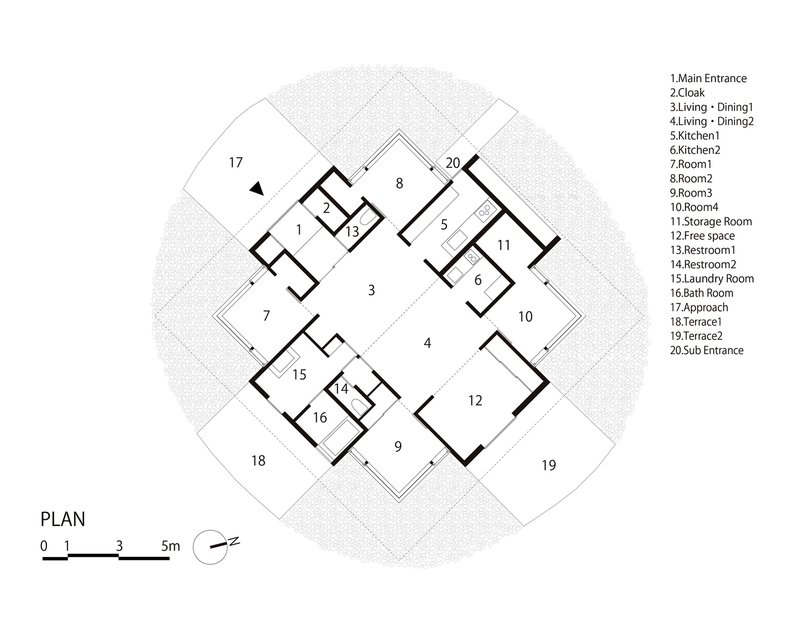
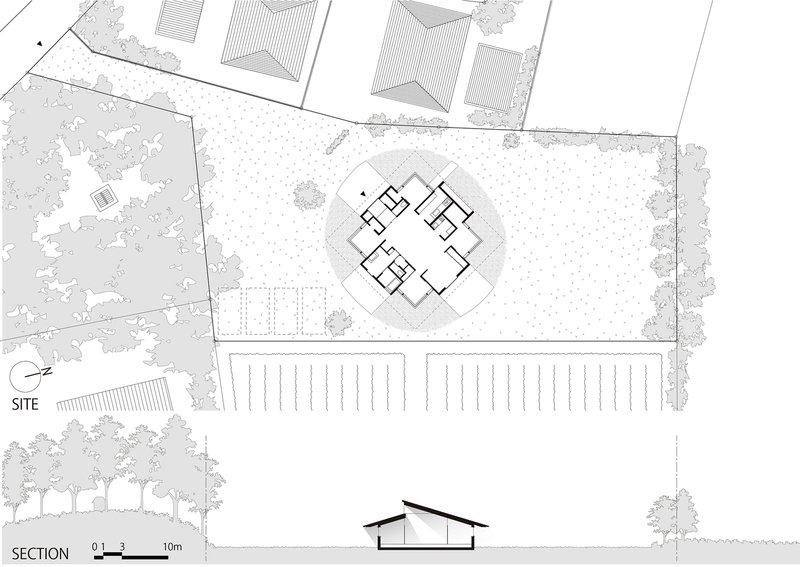
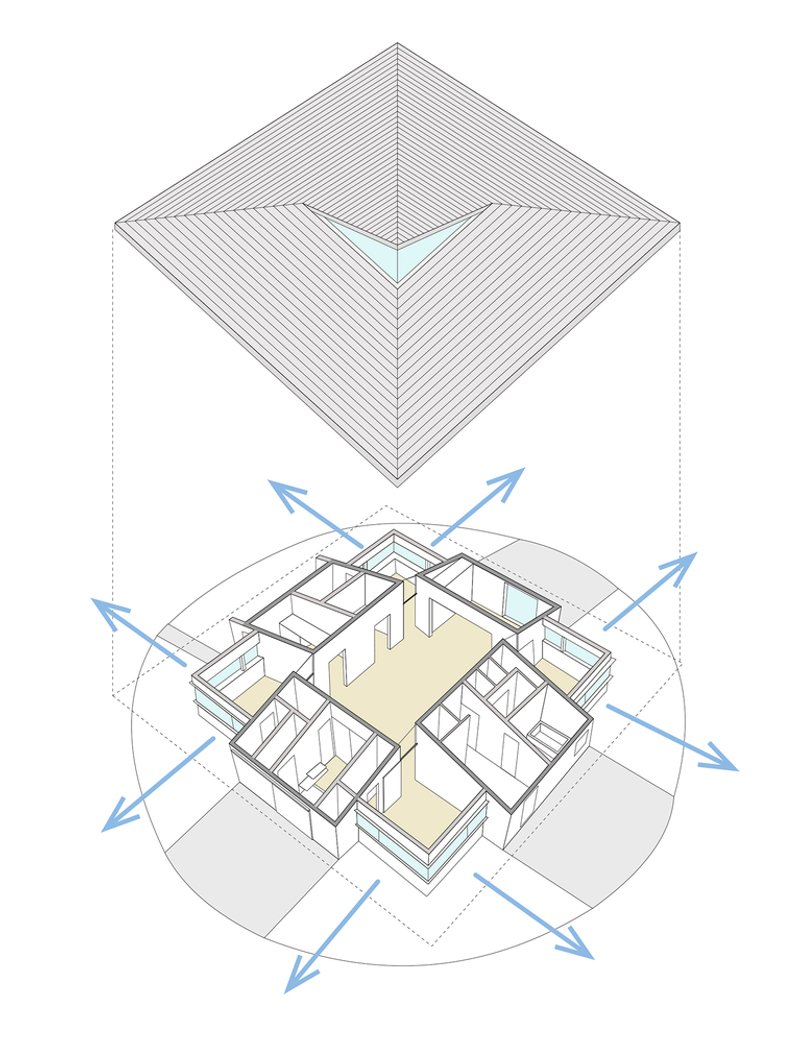
The floor plan makes the four-lobed strategy legible: rooms cluster around a compact central core that houses storage and services, while each wing pushes outward toward the landscape. The axonometric diagram reveals the key section move, a pyramidal roof that lifts free of the plan, hovering above it like a tent. The site plan and section together confirm how shallow the building sits in its plot, barely disturbing the grade of the surrounding paddy fields.
Reading these drawings, you understand why the house feels both small and expansive. The total footprint is modest, but because every room has two exposures and the ceiling rises toward the center, the perceived volume far exceeds the measured one. It is a lesson in how section and plan can conspire to amplify space.
Why This Project Matters
House U is a corrective to two persistent myths in residential architecture: that flexibility requires open plans, and that strong formal ideas produce inflexible interiors. Shinta Hamada Architects achieved both a distinctive silhouette and genuine domestic adaptability by concentrating the structure in the roof and the core, then leaving everything else open to negotiation. The four-lobed plan is not arbitrary geometry; it is a direct response to a flat site with views in every direction and a family that expects its house to change with them.
In a discipline that often treats rural commissions as opportunities for sculptural indulgence, this project is refreshingly disciplined. The material palette is tight, the moves are few, and the payoff is spatial rather than formal. It sits in its rice field not as an object to be admired but as a place to live in, season after season, configuration after configuration.
House U by Shinta Hamada Architects. Location: Japan. Photography by Ken'ichi Suzuki.
About the Studio
Share Your Own Work on uni.xyz
If projects like this are the kind of work you want to make, uni.xyz is a place to publish your own, find collaborators, and enter design competitions.




Popular Articles
Popular articles from the community

BLDUS Turns a 250-Square-Foot Screened Porch into a Pine Forest Temple in East Hampton
A gabled cedar pavilion mimics the rhythm of surrounding pines, anchoring a 1990s wooded home to its hollow in Long Island.
Constanti Architects Builds a Fortress of Privacy in Nicosia with House 345
A concrete and timber residence in Cyprus reinterprets the traditional introverted courtyard house for a new urban landscape.
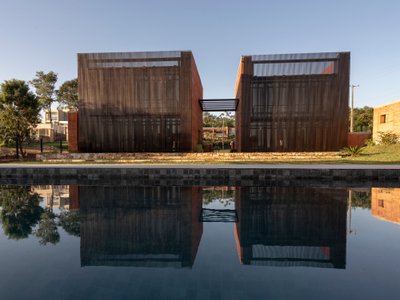
BAUEN Builds Two Rammed Earth Volumes in Paraguay Inspired by the Ovenbird's Nest
In San Bernardino, a house of compacted earth channels the instinct of a constructive bird to shelter life from the Paraguayan summer.
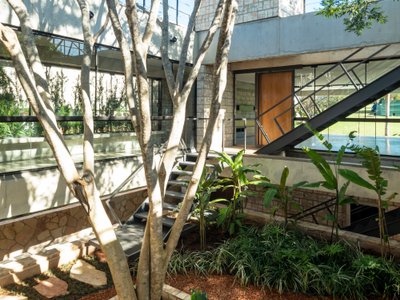
OMCM arquitectos Builds a Summer House in Paraguay from Quarry Waste Blocks and Three Sacred Trees
In the young hillside neighborhood of Altos, a 696-square-meter concrete volume hovers on six pillars around three preserved native Yvyraju trees.


Similar Reads
You might also enjoy these articles

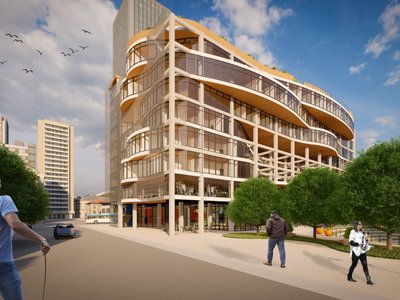
Olio Towers: A Mid-Rise for Performers That Fuses Housing, Rehearsal, and Stage
Located blocks from Houston's Theater District, this modular tower stacks living units around a central performance atrium.
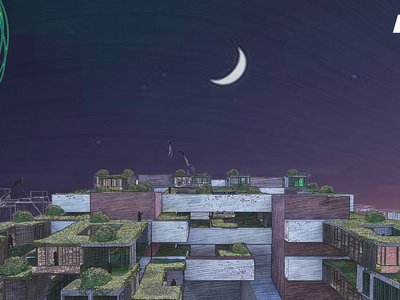
Oasis: Modular Green Housing Carved into Dhaka's Urban Fabric
A shortlisted Plugin Housing entry reclaims unauthorized settlements in Dhaka with stepped concrete volumes, green roofs, and ventilation-driven design.

Black Hole: A Floating Megastructure for the Post-Physical Era
Emiliano Mazzarotto envisions a spherical, self-scaling arena where e-sports, digital hotels, and holographic stadiums replace traditional public space.
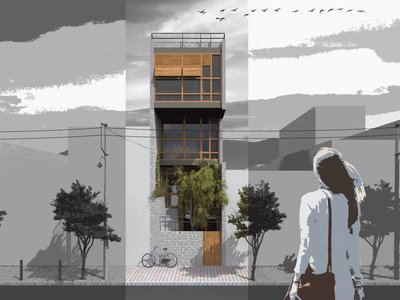
Compact & Sustainable Living in Piraeus: A Four-Level Family Home Built Around Light and Air
A narrow townhouse in one of Greece's densest port cities uses a central atrium and passive strategies to house three generations under one roof.


Explore Architecture Competitions
Discover active competitions in this discipline




The International Standard for Design Portfolios


The Global Benchmark for Architecture Dissertation Awards


The Global Benchmark for Graduation Excellence


Challenge to reimagine the Iron Throne
Comments (0)
Please login or sign up to add comments
No comments yet. Be the first to comment!