
Floating Bubbles: A Vision for Sustainable Bridge Design
Floating Bubbles redefines sustainable bridge design with lightweight, bike-powered pods that merge mobility, ecology, and public life today!


In the discourse of sustainable architecture, infrastructure is often associated with heavy engineering, massive foundations, and disruptive construction methods. Floating Bubbles challenges this perception by proposing a radical yet poetic alternative: a bridge that behaves like water itself. Instead of resisting nature, it floats, adapts, and coexists.
Designed by Hadi Nouri, Leila Delafrooz, and Mit Raa, this visionary project reimagines sustainable bridge design as a lightweight, modular, and environmentally responsive system. The proposal suggests that a bridge does not necessarily have to be a rigid, imposing structure. It can be delicate. It can float. It can become part of the river rather than an addition imposed upon it.
Sustainable Bridge Design Inspired by Nature
The conceptual foundation of Floating Bubbles draws inspiration from one of the most fragile yet intelligent forms in nature: the bubble. Bubbles are light, adaptive, and capable of floating effortlessly on water without disturbing the surface beneath. Their geometry distributes forces evenly, making them structurally efficient despite their apparent delicacy.
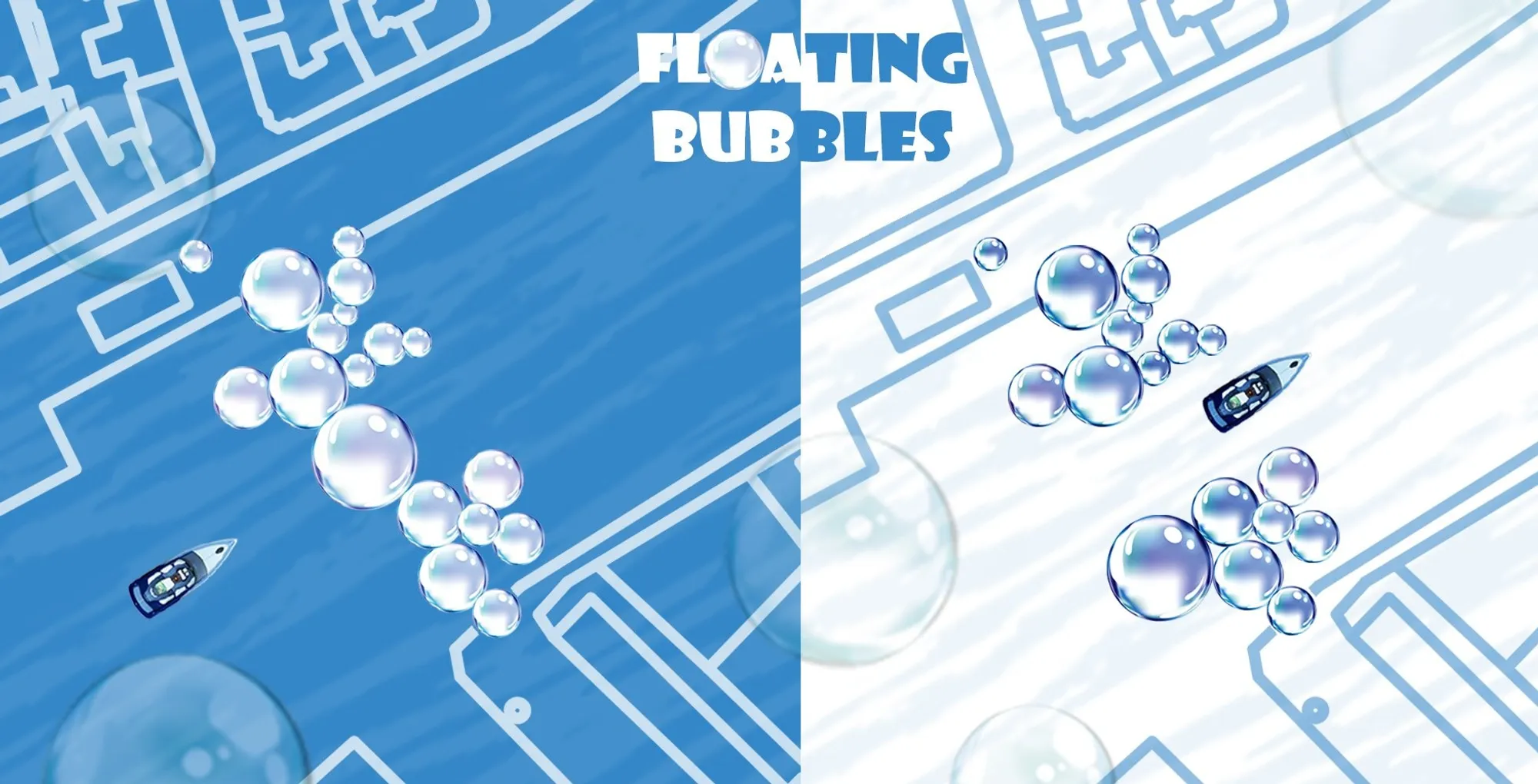
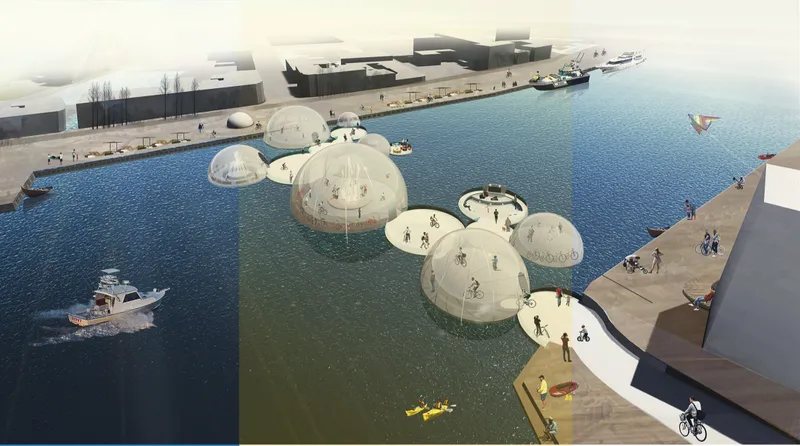
Applying this principle to sustainable bridge design, the project introduces a series of interconnected floating spheres positioned across the river. These pods act as both circulation nodes and public spaces. Just as real bubbles slip past one another, the central floating elements are designed to move laterally, allowing ships to pass through the river without obstruction.
This dynamic response system ensures minimal ecological disturbance while maintaining functional connectivity between riverbanks.
A Bike-Based Urban Mobility Concept
At its core, Floating Bubbles promotes sustainable urban mobility. The project recognizes the bicycle as one of the most optimized transportation tools of the 21st century: non-polluting, space-efficient, and beneficial for public health.
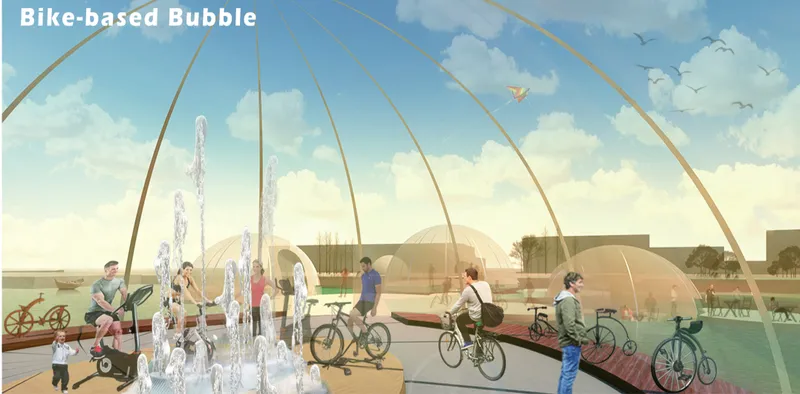
Rather than prioritizing automobiles, this sustainable bridge design separates bicycle routes from vehicular traffic entirely. Dedicated cycling paths move through and between the floating bubbles, creating a safe and engaging environment for riders. Branching routes provide intersections, rest areas, and viewing points without unnecessary elevation changes, ensuring smooth and efficient circulation.
Inside the central "Bike-Based Bubble," stationary bicycles generate energy required for fountains and subtle mechanical movements of the floating system. This human-powered energy loop reinforces the project's environmental ethos, transforming mobility into an active contributor to infrastructure performance.
Infrastructure as Public Space
Floating Bubbles transcends its role as a transportation link. It is conceived as a vibrant public realm floating on water.
The program includes:
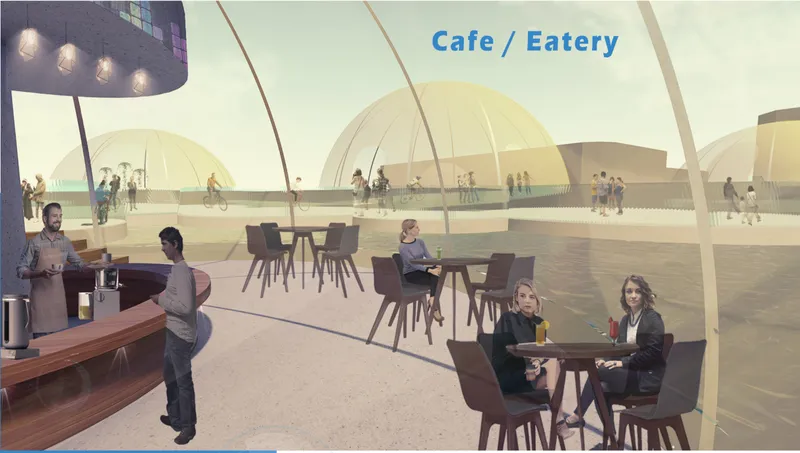
- A Cafe / Eatery overlooking the river
- An Information Center
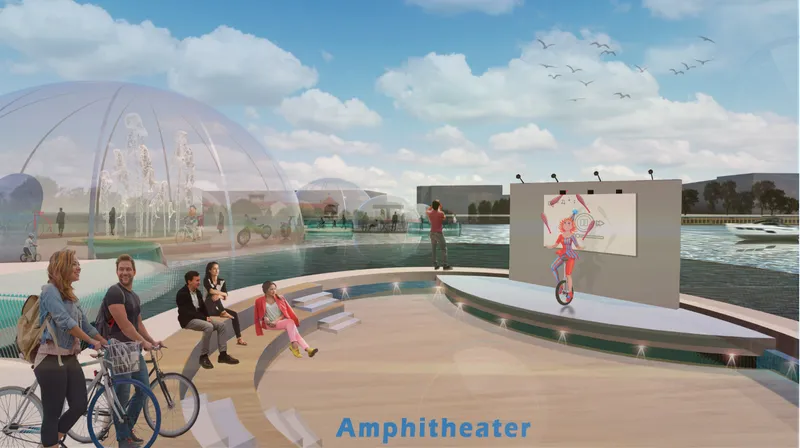
- An Amphitheater for public performances
- A Bicycle Club
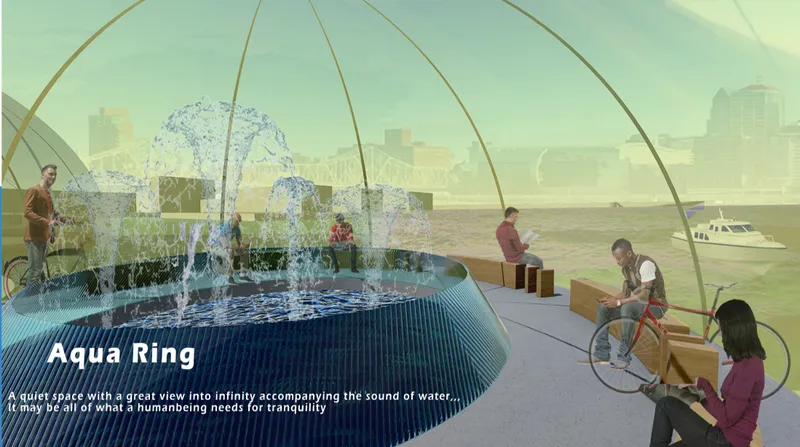
- An Aqua Ring for contemplation and relaxation
- W.C. facilities integrated discreetly within the floating pods
Half of some bubbles extend below the water surface, offering unique interior perspectives and intimate spatial experiences. Transparency and curvature create panoramic views of the river and city skyline, while preserving a sense of enclosure.
The Amphitheater transforms the bridge into a cultural landmark, hosting performances against the backdrop of open water. Meanwhile, the Aqua Ring acts as the project's quiet heart. Fountains within the ring operate like visual curtains, softening sightlines and creating cozy micro-environments for reading, reflection, and rest.
Environmental Performance and Material Innovation
True sustainable bridge design requires material responsibility. Floating Bubbles incorporates advanced lightweight materials to minimize structural mass and ecological footprint.
Aerogel is proposed in select envelope sections due to its exceptional thermal insulation, buoyancy, and low weight. Structural frames integrate steel reinforced with nanotube technology, enhancing strength while reducing material volume.
These innovations allow the floating modules to remain water-resistant, structurally resilient, and sustainable over time. By requiring fewer materials in erection and maintenance compared to conventional bridges, the project significantly lowers lifecycle impact.
Safety, Connectivity, and Urban Integration
One of the central challenges in sustainable urban design is ensuring safe coexistence between cyclists and automobiles. Floating Bubbles addresses this by completely separating bike routes from car traffic.
The spatial formation of bubbles creates natural branching points beside the main straight route. These branches function as public plazas, rest zones, and alternative crossings without interrupting the primary cycling flow.
Pedestrian routes are layered alongside bike paths, promoting inclusive access. The floating system's movability is technically calculated to prevent unpredictable deformations or unsafe motion.
By prioritizing human-scale movement, this project aligns infrastructure with contemporary urban design values focused on safety, accessibility, and sustainability.
A New Urban Landmark
Beyond performance and function, Floating Bubbles aspires to become an iconic urban landmark. Its translucent domes glimmer above the water, referencing a universal natural phenomenon while offering a futuristic silhouette.
The design demonstrates that sustainable architecture can be both efficient and emotionally resonant. By translating the beauty of bubbles into infrastructure, the project creates an identity that speaks to innovation, environmental awareness, and urban vitality.
Floating Bubbles proposes a transformative model for sustainable bridge design: one that is lightweight instead of massive, adaptive instead of rigid, and socially activated instead of purely infrastructural.
By merging bike-powered mobility, floating modular systems, material innovation, and public programming, Hadi Nouri, Leila Delafrooz, and Mit Raa present a compelling alternative to conventional bridge typologies.
In an era defined by climate responsibility and urban transformation, Floating Bubbles suggests that the future of bridges lies not in resisting nature, but in floating with it.




Popular Articles
Popular articles from the community


Co-Life: Senior Housing Design That Reconnects Older Adults With the City
Co-Life reimagines senior housing design through healing gardens, shared streets, workshops, and a sustainable community across generations.

Conexión: Biophilic Design Reimagines High-Rise Living in Hong Kong
Conexión reimagines high-rise living in Hong Kong through biophilic design, green facades, shared spaces, daylight, water and nature within.

The Ocean Hive: Sustainable Architecture for a Self-Sufficient Civilization at Sea
The Ocean Hive imagines sustainable architecture at sea, where modular habitats, algae, wave power and ocean waste sustain a growing colony.

Play: Fragments of Their World
Familiar architecture becomes modular playground design, creating safe spaces where displaced children can learn, connect, imagine and play.


Similar Reads
You might also enjoy these articles

Eco Chapel: A Green Architecture Pavilion Designed in Symbiosis with the Forest
Eco Chapel uses green architecture to weave prayer, learning and reuse into a forest pavilion shaped by modular hexagonal canopies for life.
Kaffeebühnen: Coffee Shop Architecture Designed as a Civic Stage Between Vienna’s City and Park
Kaffeebühnen turns coffee shop architecture into a civic stage, linking Vienna’s park edge, urban life, warm timber yards, and coffee craft.
Healing Façade: Sustainable Architecture for Reforestation, Community, and Sacred Ecology in Ethiopia
Healing Façade reimagines sustainable architecture as a living wall that restores soil, catches water and renews Ethiopia's forest churches.


Urban Forest: A Vertical Ecosystem for 5,000 Workers in Singapore's Changi Business Park
Radially stacked pods and layered green decks turn a 7-acre plot into 47 acres of ecological workspace projected for 2040.

Comments (0)
Please login or sign up to add comments
No comments yet. Be the first to comment!