
Floors of Culture: Public Architecture as a Generator of Social Integration
Floors of Culture reimagines public architecture as stacked urban space, reviving social life, creativity, and entrepreneurship within the city fabric.


Across contemporary cities, the gradual fade-out of public spaces has emerged as one of the most critical urban challenges. Security-driven enclosures, car-oriented planning, privatization of shared realms, and digitally mediated lifestyles have weakened everyday social interactions. In response to this condition, public architecture is increasingly being reconsidered not merely as a container of functions, but as an active social infrastructure: one that generates encounters, relationships, and collective identity.
Floors of Culture, a project by Ela Szymańska, positions architecture as a mediator between the city and its inhabitants. Conceived as a hybrid of building and public space, the proposal explores how vertically stacked urban platforms can restore social integration, stimulate creative exchange, and cultivate entrepreneurial spirit within dense urban contexts.


Theoretical Background: Public Space and Social Integration
Urban theorists such as Kevin Lynch, Jane Jacobs, Jan Gehl, and Bill Hillier have long emphasized the relationship between spatial configuration and social life. Their research highlights how the decline of legible, accessible public realms leads to weakened social bonds and fragmented urban communities. In contrast, well-integrated public architecture fosters spontaneous encounters, supports social identity, and enhances collective well-being.
Within this framework, Floors of Culture responds to two interconnected dimensions of public architecture:
- External integration, where architecture connects seamlessly with the surrounding urban fabric, extending public life into the building.
- Internal integration, where spatial continuity encourages movement, pause, interaction, and prolonged occupation by users.
The project positions architecture not as an isolated object, but as a continuation of the city itself.
Public Architecture as a Social Generator
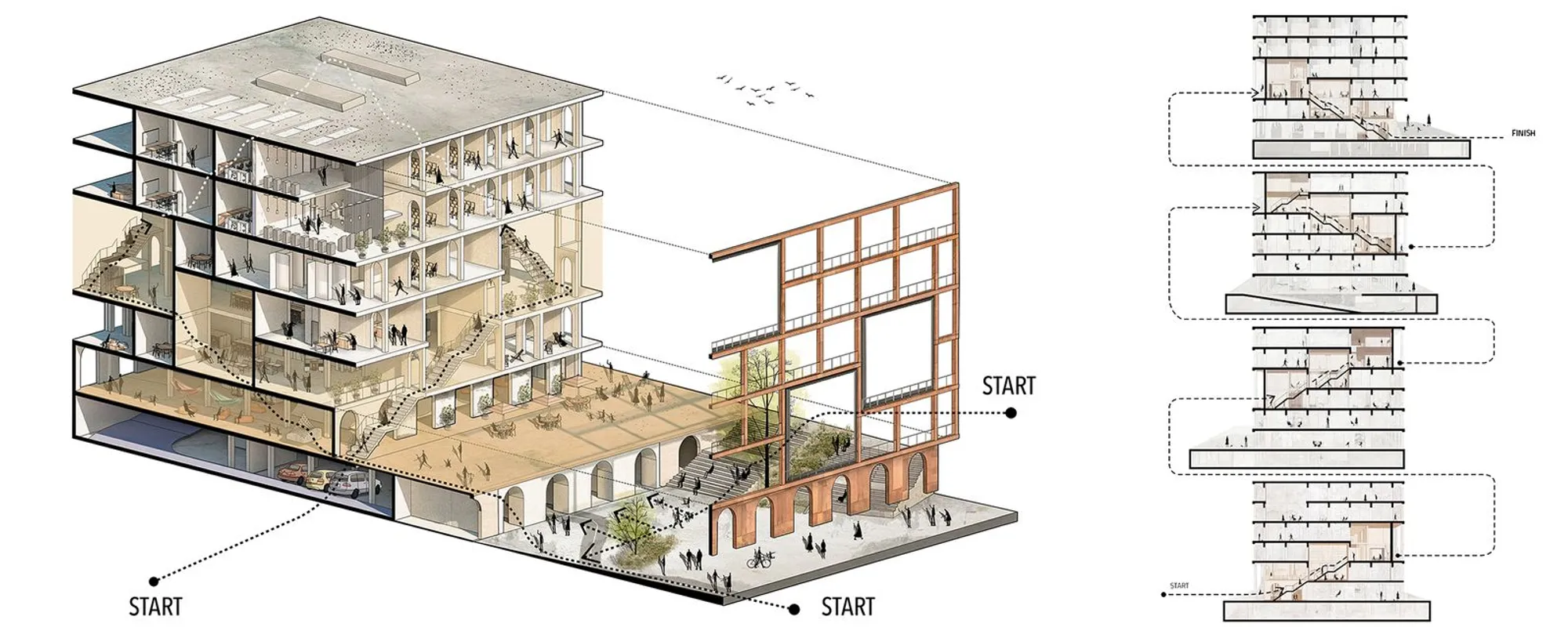
At the core of Floors of Culture lies the idea that architecture can actively produce social interaction rather than passively accommodate it. Instead of absorbing public space into a closed volume, the building unfolds as a sequence of open, accessible terraces, described as Floors of Culture, that function as vertical extensions of the urban ground.
These stacked platforms allow multiple forms of activity to coexist: working, learning, socializing, resting, and cultural production. By organizing public programs vertically, the building intensifies urban life while maintaining permeability and openness at every level.
Spatial Strategy: Generation and Concentration
The architectural concept is structured around two complementary processes:
Generation refers to the creation of consistent spatial axes that guide movement and define recognizable places within the building. These axes encourage natural circulation, visual connectivity, and intuitive orientation, key factors in sustaining active public use.
Concentration focuses on clustering specific activities and services within defined zones. By concentrating programs such as coworking spaces, research facilities, creative workshops, cafés, and community areas, the architecture sustains user attention and encourages prolonged engagement.
Together, these strategies transform the building into a dynamic urban condenser, one that amplifies social and cultural energy rather than dispersing it.
Programmatic Framework: A Vertical Public Ecosystem
The functional program of Floors of Culture reflects a deliberate mix of cultural, social, and entrepreneurial spaces. Key components include:
- Public squares and open ground-level spaces that anchor the project within the city
- Coworking zones and research centers that support innovation and knowledge exchange
- Skill-trade and DIY spaces that encourage hands-on creativity and learning
- Cafés, meeting kitchens, and informal gathering areas that nurture everyday social life
- Event spaces and cultural platforms that host exhibitions, performances, and collective activities
This diversity of programs transforms public architecture into a living ecosystem, one that adapts to different rhythms of use throughout the day.
Architecture as Continuation of Urban Space
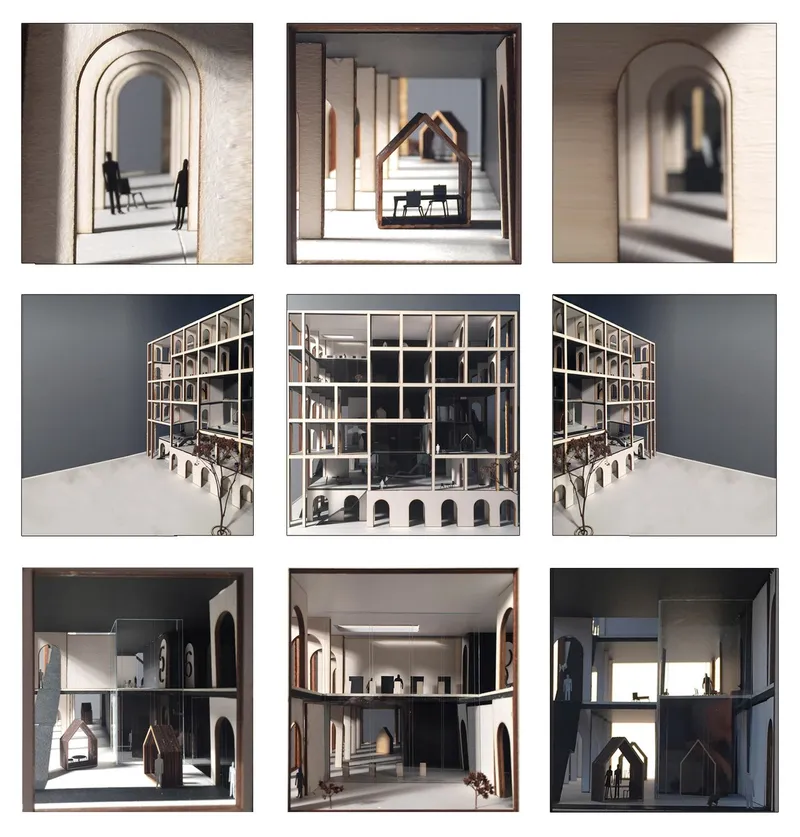
A defining principle of the project is its refusal to treat the building as a boundary. Instead, Floors of Culture presents architecture as an extension of the public realm. Terraces, voids, staircases, and visual connections blur the distinction between inside and outside, private and public.
By stacking open platforms vertically, the project preserves surrounding public space while offering a new configuration of shared environments. The building does not replace the city, it multiplies its spatial possibilities.
Social Impact and Urban Relevance
By reactivating public architecture as a social integrator, Floors of Culture addresses contemporary urban issues such as isolation, loss of community, and reduced civic engagement. The project demonstrates how architectural form, program, and circulation can collectively foster social satisfaction, an idea reinforced by comparative studies of urban environments with high social well-being.
In this sense, the project moves beyond typology and aesthetics, positioning architecture as an ethical and social act.
Floors of Culture by Ela Szymańska presents a compelling vision of public architecture as a generator of social integration. Through stacked urban terraces, mixed-use programming, and spatial continuity, the project redefines how buildings can function as active participants in civic life.
Rather than responding to the decline of public space with defensive architecture, the proposal embraces openness, interaction, and shared experience, offering a resilient architectural model for socially engaged cities of the future.



Popular Articles
Popular articles from the community

EW PARK: Sustainable Architecture Reimagines the Future of Urban Parking
EW PARK reimagines city parking as a modular wooden tower combining automation, solar energy, electric mobility, and adaptable urban design.

The Ocean Hive: Sustainable Architecture for a Self-Sufficient Civilization at Sea
The Ocean Hive imagines sustainable architecture at sea, where modular habitats, algae, wave power and ocean waste sustain a growing colony.

The Earth Pod: 3D Printed Homes for Resilient Refugee Communities
The Earth Pod reimagines refugee housing through 3D printed homes made from clay, combining resilience, self-sufficiency, and rapid shelter.

Conexión: Biophilic Design Reimagines High-Rise Living in Hong Kong
Conexión reimagines high-rise living in Hong Kong through biophilic design, green facades, shared spaces, daylight, water and nature within.


Similar Reads
You might also enjoy these articles

Eco Chapel: A Green Architecture Pavilion Designed in Symbiosis with the Forest
Eco Chapel uses green architecture to weave prayer, learning and reuse into a forest pavilion shaped by modular hexagonal canopies for life.
Kaffeebühnen: Coffee Shop Architecture Designed as a Civic Stage Between Vienna’s City and Park
Kaffeebühnen turns coffee shop architecture into a civic stage, linking Vienna’s park edge, urban life, warm timber yards, and coffee craft.
Healing Façade: Sustainable Architecture for Reforestation, Community, and Sacred Ecology in Ethiopia
Healing Façade reimagines sustainable architecture as a living wall that restores soil, catches water and renews Ethiopia's forest churches.


Urban Forest: A Vertical Ecosystem for 5,000 Workers in Singapore's Changi Business Park
Radially stacked pods and layered green decks turn a 7-acre plot into 47 acres of ecological workspace projected for 2040.


Explore Cultural Architecture Competitions
Discover active competitions in this discipline



Challenge to reimagine the Iron Throne


Photograph architecture without architects


Illustrate the lost glory of Angkor Wat - Render Challenge

Bring back Drive In's
Comments (0)
Please login or sign up to add comments
No comments yet. Be the first to comment!