

Flor de Mayo: Caravel-Inspired Modules That Turn a Border Bridge Into a Respite Center for Asylum Seekers
Arturo Silva anchors ship-like modules to a Mexico-US bridge, converting a corridor of passage into a layered sanctuary of rest, care and pause.


A border bridge is built to be crossed as quickly as possible. It is a piece of infrastructure that measures people in throughput, not in hours spent waiting, sleeping or recovering. Flor de Mayo starts from the opposite premise: that the moment of crossing is precisely where people need somewhere to stop. The proposal turns an existing bridge between Mexico and the United States into a respite center for asylum seekers, recasting a line of passage as an inhabitable place of care, transition and dignity.
Designed by Arturo Silva, with the project credited alongside Faye + Walker, the scheme draws on the historical caravel, the vessel that once carried explorers and pilgrims across uncertain waters. Here the ship becomes a static architectural system: repeatable modules anchored to the bridge, each holding approximately 192 beds across multiple levels, linked by elevated walkways and topped with gardens. The intervention keeps its footprint off the ground and grows vertically and lengthwise instead, suspending a continuous framework above the circulation routes that already run beneath it.
A Bridge That Slows Down Instead of Speeding Up

The opening rendering sets the tone with restraint. A glazed, steel-framed pedestrian span rises beside a working road, a red truck passing below while a wheelchair user waits at the base of a stair tower. The image is telling because it does not hide the existing traffic; the shelter lives alongside the infrastructure rather than replacing it. The angular framing visible in elevation gives the structure a sense of direction, a nod to the hull of a ship, while also doing honest structural work.
That wheelchair user matters. A humanitarian building on a bridge raises an obvious question about access, and the vertical circulation shown here acknowledges that arrival must be possible for everyone, not only the able-bodied. The modular logic also answers a planning reality: units can be added in phases as demand changes, which suits a crisis that rarely holds still.
The Roof as a Garden for People Under Strain

Rather than leaving the roof as residual surface, Silva turns it into a continuous garden. The rendering shows weathering steel planters, concrete benches and tall grasses under a hazy sky, with a single figure walking the deck. The palette is tough and low-maintenance, which feels right for a site of heavy use, yet the grasses soften it enough to read as landscape rather than terrace.
The argument here is therapeutic as much as spatial. For people living through stress and uncertainty, access to greenery and open air becomes part of recovery, a place to rest, explore or simply move without being processed. Because the building avoids the ground, the roof is also where the project recovers the outdoor space it declines to take below, making the most of a constrained footprint.
A Chapel Lit From Above

Among the interiors, the chapel is the most quietly ambitious. A stepped concrete altar faces wooden pews, slanted glazing angles the walls, and a skylight pulls daylight down into the room. Visitors sit and stand in loose arrangement, suggesting a space open to reflection rather than formal ceremony alone.
Its presence signals that the brief extends beyond beds. The source text frames the programme as addressing psychological well-being, social interaction and personal agency, and a contemplative room is a direct expression of that. The slanted glazing echoes the angular structure seen outside, so the chapel feels carved from the same ship-like frame rather than inserted into it.
An Arrival Lobby Built for Families

The lobby rendering shows a weathering steel reception desk, two wall-mounted screens and glass block walls, with a family and a man walking past. Glass block is a smart choice for a threshold of this kind: it admits light while preserving privacy, a balance that matters when the people arriving may be wary of being watched.
The material continuity with the rooftop planters ties the building together from first contact to the garden above. This is where the elevated pathways begin, threading arrivals into a network of linked modules that the designer describes as a continuous spatial experience, one that holds movement and rest within the same structure.
Why This Project Matters
Border architecture is usually designed to filter, delay and divide. Flor de Mayo does not pretend the border disappears, but it reframes the bridge as a shared spatial condition where transition and coexistence can happen. Treating the crossing as a place to pause, with beds, a garden, a chapel and a dignified point of arrival, is a pointed critique of infrastructure that sees only flow.
The caravel metaphor could easily have stayed decorative, yet here it does useful work: it justifies a modular, phased system, it gives the frame its directional geometry, and it offers users a story of journey rather than detention. Questions of governance and jurisdiction on such a contested site remain open, but as a proposition about what humanitarian architecture can ask of existing infrastructure, the project makes its case with clarity.
View the Full Project
About the Designers
Designer: Arturo Silva
Enter a Design Competition on uni.xyz
uni.xyz runs architecture and design competitions year-round that reward proposals with spatial conviction and real site intelligence.
Project credits: Flor de Mayo by Arturo Silva.


Popular Articles
Popular articles from the community


ETEH Reworks the Shared Spaces of São Domingos School in Brazil Around Timber, Color and Hanging Plants
At São Domingos School in Brazil, 436 m² of hall, refectory and library are recast with timber joinery, a yellow and blue code and trailing greenery.


Aquadapt: An Underwater Habitat That Rewrites Its Rooms by the Hour
Curved modules ring the seabed while one shell shifts from breakfast room to cinema, farm and football pitch as residents' needs change.

David Ortega Stacks a Two-Story Mexico City Penthouse Around a Steel Stair and a Pergola-Shaded Roof Terrace
In Colonia Roma, a 300 m² penthouse uses oak joinery, a planted steel stair and a slatted roof pergola to make a new-build apartment feel like a house.

Cube Design Draws an Ecological Corridor Between Two Shenzhen Hills with the Nankai Building
Beside Shenzhen's container docks, the Nankai Building pairs stacked balconies with a climbing green screen to connect two hillsides across its height.

Similar Reads
You might also enjoy these articles
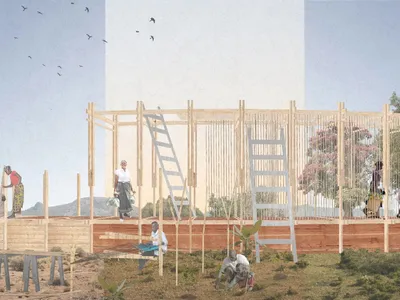
Healing Façade: A Modular Chapel System That Restores Ethiopia's Sacred Forests
Winner of the Eco-Chapel competition, this circular timber façade collects water from air to rebuild soil and reforest degraded Ethiopian landscapes.
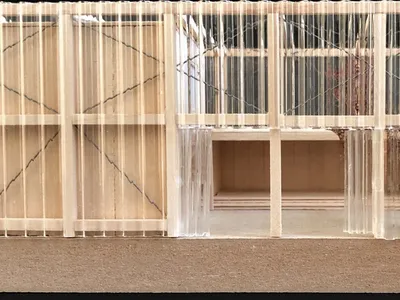
Kaffeebühnen: Where Coffee Shop Architecture Becomes a Civic Stage in Vienna
A linear sequence of timber boxes, transparent shells, and open yards turns the Viennese café tradition into a public performance space.
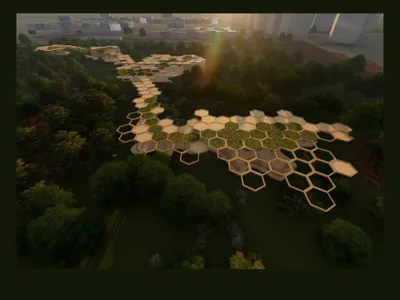
Eco Chapel: A Modular Forest Pavilion That Grows Like the Landscape It Protects
Hexagonal timber modules weave through existing trees, turning a chapel into a living system for prayer, education, and reforestation.


Urban Forest: A Vertical Ecosystem for 5,000 Workers in Singapore's Changi Business Park
Radially stacked pods and layered green decks turn a 7-acre plot into 47 acres of ecological workspace projected for 2040.

Explore Interior Design Competitions
Discover active competitions in this discipline

Challenge to design luxury tourism on rails

VR headsets Storefront design competition

Designing a staircase for a client

Design challenge to reuse E-waste
Comments (0)
Please login or sign up to add comments
No comments yet. Be the first to comment!