

Flower of the Desert: Biomimetic Architecture That Breathes in Arid Heat
A petal-shaped public institution translates the survival strategies of a 1,500-year-old desert plant into climate-responsive courtyards and passive coolin


A plant that lives for over a thousand years in one of Earth's harshest deserts might not seem like an obvious starting point for an urban children's institution. But the Welwitschia mirabilis, a ground-hugging survivor of the Namib Desert, offers a blueprint for architecture that stays low, shades the earth, harvests fog, and resists erosion. Flower of the Desert takes that blueprint seriously, translating it into a radial, petal-like building form that spreads horizontally across its site, creating sunken courtyards, channeling prevailing winds, and reducing heat gain without resorting to energy-hungry mechanical systems.
Designed by Reza Ghadirian, Hamid Shahmohammadmirab, and Nima Asadi Jozani, the project received the Institutional Excellence Award at Form Follows Climate 2020. Sited within a dense urban context exposed to high temperatures, intense solar radiation, and dry winds, it proposes a low-energy public institution that functions simultaneously as a community landmark, a child-centered facility, and an urban condenser. The design philosophy is direct: form does not merely follow function here, it follows climate.
A 1,500-Year-Old Plant as Architectural Prototype
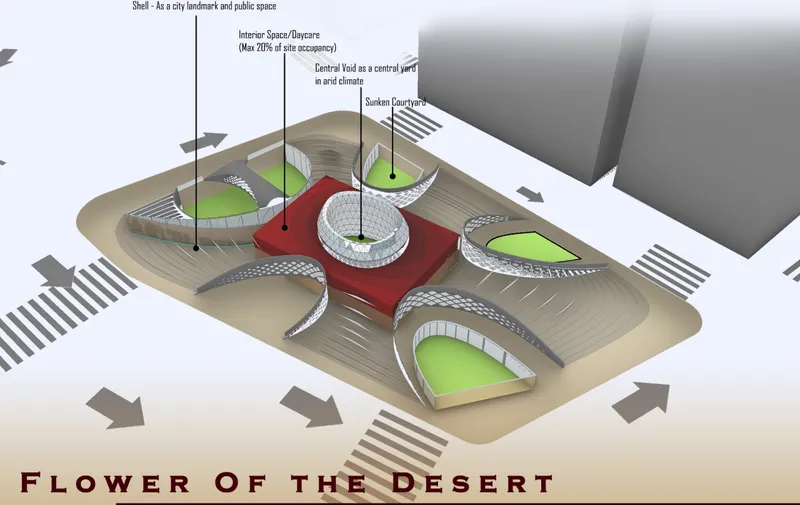
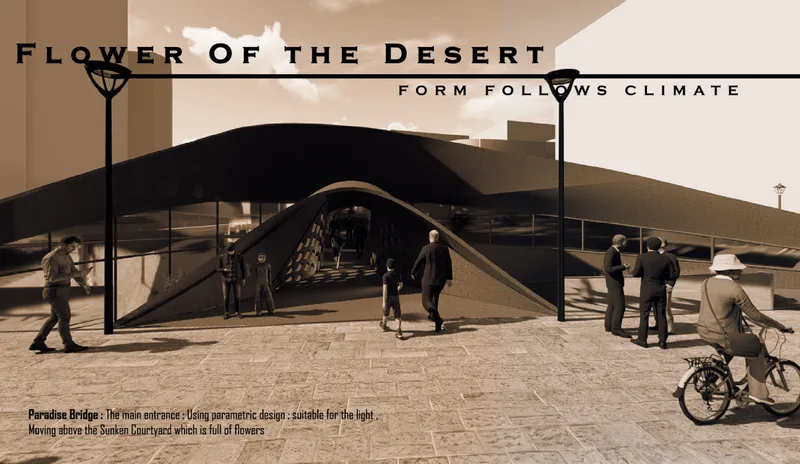
The Welwitschia mirabilis survives by doing the opposite of what most organisms do in harsh conditions: rather than reaching upward or retreating underground, it spreads broad, ground-hugging leaves that shade the soil, reduce wind erosion, and collect moisture from fog while minimizing daytime water loss. The axonometric diagram reveals how this logic translates into architecture. Lobed shell structures fan outward from a central core, each petal sheltering a planted courtyard or sunken entry zone. The building never competes vertically with its surroundings. Instead, it occupies the ground plane with deliberate horizontal reach, letting its overhanging roof form create deep shade at the pedestrian level.
The rendering of the pedestrian plaza shows this strategy in action: figures walk beneath the arched entry where the overhanging canopy produces a zone of thermal relief. Rather than a grand portico or monumental facade, the building greets the city with shade, a simple and generous act that signals its environmental priorities immediately.
Sunken Courtyards as Thermal Buffers and Social Anchors
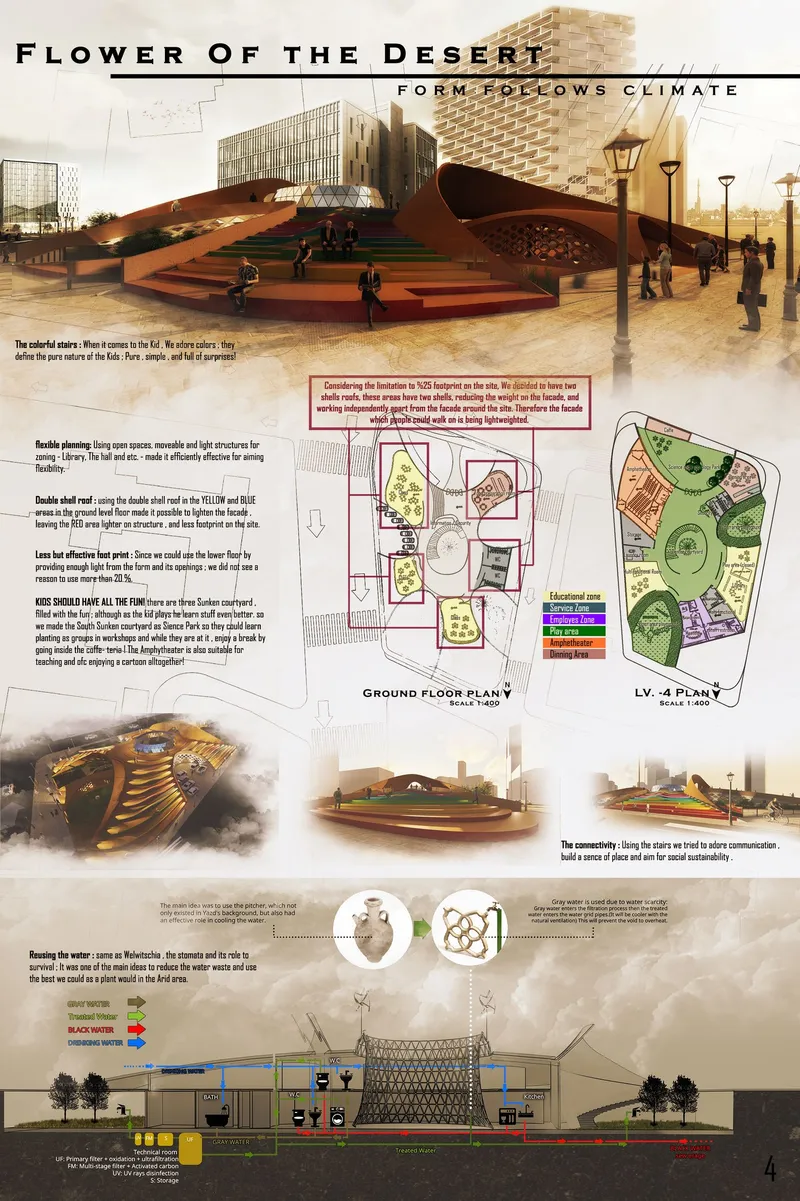
The presentation board unpacks the layered environmental machine at the core of the design. Sunken courtyards serve multiple roles: they introduce natural light deep into lower levels, improve ventilation through pressure differentials, create protected outdoor play and gathering spaces, and reduce surface temperatures through earth mass and shaded surfaces. CFD simulations informed the aerodynamic shaping of the envelope, ensuring wind flows smoothly across and through the structure, driving cross-ventilation and reducing reliance on mechanical cooling. Wind catchers and integrated turbines sit at optimal zones identified through airflow analysis.
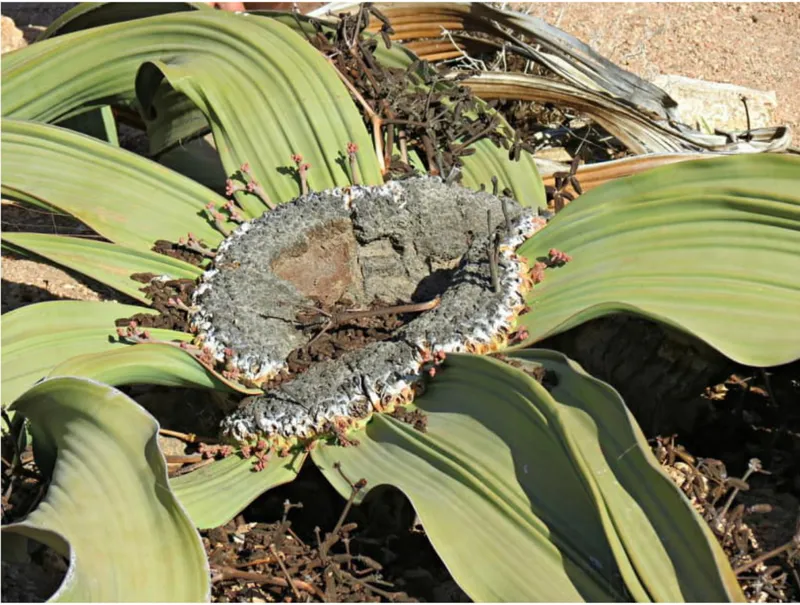
The close-up of the Welwitschia plant, photographed in bright sunlight against granular rock, is a deliberate provocation placed within the design narrative. Its thick, waxy leaves evolved over millennia to do exactly what this building attempts through architectural means: regulate temperature, manage moisture, and endure relentless solar exposure. The designers treat biomimicry not as metaphor but as a functional transfer of strategies. An Earth-to-Air Heat Exchanger stabilizes indoor temperatures during peak heat hours. Light tubes, tubular skylights, and perforated double-shell facades allow controlled daylight penetration while movable louvers respond to shifting solar angles, ensuring consistent illumination for the child-care and learning spaces within.
Open Sky Rooms: Where Kids Play in the Desert's Own Microclimate
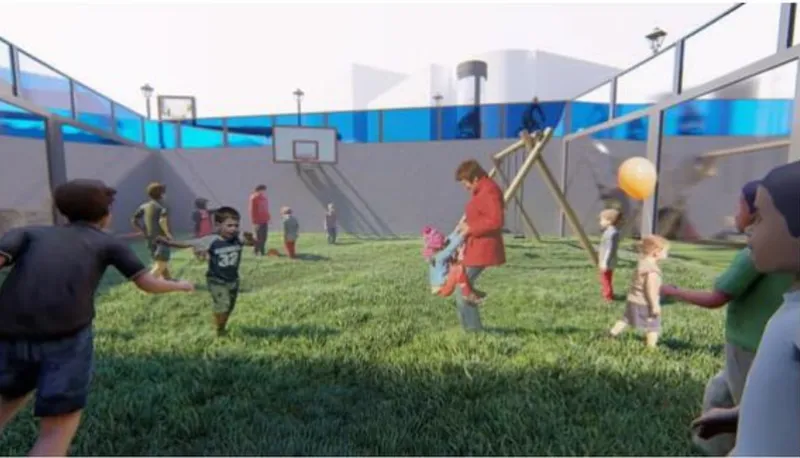
The enclosed courtyard rendering is perhaps the most compelling image in the project. Grass, basketball hoops, and children playing under an open sky, all within the protective embrace of the building's curved shell. These are not decorative voids. They are thermally buffered outdoor rooms where the earth mass of the sunken floor and the shading geometry of the surrounding structure combine to produce microclimatic comfort that would be impossible on an exposed urban surface. In a climate where outdoor play can be dangerous during peak hours, these spaces reclaim the outdoors for the building's youngest occupants.
A Roof That Opens to the City, Not Away From It
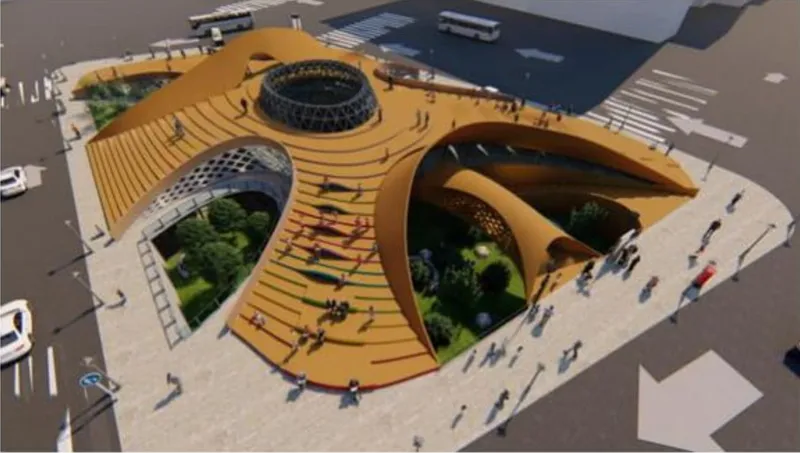
The aerial view reveals the full spatial logic of the petal configuration. Curved roof openings frame planted courtyards while pedestrians and vehicles circulate freely at street level. The building does not wall itself off from its dense urban context. Instead, it bends inward at points with limited views and activates edges facing major pedestrian movement, turning the institution into a connective urban element rather than a closed object. Stepped landscapes and public circulation paths transform its perimeter into an invitation.
Water scarcity, a defining constraint of arid sites, is addressed through graywater recycling systems inspired by natural filtration processes. Water collected from sinks and wash areas is treated and reused for irrigation and the cooling of those very courtyards visible from above. The project does not simply respond to climate as a problem to be solved; it treats climate as the generative force behind every architectural decision, from section to surface to social programme.
Why This Project Matters
Biomimicry in architecture often stops at the level of analogy: a building looks like a leaf, so we call it biomimetic. Flower of the Desert pushes past that threshold. The Welwitschia mirabilis is not a formal reference; it is a performance model. Its survival strategies, horizontal spread, ground shading, fog collection, wind resistance, are translated into measurable architectural systems, CFD-tested airflow patterns, earth-to-air heat exchangers, graywater loops, and responsive daylighting envelopes. The distinction matters because it positions climate-responsive design as engineering informed by biology, not decoration inspired by nature.
What makes the project especially resonant is its programme. This is not a research lab or a luxury resort; it is a public institution for children in a hot, dry city. The designers understood that climate responsiveness is not an abstract sustainability goal but a condition of comfort and safety for the people who will actually use the building. By centering the design on sunken courtyards where kids can play outdoors in a desert climate, the project argues that the most radical thing climate-responsive architecture can do is make ordinary daily life possible in places where the environment would otherwise forbid it.
View the Full Project
About the Designers
Designers: Reza Ghadirian, Hamid Shahmohammadmirab, Nima Asadi Jozani
Enter a Design Competition on uni.xyz
uni.xyz runs architecture and design competitions year-round that reward proposals with spatial conviction and real site intelligence.
Project credits: Flower of the Desert by Reza Ghadirian, Hamid Shahmohammadmirab, Nima Asadi Jozani Form Follows Climate 2020 (uni.xyz).




Popular Articles
Popular articles from the community


The Ocean Hive: Sustainable Architecture for a Self-Sufficient Civilization at Sea
The Ocean Hive imagines sustainable architecture at sea, where modular habitats, algae, wave power and ocean waste sustain a growing colony.

Riyadh For All: Intergenerational Urban Design for Active Aging in Rabat
Riyadh For All reimagines urban design in Rabat with intergenerational co-living, adaptive courtyards, and Moroccan cultural exchange today.

Lunar Spiral: Space Architecture Shaped by the Mathematics of the Universe
Lunar Spiral reimagines space architecture through Fibonacci geometry, lunar regolith, levitating habitats, and self-sustaining Moon living.

Co-life: Sustainable Architecture for Age-Friendly Community Living
Co-life reimagines sustainable architecture for seniors through courtyards, rammed earth, shared gardens, and spaces designed for belonging.

Similar Reads
You might also enjoy these articles
Lunar Spiral: Space Architecture Shaped by the Mathematics of the Universe
Lunar Spiral reimagines space architecture through Fibonacci geometry, lunar regolith, levitating habitats, and self-sustaining Moon living.
The Main Dream: Modular Architecture for Play, Learning, and Community
A modular playground turns recycled plastic into adaptable spaces where refugee children can play, build, learn, and reconnect.

Play: Fragments of Their World
Familiar architecture becomes modular playground design, creating safe spaces where displaced children can learn, connect, imagine and play.

Wadi Rum Observatory: Desert Architecture Designed for the Night Sky
Wadi Rum Observatory turns desert architecture into a quiet instrument for astronomy, hiding research spaces under Jordan's starlit terrain.


Comments (0)
Please login or sign up to add comments
No comments yet. Be the first to comment!