

Food-scape: A Stacked Waterfront Village Where Every Restaurant Gets a Sea View
Chiming Wong's mixed-use food building stacks modular glass boxes on a fixed frame, cascading terraces toward the sea so each level becomes a destination.


Most waterfront dining complexes give the sea to a lucky few tables and leave everyone else facing a wall. Food-scape refuses that hierarchy. It breaks the building into box modules and steps them back in cascading terraces so that every unit gets an unobstructed view of the water. Movement becomes the experience: visitors climb, wander and discover rather than walk straight to a single destination.
Designed by Chiming Wong, the project treats sustainable mixed-use architecture as an ecosystem where food, landscape and community share the same framework. The building is described as a vertical village, a stacked settlement shaped by sun, breeze and seaview. Its argument for sustainability depends less on technology than on adaptability: the structure is built to outlast the restaurants it houses.
Terraces That Turn Dining Into a Hillside Walk
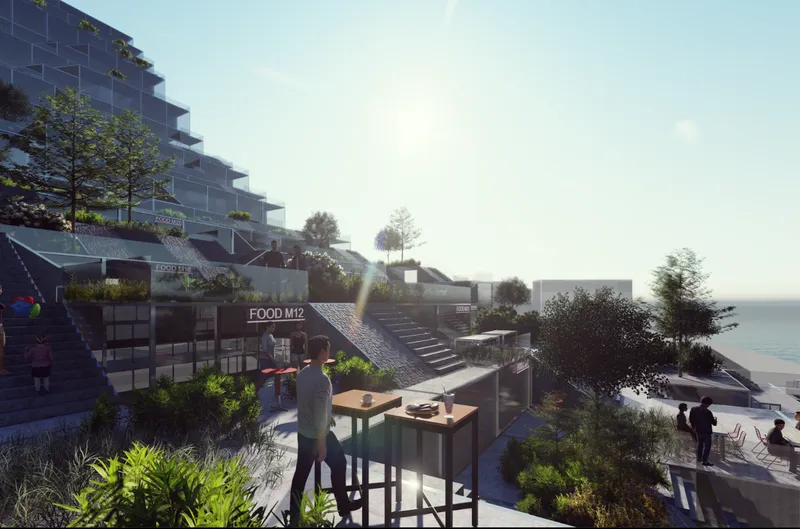
The terrace view shows the project at the scale where it works best. Glass-fronted food stalls open onto a stepped platform lined with high tables and planted beds, and the sea fills the horizon in low sun. The planting does real work. Wong uses the green pockets to shape circulation, temper the microclimate and give each level its own identity, much as gardens and courtyards do in hillside settlements.
The stepping is what makes lingering possible. Each terrace serves as the roof of the level below and the forecourt of the one above, so shaded seating, plazas and stalls overlap without crowding. The outdoor village becomes the first of three distinct ambiences, a relaxed, communal ground that rewards visitors for staying longer.
A Fixed Frame With Replaceable Rooms
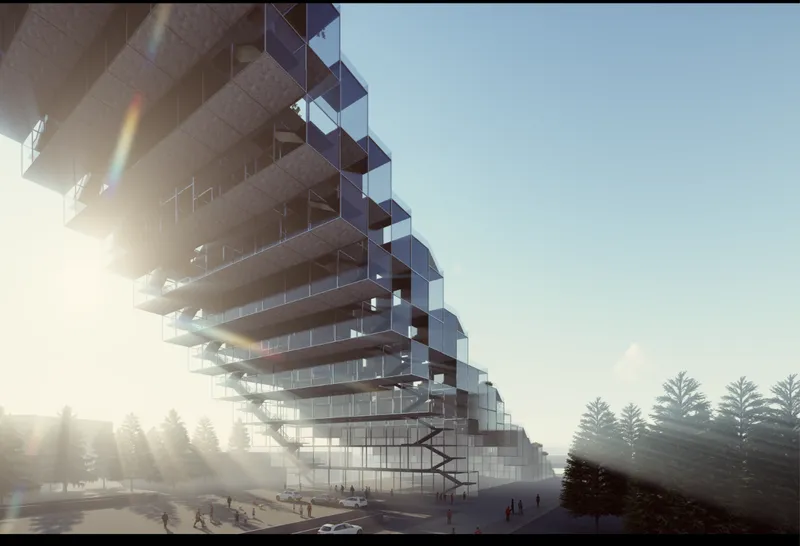
Seen from the street, the logic is easy to read: regular glass boxes sit within a clear frame structure, and exposed zigzag stairs climb across the facade. This is the project's most important move. The skeleton stays constant while the infill changes, so when a chef leaves or a new concept arrives, only the interior configuration needs rebuilding.
Food businesses turn over quickly, and conventional buildings pay for that churn in demolition waste. By separating the permanent structure from the temporary fit-out, Food-scape can host new culinary concepts, retail programmes or cultural uses without structural work. The exposed stairs also matter: they keep upper levels connected to the street and present circulation as part of the building's public face.
An Entrance Hall Built for Queues and Celebrations
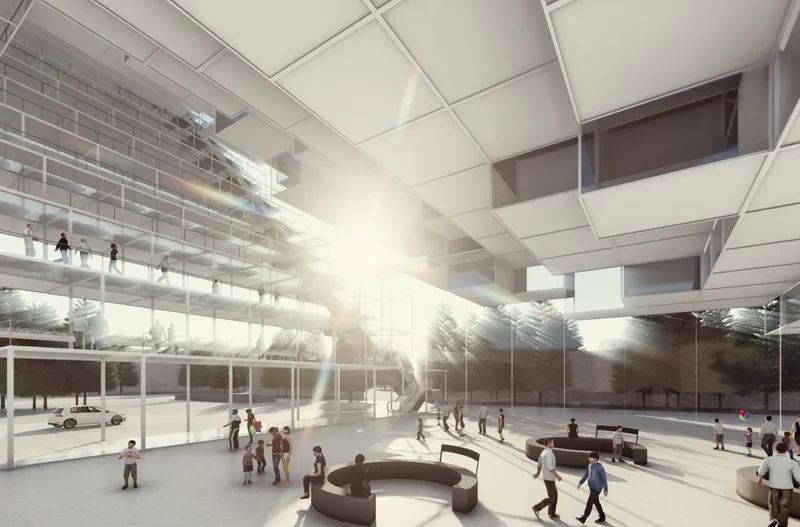
At ground level, a generous atrium with curved benches and a gridded ceiling receives visitors in strong backlight from the glass wall. On ordinary days it acts as a waiting and gathering space, absorbing the queues that would otherwise clog restaurant doorways. On special occasions it becomes an event hall for exhibitions, performances or community celebrations.
This dual role turns a functional problem into a civic asset. Waiting areas are usually leftover space; here the waiting room is an indoor plaza with the flexibility to take on a public programme. It is a modest strategy, but it gives the building a reason to be visited beyond mealtimes.
A Market Street Turned on Its Side
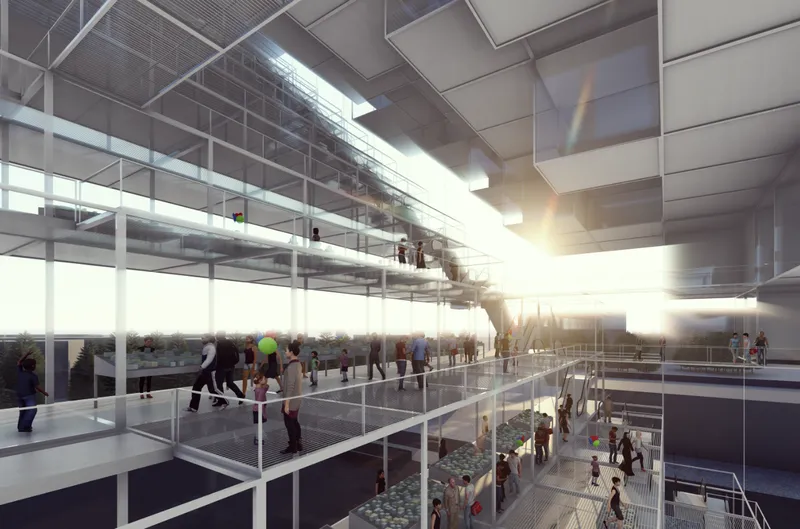
Inside, the vertical market behaves like a street drawn in section. Steel-framed walkways and balconies step upward beside a glazed wall, and crowds and planters layer the view from floor to floor. Bridges and transparent facades keep each level visible from the others, so activity above draws people upward the way a busy shopfront draws pedestrians along a road.
Daylight is the binding element. Natural light reaches deep into the plan through the glazing, keeping the interior from feeling like an enclosed mall. Together with the terraces outside, the market gives the building two parallel routes, one open-air and one sheltered, each with its own atmosphere and both leading to the same stacked village.
Stacking Studies Show the System Behind the Scenes
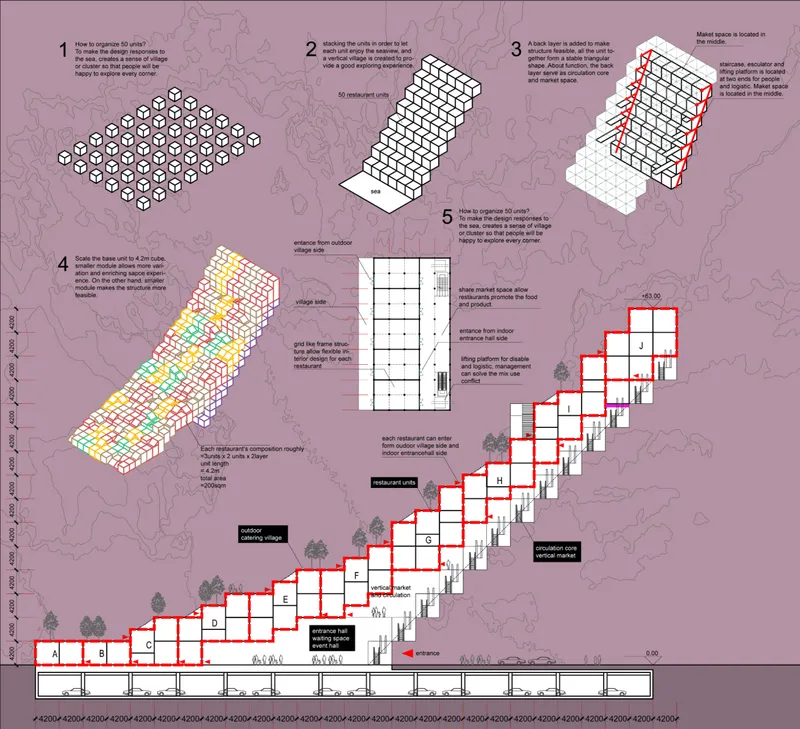
The diagram sheet sets out the rules behind the scenes. Axonometric stacking studies test how the boxes shift and step, a unit plan defines the repeatable restaurant module, and the stepped section shows restaurant units arranged around a circulation core with parking below. The section is the key drawing: it shows how each unit is offset so that none of them blocks another's light or view.
Reading the drawings alongside the renders makes clear that the varied, village-like character comes from a disciplined kit of parts. That combination of a regular structure and an irregular experience is what gives the proposal its credibility as a model for waterfront development.
Why This Project Matters
Food-scape makes a persuasive case that sustainability in commercial architecture can begin with time rather than materials. By designing a frame that expects its tenants to change, Chiming Wong addresses one of the least discussed sources of waste in the food and retail sector: the constant gutting and rebuilding of interiors. The building is built to adapt instead of being replaced.
Just as valuable is its insistence on fairness of view. Stepping the modules ensures that the sea, light and air are shared across every level instead of being reserved for a premium frontage. Whether or not the specific forms evolve, the principle of a permanent frame, adaptable infill and equal access to the landscape is one waterfront developers would do well to adopt.
View the Full Project
About the Designers
Designer: Chiming Wong
Enter a Design Competition on uni.xyz
uni.xyz runs architecture and design competitions year-round that reward proposals with spatial conviction and real site intelligence.
Project credits: Food-scape by Chiming Wong.


Popular Articles
Popular articles from the community


Extended Shell: Retrofitting Kolkata's Balconies as Living Urban Thresholds
A modular retrofit system recovers the social and environmental intelligence of Kolkata's historic verandas for contemporary Park Street residents.
Faces of the Soviet Avant-Garde: Turning Moscow's Street Names into an Open-Air Museum
A network of sculptural installations across a Moscow residential district transforms forgotten architect names into spatial encounters with cultural memor

Manzana Morphosis: Stretching Barcelona's Grid into a Living Landscape for 2050
A radical reworking of the Eixample manzana turns density into a tool for generous public space, vertical ecology, and environmental performance.

The Amber Palace Opera: A Geological Fiction Surfaces on Tallinn's Baltic Waterfront
Pierre Brillard reimagines a Baltic legend as a public landscape, opera house, and waterfront promenade rooted in Tallinn's coastal identity.

Similar Reads
You might also enjoy these articles

Healing Façade: A Modular Chapel System That Restores Ethiopia's Sacred Forests
Winner of the Eco-Chapel competition, this circular timber façade collects water from air to rebuild soil and reforest degraded Ethiopian landscapes.
Kaffeebühnen: Where Coffee Shop Architecture Becomes a Civic Stage in Vienna
A linear sequence of timber boxes, transparent shells, and open yards turns the Viennese café tradition into a public performance space.
Eco Chapel: A Modular Forest Pavilion That Grows Like the Landscape It Protects
Hexagonal timber modules weave through existing trees, turning a chapel into a living system for prayer, education, and reforestation.


Urban Forest: A Vertical Ecosystem for 5,000 Workers in Singapore's Changi Business Park
Radially stacked pods and layered green decks turn a 7-acre plot into 47 acres of ecological workspace projected for 2040.

Explore Seaside Architecture Competitions
Discover active competitions in this discipline

Challenge to reimagine the Iron Throne

Photograph architecture without architects

Illustrate the lost glory of Angkor Wat - Render Challenge

Design challenge to reuse E-waste
Comments (0)
Please login or sign up to add comments
No comments yet. Be the first to comment!