
FOREST TO BE: Sustainable Architecture Rooted in Trees, Prayer, and Community Memory
A forest chapel where trees become structure, prayer becomes ecology, and community participation rebuilds sacred nature over time.


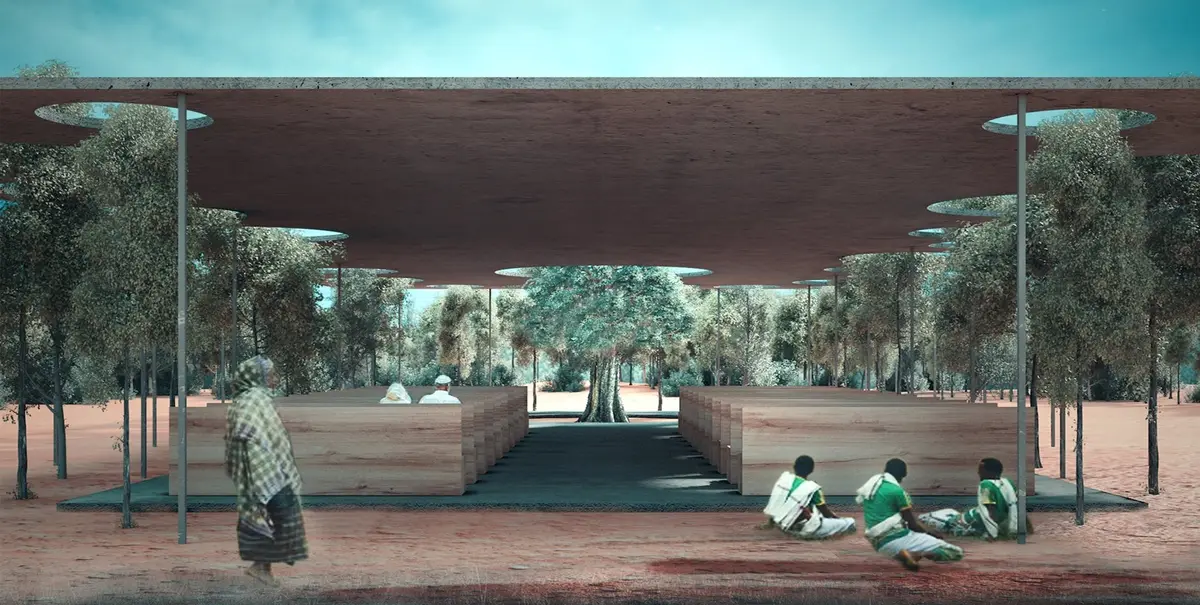
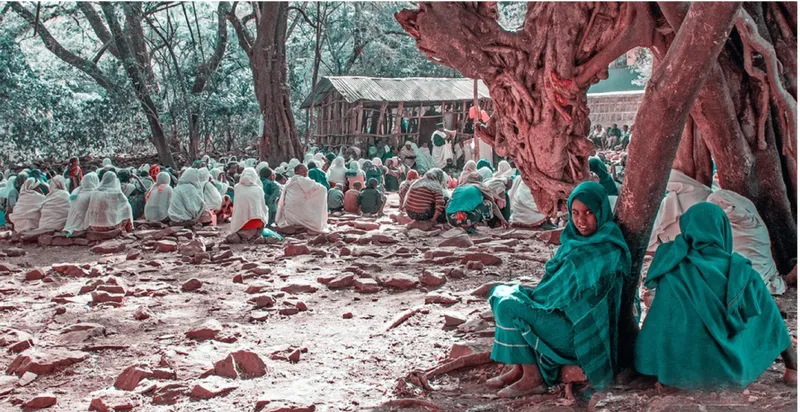
FOREST TO BE, a project by Milad Aliakbari, is an Editor’s Choice entry of Eco-Chapel that reimagines the relationship between worship, forest ecology, and architectural space. The proposal begins with a simple but powerful observation: before formal church buildings existed, people gathered in forests, prayed beneath trees, and treated the largest and oldest tree as a sacred symbol. Instead of replacing that memory with a conventional chapel, the design continues the historical process by organizing trees, people, rituals, and architectural elements into one living spiritual environment.
This project positions sustainable architecture not only as a matter of material efficiency or environmental performance, but as a cultural act. It asks how architecture can help people reconnect with ecosystems, revive forgotten bonds with nature, and transform worship into a practice of care. The chapel becomes less of a closed building and more of a living framework, where trees, shade, light, prayer, and participation construct the sacred experience together.
Architecture as a Continuation of Forest Worship
The central idea of FOREST TO BE is rooted in the memory of collective prayer under trees. In the past, communities gathered in forests and selected a larger, older tree as a symbolic center. That tree became an altar before the altar, a natural marker of reverence, gathering, and protection. Milad Aliakbari’s design does not treat this tradition as something outdated. Instead, it completes it through architecture.
The chapel is organized around the presence of trees. The design identifies the biggest and most meaningful tree, then arranges the surrounding elements around it. This process turns the tree into the spiritual and spatial focus of the project. The architectural intervention does not dominate the forest. It frames it, protects it, and makes it legible as a place of gathering.
In this way, the project creates a bridge between ancient forms of worship and contemporary sustainable architecture. The forest is not a backdrop. It is the primary sacred structure.
Trees as Columns, Forest as Church
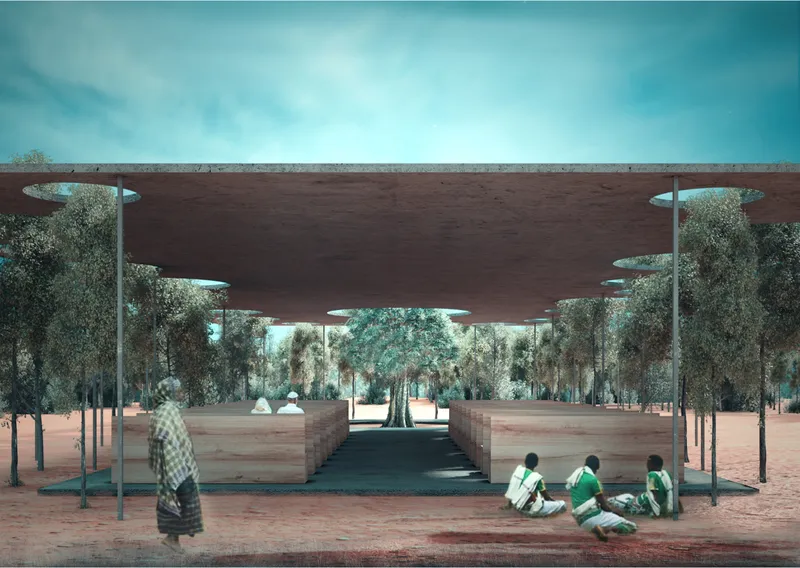
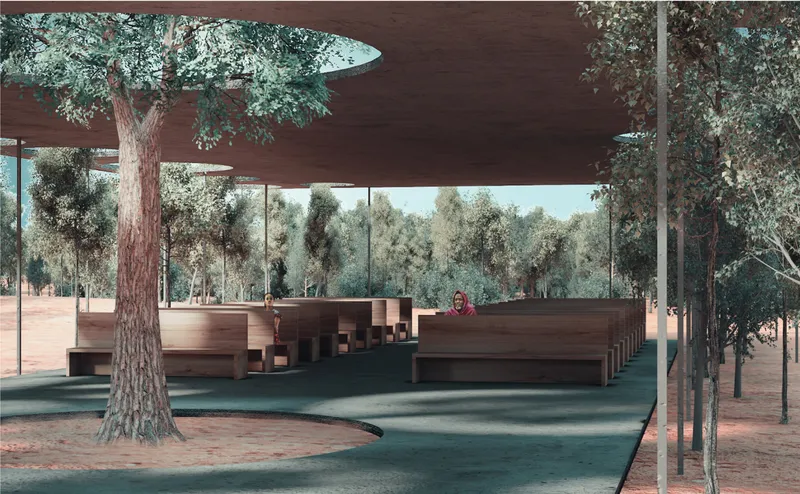
One of the strongest architectural ideas in the project is the transformation of the tree into a symbolic column. In traditional church architecture, columns create rhythm, height, procession, and sacred order. FOREST TO BE translates this language into a forest context. The trunks of trees become natural columns, while the arrangement of vegetation suggests the spatial memory of a church nave.
The project studies historic church forms and reinterprets them through the verticality of trees. The height, spacing, and symbolic weight of the forest replace the conventional stone or concrete column. The chapel’s altar is marked by a taller and more significant tree, allowing light to define the sacred turning point of the space.
This creates a compelling architectural metaphor. Instead of cutting down nature to build a church, the project allows nature to become the church. The sacred is not produced by enclosure alone, but by alignment, shade, light, movement, and ecological presence.
Sustainable Architecture Through Minimal Intervention
FOREST TO BE demonstrates a sensitive approach to sustainable architecture by reducing the need for heavy construction. The project does not propose an object building that erases the existing forest. Instead, it introduces a light architectural framework that organizes the site while preserving the natural character of the place.
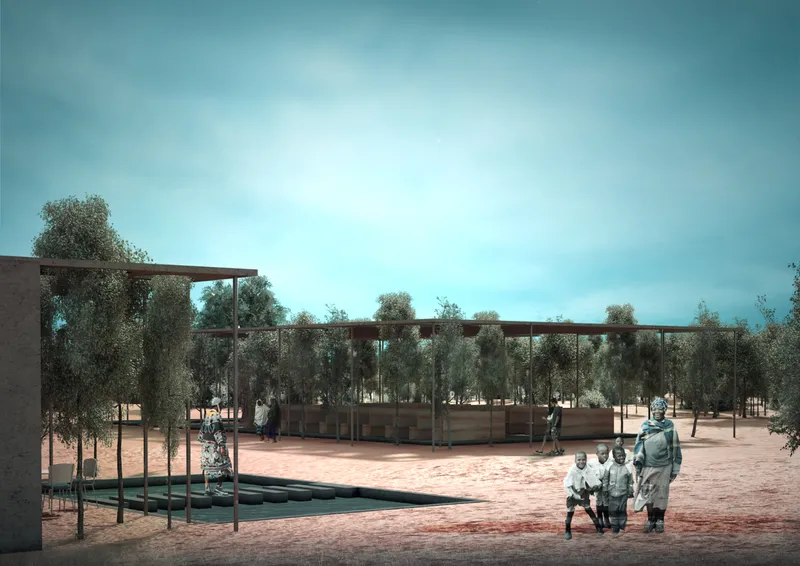
The roof plane plays a key role. It shelters the gathering space while allowing trees to pass through circular openings. These voids protect existing trees and allow sunlight, air, and growth to remain part of the chapel experience. The roof does not seal the space from nature. It negotiates with it.
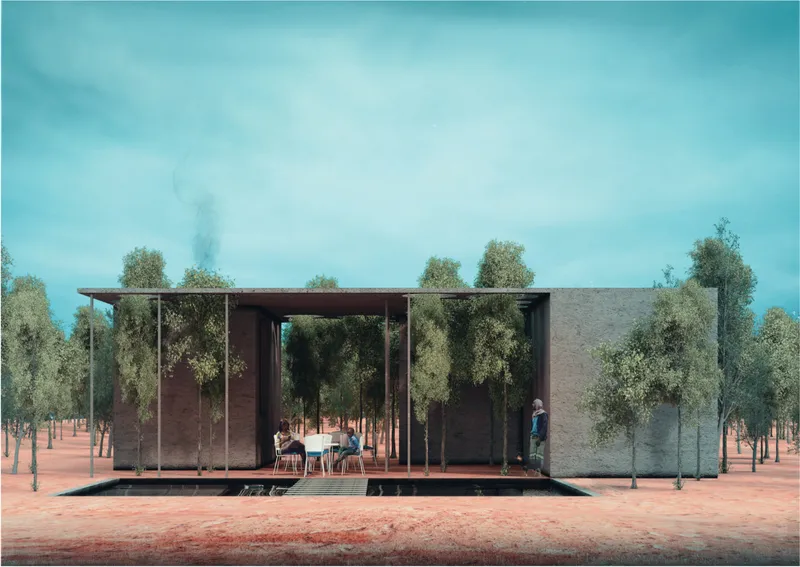
This strategy creates a chapel that feels open, breathable, and environmentally responsive. The architectural elements provide shade and order, while the forest provides identity, atmosphere, and spiritual depth. The result is a low-impact religious space where built form supports ecological continuity.
Arrangement: From Formal Order to Natural Harmony
The project avoids rigid, overly symmetrical planting. Instead, it aligns the church trees with the surrounding forest trees in a non-linear and natural arrangement. This decision is important because it allows the chapel to feel like part of the forest rather than an imposed geometric object.
The spatial plan balances church functions with ecological integration. Service areas such as restrooms, a coffee shop, and priest’s rest are placed around the main sacred area, allowing the central worship space to remain connected to the trees. The architecture defines necessary functions without disconnecting the visitor from the larger landscape.
This natural arrangement gives the chapel an organic rhythm. Visitors do not simply enter a building. They move through a planted field, pass under shade, gather around trees, and experience the forest as a sacred spatial system.
A Chapel That Grows With Its Community
One of the most meaningful aspects of FOREST TO BE is its participatory strategy. The project proposes that everyone who enters the church takes care of a tree and helps it grow. Over time, the forest around the chapel becomes larger, denser, and more complete.
This transforms the chapel from a finished architectural object into a long-term ecological process. The building is not complete on the day it opens. It grows through use, care, and repeated participation. Every visitor becomes part of the site’s future.
This idea gives the project a strong social and environmental message. Sustainability is not treated as a technical checklist. It becomes a shared ritual. The act of planting, protecting, and caring for trees becomes part of worship itself. As the number of visitors increases, the forest also expands, turning human presence into ecological regeneration.
Site Allocation and Sacred Movement
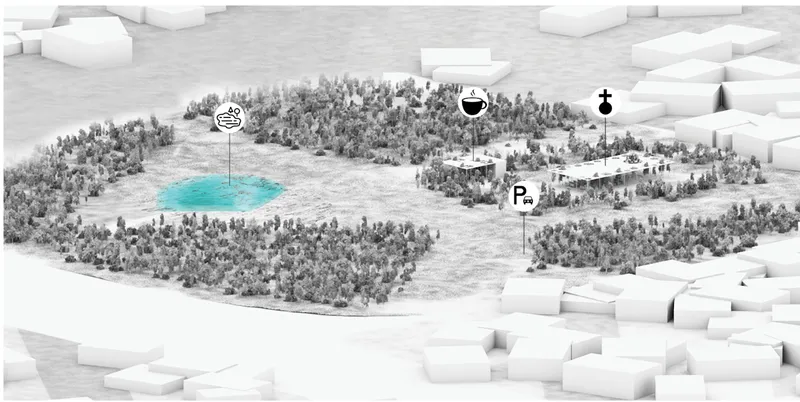
The project’s site strategy divides the area according to natural conditions and access. The chapel is placed in a zone that can connect to multiple site entrances, making it accessible while preserving other parts of the forest for parking, pond areas, and natural landscape.
The circulation diagram shows how visitors approach the chapel from different directions. This creates a sense of openness and inclusivity. The chapel is not hidden as a private object. It is woven into the broader forest landscape and connected to the everyday movement of people.
The pond, parking, wooded areas, and chapel work together as a landscape composition. The result is a site that combines ecological restoration with spiritual programming. Architecture becomes a tool for organizing care, access, and ritual within a larger environmental system.
Light, Shade, and Sacred Atmosphere
The atmosphere of FOREST TO BE is defined by the interaction of light and shade. The broad roof provides shelter from harsh sunlight, while circular openings allow trees and daylight to puncture the surface. This creates a layered interior condition where the sacred space is both protected and exposed.
The altar tree receives special emphasis through height, size, and light. This recalls the ancient act of gathering around a significant tree, while also introducing the spatial hierarchy of church architecture. The visitor experiences a gradual transition from forest to chapel, from open landscape to shaded gathering, from movement to prayer.
The design’s use of natural light is restrained and symbolic. It does not rely on dramatic ornamentation. Instead, it uses the existing qualities of the forest to create reverence.
Rebuilding Forests in Ethiopia
FOREST TO BE is presented under the theme of rebuilding forests in Ethiopia. The project’s response is both architectural and ecological. It recognizes that environmental restoration cannot happen through planting alone. It needs cultural meaning, social participation, and everyday care.
By connecting tree growth with religious gathering, the project gives ecological responsibility a spiritual dimension. It encourages people to understand the forest not as an external resource, but as a living community that supports human life, belief, and continuity.
The design also respects the idea that prayer historically happened earlier and better in the shade of trees. Rather than separating religion from ecology, FOREST TO BE reunites them. It proposes a chapel where caring for nature is part of caring for faith.
Why FOREST TO BE Matters
FOREST TO BE stands out because it does not treat sustainable architecture as a visual style. It treats sustainability as a relationship between people, land, memory, and future generations. The project understands that architecture can revive old forms of belonging while responding to urgent environmental concerns.
Its strength lies in its restraint. The chapel is not an architectural spectacle competing with the forest. It is a quiet framework that allows trees to become columns, shade to become ceiling, and community participation to become construction.
As an Editor’s Choice entry of Eco-Chapel, Milad Aliakbari’s project offers a poetic and practical model for sacred ecological design. It reminds us that architecture can do more than shelter people. It can teach care, restore memory, and help landscapes grow.
FOREST TO BE is a powerful example of sustainable architecture shaped by culture, ecology, and spiritual continuity. By transforming trees into sacred architectural elements, the project creates a chapel that belongs to the forest rather than replacing it. Its design completes an ancient historical process, where people once gathered beneath the largest tree to pray, by giving that memory a contemporary architectural form.
Through minimal intervention, natural arrangement, community participation, and ecological growth, FOREST TO BE becomes a living chapel. It is not simply a place of worship. It is a process of restoration, a lesson in environmental care, and a reminder that the future of architecture may depend on learning to love trees again.


Popular Articles
Popular articles from the community


Hill & Cross Opera: Sculptural Opera House Architecture Shaped by Tallinn’s Landscape and Identity
Hill & Cross Opera reimagines opera house architecture in Tallinn through its sculptural hill, civic plaza, glass wave and a luminous cross.

Little Red Riding Hood: Architectural Design as a Journey Through Fear, Light, and Storytelling
Little Red Riding Hood reimagines the fairy tale through architectural design shaped by fear, light, scale, memory, uncertainty, and choice.

Co-Life: Senior Housing Design That Reconnects Older Adults With the City
Co-Life reimagines senior housing design through healing gardens, shared streets, workshops, and a sustainable community across generations.

The Musturak Paradise: Senior Living Architecture for a Connected Future in Temara, Morocco
The Musturak Paradise reimagines senior living architecture in Temara via private homes, social spaces, culture, community, and shared care.

Similar Reads
You might also enjoy these articles

Eco Chapel: A Green Architecture Pavilion Designed in Symbiosis with the Forest
Eco Chapel uses green architecture to weave prayer, learning and reuse into a forest pavilion shaped by modular hexagonal canopies for life.
Kaffeebühnen: Coffee Shop Architecture Designed as a Civic Stage Between Vienna’s City and Park
Kaffeebühnen turns coffee shop architecture into a civic stage, linking Vienna’s park edge, urban life, warm timber yards, and coffee craft.
Healing Façade: Sustainable Architecture for Reforestation, Community, and Sacred Ecology in Ethiopia
Healing Façade reimagines sustainable architecture as a living wall that restores soil, catches water and renews Ethiopia's forest churches.


Urban Forest: A Vertical Ecosystem for 5,000 Workers in Singapore's Changi Business Park
Radially stacked pods and layered green decks turn a 7-acre plot into 47 acres of ecological workspace projected for 2040.

Explore Installations Competitions
Discover active competitions in this discipline

Challenge to design a portable theatre

Challenge to design a portable music platform

Challenge to design an open learning module for the elderly
Comments (0)
Please login or sign up to add comments
No comments yet. Be the first to comment!