

Forward Thinking School: Daylight, Stepped Platforms and a Campus That Teaches Beyond the Classroom
Nour Fuqa's north-south school uses curtain walls, light shelves and stepped platforms to turn circulation and landscape into learning space.


Most schools still treat learning as something that happens in a box: a room, a desk, a fixed front wall. The Forward Thinking School starts from a different premise. Here the whole building is a teaching instrument. Daylight, circulation, terraces and farmland are all expected to do pedagogical work, and the classroom becomes one setting among many.
Designed by Nour Fuqa and published as a project on uni.xyz, the scheme proposes a sustainable school that joins environmental strategy with collaborative pedagogy in a single spatial system. The building runs along a north-south axis, its two long facades glazed with curtain walls, and sits on a sloping site with outdoor play areas, farming zones and natural landscape. The ambition is clear: education should feel immersive and continuous, shaped as much by the architecture as by the timetable.
A Glazed Block Tuned to the Sun
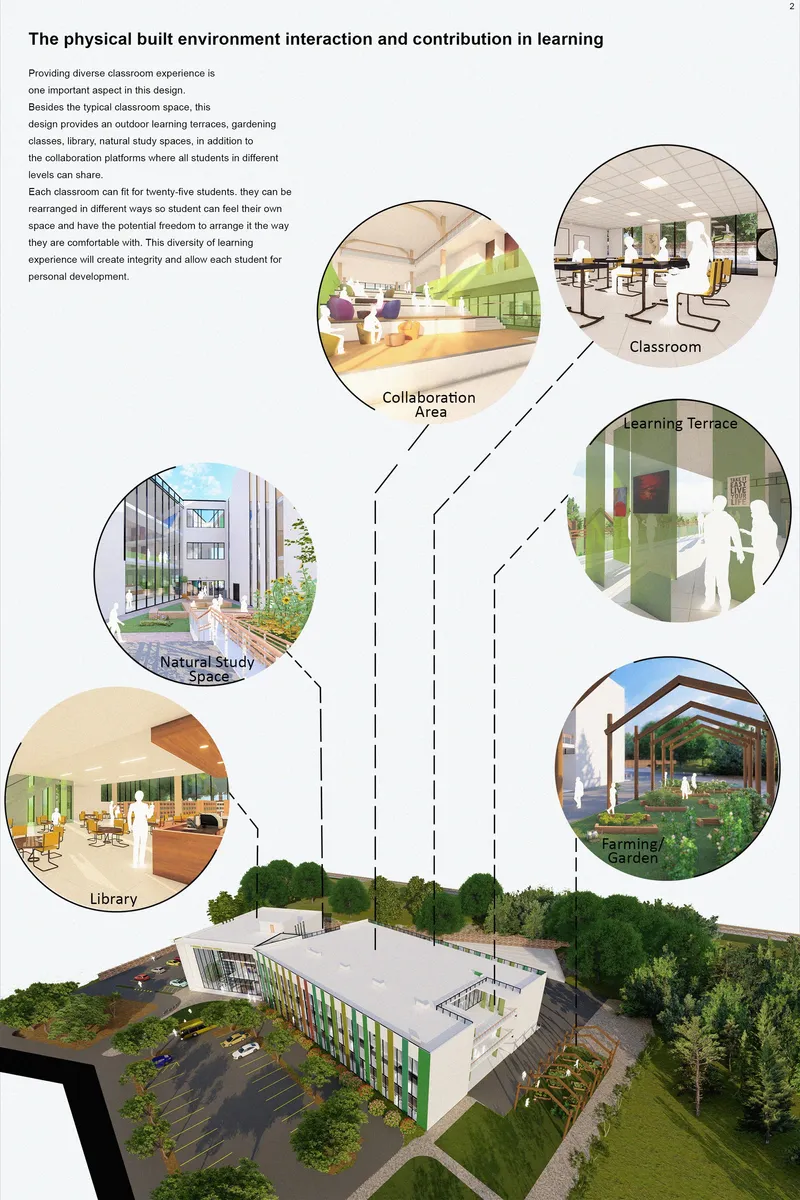
The aerial view presents a compact three-storey block with green and yellow facade panels set against generous glazing, surrounded by vignettes of interiors and gardens. The orientation drives the argument. Because the long elevations face north and south, the curtain walls on both sides can pull daylight deep into the learning spaces, which cuts reliance on artificial lighting and improves visual comfort and the general mood of the rooms.
The south facade is where the design shows real discipline. Full glazing facing the sun would overheat the rooms and produce glare, so Fuqa adds integrated light shelves that bounce daylight further into the classrooms while shading the area near the windows. It is a modest, well-proven device, and using it here signals an understanding that a sustainable school needs evenly lit rooms where students can concentrate, and glazing alone does not deliver that. The coloured panels then keep the minimalist volume from reading as purely technical.
Angled Wings Around a Shared Void
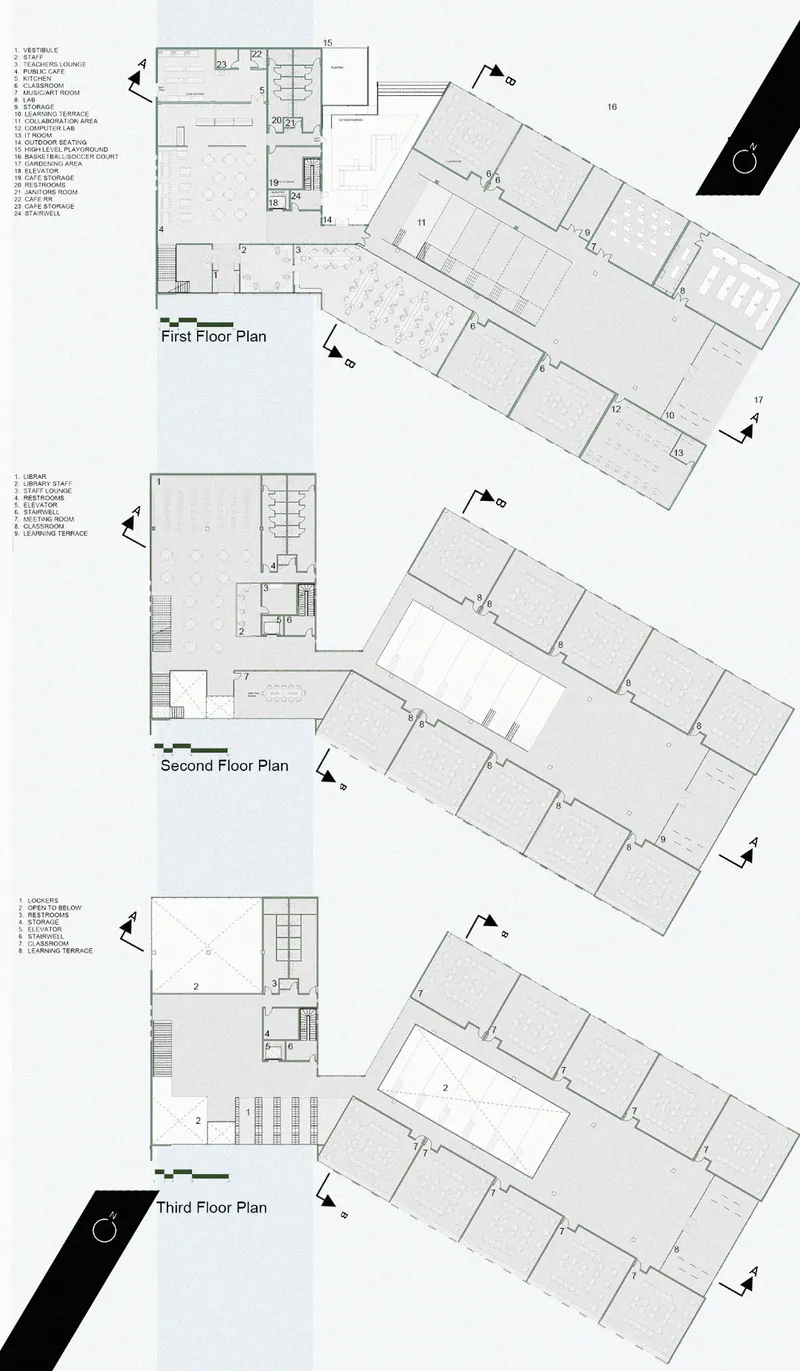
The plans for the first, second and third levels show classroom wings set at angles around a central atrium void, with a distinct library block anchoring the arrangement. The geometry matters. Angling the wings breaks up the long, repetitive corridor typical of institutional schools and creates pockets of space at the junctions, while the void connects the floors visually so that activity on one level stays visible from the others.
Each classroom holds roughly twenty-five students and can be reconfigured for group discussion, independent study or collaborative workshops. This flexibility gives students some control over their surroundings, which the project links to autonomy and comfort. The ground floor carries the same thinking: open collaborative zones, along with a cafeteria and library shared across functions, make the base of the building feel like a commons. The plan does not separate learning space from social space; it overlaps them on purpose.
Stepped Floors and a Pergola on the Slope

Sections A-A and B-B show the scheme's most persuasive idea. The floors step down with the sloping site, a stair core links the levels, and a timber pergola extends the building outward into the landscape. Inside, stepped platforms work as informal gathering zones, so the line between moving through the school and staying in it disappears. A student on the way to class passes through places where it is natural to stop, sit and talk.
Outdoor terraces carry this further, offering open-air rooms for showing work, holding discussions and learning from peers. Beyond them, farming zones, play areas and bicycle parking push the programme past academics into physical, emotional and environmental development. Read together, the sections describe a school where the edge of the building is blurred, and where sustainability is something students practise every day.
Why This Project Matters
The Forward Thinking School is not formally radical, and that works in its favour. Its minimalist geometry, light shelves and stepped section use familiar tools, but they are assembled with a clear sense of purpose: each environmental move also supports a pedagogical one. Daylight improves focus, the stepped platforms encourage interaction, and the landscape teaches. That alignment between environment and education is what many school projects claim and few manage to show this clearly in plan and section.
The next step would be to test how these ideas hold up in use: how the reconfigurable classrooms get furnished, how the atrium is managed acoustically, how the farming zones are maintained across seasons. Even as a proposal, Fuqa's project makes a strong case that the most useful thing a school building can do is stop acting as a neutral container and start taking part in learning.
View the Full Project
About the Designers
Designer: Nour Fuqa
Enter a Design Competition on uni.xyz
uni.xyz runs architecture and design competitions year-round that reward proposals with spatial conviction and real site intelligence.
Project credits: Forward Thinking School by Nour Fuqa.


Popular Articles
Popular articles from the community


Cube Design Draws an Ecological Corridor Between Two Shenzhen Hills with the Nankai Building
Beside Shenzhen's container docks, the Nankai Building pairs stacked balconies with a climbing green screen to connect two hillsides across its height.

longwave studio Reorganizes a 112 m² Tainan Apartment Around the Daily Routines of a Family and Two Cats
In Tainan, Taiwan, birch plywood, rust-red furniture and a freestanding plaster wall link arrival, storage, work and family life in one apartment.

David Macias Steps a Doorless Stone and Plaster House Down a Tropical Colombian Hillside
In the humid hills of Colombia, Threshold House replaces the front door with an open void and terraces its 850 m² down the slope instead of fighting it.

Juan García Correa, John González and Claudia Rueda Sink a Circular Amphitheater into a Manizales Engineering Building
On the La Nubia campus in Manizales, Colombia, the S1 Building folds labs and offices into a hillside of ramped lawns that double as a campus route.

Similar Reads
You might also enjoy these articles
Healing Façade: A Modular Chapel System That Restores Ethiopia's Sacred Forests
Winner of the Eco-Chapel competition, this circular timber façade collects water from air to rebuild soil and reforest degraded Ethiopian landscapes.
Kaffeebühnen: Where Coffee Shop Architecture Becomes a Civic Stage in Vienna
A linear sequence of timber boxes, transparent shells, and open yards turns the Viennese café tradition into a public performance space.
Eco Chapel: A Modular Forest Pavilion That Grows Like the Landscape It Protects
Hexagonal timber modules weave through existing trees, turning a chapel into a living system for prayer, education, and reforestation.


Urban Forest: A Vertical Ecosystem for 5,000 Workers in Singapore's Changi Business Park
Radially stacked pods and layered green decks turn a 7-acre plot into 47 acres of ecological workspace projected for 2040.

Explore Sustainable Design Competitions
Discover active competitions in this discipline

Challenge to design public laboratory

Challenge to reimagine the Iron Throne

Photograph architecture without architects

Illustrate the lost glory of Angkor Wat - Render Challenge
Comments (0)
Please login or sign up to add comments
No comments yet. Be the first to comment!