
Fresh Air School | Sustainable School Architecture for Nature-Based Learning
Fresh Air School redefines sustainable school architecture through nature-based learning, open classrooms, and ecological education.


Educational spaces have long been designed around rigid classrooms, enclosed corridors, and repetitive systems that prioritize standardization over curiosity. While schools have evolved technologically, the physical classroom itself has remained relatively unchanged for decades. Fresh Air School challenges this conventional approach by proposing an educational environment where architecture becomes an active participant in learning rather than a passive container for it.
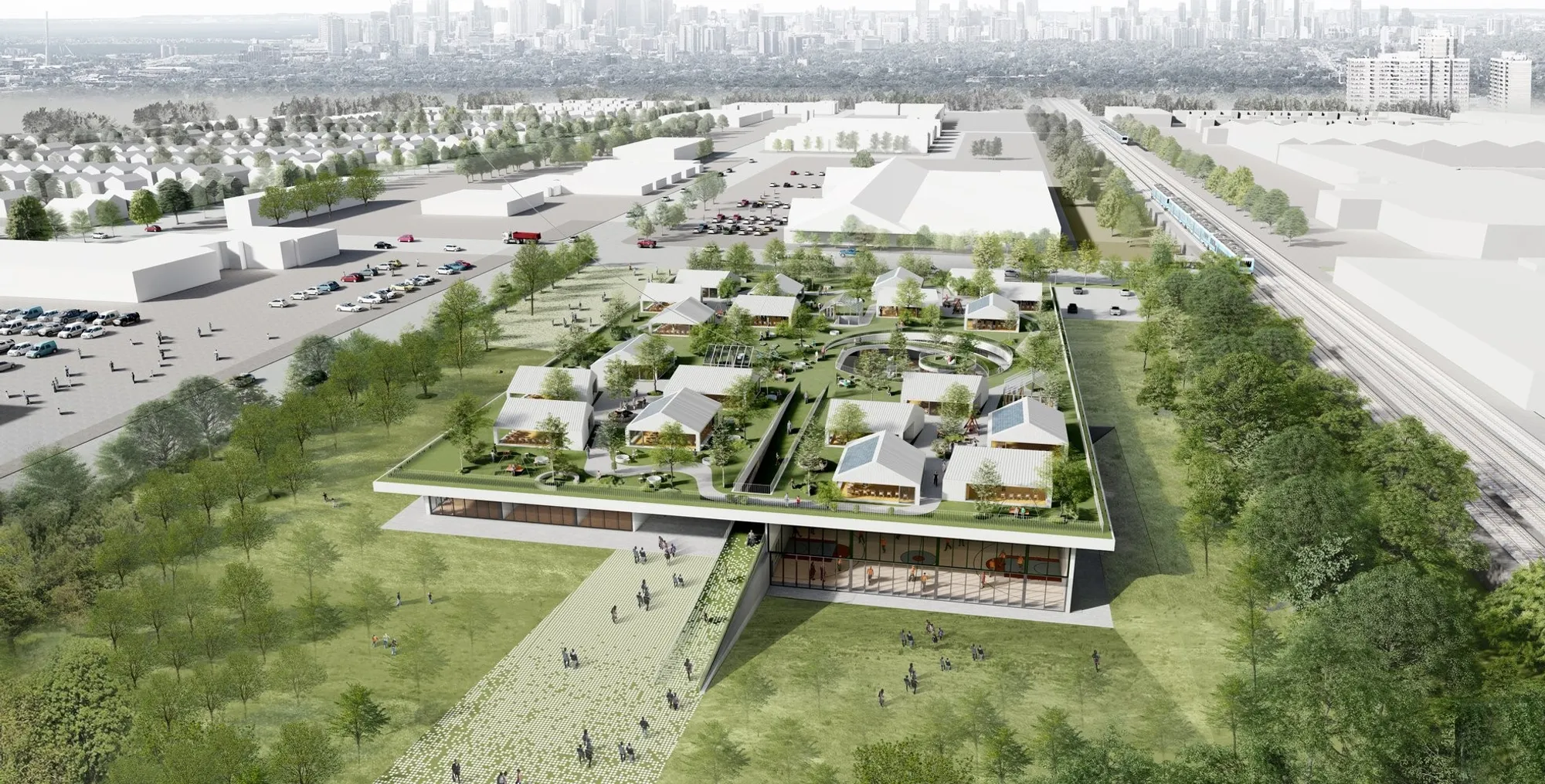
Designed by Hoan Dao Manh, the project was recognized as a Runner-up entry in the School Of Thought 2020 competition. The proposal introduces a new vision for sustainable school architecture where nature, flexibility, technology, and community coexist within a learning ecosystem designed for children’s physical, emotional, and intellectual growth.
Reimagining the Classroom Through Sustainable School Architecture
At the center of the project lies a fundamental question: why should learning remain restricted within four walls?
Fresh Air School proposes a future-focused educational model inspired by open-air classrooms and ecological learning environments. Instead of isolating students from nature, the project integrates natural systems directly into the learning experience. Trees, sunlight, water, fresh air, gardens, and outdoor social spaces become educational tools themselves.
The design reflects the belief that children learn more effectively when they interact with dynamic environments rather than static rooms. By creating an educational landscape instead of a conventional building, the project transforms architecture into an immersive learning framework.
The school embraces the philosophy that education should stimulate imagination, curiosity, and independence. Learning occurs not only in designated classrooms but throughout the entire campus, allowing students to explore spaces freely and develop their own connections with the environment.
A Nature-Centered Educational Ecosystem
One of the strongest aspects of the proposal is its integration of natural ecosystems into everyday school life. The campus is envisioned as a living educational environment where students continuously engage with ecological systems.
The project introduces farming areas, outdoor gathering spaces, open courtyards, community gardens, and recreational zones that encourage students to interact directly with nature. These spaces support both academic learning and emotional well-being.
Children are encouraged to plant trees, understand ecosystems, recycle materials, and develop environmental awareness through practical experiences. Instead of learning sustainability only through textbooks, students actively participate in sustainable practices throughout the school environment.
The architecture recognizes that children naturally develop curiosity in outdoor settings. Open green spaces, shaded pathways, natural ventilation, and visual connectivity with the surrounding landscape create an atmosphere where exploration becomes part of daily life.
This approach aligns strongly with contemporary discussions surrounding sustainable school architecture, which increasingly focuses on student wellness, environmental performance, and experiential learning.
The Hundred Languages of Children
The conceptual foundation of the project references Loris Malaguzzi’s philosophy of “The Hundred Languages of Children,” which emphasizes the many ways children express themselves and engage with the world.
Fresh Air School translates this educational philosophy into architectural form by designing diverse learning environments rather than repetitive classrooms. Every part of the campus supports different forms of interaction, creativity, communication, and self-discovery.
Students can learn through movement, collaboration, experimentation, play, observation, and reflection. The architecture creates conditions where children are free to discover knowledge independently while remaining connected to a larger community.
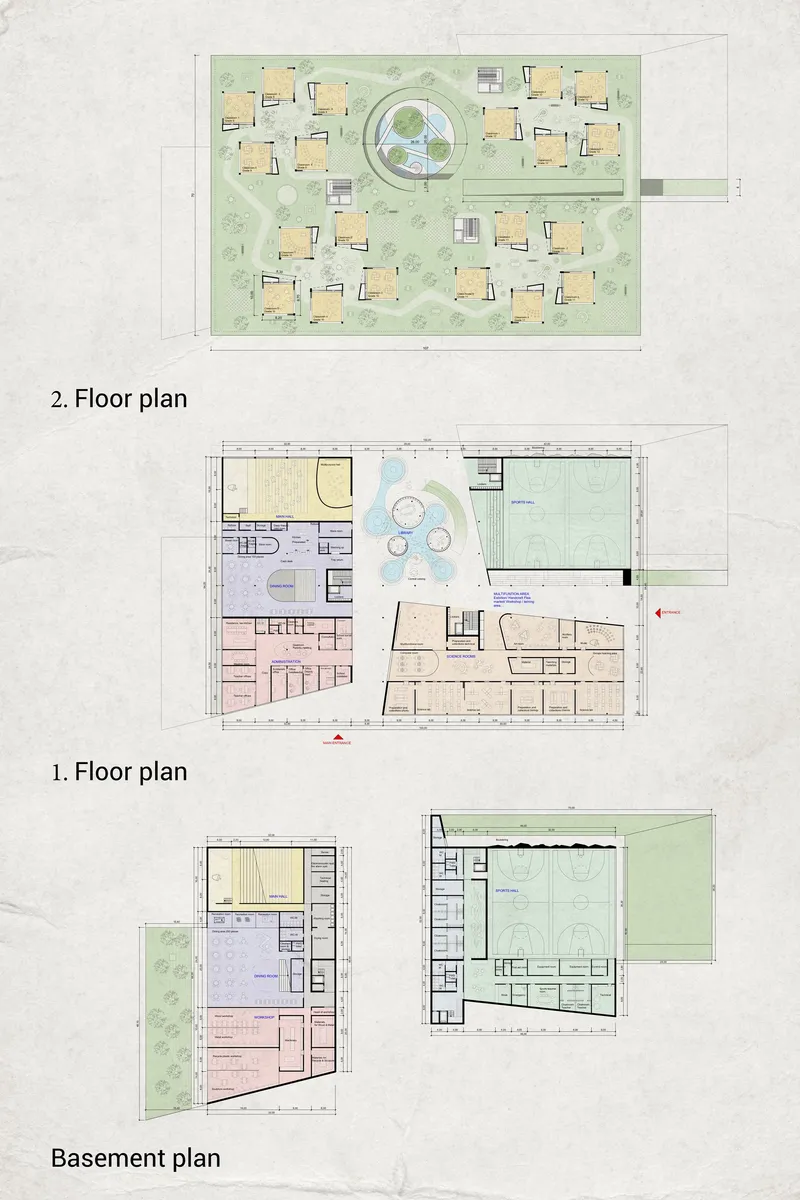
The central circular communal space acts as both a social condenser and an educational landscape. Surrounded by greenery and integrated learning areas, it becomes a symbolic and functional core of the campus.
This spatial strategy encourages social interaction while maintaining strong visual relationships across the entire school environment.
Open-Air Learning and Flexible Educational Spaces
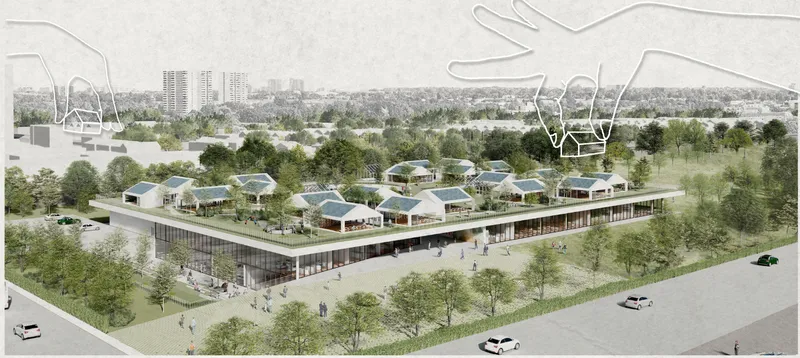
Fresh Air School rejects the traditional model of fixed classroom layouts. Instead, it introduces modular class-house spaces distributed throughout the campus.
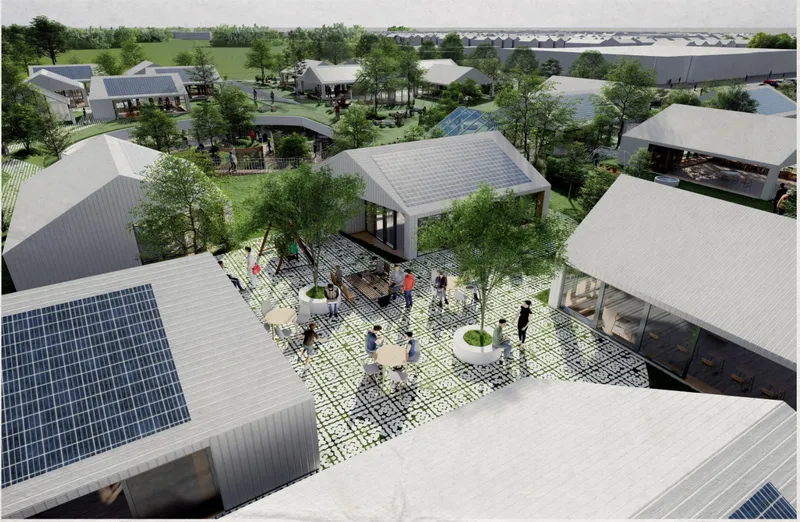
These smaller educational units create a more intimate and adaptable learning experience while reducing the institutional feeling commonly associated with schools. The distributed arrangement also allows students to remain connected to outdoor environments throughout the day.
The open-air classroom concept provides several environmental and educational benefits:
- Increased natural ventilation
- Improved daylight access
- Stronger psychological connection to nature
- Flexible learning arrangements
- Reduced dependence on mechanical systems
- Enhanced student engagement
The project demonstrates how sustainable school architecture can improve educational quality not only through energy performance but also through spatial experience.
By combining indoor and outdoor learning environments, the design supports multiple modes of education ranging from collaborative workshops to quiet self-learning zones.
Community Spaces Designed for Interaction
Community plays a central role within the architectural language of the project. The campus is designed as a social landscape where interaction occurs naturally between students, teachers, and visitors.
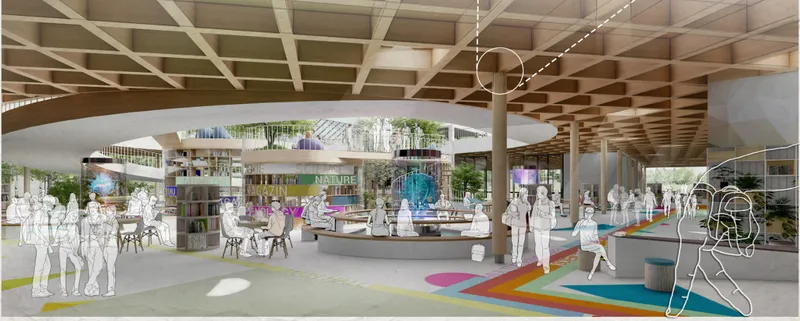
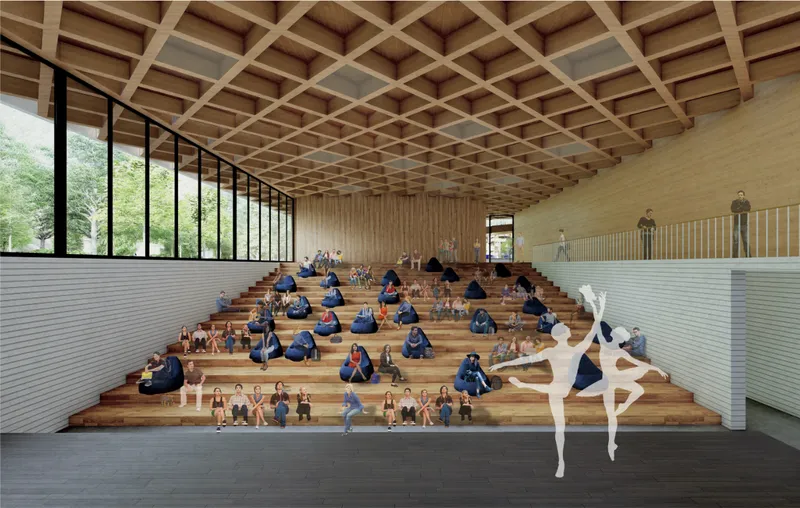
The stepped main hall acts as a multifunctional gathering space for performances, events, discussions, and collaborative learning activities. The warm material palette, large open seating areas, and timber ceiling structure create an inviting atmosphere that feels civic rather than institutional.
Instead of separating education from community life, the project encourages openness and participation.
Outdoor courtyards and social plazas further reinforce this approach by creating informal spaces for conversation, relaxation, and recreation. The campus becomes a miniature urban ecosystem where students develop communication skills, social awareness, and collective responsibility.
The architecture emphasizes flexibility over hierarchy, allowing spaces to evolve according to changing educational needs.

Environmental Strategies and Sustainable Design
Sustainability is deeply embedded within the project’s architectural and operational systems.
The proposal integrates solar panels across multiple roof surfaces, demonstrating a commitment to renewable energy generation. The distributed low-rise building arrangement also minimizes environmental impact while allowing natural light and ventilation to penetrate deeply into interior spaces.
Green roofs, permeable surfaces, and landscaped pathways help regulate microclimatic conditions across the campus. The design prioritizes passive environmental strategies instead of relying heavily on energy-intensive mechanical systems.
The modular building approach also supports long-term adaptability and future expansion.
By integrating ecological awareness directly into the physical environment, the project transforms sustainability from a technical requirement into a visible educational experience.
Students are constantly exposed to systems related to energy, climate, planting, recycling, and environmental stewardship.
This holistic integration is what makes Fresh Air School particularly relevant within current conversations around sustainable school architecture and future educational design.
Learning Beyond Academics
Fresh Air School proposes a broader understanding of education that extends beyond conventional academic performance.
The program includes recreational spaces, farming areas, workshops, science labs, art rooms, music rooms, sports facilities, and collaborative learning zones. These diverse environments support emotional intelligence, physical activity, creativity, and hands-on learning.
The school aims to develop students both mentally and physically while nurturing environmental responsibility.
By balancing nature-based experiences with technological learning environments, the project creates an educational ecosystem prepared for future generations.
This duality between ecology and innovation becomes one of the defining characteristics of the proposal.
Spatial Organization and Campus Planning
The campus planning strategy reinforces openness, accessibility, and exploration.
The distributed arrangement of classroom modules across landscaped pathways creates a village-like educational environment rather than a centralized institutional structure. Students move through gardens, courtyards, and social spaces as part of their daily routine.
The circular central zone anchors the campus visually and socially while connecting different programmatic areas.
Underground and lower-level learning spaces are carefully integrated into the landscape without disrupting the openness of the site. Sports halls, workshops, and technical facilities are positioned strategically to maintain functional efficiency while preserving the natural character of the campus.
The layered sectional organization allows the project to balance density with openness.
This planning approach demonstrates how architecture can shape behavioral patterns, movement, and social interaction.
A Vision for the Future of Educational Architecture
Fresh Air School presents a compelling vision for how educational architecture can evolve in response to environmental, social, and pedagogical challenges.
Rather than designing a school as a static institution, the project imagines education as a continuously evolving relationship between students, nature, community, and technology.
The proposal emphasizes freedom, exploration, creativity, and ecological awareness while maintaining a strong architectural identity.
Its integration of open-air learning, modular educational spaces, environmental systems, and community-centered planning reflects many of the core principles shaping the future of sustainable school architecture worldwide.
As schools increasingly seek healthier, more adaptive, and environmentally responsible learning environments, projects like Fresh Air School demonstrate the transformative potential of architecture in shaping future generations.
Through its integration of ecology, flexibility, and human-centered design, Fresh Air School becomes more than an educational facility. It becomes a living framework for learning, interaction, and environmental consciousness.
Project Credits
Project Name: Fresh Air School
Project By: Hoan Dao Manh
Recognition: Runner-up entry, School Of Thought 2020



Popular Articles
Popular articles from the community


AL-JANNAH: Sustainable Architecture and Permaculture for Afghan Widows
AL-JANNAH uses sustainable architecture and permaculture to create resilient oasis of housing, learning, work and renewal for Afghan widows.

Co-life: Sustainable Architecture for Age-Friendly Community Living
Co-life reimagines sustainable architecture for seniors through courtyards, rammed earth, shared gardens, and spaces designed for belonging.

Conexión: Biophilic Design Reimagines High-Rise Living in Hong Kong
Conexión reimagines high-rise living in Hong Kong through biophilic design, green facades, shared spaces, daylight, water and nature within.

Co-Life: Senior Housing Design That Reconnects Older Adults With the City
Co-Life reimagines senior housing design through healing gardens, shared streets, workshops, and a sustainable community across generations.


Similar Reads
You might also enjoy these articles

Eco Chapel: A Green Architecture Pavilion Designed in Symbiosis with the Forest
Eco Chapel uses green architecture to weave prayer, learning and reuse into a forest pavilion shaped by modular hexagonal canopies for life.
Kaffeebühnen: Coffee Shop Architecture Designed as a Civic Stage Between Vienna’s City and Park
Kaffeebühnen turns coffee shop architecture into a civic stage, linking Vienna’s park edge, urban life, warm timber yards, and coffee craft.
Healing Façade: Sustainable Architecture for Reforestation, Community, and Sacred Ecology in Ethiopia
Healing Façade reimagines sustainable architecture as a living wall that restores soil, catches water and renews Ethiopia's forest churches.


Urban Forest: A Vertical Ecosystem for 5,000 Workers in Singapore's Changi Business Park
Radially stacked pods and layered green decks turn a 7-acre plot into 47 acres of ecological workspace projected for 2040.


Explore Educational Building Competitions
Discover active competitions in this discipline



Challenge to design public laboratory


Design challenge to reuse E-waste
Comments (0)
Please login or sign up to add comments
No comments yet. Be the first to comment!