

Full Moon Airport: A Vision for Sustainable Airport Architecture in Koh Phangan
A circular airport merging land, sea, and mobility, redefining sustainable airport architecture through experience, ecology, and future-ready design.


In the evolving discourse of sustainable airport architecture, the need to balance infrastructure with ecological sensitivity has become increasingly critical. The Full Moon Airport proposal in Koh Phangan, Thailand, presents a compelling response to this challenge. Rather than imposing a conventional aviation typology onto a fragile island ecosystem, the project reimagines the airport as an immersive spatial experience that integrates seamlessly with its natural surroundings.
Conceptualized as a circular intervention positioned between land and sea, the design captures the essence of Koh Phangan’s landscape while redefining how airports function, feel, and perform. The project, by Misak Terzibasiyan, was recognized as an Editor’s Choice entry in the First Window competition, highlighting its innovative approach to future airport design.
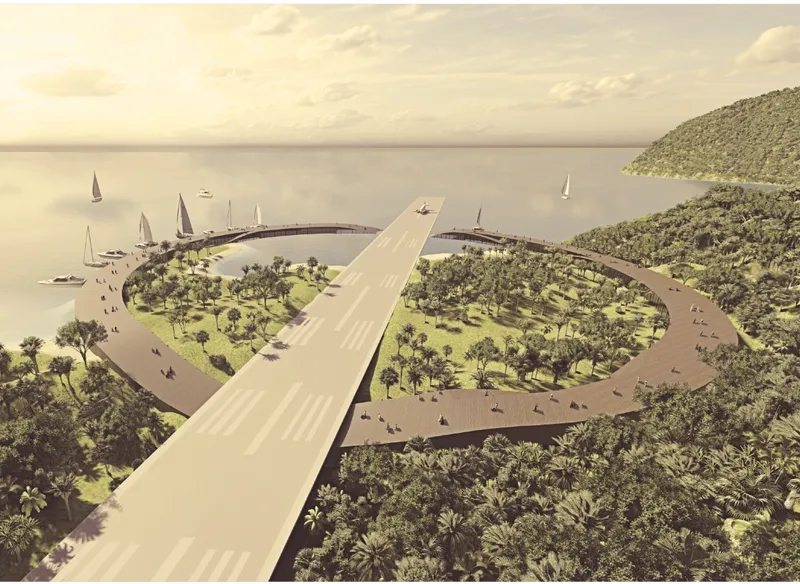
Concept: A Circular Interface Between Land and Sea
At the core of this sustainable airport architecture lies a singular geometric gesture: the circle. Positioned at the threshold between land and water, the circular form encloses a curated landscape of forests, beaches, and water bodies, effectively framing the island’s natural beauty.
This geometry is not merely symbolic. It serves multiple functional and experiential purposes:
- It creates a continuous spatial loop that organizes all airport functions
- It acts as a viewing platform offering panoramic vistas of the island
- It establishes a strong visual identity, visible from the air as a reference to the island’s iconic full moon celebrations
The landing strip cuts across the diameter of the circle, creating a dramatic moment of arrival. Passengers experience a unique descent over water, reinforcing the connection between aviation and landscape.
Spatial Organization: Circular Flow and User Experience
The project introduces a highly efficient circular circulation system, redefining passenger movement within airport architecture. Instead of linear sequencing, the airport adopts a looped flow where functions are arranged adjacently in a logical order.
Departing passengers move through a seamless progression:
- Arrival at the terminal
- Check-in
- Retail and transitional spaces
- Boarding gates
Arriving passengers follow a complementary route:
- Entry into the enclosed garden
- Movement through baggage and passport control
- Transition into the terminal or onward transport
This circular flow enhances wayfinding, reduces confusion, and creates an intuitive user experience. The spatial continuity also transforms the airport from a transit space into a place of engagement and exploration.
Airport as Landscape: Integrating Nature and Infrastructure
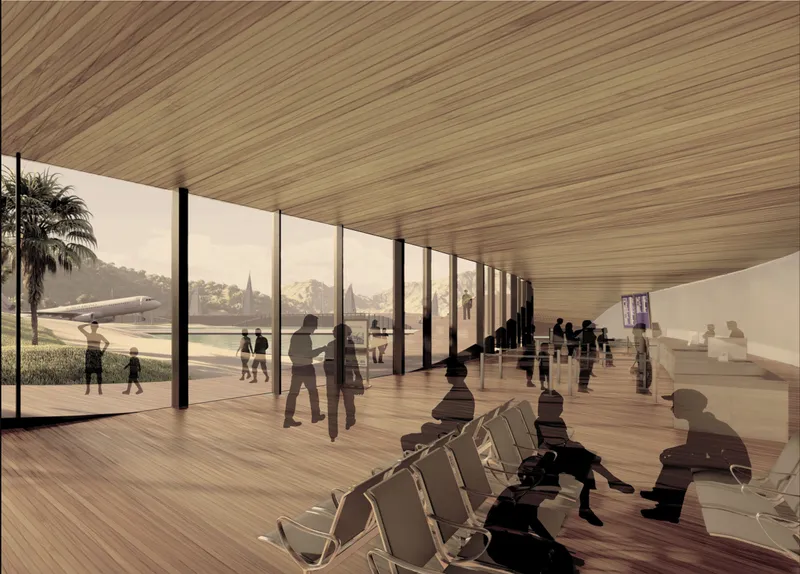
A defining aspect of this sustainable airport architecture is its integration with the natural environment. The circular structure encloses a central garden that reflects the island’s biodiversity, allowing passengers to experience Koh Phangan before even leaving the airport.
The architecture dissolves boundaries between built form and landscape through:
- Open boardwalks that encourage movement and interaction
- Gradual slopes connecting interior and exterior spaces
- Extensive visual permeability across the site
Rather than isolating passengers within enclosed terminals, the design invites them into a hybrid environment where nature and infrastructure coexist.
Hybrid Mobility: Airport and Harbour Integration
The Full Moon Airport extends beyond aviation by incorporating a harbour within its circular form. This integration of multiple transportation modes enhances connectivity and reflects a forward-thinking approach to mobility.
Visitors can:
- Arrive by boat and transition seamlessly to air travel
- Experience the airport as a leisure destination, not just a transit hub
- Engage with the waterfront through docks and promenades
This multimodal strategy strengthens the airport’s role as an infrastructural node while enriching its experiential dimension.
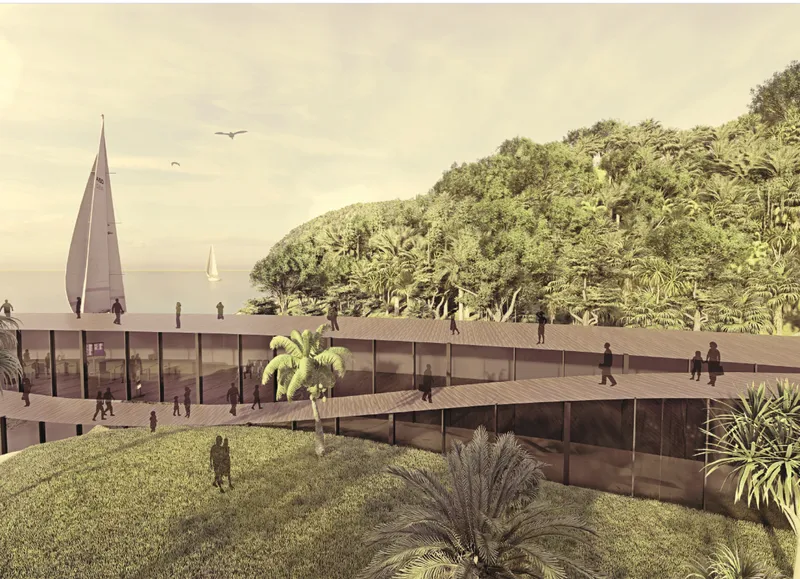
Architectural Language and Material Strategy
The material palette emphasizes sustainability, durability, and contextual sensitivity. The use of wood, steel, and glass creates a balance between structural efficiency and visual lightness.
Key architectural characteristics include:
- Horizontal continuity that emphasizes the landscape
- Minimal visual obstruction to maintain uninterrupted views
- Warm material tones that complement the tropical context
Technology is embedded subtly within the design, ensuring operational efficiency without compromising the sensory experience of the space.
Future Adaptability: Beyond Conventional Airport Typologies
One of the most compelling aspects of this future airport design is its adaptability. The circular configuration allows for flexible reprogramming of spaces, enabling parts of the airport to transform into hospitality functions such as hotel accommodations.
This adaptability positions the airport as:
- A destination in itself
- A long-stay environment rather than a transient space
- A hybrid typology that merges infrastructure, leisure, and habitation
Such a model challenges the conventional perception of airports as purely functional entities, proposing instead a more holistic and human-centered approach.
Rethinking Airport Identity
The Full Moon Airport redefines what an airport can be. It shifts the narrative from efficiency-driven infrastructure to experiential architecture that engages with its context.
By merging circular geometry, landscape integration, and hybrid mobility, the project creates a new identity for airport architecture, one that is rooted in place, culture, and sustainability.
As global discussions around sustainable airport architecture continue to evolve, the Full Moon Airport offers a visionary model that balances ecological responsibility with spatial innovation. Its circular form, integration with nature, and emphasis on user experience position it as a benchmark for future airport design.
More than an airport, it is a gateway, a landscape, and a destination that captures the spirit of Koh Phangan while redefining the possibilities of architectural infrastructure.




Popular Articles
Popular articles from the community


Conexión: Biophilic Design Reimagines High-Rise Living in Hong Kong
Conexión reimagines high-rise living in Hong Kong through biophilic design, green facades, shared spaces, daylight, water and nature within.

Co-Life: Senior Housing Design That Reconnects Older Adults With the City
Co-Life reimagines senior housing design through healing gardens, shared streets, workshops, and a sustainable community across generations.

The Earth Pod: 3D Printed Homes for Resilient Refugee Communities
The Earth Pod reimagines refugee housing through 3D printed homes made from clay, combining resilience, self-sufficiency, and rapid shelter.

Hill & Cross Opera: Sculptural Opera House Architecture Shaped by Tallinn’s Landscape and Identity
Hill & Cross Opera reimagines opera house architecture in Tallinn through its sculptural hill, civic plaza, glass wave and a luminous cross.


Similar Reads
You might also enjoy these articles

Eco Chapel: A Green Architecture Pavilion Designed in Symbiosis with the Forest
Eco Chapel uses green architecture to weave prayer, learning and reuse into a forest pavilion shaped by modular hexagonal canopies for life.
Kaffeebühnen: Coffee Shop Architecture Designed as a Civic Stage Between Vienna’s City and Park
Kaffeebühnen turns coffee shop architecture into a civic stage, linking Vienna’s park edge, urban life, warm timber yards, and coffee craft.
Healing Façade: Sustainable Architecture for Reforestation, Community, and Sacred Ecology in Ethiopia
Healing Façade reimagines sustainable architecture as a living wall that restores soil, catches water and renews Ethiopia's forest churches.


Urban Forest: A Vertical Ecosystem for 5,000 Workers in Singapore's Changi Business Park
Radially stacked pods and layered green decks turn a 7-acre plot into 47 acres of ecological workspace projected for 2040.
Comments (0)
Please login or sign up to add comments
No comments yet. Be the first to comment!