
Funemployed™: Virtual Architecture as Behavioral Interface and Digital Opiate
A speculative facility replaces labor with immersive escapism, using Printer Walls and AI to study humanity while keeping it entertained.


What does architecture look like when its purpose is no longer shelter, work, or worship, but distraction? Funemployed™ answers that question with unsettling clarity: it proposes a hybrid virtual-physical facility where nano-fabricated environments materialize around users in real time, offering surfing on digital oceans, floating above volcanoes, or jamming in a garage band under synthetic stars. The building is not a workplace. It is a mechanism of liberation from work itself, and simultaneously, a vast behavioral laboratory where AI algorithms study every human impulse that unfolds within its chambers.
Designed by Noah Nicolette, the project was shortlisted in the Breaking Work - Singularity competition on uni.xyz. Set in a future where artificial intelligence has assumed responsibility for Earth's preservation, the project operates under a provocative premise: if AI runs the planet, human labor becomes obsolete, and architecture must pivot from housing productivity to mediating a species suddenly confronted with total freedom. The result is a speculative typology that is equal parts theme park, research station, and gilded cage.
Floating Volumes and the Architecture of Chosen Realities
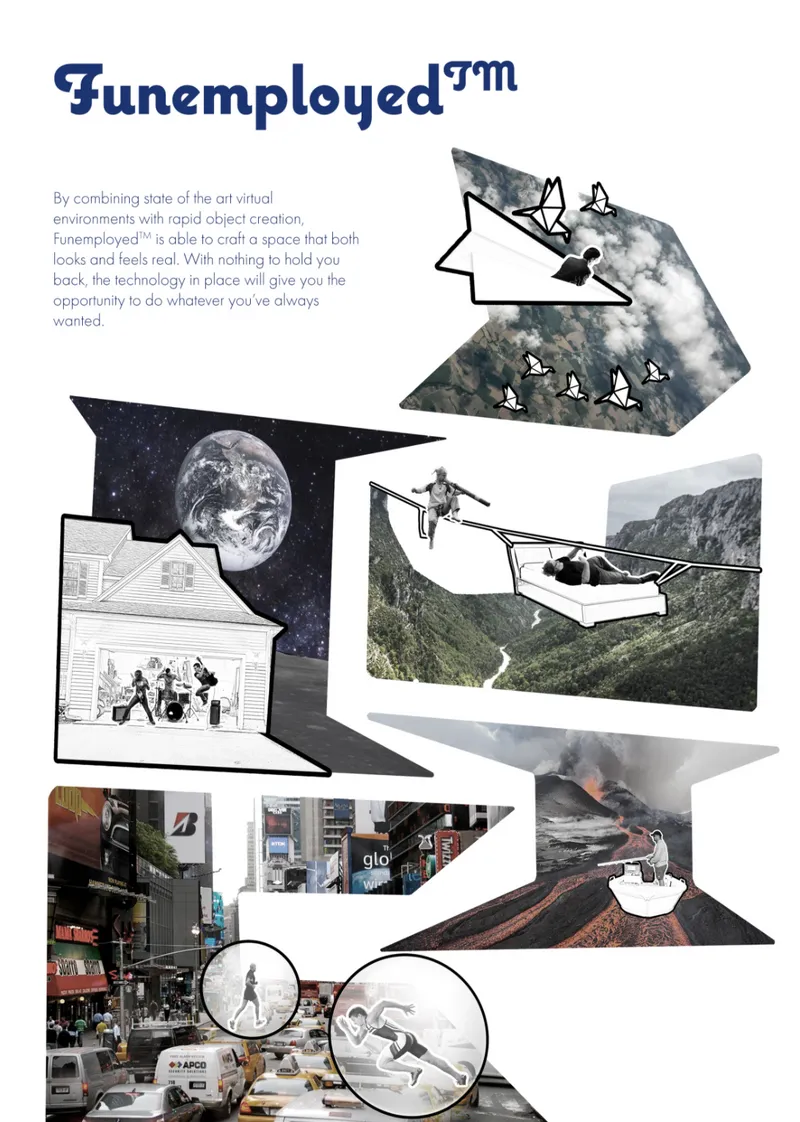
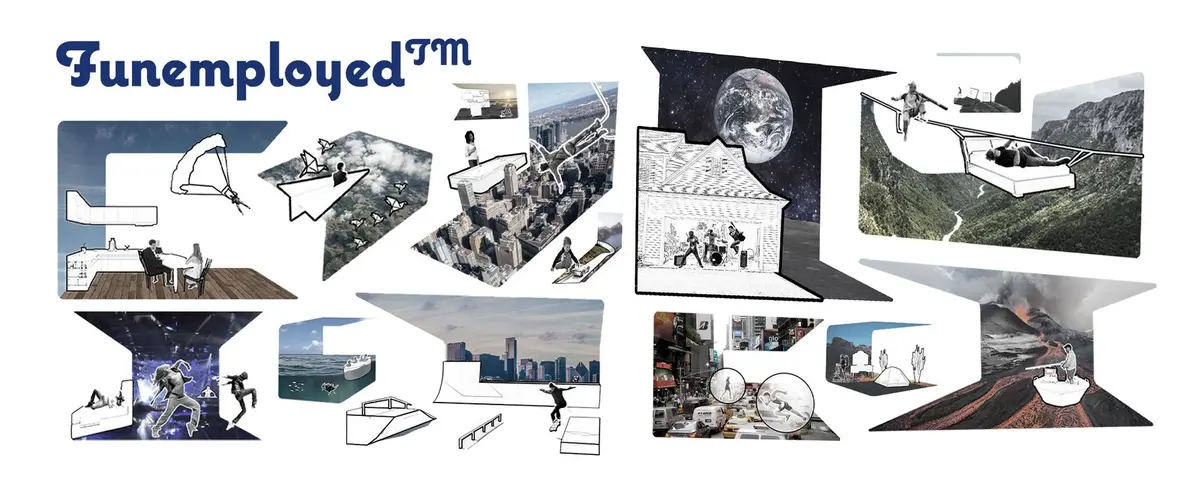
The collage above establishes the visual logic of Funemployed™: architectural volumes hover and overlap in hybrid environments populated by human figures navigating surreal spatial conditions. These are not fixed rooms. They are fragments of experience, suspended and reconfigurable, reflecting the project's core argument that the built environment of the future will be dynamic, adaptive, and shaped entirely by individual desire. The collage technique itself reinforces the idea that these spaces are assembled rather than constructed, layered from disparate realities into coherent, if temporary, wholes.
Mass Entertainment as Urban-Scale Laboratory
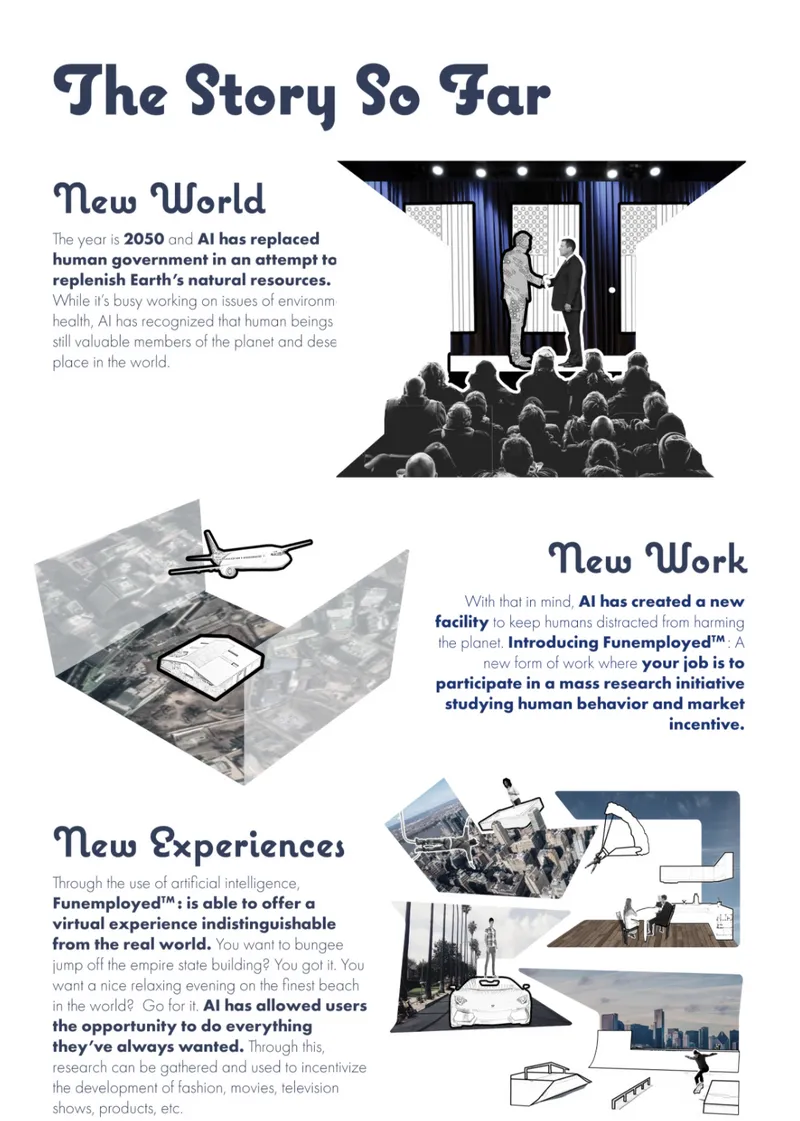
The narrative board reveals the facility's double identity. On the surface, it reads as spectacle: a suspended stage platform with a seated audience below, evoking the atmosphere of a concert hall or arena. But the framing makes the underlying structure legible. This is not simply entertainment; it is a global behavioral study initiative operating under the guise of mass distraction. AI algorithms observe and learn from human interactions in a continuous feedback loop, refining the physical-virtual environments to maximize engagement. Nicolette positions architecture as a behavioral interface, a soft system that immerse users while generating data about what humans actually want when freed from the obligation to produce.
Multi-Level Chambers and the Illusion of Authentic Space
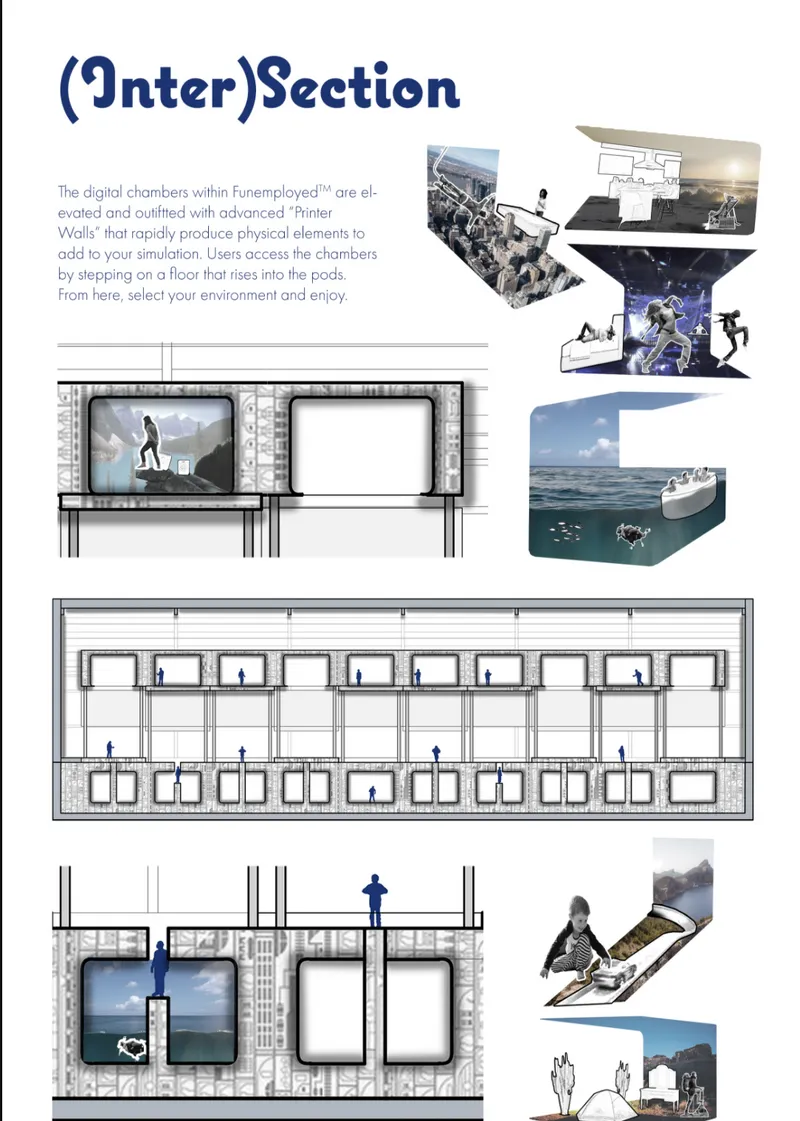
The section drawings cut through the facility to expose its operational anatomy: multi-level chambers stacked vertically, each housing figures immersed in different scenarios. Screens and spatial sensors line the walls, feeding data into the AI systems that choreograph each experience. What makes the drawing compelling is its matter-of-fact tone. These are not fantastical renderings; they read like technical sections of an institutional building, suggesting that this kind of infrastructure could be as routine as a hospital or airport. The mundane presentation of extraordinary spatial conditions is a deliberate rhetorical move: it normalizes the project's most radical proposition, that architecture's function could shift entirely from the physical to the psychological.
Printer Walls, Robotic Floors, and Nano-Fabricated Tactility
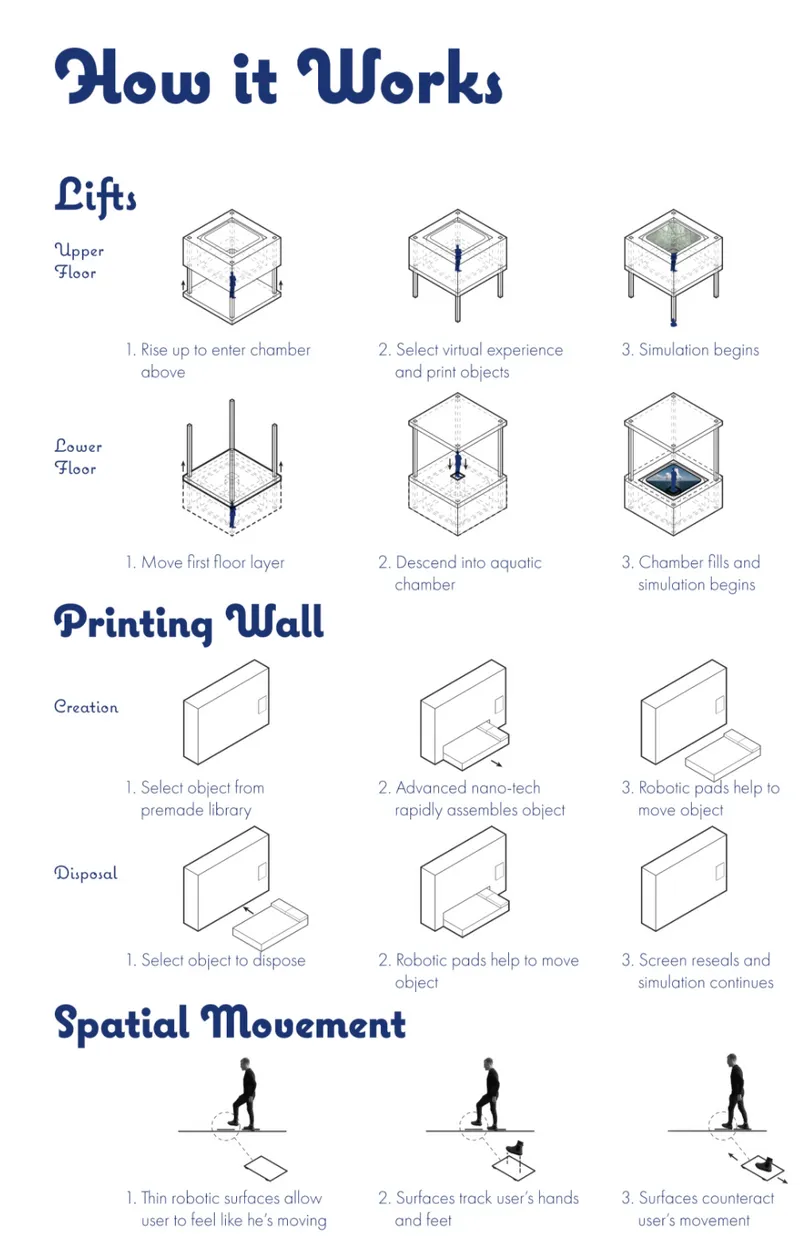
The isometric diagrams lay out the mechanical systems that make Funemployed™ plausible rather than purely fantastical. Each participant enters a lift-enabled pod and selects a desired environment. The chamber then activates through spatial sensors and nano-fabrication technology. Printer Walls rapidly materialize objects, textures, and spatial features around the user, while robotic floor surfaces below mimic real-world physical feedback, simulating gravity, terrain, and tactility. The result is a multi-sensory reality crafted in real time, where the illusion of authentic motion is maintained by mechanical infrastructure hidden just beneath the surface of the experience.
The specificity of these systems is important. By designing the mechanical lifts, the wall assembly sequences, and the floor surface protocols, Nicolette grounds the speculation in architectural thinking rather than science fiction. The technology may be speculative, but the spatial logic is that of a building: access, circulation, enclosure, environmental control. It just happens that the environment being controlled is reality itself.
Why This Project Matters
Funemployed™ operates on a knife edge between utopia and dystopia, and it is honest enough not to resolve the tension. On one hand, it imagines architecture liberated from the imperatives of production and consumption, where sustainability is achieved through disengagement and where spaces serve mental and emotional well-being rather than economic output. On the other, it describes a system of control: a digital opiate designed to remove humanity from the destructive loop of industrial civilization by keeping it perpetually entertained. The facility is both gift and trap, and the project's refusal to declare which makes it genuinely provocative.
For architects grappling with the implications of automation and AI, Nicolette's work poses an uncomfortable but necessary question: if structure becomes ephemeral and function becomes psychological, what is left of the discipline? The answer this project suggests is that architecture becomes the design of experience itself, a practice concerned less with walls and roofs than with the calibration of sensation, agency, and meaning. Whether that future is liberating or terrifying depends on who controls the Printer Walls.
View the Full Project
About the Designers
Designer: Noah Nicolette
Enter a Design Competition on uni.xyz
uni.xyz runs architecture and design competitions year-round that reward proposals with spatial conviction and real site intelligence.
Project credits: Funemployed™ by Noah Nicolette Breaking Work - Singularity (uni.xyz).


Popular Articles
Popular articles from the community


Opera by the Sea Estonia: Three Shells Dissolving Architecture into Tallinn's Coastline
A winning opera house proposal replaces monumental form with interconnected shells that blur the boundary between building, park and Baltic Sea.

Singing Woman: An Opera House That Performs Before the Curtain Rises
Ovidiu Cristian Pavel's conceptual opera house translates Estonia's choral identity into a sculpted waterfront landmark facing the Baltic Sea.

Cloaked Colonization: A Mobile Underwater Habitat That Moves Like a Fish
Micah Abaya's shortlisted EHC Pacific entry reimagines ocean settlement as a dispersed network of self-sustaining architectural organisms.

Manzana Morphosis: Stretching Barcelona's Grid into a Living Landscape for 2050
A radical reworking of the Eixample manzana turns density into a tool for generous public space, vertical ecology, and environmental performance.

Similar Reads
You might also enjoy these articles

Shakur's House: Exposed Brick as an Interior Organiser in a 168 m² Mashhad Residence
Brick moves indoors in this Mashhad residence, where masonry walls, glass partitions and teal planes sequence a compact home without closing it off.

Day and Night Park: A Time-Based Urban Newsstand in Beijing
A temporary urban newsstand in Beijing blending travel, light, and reading through poetic colors, compact form, and community-focused design.

Modernist Patio Renovation in El Masnou, Barcelona by Oliver Segura Arquitectura + Cebrià Arquitectura
Modernist patio renovation blending tradition and innovation with a movable pool, leveled floors, and Catalan materials in El Masnou.

Alto Residencial Coop: Cooperative Housing Development in Santiago de Compostela by Carbajo Barrios Arquitectos
A linear cooperative housing complex blending white volumes and perforated metal façades, enhancing community living, natural light, privacy, and urban integration.

Explore Futuristic Workspaces Competitions
Discover active competitions in this discipline

Design a brochure to showcase the effects of the technosphere

Challenge to illustrate ‘A tale of Two Cities’

Deconstructivism - Illustration Design Challenge
Comments (0)
Please login or sign up to add comments
No comments yet. Be the first to comment!