
11.29 Studio Builds an Oil Painting Workshop from Concrete Waste and Bamboo in Rayong
A 144-square-meter art studio for Thai artist Bo Puntita turns industrial byproducts into a passively ventilated creative refuge in agricultural Rayong.


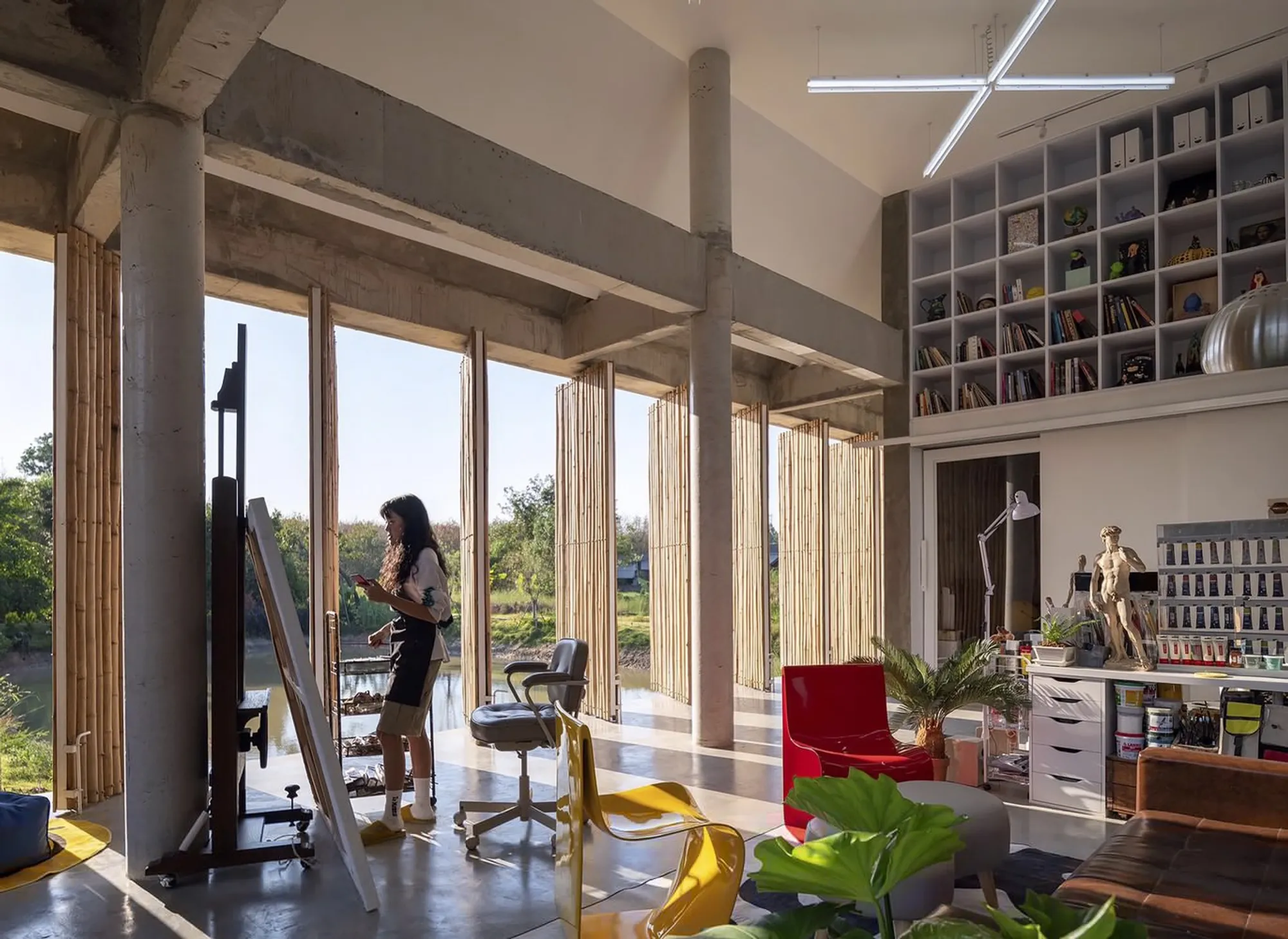
Rayong is known as the province with the highest Gross Provincial Product in Thailand, a distinction earned almost entirely through heavy industry. Finding an agricultural pocket inside that landscape is unusual enough. Building an art studio there from leftover concrete test specimens is something else entirely. Furnish Studio, the first built project by 11.29 Studio, does exactly that: it gives Thai artist Bo Puntita a 144-square-meter workspace, gallery, and living room assembled from cylindrical and cuboid concrete spacers salvaged from nearby factories, wrapped in locally sourced bamboo screens that eliminate any need for air conditioning in the primary work area.
What makes the project genuinely interesting is not the sustainability narrative alone but how precisely it serves the program. An oil painting studio demands ventilation. The evaporation of oil paint medium produces fumes that must be cleared continuously, and the quality of light has to be controllable without sealing the building shut. Every material decision here, from the porous concrete screen walls to the full-height rotating bamboo battens, directly addresses those two requirements. The result is a building that breathes by default and only closes when its occupant chooses.
Concrete Spacers as Architecture
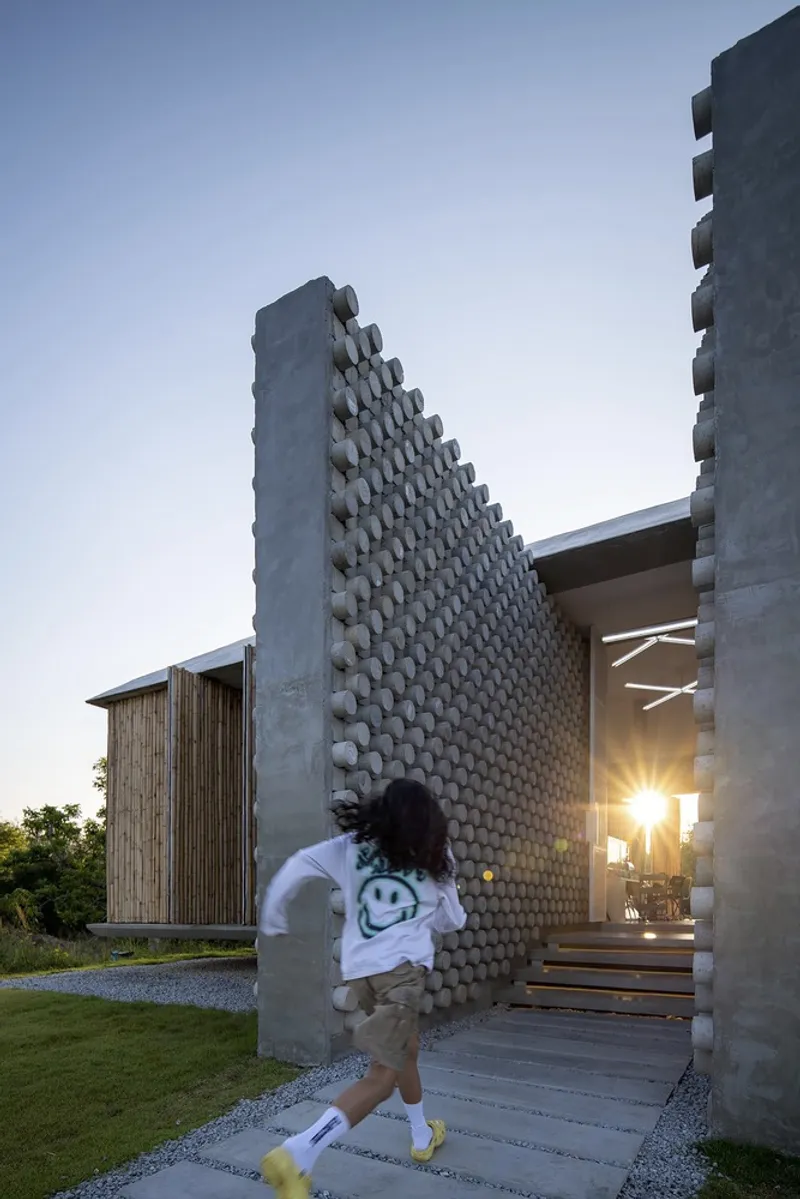
Every 20 cubic meters of poured concrete requires a strength test using three spacers. Once tested, those cylinders and cubes become waste. In a province dominated by industrial estates, the volume of discarded spacers is enormous. 11.29 Studio sourced surplus specimens from nearby factories and stacked them into two high concrete walls that define the studio's entrance. Some of the spacers are etched with their dates of origin, turning a structural test record into an ornamental timeline.
The hexagonal cutouts visible at the entry wall are not decorative afterthoughts. They continue the logic of controlled porosity that runs through the entire project. Light passes through, air moves freely, and the mass of the concrete provides thermal stability against Rayong's heat. It is industrial material doing exactly what it was engineered to do, just not in the way anyone originally intended.
Bamboo Screens and Passive Ventilation
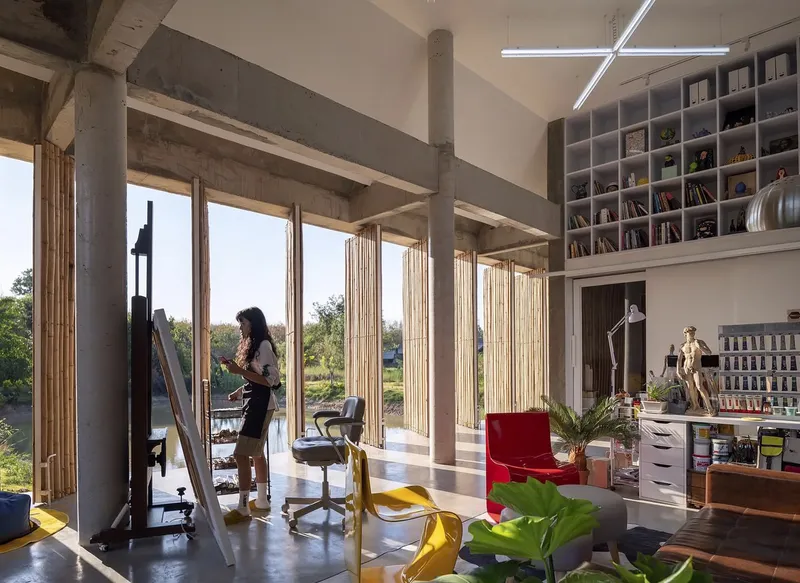
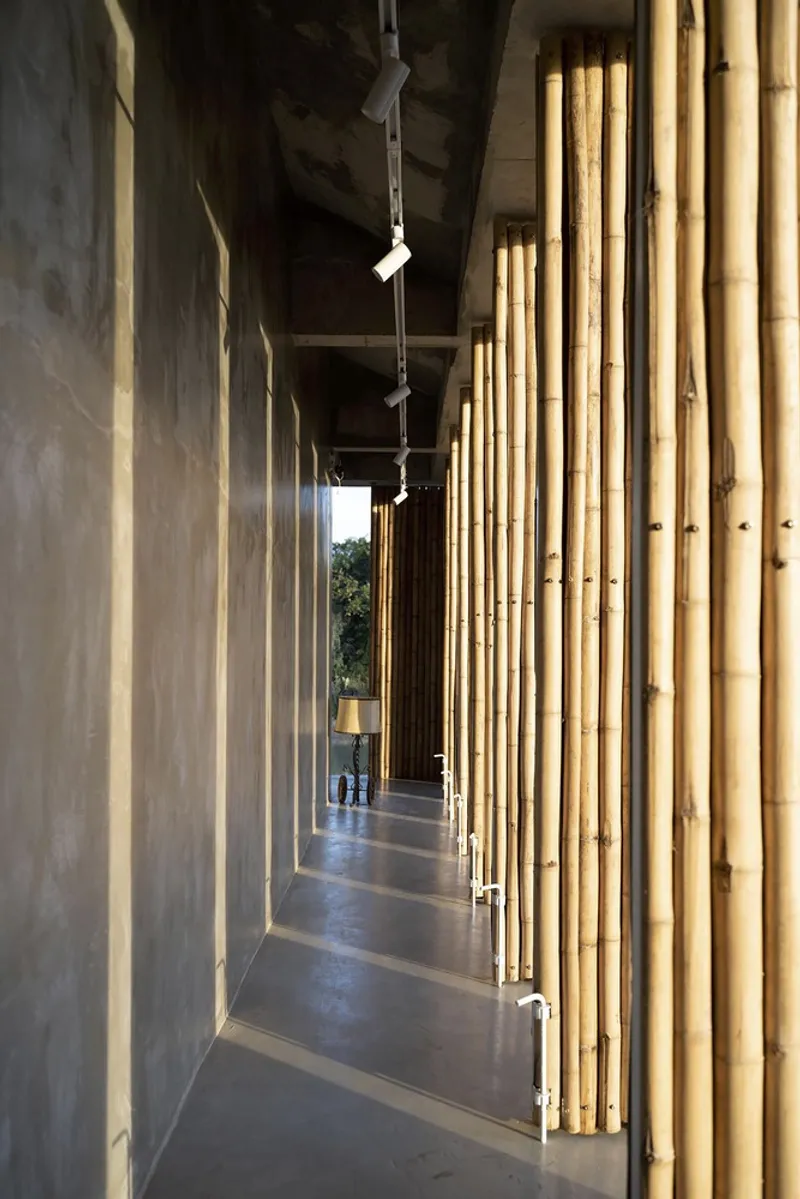
The bamboo battens that enclose the studio on all sides are not fixed. They rotate on vertical axes, letting Bo Puntita calibrate the density of incoming light and the volume of airflow in real time. For an oil painter, this is not a luxury. Solvents evaporate, pigments behave differently under varying light temperatures, and a sealed room would require mechanical ventilation at best and compromise health at worst. The rotating screens solve all three problems at once.
The building sits northeast of a pond in the surrounding agricultural area. That orientation is deliberate: the prevailing cool breeze crosses the water before reaching the studio, arriving slightly cooled and humidified. Combined with the elevated structure, which lifts the floor above the ground plane for underside ventilation, the design achieves comfortable working conditions without a single air conditioning unit in the studio proper. The bamboo itself is locally sourced, a decision that supports regional farmers and cuts transportation energy.
A Double-Height Room for Making and Showing
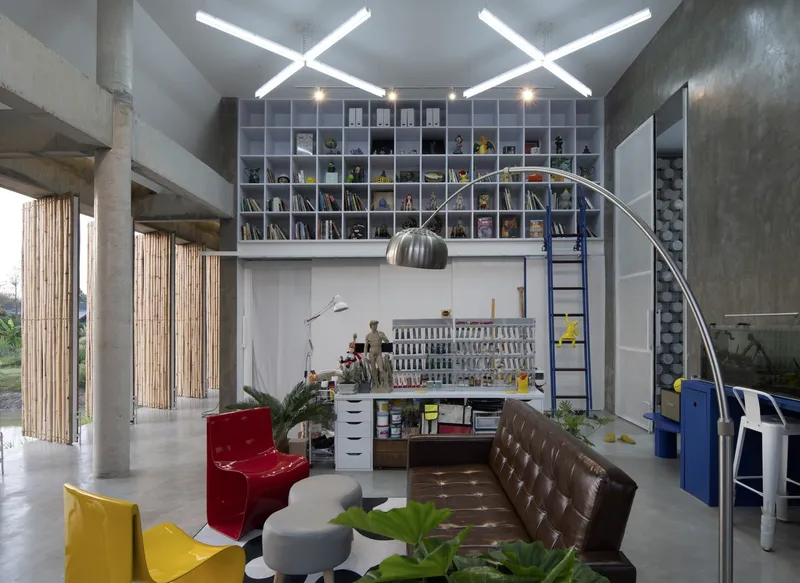
The square floor plan minimizes the number of structural columns, freeing the central volume as a single double-height space. Storage and a skylit bathroom are tucked to either side, pulled back from the building edge so that the surrounding verandah remains uninterrupted. The crossed fluorescent fixtures overhead provide even working light after sunset, and the exposed concrete frame reads cleanly against the vertical rhythm of the bamboo.
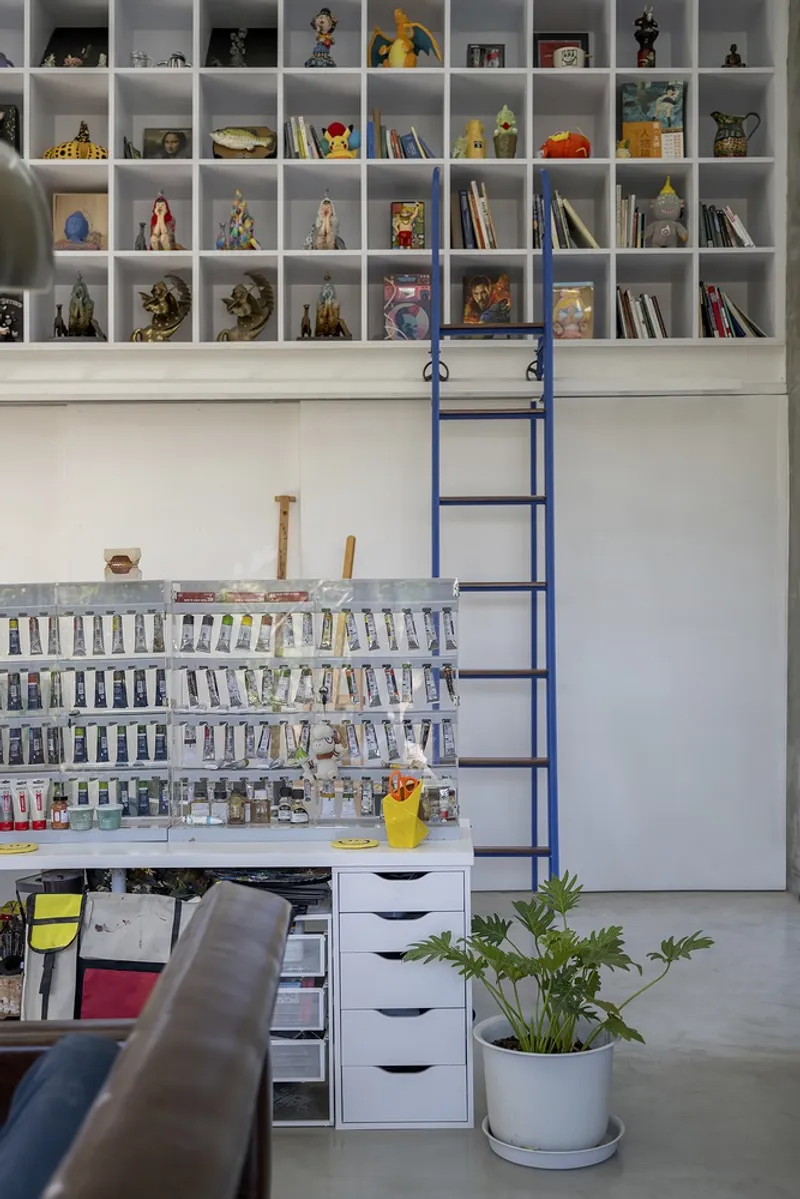
One wall is dedicated to a floor-to-ceiling white shelving system that holds figurines, art books, and painting supplies. A blue rolling ladder gives access to the highest shelves, a compact detail that doubles as a piece of studio furniture and a vertical accent against the neutral concrete. The shelving wall also functions as a display cabinet, turning the working inventory of the studio into something visitors can browse. Gallery and workshop coexist without partition.
Why This Project Matters
Furnish Studio is a first building, and it acts like one in the best sense. There is no overdesign, no unnecessary formal gesture. Every move answers a specific constraint: fumes require ventilation, industrial waste requires a destination, a young artist requires affordable construction, and Rayong's climate requires passive cooling. 11.29 Studio met all four with two materials, a square plan, and careful site orientation. The economy of means is the achievement.
More broadly, the project demonstrates that circular material strategies do not have to look provisional or apologetic. The concrete spacer walls at the entrance are genuinely sculptural. The bamboo screens produce interior light conditions that most architects would struggle to achieve with expensive louver systems. By treating waste as raw material and local agriculture as a supply chain, Furnish Studio makes a quiet argument that sustainability in Southeast Asia does not require imported technology. It requires attention to what is already there.
Furnish Studio by 11.29 Studio. Rayong, Thailand. 144 m². Completed 2023. Photography by Beersingnoi.
About the Studio
Share Your Own Work on uni.xyz
If projects like this are the kind of work you want to make, uni.xyz is a place to publish your own, find collaborators, and enter design competitions.




Popular Articles
Popular articles from the community


The Ocean Hive: Sustainable Architecture for a Self-Sufficient Civilization at Sea
The Ocean Hive imagines sustainable architecture at sea, where modular habitats, algae, wave power and ocean waste sustain a growing colony.

Conexión: Biophilic Design Reimagines High-Rise Living in Hong Kong
Conexión reimagines high-rise living in Hong Kong through biophilic design, green facades, shared spaces, daylight, water and nature within.

Co-life: Sustainable Architecture for Age-Friendly Community Living
Co-life reimagines sustainable architecture for seniors through courtyards, rammed earth, shared gardens, and spaces designed for belonging.
AL-JANNAH: Sustainable Architecture and Permaculture for Afghan Widows
AL-JANNAH uses sustainable architecture and permaculture to create resilient oasis of housing, learning, work and renewal for Afghan widows.

Similar Reads
You might also enjoy these articles


Hodi-Mandai Geram
Project Function: Preservation and revitalization of the Intangible heritage and socio-spatial identity of the Hodi by Housing, Cultural Memory Center, Sacred Grove, landscape, local tourism economy


Olio Towers: A Mid-Rise for Performers That Fuses Housing, Rehearsal, and Stage
Located blocks from Houston's Theater District, this modular tower stacks living units around a central performance atrium.

Oasis: Modular Green Housing Carved into Dhaka's Urban Fabric
A shortlisted Plugin Housing entry reclaims unauthorized settlements in Dhaka with stepped concrete volumes, green roofs, and ventilation-driven design.

Black Hole: A Floating Megastructure for the Post-Physical Era
Emiliano Mazzarotto envisions a spherical, self-scaling arena where e-sports, digital hotels, and holographic stadiums replace traditional public space.

Explore Urban Design Competitions
Discover active competitions in this discipline



Challenge to reimagine the Iron Throne


Photograph architecture without architects


Illustrate the lost glory of Angkor Wat - Render Challenge


Design challenge to reuse E-waste
Comments (0)
Please login or sign up to add comments
No comments yet. Be the first to comment!