
Fussa City Hall by Riken Yamamoto: A Civic Architecture Model Integrating Community, Landscape, and Sustainable Design
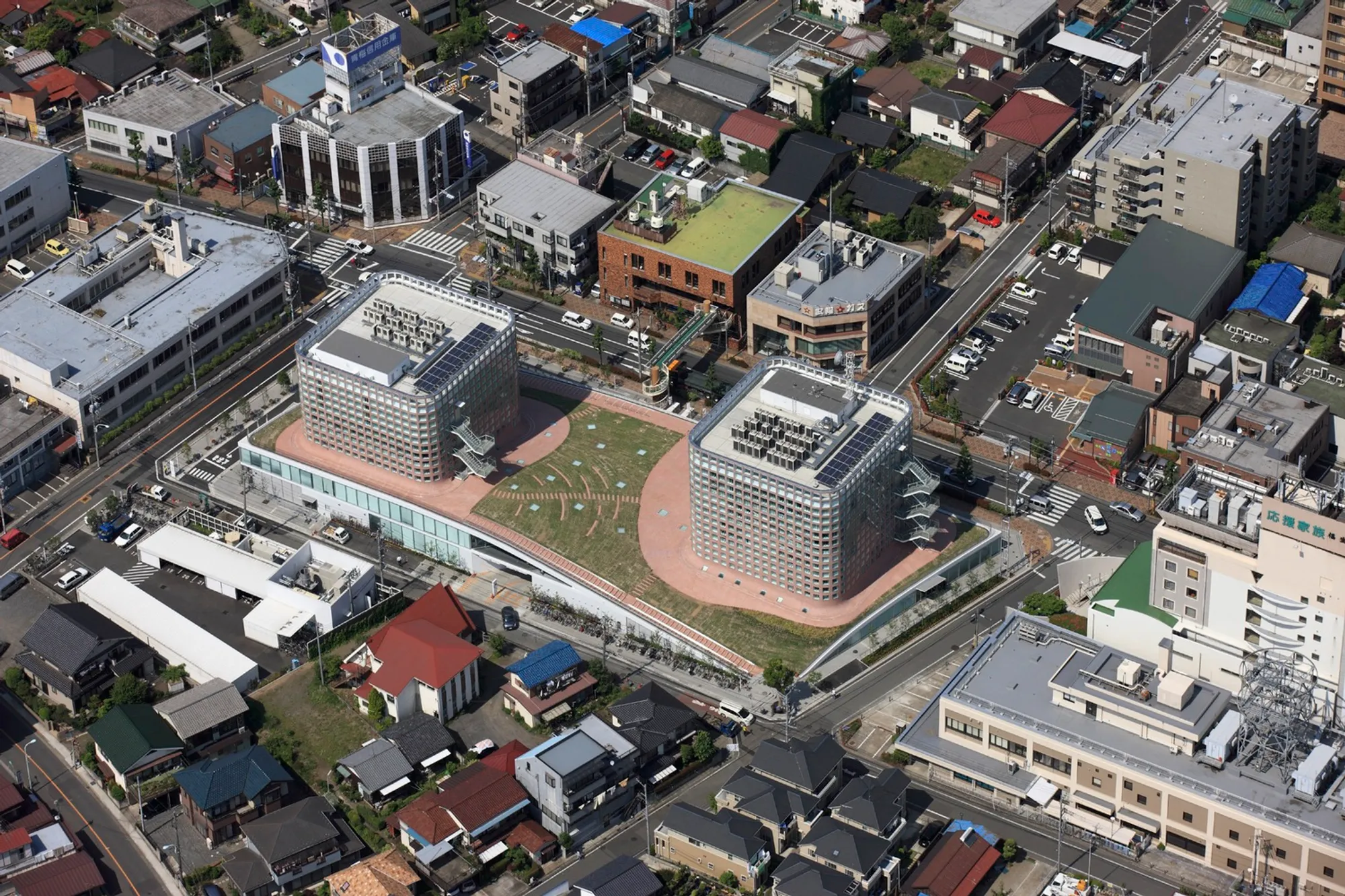
Fussa City Hall features twin towers rising from a green public roof, combining civic offices, community forum spaces, flexible interiors, and sustainable architecture.


Fussa City Hall, designed by renowned Japanese architect Riken Yamamoto, is a remarkable example of contemporary civic architecture that merges public engagement, environmental sensitivity, and innovative structural design. Located approximately 50 kilometers from central Tokyo in the suburban city of Fussa, this government building serves not only as an administrative center but also as a vibrant community hub.
Completed in 2008 and spanning an area of 10,228 square meters, Fussa City Hall demonstrates how modern municipal buildings can foster openness, civic interaction, and sustainability. The project responds carefully to the surrounding residential neighborhood and the natural landscape near the Tama River, creating a civic landmark that blends urban functionality with environmental integration.

Urban Context and Landscape Integration
The site of Fussa City Hall lies within a dense residential district characterized by gently rising hills that extend from the banks of the Tama River. Rather than imposing a monumental structure disconnected from its surroundings, the architectural concept embraces the natural topography and community scale of the area.
The building’s lower levels are organized around a large public space known as the “Forum.” This open civic platform functions as a gathering area accessible to local residents and visitors. By positioning these communal spaces at the base of the building, the architects ensure that the ground level remains highly accessible and welcoming.
Above this public forum rises an undulating organic roof that mirrors the natural contours of the surrounding hills. This roofscape plays a crucial role in connecting the architecture to the landscape while simultaneously creating usable public space for the community.
A Public Roof as an Urban Green Space
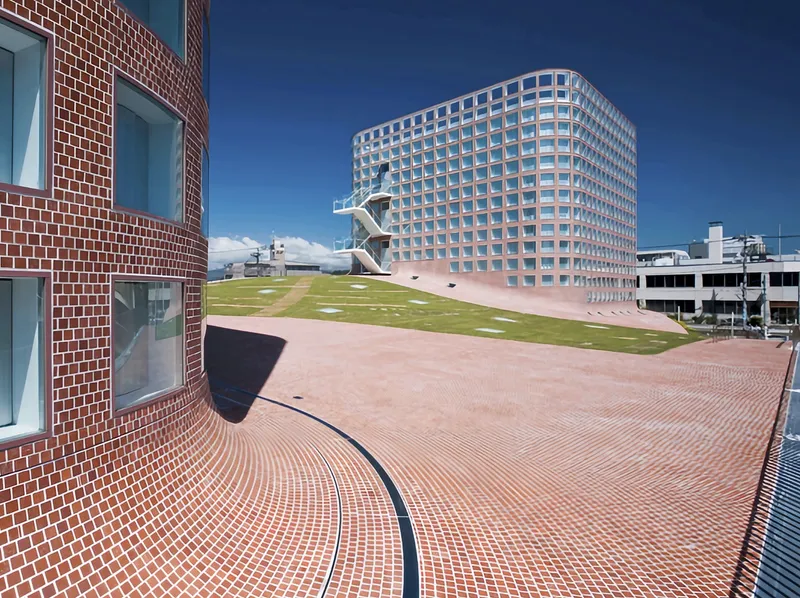
One of the most distinctive features of Fussa City Hall is its green rooftop landscape, which transforms the building into an extension of the city’s public realm. Rather than functioning solely as a roof covering, the structure becomes a multifunctional platform for social activity.
The roof is accessible to citizens and supports a variety of community uses, including gatherings, public events, and everyday leisure activities. Residents can walk, relax, or enjoy outdoor activities while overlooking the surrounding neighborhood.
From an environmental perspective, the green roof contributes significantly to the building’s sustainability strategy. Vegetation helps regulate temperature, reduce energy consumption, and minimize heat gain. By improving thermal insulation and reducing energy losses, the rooftop garden enhances the building’s energy efficiency while promoting ecological balance.
Additionally, the greenery visually integrates the city hall into the surrounding landscape, softening the architectural form and reinforcing the relationship between nature and the urban environment.

Twin Towers as an Iconic Civic Landmark
Emerging from the flowing roofscape are two slender office towers, which house the primary administrative functions of the city hall. These twin towers create a strong visual identity for the building and serve as an easily recognizable landmark within the city.
The design concept emphasizes spatial quality inside the offices. To achieve this, the structural system is strategically placed on the exterior façade rather than within the interior workspace. By relocating the columns and beams to the outer skin of the building, the architects eliminate structural obstacles inside the office floors.
This approach allows the interior spaces to remain open, flexible, and adaptable. Government offices and assembly areas can be arranged according to evolving functional needs without being restricted by internal structural elements. The result is a highly efficient workplace environment that supports collaboration and administrative efficiency.
Innovative Structural Design and Construction
The structural engineering of Fussa City Hall was developed in collaboration with Structural Design Office Plus One Co., Ltd. and Jun Sato Structural Design Office. The building uses factory-produced precast concrete elements for both the slab system and the outer structural framework.
Precast concrete offers several advantages in large-scale civic projects. It ensures high construction precision, improves structural durability, and accelerates the building process through off-site fabrication. Additionally, the material provides excellent resistance to seismic activity, which is particularly important in Japan’s earthquake-prone environment.
An interesting architectural detail is how the structural frame of the towers becomes progressively thinner toward the upper levels. This subtle adjustment reduces the visual weight of the building and gives the towers a lighter, more elegant appearance as they rise into the sky.
This structural expression not only enhances aesthetics but also reinforces the architectural narrative of transparency and openness.
Flexible Interior Spaces for Civic Administration
Inside the twin towers, the absence of internal structural barriers creates flexible and adaptable office environments. Administrative departments, meeting spaces, and assembly functions can be organized freely according to operational requirements.
This flexibility is particularly valuable for municipal buildings, where administrative structures and spatial needs frequently evolve over time. The open floor plans ensure that the city hall can adapt to future changes without requiring major structural modifications.
Furthermore, the design encourages collaboration and communication between departments, reflecting the building’s broader philosophy of openness and civic accessibility.
Civic Architecture That Connects Government and Community
Fussa City Hall represents a progressive approach to civic architecture in which government facilities become integrated with everyday urban life. Instead of functioning as isolated bureaucratic institutions, public buildings can actively encourage community participation and social interaction.
The open forum spaces, accessible green roof, and transparent architectural language all contribute to a sense of inclusivity. Citizens are invited not only to visit the building for administrative purposes but also to use it as a public place for gathering, recreation, and cultural activities.
This design philosophy reflects Riken Yamamoto’s broader architectural vision of creating spaces that foster human connection and civic engagement.
A Sustainable and Community-Centered Civic Landmark
Fussa City Hall stands as a powerful example of how architecture can strengthen the relationship between government institutions, urban landscapes, and local communities. Through its innovative structural system, green roof landscape, and open public spaces, the building transforms a typical municipal office into a vibrant civic environment.
By integrating sustainability, flexibility, and community accessibility, the project demonstrates the potential of contemporary public architecture to enhance both urban identity and social interaction. Fussa City Hall is not just a place of governance, it is a dynamic public space that embodies the spirit of civic life in modern Japan.
All photographs are works of
Sergio Pirrone




Popular Articles
Popular articles from the community


Co-Life: Senior Housing Design That Reconnects Older Adults With the City
Co-Life reimagines senior housing design through healing gardens, shared streets, workshops, and a sustainable community across generations.

Co-life: Sustainable Architecture for Age-Friendly Community Living
Co-life reimagines sustainable architecture for seniors through courtyards, rammed earth, shared gardens, and spaces designed for belonging.
AL-JANNAH: Sustainable Architecture and Permaculture for Afghan Widows
AL-JANNAH uses sustainable architecture and permaculture to create resilient oasis of housing, learning, work and renewal for Afghan widows.

Conexión: Biophilic Design Reimagines High-Rise Living in Hong Kong
Conexión reimagines high-rise living in Hong Kong through biophilic design, green facades, shared spaces, daylight, water and nature within.


Similar Reads
You might also enjoy these articles

FAMM Arquitectura Organizes Ten Villas Around Courtyards and Jungle in Nosara, Costa Rica
El Molino pairs two elongated volumes with deep overhangs and timber louvers to build a compact coastal community five minutes from the beach.
Oscar Niemeyer's Ibirapuera Park Pavilions Define São Paulo's Cultural Identity in Concrete and Curve
A constellation of modernist volumes set within São Paulo's most important urban park, conceived for the city's 400th anniversary in 1954.
How Henri Picq's 1889 Paris Pavilion Traveled 11,000 Kilometers to Become Santiago's Artequín Museum
A prefabricated iron and glass pavilion built for the Paris Universal Exposition found a second life as a children's art museum in Chile.
Sanjay Puri Architects Wraps a Jaipur Office Tower in Capsule-Shaped Green Buffers
A nine-level climate-responsive workplace near Jaipur Airport uses stacked planter terraces and aluminium screens to fight 40°C heat.


Explore Architecture Competitions
Discover active competitions in this discipline



Challenge to reimagine the Iron Throne


Photograph architecture without architects


Illustrate the lost glory of Angkor Wat - Render Challenge


Design challenge to reuse E-waste
Comments (0)
Please login or sign up to add comments
No comments yet. Be the first to comment!