

Gabriel García Márquez Library by SUMA Arquitectura
The Gabriel García Márquez Library by SUMA Arquitectura in Barcelona combines sustainable timber architecture, urban integration, and community-focused cultural spaces.


A Sustainable Cultural Landmark in Barcelona
The Gabriel García Márquez Library, designed by SUMA Arquitectura
is a striking architectural landmark located in the vibrant city of Barcelona, Spain. Completed in 2022 with a total built area of 4,170 m², this project redefines the role of libraries as social condensers, community gathering spaces, and sustainable urban icons.


Context and Urban Integration
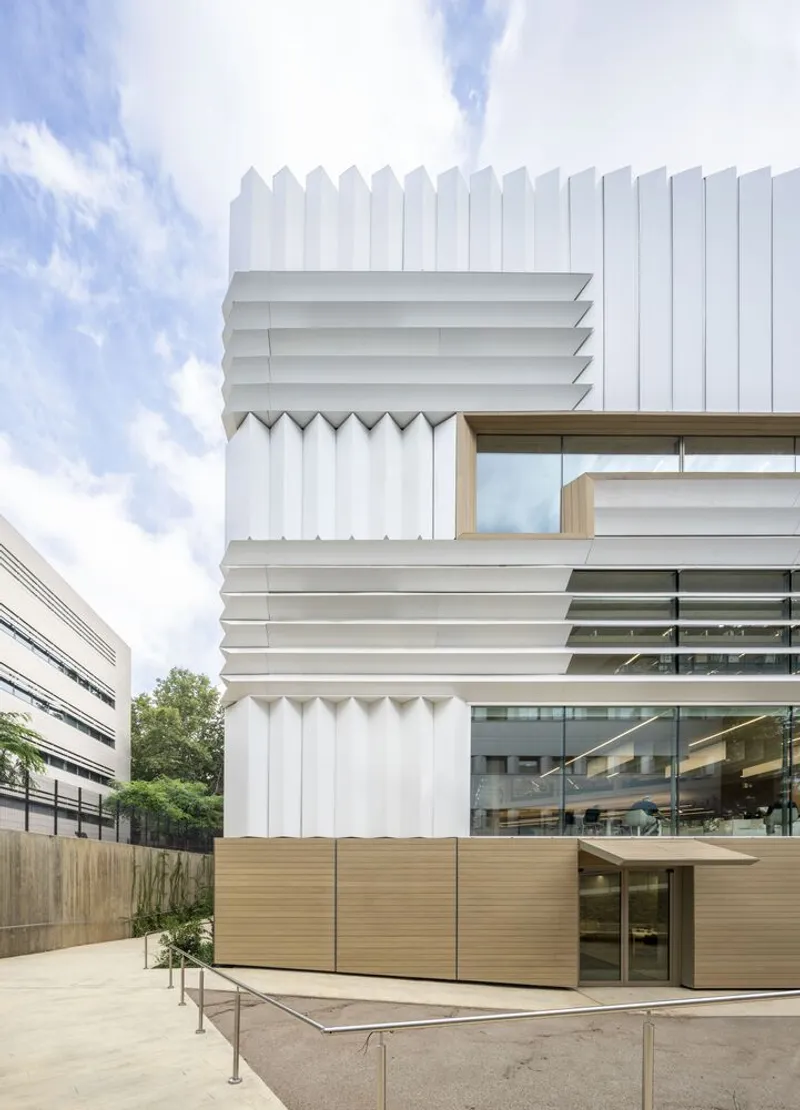
Situated within a dense urban node of Barcelona, the library’s geometry directly responds to the city’s architectural fabric. The building replicates the Barcelona chamfer—a signature urban design element—creating a seamless dialogue with its metropolitan surroundings. Elevated above a public square, the library integrates fluid pedestrian circulation while preserving magnificent existing trees, blending nature with civic life.
The exterior resembles a stack of open books, each “page” folded and perforated to enhance light, ventilation, and urban connection. Large openings, designed as viewpoints, frame Barcelona’s key landmarks, while inviting daylight into the interiors, ensuring warmth, visibility, and urban integration.

Architectural Form and Materiality
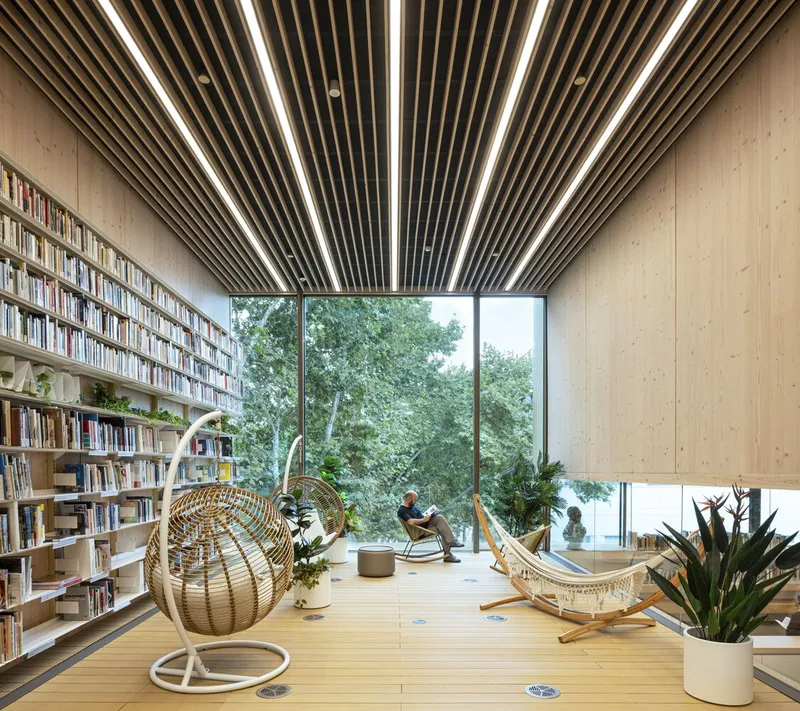
The project’s structural system is primarily built from cross-laminated timber (CLT) and prefabricated wooden panels, combined with steel reinforcements where necessary. This sustainable approach not only reduces the carbon footprint but also accelerates the construction timeline, reflecting a balance between eco-conscious design and cost efficiency.
The wood’s natural warmth permeates the interiors, creating a welcoming and human-centered environment. The façade and spatial expression highlight the potential of timber architecture as both a structural and aesthetic solution for contemporary cultural buildings.
Interior Design and Spatial Typologies
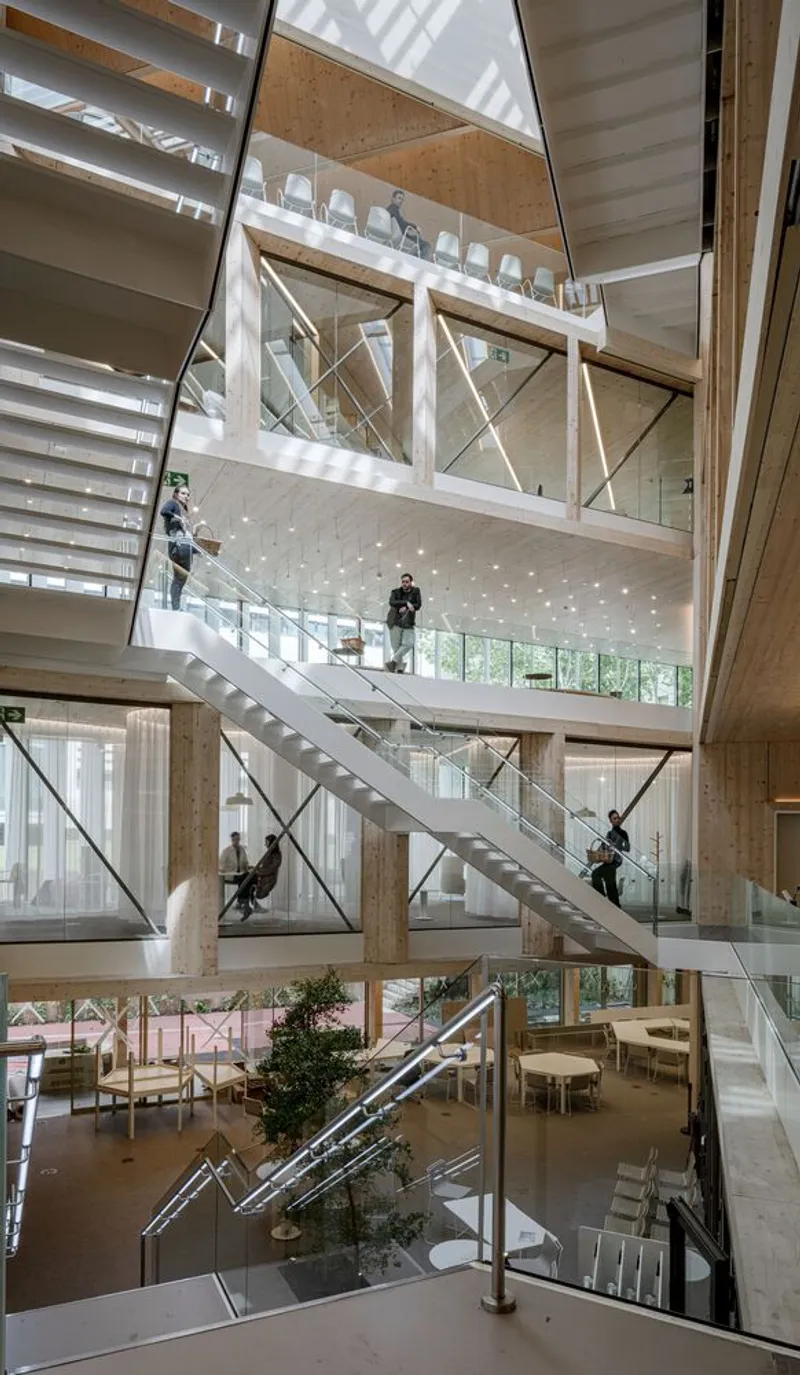
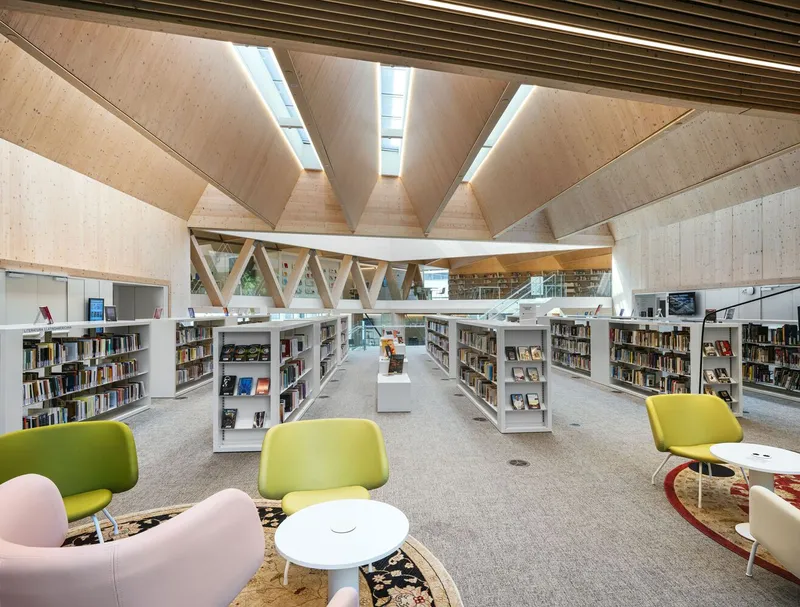
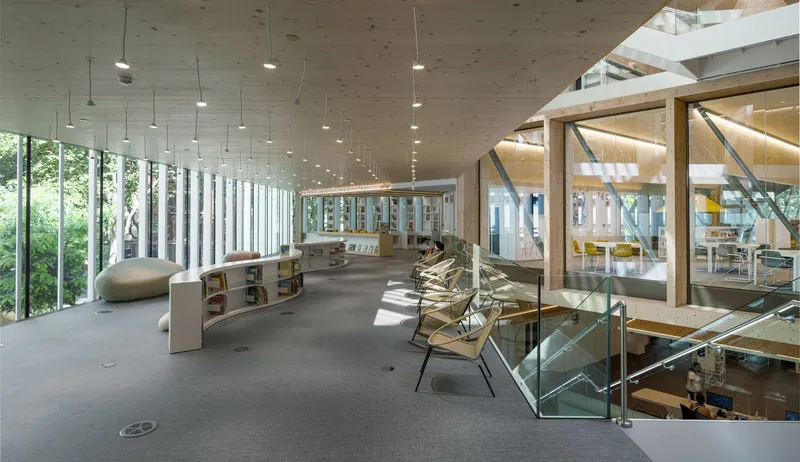
The library is organized around a large triangular courtyard, functioning as both a solar chimney for natural ventilation and a light well that illuminates all program areas. Around this central void, three vertical cores—two triangular and one square—contain circulation elements, services, and storage.
Two distinct spatial typologies define the library:
- Enclosed spaces: Designed for acoustic-intensive functions such as multipurpose halls, radio studios, laboratories, children’s areas, and group work zones. These spaces utilize a dense mixed structure of wood and steel optimized for functionality, privacy, and sound insulation.
- Open spaces: Designed for consultation, reading, and study areas, these zones embody spatial openness and flexibility, with abundant daylight and visual continuity, fostering a calm yet vibrant environment for knowledge exchange.
Sustainability and Innovation
The environmental design strategy is central to the project. The solar chimney effect enables passive cooling and air circulation, reducing energy demands in Barcelona’s humid climate. Prefabrication and industrialized timber construction minimized waste and shortened execution times. Overall, the library is a low-carbon cultural building, serving as a reference model for sustainable architecture in Europe.

A Social Condenser
Beyond architecture, the Gabriel García Márquez Library acts as a true social ecosystem. It accommodates multiple cultural and community “scenarios,” such as:
- An elevated square-agora, encouraging open-air exchange.
- A ground-floor idea forum, hosting debates and community gatherings.
- A multipurpose room that adapts for performances, lectures, or theatrical events.
- Cozy reading corners, echoing the intimacy of a home environment.
- Spiraling encounters around the central staircase, enhancing interaction and circulation.
This multiplicity of atmospheres makes the library not just a building, but a home for knowledge, culture, and community life, embodying García Márquez’s legacy of storytelling and human connection.


Popular Articles
Popular articles from the community


Jaramillo Van Sluys Arquitectura and Urbanismo Turn a Demolished Registry Lot in Quito into an Orchard Plaza
In Quito's Centro Histórico, a 2,800 m² plaza exposes the San Agustín convent wall and redraws its lost Augustinian orchard in volcanic stone.

LT2A and OPEN Architectes Thread a Brick and Glass High School Through a Wooded Belgian Campus
In Braine-l'Alleud, a 3,000 m² wing for Collège Cardinal Mercier pairs pale brick with a glazed colonnade, deferring to a small chapel and a dense wood.

David Ortega Stacks a Two-Story Mexico City Penthouse Around a Steel Stair and a Pergola-Shaded Roof Terrace
In Colonia Roma, a 300 m² penthouse uses oak joinery, a planted steel stair and a slatted roof pergola to make a new-build apartment feel like a house.

GROUP A Strips a 1969 Rotterdam Harbor Headquarters to Its Frame and Wraps It in Timber Louvers
In Rotterdam's M4H harbor district, Ferro Offices reuses a 1969 frame, adds one timber storey and reaches BREEAM-NL Outstanding.

Similar Reads
You might also enjoy these articles


Hodi-Mandai Geram
Project Function: Preservation and revitalization of the Intangible heritage and socio-spatial identity of the Hodi by Housing, Cultural Memory Center, Sacred Grove, landscape, local tourism economy


Olio Towers: A Mid-Rise for Performers That Fuses Housing, Rehearsal, and Stage
Located blocks from Houston's Theater District, this modular tower stacks living units around a central performance atrium.

Oasis: Modular Green Housing Carved into Dhaka's Urban Fabric
A shortlisted Plugin Housing entry reclaims unauthorized settlements in Dhaka with stepped concrete volumes, green roofs, and ventilation-driven design.

Black Hole: A Floating Megastructure for the Post-Physical Era
Emiliano Mazzarotto envisions a spherical, self-scaling arena where e-sports, digital hotels, and holographic stadiums replace traditional public space.

Explore Educational Building Competitions
Discover active competitions in this discipline

Challenge to design public laboratory

Challenge to reimagine the Iron Throne

Photograph architecture without architects

Illustrate the lost glory of Angkor Wat - Render Challenge
Comments (0)
Please login or sign up to add comments
No comments yet. Be the first to comment!