

Garage Renaissance: Turning Moscow's Soviet-Era Garage Cooperatives into Urban Ecosystems
A winning Beacon 2019 entry reimagines a decaying Moscow garage cooperative as a modular network of workshops, gardens, and public spaces.


Across Russia, thousands of garage cooperatives sit in various states of decay, their corrugated doors rusting and their concrete pads cracking. Born from a 1960s Soviet decree and fueled by rising car ownership through the 1980s, these clusters once functioned as far more than car storage: they were sites of informal enterprise, creative work, and neighborhood gathering. The Garage Renaissance project refuses to see them as obsolete. Instead, it treats the modular logic of the garage box as a spatial DNA worth preserving, proposing that each unit can be reprogrammed into workshops, cafes, offices, libraries, and living quarters without erasing the cooperative's original character.
Designed by Ульяна Тар and Данила Гагаркин, this project won the Beacon 2019 competition. Sited within a former garage cooperative in Moscow, the proposal transforms a neglected urban block into a multifunctional ecosystem organized around three spatial typologies: repurposed garage interiors, a contemplative garden, and a stepped public square. The result is a scalable model for adaptive reuse that could apply to similar sites across the country.
Soviet Garages as Cultural Infrastructure

The archival imagery above sets the project's historical stakes. Construction scenes and film posters from the Soviet period reveal the garage cooperative not as a marginal typology but as a product of centralized planning that became deeply embedded in everyday life. By the 1980s and 1990s, these garages had evolved into sites for personal projects and informal economies, functioning as a distributed network of micro-enterprises. Post-industrial shifts and real estate speculation eventually hollowed them out, but the spatial framework remained intact. The designers root their intervention in this history, arguing that the garages' modular structure is precisely what makes them adaptable.
Vasily's Fairytale: Narrative as Design Method

Rather than leading with floor plans, Тар and Гагаркин introduce their spatial strategy through an illustrated narrative called "The Fairytale About Vasily." The six diagrams trace a solitary garage user's journey from isolation to collective participation. Vasily imagines new ways of living and working within these static boxes, and each illustrated frame maps a programmatic transformation: a garage becomes a studio, then a cafe, then part of a larger cooperative network. Yellow-highlighted elements call out moments of spatial activation, making the diagrams read simultaneously as storyboard and site analysis.
The narrative device is more than whimsy. It serves as a communication strategy that makes the case for adaptive reuse legible to non-architects, framing the project's ambition in terms anyone who has used a garage can understand. Each function Vasily dreams up, from workshop to library, corresponds directly to a programmatic element in the master plan.
A Glass Pavilion Bridges Street and Garden


The courtyard rendering reveals the project's primary public gesture: an illuminated glass pavilion that sits among birch trees and concrete seating blocks, connecting the street edge to an interior garden. At dusk, the pavilion glows as a civic lantern, signaling activity and openness in a zone that was previously walled off by garage doors. The transparency is deliberate. Where the original cooperative turned its back to the city, the new intervention faces outward, inviting passersby into a landscape that blends hardscape with plantings.
The sectional rendering unpacks what happens inside. A stepped interior, framed in steel and punctuated by red curtains, creates a tiered auditorium where figures occupy platforms at different levels. The section makes clear that the auditorium is not a sealed box but a porous volume, with visual connections running from the street through the building and into the garden beyond. The red curtains introduce a theatrical quality, suggesting the space can shift between performance, lecture, and informal gathering without fixed seating or permanent walls.
The Hidden Library and the Rooftop Commons
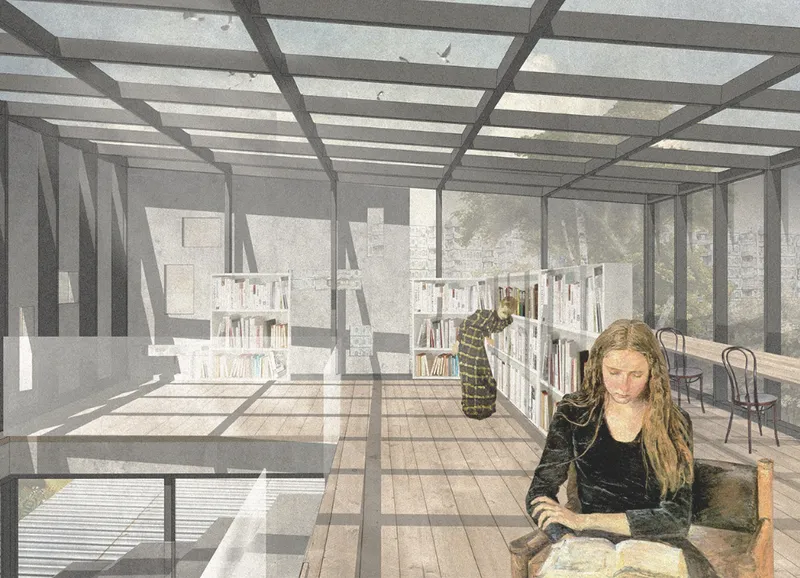

If the auditorium is the project's extroverted public face, the library is its introverted counterpart. Tucked within the repurposed garage structure, the reading room features exposed ceiling beams and white bookshelves that line the walls, creating a meditative atmosphere under the low structural grid. A woman reads at a table in warm, filtered light. The library draws visitors inward, away from the courtyard's social energy, offering a space of concentrated attention. Its elevation above ground level reinforces the sense of retreat.
The rooftop terrace completes the vertical sequence. Birch trees grow through openings in the roof plane, illuminated volumes glow at ankle height, and birds cross an evening sky. The terrace transforms what was once a flat, utilitarian roof into an accessible landscape that extends the garden logic upward. Together, auditorium, library, and rooftop form a gradient of publicness: from civic performance at ground level, to quiet study in the middle, to open-air contemplation at the top.
Why This Project Matters
Garage Renaissance succeeds because it takes a deeply familiar, deeply unglamorous building type and demonstrates that its modularity is not a limitation but an asset. The garage box, repeated hundreds of times across a single cooperative, becomes a unit of transformation: each one reprogrammable, each one contributing to a larger urban ecosystem without requiring demolition or tabula rasa planning. The project's scalability is its most powerful argument. If it works on one site in Moscow, it can work on thousands of others across Russia and beyond.
Тар and Гагаркин also make a subtler point about heritage. Adaptive reuse is often associated with grand industrial buildings, former factories, or warehouses with dramatic volumes. Garage cooperatives have none of that romance. They are low, repetitive, and prosaic. By choosing this typology, the designers expand the definition of what counts as worth saving, arguing that cultural value resides not in architectural spectacle but in the social practices a space once hosted and can host again.
View the Full Project
About the Designers
Designers: Ульяна Тар, Данила Гагаркин
Enter a Design Competition on uni.xyz
uni.xyz runs architecture and design competitions year-round that reward proposals with spatial conviction and real site intelligence.
Project credits: Garage renaissance by Ульяна Тар, Данила Гагаркин Beacon 2019 (uni.xyz).


Popular Articles
Popular articles from the community


Opera on the Sea: Driftwood Logic Shapes a Timber Opera House on Estonia's Coast
Trevor Orgill's opera house translates the entangled drift of floating timber into a civic building where wood, water, and music converge.

Manzana Morphosis: Stretching Barcelona's Grid into a Living Landscape for 2050
A radical reworking of the Eixample manzana turns density into a tool for generous public space, vertical ecology, and environmental performance.


FCC Arquitectura Expands a Portuguese Granite House with a Board-Marked Concrete Wing
In Portugal, JV House pairs a cleaned-up whitewashed and granite dwelling with a timber-shuttered concrete extension, courtyards and a garden pool.

Cube Design Draws an Ecological Corridor Between Two Shenzhen Hills with the Nankai Building
Beside Shenzhen's container docks, the Nankai Building pairs stacked balconies with a climbing green screen to connect two hillsides across its height.

Similar Reads
You might also enjoy these articles

Vereda Arquitetos Renovates a 40-Square-Meter Apartment Inside Niemeyer's Copan Building
A compact unit in São Paulo's most iconic residential tower gets a material overhaul that pairs exposed concrete with bold blue Formica.

Shakur's House: Exposed Brick as an Interior Organiser in a 168 m² Mashhad Residence
Brick moves indoors in this Mashhad residence, where masonry walls, glass partitions and teal planes sequence a compact home without closing it off.

Day and Night Park: A Time-Based Urban Newsstand in Beijing
A temporary urban newsstand in Beijing blending travel, light, and reading through poetic colors, compact form, and community-focused design.

Modernist Patio Renovation in El Masnou, Barcelona by Oliver Segura Arquitectura + Cebrià Arquitectura
Modernist patio renovation blending tradition and innovation with a movable pool, leveled floors, and Catalan materials in El Masnou.


Comments (0)
Please login or sign up to add comments
No comments yet. Be the first to comment!